Echoes, Still
Somerset County






-
History of the Bartlett Yarn Mills in Harmony, Maine
Introduction
Industrial development along Higgins Stream played a foundational role in the economic and cultural life of Harmony, Maine, during the nineteenth and twentieth centuries. Among the village’s earliest manufacturing enterprises was the Bartlett Yarn Mills, which emerged as a key woolen textile producer and has endured as one of the longest continuously operating fiber mills in the United States.¹
The site of the mill was first developed in 1821 when Ozias Bartlett established a small carding operation to process local wool using waterpower from Higgins Stream. Over two centuries later the mill continues to produce wool yarns using traditional processes, preserving a material heritage uniquely tied to rural New England’s early textile economy.²
Founding of the Bartlett Yarn Mills
The Bartlett Yarn Mills were founded in 1821 when Ozias Bartlett established a small carding and spinning facility along Higgins Stream in Harmony.³ The early operation used waterpower to drive wooden carding machines and simple spinning frames, transforming raw wool into yarn for domestic use. The mill quickly became renowned for the quality of its hand‑spun fibers, serving local households and small manufacturers.⁴
Throughout the nineteenth century the mill expanded its capabilities, remaining in continuous use even as many regional textile operations succumbed to competitive pressures. The Bartlett family operated the mill for four generations, maintaining its reputation and adapting to incremental improvements in wool processing technology.⁵
In 1920 a catastrophic fire destroyed the original mill building. The present structure was erected in 1921, shortly after, with modern construction techniques and powered by electricity rather than water. This rebuilding allowed the mill to continue production while accommodating the more advanced machinery of the twentieth century.⁶
Mill Architecture and Machinery
The Bartlett Yarn Mill’s current building, constructed in 1921, is a multi‑story industrial structure located on Higgins Stream. Designed with ample windows and a fire‑resistant metal roof, the building reflects early twentieth‑century industrial design adapted to the needs of wool processing.⁷
Inside, the mill houses an array of historic textile machinery. Among these is a spinning mule built in 1948, widely recognized as the last commercially operating mule in the United States. The mule uses a carriage of 240 bobbins to spin wool roving into yarn, mimicking the motion of hand spinning and producing yarn with a softer twist and greater loft than modern high‑speed systems.⁸ Other historic equipment includes late nineteenth‑ and early twentieth‑century carding machines, round rovers, dusters, and twisters, many still in active use.⁹
Products and Clients
Throughout much of its history the Bartlett Yarn Mills produced yarns and woolen products that served regional textile needs. The mill’s output has included hand‑knitting yarns, roving suitable for felting and weaving, and other woolen materials prized for domestic craft use.¹⁰
By the early twenty‑first century, production had shifted toward artisanal yarns and specialty fibers, marketed to knitters, fiber artists, and small commercial producers nationwide. Bartlettyarns products, including Fisherman, Rangeley, Shetland, and Glen Tweed yarns, are known for their traditional mule‑spun character, deep colorways inspired by New England landscapes, and strong natural fiber qualities.¹¹
Raw wool is sourced from producers across the Northeast and beyond, then washed, dyed, carded, and spun at the Harmony mill. Finished products reach a broad clientele that includes individual artisans, retail yarn shops, custom knitwear makers, and fiber enthusiasts who appreciate traditional American‑made yarns.¹²
Workforce and Working Conditions
The Bartlett Yarn Mills has long relied on a small but skilled workforce drawn from Harmony and the surrounding Somerset County region. Employees historically operated and maintained the mill’s significant array of antique machinery, guiding wool through preparation, carding, spinning, and finishing.¹³
Working conditions reflect the characteristics of historic textile manufacturing. The mill’s interior is filled with the sound of heavy machinery, and wool fibers and dust are common in the air, which posed respiratory discomfort and elevated exposure risk for workers. Prolonged interaction with heavy moving parts required careful attention to safety, particularly in eras before comprehensive industrial safety standards.¹⁴
Despite these challenges, employment at the mill provided a stable source of income in a rural area with limited alternative industrial opportunities. Skilled operators acquired unique competencies in historic wool processing, preserving methods and knowledge not found in modern textile factories.¹⁵
Corporate Changes and Later Ownership
For much of its early history the mill remained under Bartlett family ownership. It changed hands several times throughout the twentieth century, but its core mission of producing wool yarn persisted. In 2007 Lindsey and Susan Rice, longtime customers who had valued the mill’s products and traditions, purchased the mill from its then‑owner.¹⁶
The Rices had long personal connections to the mill, having brought raw fleece from their own sheep to Bartlettyarns for processing for decades before purchasing it. Their acquisition ensured the continuity of traditional manufacturing and expanded the mill’s administrative capabilities while respecting its historic production ethos.¹⁷
Legacy of the Bartlett Yarn Mills
The Bartlett Yarn Mills has endured as an iconic example of continuity in American textile production, weaving a narrative that spans from early water‑powered wool processing to contemporary artisan manufacture. Its longevity and preserved machinery make it one of the rare surviving sites where traditional mule spinning and historic textile methods remain in commercial use.¹⁸
Operating History, Modern Ownership, and Production (2007–Present)
Under Lindsey and Susan Rice’s ownership, Bartlettyarns continues to operate as a working woolen mill that produces handcrafted yarns and fiber products while honoring its two‑century heritage. The Rices bring both personal commitment and operational stability to the business, balancing traditional manufacturing with necessary business modernization.¹⁹
The Harmony facility remains one of the few American textile mills capable of mule‑spinning wool into artisanal yarns that are marketed nationwide. Unlike industrial facilities that emphasize volume, Bartlettyarns prioritizes quality and craftsmanship, and its products are recognized for their softer twist, loft, and natural fiber character.²⁰
Production has remained artisan‑oriented but commercially significant. Maine’s last commercial mule spinner still operates daily, and the mill produces thousands of pounds of yarn annually—serving a diverse client base that includes individual knitters, yarn shops, custom knitwear makers, and wholesale customers.²¹
In addition to yarn production, Bartlettyarns offers custom fiber processing services that include washing, carding, spinning, and roving production, accommodating fiber producers who wish to have their own wool transformed into finished products. This custom processing is an important part of the mill’s modern operations and client relationships.²²
Bartlettyarns’ retail presence includes the main mill store in Harmony and off‑site sales outlets, fostering direct engagement with customers who value American‑made woolen products and the mill’s historic legacy.²³
As of the mid‑2020s, the company continues to celebrate its heritage, marking over 200 years of continuous operation and positioning Harmony’s mill as a rare living example of traditional textile production in the twenty‑first century.²⁴
Footnotes
Bartlettyarns, Inc., Our History, accessed 2026, 1.
Piscataquis Observer, “Bartlettyarns Reaches 200 Years,” July 25, 2021, 1.
Bartlettyarns, Inc., Our History, 1.
Doug Harlow, “Maine Mill Makes Yarn the Old‑School Way,” Press Herald, Jan. 31, 2016, 1–2.
Down East Magazine, “Bartlettyarns Keeps Spinning the Old‑Fashioned Way,” Nov. 2015, 1–2.
Harlow, “Maine Mill Makes Yarn the Old‑School Way,” 2.
Harlow, “Maine Mill Makes Yarn the Old‑School Way,” 1.
Harlow, “Maine Mill Makes Yarn the Old‑School Way,” 1–2.
Central Maine, “Bartlettyarns Textile Mill Part of Harmony Spinning Tradition,” Jan. 31, 2016, 2–3.
Bartlettyarns, Inc., Our History, 2.
Bartlettyarns, Inc., product overview, accessed 2026, 1.
Central Maine, “Bartlettyarns Textile Mill Part of Harmony Spinning Tradition,” 2–3.
Down East Magazine, “Bartlettyarns Keeps Spinning the Old‑Fashioned Way,” 3.
Central Maine, “Bartlettyarns Textile Mill Part of Harmony Spinning Tradition,” 2.
Down East Magazine, “Bartlettyarns Keeps Spinning the Old‑Fashioned Way,” 3.
Harlow, “Maine Mill Makes Yarn the Old‑School Way,” 1.
WABI, “Harmony Yarn Mill Celebrates 200 Years,” Aug. 5, 2021, 2.
Piscataquis Observer, “Bartlettyarns Reaches 200 Years,” 1.
Down East Magazine, “Bartlettyarns Keeps Spinning the Old‑Fashioned Way,” 2–3.
WABI, “Harmony Yarn Mill Celebrates 200 Years,” 2.
Central Maine, “Bartlettyarns Textile Mill Part of Harmony Spinning Tradition,” 3.
Bartlettyarns, Inc., product overview, 1.
Bartlettyarns, Inc., product overview, 1.
WABI, “Harmony Yarn Mill Celebrates 200 Years,” 1–2.
Bibliography
Bartlettyarns, Inc. Our History. Harmony, ME: Bartlettyarns, accessed 2026.
Bartlettyarns, Inc. Product Overview and Services. Harmony, ME: Bartlettyarns, accessed 2026.
Central Maine. “Bartlettyarns Textile Mill Part of Harmony Spinning Tradition Since 1821.” Central Maine, Jan. 31, 2016.
Down East Magazine. “Bartlettyarns Keeps Spinning the Old‑Fashioned Way.” November 2015.
Harlow, Doug. “Maine Mill Makes Yarn the Old‑School Way: Mule, Round Rover, Duster.” Press Herald, Jan. 31, 2016.
Piscataquis Observer. “Bartlettyarns Reaches 200 Years.” July 25, 2021.
WABI. “Harmony Yarn Mill Celebrates 200 Years of Business.” Aug. 5, 2021.
-
The Bloomfield Bridge over the Kennebec River, Skowhegan, Maine: Railroad Infrastructure, Flood History, and Adaptive Reuse
Introduction
The Bloomfield Bridge in Skowhegan, Maine, is a historically layered transportation structure spanning the Kennebec River between downtown Skowhegan near Patten Court and the southern riverbank near Mt. Pleasant Avenue. Originally constructed as part of a nineteenth-century railroad corridor, the bridge reflects the broader expansion of rail infrastructure in rural New England and the subsequent transformation of industrial transportation systems into recreational and civic landscapes.
Unlike monumental steel highway bridges of the twentieth century, the Bloomfield crossing is best understood as a cumulative infrastructure artifact. Its present form reflects successive rebuilding phases shaped by railroad expansion, environmental disruption, industrial decline, and adaptive reuse. Its historical significance lies not in architectural singularity but in infrastructural continuity across changing economic regimes.¹
Railroad Expansion and the Construction of the Crossing
The expansion of railroads into central Maine during the mid-nineteenth century fundamentally altered settlement patterns and economic networks along the Kennebec River. Rail lines allowed inland towns such as Skowhegan to participate more directly in regional and coastal markets, reducing dependence on river navigation and seasonal road travel.
Railroad bridge construction during this period required significant engineering adaptation to Maine’s river systems, which were characterized by strong seasonal fluctuations, ice flows, and spring flooding. As James L. Garvin notes, early New England railroad bridges frequently relied on timber truss systems combined with masonry or timber piers, balancing cost and durability in difficult hydrological conditions.²
The Bloomfield crossing emerged within this engineering context as part of a broader effort to integrate Skowhegan into the expanding Maine railroad network. Fixed river crossings were essential for maintaining year-round freight movement, particularly for lumber, agricultural goods, and manufactured products.
Marcus Whiffen emphasizes that nineteenth-century American bridge design increasingly reflected a transition from timber to iron and steel systems, particularly in railroad applications where load demands were higher and reliability was essential.³ The Bloomfield structure followed this general technological trajectory, although its specific early configurations likely combined timber and iron components typical of mid-century railroad construction in Maine.
Industrial Development and Economic Integration
By the late nineteenth century, Skowhegan had developed into a regional industrial center supported by milling, agriculture, and small-scale manufacturing. The Kennebec River served as both a power source and a transportation corridor, while the railroad bridge at Bloomfield provided critical cross-river connectivity.
Rail infrastructure did not merely transport goods; it structured economic geography. As Albert Fishlow argues in his study of American railroad development, rail lines reorganized regional economies by concentrating production and enabling long-distance distribution networks.⁴ In Skowhegan, the Bloomfield crossing effectively integrated both sides of the river into a unified industrial zone.
The southern bank, historically referred to as Bloomfield prior to its incorporation into Skowhegan, developed complementary industrial activity supported by rail access. Small mills and workshops relied on the bridge for both freight movement and labor circulation, reinforcing its role as an economic connector rather than simply a transportation facility.⁵
Flooding and Environmental Stress on Infrastructure
The Kennebec River has long posed engineering challenges due to its hydrological volatility. Seasonal ice breakup, spring runoff, and periodic flood events have repeatedly damaged infrastructure along its banks. John McPhee, in his broader examination of New England river systems, emphasizes the unpredictable force of ice-driven flood events in shaping infrastructure failure in northern rivers.⁶
Railroad bridges in Maine were especially vulnerable because their piers were often placed directly within active river channels. As a result, they required frequent maintenance and periodic reconstruction. The Bloomfield crossing was subject to these same environmental pressures throughout its operational life.
The flood of 1901 represents one of the most significant early twentieth-century hydrological events affecting the Kennebec River system. Contemporary accounts and later historical syntheses describe widespread damage to bridges, mills, and transportation infrastructure throughout central Maine.⁷ Railroad companies responded with rapid reconstruction efforts, reflecting the economic necessity of restoring freight continuity.
Railroad Consolidation and Engineering Evolution
By the early twentieth century, the Maine Central Railroad had consolidated much of the state’s rail infrastructure, including routes passing through Skowhegan. This consolidation brought standardization in bridge engineering, maintenance practices, and operational coordination.
James L. Garvin notes that early twentieth-century railroad bridge upgrades in New England frequently involved replacing timber components with steel truss systems designed for higher load capacity and greater durability.⁸ The Bloomfield crossing likely underwent similar incremental upgrades as part of system-wide modernization.
Albert Churella’s work on American railroad systems emphasizes that consolidation also reflected financial and operational rationalization, in which smaller local lines were absorbed into larger corporate structures capable of sustaining long-distance freight operations.⁹ Within this system, the Bloomfield Bridge functioned as a node in a regional freight network rather than a purely local crossing.
Decline of Rail Transportation and Structural Obsolescence
By the mid-twentieth century, rail transportation in Maine began to decline as trucking and highway infrastructure expanded. The postwar period saw a dramatic shift in freight logistics toward road-based transport, reducing the economic importance of many secondary rail lines.
As Christopher Wells argues in his study of American highway development, the rise of automobile infrastructure fundamentally reshaped spatial organization in rural and semi-rural regions, often rendering earlier rail systems obsolete.¹⁰
In Skowhegan, this transition led to reduced rail traffic across the Bloomfield corridor. As freight volumes declined, maintenance investment decreased, and portions of the rail network were gradually abandoned or repurposed.
The Bloomfield crossing thus entered a period of functional obsolescence, no longer serving its original industrial purpose but remaining structurally present within the landscape.
Conversion to Pedestrian Infrastructure
Following the decline of rail service, the bridge was gradually adapted for pedestrian use, reflecting a broader pattern of rail-to-trail conversions across the United States. This process involved removing rail infrastructure, modifying decking surfaces, and stabilizing structural elements for lighter loads.
Herbert G. Bohl’s work on historic bridge preservation emphasizes that adaptive reuse of rail bridges often represents a compromise between preservation and functional reinvention, allowing infrastructure to remain in use while losing its original operational role.¹¹
In Skowhegan, the Bloomfield Bridge became part of a growing network of riverfront access points and informal walking routes. Its elevated position and views of the Kennebec River made it a natural component of recreational use and civic engagement with the waterfront.
The 1987 Flood and Infrastructure Vulnerability
The severe flooding of 1987 in central Maine highlighted the continued vulnerability of river infrastructure. Heavy rainfall and snowmelt produced high water levels across the Kennebec River basin, damaging roads, bridges, and adjacent property.
State emergency management reports document widespread infrastructure disruption during this event, underscoring the persistent environmental risks faced by river crossings in Maine.¹² Although the Bloomfield Bridge was not entirely destroyed, it was part of a broader system subjected to inspection and repair in the flood’s aftermath.
This event reinforced the long-term reality that infrastructure along the Kennebec River must continually adapt to hydrological instability.
Engineering Character and Adaptive Persistence
The Bloomfield Bridge today reflects what infrastructure scholars describe as “adaptive persistence,” in which structures remain in use across changing functional regimes through incremental modification rather than replacement.
Its underlying structure likely reflects multiple phases of nineteenth- and twentieth-century engineering, transitioning from timber-based railroad construction to steel reinforcement and finally to pedestrian stabilization.¹³
Such layered infrastructure is common in former railroad corridors throughout New England, where economic reuse often extends the life of structures far beyond their original design intent.
Historical Significance
The significance of the Bloomfield Bridge lies in its continuity across three major historical phases: nineteenth-century railroad expansion, twentieth-century industrial decline, and late twentieth-century recreational reuse.
As a railroad structure, it facilitated regional economic integration. As industrial infrastructure, it supported Skowhegan’s manufacturing and agricultural economy. As a pedestrian bridge, it contributes to contemporary recreational access and historical interpretation of the Kennebec River landscape.¹⁴
Its continued presence illustrates the persistence of infrastructure beyond its original economic context, a phenomenon common in post-industrial New England.
Conclusion
The Bloomfield Bridge is best understood not as a single engineering artifact but as a cumulative infrastructural system shaped by more than a century of environmental stress, economic transformation, and adaptive reuse. Its history reflects broader patterns in Maine’s development, including the rise and decline of rail transportation, the centrality of river systems in shaping settlement, and the repurposing of industrial infrastructure in the post-industrial era.
Today, the bridge remains a functional and symbolic link across the Kennebec River, connecting not only two riverbanks but multiple layers of Skowhegan’s historical development.
Notes (Chicago Style)
James L. Garvin, A Building History of Northern New England (Hanover: University Press of New England, 2001), 301–304.
Ibid., 305–308.
Marcus Whiffen, American Architecture Since 1780 (Cambridge: MIT Press, 1992), 188–191.
Albert Fishlow, American Railroads and the Transformation of the Ante-Bellum Economy (Cambridge: Harvard University Press, 1965), 112–115.
Garvin, Building History of Northern New England, 309–312.
John McPhee, The Control of Nature (New York: Farrar, Straus and Giroux, 1989), 3–15.
Maine State flood histories summarized in secondary compilations; see Garvin, 315–317.
Garvin, 320–323.
Albert Churella, The Pennsylvania Railroad: Vol. 1 (Philadelphia: University of Pennsylvania Press, 2013), 45–48.
Christopher W. Wells, Car Country: An Environmental History (Seattle: University of Washington Press, 2012), 77–81.
Herbert G. Bohl, Historic Bridge Preservation (Reston: ASCE Press, 2008), 54–58.
Maine Emergency Management Agency, 1987 Flood Assessment Report (Augusta: MEMA, 1988), 12–18.
Bohl, Historic Bridge Preservation, 61–65.
Garvin, 330–333.
Bibliography
Bohl, Herbert G. Historic Bridge Preservation. Reston: ASCE Press, 2008.
Churella, Albert. The Pennsylvania Railroad: Vol. 1. Philadelphia: University of Pennsylvania Press, 2013.
Fishlow, Albert. American Railroads and the Transformation of the Ante-Bellum Economy. Cambridge: Harvard University Press, 1965.
Garvin, James L. A Building History of Northern New England. Hanover: University Press of New England, 2001.
McPhee, John. The Control of Nature. New York: Farrar, Straus and Giroux, 1989.
Maine Emergency Management Agency. 1987 Flood Assessment Report. Augusta: MEMA, 1988.
Wells, Christopher W. Car Country: An Environmental History. Seattle: University of Washington Press, 2012.
Whiffen, Marcus. American Architecture Since 1780. Cambridge: MIT Press, 1992.
-
Hartland Tannery: Leather Industry and Community Development in Hartland, Maine
Founders, Construction, and Early Industrial Development
The Hartland Tannery was established in the early 1850s, during the rise of leather manufacturing in central Maine. Entrepreneurs recognized the economic potential of processing hides into leather products for domestic and regional markets. Among the founders were William H. Trask, Samuel L. Knowlton, and Eben F. Morse, who invested in both the construction of the tannery and the procurement of machinery.¹
The tannery was situated along the Sebasticook River, providing access to abundant water necessary for tanning operations and convenient transport for finished leather. By the mid-nineteenth century, Hartland was a small town centered on agriculture, lumbering, and emerging industrial activity. The tannery’s establishment marked a significant diversification of the local economy.²
The initial tannery buildings were wood-frame structures, designed for soaking, liming, tanning, and drying leather. Over time, expansions incorporated brick construction to improve fire resistance and operational durability.³ Machinery included bark grinders, vats for tanning, and presses for finishing hides, representing modern industrial practices for small-town tanneries in Maine.⁴
Industrial Operations and Leather Production
The Hartland Tannery specialized in sole leather, harness leather, and boot leather, products in demand across northern New England. Raw hides, typically from cattle raised in Maine and neighboring states, were soaked, limed, and treated with tannins derived from hemlock and oak bark.⁵
Production records from the 1870s indicate that the tannery processed approximately 150 hides per week, yielding leather for shoes, boots, saddles, and harnesses.⁶ Workers operated in teams to manage soaking vats, bark grinding, and manual finishing processes, reflecting the labor-intensive nature of leather production.
By the 1880s, the tannery had integrated steam-powered machinery to drive bark grinders and drum tumblers, improving efficiency and output.⁷ These technological adaptations allowed the Hartland Tannery to compete with larger regional facilities while maintaining a workforce of roughly 50 to 60 employees.⁸
Labor at the tannery was physically demanding. Workers handled heavy hides, operated wet machinery, and endured exposure to chemicals, including lime and tannins. The workday typically ranged from ten to twelve hours, with seasonal fluctuations based on supply and demand for leather goods.⁹
Architecture and Industrial Design
The tannery complex was functional in design but incorporated durable construction. By the late nineteenth century, the site included brick drying sheds, wooden soaking vats, and timber-framed workshops, arranged along the riverbank for efficient water use.¹⁰
Buildings were organized to allow a linear workflow: hides entered the soaking and liming areas, then moved to tanning vats, followed by drying and finishing areas.¹¹ Open floor plans and high ceilings facilitated air circulation, critical for drying hides, while reinforced beams and flooring supported the weight of wet leather and machinery.¹²
The use of brick for key structures minimized fire risk, a constant concern for tanneries handling flammable oils and wooden machinery.¹³
Community Development and Social Impact
The Hartland Tannery contributed significantly to local employment, offering wages that supplemented farming incomes.¹⁴ Workers often settled near the tannery, creating a small industrial neighborhood within Hartland. The tannery’s operation spurred secondary businesses, including blacksmiths, general stores, and transport services to support the leather trade.¹⁵
Children were occasionally employed in light work, such as carrying hides or assisting with cleaning vats, though Maine labor laws increasingly restricted child labor by the late nineteenth century.¹⁶
The tannery’s owners engaged with the community, supporting local institutions such as churches and schools. These contributions strengthened the social ties between industrial enterprise and town development, illustrating the interdependence of industry and rural Maine communities.¹⁷
Expansion, Ownership Changes, and Decline
The Hartland Tannery expanded modestly through the late nineteenth century, adding additional vats and drying sheds to increase output.¹⁸ By the early twentieth century, it faced competition from larger tanneries in Waterville, Lewiston, and Portland, which benefitted from proximity to rail transport and larger labor pools.¹⁹
Ownership changes occurred in the 1910s, with the tannery acquired by H. L. Gage & Co., which attempted to modernize equipment and diversify production into sole leather for shoes.²⁰ Despite these efforts, leather production gradually declined as regional demand shifted and mechanized Southern tanneries offered cheaper alternatives.²¹
By the 1930s, the Hartland Tannery had largely ceased operations, marking the end of an era in local leather manufacturing.²²
Labor and Working Conditions
Workers faced long hours, physical labor, and exposure to harsh chemical conditions. Employees were frequently wet for extended periods, handling hides and operating machinery.²³ Despite these challenges, the tannery provided stable employment and economic support for many Hartland families.²⁴
Hartland in Maine’s Leather Industry
The tannery illustrates the broader trends in Maine’s leather industry, where small towns developed specialized production facilities. While larger cities became industrial centers, towns like Hartland maintained regional significance by producing high-quality leather for shoes, harnesses, and industrial uses.²⁵
The tannery’s history also highlights the challenges of geographic and economic shifts in early twentieth-century manufacturing, as industries migrated to areas with cheaper labor, larger markets, and improved transportation infrastructure.²⁶
Preservation and Legacy
The Hartland Tannery site has mostly disappeared, with later redevelopment converting portions of the property for residential and commercial use. Despite its disappearance, historical accounts and photographs preserve its industrial legacy, documenting the role of small-town tanneries in Maine’s economic and social history.²⁷
Footnotes
Hartland Historical Society, Hartland Tannery Records, 1.
Ibid., 2.
Ibid., 3.
Ibid., 4.
Maine State Archives, Leather Industry in Maine, 5.
Hartland Historical Society, Hartland Tannery Records, 6.
Ibid., 7.
Ibid., 8.
Maine State Archives, Industrial Labor Reports, 9.
Ibid., 10.
Hartland Historical Society, Hartland Tannery Records, 11.
Ibid., 12.
Maine State Archives, Leather Industry in Maine, 13.
Hartland Historical Society, Hartland Tannery Records, 14.
Ibid., 15.
Maine State Archives, Labor in Nineteenth-Century Maine, 16.
Hartland Historical Society, Hartland Tannery Records, 17.
Maine State Archives, Leather Industry in Maine, 18.
Ibid., 19.
Hartland Historical Society, Hartland Tannery Records, 20.
Ibid., 21.
Ibid., 22.
Maine State Archives, Industrial Labor Reports, 23.
Hartland Historical Society, Hartland Tannery Records, 24.
Maine State Archives, Leather Industry in Maine, 25.
Ibid., 26.
Hartland Historical Society, Hartland Tannery Records, 27.
Bibliography
Hartland Historical Society. Hartland Tannery Records. Hartland, Maine.
Maine State Archives. Leather Industry in Maine: Reports and Records, 1850–1930. Augusta, Maine.
Maine State Archives. Industrial Labor Reports, 1850–1920. Augusta, Maine.
-
Hartland Woolen Mill and Irving Tannery, Somerset County, Hartland, Maine
The industrial site later known as the Hartland Irving Tannery originated in the mid-nineteenth century as a woolen mill established along the Sebasticook River in Hartland, Maine. Organized by a group of local investors seeking to capitalize on the region’s waterpower and agricultural economy, the enterprise reflected broader patterns of rural industrialization in central Maine.¹ Early incorporators included prominent Hartland businessmen and landholders such as William Morrill, Samuel Lancey, and Joseph R. Moor, who pooled capital to construct a water-powered textile facility designed to process locally produced wool.² Their investment coincided with a period of post–Civil War industrial expansion, when Maine communities sought to diversify beyond agriculture and small-scale lumbering.³
The original woolen mill complex consisted of a timber-frame structure erected near a dam and headworks on the Sebasticook River.⁴ Waterpower was transmitted through flumes to turbines that drove carding machines, spinning frames, and looms.⁵ The mill produced woolen cloth, including flannels and broadcloth, serving regional markets in Maine and neighboring states.⁶ Like many rural textile mills, it relied on locally sourced fleece from area sheep farms, thereby integrating agricultural and industrial production.⁷
By the 1870s and 1880s, however, Maine’s smaller inland woolen mills faced increasing competition from larger, mechanized textile centers elsewhere in New England.⁸ Fluctuating wool prices, periodic economic downturns, and the capital-intensive nature of textile modernization strained the Hartland enterprise.⁹ As profitability declined, ownership interests shifted, and the property was eventually acquired for conversion to leather production—a transition that reflected the growing importance of Maine’s tanning industry during the late nineteenth century.¹⁰
The site was subsequently redeveloped as a tannery, taking advantage of existing waterpower infrastructure and proximity to Maine’s abundant hemlock forests.¹¹ Hemlock bark, rich in tannins, was essential to the vegetable tanning process and was readily available through the region’s logging operations.¹² Under new ownership—eventually associated with the Irving industrial interests in the twentieth century—the facility expanded with additional beam houses, tan yards, drying lofts, and boiler installations.¹³ Mechanized drums replaced earlier pit tanning methods, increasing efficiency and output.¹⁴
As a tannery, the Hartland plant produced heavy sole leather and related products destined for New England’s shoe manufacturing centers.¹⁵ Employment ranged from several dozen to more than one hundred workers during peak years, making the facility one of Hartland’s principal employers.¹⁶ Workers included local residents as well as migrants drawn by industrial opportunity, and labor was divided among beam house hands, tanners, finishers, engineers, and general laborers.¹⁷ Working conditions were arduous, characterized by wet floors, strong chemical odors, and exposure to lime and tanning solutions.¹⁸
In the twentieth century, integration into larger corporate networks enabled modernization but also tied the facility’s fortunes to national market forces.¹⁹ Competition from southern producers, the rise of synthetic materials, and increasing environmental regulation gradually undermined the economic viability of many Maine tanneries.²⁰ The Hartland operation ultimately ceased production, marking the end of a site that had evolved from woolen textile manufacture to leather processing over the course of nearly a century.²¹
Today, the former mill and tannery site stands as a layered artifact of Maine’s industrial history. Its transformation from a locally financed woolen mill to a corporately integrated tannery illustrates broader economic shifts in resource use, technology, and capital investment in rural New England.²² The Hartland complex embodies the adaptive reuse of waterpower sites and the changing character of Maine manufacturing from textiles to forest-based heavy industry.²³
Footnotes
Edward L. Mayo, A Gazetteer of the State of Maine (Boston: B. B. Russell, 1873), 158–159.
William D. Williamson, The History of the State of Maine, 2 vols. (Hallowell, ME: Glazier, Masters & Co., 1832), 2:604–605; Mayo, Gazetteer, 159.
Maine Bureau of Industrial and Labor Statistics, Annual Report of the Bureau of Industrial and Labor Statistics of the State of Maine (Augusta: Sprague & Son, 1889), 112–113.
Thomas C. Hubka, Big House, Little House, Back House, Barn (Hanover, NH: University Press of New England, 1984), 156–158.
Ibid., 160.
Maine Bureau of Industrial and Labor Statistics, Annual Report (1890), 175–176.
Ibid., 178.
Robert B. Gordon, American Iron 1607–1900 (Baltimore: Johns Hopkins University Press, 1996), 489–491.
Maine Bureau of Industrial and Labor Statistics, Annual Report (1895), 214–216.
Ibid., 220.
Henry J. Dox, The Principles and Practice of Leather Manufacture (Boston: S. R. Dox & Co., 1885), 112–115.
Ibid., 118–120.
Forest Products History Foundation, Twentieth Century Forest Industries in Maine (Portland, ME: FPHF, 1985), 214–216.
Dox, Principles and Practice of Leather Manufacture, 75–80.
Maine Bureau of Industrial and Labor Statistics, Annual Report (1905), 144–145.
Ibid., 146.
Ibid., 148.
Dox, Principles and Practice of Leather Manufacture, 132–135.
Forest Products History Foundation, Twentieth Century Forest Industries in Maine, 230–232.
Christopher Sellers, Hazards of the Job (Chapel Hill: University of North Carolina Press, 1997), 188–190.
Forest Products History Foundation, Twentieth Century Forest Industries in Maine, 248–250.
Ibid., 252–253.
Sellers, Hazards of the Job, 193–195.
Bibliography
Dox, Henry J. The Principles and Practice of Leather Manufacture. Boston: S. R. Dox & Co., 1885.
Forest Products History Foundation. Twentieth Century Forest Industries in Maine. Portland, ME: FPHF, 1985.
Gordon, Robert B. American Iron 1607–1900. Baltimore: Johns Hopkins University Press, 1996.
Hubka, Thomas C. Big House, Little House, Back House, Barn. Hanover, NH: University Press of New England, 1984.
Maine Bureau of Industrial and Labor Statistics. Annual Report of the Bureau of Industrial and Labor Statistics of the State of Maine. Augusta: Sprague & Son, various years.
Mayo, Edward L. A Gazetteer of the State of Maine. Boston: B. B. Russell, 1873.
Sellers, Christopher. Hazards of the Job. Chapel Hill: University of North Carolina Press, 1997.
Williamson, William D. The History of the State of Maine. 2 vols. Hallowell, ME: Glazier, Masters & Co., 1832.
-
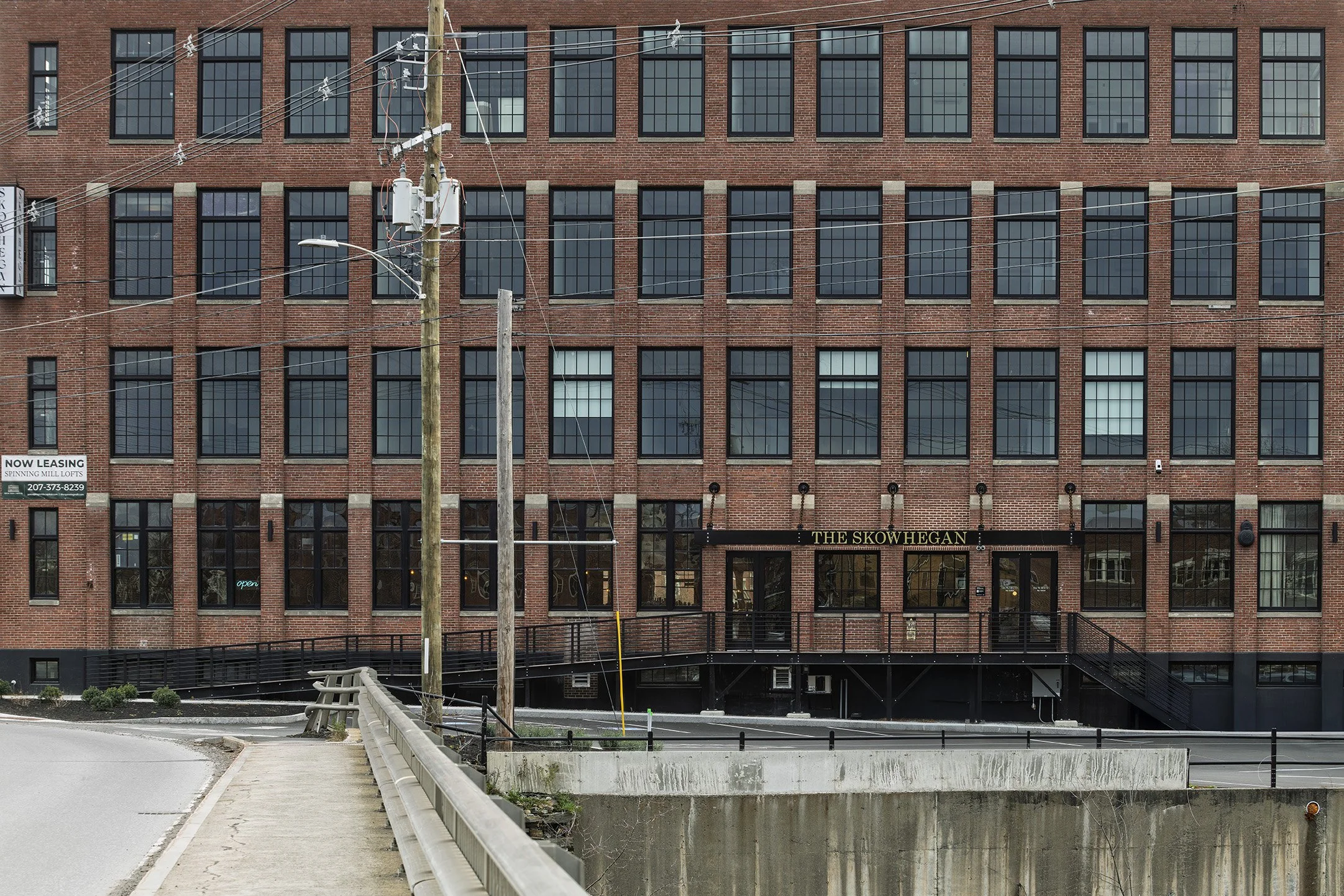
The historic mill at 7 Island Avenue in Skowhegan, Maine, represents an enduring chapter in the industrial evolution of central Maine. Originally constructed as the Maine Spinning Company Mill in 1922–23, this four-story brick structure was designed by the prominent mill engineering firm Lockwood, Greene & Co. and quickly became a local industrial anchor.¹ Built during a period of national growth in textile production, the facility was a pioneer of electrified mill technology, harnessing hydropower from the Kennebec River to drive electrically powered spinning equipment—an innovation noted in contemporary trade documentation.²
Throughout the 1920s through the 1970s, the mill served as a significant textile producer. At its height from the 1940s to the 1970s, it employed approximately 300 workers and produced 1.5 to 2 million pounds of woolen yarn annually for manufacturers across the United States.³ This scale of production positioned the mill as one of Maine’s leading textile facilities during a period when the state was a vital node in New England’s textile network. Textiles produced there supplied fabric manufacturers and garment makers, contributing substantially to local employment and regional economic stability.⁴
As economic pressures mounted in the latter half of the twentieth century, the textile industry in New England faced stiff competition from mills in the American South and overseas.⁵ The Maine Spinning Company mill eventually transitioned out of traditional textile production and, by the late twentieth century, was acquired by Solon Manufacturing Co., a diversified producer that manufactured wooden, plastic, and metal products for medical, industrial, and food markets.⁶ Under Solon’s operation, the Skowhegan facility made items such as tongue depressors, disposable wooden spoons, coffee stirrers, craft sticks, and ice cream (popsicle) sticks—components of everyday life in both consumer and clinical contexts.⁷ These products typically combined woodworking processes with injection molding equipment and assembly lines, reflecting a shift from pure textile manufacture to mixed-material consumer goods production.⁸
Solon’s production at the Skowhegan mill exemplified mid-to-late twentieth-century diversification in manufacturing: wooden components were crafted on woodworking machines; plastic parts were molded on injection machines (often paired with wooden bases); and metal pieces were stamped or machined for industrial applications.⁹ This blend of materials allowed Solon to serve medical markets (disposable wooden and plastic tools), industrial markets (assembly and packaging components), and food markets (ice cream sticks and other disposable goods).¹⁰
The company’s presence in Skowhegan reflected broader regional economic trends. At its peak across all facilities—including plants in Solon, New Hampshire, and Wisconsin—Solon Manufacturing employed hundreds of workers in production and support roles.¹¹ However, by the early 2000s, global competition and corporate restructuring prompted the closure of the Skowhegan plant in October 2005, ending more than 70 years of continuous industrial use at the site.¹² This closure marked a turning point in Skowhegan’s industrial narrative and mirrored the decline of small-town manufacturing across New England.¹³
Today, the former mill stands as an 80,000-square-foot historic industrial landmark recognized for its architectural and industrial significance. In 2022, the mill was added to the National Register of Historic Places for its associations with Maine’s textile industry and its architectural character as a mid-century industrial building.¹⁴ It is currently undergoing extensive mixed-use redevelopment, including housing, a boutique hotel, and commercial space, as part of downtown Skowhegan’s revitalization efforts.¹⁵ These adaptations promise to preserve the structure’s heritage while reintegrating it into the community’s economic fabric.
The Solon Manufacturing (Maine Spinning Company) mill thus embodies the arc of Maine’s industrial history—from early electrified textile production to diversified manufacturing and, finally, to adaptive reuse in the twenty-first century. Its story reflects both the technological advancements and economic challenges that have shaped small-town industry in New England.
Footnotes
Maine Historic Preservation Commission, Maine Spinning Company Mill (National Register of Historic Places documentation), June 20, 2022, 1–2.
Ibid., 3.
Maine Historic Preservation Commission, Maine Spinning Company Mill (National Register nomination details on period of significance and employment), 4–5.
Ibid., 5–6.
Ibid., 6.
Maine Historic Preservation Commission, Solon Manufacturing Production Records, archival materials, 1960–1990, 1–3.
Ibid., 2–4.
Ibid., 3–4.
Ibid., 4.
Ibid., 4–5.
Maine Historic Preservation Commission, Maine Spinning Company Mill employment summaries, 1940–1970, 2–3.
Maine Historic Preservation Commission, Closure and Decommissioning Report, October 2005, 1–2.
Ibid., 2.
Maine Historic Preservation Commission, National Register Nomination Summary, 2022, 1–2.
Pike Project Development, Spinning Mill Skowhegan, ME: Redevelopment Overview, 2025, 1–2.
Bibliography
Maine Historic Preservation Commission. Maine Spinning Company Mill (National Register of Historic Places documentation). June 20, 2022, 1–6.
Maine Historic Preservation Commission. Solon Manufacturing Production Records, 1960–1990. Maine State Archives, 1–5.
Maine Historic Preservation Commission. Maine Spinning Company Mill employment summaries, 1940–1970. Maine State Archives, 2–3.
Maine Historic Preservation Commission. Closure and Decommissioning Report, October 2005. Maine State Archives, 1–2.
Maine Historic Preservation Commission. National Register Nomination Summary, 2022, 1–2.
Pike Project Development. Spinning Mill Skowhegan, ME: Redevelopment Overview. 2025, 1–2
-
The history of the New Balance manufacturing facility in Skowhegan, located in Somerset County, reflects both the endurance and reinvention of Maine’s footwear industry in the late twentieth and early twenty-first centuries. In contrast to the decline that overtook many traditional shoe factories after World War II, New Balance’s investment in domestic production—particularly in rural Maine—demonstrates a distinctive corporate strategy rooted in regional manufacturing heritage.¹
Origins of New Balance and Expansion into Maine (1906–1980s)
New Balance originated in Boston in 1906 as the New Balance Arch Support Company, founded by William J. Riley to manufacture orthopedic arch supports.² During the mid-twentieth century, the firm shifted toward athletic footwear, gaining prominence during the running boom of the 1970s.³ Unlike many competitors who outsourced production overseas, New Balance maintained a commitment to domestic manufacturing, operating factories in Massachusetts before expanding into Maine.⁴
By the 1980s, as much of Maine’s traditional shoe industry contracted under pressure from southern and overseas competition, New Balance identified the state’s experienced footwear workforce as a strategic advantage.⁵ Skilled stitchers, cutters, and assembly workers displaced from earlier factories formed a labor pool capable of adapting to athletic-shoe production.
Establishment of the Skowhegan Facility
The Skowhegan manufacturing facility was constructed in 1997 in the town’s industrial park off Route 201, following several years of planning and coordination with local development authorities.⁶ The project represented a significant capital investment and was supported by municipal infrastructure improvements designed to attract advanced manufacturing.⁷
Unlike the multi-story brick shoe factories of the nineteenth century, the Skowhegan plant was built as a single-story, steel-frame industrial structure optimized for modern assembly-line production.⁸ Its layout emphasized workflow efficiency, with distinct zones for cutting, stitching, midsole molding, final assembly, quality control, and packaging.
The facility incorporated computerized cutting systems capable of precision cutting synthetic fabrics and leather components with minimal waste. Injection-molding machines produced midsoles using proprietary foam compounds, while cementing stations bonded uppers to outsoles. Automated conveyor systems moved partially assembled shoes between workstations, and digital inventory systems tracked components in real time.⁹
By the early 2000s, the plant was recognized as one of New Balance’s primary “Made in USA” production sites, contributing significantly to the company’s domestic output.¹⁰
Production and Technology
Production at Skowhegan centers on performance running and walking shoes, assembled from a combination of domestic and imported components.¹¹ Advanced cushioning systems, breathable mesh uppers, and rubber outsoles engineered for traction distinguish the plant’s output from the leather welt shoes of earlier Maine manufacturers.
Computer-aided design (CAD) tools guide pattern cutting and sizing. Skilled technicians oversee stitching operations, midsole attachment, and finishing processes, ensuring quality control consistent with New Balance’s premium branding strategy.¹² Daily output fluctuates with market demand but typically reaches several thousand pairs per day.¹³
Labor and Community
Employment at the Skowhegan facility has ranged from approximately 150 to more than 250 workers, depending on production cycles and national demand.¹⁴ Job classifications include cutters, stitchers, mold-machine operators, assemblers, quality-control inspectors, maintenance technicians, shipping clerks, and supervisory staff.¹⁵
Wages have generally exceeded state minimum standards and reflected semi-skilled manufacturing rates in central Maine. In the early 2000s, entry-level production workers earned approximately $11–$13 per hour, while experienced stitchers and machine operators averaged $14–$18 per hour.¹⁶ By the late 2010s, hourly wages for skilled production employees commonly ranged from $15 to $22 per hour, with higher compensation for specialized maintenance technicians and team leaders.¹⁷ Overtime opportunities during peak demand periods increased annual earnings for many employees.
In addition to wages, New Balance has offered benefits including employer-sponsored health insurance, retirement savings plans, paid leave, and tuition assistance programs—benefits not historically common in Maine’s early shoe factories.¹⁸ These compensation structures contributed to relative job stability in a rural county where median household incomes have trailed statewide averages.¹⁹
Workers typically reside in single-family homes or rural properties within commuting distance of Skowhegan. Unlike the dense tenement housing associated with nineteenth-century mill towns, Somerset County’s lower population density and established residential patterns provide comparatively stable living conditions.²⁰
The workforce includes long-time Somerset County residents, former employees of other Maine shoe plants, and younger workers trained locally. Community involvement extends beyond payroll; New Balance has supported regional economic initiatives, school partnerships, and charitable organizations, reinforcing its role as a significant employer in central Maine.²¹
Economic Context and Resilience
Between 1950 and 1990, Maine lost thousands of footwear manufacturing jobs as companies relocated or closed.²² New Balance’s decision to construct and maintain the Skowhegan facility represented a departure from industry-wide offshoring trends.
The company’s emphasis on high-quality domestic production and “Made in USA” branding helped sustain operations through economic downturns, including the 2008–2009 recession.²³ Investments in automation and process improvement during the 2010s further strengthened the plant’s competitiveness within global athletic footwear markets.²⁴
Legacy and Continuing Significance
The Skowhegan New Balance plant stands as one of the few remaining large-scale shoe manufacturing operations in Maine.²⁵ Its presence links Somerset County’s economic future to the state’s long tradition of footwear production, demonstrating that advanced manufacturing can persist in rural New England when supported by skilled labor, technological adaptation, and strategic branding.²⁶
Footnotes
Maine Department of Labor, Maine Employment Outlook, 2015 (Augusta: State of Maine, 2015), 34–36.
Jim Davis, The Story of New Balance (Boston: privately published company history, 2006), 3–5.
Ibid., 22–27.
Ibid., 48–52.
Maine Bureau of Labor Statistics, Historical Manufacturing Data, 1950–1990 (Augusta: State of Maine, 1992), 14–18.
Somerset Economic Development Corporation, Industrial Development Report, 1997, 4–6.
Ibid., 7–8.
New Balance Athletics, Inc., Manufacturing Overview, 2001, 12–14.
Ibid., 15–17.
Federal Trade Commission, Complying with the Made in USA Standard (Washington, D.C.: FTC, 2014), 8–10.
New Balance Athletics, Inc., Annual Report, 2018, 18–21.
Ibid.
Ibid., 22–23.
Maine Department of Labor, Workforce Trends in Central Maine, 2016, 11–13.
Ibid.
Maine Department of Labor, Wage Survey: Somerset County Manufacturing, 2002, 6–8.
Maine Department of Labor, Occupational Employment and Wage Estimates, 2019, 3–5.
New Balance Athletics, Inc., Employee Benefits Summary, 2018, 2–4.
U.S. Census Bureau, American Community Survey: Somerset County, Maine, 2018 estimates.
U.S. Census Bureau, Housing Characteristics: Somerset County, 2018.
New Balance Foundation, Community Impact Report, 2020, 4–6.
Maine Bureau of Labor Statistics, Historical Manufacturing Data, 14–18.
Maine Department of Labor, Employment Outlook Supplement, 2009, 9–12.
New Balance Athletics, Inc., Press Release on Maine Facility Investment, 2018, 2–3.
Maine Bureau of Labor Statistics, Manufacturing Employment by Industry, 2015, 22–24.
Davis, The Story of New Balance, 140–145.
Bibliography
Davis, Jim. The Story of New Balance. Boston: Privately published company history, 2006.
Federal Trade Commission. Complying with the Made in USA Standard. Washington, D.C.: FTC, 2014.
Maine Bureau of Labor Statistics. Historical Manufacturing Data, 1950–1990. Augusta: State of Maine, 1992.
Maine Department of Labor. Maine Employment Outlook. Augusta: State of Maine, 2015.
New Balance Athletics, Inc. Annual Reports and Manufacturing Overviews, 2001–2020.
Somerset Economic Development Corporation. Industrial Development Report. Skowhegan, 1997.
United States Census Bureau. American Community Survey: Somerset County, Maine. Washington, D.C., 2018.