Echoes, Still
Cumberland County




-
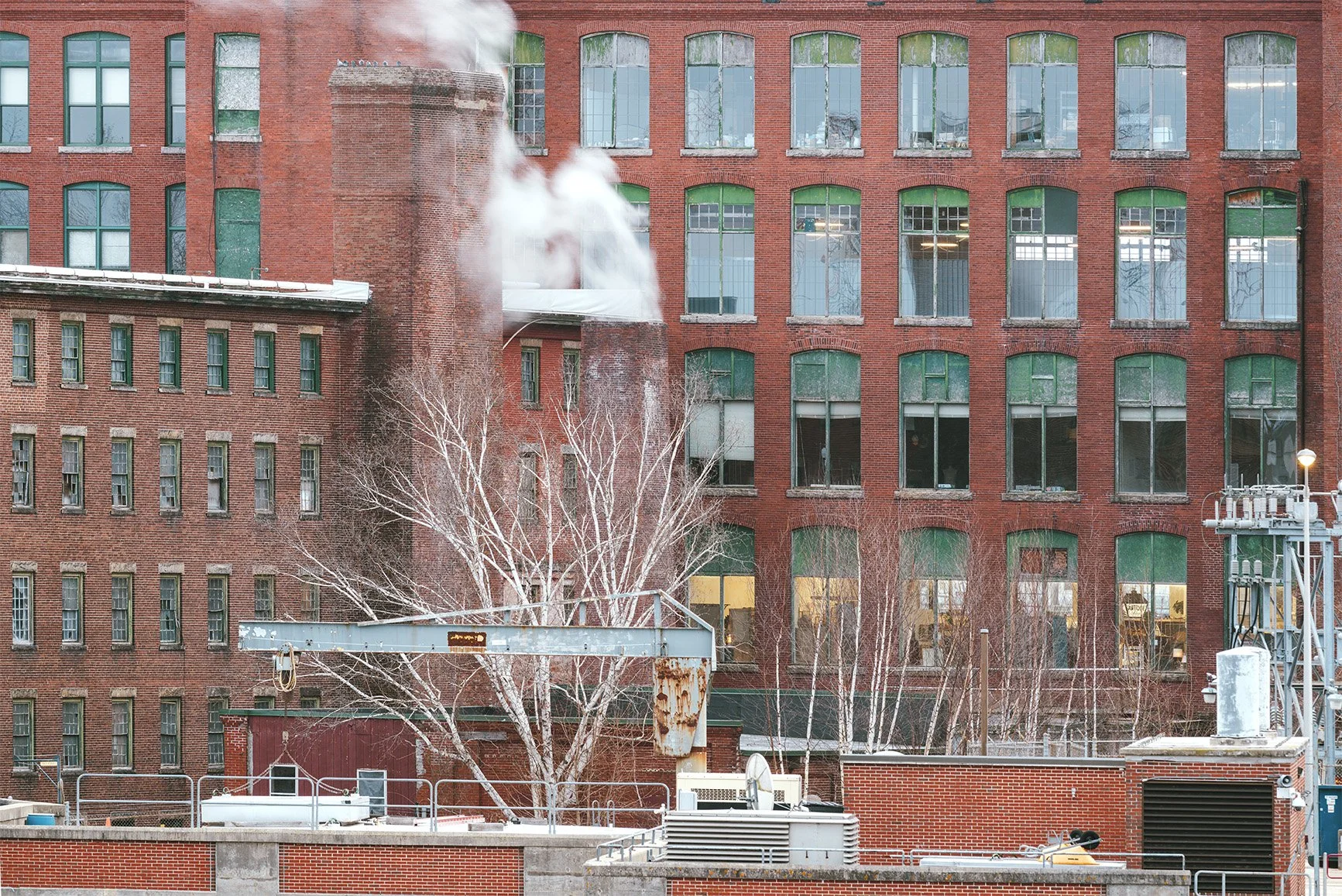
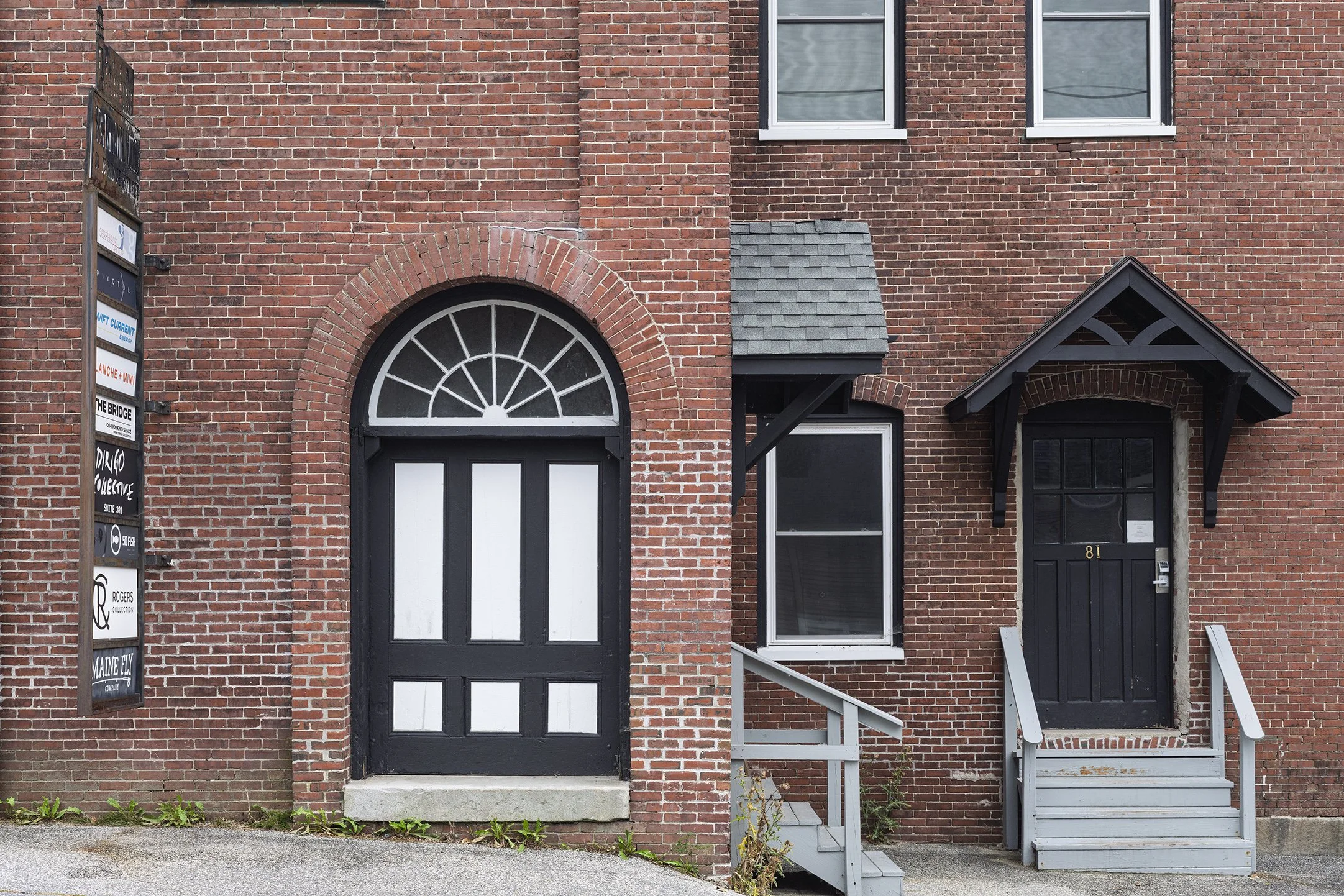
The early nineteenth century marked the emergence of mechanized textile production as a transformative force in New England’s economic development. In Maine, the Brunswick Cotton Manufactory Company, incorporated in 1809, pioneered cotton manufacturing along the Androscoggin River at Pejepscot Falls, harnessing waterpower to spin and weave cotton yarn for domestic markets.¹ As the first cotton mill in Maine and one of the earliest in the United States, the Brunswick manufactory played a foundational role in the region’s industrialization, reshaping Brunswick from a modest commercial village into a manufacturing center integrated into national textile networks.²
The mill’s history reflects broader patterns in American industrialization: subscription-based local capitalism, technological adaptation, labor stratification, immigration, and eventual corporate consolidation. From its founding investors to its acquisition by the Cabot Manufacturing Company in 1857, the Brunswick mill exemplifies the evolution of textile manufacturing in northern New England.³
I. Founding, Investors, and Technical Leadership (1809–1857)
The Brunswick Cotton Manufactory Company was incorporated on March 4, 1809, by a coalition of Brunswick merchants, landholders, and civic leaders.⁴ According to Wheeler, the original investors were motivated by the potential of Pejepscot Falls to power large-scale textile machinery, and included Samuel Melcher, Robert H. Bowker, and members of the Wadsworth and Bowdoin-connected families who dominated Brunswick’s commercial and civic life.⁵
The company operated under a subscription capital model, in which investors purchased shares to fund mill construction, hydraulic improvements, and machinery acquisition.⁶ Wheeler emphasizes that this approach tied the manufactory closely to the town’s mercantile and shipping interests, ensuring local engagement and support.⁷
Bowdoin College and Elite Networks
Bowdoin College, founded in 1794, significantly influenced Brunswick’s intellectual and economic climate. Faculty members, trustees, and affiliated families were among the town’s wealthiest citizens, many of whom participated in or supported early industrial ventures.⁸ While the college itself did not invest directly, its networks facilitated modernization initiatives and technical knowledge transfer.⁹
Engineers and Millwrights
The mill relied on skilled millwrights and hydraulic engineers to construct waterpower systems at Pejepscot Falls.¹⁰ Wheeler documents the installation of waterwheels, dams, and gearing systems designed to power Arkwright-style spinning frames.¹¹ Following a destructive fire in 1825, the company rebuilt in granite during the 1830s, incorporating improved water-control systems and expanded spindle capacity.¹²
II. Production, Products, and Raw Material Sources
By 1855, shortly before the Brunswick Cotton Manufactory’s acquisition by the Cabot Manufacturing Company, the granite mill had reached its mid-nineteenth-century production peak. The facility housed approximately 5,120 spindles and employed roughly 900 workers, reflecting its status as one of Maine’s largest textile operations at the time.¹³ Each spindle produced an estimated seven to ten yards of cotton cloth per day, resulting in a daily output that ranged between 35,840 and 51,200 yards of finished fabric. Operating six days per week over fifty weeks per year, the mill’s annual production totaled an estimated 10,752,000 to 15,360,000 yards of cotton cloth.¹⁴
Wheeler’s contemporary account confirms that the Brunswick manufactory produced utilitarian textiles—such as sheeting, shirting, drill cloth, and heavier industrial fabrics like cotton duck—which were sold regionally and to Boston markets.¹⁵ By the 1840s and 1850s, the mill increasingly standardized production to include bleached and unbleached sheeting, a product line Wheeler notes as central to the company’s commercial strategy.¹⁶
Raw cotton was primarily sourced from the American South, including Georgia, Alabama, and Mississippi, then shipped via Boston from ports such as Charleston and Savannah.⁷ This supply chain connected Brunswick directly to the southern plantation economy and the labor system producing raw cotton, reflecting the intertwined regional and national nature of the textile trade.¹⁷
III. Labor Structure and Workforce Composition
Labor at the Brunswick mill was hierarchical and skill-based. Skilled male employees served as overseers, mechanics, machinists, and waterpower engineers, receiving the highest wages.¹⁸
Women comprised a large share of spinning and weaving operatives. Although pay was formally based on skill set rather than gender, occupational segmentation concentrated women in lower-paid positions.¹⁹
Children worked as doffers and assistants. Workdays commonly lasted twelve to thirteen hours, six days per week, with child wages representing a small fraction of adult earnings.²⁰
The 1881 Strike
In 1881, young Franco-American operatives initiated a strike after discovering that child laborers in Lewiston mills earned slightly higher wages. The walkout lasted approximately three days and temporarily halted production.²¹
Management granted modest wage increases but reportedly issued housing notices to company-tenement occupants during the dispute, revealing the intertwined nature of employment and domestic dependency.²²
IV. Industrial Infrastructure and Community Development
Industrial growth reshaped Brunswick’s physical landscape. Wheeler records that early mill housing was clustered near Pejepscot Falls and connected to the main factory by footbridges, providing safe and efficient access for workers.²³ These early structures prefigure the later Androscoggin Swinging Bridge, constructed in 1892, which allowed employees to traverse the river safely between residential and industrial areas.²⁴
Company-owned tenements reinforced industrial geography but also produced overcrowding concerns. During the 1885 diphtheria outbreak, sanitation conditions in mill housing drew scrutiny from public health authorities.²⁵
By the early twentieth century, the Cabot Mill employed over 1,100 workers, making it one of Maine’s largest textile employers.²⁶
V. Corporate Transition and Decline
Financial pressures and competitive shifts led to Brunswick’s acquisition by the Cabot Manufacturing Company in 1857.²⁷ Boston-based investors centralized management and expanded labor recruitment, particularly among French-Canadian immigrants.²⁸
By the early twentieth century, competition from southern textile centers reduced northern mills’ dominance. In 1941, the Cabot Manufacturing Company sold the Brunswick mill to the Verney Corporation.²⁹ Operations ceased in the mid-1950s, ending nearly 150 years of textile production at Pejepscot Falls.
Today, the granite mill complex—Fort Andross—remains as a preserved testament to Brunswick’s industrial heritage.³⁰
Footnotes
Wheeler, History of Brunswick, Topsham, and Harpswell, Maine, 214.
Ibid., 217.
Ibid., 218.
Brunswick Company, Corporate Reorganization Documents, 1856–1857, Brunswick Historical Society Archives.
Wheeler, History of Brunswick, Topsham, and Harpswell, 214–218.
Brunswick Company, Mill Records and Spindle Inventory, 1855, Brunswick Historical Society Archives.
Wheeler, History of Brunswick, 221–222.
Bowdoin College Trustee Records, 1800–1830, Brunswick Historical Society Archives.
Wheeler, History of Brunswick, 218.
Brunswick Company employment ledgers, 1855.
Wheeler, History of Brunswick, 225.
Brunswick Company rebuilding records, 1830s.
Brunswick Company, Mill Records and Spindle Inventory, 1855.
Jonathan Prude, The Coming of Industrial Order, 52–55.
Wheeler, History of Brunswick, 221–222.
Ibid., 223.
Sven Beckert, Empire of Cotton, 103–109.
Brunswick Company employment ledgers, 1855.
Ibid.
Ibid.
“The Brunswick Children Strike the Cabot Mill,” 1881 Labor Report.
Ibid.
Wheeler, History of Brunswick, 225.
Androscoggin Swinging Bridge National Register Nomination, 1892.
Maine State Board of Health, Annual Report, 1885.
Cabot Manufacturing Company, Employment Summary, 1930.
Brunswick Company, Corporate Reorganization Documents, 1856–1857.
Cabot Manufacturing Company, Annual Report, 1858, 3–6.
Verney Corporation acquisition records, 1941.
Fort Andross Preservation Records, Brunswick Historical Society Archives.
Bibliography
Beckert, Sven. Empire of Cotton: A Global History. New York: Alfred A. Knopf, 2014. pp. 103–109.
Brunswick Company. Corporate Reorganization Documents, 1856–1857. Brunswick Historical Society Archives.
———. Mill Records and Spindle Inventory, 1855. Brunswick Historical Society Archives.
Cabot Manufacturing Company. Annual Report, 1858. pp. 3–6.
———. Employment Summary, 1930. Brunswick Historical Society Archives.
Maine State Board of Health. Annual Report, 1885. Augusta: State of Maine, 1886. pp. 22–24.
Prude, Jonathan. The Coming of Industrial Order: Town and Factory Life in Rural Massachusetts, 1810–1860. Cambridge: Cambridge University Press, 1983. pp. 52–55.
“The Brunswick Children Strike the Cabot Mill,” 1881 Labor Report. Brunswick Historical Society Archives.
Wheeler, George Augustus. History of Brunswick, Topsham, and Harpswell, Maine. Brunswick, ME: George A. Wheeler, 1837. pp. 214–225.
Androscoggin Swinging Bridge National Register Nomination. National Park Service, 1892. pp. 1–6.
Verney Corporation. Acquisition Records for Brunswick Mill, 1941. Brunswick Historical Society Archives.
Brunswick Company Employment Ledgers, 1855. Brunswick Historical Society Archives.
-
The Casco Mill at First Falls
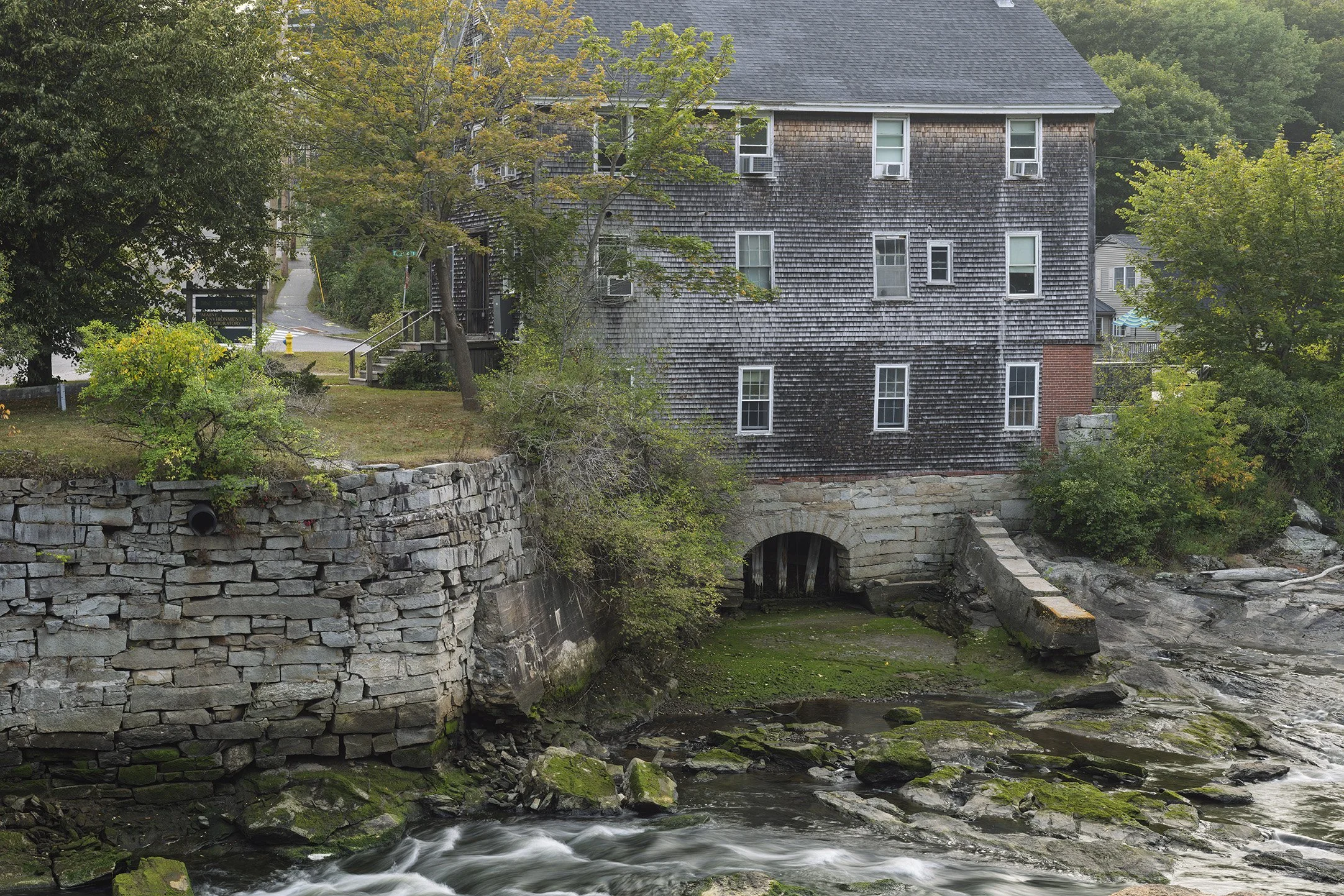
The mill later known as the Casco Mill, located at the First Falls of the Royal River in present-day Yarmouth, Maine, represents one of the earliest industrial enterprises in northern New England. First established in 1674, and substantially rebuilt and expanded in 1681 under Walter Gendall, the mill played a central role in transforming the region from a frontier settlement into a permanent agricultural and commercial community.
The original mill site was selected for its exceptional natural advantages. At First Falls, the Royal River descends sharply near its tidal head, creating a reliable source of waterpower. Early English settlers recognized this location as ideal for milling operations, particularly sawmills, which were essential for constructing dwellings, barns, and other structures necessary for long-term settlement.¹ The earliest mill, attributed to Henry Sayward and associates, functioned primarily as a water-powered sawmill, converting local pine timber into boards and clapboards.²
This initial enterprise was short-lived. During King Philip’s War (1675–1676), hostilities forced settlers to abandon much of the Casco Bay region, and the mill fell into disuse.³ Following the war and the gradual resettlement of the area, Walter Gendall emerged as a leading figure in reestablishing economic activity at First Falls. On July 12, 1681, Gendall acquired property associated with the earlier mill site and undertook the rebuilding and expansion of the operation.⁴
Under Gendall’s management, the Casco Mill became a dual-purpose sawmill and gristmill. In addition to lumber, the mill ground locally grown grain—primarily corn—into meal. Corn meal formed the dietary staple of early settlers and was used to make foods such as johnnycake, hasty pudding, porridge, and ash cakes.⁵ The mill operated on a customary toll system, whereby the miller retained a portion of the grain or sawn lumber as payment, an arrangement well suited to the largely cashless frontier economy.⁶
Technologically, the mill relied on a vertical waterwheel—likely an overshot or breast wheel—driving wooden gearing connected either to a vertical sash saw or to millstones. Although output was limited by modern standards, the mill’s productivity was sufficient to meet local needs and sustain settlement growth.⁷ Gendall resided near the mill and constructed additional buildings, including worker housing, further emphasizing the site’s role as a small industrial and social hub.⁸
Beyond its economic importance, the Casco Mill functioned as a focal point of community life. Settlers gathered there to exchange news, resolve disputes, and coordinate labor. Its vulnerability during periods of conflict also underscored its significance: mills were frequent targets in frontier warfare because their destruction could cripple an entire settlement’s food supply.⁹
Although the original 17th-century structures no longer survive, archaeological remnants of mill foundations, dams, and raceways remain visible today at Grist Mill Park. The Casco Mill thus stands as a foundational institution in the history of Yarmouth, illustrating how early water-powered industry enabled permanent settlement, economic stability, and community formation in colonial Maine.¹⁰
Footnotes
Maine Historical Society, Grist Mill Park and the First Falls of the Royal River, Maine Memory Network.
William Hutchinson Rowe, Ancient North Yarmouth and Yarmouth (Portland: Press of Loring, Short & Harmon, 1880), 23–25.
James Phinney Baxter, The Popham Colony (Portland: Maine Historical Society, 1888), 212–214.
York County Deeds, Book IV (1684–1699), deed dated July 12, 1681, Walter Gendall and Bartholomew Gedney.
Sarah Josepha Hale, The New England Housekeeper (Boston: Munroe and Francis, 1839), 45–48.
Percy Wells Bidwell and John I. Falconer, History of Agriculture in the Northern United States (Washington, DC: Carnegie Institution, 1925), 112–113.
Terry S. Reynolds, Stronger Than a Hundred Men: A History of the Vertical Water Wheel (Baltimore: Johns Hopkins University Press, 1983), 34–36.
Collections of the Maine Historical Society, vol. 3 (Portland: Maine Historical Society, 1853), 189–191.
Emerson W. Baker, The Devil of Great Island (New York: Palgrave Macmillan, 2007), 97–99.
Yarmouth Historical Society, Interpretive Materials for Grist Mill Park, Yarmouth, Maine.
Bibliography
Baker, Emerson W. The Devil of Great Island. New York: Palgrave Macmillan, 2007.
Baxter, James Phinney. The Popham Colony. Portland: Maine Historical Society, 1888.
Bidwell, Percy Wells, and John I. Falconer. History of Agriculture in the Northern United States. Washington, DC: Carnegie Institution, 1925.
Hale, Sarah Josepha. The New England Housekeeper. Boston: Munroe and Francis, 1839.
Maine Historical Society. Collections of the Maine Historical Society. Vol. 3. Portland: Maine Historical Society, 1853.
Maine Historical Society. Grist Mill Park and the First Falls of the Royal River. Maine Memory Network.
Reynolds, Terry S. Stronger Than a Hundred Men: A History of the Vertical Water Wheel. Baltimore: Johns Hopkins University Press, 1983.
Rowe, William Hutchinson. Ancient North Yarmouth and Yarmouth. Portland: Press of Loring, Short & Harmon, 1880.
York County Deeds. Book IV (1684–1699). York County Registry of Deeds
-
The Dana Warp Mill and Industrial Development at Saccarappa Falls, Westbrook, Maine
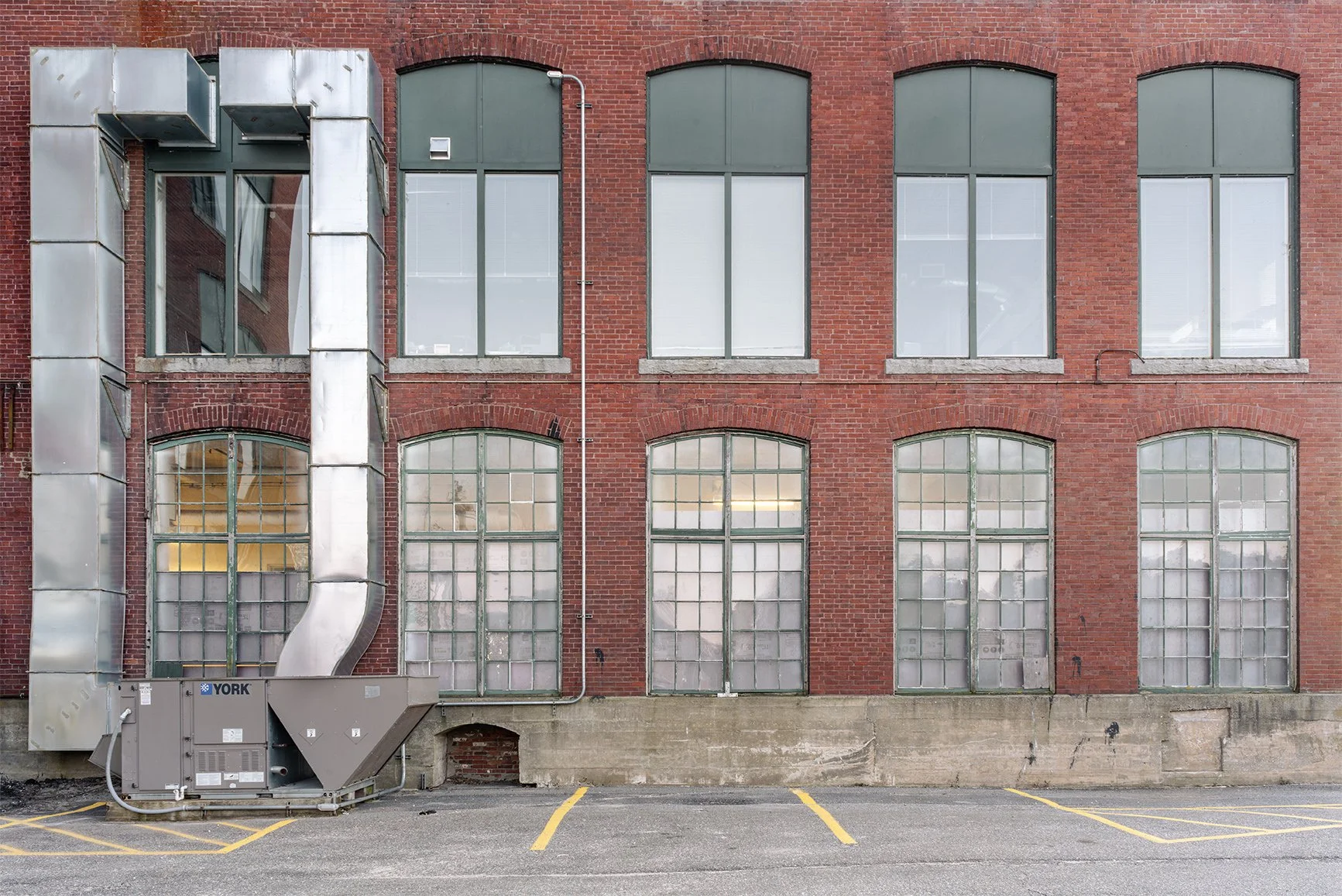
The Dana Warp Mill, constructed in 1866 along the Presumpscot River at Saccarappa Falls in Westbrook, Maine, emerged as one of the region’s important textile manufacturing facilities during the rapid industrial expansion of post–Civil War New England. Located within the historic Saccarappa industrial district, the mill formed part of the broader transformation of Westbrook from a rural river settlement into a major manufacturing center powered by the hydraulic energy of the Presumpscot River. The history of the Dana Warp Mill illustrates the development of Maine’s textile economy, the dependence of nineteenth-century industry upon waterpower, the growth of industrial labor systems—including child labor—and the social tensions that accompanied factory production during the Gilded Age and early twentieth century.
Industrial development at Saccarappa Falls predated the Dana Warp Mill by more than a century. The Presumpscot River had long attracted sawmills, gristmills, and small manufacturing operations because of the substantial hydraulic power generated by the river’s falls and rapids.¹ During the early nineteenth century, investors recognized the potential for large-scale textile manufacturing at Saccarappa, particularly as New England’s cotton industry expanded beyond Massachusetts into northern New England.² By the 1840s and 1850s, dams, canals, and water control systems had transformed portions of the Presumpscot into organized industrial power sites.³
The Dana Warp Mill itself was constructed in 1866 during the post–Civil War industrial boom.⁴ The mill was organized primarily for the production of cotton warp yarns, an essential component used in weaving cloth within larger textile mills throughout New England.⁵ Warp yarns formed the longitudinal threads held under tension on weaving looms and required strong, tightly twisted cotton fibers capable of withstanding continuous mechanical stress during weaving operations.⁶ The Dana Warp Mill therefore specialized in preparing and spinning cotton yarns rather than producing finished cloth directly.
Investment in the mill came from regional industrialists and textile financiers associated with Maine’s growing manufacturing economy. Among the principal investors were members of the Dana family, local businessmen connected to Portland banking interests, and industrial promoters involved in waterpower development along the Presumpscot River.⁷ Construction costs reportedly exceeded $150,000, a substantial investment for a Maine textile operation during the immediate postwar period.⁸ The mill building itself was constructed primarily of brick with heavy timber framing designed to support large textile machinery and minimize fire risks associated with cotton dust and oil-lubricated equipment.⁹
The Dana Warp Mill relied heavily upon hydraulic power generated by the Presumpscot River. Water diverted through dam and canal systems at Saccarappa Falls drove large water turbines located beneath the mill structure.¹⁰ These turbines transferred mechanical energy upward through vertical shafting systems connected to belts, pulleys, and overhead line shafts distributed throughout the factory floors.¹¹ Prior to widespread electrification during the late nineteenth century, this water-powered mechanical system provided the primary energy source for nearly all textile manufacturing operations within the mill.
Inside the factory, workers operated a variety of textile machines common to nineteenth-century cotton mills. Machinery included carding machines, spinning frames, warping machines, bobbin winders, and drawing frames used to straighten, twist, and prepare cotton fibers for weaving applications.¹² Much of this equipment was manufactured by firms based in Lowell, Massachusetts, and Providence, Rhode Island, which dominated American textile machinery production during the period.¹³ The constant motion of belts, shafts, and gears created extremely dangerous working conditions, particularly in crowded factory environments where machinery often lacked protective guards.
At its peak during the late nineteenth century, the Dana Warp Mill employed several hundred workers, including substantial numbers of women and children.¹⁴ Textile manufacturing throughout New England depended heavily upon child labor during this period because children could be paid lower wages and were considered capable of performing repetitive machine-tending tasks requiring small hands and agility.¹⁵ Children at the Dana Warp Mill reportedly worked as doffers, bobbin carriers, sweepers, and machine assistants, often laboring ten to twelve hours per day under difficult conditions.¹⁶ Many working-class families depended upon the wages earned by children in order to survive economically.
Working conditions within the mill reflected broader labor conditions throughout New England’s textile industry. Cotton dust, poor ventilation, high humidity, excessive noise, and long working hours created serious health hazards for employees.¹⁷ Workers frequently suffered respiratory illnesses associated with inhaling cotton fibers and dust particles suspended in the factory air.¹⁸ Mechanical injuries were also common. Employees risked crushed fingers, severed hands, scalp injuries from exposed rotating shafts, broken bones from machinery accidents, and severe burns from steam equipment and overheated bearings.¹⁹ Women working near spinning frames occasionally suffered fatal injuries when loose clothing or hair became entangled in moving machinery.²⁰
Labor tensions and industrial disputes periodically affected operations at the Dana Warp Mill and neighboring textile factories throughout Westbrook. Wage reductions, long working hours, and dangerous conditions contributed to worker dissatisfaction during the late nineteenth century.²¹ Textile workers in Maine increasingly participated in labor organizing efforts associated with the Knights of Labor and later the United Textile Workers of America.²² Although large-scale strikes at the Dana Warp Mill itself were less prominent than those in larger Massachusetts mill cities, labor unrest periodically disrupted production.²³ Workers protested wage cuts during economic downturns and demanded reductions in excessively long factory hours, particularly for women and children.²⁴
The issue of child labor became especially controversial during the Progressive Era as reformers criticized the exploitation of children within textile factories. Maine’s textile mills, including facilities at Westbrook, gradually faced increasing state regulation limiting the working hours and ages of child employees.²⁵ Reform advocates argued that industrial labor deprived children of education, endangered their health, and contributed to cycles of poverty within immigrant and working-class communities.²⁶ Factory owners, however, frequently resisted such regulations, claiming that family wage systems depended upon child earnings and that labor restrictions would reduce industrial competitiveness.
During the late nineteenth and early twentieth centuries, the Dana Warp Mill contributed significantly to Westbrook’s economic growth. The factory attracted immigrant laborers from Ireland, French Canada, and later Eastern Europe, contributing to the rapid urbanization of the Saccarappa district.²⁷ Worker housing, boarding houses, churches, and commercial districts developed around the expanding industrial center.²⁸ The mill thus became not only an economic institution but also a major force shaping the social geography of Westbrook.
Technological changes during the twentieth century gradually altered operations at the Dana Warp Mill. Electrification replaced many earlier water-powered mechanical systems, while advances in textile production increased automation and reduced labor demands.²⁹ Nevertheless, competition from southern textile mills and later foreign manufacturers contributed to the decline of New England cotton manufacturing after the 1920s.³⁰ Like many regional textile facilities, the Dana Warp Mill eventually experienced reduced production, workforce contraction, and industrial decline.
Today, surviving mill structures at Saccarappa Falls remain important reminders of Maine’s industrial past. The history of the Dana Warp Mill reflects the broader transformation of New England through industrialization, waterpower development, labor conflict, and technological change. Its operations depended upon the hydraulic energy of the Presumpscot River, the labor of immigrant workers and children, and the mechanical systems that defined nineteenth-century textile production. At the same time, the mill’s history reveals the human costs of industrial capitalism, including dangerous working conditions, labor exploitation, and recurring industrial conflict. Through its connection to the broader industrial landscape of Westbrook and the Presumpscot River, the Dana Warp Mill remains a significant example of Maine’s textile manufacturing heritage.
Footnotes
William D. Barry, The History of Westbrook, Maine (Westbrook, ME: Westbrook Historical Society, 1977), 14.
Bryant F. Tolles Jr., The Textile Mills of New England (Hanover, NH: University Press of New England, 1987), 66.
Maine Historic Preservation Commission, Historic Industrial Resources of Westbrook, Maine (Augusta, ME: Maine Historic Preservation Commission, 1991), 9.
Ibid., 17.
Amos D. Lockwood, Textile Manufacturing in New England (Boston: Houghton Mifflin, 1882), 213.
Ibid., 214.
Barry, The History of Westbrook, Maine, 48.
Maine Historic Preservation Commission, Historic Industrial Resources of Westbrook, Maine, 18.
Tolles, The Textile Mills of New England, 91.
Historic American Engineering Record, Presumpscot River Industrial System (Washington, DC: National Park Service, 1975), 6.
Ibid., 8.
Lockwood, Textile Manufacturing in New England, 229.
Tolles, The Textile Mills of New England, 117.
Barry, The History of Westbrook, Maine, 62.
David A. Zonderman, Aspirations and Anxieties: New England Workers and the Mechanized Factory System (New York: Oxford University Press, 1992), 134.
Ibid., 138.
Judith A. McGaw, Most Wonderful Machine: Mechanization and Social Change in Berkshire Paper Making, 1801–1885 (Princeton, NJ: Princeton University Press, 1987), 211.
Zonderman, Aspirations and Anxieties, 142.
Maine Bureau of Industrial and Labor Statistics, Annual Report on Factory Accidents in Maine (Augusta, ME: State of Maine, 1904), 88.
Ibid., 91.
Barry, The History of Westbrook, Maine, 75.
Philip S. Foner, History of the Labor Movement in the United States, vol. 2 (New York: International Publishers, 1955), 317.
Maine Bureau of Industrial and Labor Statistics, Labor Conditions in Maine Textile Mills (Augusta, ME: State of Maine, 1907), 41.
Ibid., 44.
Hugh D. Hindman, Child Labor: An American History (Armonk, NY: M.E. Sharpe, 2002), 188.
Ibid., 193.
Barry, The History of Westbrook, Maine, 81.
Maine Historic Preservation Commission, Historic Industrial Resources of Westbrook, Maine, 27.
Tolles, The Textile Mills of New England, 203.
Ibid., 245.
Bibliography
Barry, William D. The History of Westbrook, Maine. Westbrook, ME: Westbrook Historical Society, 1977.
Foner, Philip S. History of the Labor Movement in the United States. Vol. 2. New York: International Publishers, 1955.
Hindman, Hugh D. Child Labor: An American History. Armonk, NY: M.E. Sharpe, 2002.
Historic American Engineering Record. Presumpscot River Industrial System. Washington, DC: National Park Service, 1975.
Lockwood, Amos D. Textile Manufacturing in New England. Boston: Houghton Mifflin, 1882.
Maine Bureau of Industrial and Labor Statistics. Annual Report on Factory Accidents in Maine. Augusta, ME: State of Maine, 1904.
Maine Bureau of Industrial and Labor Statistics. Labor Conditions in Maine Textile Mills. Augusta, ME: State of Maine, 1907.
Maine Historic Preservation Commission. Historic Industrial Resources of Westbrook, Maine. Augusta, ME: Maine Historic Preservation Commission, 1991.
McGaw, Judith A. Most Wonderful Machine: Mechanization and Social Change in Berkshire Paper Making, 1801–1885. Princeton, NJ: Princeton University Press, 1987.
Tolles, Bryant F., Jr. The Textile Mills of New England. Hanover, NH: University Press of New England, 1987.
Zonderman, David A. Aspirations and Anxieties: New England Workers and the Mechanized Factory System. New York: Oxford University Press, 1992.
-
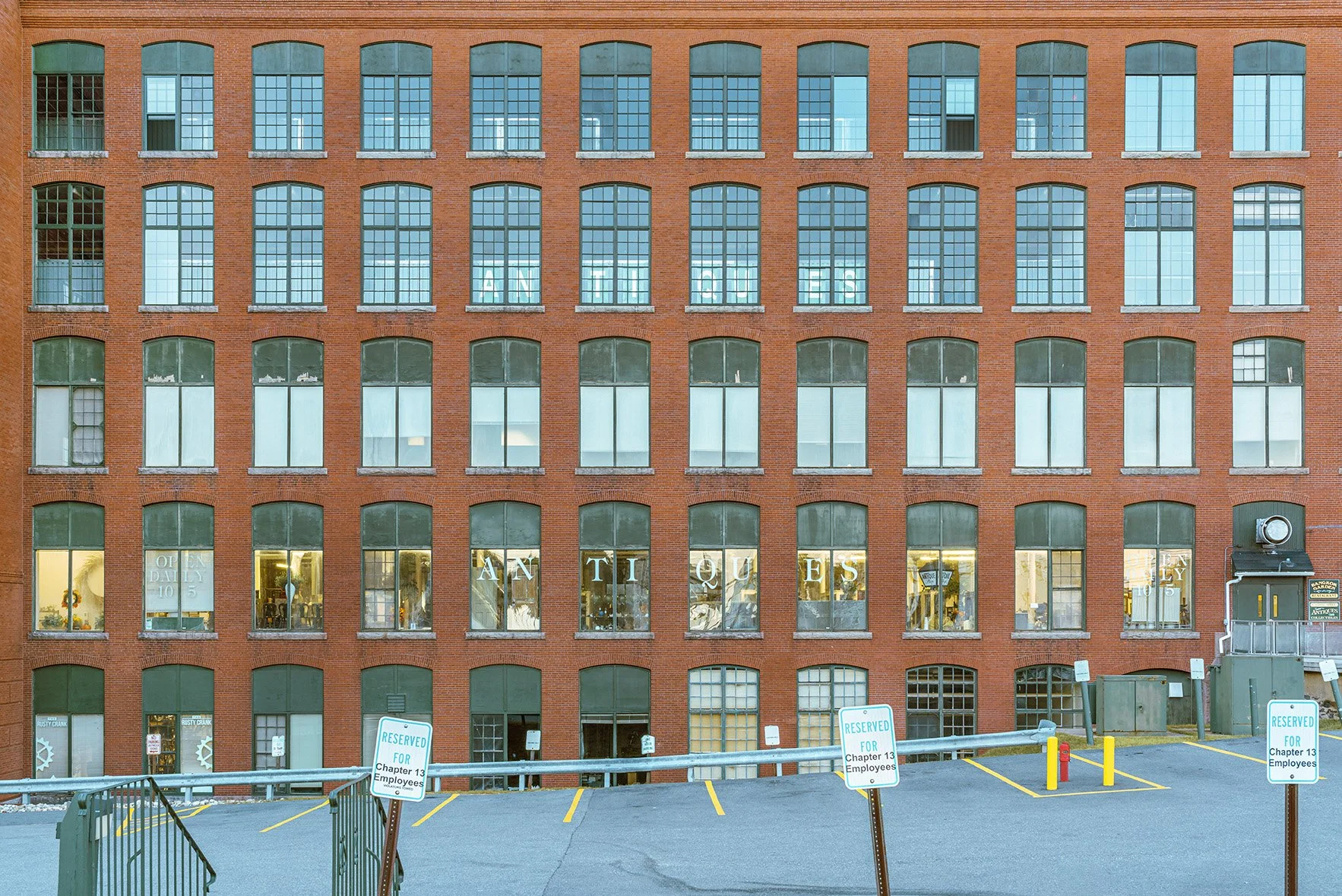
The first mill on this site was the North Yarmouth Manufacturing Company, founded in 1847 by Eleazer Burbank. The company produced cotton yarn and cloth, continuing an industrial tradition at the Second Falls of the Royal River, where a wooden mill had operated since 1817.¹ In 1855, Libby and Harrison rebuilt the mill in brick to accommodate their new venture, the Royal River Manufacturing Company, which specialized in cotton grain bags and expanded textile production at the site.²
At its peak in the late nineteenth century, the Royal River Manufacturing Company employed approximately sixty workers, including a significant number of migrants from Prince Edward Island, Canada, who came to Maine seeking industrial employment.³ Employees typically worked twelve-hour days, six days per week, under tightly regulated factory schedules.⁴ Wages were modest: a weaver earned approximately $1.40 to $1.50 per day, while weekly room and board in company-provided boarding houses cost between $2 and $3.⁵ These arrangements reflected common labor practices in New England textile villages, where mill owners often exercised influence over both work and domestic life.⁶
The mill produced cotton yarn, woven cloth, and seamless cotton grain bags using spinning frames, power looms, and ancillary textile machinery.⁷ Power was initially supplied by water turbines drawing energy from the Royal River via the Bridge Street Dam.⁸ In the 1880s, the complex was expanded to include a prominent square brick tower, lending the mill its distinctive Italianate architectural character and improving vertical circulation within the facility.⁹ During the twentieth century, the site incorporated electric turbines; these generating systems were revitalized in 1986 and continue to function, reflecting the layered evolution of the site’s industrial infrastructure.¹⁰
Operations under the Royal River Manufacturing Company continued—interrupted briefly during the Great Depression—until 1951.¹¹ In the early 1950s, the Old Sparhawk Mills Company relocated from South Portland, Maine, to the Yarmouth facility, shifting production toward braided rugs.¹² In 1957, Sherman O. Yale assumed control of the property under the name Yale Cordage, manufacturing braided twine used for lobster traps and yachting cordage.¹³ Yale Cordage operated at the site until 1991, when it moved to a larger facility; the former mill was subsequently adapted for mixed commercial rental use.¹⁴
Although the Sparhawk Mill and surrounding structures have been identified locally as contributing resources within a proposed Royal River Manufacturing Historic District, the mill itself is not individually listed on the U.S. National Register of Historic Places.¹⁵ Certain elements of the site, including the Bridge Street Dam, have been identified as eligible for listing as part of a historic district, but formal designation has not been completed.¹⁶ The complex remains a prominent reminder of Yarmouth’s nineteenth- and twentieth-century textile heritage and the enduring industrial significance of the Royal River corridor.¹⁷
Footnotes
Yarmouth History Center, “Royal River and the Mill,” Yarmouth Historical Society, accessed January 2026, 2–3.
Ibid., 4–5.
Ibid., 6–7.
Ibid., 8.
Ibid., 9.
Ibid., 10.
Ibid., 11–12.
Town of Yarmouth, Maine, Historic Preservation Committee, Royal River Manufacturing Historic District: Context Statement Update, June 27, 2025 (Yarmouth, ME: Town of Yarmouth, 2025), 14–16.
Ibid., 18–19.
The Maine Monitor, “Yarmouth Moves Closer to Dam Removals on the Royal River,” May 19, 2024, 3–4.
Yarmouth History Center, “Royal River and the Mill,” 13.
Ibid., 14.
Ibid., 15.
Ibid., 16.
Town of Yarmouth, Royal River Manufacturing Historic District, 21–22.
Ibid., 23–24.
Ibid., 25.
Bibliography
The Maine Monitor. “Yarmouth Moves Closer to Dam Removals on the Royal River.” May 19, 2024.
Town of Yarmouth, Maine, Historic Preservation Committee. Royal River Manufacturing Historic District: Context Statement Update. June 27, 2025. Yarmouth, ME: Town of Yarmouth, 2025.
Yarmouth History Center. “Royal River and the Mill.” Yarmouth Historical Society. Accessed January 2026.
-
From Mill to Modern Office: The Transformation of One Riverfront Plaza in Westbrook, Maine
The site of present-day One Riverfront Plaza in Westbrook, Maine, reflects a broader narrative of industrial rise, decline, and redevelopment that shaped much of New England. While the modern office building, completed in 2004, bears little architectural resemblance to the structures that once occupied the land, it stands directly atop the footprint of earlier industrial facilities, most notably Mill No. 2 of the Westbrook Manufacturing Company. The evolution of this parcel—from textile production to light industry, abandonment, and ultimately redevelopment—illustrates both continuity of economic purpose and a decisive break in architectural identity.
Mill No. 2 and Its Industrial Context
Mill No. 2 of the Westbrook Manufacturing Company was constructed in 1868 along Bridge Street, at a time when the Presumpscot River powered a thriving industrial corridor. Like many textile mills of its era, the building was constructed of brick with multiple stories, large regularly spaced windows, and a belfry containing a bell used to regulate the workday.¹ The mill formed part of a dense cluster of industrial buildings that defined Westbrook as a classic mill town, where economic life revolved around river-powered manufacturing.
Production at Mill No. 2
The Westbrook Manufacturing Company specialized in the production of “duck,” a heavy cotton fabric also known as canvas.² This material was valued for its durability and was widely used in the nineteenth century for sails, tents, wagon covers, and industrial applications requiring strong woven cloth. During and after the Civil War, demand for such materials was particularly high, especially for military tents and maritime uses.³ The production of duck required large-scale weaving operations, which were well suited to multi-story mills like Mill No. 2, where different stages of textile processing could be organized vertically.
The manufacturing of such goods placed Westbrook within a broader regional and national textile economy. Though smaller than the major textile centers of Massachusetts, mills like those operated by the Westbrook Manufacturing Company contributed significantly to local employment and economic stability.⁴
Flood of 1896 and Industrial Transition
This prosperity came to an abrupt end in March 1896, when a catastrophic flood along the Presumpscot River caused extensive damage to industrial infrastructure throughout the area.⁵ The Westbrook Manufacturing Company suffered heavily and, unable to recover financially, ceased operations later that year.⁶ The closure marked not only the end of a major local employer but also a shift in the use of the site itself.
Following the company’s collapse, the property was acquired by the Dana Warp Mill, which repurposed the building for textile-related processes, particularly the preparation and treatment of yarns.⁷ This transition reflects a broader trend in New England industry at the turn of the twentieth century. The Dana Warp Mill continued operations at the site until 1956, maintaining the industrial function of the property even as the original structure began to deteriorate.⁸ Over time, the upper floors became structurally unsound and were gradually dismantled.
An important artifact of the original mill—the bell housed in its belfry—was preserved and donated to the First Baptist Church of Westbrook, where it remains today.⁹
Late Industrial Use and Decline
In 1956, the remaining structure was purchased by Stultz Electric Motor Company, which used the site for industrial repair and related operations.¹⁰ This marked the final phase of continuous industrial use on the property. By the late twentieth century, however, the structure had become obsolete and increasingly unsafe. Nearby stood other deteriorating industrial buildings, including the Foye Mill, which was destroyed by fire in 1992.¹¹
By the 1990s, the site had effectively become a brownfield, characterized by abandoned structures, debris, and environmental contamination from decades of industrial activity.¹² Hazardous substances including PCBs, arsenic, and lead required significant remediation prior to redevelopment.¹³
Construction and Early Development of One Riverfront Plaza
The construction of One Riverfront Plaza in 2004 marked a decisive transformation of the site. The project was undertaken as part of a broader effort by the City of Westbrook to redevelop its downtown riverfront along the Presumpscot River.¹⁴ Developed by Flannery Properties with municipal support, the project included a six-story office building of approximately 130,000 to 140,000 square feet, along with a large adjacent parking garage containing roughly 550 spaces.¹⁵
The development was complicated by the site’s industrial legacy. As a former brownfield, it required extensive environmental cleanup and careful planning due to spatial constraints and contamination concerns.¹⁶ Despite these challenges, the completed structure quickly became the largest office building in downtown Westbrook and was intended to serve as an anchor for economic revitalization.¹⁷
Occupancy, Decline, and Revitalization (2004–Present)
Following its completion, One Riverfront Plaza entered a period of economic stability and growth. Its primary tenant was Disability RMS, a disability insurance company that occupied a substantial portion of the building.¹⁸ In 2005, the property was sold to an investment group for approximately $23.5 million, reflecting its strong early value and importance as a commercial asset.¹⁹ During this period, the building functioned as a major employment hub and contributed significantly to downtown economic activity.
This stability was disrupted in 2015 when Disability RMS relocated to South Portland, leaving the building largely vacant.²⁰ The loss of its anchor tenant represented a major economic setback for Westbrook, and the property’s owners struggled to manage a mortgage of roughly $20 million.²¹ Legal and financial difficulties led to receivership, and in February 2017 the building was sold at foreclosure auction for approximately $9.2 million.²² By this time, it had remained vacant for over a year, raising concerns about the vitality of the downtown area.
A turning point came in June 2017, when Maine Medical Center purchased the building for $10.75 million.²³ The institution repurposed the facility to house administrative and information technology operations, consolidating hundreds of employees—eventually between 400 and 500—into a single location.²⁴ Staff began moving into the building between late 2017 and 2018, restoring daily activity and economic presence to the area.²⁵ This acquisition marked a significant moment of recovery, reestablishing the building as a major employment center and contributing to the stabilization of Westbrook’s downtown economy.
Conclusion
In conclusion, the history of One Riverfront Plaza’s site encapsulates the trajectory of industrial New England: initial growth driven by water-powered textile manufacturing, disruption through natural disaster and economic change, gradual decline and abandonment, and eventual redevelopment through modern investment. While the present building does not visually resemble Mill No. 2, its continued role as a center of employment reflects a deeper continuity of purpose. The transformation from a nineteenth-century textile mill to a twenty-first-century office complex thus represents both a break from and a continuation of Westbrook’s industrial heritage.
Notes
Earle G. Shettleworth Jr., Maine’s Built Heritage: Historic Structures and Their Stories (Augusta: Maine Historic Preservation Commission, 2006), 112.
Ibid., 113.
Ibid., 114.
Maine Historic Preservation Commission, Industrial Survey of Cumberland County (Augusta: MHPC, 1988), 45.
Herbert G. Jones, The Presumpscot River and Its Industrial Development (Portland: Maine Historical Society, 1955), 78.
Ibid., 80.
Maine Historic Preservation Commission, Industrial Survey, 46.
Ibid.
Shettleworth, Maine’s Built Heritage, 115.
Maine Historic Preservation Commission, Industrial Survey, 47.
Environmental Protection Agency, Brownfields Assessment: Westbrook Riverfront (Boston: EPA Region I Report, 2002), 23.
Ibid., 25.
Ibid., 27.
City of Westbrook Planning Office, Riverfront Redevelopment Plan (Westbrook, ME: City of Westbrook, 2003), 14.
Ibid., 16.
Environmental Protection Agency, Brownfields Assessment, 29.
City of Westbrook Planning Office, Riverfront Redevelopment Plan, 18.
Mainebiz, “Westbrook Office Market Report,” (Portland, ME: Mainebiz, 2006), 12.
Ibid., 13.
Portland Press Herald, “Westbrook Office Vacancy संकट,” January 2016, 1.
Ibid., 3.
Portland Press Herald, “Riverfront Plaza Auction Results,” February 2017, 2.
Maine Public Broadcasting, “Maine Medical Center Expansion,” June 2017, 1.
Ibid., 2.
Portland Press Herald, “Workers Return to Westbrook,” January 2018, 1.
Bibliography
City of Westbrook Planning Office. Riverfront Redevelopment Plan. Westbrook, ME: City of Westbrook, 2003.
Environmental Protection Agency. Brownfields Assessment: Westbrook Riverfront. Boston: EPA Region I Report, 2002.
Jones, Herbert G. The Presumpscot River and Its Industrial Development. Portland: Maine Historical Society, 1955.
Maine Historic Preservation Commission. Industrial Survey of Cumberland County. Augusta: MHPC, 1988.
Maine Public Broadcasting. “Maine Medical Center Expansion.” June 2017.
Mainebiz. “Westbrook Office Market Report.” Portland, ME: Mainebiz, 2006.
Portland Press Herald. “Riverfront Plaza Auction Results.” February 2017.
Portland Press Herald. “Westbrook Office Vacancy Crisis.” January 2016.
Portland Press Herald. “Workers Return to Westbrook.” January 2018.
Shettleworth, Earle G., Jr. Maine’s Built Heritage: Historic Structures and Their Stories. Augusta: Maine Historic Preservation Commission, 2006.