Rockland Ferry Terminal, c. 1958
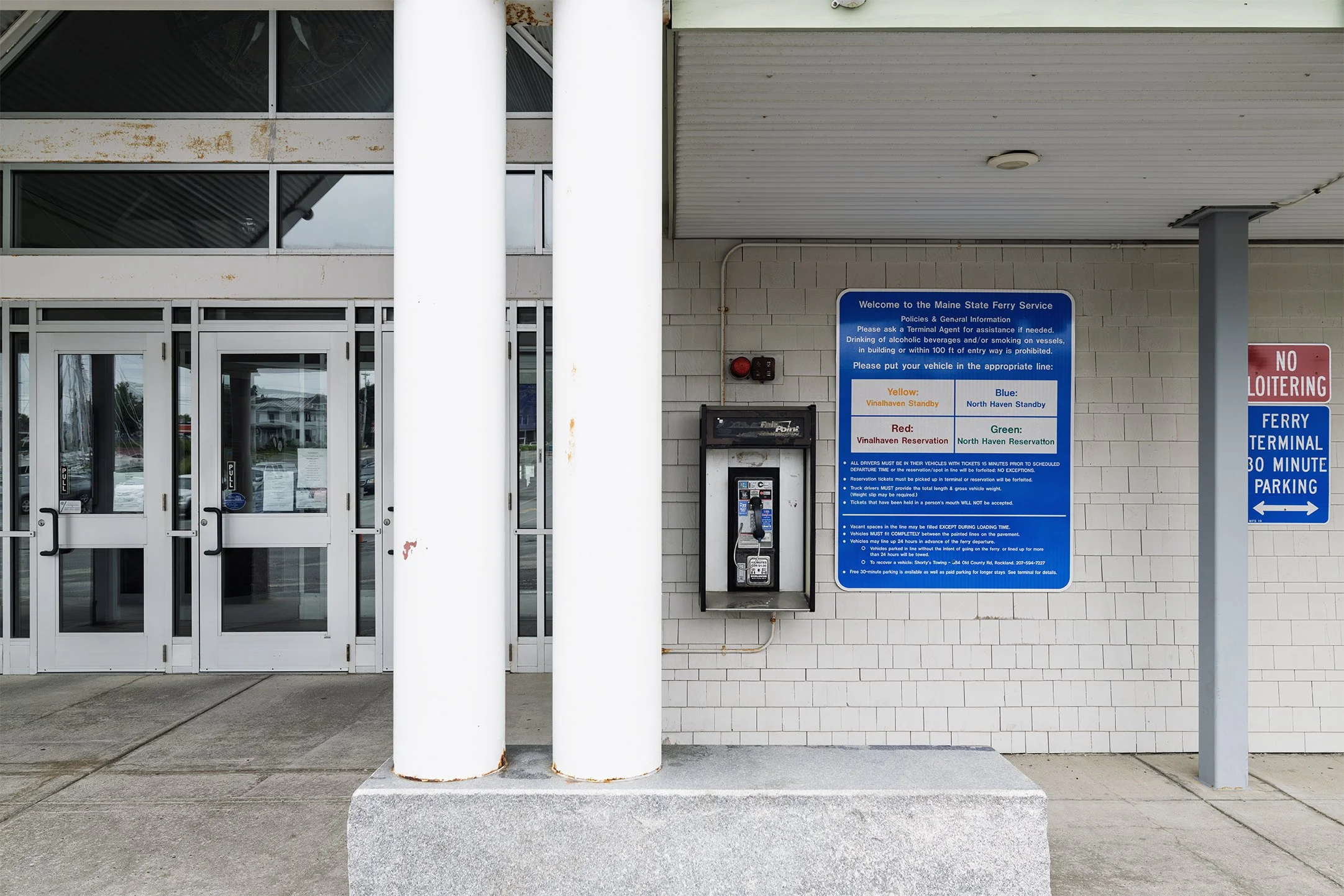
Rockland Ferry Terminal, c. 1958
517A Main Street, Port Terminal Rd. Rockland, Knox County, Maine
From the Echoes, Still: Maine's Industrial Remnants Collection (2024–2028)
Renaissance Portfolio
Historical Narrative
Rockland Ferry Terminal: Maritime Transportation, Coastal Commerce, and Modern Ferry Infrastructure
Kevin LeDuc Pigment print on Hahnemühle Baryta
Edition of 5 + 1 Artist's Proof (Portfolio of 40 Images)
30 × 45 inches
Paper size: 40 × 55 inches
Image size: 32 × 47 inches
Border: 4 inches (all sides)
Historic Significance
The Rockland Ferry Terminal occupies a central position within the historic waterfront of Rockland, Maine, serving as the principal mainland gateway to the islands of Penobscot Bay. Although the terminal is a modern transportation facility, its significance extends well beyond its physical structure. It represents the continuation of more than two centuries of maritime commerce, passenger transportation, and coastal connectivity that have shaped Rockland's identity as one of Maine's principal seaports. Situated on one of Maine's most active working waterfronts, the terminal links the mainland with Vinalhaven, North Haven, and Matinicus Island while continuing a maritime transportation tradition that long predates the construction of the present facility
Historical Narrative
-
Rockland Ferry Terminal: Maritime Transportation, Coastal Commerce, and Modern Ferry Infrastructure
Introduction
The Rockland Ferry Terminal occupies a central position within the historic waterfront of Rockland, Knox County, Maine, serving as the principal mainland gateway to the islands of Penobscot Bay. Although the terminal is a modern transportation facility, its significance extends well beyond its physical structure. It represents the continuation of more than two centuries of maritime commerce, passenger transportation, and coastal connectivity that have shaped Rockland's identity as one of Maine's principal seaports. Situated on one of Maine's most active working waterfronts, the terminal links the mainland with Vinalhaven, North Haven, and Matinicus Island while continuing a maritime transportation tradition that long predates the construction of the present facility.¹
The history of the terminal is inseparable from the broader development of Rockland itself. The beginnings of the community date to the 1760s, when European settlers established permanent settlement in what was then known as Shore Village, a coastal settlement within the Town of Thomaston. Benefiting from one of the finest natural harbors on the coast of Maine, Shore Village developed through fishing, shipbuilding, coastal commerce, and the carrying trade. During the first half of the nineteenth century, the commercial exploitation of extensive limestone deposits transformed the settlement into one of New England's leading industrial ports. Wharves, lime kilns, warehouses, shipyards, and commercial buildings rapidly expanded along the waterfront, and in recognition of its remarkable growth, the community was incorporated as the Town of Rockland in 1854.²
While Rockland's maritime heritage extends to the eighteenth century, the Rockland Ferry Terminal itself is not an eighteenth-century facility. Regular passenger service to the islands of Penobscot Bay developed during the nineteenth century through privately operated sailing packets and later steamship lines that connected Rockland with Vinalhaven, North Haven, Matinicus, and other island communities. The modern state-operated terminal traces its origins to the establishment of a permanent mainland ferry terminal by the Maine Port Authority in 1958–1959. The existing terminal building, completed during the mid-1990s, reflects the continued modernization of Maine's publicly operated ferry system while preserving Rockland's historic role as the principal transportation hub for the islands of Penobscot Bay.³
Unlike many transportation facilities whose functions have changed little over time, the Rockland Ferry Terminal reflects the continual evolution of coastal transportation technology. Sailing packets, steamships, diesel ferries, and modern state-operated vessels have all served essentially the same purpose: maintaining reliable connections between island communities and the mainland. Consequently, the terminal embodies the intersection of maritime history, public infrastructure, regional commerce, and state transportation policy.
This essay examines the historical development of the Rockland Ferry Terminal within the broader context of Rockland's maritime economy, the evolution of passenger ferry service in Penobscot Bay, and the continuing importance of publicly operated marine transportation in coastal Maine.
Rockland and the Development of a Maritime Port
Rockland occupies one of the finest natural harbors on the coast of Maine. Protected by Penobscot Bay and deep-water anchorages, the harbor became an important commercial center during the late eighteenth and nineteenth centuries. Early settlement depended upon fishing, coastal trade, and shipbuilding, while the discovery of extensive limestone deposits transformed the community into one of the nation's leading producers of lime during the nineteenth century.⁴
Maritime transportation became the foundation of Rockland's economy. Sailing vessels carried lime, lumber, fish, and granite throughout the eastern seaboard, while packet vessels connected the city with neighboring coastal communities. The harbor consequently developed extensive wharf facilities, warehouses, chandlers, and shipyards that reinforced Rockland's position as one of Maine's principal commercial ports.⁵
As maritime commerce expanded, regular passenger transportation assumed increasing importance. Coastal residents relied upon scheduled vessels for access to markets, medical services, education, and government institutions on the mainland. These early transportation networks established the functional precedent later assumed by organized ferry services.
Passenger Transportation in Penobscot Bay
Throughout the nineteenth century, island transportation relied primarily upon privately operated sailing vessels and later steamships. Steam navigation transformed coastal travel by providing more reliable schedules and reducing dependence upon wind and weather conditions. By the late nineteenth century, steamship companies maintained regular service between Rockland and numerous island communities throughout Penobscot Bay.⁶
The arrival of steam transportation coincided with broader economic integration throughout coastal Maine. Island residents increasingly depended upon mainland communities for banking, commercial exchange, education, and medical care. Rockland emerged as the principal transportation hub because of its railroad connections, commercial infrastructure, and protected harbor.
The development of scheduled passenger service also reflected growing tourism. Visitors from urban centers traveled to Maine’s islands for recreation, creating seasonal demand for dependable marine transportation and strengthening Rockland’s role as a regional gateway.
State Ferry Service and Public Infrastructure
During the twentieth century, responsibility for island transportation gradually shifted from private operators to the State of Maine. Rising operating costs, technological changes, and the essential public nature of island access encouraged greater governmental involvement in ferry operations. Public ownership ensured year-round service regardless of profitability, recognizing marine transportation as an essential public utility rather than a purely commercial service.⁷
The Maine State Ferry Service eventually assumed responsibility for routes serving Vinalhaven, North Haven, and Matinicus. Rockland became the primary mainland terminal due to its harbor depth, rail and highway connections, and existing maritime infrastructure.
This transition reflected broader twentieth-century trends in transportation policy, in which governments increasingly invested in infrastructure such as highways, airports, and public transit systems. Ferry terminals became part of this integrated transportation network.
Construction and Architectural Character
The present Rockland Ferry Terminal reflects modern functional design emphasizing efficiency, vehicular circulation, and passenger processing rather than architectural ornamentation. Unlike nineteenth-century waterfront structures characterized by brick warehouses and industrial detailing, the terminal prioritizes operational logistics through loading aprons, staging lanes, ticketing areas, and sheltered waiting spaces.⁸
Architecturally, the building exemplifies late twentieth-century public infrastructure design. Durable materials, utilitarian forms, and clear circulation patterns reflect transportation planning priorities rather than symbolic architectural expression. Its design is best understood as engineering-driven rather than stylistically expressive.
Despite its modern form, the terminal maintains continuity with Rockland’s historic waterfront, reinforcing the long-standing maritime character of the district.
Economic and Social Importance
The Rockland Ferry Terminal serves functions extending beyond passenger transportation. Island communities depend upon ferry service for essential goods including food, fuel, construction materials, medical supplies, and mail. Residents also rely on ferry access for employment, education, healthcare, and governmental services on the mainland.⁹
This functional dependence distinguishes the terminal from recreational maritime facilities. Although tourism contributes significantly to passenger volume, the terminal remains fundamentally a lifeline infrastructure for year-round island populations.
The terminal also plays a significant role in Rockland’s economy. Ferry passengers support downtown businesses, restaurants, lodging, and retail establishments, reinforcing the city’s position as the commercial center of Knox County.
The Terminal within Rockland's Working Waterfront
Despite increasing tourism and waterfront redevelopment, Rockland retains a functioning working waterfront. Commercial fishing vessels, marine service industries, Coast Guard operations, and ferry services continue to operate alongside recreational boating and tourism activities.¹⁰
The ferry terminal is one component of this mixed-use maritime landscape, which includes piers, fish processing facilities, shipyards, and support services. Its continued operation reflects the persistence of traditional maritime industries even as economic activity diversifies.
This coexistence of commercial fishing, transportation infrastructure, and tourism distinguishes Rockland from many coastal towns whose working waterfronts have been largely displaced.
Historical Significance
The Rockland Ferry Terminal is historically significant as a modern expression of a much older transportation system. While the current structure dates to the late twentieth century, its operational role continues a maritime tradition extending back to the nineteenth-century packet and steamship era.
It also illustrates the evolution of public infrastructure in Maine. The state’s assumption of ferry operations reflects recognition that transportation to island communities is not optional but essential public infrastructure.
More broadly, the terminal demonstrates the enduring relationship between geography and transportation. Penobscot Bay’s island geography ensures continued dependence on marine transportation, regardless of technological change.
Conclusion
The Rockland Ferry Terminal occupies a unique position within Maine’s transportation system. As the principal mainland gateway to Penobscot Bay’s island communities, it continues a maritime tradition that has shaped Rockland’s development for more than two centuries.
Although modern in design, the terminal embodies historical continuity, linking contemporary state-operated ferry service with earlier systems of sailing packets and steamship routes. Its continued importance reflects the enduring significance of maritime infrastructure in Maine’s coastal economy and geography.
Notes
Ralph Linwood Snow, A History of Rockland, Maine (Rockland, ME: City of Rockland, 1941), 176–188; Charles A. Dana, The Maine State Ferry Service (Augusta: State of Maine, 1978), 15–28.
Richard W. Judd, Edwin A. Churchill, and Joel W. Eastman, Maine: The Pine Tree State from Prehistory to the Present (Orono: University of Maine Press, 1995), 308–315.
Dana, The Maine State Ferry Service, 15–28.
Edwin A. Churchill, Maine: The Pine Tree State from Prehistory to the Present (Gardiner, ME: Tilbury House Publishers, 2023), 241–245.
Richard W. Judd et al., 308–315.
Snow, A History of Rockland, 176–188.
Dana, The Maine State Ferry Service, 42–56.
James L. Garvin, A Building History of Northern New England (Hanover: University Press of New England, 2001), 337–342.
Dana, The Maine State Ferry Service, 42–56.
Churchill, Maine, 412–416.
Bibliography
Churchill, Edwin A. Maine: The Pine Tree State from Prehistory to the Present. Gardiner, ME: Tilbury House Publishers, 2023.
Dana, Charles A. The Maine State Ferry Service. Augusta: State of Maine, 1978.
Garvin, James L. A Building History of Northern New England. Hanover: University Press of New England, 2001.
Judd, Richard W., Edwin A. Churchill, and Joel W. Eastman. Maine: The Pine Tree State from Prehistory to the Present. Orono: University of Maine Press, 1995.
Snow, Ralph Linwood. A History of Rockland, Maine. Rockland, ME: City of Rockland, 1941