The Myrtle House, c. 1892
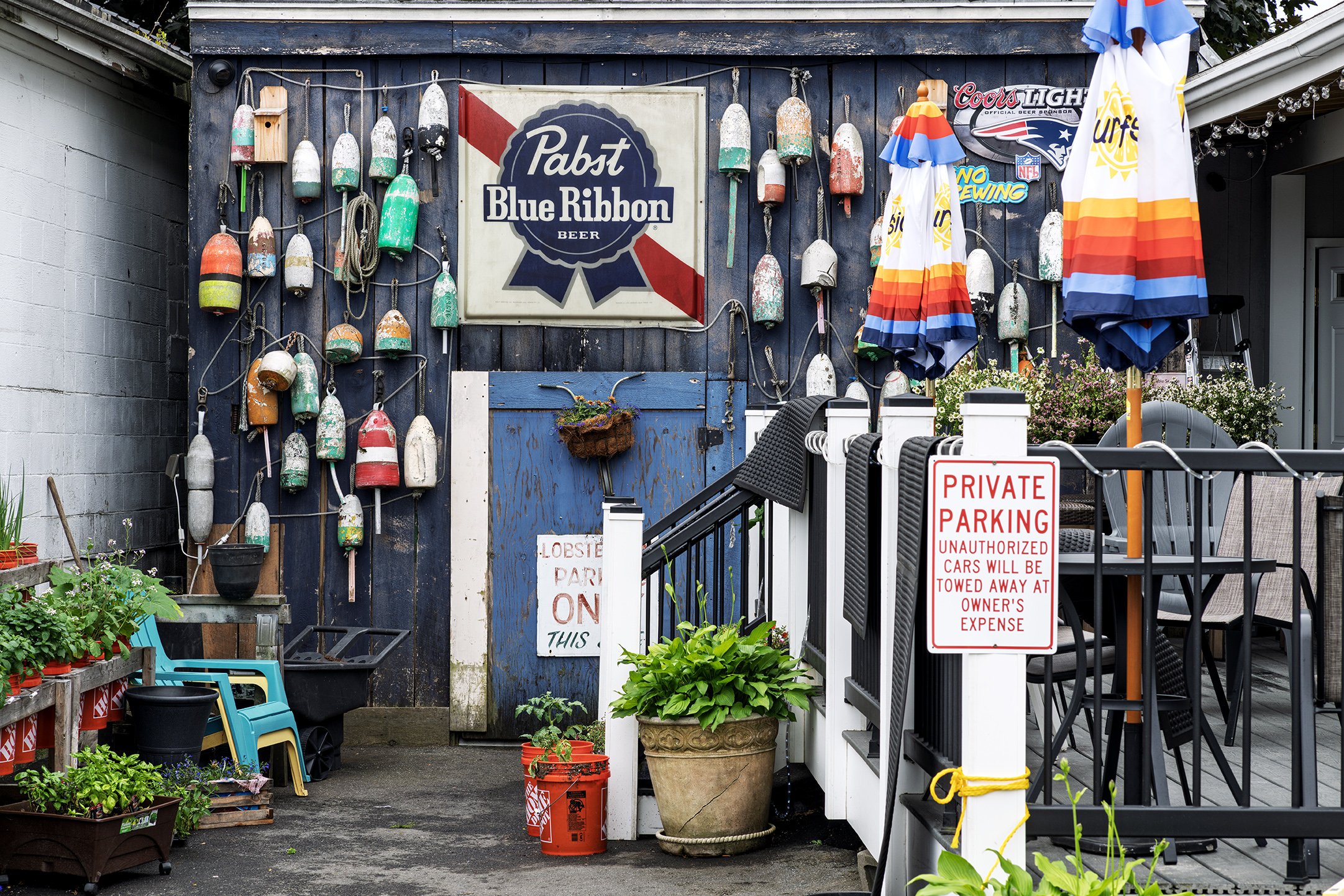
The Myrtle House, c. 1892
12 Myrtle Street Rockland, Knox County, Maine
From the Echoes, Still: Maine's Industrial Remnants Collection (2024–2028)
Renaissance Portfolio
Historical Narrative
From Myrtle House to Myrtle Street Tavern: The Changing Identity of 12 Myrtle Street, Rockland, Maine, 1885–Present
Kevin LeDuc Pigment print on Hahnemühle Baryta
Edition of 5 + 1 Artist's Proof (Portfolio of 40 Images)
30 × 45 inches
Paper size: 40 × 55 inches
Image size: 32 × 47 inches
Border: 4 inches (all sides)
Historic Significance
At the corner of Myrtle and Main Streets in Rockland, Maine, stands a building whose history reflects the changing character of the city itself. Today known as Myrtle Street Tavern, the structure at 12 Myrtle Street has served several distinct roles over more than a century: vacant lot, lodging house, mixed-use commercial property, heating and appliance business, hotel, and finally a neighborhood tavern. Its evolution mirrors Rockland’s transition from a nineteenth-century maritime and industrial town into a twentieth-century commercial center and, later, a community focused on preservation and local identity.
Historical Narrative
-
From Myrtle House to Myrtle Street Tavern: The Changing Identity of 12 Myrtle Street, Rockland, Maine, 1885–Present
Introduction
At the corner of Myrtle and Main Streets in Rockland, Maine, stands a building whose history reflects the changing character of the city itself. Today known as Myrtle Street Tavern, the structure at 12 Myrtle Street has served several distinct roles over more than a century: vacant lot, lodging house, mixed-use commercial property, heating and appliance business, hotel, and finally a neighborhood tavern. Its evolution mirrors Rockland’s transition from a nineteenth-century maritime and industrial town into a twentieth-century commercial center and, later, a community focused on preservation and local identity.
The story of 12 Myrtle Street can be traced most clearly through Sanborn Fire Insurance Maps, which provide a detailed visual record of building footprints, uses, and changes over time. Beginning with the 1885 map and continuing through the 1892, 1896, 1904, 1912, and 1922 editions, these maps document the physical and functional transformation of the property.¹
The Empty Lot and the Birth of Myrtle House, 1885–1892
The earliest Sanborn record for this location is the January 1885 Rockland map. At that time, the parcel at 12 Myrtle Street was shown as an open lot.² The absence of a structure establishes an important chronological boundary: the present building was not yet standing in 1885.
By January 1892, however, the property had changed dramatically. The Sanborn map identified the building as the Myrtle House.³ This establishes a construction period between 1885 and 1892. The building was likely erected during a period when Rockland’s commercial district was expanding and when small lodging houses were common features of working waterfront communities.
The Myrtle House appears to have served the needs of visitors, workers, and travelers coming to Rockland. During the late nineteenth century, Rockland attracted merchants, industrial workers, sailors, and seasonal visitors drawn by the city’s granite industry, lime production, shipping activity, and coastal location. A lodging establishment located near Main Street would have been strategically positioned to serve this transient population.
The Myrtle House Era, 1896–1904
The 1896 Sanborn map continued to identify the building as the Myrtle House and recorded it as a two-and-one-half-story structure.⁴ The building’s height and location suggest a substantial lodging establishment rather than a simple residence.
By 1904, the building’s identity had begun to change. The Sanborn map described the property as:
“Myrtle House, Heat, Stoves, Lights & Gas.”⁵
This notation reveals an important transitional period. The building retained the Myrtle House name, but it had also become associated with a business dealing in heating systems, stoves, lighting equipment, and gas fixtures. Rather than a complete replacement of one use by another, the evidence suggests a period of mixed use, where lodging and commercial activity existed together.
This transition reflects broader changes occurring in American cities at the beginning of the twentieth century. As electricity, gas lighting, and modern heating systems became increasingly important, businesses selling these technologies became prominent features of downtown commercial districts.
Commercial Use and the Central Heating Business, 1912
The 1912 Sanborn map no longer identified the building primarily as a lodging establishment. Instead, it listed:
“Central Ho., Heat.; Stoves & Gas Lights.”⁶
By this date, the property’s primary identity had shifted from lodging to commercial enterprise. The building continued to occupy the same downtown location but now represented a different era of Rockland’s development: one focused on household modernization and consumer services.
The change is significant because it demonstrates how downtown buildings adapted over time. Rather than being demolished and replaced, the structure at 12 Myrtle Street continued to serve the community by accommodating new economic activities.
Return to Hospitality: The Windsor House, 1922
The January 1922 Sanborn map reveals another major transformation. The property was identified as the Windsor House, and the building had increased from two-and-one-half stories to three stories.⁷
The addition of a full third story indicates a substantial physical alteration. The building had returned to a hospitality function, although under a new name. The Windsor House represents another chapter in the property’s long association with lodging and hospitality.
The sequence is therefore notable:
Myrtle House: lodging establishment
Myrtle House with heating and appliance business: mixed use
Central heating business: commercial specialization
Windsor House: expanded hotel use
Few downtown buildings retain such a clear record of changing economic roles.
The Tavern Era and Local Memory
At some point during the twentieth century, 12 Myrtle Street transitioned from hotel use into a tavern. The exact year of this conversion requires additional research through city directories, liquor license records, and newspaper archives. By the later twentieth century, however, the building was remembered locally as a neighborhood drinking establishment.
Informal recollections from longtime residents describe the building as a traditional waterfront-oriented tavern associated with maritime workers, including sailors. These memories should be understood as community oral tradition rather than documented historical evidence. Nevertheless, such recollections provide valuable insight into how residents understood the social role of the building.
The description of the establishment as a “sailor’s bar” reflects a common pattern in coastal Maine communities. Visitors from outside the state frequently came to Rockland during the summer months, and local residents often used this phrase when describing taverns that served maritime workers, fishermen, and seasonal visitors. These informal descriptions capture the cultural memory surrounding the building even when written records are incomplete.
Myrtle Street Tavern and Preservation Significance
Today, the building operates as Myrtle Street Tavern. Its continued use as a gathering place preserves an important aspect of downtown Rockland’s social history.
The significance of 12 Myrtle Street lies not only in its age but in its adaptability. The building has continuously responded to changing community needs:
late nineteenth-century lodging,
early twentieth-century commercial modernization,
expanded hotel service,
twentieth-century tavern culture,
and present-day neighborhood hospitality.
The Sanborn maps demonstrate that preservation is not simply about maintaining buildings in one historical moment. Instead, historic buildings often survive because they evolve. The history of 12 Myrtle Street is a record of adaptation, reflecting the economic and social changes that shaped downtown Rockland over more than 135 years.
Footnotes
Sanborn Map & Publishing Co., Insurance Maps of Rockland, Knox County, Maine (New York: Sanborn Map & Publishing Co., 1885); Sanborn-Perris Map Co., Insurance Maps of Rockland, Knox County, Maine (New York: Sanborn-Perris Map Co., 1892); Sanborn Map Co., Insurance Maps of Rockland, Knox County, Maine (New York: Sanborn Map Co., 1896); Sanborn Map Co., Insurance Maps of Rockland, Knox County, Maine (New York: Sanborn Map Co., 1904); Sanborn Map Co., Insurance Maps of Rockland, Knox County, Maine (New York: Sanborn Map Co., 1912); Sanborn Map Co., Insurance Maps of Rockland, Knox County, Maine (New York: Sanborn Map Co., 1922).
Sanborn Map & Publishing Co., Insurance Maps of Rockland, Knox County, Maine, January 1885.
Sanborn-Perris Map Co., Insurance Maps of Rockland, Knox County, Maine, January 1892.
Sanborn Map Co., Insurance Maps of Rockland, Knox County, Maine, December 1896.
Sanborn Map Co., Insurance Maps of Rockland, Knox County, Maine, February 1904.
Sanborn Map Co., Insurance Maps of Rockland, Knox County, Maine, June 1912.
Sanborn Map Co., Insurance Maps of Rockland, Knox County, Maine, January 1922.
Bibliography
Sanborn Map & Publishing Co. Insurance Maps of Rockland, Knox County, Maine. New York: Sanborn Map & Publishing Co., 1885.
Sanborn-Perris Map Co. Insurance Maps of Rockland, Knox County, Maine. New York: Sanborn-Perris Map Co., 1892.
Sanborn Map Co. Insurance Maps of Rockland, Knox County, Maine. New York: Sanborn Map Co., 1896.
Sanborn Map Co. Insurance Maps of Rockland, Knox County, Maine. New York: Sanborn Map Co., 1904.
Sanborn Map Co. Insurance Maps of Rockland, Knox County, Maine. New York: Sanborn Map Co., 1912.
Sanborn Map Co. Insurance Maps of Rockland, Knox County, Maine. New York: Sanborn Map Co., 1922.
United States Census Bureau. Population Schedules of the United States Census, 1900–1950. Washington, D.C.: National Archives and Records Administration.
Rockland City Directories, 1892–1920s. Rockland, Maine.
Rockland Courier-Gazette. Rockland, Maine.
Rockland Historical Society Collections. Rockland, Maine.