United Home Furniture, c. 1966
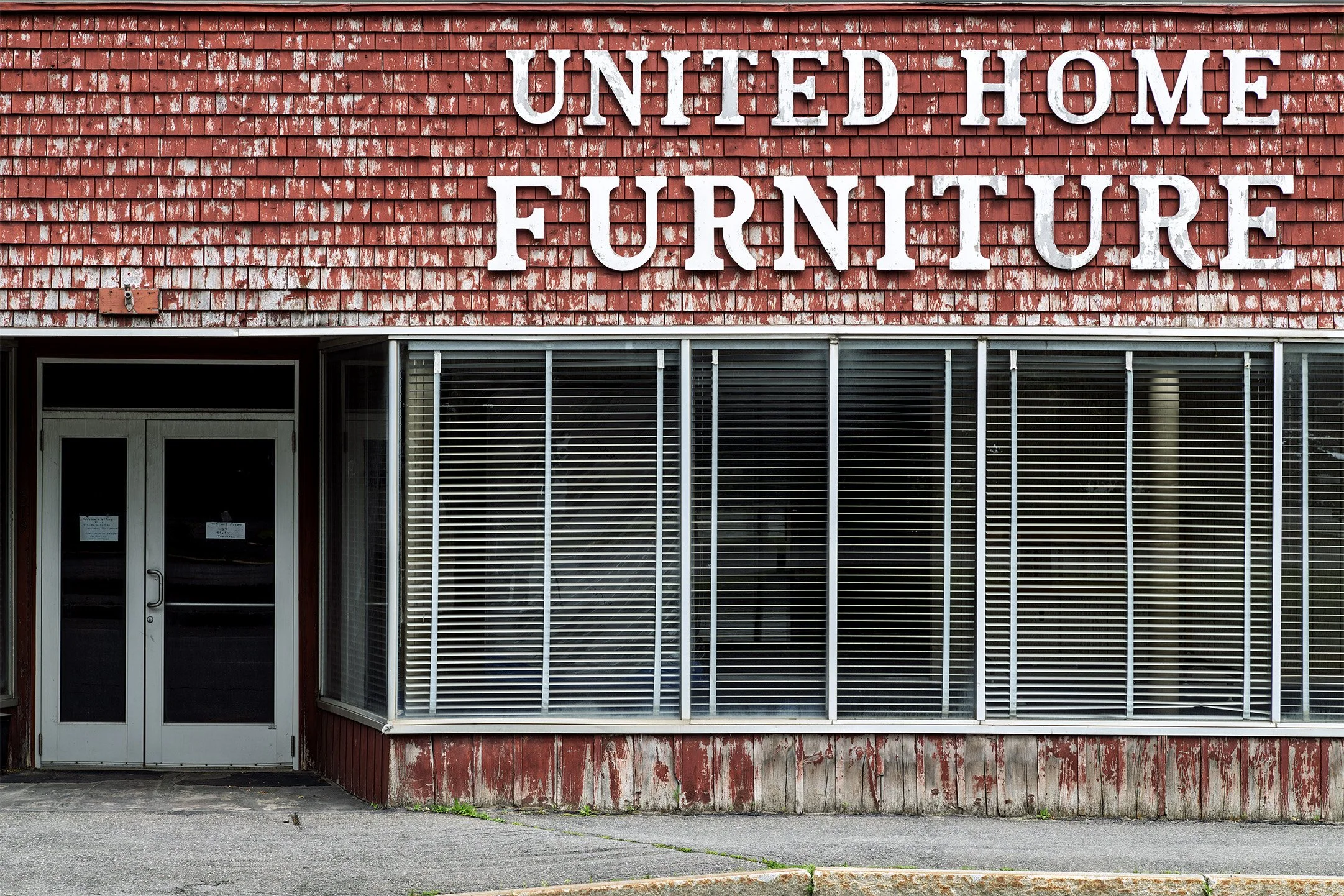
United Home Furniture, c. 1966
579 Main Street Rockland, Knox County, Maine
From the Echoes, Still: Maine's Industrial Remnants Collection (2024–2028)
Renaissance Portfolio
Historical Narrative
United Home Furniture: Adaptive Retail Space, and the Evolution of Main Street Commerce
Kevin LeDuc Pigment print on Hahnemühle Baryta
Edition of 5 + 1 Artist's Proof (Portfolio of 40 Images)
30 × 45 inches
Paper size: 40 × 55 inches
Image size: 32 × 47 inches
Border: 4 inches (all sides)
Historic Significance
United Home Furniture, located at 579 Main Street in Rockland, Maine, occupies a modest but historically meaningful position within the city’s long-established commercial corridor. The building itself dates to 1946, according to the City of Rockland’s 2011 Downtown Improvement Area Survey, which identifies the property as a one-story, 6,996-square-foot structure used as a furniture store. A current property record independently confirms the 1946 construction date and describes the building as a one-story frame structure. The 1946 date places the building within a later period of Rockland’s commercial development, while its location connects it to a downtown landscape shaped by generations of maritime commerce, industry, transportation, and retail activity.
The broader setting of 579 Main Street reflects Rockland’s development as an important midcoast commercial and industrial center. During the nineteenth century, Rockland grew through shipbuilding, the lime industry, harbor commerce, and transportation, eventually becoming the Knox County seat in 1860. Main Street developed as the city’s principal commercial thoroughfare, with businesses serving residents, workers, merchants, and visitors. The Main Street Historic District contains buildings representing this long commercial history and illustrates how Rockland’s downtown evolved as economic conditions and patterns of commerce changed. Although 579 Main Street is not individually listed on the National Register, the property contributes to the understanding of the broader commercial environment in which it operates.
The history of United Home Furniture illustrates the persistence and adaptation of independent retail businesses within this established urban setting. Business-directory records identify United Home Furniture Co. as having been established in 1966, approximately twenty years after the present building was constructed. Contemporary evidence from the Friendship Sloop Society confirms that the company was operating in Rockland by at least 1966, when it advertised itself as a business providing “Everything For The Home.” The company's presence during the mid-twentieth century demonstrates the continuing importance of locally oriented retail establishments as Rockland transitioned away from an economy dominated by maritime and industrial activity toward greater reliance on retail, services, tourism, and other forms of commerce.
Architecturally, 579 Main Street is best understood as an example of vernacular commercial continuity rather than monumental historic architecture. Its 1946 construction date places it outside the principal nineteenth- and early twentieth-century period represented by many of Rockland’s most prominent downtown buildings, yet its continued commercial use demonstrates how later buildings became integrated into an older commercial landscape.
Historical Narrative
-
United Home Furniture, 579 Main Street, Rockland, Knox County, Maine: Commercial Continuity, Adaptive Retail Space, and the Evolution of Main Street Commerce
Introduction
United Home Furniture, located at 579 Main Street in Rockland, Maine, occupies a modest but historically meaningful position within the city’s long-established commercial corridor. While not a monumental structure in architectural terms, the building reflects broader patterns in the evolution of Rockland’s downtown economy, particularly the persistence of independent retail enterprises within a historic Main Street environment shaped by maritime industry, regional trade, and twentieth-century consumer culture.
The building stands within Rockland’s Main Street Historic District, an area characterized by dense nineteenth- and early twentieth-century commercial development tied to the city’s rise as a regional center for shipping, lime production, and coastal commerce.¹ Although the present use of the structure is contemporary, the site participates in a continuous tradition of small-scale commercial adaptation that has defined Main Street for nearly two centuries.
Unlike industrial waterfront infrastructure or monumental civic architecture, United Home Furniture represents a category of vernacular commercial persistence: locally owned retail establishments occupying pre-existing urban fabric and adapting older building stock to changing patterns of consumption, logistics, and interior retail display.
This essay examines the historical and architectural context of 579 Main Street, the evolution of Rockland’s downtown commercial economy, and the broader significance of independent furniture retail within small New England cities experiencing long-term economic transition.
Rockland’s Main Street and Commercial Development
Rockland’s Main Street developed as the city’s principal commercial artery during the nineteenth century, following its incorporation in 1854 and its rapid expansion as a maritime and industrial center. Early prosperity derived from lime production, coastal shipping, shipbuilding, and later rail connectivity, all of which concentrated commercial activity within a tightly defined downtown corridor.²
As the city grew, Main Street became a dense linear district of brick commercial blocks, mixed-use buildings, and storefronts housing a wide range of mercantile businesses. These included general stores, dry goods retailers, furniture dealers, banks, professional offices, and specialty trades. The architectural fabric of the street reflects successive waves of reconstruction following fires, economic cycles, and shifting commercial demands, resulting in a layered streetscape of Greek Revival, Italianate, and later Colonial Revival commercial forms.³
By the late nineteenth and early twentieth centuries, furniture retail had become a stable component of downtown commercial life. Furniture stores were typically long-term tenants, often occupying substantial ground-floor spaces due to their need for display areas, storage capacity, and delivery access. This retail category persisted into the automobile era, when regional shopping patterns began shifting toward suburban commercial centers.
579 Main Street in Context
The building at 579 Main Street is part of this broader commercial continuum. Constructed in the mid-twentieth century (with property records indicating a circa 1946 origin), the structure reflects a transitional phase in Rockland’s downtown development, when older nineteenth-century commercial architecture was increasingly supplemented by simpler, utilitarian infill buildings.⁴
Unlike earlier brick Italianate storefronts or elaborately detailed nineteenth-century commercial blocks, mid-century Main Street buildings often emphasized functional construction, simplified façades, and adaptable interior layouts. These characteristics made them particularly suitable for long-term small business occupancy, including furniture retail operations that required flexible showroom space rather than architecturally specialized interiors.
The site’s continued commercial use demonstrates the resilience of Main Street as a retail environment despite broader regional shifts in economic activity. While many small American cities experienced downtown decline after the mid-twentieth century, Rockland’s Main Street retained a comparatively stable commercial identity due to tourism, local services, and civic investment in historic preservation.⁵
United Home Furniture and Independent Retail Continuity
United Home Furniture operates within this architectural and economic framework as a long-standing independent furniture retailer serving the Rockland region. Furniture stores of this type typically function as hybrid retail environments, combining showroom display areas with storage and localized delivery operations. This model reflects a traditional form of American retail distribution that predates large-scale national furniture chains and remains viable in smaller regional markets.
The business has been described in local listings as a long-established operation occupying 579 Main Street for multiple decades, contributing to the continuity of small-scale retail within the downtown district.⁶ Customer accounts emphasize personalized service, local ownership, and long-term community relationships—characteristics commonly associated with independent furniture businesses in rural and small urban markets.
This mode of retailing contrasts sharply with contemporary e-commerce and big-box furniture distribution models. Instead, it reflects a historically grounded economic structure in which trust, familiarity, and in-person selection remain central to consumer behavior.
Architectural Character and Adaptive Commercial Space
Architecturally, the building at 579 Main Street is representative of mid-twentieth-century commercial infill construction within historic downtown districts. Its design emphasizes efficiency rather than ornamentation, with a focus on interior adaptability, storefront visibility, and compatibility with automobile-era logistics.
Such buildings often lack the stylistic detailing of earlier nineteenth-century commercial architecture, yet they play a crucial role in maintaining the functional continuity of downtown districts. In Rockland, these structures allow older commercial corridors to remain economically active even as original building stock is repurposed or replaced.⁷
Within this context, United Home Furniture occupies a space defined less by architectural distinction than by adaptive reuse. The building’s value lies in its sustained commercial occupancy rather than its aesthetic prominence.
Main Street Economy and Cultural Persistence
Rockland’s Main Street continues to function as a mixed-use commercial district, supported by local businesses, tourism, civic institutions, and residential density. The persistence of independent retailers such as United Home Furniture contributes to the district’s economic diversity, balancing tourism-oriented businesses with essential goods and services for local residents.
This dual function—serving both visitors and permanent residents—is a defining feature of many coastal Maine downtowns. It allows Main Street economies to remain viable despite broader national trends toward retail consolidation and suburbanization.
Furniture retail in particular occupies a symbolic role in this landscape. It represents long-term household investment, continuity of domestic life, and the material stability of local economies. Even as retail delivery systems evolve, physical furniture stores maintain relevance in communities where in-person evaluation and regional delivery remain important.
Historical Significance
The historical significance of United Home Furniture lies not in architectural monumentality but in its representational value as a surviving form of traditional Main Street commerce. The business reflects continuity within a commercial corridor shaped by nearly two centuries of economic adaptation.
At a broader level, the site illustrates three intersecting historical processes:
The long-term development of Rockland’s Main Street as a commercial spine.
The mid-twentieth-century transformation of urban retail architecture toward functional simplicity.
The persistence of independent retail businesses within small New England urban economies.
Together, these factors position 579 Main Street as part of a larger narrative of continuity and adaptation in American small-city commercial history.
Conclusion
United Home Furniture at 579 Main Street represents a quiet but persistent thread within Rockland’s evolving urban fabric. While lacking the architectural prominence of earlier nineteenth-century commercial blocks, the building and its long-term retail use reflect the adaptability of Main Street as an economic and social system.
Its continued operation demonstrates the resilience of independent retail in a changing economic environment and underscores the importance of small-scale commercial actors in sustaining historic downtown districts. Within the broader history of Rockland, the site contributes to an ongoing narrative of continuity, adaptation, and localized economic identity.
Notes
Maine Historic Preservation Commission, Main Street Historic District Boundary Increase, Rockland (1848–1941), National Register of Historic Places documentation (Augusta, ME: MHPC, 2012).
Richard W. Judd, Edwin A. Churchill, and Joel W. Eastman, Maine: The Pine Tree State from Prehistory to the Present (Orono: University of Maine Press, 1995), 308–315.
Maine Historic Preservation Commission, Main Street Historic District Documentation.
Portside Real Estate Group, “579 Main Street, Rockland, ME 04841 Property Record,” accessed 2026.
Advisory Council on Historic Preservation, “Rockland, Maine: Preservation Profile,” accessed 2026.
“United Home Furniture Co,” Rockland business listings and customer reviews, accessed 2026.
Judd, Churchill, and Eastman, Maine, 312–316.
Bibliography
Advisory Council on Historic Preservation. “Rockland, Maine: Preservation Profile.” Accessed 2026.
Judd, Richard W., Edwin A. Churchill, and Joel W. Eastman. Maine: The Pine Tree State from Prehistory to the Present. Orono: University of Maine Press, 1995.
Maine Historic Preservation Commission. Main Street Historic District Boundary Increase, Rockland (1848–1941). Augusta, ME, 2012.
Portside Real Estate Group. “579 Main Street, Rockland, ME 04841 Property Record.” Accessed 2026.
United Home Furniture Co. Local business listing and customer review data. Accessed 2026.
-
United Home Furniture: Building History and Commercial Context
United Home Furniture, located at 579 Main Street in Rockland, Maine, occupies a modest but historically meaningful position within the city’s long-established commercial corridor. The building itself dates to 1946, according to the City of Rockland’s 2011 Downtown Improvement Area Survey, which identifies the property as a one-story, 6,996-square-foot structure used as a furniture store. The survey also records the building as being in good condition and, importantly, identifies it as not individually listed on the National Register of Historic Places.¹ A current property record independently confirms the 1946 construction date and describes the building as a one-story frame structure with wood siding or shingles and a tar-and-gravel roof.² The building therefore represents a mid-twentieth-century layer of development within a downtown whose principal commercial character was established much earlier.
The broader setting of 579 Main Street reflects Rockland’s development as an important midcoast commercial and industrial center. Rockland’s nineteenth-century growth was closely connected to shipbuilding, the lime industry, harbor commerce, and transportation, with the city becoming Knox County’s seat in 1860.³ Its harbor provided an important transportation route for the local lime industry and for merchants and manufacturers, helping transform Rockland into a significant regional center. By the late nineteenth century, the city’s commercial district had become densely developed along Main Street, reflecting the prosperity generated by commerce, industry, and population growth.⁴ The National Register recognizes Rockland’s Main Street Historic District as significant for its architectural and commercial history, but the available municipal survey indicates that 579 Main Street itself was not included as a National Register property.¹ This distinction is important when interpreting the building: its significance lies less in exceptional architectural design than in its relationship to the continuing commercial evolution of Main Street.
The building’s history also illustrates the persistence and adaptation of independent retail businesses in Rockland. Business-directory records identify United Home Furniture Co. as established in 1966, approximately twenty years after the present building was constructed.⁵ Contemporary evidence from the Friendship Sloop Society yearbooks confirms that United Home Furniture was operating in Rockland by at least 1966, advertising itself as “Everything For The Home.”⁶ The company continued to appear in subsequent yearbooks, demonstrating its presence within the local commercial landscape during the late 1960s and early 1970s.⁷ This history places United Home Furniture within a broader pattern of small, locally oriented businesses that occupied and adapted Rockland’s commercial buildings as the city’s economy shifted from its nineteenth-century industrial foundations toward retail and service-oriented commerce.
Architecturally, 579 Main Street is therefore best understood as an example of vernacular commercial continuity rather than monumental historic architecture. Its 1946 construction date places it outside the principal nineteenth- and early twentieth-century period represented by many of Rockland’s most architecturally prominent downtown buildings, while its long association with a local furniture business demonstrates how later commercial construction could become integrated into an older urban landscape. United Home Furniture’s continued presence also illustrates the importance of independent retail in maintaining the everyday commercial function of Main Street. Rather than representing a single moment in Rockland’s history, the property embodies several layers of change: a mid-century building, a locally established furniture business, and a downtown environment shaped over generations by maritime commerce, industry, transportation, and changing patterns of consumer activity.⁸
Footnotes
City of Rockland, Maine, Downtown Improvement Area Survey (Rockland, ME, 2011), property record for 579 Main Street, identifying the building as constructed in 1946, one story, 6,996 square feet, used as a furniture store, and not individually listed on the National Register of Historic Places.
Portside Real Estate Group, “579 Main Street, Rockland, ME 04841,” property record, identifying the building as constructed in 1946, one story, and frame construction.
National Park Service, “Rockland Residential Historic District,” National Register of Historic Places, nomination documentation, describing Rockland’s nineteenth-century development through shipbuilding and the lime industry and its establishment as the Knox County seat in 1860.
Maine Historic Preservation Commission, “Main Street Historic District Boundary Increase, Rockland, 1848–1941,” noting that Main Street served as Rockland’s principal commercial thoroughfare for almost two centuries and that the district’s buildings reflect the city’s commercial, industrial, social, and architectural history.
Manta, “United Home Furniture CO,” business directory entry for 579 Main Street, Rockland, Maine, listing the company’s establishment date as 1966.
Friendship Sloop Society, Friendship Sloop Days, 1966 yearbook, advertisement for United Home Furniture Co., Rockland, Maine.
Friendship Sloop Society, Friendship Sloop Days, 1967 and 1973 yearbooks, advertisements for United Home Furniture Co., Rockland, Maine.
City of Rockland, Maine, Downtown Improvement Area Survey; Maine Historic Preservation Commission, “Main Street Historic District Boundary Increase, Rockland, 1848–1941.”
Bibliography
City of Rockland, Maine. Downtown Improvement Area Survey. Rockland, ME, 2011.
Friendship Sloop Society. Friendship Sloop Days. 1966 Yearbook.
———. Friendship Sloop Days. 1967 Yearbook.
———. Friendship Sloop Days. 1973 Yearbook.
Maine Historic Preservation Commission. “Main Street Historic District Boundary Increase, Rockland, 1848–1941.” January 4, 2012.
Manta. “United Home Furniture CO.” Business directory listing. Rockland, ME.
National Park Service. “Rockland Residential Historic District.” National Register of Historic Places.
Portside Real Estate Group. “579 Main Street, Rockland, ME 04841.” Property record.
-
The building at 579 Main Street, Rockland, Maine, occupied by United Home Furniture, dates to 1946 according to the City of Rockland’s Downtown Improvement Area Survey. The municipal survey identifies the property as a one-story, 6,996-square-foot building and records 1946 as its year built. It also describes the structure as being in good condition and in use as a furniture store at the time of the survey.¹ This date is independently corroborated by a contemporary real-estate property record, which likewise identifies 1946 as the construction year and describes the building as a one-story frame structure with wood siding or shingles and a tar-and-gravel roof.² Thus, 1946 is the best-supported construction date currently available for the building itself.
The history of the business appears to be somewhat later than the construction of the building. Business-directory records identify United Home Furniture Co. at 579 Main Street and give 1966 as its establishment date.³ This means that the furniture business, based on the available directory evidence, began approximately twenty years after the building was constructed. The distinction is important: a 1966 date should not be interpreted as the construction date of 579 Main Street. Rather, the available evidence indicates that the existing building was erected in 1946 and was subsequently associated with United Home Furniture by the 1960s.
Evidence from historical publications confirms that United Home Furniture was operating in the Rockland area by the mid-1960s. The 1966 Friendship Sloop Society yearbook contains an advertisement for “United Home Furniture Co.” identifying it with Rockland, Maine, and promoting it as a business offering “Everything For The Home.”⁴ This contemporary evidence provides useful confirmation that the company was active in 1966, although it does not by itself establish whether the business opened at 579 Main Street precisely that year. Later historical and business-directory sources continue to associate United Home Furniture with 579 Main Street, supporting the conclusion that the property has had a long-standing connection with the furniture business.
Taken together, the evidence supports a 1946 construction date for the building at 579 Main Street, with United Home Furniture established or operating there by 1966. The City of Rockland survey is the strongest source for the building date because it is a municipal property survey specifically documenting the address, while the 1966 yearbook provides valuable contemporaneous evidence for the furniture company. The available records do not currently establish an exact day or month of construction, nor do they identify the original builder. For a historical-property record, therefore, the most defensible wording is: “Building constructed in 1946; United Home Furniture established by 1966.”¹⁴
Footnotes
City of Rockland, Maine, Downtown Improvement Area Survey (2011), property record for 579 Main Street, listing “Year Built: 1946,” owner Martin Rubenstein, 6,996 square feet, and one floor.
Portside Real Estate Group, “579 Main Street, Rockland, ME 04841,” property record, identifying the building’s “Year Built” as 1946 and its construction as frame, one story.
Manta, “United Home Furniture CO,” business directory entry for 579 Main Street, Rockland, Maine, listing the company’s opening/establishment date as 1966.
Friendship Sloop Society, Friendship Sloop Days, 1966 yearbook, advertisement for United Home Furniture Co., Rockland, Maine, describing the business as “Everything For The Home.”
Bibliography
Friendship Sloop Society. Friendship Sloop Days. 1966 yearbook. Friendship, Maine.
Manta. “United Home Furniture CO.” Business directory listing. Rockland, Maine. Accessed August 12, 2026.
Portside Real Estate Group. “579 Main Street, Rockland, ME 04841.” Property record. Accessed August 12, 2026.
City of Rockland, Maine. Downtown Improvement Area Survey. 2011. Rockland, Maine.