Rankin Block c. 1853
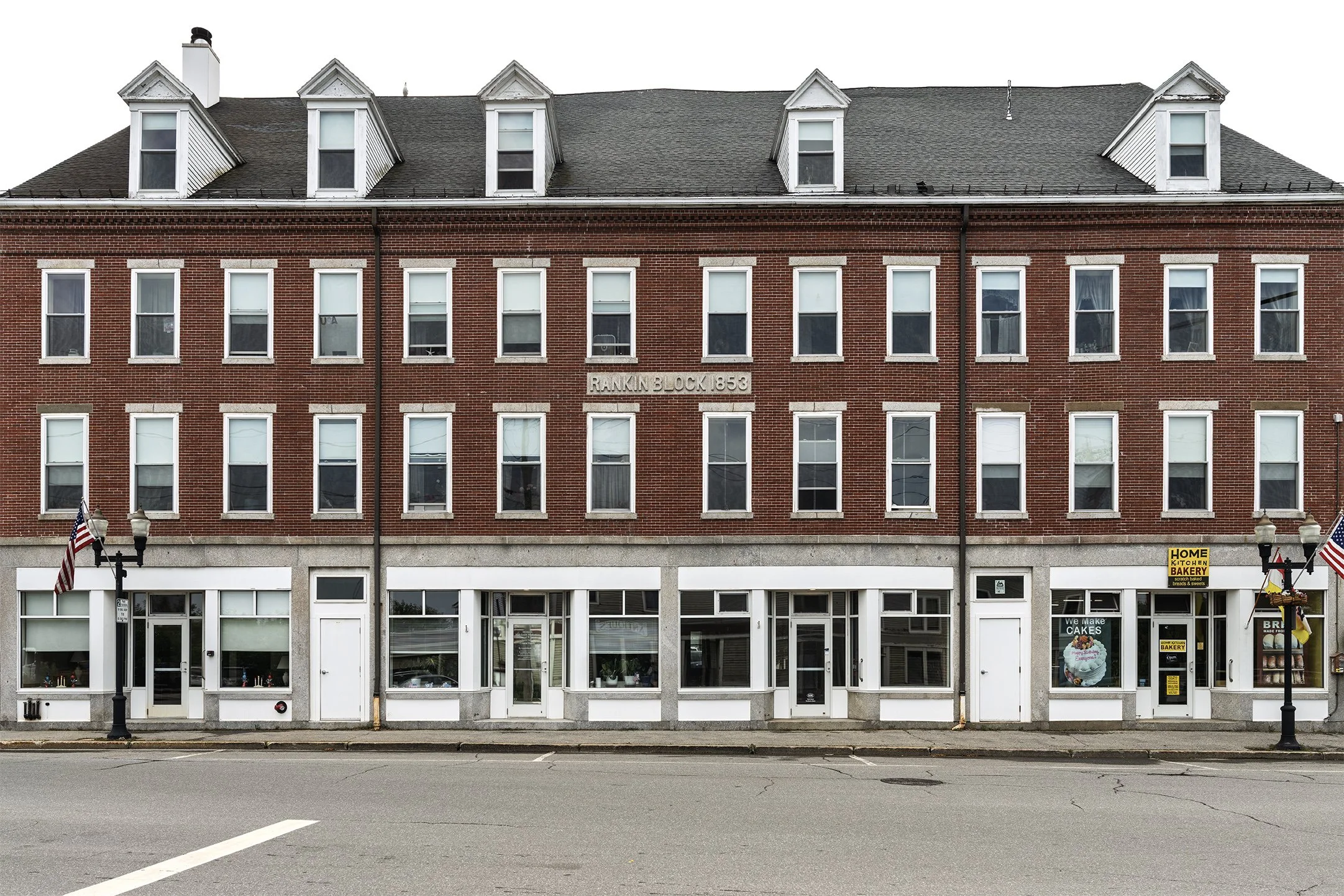
Rankin Block c. 1853
606 Main Street Rockland, Knox County, Maine
From the Echoes, Still: Maine's Industrial Remnants Collection (2024–2028)
Grain, Leather, Pulp Portfolio
Historical Narrative
Kevin LeDuc Pigment print on Hahnemühle Baryta Edition of 5 + 1 Artist's Proof (Portfolio of 40 Images)
Paper Size: 40 × 55 inches Image Size: 31.33 × 37 inches Borders: Approximately 4 inches (All Sides)
Historic Significance
The Rankin Block, constructed in 1853 in Rockland, Maine, stands as one of the most significant surviving mid-nineteenth-century commercial structures in Knox County. Erected during a period of rapid economic expansion driven by the coastal trade, shipbuilding, and the lime industry, the building reflects the transition of Rockland from a modest harbor settlement into one of the principal commercial centers of mid-coast Maine. The structure is closely associated with Samuel Rankin, a prominent local merchant whose investment in durable brick commercial architecture signaled both confidence in Rockland’s economic future and the increasing permanence of its downtown built environment.
Before the construction of the Rankin Block, Rockland’s economy was already closely connected to the waterfront. Shipyards, wharves, fishing operations, and lime production created demand for merchants, warehouses, financial services, and commercial spaces. The Rankin Block became part of this expanding downtown network, providing storefronts, offices, storage areas, and workspaces that supported the movement of goods between the harbor and the regional economy. Its location along Main Street placed it at the center of Rockland’s commercial activity and growth.
Architecturally, the Rankin Block reflects the Greek Revival commercial style common throughout New England during the mid-nineteenth century. Its brick construction, symmetrical façade, granite details, and practical multi-story design emphasized durability, fire resistance, and adaptability. The ground-floor storefronts supported retail and mercantile activities, while the upper levels provided space for offices, storage, and small businesses. The building represents the shift from earlier wooden commercial structures toward more permanent urban architecture that shaped the development of Maine’s growing towns and cities.
Over time, the Rankin Block adapted to changes in Rockland’s economy as maritime industries declined and new forms of commerce emerged. Despite changes in ownership and use, the building remained an important part of the city’s historic commercial district. Today, it serves as a lasting reminder of Rockland’s nineteenth-century prosperity and preserves the history of the merchants, industries, and architectural traditions that helped transform a coastal settlement into a major commercial center in mid-coast Maine.
Historical Narrative
-
The Rankin Block: Commercial Architecture, Maritime Commerce, and Urban Development in Nineteenth-Century Rockland, Maine
Introduction
The Rankin Block, constructed in 1853 in Rockland, Maine, stands as one of the most significant surviving mid-nineteenth-century commercial structures in Knox County. Erected during a period of rapid economic expansion driven by the coastal trade, shipbuilding, and the lime industry, the building reflects the transition of Rockland from a modest harbor settlement into one of the principal commercial centers of mid-coast Maine. The structure is closely associated with Samuel Rankin, a prominent local merchant whose investment in durable brick commercial architecture signaled both confidence in Rockland’s economic future and the increasing permanence of its downtown built environment.¹
As Rockland developed into a regional shipping and industrial hub, commercial blocks such as the Rankin Block became essential to the organization of trade, warehousing, retail activity, and professional services. The building’s form, materials, and arrangement of storefronts reflect broader patterns in New England commercial architecture during the mid-nineteenth century, particularly the adoption of Greek Revival and early Italianate influences in urban commercial design.²
Rockland Before 1853: Maritime Foundations of Urban Growth
Prior to its incorporation as a city in 1854, Rockland had already emerged as an important maritime and industrial center along Maine’s central coast. The town’s early economy was shaped by shipbuilding, fishing, and particularly the extraction and processing of limestone, which became one of its most profitable industries by the 1830s and 1840s.³ The presence of high-quality limestone deposits along the shore led to the construction of numerous lime kilns and shipping facilities, which in turn stimulated demand for mercantile services, warehouses, and financial institutions.
By the mid-nineteenth century, Rockland’s waterfront was heavily developed with wharves, shipyards, and industrial facilities. The increasing volume of maritime commerce required a parallel expansion of inland commercial infrastructure, particularly along Main Street, where merchants established brick and wood-frame buildings to house retail stores, offices, and supply firms.⁴ The Rankin Block emerged within this context of accelerated commercial development.
Samuel Rankin and Early Commercial Investment
Samuel Rankin belonged to a generation of Rockland entrepreneurs who capitalized on the economic opportunities generated by maritime trade and industrial production. Members of the Rankin family were among the early settlers of the region, and by the mid-nineteenth century they had established themselves as landowners and participants in local commerce.⁵
Rankin’s decision to construct a substantial brick commercial block in 1853 reflected both economic confidence and a broader shift in building practices. Following several destructive urban fires in Maine towns during the early nineteenth century, merchants increasingly turned to brick and granite construction as a means of reducing fire risk and ensuring long-term structural durability.⁶ The Rankin Block thus represented not only an investment in commercial property but also participation in a regional movement toward more permanent urban architecture.
Construction of the Rankin Block (1853)
The Rankin Block was constructed in 1853 on Main Street in Rockland’s developing commercial district. The building was designed as a multi-tenant commercial structure, with ground-floor storefronts and upper-floor space intended for offices, storage, and light industrial or artisanal use.⁷ Its construction coincided with a broader wave of commercial building activity in Rockland during the decade preceding its incorporation as a city.
The use of brick as the primary building material placed the Rankin Block within a growing tradition of fire-resistant commercial architecture in New England. Granite detailing, particularly in lintels and structural accents, further reinforced both the aesthetic and structural qualities of the building.⁸ The design reflected practical commercial concerns rather than purely ornamental ambitions, emphasizing utility, durability, and adaptability.
Architectural Form and Style
Architecturally, the Rankin Block is best understood within the context of the Greek Revival commercial tradition, which remained influential in Maine well into the 1850s. The building’s symmetrical façade, rectangular window openings, and restrained decorative detailing reflect the persistence of classical architectural ideals adapted to commercial purposes.⁹
While more elaborate Italianate commercial blocks would become common in later decades, the Rankin Block retains a transitional quality, combining Greek Revival simplicity with emerging Victorian-era commercial forms. The structure’s emphasis on vertical organization—storefronts below and service or storage functions above—illustrates the functional stratification typical of mid-nineteenth-century mercantile buildings.¹⁰
Maritime Commerce and Early Tenancy
The earliest tenants of the Rankin Block reflected Rockland’s maritime and industrial economy. Commercial spaces were occupied by merchants dealing in ship provisions, dry goods, and lime-related trade. Upper floors were frequently used for storage, small workshops, or offices associated with shipping and trade.¹¹
The proximity of the building to Main Street’s commercial corridor and the nearby waterfront allowed it to function as part of an integrated economic system linking maritime transportation with inland commercial distribution. Goods arriving at Rockland’s wharves were quickly transferred to nearby commercial establishments, including those housed within structures such as the Rankin Block.
Urban Development and Commercial Expansion
Following Rockland’s incorporation as a city in 1854, the downtown district experienced continued commercial expansion. The Rankin Block became part of a dense network of brick commercial buildings that defined the city’s nineteenth-century urban core.¹² The stability of brick construction allowed these buildings to survive longer than earlier wooden structures, many of which were lost to fire or redevelopment.
During the late nineteenth century, Rockland’s economy diversified beyond lime production to include shipping, trade, and emerging manufacturing activities. The Rankin Block adapted to these changes by accommodating a variety of tenants over time, reflecting the flexible nature of commercial block architecture in small industrial cities.¹³
Twentieth-Century Changes and Adaptive Use
By the early twentieth century, Rockland’s economic base had begun to shift, influenced by changes in maritime transportation and industrial production. Like many historic commercial buildings in small New England cities, the Rankin Block underwent periods of changing occupancy and use.¹⁴
Despite these changes, the building retained its structural integrity and continued to serve commercial or mixed-use purposes. Its survival into the modern period reflects both the durability of its construction and the relatively stable commercial character of Rockland’s downtown district compared to larger industrial cities that experienced more extensive redevelopment.
Preservation and Historical Recognition
In the late twentieth century, growing interest in historic preservation led to increased recognition of Rockland’s nineteenth-century commercial architecture. The Rankin Block was identified as a contributing structure within the broader historic character of downtown Rockland and recognized for its architectural and historical significance.¹⁵
Its preservation reflects broader statewide efforts in Maine to document and protect commercial architecture associated with maritime and industrial development during the nineteenth century. Buildings such as the Rankin Block serve as tangible evidence of the economic and social history of coastal Maine communities.
Historical Significance
The Rankin Block is significant for several interrelated reasons. Architecturally, it represents a well-preserved example of mid-nineteenth-century commercial construction in a transitional Greek Revival style. Historically, it reflects the commercial expansion of Rockland during its rise as a maritime and industrial center. Economically, it illustrates the relationship between waterfront commerce and inland commercial development in small New England cities.¹⁶
The building also embodies broader patterns in American urban history, particularly the shift toward fire-resistant commercial construction, the growth of mixed-use commercial blocks, and the increasing permanence of downtown business districts in the nineteenth century.
Conclusion
Since its construction in 1853, the Rankin Block has remained an enduring feature of Rockland’s architectural and commercial landscape. Erected during a period of rapid economic expansion driven by maritime trade and industrial production, the building reflects both the ambitions of its builder and the broader development of Rockland as a regional commercial center.
Its continued presence within the historic downtown district underscores the importance of commercial architecture in understanding the economic and social history of nineteenth-century Maine. As both a physical artifact and a historical document, the Rankin Block provides insight into the evolution of urban form, mercantile activity, and architectural practice in coastal New England.
Notes
William D. Williamson, The History of the State of Maine (Hallowell: Glazier, Masters & Co., 1832), 412–414.
Marcus Whiffen, American Architecture Since 1780 (Cambridge: MIT Press, 1992), 103–107.
Edwin A. Churchill, Maine: An Illustrated History (Gardiner: Tilbury House, 2018), 184–186.
Knox County Historical Society, Commercial Development of Midcoast Maine (Rockland: KCHS Press, 1979), 56–60.
George J. Varney, A Gazetteer of the State of Maine (Boston: B. B. Russell, 1886), 534–536.
James L. Garvin, A Building History of Northern New England (Hanover: University Press of New England, 2001), 211–213.
Knox County Deed Records, Vol. 48 (1853), 112–114.
Garvin, Building History of Northern New England, 215–217.
Whiffen, American Architecture Since 1780, 109–112.
Richard Candee, Buildings of Maine (Orono: University of Maine Press, 1984), 92–95.
Rockland City Directories, 1860–1880 editions.
Churchill, Maine: An Illustrated History, 201–203.
Candee, Buildings of Maine, 97–99.
Knox County Historical Society, Rockland in Transition (Rockland: KCHS Press, 1955), 33–36.
Maine Historic Preservation Commission, Historic Resources Survey: Rockland Downtown District (Augusta: MHPC, 1982), 14–18.
Garvin, Building History of Northern New England, 219–221.
Bibliography
Candee, Richard. Buildings of Maine. Orono: University of Maine Press, 1984.
Churchill, Edwin A. Maine: An Illustrated History. Gardiner: Tilbury House, 2018.
Garvin, James L. A Building History of Northern New England. Hanover: University Press of New England, 2001.
Knox County Deed Records. Vol. 48. 1853.
Knox County Historical Society. Commercial Development of Midcoast Maine. Rockland: KCHS Press, 1979.
———. Rockland in Transition. Rockland: KCHS Press, 1955.
Maine Historic Preservation Commission. Historic Resources Survey: Rockland Downtown District. Augusta: MHPC, 1982.
Rockland City Directories. 1860–1880 editions.
Varney, George J. A Gazetteer of the State of Maine. Boston: B. B. Russell, 1886.
Whiffen, Marcus. American Architecture Since 1780. Cambridge: MIT Press, 1992.
Williamson, William D. The History of the State of Maine. Hallowell: Glazier, Masters & Co., 1832.