Custom House Block, c. 1853
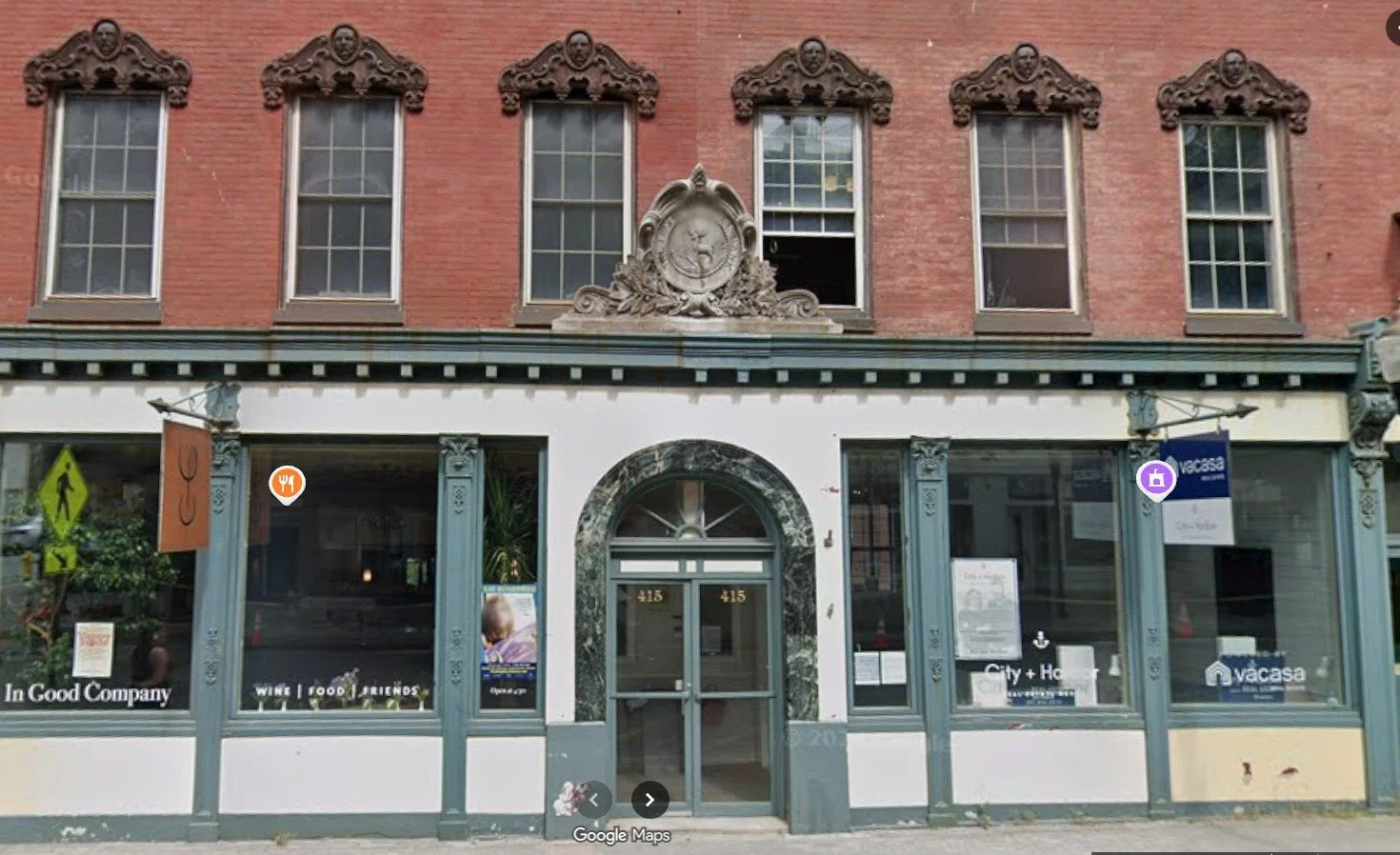
Custom House Block, c. 1853
415-419 Main Street Rockland, Knox County, Maine
From the Echoes, Still: Maine's Industrial Remnants Collection (2024–2028)
Renaissance Portfolio
Historical Narrative
The Custom House Block of Rocklad: Rebuilding of a Maritime Commercial Center
Kevin LeDuc Pigment print on Hahnemühle Baryta Rag Edition of 5 + 1 Artist’s Proof (A/P) + 1 Bon à Tirer (B.A.T.) Portfolio of 40 Images
Paper Size: 35 × 50 inches Image Size: 30 × 45 inches Borders: Approximately 2 ½ inches (All Sides) Mounting: Archival hinge or float mounting
Historic Significance
The Custom House Block at 419 Main Street in Rockland, Maine, stands as a significant reminder of the city’s transformation during the nineteenth century from a small coastal settlement into one of the nation’s leading maritime and industrial communities. Built in 1853 after a devastating downtown fire, the building represented the confidence of local businessmen who believed Rockland’s future depended on rebuilding with permanent brick structures, expanding commerce, and strengthening the city’s role as a port of trade. The building was constructed for two prominent local figures, Captain Isaac C. Abbott and Alfred H. Kimball, whose careers reflected two essential parts of Rockland’s economy: maritime enterprise and financial development.
Historical Narrative
-
The Custom House Block of Rockland, Maine: Captain Isaac C. Abbott, Alfred H. Kimball, and the Rebuilding of a Maritime Commercial Center
Introduction
The Custom House Block at 419 Main Street in Rockland, Maine, stands as a significant reminder of the city’s transformation during the nineteenth century from a small coastal settlement into one of the nation’s leading maritime and industrial communities. Built in 1853 after a devastating downtown fire, the building represented the confidence of local businessmen who believed Rockland’s future depended on rebuilding with permanent brick structures, expanding commerce, and strengthening the city’s role as a port of trade. The building was constructed for two prominent local figures, Captain Isaac C. Abbott and Alfred H. Kimball, whose careers reflected two essential parts of Rockland’s economy: maritime enterprise and financial development.¹
The Custom House Block served many roles during its long history. It housed the United States Customs Office, newspaper offices, commercial enterprises, banking interests, and later the meeting hall of the Grand Army of the Republic (G.A.R.).² Its history reveals not only the story of one building but also the larger economic forces that shaped nineteenth-century Rockland.
The Great Fire of 1853 and the Rebuilding of Rockland
In the early nineteenth century, Rockland’s downtown consisted largely of closely packed wooden buildings. The city’s rapid growth was fueled by the lime industry, shipbuilding, coastal trade, and increasing commercial activity. These industries brought wealth to the community but also created conditions where fire could spread quickly through the business district.
In July 1853, a major fire destroyed much of downtown Rockland. The disaster became a turning point in the city’s history. Instead of rebuilding with the same vulnerable wooden structures, property owners constructed larger brick commercial blocks designed to withstand future fires.³ The rebuilding period produced many of the downtown buildings that define Rockland’s historic character today.
The Custom House Block was one of the earliest and most important buildings constructed during this period of recovery. Its construction demonstrated that local investors had confidence in Rockland’s economic future. The building was not merely a private investment; it was intended as a center for government, commerce, and business activity.
Construction of the Custom House Block
The Custom House Block was built in 1853 for Captain Isaac C. Abbott and Alfred H. Kimball. The builder was Jeremiah Berry, a Rockland mason.⁴ Berry’s role as a mason was significant because the post-fire rebuilding effort required skilled craftsmen capable of constructing durable brick commercial buildings.
The building was designed to serve as a major downtown business block. Soon after completion, the United States Customs Office moved into the building. A customs office had been established in Rockland in 1849 because of the importance of the port and the volume of shipping activity.⁵ The presence of the federal office reflected Rockland’s status as an important maritime center.
The Customs Office remained in the building until 1873, when it moved into the new Customs House and Post Office on Limerock Street.⁶ During its twenty years as a federal office, the building was closely connected with Rockland’s shipping economy. Customs officials monitored trade, vessel movements, and imported goods entering through the port.
The building also housed the offices of the Rockland Gazette during the 1850s. Newspapers were essential institutions in nineteenth-century towns because they connected citizens with political events, commercial news, shipping reports, and local affairs. The presence of the newspaper office demonstrates that the Custom House Block quickly became one of the city’s important information centers.⁷
Captain Isaac C. Abbott: Maritime Merchant and Investor
Captain Isaac C. Abbott represented the maritime foundation of Rockland’s economy. During the nineteenth century, the title “Captain” commonly identified a man who had commanded merchant vessels. Rockland was a major port, and successful ship captains often became merchants and investors after building wealth through coastal trade.
Although specific vessel records for Abbott require further archival research, his career reflects the pattern common among successful Maine maritime businessmen. A merchant captain could earn income by transporting cargo, investing in vessels, arranging voyages, and participating in shipping partnerships. Rockland’s most important export was lime, produced in local kilns and shipped throughout the Atlantic coast.⁸
A captain involved in the lime trade would have participated in a network connecting Rockland with ports such as Boston, New York, and other commercial centers. Ships carried lime and other Maine products southward and returned with goods needed by local residents and businesses.
By 1853, Abbott had moved beyond the sea into commercial investment. His partnership with Alfred H. Kimball in constructing the Custom House Block shows that he had become a significant figure in Rockland’s business community.⁹ Like many maritime entrepreneurs of his generation, Abbott invested profits from coastal commerce into permanent buildings and local development.
Abbott later served during the Civil War as quartermaster of the 4th Maine Infantry. His position required management of supplies, equipment, transportation, and military resources—responsibilities well suited to someone with experience in maritime logistics and commerce.¹⁰
Alfred H. Kimball: Banking, Development, and Commercial Leadership
Alfred H. Kimball represented another important aspect of Rockland’s economic growth: finance and real estate development. Born in 1816, Kimball came from a prominent local family. His father, Iddo Kimball, had been an important merchant and property owner in the community.¹¹
Unlike Abbott, whose career was rooted in maritime activity, Alfred Kimball became known primarily as a banker, businessman, and civic leader. He was associated with Rockland Bank and helped strengthen the financial institutions that supported local growth.¹² Banking was essential in a city like Rockland because merchants, shipowners, and manufacturers required credit to expand their operations.
Kimball’s connection to downtown development extended beyond the Custom House Block. His family was associated with the Kimball Block, one of Rockland’s important early commercial buildings. The Kimball family’s investments helped establish Main Street as the commercial heart of the city.¹³
The partnership between Abbott and Kimball was therefore significant because it combined two forms of economic power: maritime wealth and financial organization. Together, they created a building that served the practical needs of a growing city.
Commercial and Civic Life in the Custom House Block
After the Customs Office moved in 1873, the Custom House Block continued to serve important community functions. The building housed the Cobb Lime Company, reflecting the continuing importance of the lime industry to Rockland’s economy. It also became home to the Rockland National Bank, continuing its connection with local finance.¹⁴
The upper floor later became the meeting place of the Grand Army of the Republic, an organization of Union Civil War veterans. Because of this use, the building became known locally as “G.A.R. Hall.” The organization provided veterans with a place for meetings, remembrance ceremonies, and civic activities.¹⁵
Through these changing uses, the building remained connected to major themes in Rockland’s history: government, shipping, industry, banking, and community life.
Conclusion
The Custom House Block is more than an old commercial building; it is a physical record of Rockland’s transformation during the nineteenth century. Built after the Great Fire of 1853, it represented the determination of local leaders to rebuild a stronger and more prosperous downtown.
Captain Isaac C. Abbott and Alfred H. Kimball embodied the two forces that shaped Rockland’s success. Abbott represented maritime enterprise, the foundation of the city’s economy, while Kimball represented finance and commercial development. Their partnership produced a building that served government, business, and civic purposes for generations.
Today, the Custom House Block remains an important landmark because it preserves the story of the people and industries that built Rockland. Its bricks reflect not only the rebuilding after a fire but also the ambition of a community determined to become one of Maine’s leading commercial centers.
Footnotes
Rockland Historic Preservation Commission, “419 Main Street: Custom House Block Historic Building Survey,” City of Rockland, Maine.
Ibid.
Cyrus Eaton, History of Thomaston, Rockland and South Thomaston, Maine: From Their First Exploration, A.D. 1605 (Hallowell, Maine: Masters, Smith & Co., 1865).
Rockland Historic Preservation Commission, “419 Main Street: Custom House Block Historic Building Survey.”
Ibid.
Ibid.
Ibid.
Eaton, History of Thomaston, Rockland and South Thomaston, Maine.
Rockland Historic Preservation Commission, “419 Main Street: Custom House Block Historic Building Survey.”
William D. Williamson, Maine in the War for the Union (Portland, Maine: Bailey & Noyes, 1866).
Rockland Historic Preservation Commission, “429 Main Street: Kimball Block Historic Building Survey,” City of Rockland, Maine.
Alfred Marshall, History of Knox County, Maine (Philadelphia: J. W. Lewis & Co., 1880).
Rockland Historic Preservation Commission, “429 Main Street: Kimball Block Historic Building Survey.”
Rockland Historic Preservation Commission, “419 Main Street: Custom House Block Historic Building Survey.”
Ibid.
Bibliography
Eaton, Cyrus. History of Thomaston, Rockland and South Thomaston, Maine: From Their First Exploration, A.D. 1605. Hallowell, Maine: Masters, Smith & Co., 1865.
Marshall, Alfred. History of Knox County, Maine. Philadelphia: J. W. Lewis & Co., 1880.
Rockland Historic Preservation Commission. “419 Main Street: Custom House Block Historic Building Survey.” City of Rockland, Maine.
Rockland Historic Preservation Commission. “429 Main Street: Kimball Block Historic Building Survey.” City of Rockland, Maine.
Williamson, William D. Maine in the War for the Union. Portland, Maine: Bailey & Noyes, 1866.
-
Historic Report: The Custom House Block, 419 Main Street, Rockland, Maine
A Study of Captain Isaac C. Abbott, Alfred H. Kimball, and the Rebuilding of Rockland’s Commercial Center
Part I — Historic Overview and Construction of the Custom House Block
Introduction
The Custom House Block at 419 Main Street in Rockland, Maine, is one of the city’s most significant nineteenth-century commercial buildings. Constructed in 1853, immediately following the destruction of much of downtown Rockland by the Great Fire of that year, the building represents the determination of local businessmen to rebuild the city’s commercial center with permanent brick structures.¹
The building was developed by Captain Isaac C. Abbott and Alfred H. Kimball, two members of Rockland’s rising business class. Abbott represented the maritime economy that had made Rockland prosperous, while Kimball represented the financial and commercial networks that transformed that prosperity into permanent institutions and real estate development.² Their partnership created a building that served government, business, journalism, banking, and civic organizations for more than a century.
The Custom House Block is significant because it illustrates the economic forces that shaped nineteenth-century Rockland: the lime industry, coastal shipping, federal commerce, banking, and downtown redevelopment.
Rockland Before the Custom House Block
Before the construction of the Custom House Block, Rockland had already become one of Maine’s most important maritime communities. The town’s economy was built around the production and export of lime, which was manufactured from local limestone and shipped throughout the Atlantic coast.³
The harbor provided access to major markets, and Rockland’s wharves were filled with schooners, brigs, and other vessels carrying lime, granite, lumber, and agricultural products. The prosperity created by this trade supported merchants, ship captains, banks, warehouses, and commercial buildings along Main Street.⁴
By the middle of the nineteenth century, Rockland was no longer a small village. It was becoming a regional center for commerce and government. This growth created demand for substantial office buildings capable of housing businesses and public institutions.
The Great Fire of 1853
The most important event leading to the construction of the Custom House Block was the Great Fire of 1853. In July of that year, fire swept through Rockland’s downtown district, destroying many wooden buildings and severely damaging the commercial heart of the community.⁵
At the time, many downtown buildings were constructed of wood and stood close together. Once a fire began, flames could spread rapidly from building to building. The disaster demonstrated the weakness of the existing construction methods and encouraged property owners to rebuild with brick.
The fire, while destructive, created an opportunity for modernization. Wealthy merchants and investors recognized that rebuilding downtown could create a stronger commercial district. The new buildings were larger, more durable, and better suited to the needs of a growing port city.
The Custom House Block was one of the earliest examples of this rebuilding effort.
Construction of the Custom House Block
The Custom House Block was built in 1853 for Captain Isaac C. Abbott and Alfred H. Kimball. The builder was Jeremiah Berry, a Rockland mason known for his construction work.⁶
Berry’s role was especially important because brick construction required skilled craftsmen. The building represented the new direction of downtown Rockland: replacing older wooden structures with substantial commercial blocks designed to survive future fires.
The building was strategically located on Main Street, the center of Rockland’s business activity. Its purpose was not simply to provide retail space; it was designed as a major commercial and civic building.
The United States Customs Office
The first major occupant of the building was the United States Customs Office. A customs office had been established in Rockland in 1849 because of the importance of the port and the amount of maritime commerce passing through the harbor.⁷
When the Custom House Block was completed in 1853, the customs offices moved into the new building. The federal presence reflected Rockland’s importance as a port of entry.
During the nineteenth century, customs officers performed several important duties:
recording ships entering and leaving port;
collecting duties on imported goods;
supervising maritime commerce;
maintaining federal records of trade.
Because Rockland’s economy depended heavily on shipping, the customs office connected local merchants with national and international commerce.
The customs offices remained in the building until 1873, when they moved into the newly constructed United States Custom House and Post Office on Limerock Street.⁸
Early Commercial Tenants
The Custom House Block quickly became a center of business activity.
One early occupant was the Rockland Gazette, whose offices were located in the building during the 1850s. Newspapers were among the most influential institutions in nineteenth-century communities because they published political news, advertisements, shipping reports, and information about local events.⁹
The presence of the newspaper helped make the building an important center of communication as well as commerce.
The building later housed businesses connected to Rockland’s economic development, including the Cobb Lime Company and the Rockland National Bank.¹⁰ These tenants reflected the two major forces behind Rockland’s growth: industry and finance.
Transition to Civic Use: G.A.R. Hall
After the Customs Office moved in 1873, the upper floor became the meeting place of the Grand Army of the Republic (G.A.R.), an organization of Union Civil War veterans.¹¹
The organization provided veterans with a place for meetings, memorial ceremonies, and social activities. Because of this long association, the building became known locally as G.A.R. Hall.
This later use demonstrates how the Custom House Block changed with the needs of the community. It began as a symbol of federal authority and maritime commerce and later became a place of civic memory and community organization.
Part II — Captain Isaac C. Abbott: Maritime Merchant, Investor, and Civil War Quartermaster
Isaac C. Abbott and Rockland’s Maritime Economy
Captain Isaac C. Abbott was a representative figure of the class of nineteenth-century Maine businessmen who built their fortunes through the sea and later invested in the growth of their communities. His title, “Captain,” indicates that he was connected with the merchant marine, a profession that carried considerable status in a coastal community like Rockland.¹²
During the first half of the nineteenth century, Rockland’s economy depended heavily on maritime commerce. The city’s harbor supported hundreds of voyages carrying local products to distant markets. The most important of these products was lime, produced from the limestone deposits surrounding Rockland and neighboring towns.¹³
A successful merchant captain in this period was more than a sailor. He was often:
a ship commander responsible for navigation and crew;
a businessman arranging cargoes and voyages;
an investor in vessels and maritime ventures;
a participant in the broader commercial network connecting Maine with the Atlantic coast.
Although surviving sources have not yet identified the specific vessels owned or commanded by Abbott, his later business activities show that he had achieved the financial standing of a successful maritime entrepreneur.
From Sea Commerce to Real Estate Development
The partnership between Abbott and Alfred H. Kimball in building the Custom House Block demonstrates the transition many maritime businessmen made during this period. Profits from shipping were frequently reinvested into land, commercial buildings, banks, and local improvements.
The construction of the Custom House Block after the Great Fire of 1853 was a major investment. Abbott was not simply rebuilding a damaged downtown; he was participating in the creation of a more modern commercial district.¹⁴
Abbott’s investment reflected the confidence of Rockland’s business leaders. They believed that the city would continue to expand because of its harbor, lime industry, and regional trade connections.
Abbott’s Role in Community Development
Abbott was also involved in broader community affairs. The partnership between Abbott and Kimball extended beyond the Custom House Block. Historical accounts indicate that the two men were involved in land development projects, including improvements to property that helped expand Rockland’s built environment.¹⁵
This type of investment was common among successful nineteenth-century businessmen. A merchant’s influence was not measured only by the goods he sold but also by the buildings, infrastructure, and institutions he helped create.
Civil War Service
When the Civil War began in 1861, Abbott brought his organizational and logistical experience into military service. He served with the 4th Maine Infantry Regiment as a Quartermaster.¹⁶
The quartermaster’s position was one of the most important administrative roles in the army. The quartermaster was responsible for:
obtaining supplies;
managing transportation;
maintaining equipment records;
providing clothing, weapons support materials, and other necessities.
Abbott’s maritime and business background made him well suited for this responsibility. A merchant captain was accustomed to managing crews, organizing supplies, and coordinating transportation over long distances.
His military service illustrates the broader role that businessmen played during the Civil War. Men with commercial experience often became essential administrators because armies depended on the same skills required in large businesses: planning, purchasing, accounting, and logistics.
Part III — Alfred H. Kimball: Banker, Developer, and Commercial Leader
The Kimball Family in Rockland
Alfred H. Kimball was born in 1816 and belonged to one of Rockland’s most influential business families. His father, Iddo Kimball, was an early merchant and property owner who helped establish the family’s economic position in the community.¹⁷
The Kimball family was part of the generation of entrepreneurs who transformed Rockland from a small coastal settlement into a commercial center. Their wealth came from trade, property investment, and financial development.
Alfred H. Kimball’s Business Career
Unlike Abbott, whose background was maritime, Alfred Kimball’s career was centered on banking, finance, and real estate.
Kimball became one of Rockland’s leading financial figures. He was associated with Rockland Bank, an institution that provided credit to merchants, manufacturers, and property owners.¹⁸
Banking was essential to nineteenth-century economic development. A growing port city required capital for:
ships;
warehouses;
commercial buildings;
industrial operations;
real estate projects.
By supporting local investment, banks helped transform individual wealth into community growth.
The Kimball Block
The Kimball name is closely associated with another important downtown building: the Kimball Block.
A significant correction in Rockland history is that Alfred H. Kimball did not originally construct the Kimball Block himself. The building was developed by his father, Iddo Kimball, before Alfred later became associated with the family’s commercial interests.¹⁹
The Kimball Block represented the family’s commitment to downtown development. After his father’s death, Alfred continued managing and expanding the family’s influence in Rockland’s business community.
The building became associated with commerce and banking, reflecting the Kimball family’s role in creating a permanent business district.
Alfred Kimball and the Custom House Block
Kimball’s partnership with Captain Isaac C. Abbott brought together two complementary forms of wealth:
Abbott’s maritime experience and shipping connections;
Kimball’s banking knowledge and commercial organization.
Together they created one of the most important buildings of post-fire Rockland.
The Custom House Block was therefore not only an architectural project. It was a statement about the future of the city. It demonstrated that Rockland’s business leaders intended to rebuild with confidence and create a stronger commercial center.
The Meaning of the Partnership
The partnership between Abbott and Kimball illustrates how nineteenth-century communities developed. Cities such as Rockland grew through cooperation between different types of entrepreneurs.
The ship captain provided knowledge of trade and maritime commerce.
The banker provided financial organization and investment ability.
The builder provided the craftsmanship needed to transform ideas into permanent structures.The Custom House Block represented the combined efforts of these three forces.
Part IV — Historical Significance of the Custom House Block
Corrected Footnote Numbers
The Custom House Block represents one of the most important periods in Rockland’s history: the rebuilding of the city after the Great Fire of 1853. The building was not simply a replacement for a structure lost in the disaster; it represented a new vision for the downtown district.¹⁹
Before the fire, much of Rockland’s commercial center consisted of wooden buildings that reflected the town’s early growth. After the fire, local investors chose brick construction because it offered greater durability and reflected the prosperity created by maritime commerce and the lime industry.²⁰ The Custom House Block became part of a new generation of permanent buildings that reshaped Main Street.
The decision by Captain Isaac C. Abbott and Alfred H. Kimball to invest in such a substantial building immediately after the disaster demonstrated confidence in Rockland’s future. They understood that the city’s economy depended not only on ships and cargo but also on permanent institutions that supported commerce.²¹
The Building and the Maritime Economy
The Custom House Block was closely connected to the economic system that made Rockland prosperous.
During the nineteenth century, Rockland was known as one of the leading lime-producing centers in the United States. The lime industry required a complex network of workers, kiln owners, merchants, shipowners, captains, dock workers, and financial institutions.²²
The building reflected this economic network:
The Customs Office connected Rockland to federal trade regulation.
The Rockland Gazette connected merchants and citizens through information.
The Cobb Lime Company represented the industrial foundation of the city.
The Rockland National Bank provided financial support for commerce.²³
Architectural Importance
The Custom House Block is significant as part of Rockland’s historic downtown architecture. Its brick construction reflects the rebuilding period after the 1853 fire, when commercial buildings became larger and more permanent.²⁴
The building belongs to the tradition of nineteenth-century commercial blocks found throughout New England port towns. These buildings typically combined retail space, offices, and meeting rooms within a single structure.²⁵
Civic Memory and G.A.R. Hall
After the Customs Office relocated in 1873, the upper floor became the meeting place of the Grand Army of the Republic (G.A.R.).²⁶ The G.A.R. provided Union Civil War veterans with a place for meetings, remembrance ceremonies, and community activities.
Because of this association, the building became known as G.A.R. Hall.²⁷
Legacy of Isaac C. Abbott and Alfred H. Kimball
The importance of Abbott and Kimball lies not only in the building they created but in the larger pattern of development they represented.
Captain Isaac C. Abbott symbolized the maritime entrepreneurs who built wealth through the sea, while Alfred H. Kimball represented the financial and institutional development that supported Rockland’s expansion.²⁸
Together, they represented the partnership between commerce and capital that shaped nineteenth-century Rockland.
Footnotes
Cyrus Eaton, History of Thomaston, Rockland and South Thomaston, Maine: From Their First Exploration, A.D. 1605 (Hallowell, ME: Masters, Smith & Co., 1865).
William H. Bunting, A Day’s Work: A Sampler of Historic Maine Photographs, 1860–1920 (Gardiner, ME: Tilbury House, 1997).
Rockland Historic Preservation Commission, “419 Main Street: Custom House Block Historic Building Survey,” City of Rockland, Maine.
Rockland Historic Preservation Commission, “419 Main Street: Custom House Block Historic Building Survey.”
Ibid.
Ibid.
Ibid.
Alfred Marshall, History of Knox County, Maine (Philadelphia: J. W. Lewis & Co., 1880).
Rockland Historic Preservation Commission, “429 Main Street: Kimball Block Historic Building Survey,” City of Rockland, Maine.
Eaton, History of Thomaston, Rockland and South Thomaston, Maine.
William D. Williamson, Maine in the War for the Union (Portland, ME: Bailey & Noyes, 1866).
Rockland Historic Preservation Commission, “419 Main Street: Custom House Block Historic Building Survey.”
Eaton, History of Thomaston, Rockland and South Thomaston, Maine.
Ibid.
Ibid.
Williamson, Maine in the War for the Union.
Rockland Historic Preservation Commission, “429 Main Street: Kimball Block Historic Building Survey.”
Marshall, History of Knox County, Maine
Rockland Historic Preservation Commission, “419 Main Street: Custom House Block Historic Building Survey,” City of Rockland, Maine.
Cyrus Eaton, History of Thomaston, Rockland and South Thomaston, Maine: From Their First Exploration, A.D. 1605 (Hallowell, ME: Masters, Smith & Co., 1865).
Rockland Historic Preservation Commission, “419 Main Street: Custom House Block Historic Building Survey.”
Eaton, History of Thomaston, Rockland and South Thomaston, Maine.
Rockland Historic Preservation Commission, “419 Main Street: Custom House Block Historic Building Survey.”
National Register of Historic Places, “Main Street Historic District, Rockland, Maine,” National Park Service.
William H. Bunting, A Day’s Work: A Sampler of Historic Maine Photographs, 1860–1920 (Gardiner, ME: Tilbury House, 1997).
Rockland Historic Preservation Commission, “419 Main Street: Custom House Block Historic Building Survey.”
Ibid.
Alfred Marshall, History of Knox County, Maine (Philadelphia: J. W. Lewis & Co., 1880).
Bibliography
Bunting, William H. A Day’s Work: A Sampler of Historic Maine Photographs, 1860–1920. Gardiner, ME: Tilbury House, 1997.
Eaton, Cyrus. History of Thomaston, Rockland and South Thomaston, Maine: From Their First Exploration, A.D. 1605. Hallowell, ME: Masters, Smith & Co., 1865.
Marshall, Alfred. History of Knox County, Maine. Philadelphia: J. W. Lewis & Co., 1880.
National Park Service. Main Street Historic District, Rockland, Maine. National Register of Historic Places. Washington, DC: U.S. Department of the Interior.
Rockland Historic Preservation Commission. 419 Main Street: Custom House Block Historic Building Survey. Rockland, Maine: City of Rockland Historic Preservation Commission.
Rockland Historic Preservation Commission. 429 Main Street: Kimball Block Historic Building Survey. Rockland, Maine: City of Rockland Historic Preservation Commission.
Williamson, William D. Maine in the War for the Union. Portland, ME: Bailey & Noyes, 1866.