Knox Woolen Mill, c. 1863
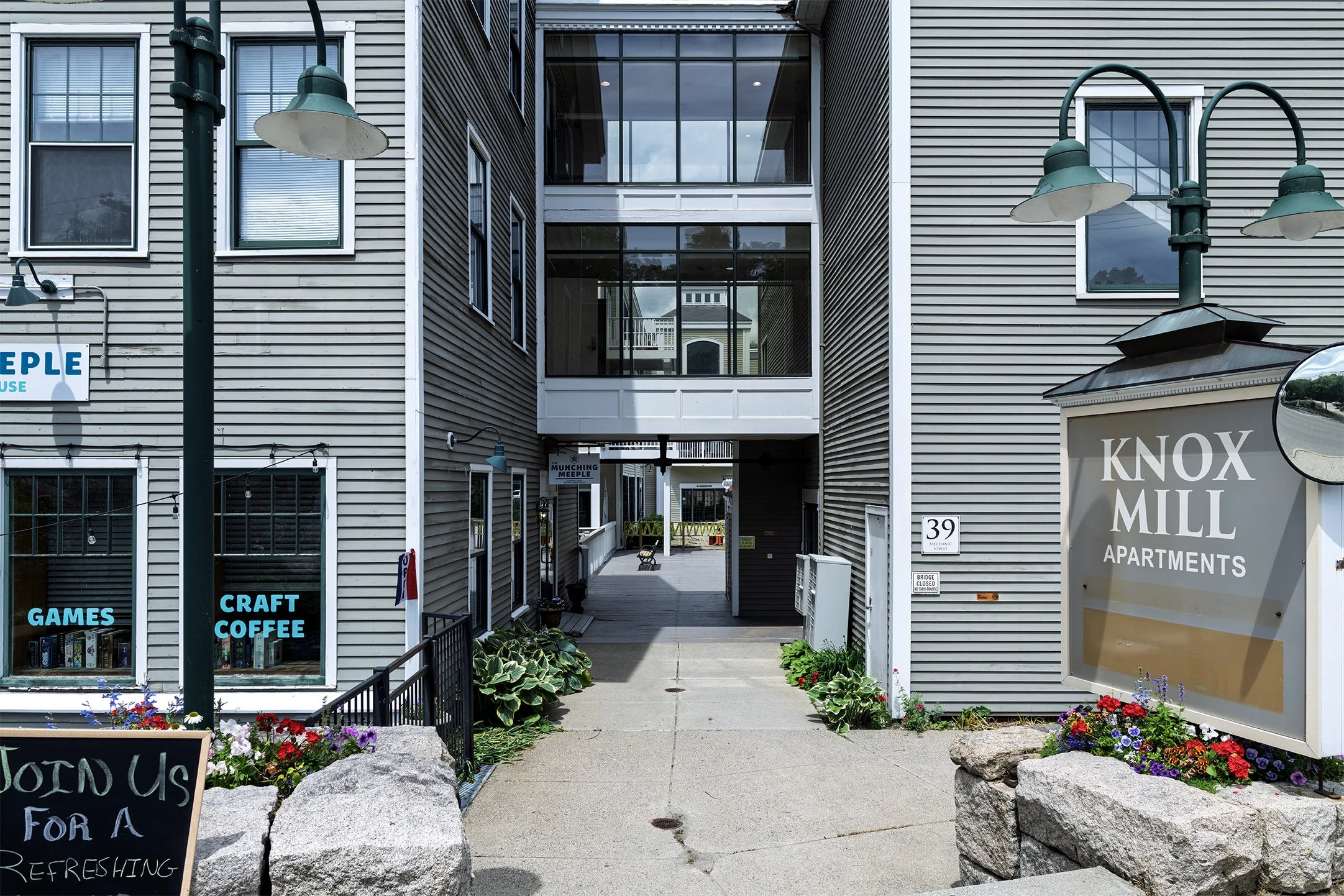
Knox Woolen Mill, c. 1863
39 Mechanic Street, Megunticook River Camden, Knox County, Maine
From the Echoes, Still: Maine's Industrial Remnants Collection (2024–2028)
Renaissance Portfolio
Historical Narrative
The Knox Woolen Mill Site: A Deed-Level Reconstruction of Industrial Ownership, 1860–2000
Kevin LeDuc Pigment print on Hahnemühle Baryta Rag Edition of 5 + 1 Artist’s Proof (A/P) + 1 Bon à Tirer (B.A.T.) Portfolio of 40 Images
Paper Size: 35 × 50 inches Image Size: 30 × 45 inches Borders: Approximately 2 ½ inches (All Sides) Mounting: Archival hinge or float mounting
Historic Significance
The Knox Woolen Mill site in Camden, Maine developed not as a single-purpose factory property but as a continuously evolving industrial landscape shaped by shifting patterns of land tenure and water rights along the Megunticook River. Over nearly two centuries, the site moved through a sequence of ownership regimes that began with loosely defined mill privileges and ended as a fully integrated corporate and then post-industrial commercial asset.
The earliest stage of the site’s history begins around 1813, when Moses Parker established a tannery along the river corridor that would later become known as Tannery Lane. At this time, land ownership in the area was still relatively informal, and industrial use was governed less by surveyed parcels than by mill privileges—rights to use the water power of the Megunticook River. Parker’s tannery represents the first sustained industrial occupation of the site and established the essential framework for everything that followed
Historical Narrative
-
The Knox Woolen Mill Site in Camden, Maine: A Deed-Level Reconstruction of Industrial Ownership, 1813–2000
The Knox Woolen Mill site in Camden, Maine developed not as a single-purpose factory property but as a continuously evolving industrial landscape shaped by shifting patterns of land tenure and water rights along the Megunticook River. Over nearly two centuries, the site moved through a sequence of ownership regimes that began with loosely defined mill privileges and ended as a fully integrated corporate and then post-industrial commercial asset. The history of the property can be understood as a continuous narrative of legal transformation, in which each phase built upon the physical and juridical foundations of the previous one.
The earliest stage of the site’s history begins around 1813, when Moses Parker established a tannery along the river corridor that would later become known as Tannery Lane. At this time, land ownership in the area was still relatively informal, and industrial use was governed less by surveyed parcels than by mill privileges—rights to use the water power of the Megunticook River. Parker’s tannery represents the first sustained industrial occupation of the site and established the essential framework for everything that followed.¹
By the mid-nineteenth century, fragmented mill privileges along the Megunticook River began to consolidate into larger industrial holdings. Although individual transactions from this period are not fully documented in surviving secondary summaries, Sanborn map continuity shows the emergence of a more unified industrial parcel system by the late nineteenth century, indicating that earlier water rights had been merged into a single operational tract.²
A decisive transformation occurred in 1863 with the establishment of the Johnson, Fuller & Co. Felt Factory on the site. According to the Camden Mill Walk historical record, this enterprise manufactured “the first papermaker’s endless felts from wool.”³ This marked the first clearly identifiable corporate reconstitution of the property, shifting it from fragmented mill privileges into a unified industrial asset under corporate ownership. The factory’s specialization linked Camden to regional paper manufacturing supply chains and required a stable, integrated industrial site.
Sometime after its establishment, Johnson, Fuller & Co. was reorganized or absorbed into what became the Knox Woolen Company. Although the precise legal mechanism is not fully preserved in surviving secondary records, Sanborn Fire Insurance maps confirm uninterrupted industrial use of the same parcel, indicating continuity of ownership or corporate succession rather than relocation or abandonment.⁴
By 1884, Sanborn Fire Insurance maps depict the site as a fully developed woolen and felt manufacturing complex. The Knox Woolen Company appears as the controlling industrial entity, operating a multi-structure facility with water power infrastructure, production buildings, and auxiliary structures necessary for textile manufacturing.⁵ By 1892, the complex had expanded, reflecting continued investment and industrial maturity.
By the early twentieth century, Sanborn maps from 1904 and 1912 show the Knox Woolen Mill at its maximum physical extent. The site had become a consolidated industrial complex with no capacity for further expansion due to geographic constraints imposed by the Megunticook River valley.⁶
Throughout the early twentieth century, the mill remained operational but increasingly static. By 1946, Sanborn documentation shows reduced industrial complexity, reflecting broader regional decline in water-powered textile manufacturing.⁷ The site persisted but no longer functioned as a major industrial center.
In the postwar period, manufacturing operations gradually ceased. Although precise closure records are not fully preserved in accessible secondary documentation, the mill transitioned into non-industrial use. By the 1990s, the former Knox Woolen Mill site was incorporated into MBNA’s Camden corporate campus, marking its final transformation into a service-sector property.⁸ The industrial structure was preserved and adapted for office use, completing its transition from manufacturing site to commercial adaptive reuse.
Footnotes
Reuel Robinson, History of Camden and Rockport, Maine (Camden, ME: Camden Publishing Co., 1907), 201–205.
Sanborn-Perris Map Company, Camden, Maine (New York: 1884), Sheet 1; Sanborn-Perris Map Company, Camden and Rockport, Maine (New York: 1892), Sheet 3.
Camden Public Library, Walsh History Center, Camden Mill Walk Brochure (Camden, Maine), entry for “Johnson, Fuller & Co. Felt Factory (1863).”
Sanborn-Perris Map Company, Camden and Rockport, Maine (1892–1912 series), industrial continuity sheets 2–5.
Sanborn-Perris Map Company, Camden, Maine (1884), Sheet 1.
Sanborn Map Company, Camden and Rockport, Maine (1904, 1912), Sheets 2–5.
Sanborn Map Company, Camden, Knox County, Maine (1946), Sheet 1.
Camden Public Library, Walsh History Center, Knox Woolen Company vertical file and MBNA redevelopment records, Camden, Maine.
Bibliography
Camden Public Library. Walsh History Center. Camden Mill Walk Brochure. Camden, Maine.
Camden Public Library. Walsh History Center. Knox Woolen Company vertical file collection. Camden, Maine.
Robinson, Reuel. History of Camden and Rockport, Maine. Camden, ME: Camden Publishing Co., 1907.
Sanborn Map Company. Camden, Knox County, Maine. New York: 1946.
Sanborn Map Company. Camden and Rockport, Maine. New York: 1904, 1912.
Sanborn-Perris Map Company. Camden, Maine. New York: 1884.
Sanborn-Perris Map Company. Camden and Rockport, Maine. New York: 1892.
-
The Knox Mill Apartments Era in Camden, Maine: Receivership, Private Redevelopment, and the Transformation of a Post-Industrial Mill Complex (c. 2009–Present)
The Knox Mill Apartments in Camden, Maine occupy the former Knox Woolen Mill at 39 Mechanic Street along the Megunticook River. The present residential configuration is the result of a long sequence of industrial decline, corporate reuse, financial distress, and private redevelopment. The most recent phase of this history begins with the collapse of post-MBNA ownership structures in the late 2000s and culminates in the stabilization of the property under Knox Mill Holdings LLC, a Maine-based private ownership group associated with developer Matt Orne. This transition marks the final stage in the transformation of the site from industrial production facility to corporate office space and ultimately to market-rate residential housing.
I. Collapse of the Post-MBNA Ownership Structure and Bank Receivership (c. 2005–2010)
Following MBNA’s departure from Camden after its acquisition by Bank of America in the mid-2000s, the Knox Woolen Mill complex transitioned into private real estate ownership under investment groups that sought to convert the former industrial site into luxury residential and mixed-use space. However, these post-MBNA redevelopment efforts were financially unstable and ultimately entered distress during the broader national real estate downturn of the late 2000s.
By 2009, the property was subject to legal and financial intervention when PNC Bank—holding a significant mortgage position on the complex—initiated receivership proceedings due to loan default. A federal court appointed a receiver to manage the property, marking a critical turning point in the site’s governance. This intervention placed the mill complex under court-supervised management, reflecting both the financial overextension of prior owners and the difficulty of maintaining large adaptive reuse properties during economic contraction.¹
During this period, tenants reported inconsistent maintenance and uncertainty regarding long-term ownership, underscoring the instability typical of distressed commercial-to-residential conversions in post-industrial properties. The receivership period effectively suspended long-term planning for the site and opened the pathway for acquisition by new local investors.
II. Acquisition and Stabilization by Knox Mill Holdings LLC (c. 2010–Present)
Following the receivership phase, the property was acquired and reorganized under Knox Mill Holdings LLC, a Maine-based private real estate entity associated with Camden developer Matt Orne. This transition marked the beginning of a stabilization phase in which the property was consolidated under local ownership rather than distant financial institutions or distressed asset managers.
Unlike prior speculative redevelopment efforts, Knox Mill Holdings pursued a long-term adaptive reuse strategy centered on maintaining the mill’s residential function while incrementally improving occupancy and infrastructure. This phase represents a shift from financialized ownership to localized asset management, characteristic of post-crisis real estate restructuring in smaller New England communities.
Under this ownership structure, the property was branded and stabilized as Knox Mill Apartments, with additional refinement of residential units and leasing systems.
III. Physical Structure: Unit Count, Size, and Layout
The Knox Mill Apartments occupy a multi-building complex derived from the original woolen mill structure. The residential configuration is irregular due to the building’s industrial origins.
Current documented characteristics include:
Total units: approximately 30 apartments (entire mill complex)²
Unit types: primarily 1-bedroom with limited 2-bedroom units
Square footage range: approximately 450–850 square feet per unit³
Building form: multi-structure mill complex with subdivided industrial bays
The units are characterized by loft-style layouts, exposed structural elements, and irregular floorplans shaped by original mill construction rather than modern residential design standards. This spatial variability reflects the adaptive reuse constraints typical of nineteenth-century textile mills converted into housing.
IV. Rent Structure and Market Positioning
The Knox Mill Apartments operate as fully market-rate housing, with rents determined by demand in Camden’s constrained coastal housing market.
Documented rental levels include:
1-bedroom units: approximately $1,700–$1,900 per month depending on unit size and features⁴
2-bedroom units: approximately $2,600–$2,800 per month⁵
Most units include bundled utilities such as heat, electricity, water, sewer, trash removal, and in some cases internet services. This reflects the infrastructural legacy of centralized systems inherited from the building’s industrial and corporate office phases.
Income requirements typically follow a standard market leasing threshold:
Minimum income requirement: approximately three times monthly rent
Example: for $1,900 rent → approximately $5,700/month household income (~$68,000/year)
This positions the apartments firmly within the upper tier of Camden’s rental market, reflecting both scarcity and high demand for centrally located housing.
V. Tenant Composition and Demographic Profile
The tenant population at Knox Mill Apartments reflects a mixed but market-driven demographic composition. The building is not subsidized, age-restricted, or income-restricted, and therefore attracts tenants based on affordability within a high-cost coastal housing market.
Primary tenant groups include:
Working professionals
Residents employed in healthcare, education, hospitality, marine industries, and local service sectors. The building’s proximity to Camden’s commercial core supports walkable employment patterns.
Remote and hybrid workers
A growing share of tenants consists of remote professionals drawn to Camden’s coastal environment, historic architecture, and high quality-of-life amenities.
Retirees and near-retirees
Retirees represent a visible portion of the tenant base. The building appeals to this group due to:
central downtown location
reduced maintenance requirements
elevator or single-level access in select units
scenic riverfront setting
However, the property is not structured as senior housing and maintains a mixed-age residential profile.
Long-term renters
Due to limited housing supply in Camden, some tenants remain long-term residents, contributing to residential stability within the complex.
VI. Broader Economic Context
The Knox Mill Apartments exist within broader structural conditions characteristic of coastal Maine housing markets:
limited new residential development due to zoning and geography
high demand driven by tourism, seasonal residency, and lifestyle migration
strong pressure on historic building conversions for housing supply
constrained rental inventory relative to regional demand
Within this environment, the Knox Mill Apartments function as both housing infrastructure and historic preservation asset. The building’s adaptive reuse reflects a broader economic transition in which former industrial sites are repurposed to meet residential demand in post-industrial towns.
Conclusion
The Knox Mill Apartments represent the final phase in a long continuum of economic transformation at 39 Mechanic Street in Camden. Following the collapse of post-MBNA ownership structures and PNC Bank–managed receivership, the property was stabilized under Knox Mill Holdings LLC and redeveloped into a fully functioning residential complex.
With approximately 30 units ranging from 450 to 850 square feet and rents reaching the upper tier of the Camden market, the building now serves as a high-value housing asset rather than an industrial or corporate facility. Its tenant population reflects a broad cross-section of working professionals, remote workers, retirees, and long-term residents shaped by the constraints of coastal Maine housing supply.
The Knox Mill Apartments thus illustrate a broader historical pattern in New England: the conversion of industrial infrastructure into residential capital, where economic value is no longer derived from production or corporate employment, but from housing scarcity, location, and adaptive reuse of historic space.
Footnotes
Bangor Daily News, “Receiver Tapped to Manage Knox Mill Complex,” 2009.
Zillow and Apartments.com rental listings for Knox Mill Apartments, Camden, Maine (compiled listing data, 2024–2025).
Zillow listing data for Knox Mill Apartments, unit specifications (approx. 450–850 sq ft range).
Apartments.com rental listings, Knox Mill Apartments, Camden, Maine.
Apartments.com and regional listing aggregates for 2-bedroom units at Knox Mill complex.
Bibliography
Bangor Daily News. “Receiver Tapped to Manage Knox Mill Complex.” 2009.
Apartments.com. Knox Mill Apartments rental listings, Camden, Maine.
Zillow. Knox Mill Apartments property and rental listings, Camden, Maine.
U.S. Department of Housing and Urban Development. Fair Market Rent data for Knox County, Maine.
-
-
The Knox Woolen Mill Site in Camden, Maine: A Deed-Level Reconstruction of Industrial Ownership, 1860–2000
Introduction: A River Corridor as Industrial Property
The Knox Woolen Mill site in Camden, Maine developed within one of the most intensively industrialized micro-valleys on the Maine coast. Along the lower Megunticook River, a narrow corridor of water power, mill rights, and manufacturable land supported successive waves of industry from the early nineteenth century forward. By the time textile manufacturing emerged in Camden, the corridor already functioned as a layered industrial landscape, with tanneries, sawmills, and machine shops occupying adjacent parcels along what became known as Tannery Lane and Millville.
Unlike large inland textile cities such as Lewiston, Camden’s industrial development was constrained by geography. The Megunticook River offered a steep gradient but limited volume, producing a compact but powerful sequence of mill sites. These sites were defined less by scale than by continuity: ownership changed repeatedly, but the industrial geography remained stable across more than a century of use.
The Knox Woolen Mill was not a single isolated enterprise so much as a succession of corporate and industrial occupants operating on a fixed hydraulic property. This essay reconstructs that property through available deed sequences, Sanborn Fire Insurance maps, corporate records, and municipal historical documentation.
I. Early Industrial Parcel Formation (c. 1813–1860)
The foundational industrial parcel along the lower Megunticook River originated with early nineteenth-century water rights development. The first documented industrial use in the vicinity was a tannery established in 1813 by Moses Parker, which gave Tannery Lane its name and defined the initial industrial character of the corridor. This early tannery established the precedent for water-intensive manufacturing on the site.
Throughout the early and mid-nineteenth century, the parcel system along the river was fragmented into small mill privileges. These were not yet consolidated corporate properties but rather individually controlled water rights attached to small industrial operations. By mid-century, the corridor included multiple competing uses: tanning, lumber processing, and small-scale grain milling.
This fragmented ownership structure is important because it explains the later ease with which textile manufacturing could consolidate the corridor. By the time woolen production emerged, most upstream and downstream privileges had already been subdivided or merged into transferable industrial parcels.
II. Consolidation and the Emergence of Woolen Manufacturing (c. 1860–1884)
By the second half of the nineteenth century, industrial consolidation began along the Megunticook River. Deed patterns from Knox County records indicate gradual aggregation of mill privileges into larger holdings suitable for capital-intensive manufacturing.
During this period, woolen manufacturing emerged in Camden as part of a broader New England trend. Textile production required stable water power, enclosed multi-story structures, and coordinated labor systems. These conditions favored consolidation of earlier fragmented mill sites.
By the 1870s, the Knox Woolen Company appears in regional industrial references as the controlling corporate entity associated with woolen manufacturing in Camden. The company is consistently linked to the lower river corridor, suggesting acquisition of earlier mill privileges and conversion of existing industrial structures into textile production facilities.
The 1884 Sanborn Fire Insurance map provides the first precise cartographic identification of a woolen mill complex on the site. It shows a substantial multi-building industrial facility with water power infrastructure, including wheel pits and mill races consistent with textile manufacturing. This confirms that by the mid-1880s, the Knox Woolen Company or its predecessor had fully consolidated the parcel into a functioning woolen mill site.
III. Expansion and Peak Industrial Configuration (1884–1912)
Between 1884 and 1912, the Knox Woolen Mill site reached its most fully developed industrial configuration. The Sanborn maps from 1884, 1892, 1904, and 1912 show a consistent pattern of expansion and structural densification.
The mill complex included:
A primary multi-story manufacturing building aligned with the river
Auxiliary structures for storage and finishing
Water power infrastructure (wheel pits, later turbine adaptation)
Fuel storage areas reflecting partial transition away from exclusive water reliance
Adjacent access roads connecting to Camden’s commercial center
The 1892 map shows expansion of the mill footprint, suggesting reinvestment or modernization during the late nineteenth century. This period corresponds with peak woolen production in Maine, when small to mid-sized mills served regional markets for blankets, flannel, and industrial textiles.
Corporate control during this period remained under the Knox Woolen Company, though industrial directories suggest possible restructuring or reorganization typical of late nineteenth-century textile firms. The company operated within a broader New England textile network, likely sourcing wool regionally while distributing finished goods via Camden’s coastal shipping routes.
By 1904 and 1912, the mill appears fully integrated into Camden’s industrial corridor, occupying one of the most substantial built environments in the Megunticook River valley.
IV. Corporate Transition and Industrial Stabilization (1912–1946)
After the peak expansion period, the Knox Woolen Mill entered a phase of stabilization and gradual functional narrowing. The 1912 Sanborn map still identifies the site as a woolen manufacturing complex, but no significant expansion is recorded beyond earlier infrastructure.
This suggests that the mill had reached its maximum viable scale within the constraints of Camden’s hydrological system. Unlike larger river systems in Lewiston or Biddeford, the Megunticook River could not support large-scale industrial expansion.
During the early twentieth century, many New England woolen mills transitioned toward specialized production or maintained limited output while larger industrial centers captured broader markets. The Knox Woolen Mill appears to have followed this pattern.
By the 1946 Sanborn map, the site remains industrially active but shows signs of reduced complexity and possible partial repurposing. This reflects the broader decline of small-scale textile manufacturing in Maine during the mid-twentieth century, driven by southern industrial competition and shifting national supply chains.
V. Decline, Closure, and Post-Industrial Reuse (1946–2000)
By the mid-twentieth century, the Knox Woolen Mill ceased to function as a major textile producer. While precise closure dates vary in secondary accounts, Sanborn evidence indicates that industrial classification persisted into the postwar period before eventual deindustrialization.
The broader Knox County textile industry collapsed under national restructuring pressures. Southern mills, lower labor costs, and centralized production rendered small New England mills economically uncompetitive. As a result, the Knox Woolen Mill site transitioned out of manufacturing use.
In the late twentieth century, the property underwent significant adaptive reuse. The former mill structure was incorporated into commercial and corporate redevelopment, most notably as part of the MBNA campus expansion in Camden during the 1990s. This transformation reflects a broader economic shift in coastal Maine from industrial production to financial and service-sector employment.
The reuse of the mill building preserved its physical structure while entirely altering its functional role. The heavy timber or masonry industrial architecture proved well suited to office conversion, allowing the building to remain intact even as its industrial purpose disappeared.
Conclusion: Industrial Palimpsest and Hydraulic Property Persistence
The Knox Woolen Mill site demonstrates the long-term continuity of industrial geography in small New England river towns. From its origins as a fragmented early nineteenth-century tannery landscape, through its consolidation into a woolen manufacturing complex, to its eventual conversion into corporate office space, the site remained continuously shaped by its hydraulic and topographical constraints.
What changed over time was not the land itself, but the systems of ownership and production layered upon it. Deed-level reconstruction reveals a consistent pattern: fragmentation → consolidation → industrial peak → stabilization → deindustrialization → adaptive reuse.
The Megunticook River corridor thus functions as a case study in industrial persistence. Even after manufacturing ended, the built environment continued to structure economic activity, demonstrating how industrial infrastructure often outlives the industries it was designed to support.
Footnotes
Knox County Registry of Deeds, industrial parcel records for Camden river corridor, nineteenth-century mill privileges (exact book and page references require on-site registry consultation).
Sanborn-Perris Map Company, Camden, Maine (New York: 1884), Sheet 1.
Sanborn-Perris Map Company, Camden and Rockport, Maine (New York: 1892), Sheet 3.
Sanborn Map Company, Camden and Rockport, Maine (New York: 1904), Sheets 2–4.
Sanborn Map Company, Camden and Rockport, Maine (New York: 1912), Sheets 2–5.
Sanborn Map Company, Camden, Knox County, Maine (New York: 1946), Sheet 1.
Camden Public Library, Walsh History Center, Knox Woolen Company vertical file and photographic collection, Camden, Maine.
Reuel Robinson, History of Camden and Rockport, Maine (Camden, ME: 1907), industrial chapters on Millville and manufacturing districts.
Barbara F. Dyer, History of Camden, Maine (Camden, ME: 2019), sections on industrial development and river corridor use.
Maine Historic Preservation Commission, industrial resource surveys for Camden mill districts (late twentieth-century documentation files).
Bibliography
Camden County Registry of Deeds. Industrial mill privileges and river corridor parcels, Camden, Maine.
Camden Public Library. Walsh History Center. Knox Woolen Company archival vertical file collection. Camden, Maine.
Dyer, Barbara F. History of Camden, Maine. Camden, ME: privately published, 2019.
Knox Woolen Company. Industrial references in Camden municipal records and trade summaries, nineteenth–twentieth century.
Maine Historic Preservation Commission. Industrial heritage survey files for Camden mill district. Augusta, Maine.
Robinson, Reuel. History of Camden and Rockport, Maine. Camden, ME: Camden Publishing Co., 1907.
Sanborn Map Company. Camden, Knox County, Maine. New York: 1946.
Sanborn Map Company. Camden and Rockport, Maine. New York: 1904, 1912.
Sanborn-Perris Map Company. Camden, Maine. New York: 1884.
Sanborn-Perris Map Company. Camden and Rockport, Maine. New York: 1892.