Weston Station Hydroelectric Plant, c. 1920
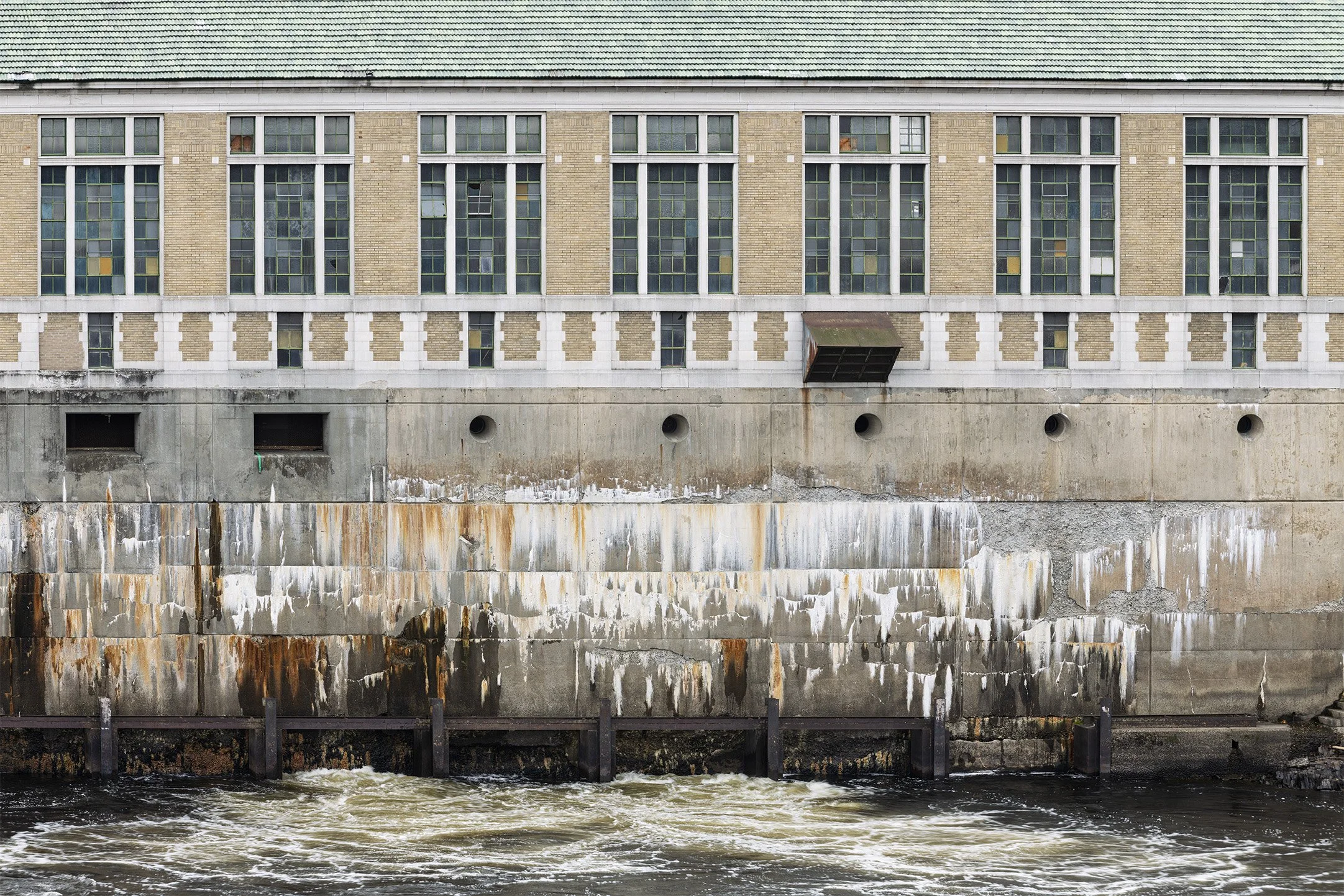
Weston Station Hydroelectric Plant, c. 1920
Island Avenue, Kennebec River
Skowhegan, Somerset County, Maine
From the Echoes, Still: Maine's Industrial Remnants Collection (2024–2028)
Falls, Outlets, Rivers Portfolio
Historical Narrative
Weston Station and the Electrification of Skowhegan’s Mills
Kevin LeDuc Pigment print on Hahnemühle Baryta Edition of 5 + 1 Artist's Proof (Portfolio of 40 Images)
Paper Size: 40 × 55 inches Image Size: 31.33 × 37 inches Borders: Approximately 4 inches (All Sides)
Historic Significance
Weston Station in Skowhegan, Maine, represents a major turning point in the town’s long industrial relationship with the Kennebec River. Built at Skowhegan Falls in 1919–1920, the hydroelectric station transformed the river’s traditional role as a source of direct mechanical power into a source of centrally generated electricity. Skowhegan’s industrial history had begun much earlier, with gristmills, sawmills, fulling and carding mills, and later textile, paper, pulp, and manufacturing operations relying on the falls and milldam for power. By the early twentieth century, however, electricity offered a new way to distribute the river’s energy beyond individual mills and connect industries to an expanding regional utility system.
The construction of Weston Station coincided with significant changes in Skowhegan’s industrial landscape. Designed by engineer John F. Vaughan and architect John Calvin Stevens, the powerhouse combined sophisticated hydroelectric technology with a distinctive Renaissance Revival architectural design. When it began operating in December 1920, it became an important component of the developing Central Maine Power system. The project also altered the physical landscape, including the removal of the Island Foundry to accommodate construction. Rather than simply replacing waterpower, Weston helped reorganize it, allowing the Kennebec’s energy to be converted into electricity and distributed among multiple industrial customers rather than being mechanically transmitted to a single mill.
The transition to electricity can be seen particularly clearly in Skowhegan’s textile and paper industries. The Maine Spinning Company constructed a new brick mill in 1922–1923 that was designed around electric power rather than the traditional system of water wheels, shafts, and belts. Other industries followed more transitional models. The Maine Pulp & Paper Company, for example, combined its own waterpower with purchased electricity from Central Maine Power. The American Woolen Company and other pulp and paper operations likewise remained connected to the older waterpower system while operating within an increasingly electrified industrial environment. These examples demonstrate that electrification was gradual: waterpower remained important, but electricity provided greater flexibility, expanded capacity, and the ability to power individual machines.
Weston Station therefore represents more than a hydroelectric facility; it symbolizes the transformation of Skowhegan from a nineteenth-century mill town into a modern electrified industrial community. Its largely intact powerhouse provides a physical record of this transition, while its continued maintenance—including major stabilization work in 1958—demonstrates its lasting importance to the regional power system. The Kennebec River remained at the center of Skowhegan’s industrial economy, but Weston changed how its energy could be used: instead of simply turning machinery beside the falls, the river could generate electricity that traveled through a broader utility network to factories, businesses, and communities.
Historical Narrative
-
Weston Station and the Electrification of Skowhegan’s Mills
The history of Weston Station in Skowhegan, Maine, is more than the history of a hydroelectric dam. It is the story of a technological and economic transition: from a nineteenth-century industrial town whose mills drew mechanical power directly from the Kennebec River to a twentieth-century manufacturing community increasingly dependent upon electricity distributed through a modern utility system. Built at the Skowhegan Falls in 1919–1920, Weston Station transformed an ancient source of waterpower into electrical energy and helped connect Skowhegan’s paper, pulp, textile, and woolen industries to the expanding Central Maine Power system.¹
Skowhegan’s industrial history began long before the construction of Weston Station. The falls of the Kennebec River had attracted manufacturing from the earliest years of European settlement. In 1790, Peter Heywood established a gristmill and sawmill on Skowhegan Island, followed by a fulling and carding mill for processing wool. Waterpower from the falls supported these early enterprises, and the construction of a milldam in 1811 increased the amount of usable power available to industry. During the nineteenth century, the river powered an increasingly diverse industrial economy that included foundries, tanneries, sawmills, woodworking operations, woolen mills, paper and pulp mills, and manufacturers of tools and agricultural implements. By the end of the century, shoes, paper, and wool had become among Skowhegan’s principal industries.²
This older system was based on direct mechanical use of the river. Water passed through a wheel or turbine, which turned shafts connected by belts to machinery inside a mill. The location of a factory was therefore closely tied to the physical location of the waterpower. Skowhegan Island became densely occupied with industrial buildings because it sat directly within the river’s system of channels and falls. In this environment, the Kennebec was not merely a geographical feature; it was the fundamental source of industrial energy.³
By the early twentieth century, however, electrical generation was changing the meaning of waterpower. Instead of using the river only to turn machinery in one building, water could be used to generate electricity that could then be distributed to multiple factories, businesses, and homes. Central Maine Power was part of a broader movement toward consolidation in the electric utility industry. The Maine Historical Society’s Central Maine Power collection documents this evolution from small, water-powered electric systems serving individual factories or limited areas toward consolidated companies and an interconnected electric grid.⁴
Weston Station emerged from this transformation. The hydroelectric facility was constructed beginning in 1919 on an island in the Kennebec River at Skowhegan Falls. Its engineering was associated with John F. Vaughan, while the powerhouse was designed by the prominent Portland architect John Calvin Stevens. Stevens gave the building a Renaissance Revival architectural character unusual for an industrial power station. The powerhouse used brick, Indiana limestone, structural steel, and concrete, and its carefully designed exterior made the building resemble an important civic or institutional structure rather than a purely utilitarian factory.⁵
The completed powerhouse was approximately 180 feet long and 41 feet wide. Its reinforced-concrete foundations and hydraulic structures were integrated with the dam, while the interior accommodated the turbines and electrical generating equipment. The station's architecture was not simply decorative: the building was designed around the machinery required to convert the energy of the Kennebec into electricity. The surviving structure remains remarkably intact, and the architectural record notes that the powerhouse and superstructure have remained essentially unaltered since 1920, despite later repairs and relatively minor modifications.⁶
The station's date of operation is especially important. A plaque on the building identifies December 13, 1920, as the date of first operation.⁷ Weston therefore belongs to a pivotal moment in Skowhegan's industrial history. At almost exactly the same time, existing manufacturers were being reorganized, new industrial buildings were being constructed, and older waterpower properties were being consolidated under the growing Central Maine Power system.
The changes were not confined to the construction of the dam itself. The old industrial landscape of Skowhegan Island was physically altered by the project. The Island Foundry, an important nineteenth-century industrial establishment, was removed in 1920 to make room for construction associated with the south dam.⁸ The significance of this event is easy to overlook. Weston did not simply add a new power source beside the old mills. It helped mark the replacement of an older industrial landscape with one based increasingly on centralized electrical generation and distribution.
One of the clearest examples of this transition is the Maine Spinning Company. The company was established in Skowhegan in 1904 and initially operated in older wood-frame mill buildings. Its earlier manufacturing system depended upon waterpower and mechanical transmission. In 1921–1922, however, the company constructed a new brick mill on Skowhegan Island. The building was designed by Lockwood, Greene & Co., one of the leading American mill-engineering firms of the period.⁹
The new Maine Spinning mill embodied the new electrical age. Contemporary historical accounts describe it as one of the first Skowhegan industries to be powered entirely by electricity from the Skowhegan Electric Works, which was located immediately behind the building.¹⁰ The Maine Historic Preservation Commission likewise identifies electrically powered equipment as an important technological feature of the mill and dates its construction to 1922–1923.¹¹ The significance of the building therefore extends beyond its architecture. Its machinery was organized around electricity rather than the traditional system of water wheels, shafts, and leather belts.
The timing is striking. Weston Station began operation in December 1920; construction of the new Maine Spinning mill began in 1922; and the mill became an example of an industrial plant designed around electric power. It would be too strong to claim that every electron used by the Maine Spinning Company can be traced to a particular Weston generator. The available evidence does not provide such a feeder-level connection. What can be said with confidence is that Maine Spinning was part of the Skowhegan electrical system at precisely the time Weston was becoming an important source of centralized hydroelectric generation.¹²
The Maine Pulp & Paper Company provides another important example, and in this case the evidence is contemporary with the construction of Weston. In 1920, the company purchased the real estate, buildings, machinery, and water and power rights of the Savage Manufacturing Company in Skowhegan.¹³ A contemporary Paper Trade Journal report described the Skowhegan paper mill as possessing its own waterpower while also contracting for additional electric power from the Central Maine Power system.¹⁴
This arrangement reveals an important feature of the transition to electricity. Electrification did not necessarily mean that a mill immediately abandoned its traditional waterpower. Instead, factories could combine their existing mechanical power with purchased electricity. Water remained an important industrial resource, but electricity offered flexibility, additional capacity, and the ability to power machinery without depending entirely upon mechanical shafts and belts.
The pulp and paper industry was particularly important to this transformation. A 1921 Paper Trade Journal article described Maine's pulp and paper companies as major users of both waterpower and electrical power and noted the growing role of Central Maine Power in the state's electrical system.¹⁵ This broader context helps explain why a hydroelectric station such as Weston was economically valuable even when individual mills continued to possess their own water rights and generating machinery.
The American Woolen Company represents another major piece of Skowhegan's industrial landscape. Its Anderson and Arms Mills were substantial woolen operations. A company publication from the early twentieth century describes the Skowhegan mills as producing fancy worsteds and cassimeres and identifies equipment including carding machines, looms, spindles, boilers, and a water wheel. The combined mills employed approximately 200 people at the time.¹⁶ The American Woolen complex therefore demonstrates the continuing importance of direct waterpower even as the electric system was expanding.
There is also strong geographical evidence connecting the American Woolen complex with the Central Maine Power operation. A historic image identifies the Central Maine Power station in Skowhegan as being along the Kennebec River by the American Woolen Company mill.¹⁷ This proximity makes it highly plausible that the woolen mills participated in the developing CMP electrical system, but the currently accessible evidence does not establish a specific electrical contract or feeder proving that American Woolen received electricity directly from Weston. It is therefore better historical practice to describe the connection as probable rather than certain.
The same caution applies to the Kennebec Pulp Company, Riverside Pulp Company, and Skowhegan Pulp Company. These companies were part of the complex history of waterpower consolidation in Skowhegan. Central Maine Power acquired or controlled important waterpower properties in the area, including properties associated with the Skowhegan Pulp Company and Riverside Pulp Company. The 1920 trade press reported that Central Maine Power was acquiring Riverside's property and waterpower while pulp production continued at the Kennebec Pulp Company.¹⁸ These transactions suggest that CMP's objective was not simply to build a generating station but to consolidate and reorganize the region's existing power resources.
This distinction is essential to understanding Weston. It would be misleading to describe the station as a dedicated power plant built to supply a handful of named factories. Weston was instead a central generating station within a growing utility system. Its electricity entered the CMP network, which could then distribute power to industrial customers throughout the Skowhegan area. The Maine Historical Society's Central Maine Power collection contains records concerning power production and delivery, engineering, customer service, blueprints, and maps, as well as records of the Skowhegan Electric Light Company and Skowhegan Water Power Company.¹⁹ These surviving records indicate the existence of a considerably more complex distribution system than a simple point-to-point connection between Weston and a single mill.
Evidence from the 1920s also demonstrates that Skowhegan had developed a primary electrical distribution network. A 1925 notice concerning planned work on primary circuits announced a lengthy interruption affecting the north side of the river and the island.²⁰ Such an announcement is significant because it indicates that the electric system had become a network serving multiple portions of the community, including the industrial island.
Weston thus represented a fundamental change in the relationship between Skowhegan and the Kennebec River. For more than a century, the river had supplied mechanical energy directly to individual mills. After Weston, the river increasingly became the source of centrally generated electrical energy that could be distributed among many customers. The distinction may seem technical, but it had profound consequences. Electricity allowed factories to locate machinery more flexibly, use individual electric motors rather than centralized shafts, expand production, and participate in an increasingly interconnected regional economy.
The architectural survival of Weston makes this transformation unusually tangible. The powerhouse that stands beside the Kennebec today retains much of its original 1920 appearance. Its brick walls, limestone details, steel structure, and industrial interior remain as physical evidence of the moment when Skowhegan's ancient waterpower economy was being converted into an electrical one.²¹
The plant also survived serious challenges. In 1958, Central Maine Power undertook stabilization work after movement or slipping occurred in the powerhouse's foundation structure. The cost was $271,425, a substantial expenditure for the period. The Maine Supreme Judicial Court later considered the expense in a case involving CMP's rates and maintenance costs.²² The episode demonstrates the continuing importance of the station to the company's generating system: rather than abandoning the aging facility, CMP invested heavily in its stabilization.
The history of Weston therefore cannot be separated from the history of Skowhegan's mills. The river had powered Skowhegan's industrial economy since the eighteenth century, but the form of that power changed dramatically in the twentieth century. The old system was characterized by individual mills directly harnessing the falls. The new system was characterized by centralized generation, electrical distribution, and factories increasingly designed around electric motors.
The Maine Spinning Company provides perhaps the clearest illustration of this transformation. Its 1922 mill was conceived as an electrically powered factory, while the Maine Pulp & Paper Company demonstrates a transitional model in which purchased electricity supplemented existing waterpower. The American Woolen Company and the pulp mills show how older industries continued to operate within a landscape increasingly dominated by consolidated utility power.
Weston Station, then, should be understood not merely as a hydroelectric dam but as a turning point in Skowhegan's industrial history. It did not single-handedly electrify every mill in town, nor can the surviving online evidence establish a direct electrical feeder from Weston to every factory. Rather, Weston supplied an important source of centralized hydroelectric generation at precisely the moment when Skowhegan's industries were moving from direct mechanical waterpower toward electrical manufacturing.
The Kennebec River had always been the source of Skowhegan's industrial strength. Weston changed the way that strength could be used. Water no longer had to turn the machinery in the building beside the falls. It could generate electricity, travel through a utility network, and power a modern factory elsewhere on the island—or beyond it. In that sense, Weston Station represents the physical transition from the mill town of the nineteenth century to the electrified industrial town of the twentieth century.
Notes
John F. Bauman, “Weston Station,” SAH Archipedia, Society of Architectural Historians, University of Virginia, accessed August 10, 2026.
Skowhegan History House and Maine Memory Network, “Skowhegan Community History—A Brief History of the Skowhegan Area,” accessed August 10, 2026.
Ibid.
Maine Historical Society, “Wired! How Electricity Came to Maine,” Maine Historical Society Newsletter, Summer 2012. The article describes the evolution from small water-powered generation systems serving individual factories toward consolidated electric companies and an electric grid.
Bauman, “Weston Station.”
Ibid.
Ibid.
Skowhegan History House, Henry Wyman Collection, “Island Foundry” material, cited in the preceding research.
Maine Historic Preservation Commission, “Maine Spinning Company Mill,” National Register of Historic Places listing, June 20, 2022.
Bigelow Brewing Company, “Preservation IPA: The Road to Revitalization,” May 18, 2021.
Maine Historic Preservation Commission, “Maine Spinning Company Mill.”
The National Museum of American History also preserves Lockwood-Greene records for the Maine Spinning Company project dated 1922, corroborating the mill's place within the firm's contemporary engineering work. Smithsonian Institution, “5657, Maine Spinning Company (Skowhegan, Maine),” National Museum of American History.
Paper Trade Journal, June 17, 1920, “Maine Pulp & Paper Co. Buys Savage Mill.”
Paper Trade Journal, July 29, 1920, report on the Maine Pulp & Paper Company and its Skowhegan operations.
Paper Trade Journal, January 6, 1921, discussion of Maine pulp and paper companies as users of water and electric power and the expansion of Central Maine Power.
American Woolen Company, The American Woolen Company: Maine—Skowhegan (1921). The company's Skowhegan mills included the Anderson and Arms Mills.
Maine Memory Network, “Central Maine Power Station, Skowhegan,” historic photograph, accessed August 10, 2026.
Paper Trade Journal, July 1, 1920, report concerning Central Maine Power's acquisition of Riverside Pulp Company's property and waterpower.
Maine Historical Society, Central Maine Power Company Collection, Coll. 2115, finding aid. The collection includes power-production and delivery, engineering, customer-service, blueprint, map, and Skowhegan-related records.
Daily Kennebec Journal, May 1, 1925, notice concerning Central Maine Power work on primary circuits serving Skowhegan.
Bauman, “Weston Station.”
Central Maine Power Co. v. Public Utilities Commission, 156 Me. 295, 163 A.2d 762 (1960). The court records CMP's $271,425 stabilization expenditure at Weston Station in 1958.
Bibliography
American Woolen Company. The American Woolen Company: Maine—Skowhegan. 1921. Accessed August 10, 2026.
Bauman, John F. “Weston Station.” SAH Archipedia. Society of Architectural Historians, University of Virginia. Accessed August 10, 2026.
Bigelow Brewing Company. “Preservation IPA: The Road to Revitalization.” May 18, 2021. Accessed August 10, 2026.
Central Maine Power Co. v. Public Utilities Commission. 156 Me. 295, 163 A.2d 762 (1960). Accessed August 10, 2026.
Maine Historic Preservation Commission. “Maine Spinning Company Mill.” National Register of Historic Places. June 20, 2022. Accessed August 10, 2026.
Maine Historical Society. “Wired! How Electricity Came to Maine.” Maine Historical Society Newsletter. Summer 2012. Accessed August 10, 2026.
Maine Historical Society. Central Maine Power Company Collection, Coll. 2115: Finding Aid. Maine Historical Society. Accessed August 10, 2026.
Maine Memory Network. “Skowhegan Community History—A Brief History of the Skowhegan Area.” Maine Historical Society. Accessed August 10, 2026.
National Museum of American History, Smithsonian Institution. “5657, Maine Spinning Company (Skowhegan, Maine).” Lockwood-Greene Records, Series 3: Job Files. 1922. Accessed August 10, 2026.
Paper Trade Journal. “Maine Pulp & Paper Co. Buys Savage Mill.” June 17, 1920. Accessed August 10, 2026.
Paper Trade Journal. July 1920 and January 1921 issues. Reports concerning Maine pulp and paper companies, Central Maine Power, and Skowhegan waterpower and electrical development. Accessed August 10, 2026.
Maine Memory Network. “Central Maine Power Station, Skowhegan.” Historic photograph. Accessed August 10, 2026.
Daily Kennebec Journal. May 1, 1925. Notice concerning Central Maine Power work on primary circuits serving Skowhegan. Accessed August 10, 2026.
Skowhegan History House. Henry Wyman Collection. Materials concerning the Island Foundry and the development of the Skowhegan Falls power system. Accessed August 10, 2026.