Ball Mill
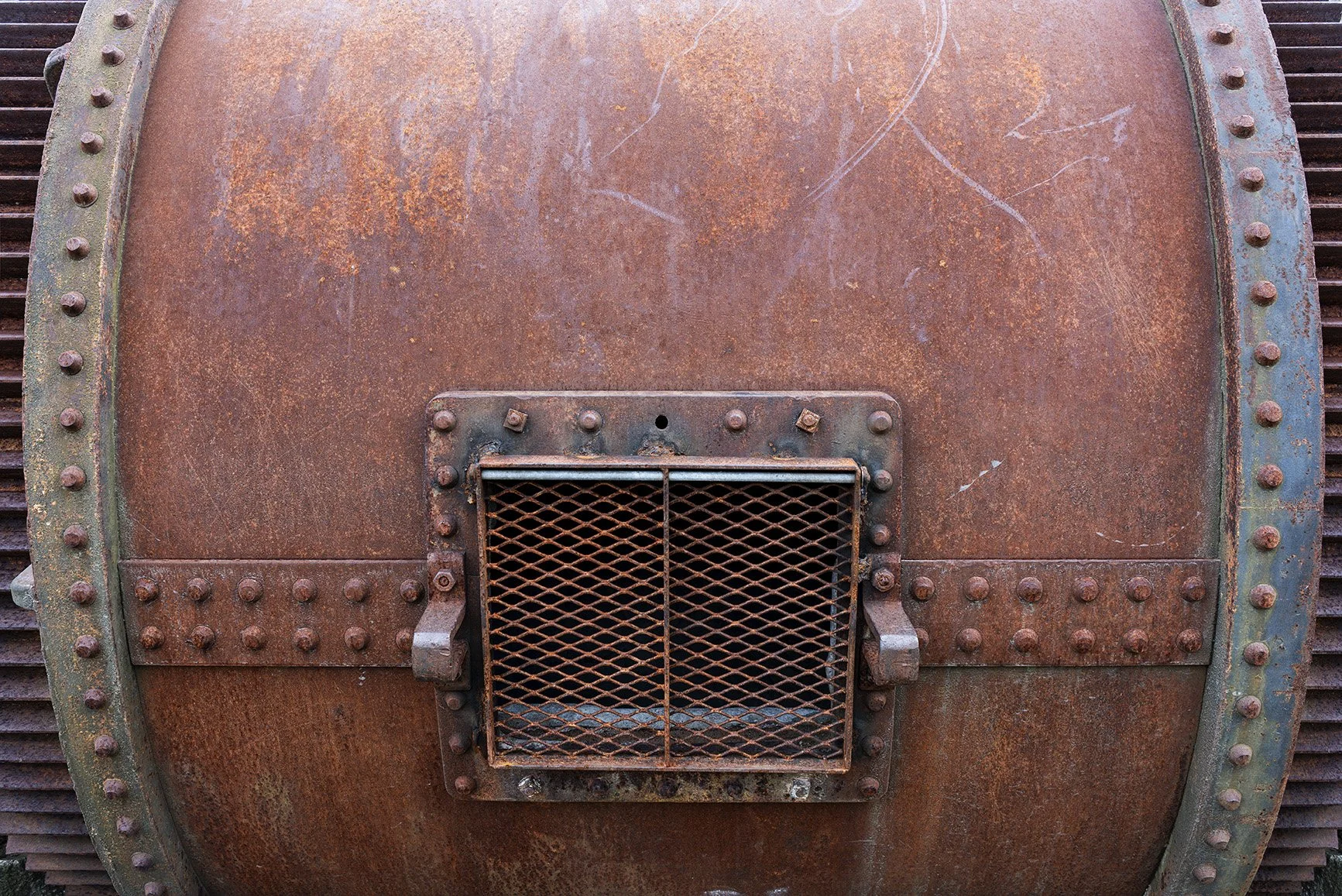
Ball Mill
Trenton Flint and Spar Company, c.1869 Cathance Station, Topsham, Sagadahoc County, Maine
From the Echoes, Still: Maine's Industrial Remnants Collection (2024–2028) Machinery Portfolio
Historical Narrative
Kevin LeDuc Pigment print on Hahnemühle Baryta Edition of 5 + 1 Artist's Proof (Portfolio of 40 Images)
Paper Size: 40 × 55 inches Image Size: 31.33 × 37 inches Borders: Approximately 4 inches (All Sides)
Historic Significance
Historical Narrative
-
Trenton Flint & Spar Company (1864–c. 1930s): Feldspar Mining and Milling at Cathance Station, Topsham, Sagadahoc County, Maine
Part I — Origins, Incorporation, Capitalization, and Establishment of the Topsham Works
The Trenton Flint & Spar Company was one of the earliest and most important commercial feldspar-mining enterprises to operate in Maine. Although organized outside the state, the company’s most significant industrial activity developed at Cathance Station in Topsham, Sagadahoc County, where it established a quarry and processing mill that became one of the principal feldspar operations in Maine during the late nineteenth and early twentieth centuries.¹
The company was organized in 1864 as a corporation based in Trenton, New Jersey, with a reported capital stock of $48,000. The purpose of the company was the extraction and processing of mineral materials used by manufacturers requiring feldspar and flint. These materials were essential ingredients in the production of ceramics, porcelain, glass, enamel, and related industrial products.²
The selection of Topsham for the company’s Maine operations was based on the geological characteristics of the region. The Cathance area contained extensive pegmatite formations composed primarily of feldspar and quartz. These deposits provided a valuable source of high-quality feldspar suitable for grinding and shipment to industrial markets.³
The company began work in Topsham in 1869, establishing quarrying operations and constructing facilities to process the extracted material. The opening of the Cathance works placed the company among the early industrial developers of Maine’s feldspar resources. Unlike traditional quarrying operations that sold unprocessed stone locally, the Trenton Flint & Spar Company developed a specialized system for extracting, preparing, and shipping mineral products to distant manufacturers.⁴
The company’s early development reflected the growing national demand for mineral materials used in manufactured goods. During the second half of the nineteenth century, American ceramic and glass industries expanded rapidly, creating increased demand for feldspar and flint. Feldspar served as a fluxing agent in pottery and porcelain production, while high-quality silica materials were important in glass manufacturing.⁵
The Trenton Flint & Spar Company was therefore part of a larger transformation in American mining. Mineral resources that had previously been used primarily for local purposes became nationally marketed industrial commodities. Companies increasingly invested in specialized extraction methods, processing facilities, transportation systems, and skilled labor forces to supply expanding manufacturing industries.⁶
The company’s Topsham operation centered on a major pegmatite quarry located near the Cathance River. Geological surveys later described the quarry as one of the most important feldspar deposits in Maine. The working area extended along a large pegmatite body containing feldspar, quartz, and associated minerals.⁷
The quarry was developed as a commercial industrial site rather than a small-scale extraction operation. Rock was removed from the deposit, transported to processing facilities, crushed, ground, and prepared for shipment. This required investment in machinery, buildings, transportation equipment, and a permanent workforce.⁸
By the late nineteenth century, the Trenton Flint & Spar Company had become firmly established as a significant feldspar producer. Maine industrial reports identified the company as one of the important operators in the state’s feldspar industry and noted the continued growth of demand for its products.⁹
The company’s capital investment allowed it to remain competitive as feldspar production became increasingly industrialized. Quarrying required heavy labor, but the value of the finished product depended upon efficient processing. The company therefore combined mineral extraction with milling operations, creating an integrated production system.¹⁰
The available records do not identify all of the original incorporators, investors, or company officers. Because the corporation was organized in New Jersey, those records are more likely to exist in New Jersey corporate filings rather than Maine industrial reports. However, contemporary Maine sources clearly identify the company as a New Jersey corporation operating a major feldspar quarry and mill in Topsham.¹¹
The company’s early success demonstrated the economic importance of Maine’s pegmatite deposits. By establishing a permanent industrial presence at Cathance, the Trenton Flint & Spar Company helped develop a specialized mineral industry that connected Maine quarries with national manufacturing markets.¹²
By the beginning of the twentieth century, the company had developed into one of the leading feldspar-processing operations in Maine. Its Topsham works represented more than a quarry; they were a complete industrial enterprise involving extraction, processing, transportation, and distribution of mineral products to manufacturers throughout the United States.¹³
Part II — Quarrying, Milling Operations, Products, Workforce, Machinery, and Transportation
The success of the Trenton Flint & Spar Company depended upon the integration of quarrying and milling operations. Unlike simple stone extraction enterprises, the company processed raw pegmatite into refined mineral products suitable for industrial customers. The Topsham works combined quarry labor, crushing equipment, grinding machinery, storage facilities, and transportation systems into a complete manufacturing operation.¹⁴
The company’s principal raw material was feldspar obtained from pegmatite deposits near Cathance. Pegmatite is a coarse-grained igneous rock containing large crystals of feldspar and quartz, and the deposits in the Topsham district were among the most important sources of commercial feldspar in Maine. The quality of the material made it valuable for manufacturers requiring mineral ingredients with specific chemical and physical characteristics.¹⁵
Mining operations began with the removal of feldspar-bearing rock from the quarry. During the nineteenth and early twentieth centuries, extraction relied heavily on skilled quarry labor. Workers drilled holes into the rock, used explosives to break the pegmatite, separated valuable feldspar from waste material, and moved stone to the processing facilities.¹⁶
The principal Trenton Flint & Spar Company quarry was described by geological investigators as a large and important working. The quarry extended approximately 200 feet along the exposed deposit and developed into multiple working levels as excavation continued. The size of the operation demonstrated the company’s long-term investment in the Topsham mineral resource.¹⁷
After extraction, the feldspar-bearing rock was transported to the company’s mill. The milling process transformed large pieces of quarried material into a finely prepared product suitable for industrial use. The operation required crushing, grinding, screening, and storage before shipment to customers.¹⁸
The company’s mill represented the most important stage of production because the value of feldspar depended upon preparation quality. Manufacturers purchasing feldspar required material with consistent size and purity. The Trenton Flint & Spar Company therefore operated specialized machinery designed to reduce raw mineral material into a standardized industrial product.¹⁹
The United States Geological Survey documented that the Cathance mill had a production capacity of approximately 16 tons of finished feldspar every twenty-four hours. This capacity placed the operation among the significant feldspar-processing facilities in Maine.²⁰
The milling process included several stages:
crushing large quarry stones into smaller pieces;
grinding feldspar into usable powder;
screening material to achieve consistent grades;
storing finished products before shipment.
The company also processed flint and related mineral materials, supplying industries that required silica-rich materials for glass and ceramic production.²¹
The principal markets for Trenton Flint & Spar Company products were manufacturers of pottery, porcelain, china, enamel, and glass. Feldspar served as an important ingredient in ceramic manufacturing because it acted as a flux, helping create stronger and more durable finished products.²²
Transportation was essential to the success of the operation. After processing, finished material was hauled approximately one-half mile to Cathance Station on the Maine Central Railroad. From there, shipments could reach industrial customers throughout New England and other manufacturing regions.²³
The company’s connection with the railroad allowed a remote quarry operation to participate in national markets. Without reliable transportation, mineral resources located outside major industrial centers could not compete effectively. The combination of valuable deposits and railroad access made Cathance an important feldspar-producing location.²⁴
Employment at the Trenton Flint & Spar Company included both quarry and mill workers. The 1884 Maine industrial statistics recorded 15 employees at the company’s Topsham operation. These workers represented the specialized labor required to operate an industrial mineral enterprise.²⁵
The workforce likely included:
quarrymen,
drill operators,
blasters,
stone handlers,
mill operators,
crusher operators,
grinders,
packers,
teamsters,
maintenance workers.
A superintendent or foreman would have coordinated quarry production, mill operations, equipment maintenance, and shipment schedules. The organization of labor reflected the transition from small-scale quarrying toward modern industrial mineral production.²⁶
Working conditions at the operation reflected the realities of nineteenth-century extractive industries. Quarry workers performed physically demanding labor involving heavy materials, explosives, and outdoor conditions. Mill workers operated machinery in dusty environments where ventilation and workplace safety became increasing concerns during the early twentieth century.²⁷
Despite these challenges, the company provided stable industrial employment and contributed to the growth of Maine’s feldspar industry. By the early twentieth century, the Trenton Flint & Spar Company had become one of the state’s best-known feldspar producers and an important supplier to American manufacturing industries.²⁸
Part III — Expansion, Competition, Decline, Sale of the Flint Business, and Historical Significance
During the early twentieth century, the Trenton Flint & Spar Company reached the height of its importance as one of Maine’s leading feldspar producers. The company’s Cathance operation had developed from a quarry and processing mill into an integrated industrial enterprise capable of extracting, preparing, and shipping mineral products to national markets. By this period, the company represented one of the most established feldspar operations in Maine.²⁹
The company’s growth was closely connected to increasing demand from American ceramic, porcelain, enamel, and glass manufacturers. Feldspar was an essential industrial mineral because it acted as a flux in ceramic production and improved the quality of finished products. The Trenton Flint & Spar Company benefited from this expanding market by supplying processed feldspar and related mineral materials to manufacturers throughout the northeastern United States.³⁰
By the early twentieth century, the Topsham feldspar district had become one of Maine’s most important mineral-producing regions. Geological investigations identified numerous pegmatite deposits in the area, but only a limited number of companies possessed the capital and equipment necessary to operate large-scale grinding facilities. The Trenton Flint & Spar Company’s Cathance mill was among the principal feldspar-processing plants in the district.³¹
The company’s competitive advantage came from its ability to control multiple stages of production. Instead of simply extracting raw feldspar, the company quarried the material, transported it to its mill, processed it into finished grades, and shipped the final product to industrial customers. This integration allowed the company to maintain consistent quality and compete in broader markets.³²
However, the conditions that had supported the company’s growth gradually changed. During the early twentieth century, feldspar production expanded in other parts of the United States, particularly in North Carolina, where large deposits and lower production costs challenged Maine producers.³³
The rise of competing feldspar regions weakened Maine’s position in the national market. Although Maine continued to produce high-quality feldspar, transportation costs, labor expenses, and competition from newer mining districts placed increasing pressure on older companies such as Trenton Flint & Spar.³⁴
The decline of the company was not caused by exhaustion of the Cathance deposit. Geological reports continued to recognize the quality and importance of Maine’s pegmatite resources. Instead, the company’s difficulties resulted primarily from changing economic conditions, industrial competition, and shifts in national mineral production.³⁵
The Great Depression accelerated these problems. Reduced demand from ceramic and glass industries affected mineral producers throughout the United States. Maine State Geologist reports from the late 1920s and early 1930s described the feldspar industry as declining and noted that Maine was unlikely to regain the national leadership it had previously held.³⁶
Despite these difficulties, the Trenton Flint & Spar Company continued operating into the Depression era. The company adapted to changing market conditions, but its position was increasingly affected by industry consolidation and reduced demand.³⁷
A major change occurred in 1930, when the Trenton Flint & Spar Company sold its flint business to the Consolidated Feldspar Corporation. This transaction represented a significant restructuring of the company and reflected the broader consolidation occurring within the American feldspar industry during this period.³⁸
The sale of the flint business did not immediately terminate all company activity. Federal mineral reports continued to identify the Trenton Flint & Spar Company as operating a feldspar mill at Cathance, Maine, in 1931. This indicates that the company’s Maine feldspar operations continued after the transfer of its flint interests.³⁹
After 1931, references to the Trenton Flint & Spar Company become increasingly limited. Later mineral reports emphasized successor firms and larger consolidated operations rather than the original company. The surviving evidence suggests that the company gradually disappeared through industry consolidation rather than through a single documented bankruptcy or closure event.⁴⁰
The exact date of corporate dissolution remains uncertain. Available records do not identify a formal liquidation, court proceeding, or official announcement of closure. Therefore, the company’s final years should be understood as a gradual decline resulting from economic and industrial transformation.⁴¹
The historical importance of the Trenton Flint & Spar Company extends beyond its own corporate history. The company represents the development of Maine’s industrial mineral economy during the late nineteenth and early twentieth centuries. Its operations connected local geological resources with national manufacturing industries and demonstrated the importance of specialized mineral processing.⁴²
The company also illustrates the evolution of industrial organization. Beginning as a mineral extraction enterprise, it developed into a complete production system involving quarrying, milling, transportation, and distribution. Its history reflects the broader movement toward modern industrial supply chains in the United States.⁴³
For more than sixty years, the Trenton Flint & Spar Company remained a significant participant in Maine’s feldspar industry. From the opening of its Topsham works in 1869 through its continued operation during the early 1930s, the company supplied essential mineral materials to American manufacturers and helped establish Maine as a major feldspar-producing region.⁴⁴
Although the company eventually declined, its legacy remained significant. The Cathance operation represents an important chapter in Maine’s industrial history and demonstrates how geological resources, corporate investment, technology, and labor combined to create a nationally connected manufacturing enterprise.⁴⁵
Footnotes
Maine Bureau of Industrial and Labor Statistics, Seventeenth Annual Report of the Bureau of Industrial and Labor Statistics of Maine (Augusta: Kennebec Journal Print, 1902), discussion of the Trenton Flint and Spar Company.
Ibid.
George O. Smith, The Commercial Marbles and Granites of Maine, United States Geological Survey reports on Maine mineral resources.
Maine Bureau of Industrial and Labor Statistics, Seventeenth Annual Report, 1902.
United States Geological Survey, Mineral Resources of the United States, annual reports on feldspar production and markets.
Ibid.
United States Geological Survey, Feldspar and Mica Deposits of Maine (Washington, D.C.: Government Printing Office), geological description of Topsham pegmatites.
Ibid.
Maine Bureau of Industrial and Labor Statistics, Annual Reports, discussion of Maine feldspar industries.
United States Geological Survey, Mineral Resources of the United States.
Maine Bureau of Industrial and Labor Statistics, Seventeenth Annual Report, 1902.
Maine State Geologist reports concerning Maine mineral industries.
United States Geological Survey, reports on feldspar mining and milling operations in Maine.
United States Geological Survey, Feldspar and Mica Deposits of Maine (Washington, D.C.: Government Printing Office).
Ibid.
Ibid., discussion of quarrying methods in Maine pegmatite districts.
United States Geological Survey, geological descriptions of the Topsham feldspar district.
United States Geological Survey, Mineral Resources of the United States, reports on feldspar milling.
Ibid.
United States Geological Survey, Mineral Resources of the United States, description of Maine feldspar mills.
Ibid., discussion of feldspar and flint markets.
Maine Bureau of Industrial and Labor Statistics, Annual Reports, discussion of mineral industries.
United States Geological Survey, Feldspar and Mica Deposits of Maine.
Ibid.
Maine Bureau of Industrial and Labor Statistics, Annual Report, 1884.
United States Geological Survey, reports concerning Maine feldspar mining labor organization.
Maine Bureau of Industrial and Labor Statistics, reports on industrial labor conditions.
Maine Bureau of Industrial and Labor Statistics, Seventeenth Annual Report, 1902.
Maine Bureau of Industrial and Labor Statistics, Annual Reports of the Bureau of Industrial and Labor Statistics of Maine, discussion of Maine feldspar production.
Ibid., discussion of feldspar markets and industrial uses.
United States Geological Survey, reports on the feldspar and mica deposits of Maine, discussion of the Topsham feldspar district.
United States Geological Survey, Mineral Resources of the United States, feldspar production reports.
Ibid., discussion of national feldspar production and competing feldspar districts.
Maine State Geologist, Annual Reports on the Mineral Resources of Maine, discussion of Maine mineral industry conditions.
United States Geological Survey, geological reports concerning Maine pegmatite resources.
Maine State Geologist, Annual Report, 1929–1930, discussion of decline in the Maine feldspar industry.
United States Geological Survey, Mineral Resources of the United States, reports on feldspar production during the Depression period.
New Jersey Department of Conservation and Development, Annual Report, 1930, documenting the sale of the Trenton Flint & Spar Company’s flint business to Consolidated Feldspar Corporation.
United States Geological Survey, Mineral Resources of the United States, 1931, listing the Trenton Flint & Spar Company mill at Cathance, Maine.
Maine State Geologist reports and United States Geological Survey mineral reports concerning feldspar industry consolidation.
New Jersey corporate records and later mineral-industry reports; no formal dissolution record identified.
Maine Bureau of Industrial and Labor Statistics; United States Geological Survey reports on Maine feldspar production.
United States Geological Survey studies of Maine mineral industries and pegmatite districts.
Maine Bureau of Industrial and Labor Statistics; United States Geological Survey mineral reports.
Maine State Geologist reports; United States Geological Survey reports concerning Maine’s feldspar industry.
Bibliography
Primary Sources
Maine Bureau of Industrial and Labor Statistics. Annual Reports of the Bureau of Industrial and Labor Statistics of Maine. Augusta, Maine: State Printer, various years, including 1884 and 1902.
Maine State Geologist. Annual Reports on the Mineral Resources of Maine. Augusta, Maine: State publications, various years.
New Jersey Department of Conservation and Development. Annual Reports. Trenton, New Jersey: State of New Jersey, 1930.
United States Geological Survey. Mineral Resources of the United States. Washington, D.C.: Government Printing Office, annual volumes.
United States Geological Survey. Reports on the feldspar and mica deposits of Maine. Washington, D.C.: Government Printing Office.
Secondary Sources
Geological studies of Maine pegmatite districts and feldspar resources.
Historical studies of Maine mining and industrial development.
Local historical collections concerning the Cathance and Topsham mineral industries.
Company Summary
Company: Trenton Flint & Spar Company
Organized: 1864
Topsham operations: Began 1869
Location: Cathance Station, Topsham, Sagadahoc County, Maine
Corporate base: Trenton, New JerseyProducts:
Feldspar
Ground spar
Flint
Ceramic-grade mineral materials
Glass-industry materials
Documented production:
Approximately 16 tons of finished feldspar per 24 hours
Documented workforce:
15 employees (1884)
Major customers:
Pottery manufacturers
Porcelain manufacturers
Glass manufacturers
Ceramic industries
Decline:
Competition from southern feldspar producers
Declining ceramic markets
Great Depression
Sale of flint business in 1930
Last documented operation:
Cathance mill listed as operating in 1931
Final dissolution:
Exact date not yet documented
The Trenton Flint & Spar Company was one of Maine’s most significant nineteenth-century mineral enterprises. Its history demonstrates how Maine’s geological resources were transformed into nationally important industrial materials through investment, technology, transportation, and skilled labor.