Model 10 Crossing Signal, c. 1936
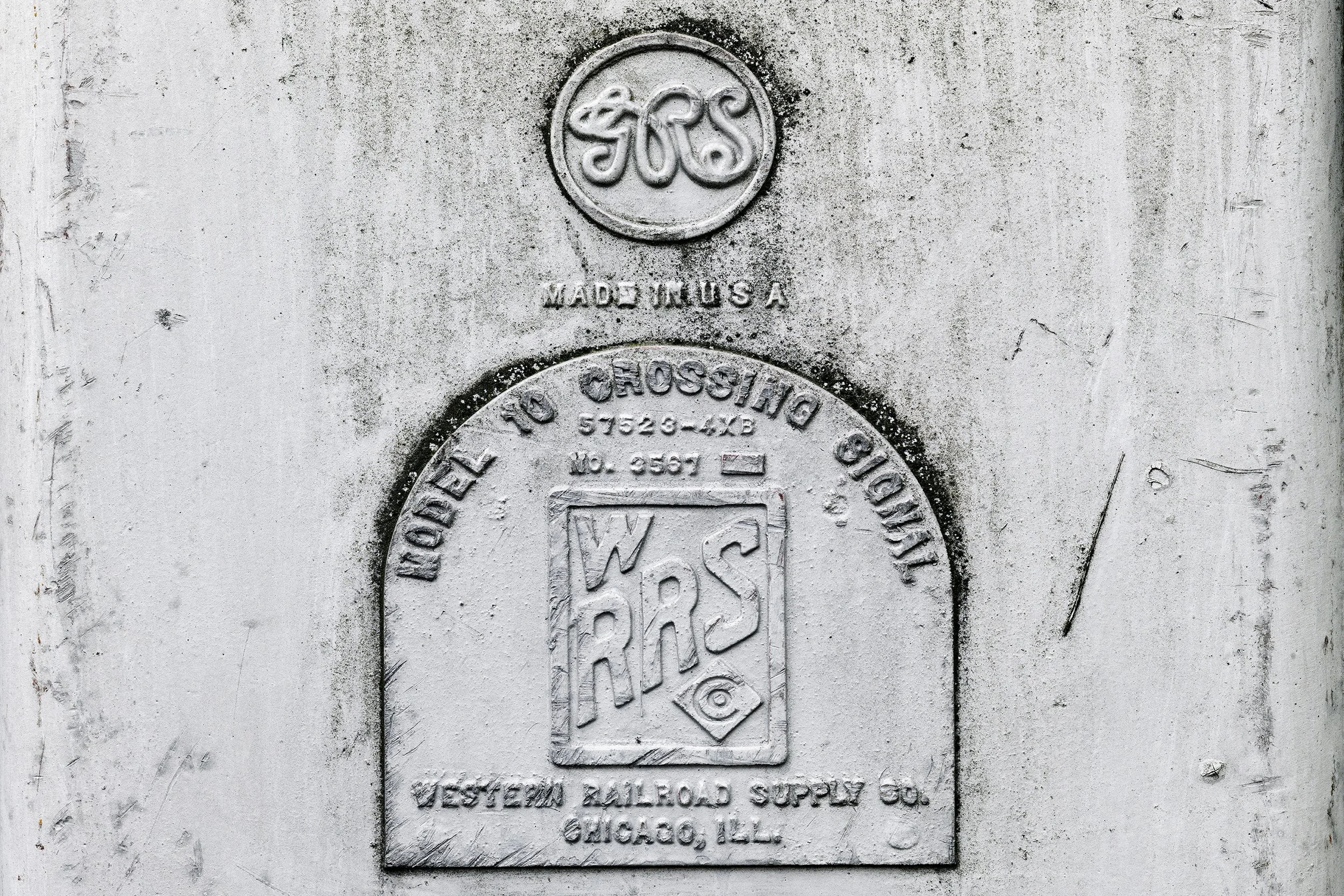
Model 10 Crossing Signal, c. 1936
Western Railroad Company, c. 1895 Main Street Crossing
Richmond, Sagadahoc County, Maine
From the Echoes, Still: Maine's Industrial Remnants Collection (2024–2028) Machinery Portfolio
Historical Narrative
Western Railroad Supply Model 10: The Richmond, Maine, Crossing Signal
Kevin LeDuc Pigment print on Hahnemühle Baryta Rag Edition of 5 + 1 Artist’s Proof (A/P) + 1 Bon à Tirer (B.A.T.) Portfolio of 40 Images
Paper Size: 35 × 50 inches Image Size: 30 × 45 inches Borders: Approximately 2 ½ inches (All Sides) Mounting: Archival hinge or float mounting
Historic Significance
The Western Railroad Supply Company (WRRS) of Chicago, Illinois, was an important American manufacturer of railroad signaling and crossing-protection equipment. Established through a long history of railroad supply manufacturing and adopting the Western Railroad Supply name in 1932, the company developed a variety of mechanical and electrical warning devices. Among its notable products was the Model 10 automatic crossing signal, introduced in 1936. The Model 10 represented an important advancement in highway-railroad safety by combining flashing warning lights, bells, and electrically operated crossing gates to protect motorists from approaching trains.
An example of this equipment was installed at the Main Street railroad crossing in Richmond, Maine, where WRRS Type D mechanisms protected both the eastern and western sides of the roadway. The mechanisms are identified as Model 10 Crossing Signals, Type No. 3567, and carry the additional marking 57523-4XB. Their distinctive cast identification plates feature the intertwined RRS script monogram within a circular emblem, along with the manufacturer's name and Chicago, Illinois, location. Associated equipment included WRRS Type 2149 bases and mechanical warning bells. Photographic documentation of the Richmond crossing provides a valuable record of this surviving railroad signaling installation.
The Model 10 Type 3567 mechanism combined several mechanical and electrical systems to operate the crossing gates automatically. Its principal components included an electric motor, reduction gearing, clutch, centrifugal governor, hold-clear magnet, ratchet and pawl assembly, and position-sensitive electrical controller. These components worked together to raise and lower the gate arms, regulate their movement, and communicate gate position to the crossing-control system. Electrical connections within the supporting base linked the mechanism with the railroad's field wiring and associated warning equipment. The rubber-insulated wiring and individual soldered or wire-nut connections observed in the Richmond equipment may reflect various periods of maintenance and repair during its service life.
The Richmond Model 10 installation represents an important surviving example of twentieth-century American railroad engineering. Although the exact manufacturing dates of the two Type 3567 mechanisms and the meaning of the additional 57523-4XB marking remain undetermined, their manufacturer identification, mechanical designations, and documented location establish their historical significance. Together, they preserve a tangible connection to Western Railroad Supply Company's contribution to railroad safety and to the history of the former Maine Central Lower Road. Their documentation helps preserve the story of an era when ingenious mechanical and electrical engineering transformed railroad crossing protection.
Historical Narrative
-
Western Railroad Supply Company of Chicago, Illinois, and the Model 10 Crossing Signal: A History of the Type 3567 Installation at Main Street, Richmond, Maine
Introduction
The development of automatic railroad grade-crossing protection represents an important chapter in the history of American railroad engineering. As railroads expanded and highway transportation increased during the late nineteenth and early twentieth centuries, the danger created by the intersection of railroad tracks and public highways became an increasingly important safety concern. Railroad signal manufacturers responded by developing mechanical and electrical devices designed to warn motorists of approaching trains and, eventually, physically prevent vehicles from entering the crossing.
Among the companies contributing to this technological development was the Western Railroad Supply Company (WRRS) of Chicago, Illinois. The company became an important manufacturer of railroad signaling equipment, including crossing bells, flashing-light signals, mechanical warning devices, and automatic crossing gates. Its Model 10 automatic crossing signal represented a significant advancement in the evolution of highway grade-crossing protection.
One surviving example of this equipment is associated with the former railroad crossing at Main Street in Richmond, Maine. The equipment is identified as a Western Railroad Supply Model 10 Crossing Signal, with a Type 3567 mechanism. The cast identification marking also bears the designation 57523-4XB. The manufacturer's distinctive intertwined RRS script monogram appears within a circular casting above the identification lettering.
Historical photographs and equipment documentation identify WRRS/GRS Type D gate mechanisms at both the eastern and western roadway signals at the Richmond crossing. The installation also included Western Railroad Supply signal bases and mechanical warning bells.
The Richmond installation provides an opportunity to examine not only the history of Western Railroad Supply but also the engineering principles behind the Model 10 crossing signal. Its mechanical governor, electric motor, hold-clear arrangement, ratchet and pawl assembly, and position-sensitive electrical controller illustrate the combination of mechanical and electrical engineering that characterized an earlier generation of automatic railroad crossing equipment.
This essay examines the history of the manufacturer, the development and operation of the Model 10, the Type 3567 mechanism, and the historical significance of the Richmond, Maine, installation.
I. The Origins and Development of Western Railroad Supply Company
The corporate history of Western Railroad Supply extends into the nineteenth century. The company's predecessor was organized in 1855 as the American Signal Company, an enterprise devoted primarily to railroad signaling and communications equipment. As American railroads expanded, the need for dependable signaling appliances increased, creating opportunities for specialized manufacturers.
In 1895, the company adopted the name Railroad Supply Company. During the following decades, it expanded its product line through the acquisition of other railroad equipment manufacturers. Among these were the Chicago Railroad Signal and Supply Company, acquired in 1903, and the L. S. Brach Manufacturing Company, acquired in 1910. The latter was associated with the development of visual crossing-warning devices that simulated the movement of a railroad watchman's lantern.¹
Another important acquisition involved the Bryant Zinc Company and its development of the Autowag, or wigwag, crossing signal. This type of signal used a moving visual target to attract the attention of highway motorists. The wigwag became one of the recognizable forms of early automatic railroad crossing protection.
In 1932, the company changed its name to Western Railroad Supply Company. Operating from Chicago, Illinois, it continued developing equipment for railroad signaling and highway crossing protection.²
The company's products included mechanical bells, flashing-light signals, automatic warning devices, wigwag signals, crossing-gate mechanisms, and associated electrical equipment.
The intertwined RRS script monogram found on the Richmond Model 10 casting is particularly interesting in this historical context. It provides a distinctive manufacturer identification associated with the company's earlier Railroad Supply identity. The circular monogram, together with the WRRS lettering and Chicago address, forms an important part of the physical identification of the equipment.
The company subsequently underwent several changes in ownership. In 1953, it was acquired by J. Patrick Lannon and became part of Western Industries. Federal Signal Corporation acquired Western Railroad Supply in 1968. Following additional corporate transactions, the Western-Cullen-Hayes name emerged in 1977.³
The company's later corporate identity therefore represents a continuation of a railroad signaling manufacturing tradition extending back to the middle of the nineteenth century.
II. The Development of the Model 10 Crossing Signal
The introduction of the Western Railroad Supply Model 10 represented a significant advancement in automatic highway grade-crossing protection.
Before the widespread adoption of automatic crossing gates, highway motorists were commonly warned by signs, bells, flashing lights, flagmen, or manually operated barriers. Although these systems provided varying degrees of protection, the automatic gate offered an additional physical warning by placing a barrier across the roadway.
Western Railroad Supply introduced its Model 10 automatic crossing-gate equipment in 1936. The company's successor, Western-Cullen-Hayes, later identified the Model 10 as the first automatically actuated crossing-gate signal installed in North America, dating the installation to that year.⁴
The Model 10 combined an electrically operated gate mechanism with the railroad's track-detection and crossing-warning circuits.
When a train approached, the railroad's detection system initiated the warning sequence. Flashing lights and bells alerted motorists, after which the crossing gates descended. Following the passage of the train and restoration of the track circuits, the gates returned to their upright positions.
The Model 10 was not simply a motor attached to a gate arm. It was an integrated mechanical and electrical assembly containing a motor, gearing, clutch, governor, holding mechanism, and electrical position controller.
The design was sufficiently adaptable to accommodate different roadway widths and gate-arm lengths. Contemporary railroad engineering descriptions document Model 10 installations using several different mechanism configurations. These included Type 3563 and Type 3564 mechanisms.⁵
The distinction between the Model 10 designation and the mechanism number is important. Model 10 identified the overall crossing-signal equipment, while the numerical designation identified a particular mechanism configuration.
The Richmond equipment bears the designation No. 3567.
III. The Richmond, Maine, Railroad Crossing
The Main Street crossing in Richmond was located on the historic Lower Road railroad corridor.
The Lower Road was originally constructed by two separate railroad companies. The Kennebec and Portland Railroad completed the route between Portland, Brunswick, and Augusta in 1852. The Somerset and Kennebec Railroad subsequently constructed the route from Augusta northward to Waterville in 1856.
In 1870, the Maine Central Railroad consolidated these two routes into its expanding railroad system. The Lower Road became an important component of the Maine Central network, connecting Portland with communities along the Kennebec River and the agricultural, commercial, and industrial regions of central Maine.⁶
During its period of greatest activity, the Lower Road carried both passenger and freight traffic. The railroad provided transportation for local communities and connected industrial facilities with the broader railroad network.
Rail traffic eventually declined as automobile, truck, and bus transportation expanded. The decline was particularly noticeable after the Second World War. Passenger service over the Lower Road ended in 1960. Freight operations continued for a number of years, although traffic became increasingly limited.⁷
The Guilford Transportation Industries acquisition of the Maine Central in 1981 brought further operational changes. Guilford concentrated its freight operations on the Back Road through Lewiston and reduced operations over the Lower Road. The last through train between Brunswick and Augusta operated in 1986. The State of Maine acquired the Brunswick-to-Augusta section in 1991 to preserve the transportation corridor.⁸
The Richmond Main Street crossing remained an identifiable example of the railroad's earlier crossing-protection equipment.
The Western Railroad Supply installation
The RailfanRXR photographic documentation of the Main Street crossing provides a valuable record of the equipment that remained at the location.
Thirty-one photographs taken on June 19, 2024, document the crossing and its associated equipment. The inventory identifies the following components:
Eastern roadway signal: GRS/WRRS Type D gate mechanism.
Western roadway signal: GRS/WRRS Type D gate mechanism.
Eastern and western signal bases: WRRS Type 2149.
Eastern and western warning bells: WRRS Mini Mechanical.
Signal-light brackets: Western Railroad Supply.
Signal lights: WCH incandescent equipment.
Gate lights: incandescent units.
Separate eastern and western pedestrian signals, also identified with GRS/WRRS Type D mechanisms.⁹
The western roadway signal was particularly noteworthy because its gate arm remained attached when photographed.
The documentation demonstrates that the Richmond crossing retained a substantial amount of Western Railroad Supply equipment, including both roadway gate mechanisms and associated signal components.
The railroad's history at this crossing should be considered separately from the history of the individual mechanisms. The photographic inventory establishes the presence of Type D equipment at Richmond in 2024. The identification of the particular Type 3567 markings on both the eastern and western mechanisms is additionally based on the equipment identification reported for this installation.
IV. Identification of the Model 10, Type 3567
The Richmond equipment carries a distinctive cast identification arrangement.
The manufacturer's identification is located on a large, tombstone-shaped casting. At the top is a circular raised emblem containing the intertwined RRS script monogram.
Immediately below the emblem, the casting identifies the equipment as:
MODEL 10
CROSSING SIGNALThe identification marking 57523-4XB appears beneath the Model 10 designation, followed by:
NO. 3567
A large rectangular area below this marking contains the letters WRRS.
At the bottom of the casting, the manufacturer's name and location appear:
WESTERN RAILROAD SUPPLY CO.
CHICAGO, ILL.This arrangement provides a particularly useful example of the company's cast identification style.
The intertwined RRS monogram is not a locomotive emblem. It is a script manufacturer's monogram contained within a circular raised casting.
The Type 3567 designation is also significant because railroad engineering documentation identifies a Western Railroad Supply Type D No. 3567 gate mechanism. An engineering drawing associated with Union Pacific Railroad records identifies the mechanism by that designation and provides electrical information concerning its operation.¹⁰
The Type D designation therefore establishes a technical connection between the Richmond equipment and the documented WRRS mechanism family.
The additional marking 57523-4XB appears on the identification castings of both the eastern and western mechanisms, according to the equipment identification reported for the Richmond installation.
The exact meaning of this marking has not yet been established. It may represent an assembly, drawing, casting, production, or serial identification. Without an original WRRS numbering schedule or factory record, it would be inappropriate to assign it a specific manufacturing meaning.
Similarly, the exact manufacturing year of the Richmond mechanisms remains undetermined.
V. Mechanical Construction and Operation of the Type 3567
The Type 3567 mechanism represents an interesting example of early automatic gate engineering.
Its operation depended on the coordinated action of several mechanical components:
Electric motor.
Reduction gearing.
Clutch assembly.
Centrifugal governor.
Hold-clear magnet.
Ratchet wheel and pawl.
Mechanical snubbing arrangement.
Electrical circuit controller.
These components worked together to raise, lower, hold, and control the crossing gate.
The electric motor and reduction gearing
The electric motor supplied the power required to move the gate arm.
Because a crossing gate could have a considerable length and weight, the motor operated through a reduction gear arrangement. The gearing converted the relatively high rotational speed of the motor into slower movement with greater available torque at the gate shaft.
The resulting movement was controlled by the mechanism's electrical contacts and mechanical components.
Contemporary descriptions of Model 10 mechanisms document low-voltage direct-current motor operation. A 1947 description of a Model 10 installation using a Type 3564 mechanism identifies a motor designed for 12-to-18-volt direct-current operation.¹¹
That specification is useful historical evidence for the Model 10 family, but it should not automatically be assigned to the Richmond Type 3567 without its own motor identification or factory specification.
The clutch and centrifugal governor
One of the most important features of the Model 10 mechanism was its speed-control arrangement.
A long gate arm could not safely be allowed to fall freely under gravity. Excessive speed could cause violent impact at the lower stop and impose unnecessary stress on the gate shaft, gearing, and supporting structure.
The clutch and governor helped regulate the gate's movement.
The centrifugal governor operated in response to rotational speed. As the rotating governor assembly increased in speed, centrifugal force acted on its moving components. This movement controlled the application of mechanical friction, helping prevent excessive speed.
A contemporary 1947 description of a Model 10 Type 3563 mechanism explains that the motor drove the gate upward from horizontal to vertical and also powered the initial portion of the downward movement. From approximately 45 degrees, gravity completed the descent to horizontal. The article specifically identifies the clutch and mechanically controlled centrifugal governor as important components of the mechanism.¹²
This description illustrates the engineering principles used in the Model 10 family. The exact movement profile of the Type 3567 should be established from its own mechanical drawing rather than assumed to be identical to the Type 3563.
The hold-clear magnet, ratchet, and pawl
The hold-clear arrangement was another important feature.
When the gate was upright, a mechanical holding arrangement prevented it from descending under its own weight.
The hold-clear magnet controlled the release of this arrangement. Its electrical operation was coordinated with the crossing-control system.
The ratchet wheel and pawl provided the mechanical means of holding and releasing the gate mechanism.
When the appropriate electrical control changed state, the holding arrangement released, allowing the gate to descend.
After the train cleared the crossing and the raising sequence began, the motor returned the gate to its upright position, where the holding arrangement could again secure it.
This arrangement meant that the motor did not have to operate continuously merely to keep the gate raised.
VI. Electrical Control and the Circuit Controller
The mechanical components of the Type 3567 were coordinated by an electrical controller.
The Union Pacific engineering drawing specifically identifies the WRRS Type D No. 3567 mechanism and illustrates its electrical contact arrangements.
The mechanism included multiple contact spaces associated with motor control, hold-clear operation, gate-position indication, snubbing, external crossing control, and bell control.¹³
These contacts allowed the mechanism to respond to its own physical position and communicate with the larger crossing-protection system.
As the gate shaft rotated, the controller changed the electrical condition of its contacts. These changes provided information about the gate's position and controlled the appropriate operating circuits.
The importance of this arrangement cannot be overstated. The mechanism was not simply operated by applying power to a motor. Its electrical controller coordinated the motor, holding system, and position-dependent functions.
Electrical connections in the base
The base of the crossing signal provided the structural support for the mechanism and accommodated the electrical connections between the signal assembly and the railroad's field wiring.
The Richmond installation is documented with WRRS Type 2149 bases.
The electrical connections within an individual base could include conductors associated with the mechanism motor, hold-clear circuit, controller circuits, and other signal equipment.
The surviving Richmond equipment has been described as containing individual rubber-insulated conductors joined through wire-nut or soldered connections rather than a readily identifiable terminal-board arrangement.
This is an important observation, but it does not establish that these connections were part of the original factory wiring.
Railroad signal equipment remained in service for many years and was subject to inspection, repair, and modification. Individual splices may therefore represent later maintenance rather than the original WRRS installation.
Rubber-insulated wiring is consistent with older industrial and railroad electrical installations, but rubber insulation remained in use over an extended period. Its presence alone cannot establish the manufacturing date of the mechanism or the date of the electrical work.
The base wiring should consequently be understood as part of the equipment's service history rather than assumed to be an untouched factory installation.
VII. The Model 10 as Part of a Complete Crossing-Protection System
The Model 10 mechanism did not operate independently. It formed part of a coordinated railroad crossing-warning installation.
A complete installation included several systems:
Railroad track circuits for train detection.
Electrical control equipment.
Flashing-light warning signals.
Audible warning bells.
Automatic crossing gates.
Gate-position contacts.
Power supplies and associated field wiring.
When a train approached, the track-detection system initiated the warning sequence.
The flashing lights and bells alerted motorists that a train was approaching. The crossing-control equipment then initiated the gate-lowering cycle.
The gate mechanism released its holding arrangement and operated according to its motor and mechanical control system.
After the train cleared the crossing, the control circuits permitted the gate to return to its upright position.
The 1947 railroad engineering literature demonstrates how Model 10 equipment was integrated into larger crossing-protection installations.
In Gary, Indiana, for example, Model 10 mechanisms were used with flashing lights, mechanical bells, and track-circuit controls. The documented Type 3564 installation included 12-to-18-volt direct-current motors and gate arms of varying lengths.¹⁴
These contemporary descriptions demonstrate that the Model 10 was part of a broader system of coordinated railroad safety equipment.
The Richmond installation represents another example of this approach, using Western Railroad Supply gate mechanisms, bases, bells, and signal components.
VIII. The Later History of the Richmond Crossing
The history of the Main Street crossing reflects the larger decline and subsequent preservation of the Lower Road railroad corridor.
Maine Central passenger service ended in 1960, while freight operations continued for several additional decades.
After the Guilford Transportation Industries acquisition, the railroad increasingly concentrated its operations on the Back Road. The State of Maine acquired the Brunswick-to-Augusta section of the Lower Road in 1991.
Subsequent operators included Maine Coast Railroad, Safe Handling, and Maine Eastern. Seasonal excursion operations also took place during portions of this period.¹⁵
The Maine Department of Transportation's 2023 Lower Road Rail Corridor Study provides an extensive account of the line's history and subsequent changes in ownership and operation.
The Main Street crossing in Richmond is therefore part of a railroad corridor with a long history extending from the nineteenth-century Kennebec and Portland Railroad through the Maine Central era and subsequent short-line operations.
The photographs taken at Richmond in June 2024 preserve an important record of the surviving crossing equipment.
They are particularly valuable because they document the continued presence of WRRS/GRS Type D gate mechanisms and associated Western Railroad Supply equipment at a former railroad crossing.
IX. Historical Significance of the Model 10 and Type 3567
The Western Railroad Supply Model 10 represents an important stage in the development of automatic railroad crossing protection.
Its design combined mechanical engineering with electrical control in a manner that allowed a heavy gate arm to operate automatically and consistently.
The use of a motor, reduction gearing, centrifugal governor, clutch, hold-clear magnet, ratchet, pawl, and position-sensitive electrical controller demonstrates the complexity of the equipment.
The Type 3567 designation provides an opportunity to examine a specific configuration within the Model 10 family.
The Richmond installation is particularly interesting because the historical photographic record documents Type D mechanisms on both the eastern and western roadway signals.
The manufacturer's cast identification plate is also significant. The intertwined RRS monogram, Model 10 designation, Type 3567 number, additional 57523-4XB marking, and Chicago manufacturer identification collectively preserve a substantial amount of information about the equipment's identity.
Although the precise manufacturing date and the meaning of the additional marking remain unresolved, the combination of manufacturer identification, mechanism designation, and documented installation location makes the Richmond equipment a valuable subject for railroad historical research.
Conclusion
The Western Railroad Supply Company of Chicago, Illinois, played an important role in the development of American railroad crossing-protection equipment.
Its Model 10 automatic crossing signal represented a significant advancement in the transition from manually operated crossing protection to electrically controlled automatic gates.
The Type 3567 mechanism illustrates the mechanical and electrical engineering involved in this development. Its motor, gearing, clutch, centrifugal governor, hold-clear magnet, ratchet and pawl arrangement, and electrical circuit controller worked together to provide controlled gate operation.
At Main Street in Richmond, Maine, the surviving historical record identifies WRRS/GRS Type D mechanisms on both the eastern and western roadway signals. The associated equipment included WRRS Type 2149 bases, mechanical bells, and other Western Railroad Supply components.
The distinctive cast identification of the Model 10, including its intertwined RRS monogram and the markings 57523-4XB and No. 3567, provides an additional connection to the company's manufacturing history.
Although the precise production date and factory meaning of the additional identification number remain subjects for further research, the equipment's identity and its association with the Richmond crossing are sufficiently documented to establish its historical importance.
The Richmond Model 10 is more than an old railroad crossing mechanism. It is a surviving example of the engineering technology that helped make American highway-railroad crossings safer during the twentieth century. Its preservation provides an opportunity to document the history of Western Railroad Supply, the evolution of automatic crossing gates, and the railroad heritage of Richmond and the former Maine Central Lower Road.
Chicago-Style Footnotes
Western Railroad Supply Company corporate-history summary, reproduced in My_Private_Photographer, “(WRRS) Western Railroad Supply Company,” Flickr, June 12, 2011.
Ibid.
Ibid.; see also Mike's Railroad Crossing Forum, “History of Crossing Signal Companies,” discussion of Western Railroad Supply, Federal Signal, and Western-Cullen-Hayes.
Western-Cullen-Hayes, Inc., Model 10 Signal Installation and Maintenance Instructions, rev. 5 (May 1998), introduction. The manual identifies the company's first automatically actuated crossing-gate installation in North America as dating from 1936.
“Highway Crossing Protection Installed by Several Railroads in Gary, Indiana,” Railway Signaling 40 (August 1947); “Crossing Protection in Gary, Indiana,” Railway Signaling 40 (August 1947).
Tom Reeves, The History of the Lower Road Rail Line, Appendix F, Maine Department of Transportation, May 30, 2023.
Ibid.
Maine Department of Transportation, Lower Road Rail Corridor Study, August 2023; Reeves, The History of the Lower Road Rail Line.
RailfanRXR, “Main St. (Richmond, ME),” photographic documentation and equipment inventory. Photographs taken June 19, 2024.
Union Pacific Railroad, “W.R.R.S. Co. Type D No. 3567 Gate Mechanism,” engineering wiring diagram, undated. The drawing identifies the Type 3567 mechanism and its electrical contact arrangement.
“Crossing Protection in Gary, Indiana,” 1947. The article describes Model 10 equipment using Type 3564 mechanisms. Its motor specifications should not be assumed to apply directly to Type 3567.
“Highway Crossing Protection Installed by Several Railroads in Gary, Indiana,” Railway Signaling 40 (August 1947), 480 ff. The article describes Model 10 Type 3563 mechanisms and their motor, clutch, and centrifugal-governor operation.
Union Pacific Railroad, “W.R.R.S. Co. Type D No. 3567 Gate Mechanism,” engineering wiring diagram.
“Crossing Protection in Gary, Indiana,” Railway Signaling 40 (August 1947).
Maine Department of Transportation, Lower Road Rail Corridor Study, August 2023; Reeves, The History of the Lower Road Rail Line.
Bibliography
Corporate and Manufacturer Publications
Western-Cullen-Hayes, Inc. Model 10 Signal Installation and Maintenance Instructions. Revision 5, May 1998.
Western Railroad Supply Company. Catalog. July 1, 1941. Manufacturer's trade catalog. Listed in the Jon Roma railroad signaling document archive.
Engineering Drawings and Technical Records
Union Pacific Railroad. “W.R.R.S. Co. Type D No. 3567 Gate Mechanism.” Engineering wiring diagram. Undated.
Government Publications
Maine Department of Transportation. Lower Road Rail Corridor Study. August 2023.
Reeves, Tom. The History of the Lower Road Rail Line. Appendix F. Maine Department of Transportation, May 30, 2023.
Historical Railroad Publications
“Crossing Protection in Gary, Indiana.” Railway Signaling 40 (August 1947).
“Highway Crossing Protection Installed by Several Railroads in Gary, Indiana.” Railway Signaling 40 (August 1947).
Archival and Historical Collections
Smithsonian Libraries. American History Trade Literature Collection. Western Railroad Supply Company trade catalogs concerning crossing signals, warning devices, signaling accessories, crossing gates, and railroad equipment. Collection number 46349. Catalog holdings beginning in 1938.
Boston and Maine Railroad Historical Society. Maine Central Railroad Valuation Plans. June 30, 1916.
Photographic and Documentary Sources
RailfanRXR. “Main St. (Richmond, ME).” Photographic documentation and equipment inventory. Photographs taken June 19, 2024.
My_Private_Photographer. “(WRRS) Western Railroad Supply Company.” Flickr. June 12, 2011.
Mike's Railroad Crossing Forum. “History of Crossing Signal Companies.” Historical discussion concerning Western Railroad Supply, Federal Signal Corporation, and Western-Cullen-Hayes.
A historical research note: I have deliberately not assigned a manufacturing year to serial marking 57523-4XB, nor claimed that the 1947 Type 3563 or Type 3564 operating specifications necessarily apply to Type 3567. Those distinctions are important if this essay is to serve as a credible historical record rather than simply a descriptive account.