The Foundry

The Foundry
Lewiston Machine Company, c. 1852 5-20 West Bates Street
Lewiston, Androscoggin County, Maine
From the Echoes, Still: Maine's Industrial Remnants Collection (2024–2028)
Facades Portfolio
Historical Narrative
Iron, Steam, and Waterpower: The Lewiston Machine Works and the Industrialization of Androscoggin Valley
Kevin LeDuc Pigment print on Hahnemühle Baryta Edition of 5 + 1 Artist's Proof (Portfolio of 40 Images)
Paper Size: 40 × 55 inches Image Size: 31.33 × 37 inches Borders: Approximately 4 inches (All Sides)
Historic Significance
Located near Lewiston's canal system and the Maine Central Railroad, the company occupied an ideal position within the city's industrial infrastructure. Its foundry and machine shop transformed raw iron and brass into precision-engineered parts through a combination of skilled craftsmanship and increasingly sophisticated machine tools. Pattern makers, machinists, foundrymen, and mechanics worked together to produce gears, shafts, pulleys, and other essential components that powered textile mills, paper mills, and waterpower systems throughout the Androscoggin River valley. By the late nineteenth century, the Lewiston Machine Works had become one of Maine's largest engineering establishments, employing approximately two hundred workers and maintaining a substantial monthly payroll.
While the large textile mills of Lewiston and Auburn dominated the skyline and economy, they depended on machine shops like the Lewiston Machine Works to manufacture, repair, and maintain the machinery that kept production running. Established in 1865 as the Lewiston Machine Company, the enterprise expanded alongside the region's booming textile industry, producing iron castings, water turbines, steam-engine components, and specialized cotton-mill machinery that served factories throughout Maine and northern New England.
The success of the company depended upon a highly skilled workforce. Unlike many factory jobs that relied on repetitive labor, machine building required technical knowledge acquired through apprenticeships and years of practical experience. Foundry workers endured intense heat while casting molten iron, machinists carefully shaped metal parts to precise measurements, and pattern makers crafted wooden molds that allowed identical machine components to be produced repeatedly. Many of these workers were part of Lewiston's growing French Canadian immigrant community, whose labor supported not only the city's textile mills but also the engineering industries that sustained them.
Historical Narrative
-
Iron, Steam, and Waterpower: The Lewiston Machine Works and the Industrialization of Androscoggin Valley
In the roar of furnaces and the rhythm of iron hammers, the Lewiston Machine Works forged the machinery that kept the Androscoggin Valley’s mills alive. Here, molten metal was cast into gears, turbines, and cotton-mill machinery that powered the great textile factories along the Androscoggin River. Skilled machinists and foundry workers shaped the iron backbone of industrial Lewiston and Auburn, keeping looms turning and engines running day and night. Though largely forgotten today, the Lewiston Machine Works helped drive the rise of one of New England’s most important manufacturing regions.
Introduction
The Lewiston Machine Works, established during the early 1870s in Lewiston, Maine, was an important industrial enterprise serving the rapidly expanding manufacturing economy of the Androscoggin River valley. During the second half of the nineteenth century Lewiston emerged as one of Maine’s principal industrial cities, dominated by large textile mills and related manufacturing industries that relied on the waterpower of the Androscoggin River. Within this industrial environment machine shops and foundries such as the Lewiston Machine Works played a crucial supporting role by producing and repairing the machinery required for textile manufacturing, paper production, and other forms of mechanized industry.¹
Located within Lewiston’s growing industrial district near the city’s canal system and railroad depots, the Lewiston Machine Works manufactured a wide range of mechanical equipment including iron castings, turbines, and specialized textile machinery. These products served the city’s large textile factories as well as industrial enterprises throughout Maine and northern New England.²
The development of the Lewiston Machine Works reflects broader trends in nineteenth-century American industrialization. As factory production expanded, specialized engineering firms emerged to design, manufacture, and maintain the complex mechanical systems required for industrial manufacturing. Machine shops became indispensable components of industrial cities, linking skilled mechanical labor with the needs of rapidly growing manufacturing enterprises.³
Early Ownership and Development
The enterprise that later became known as the Lewiston Machine Works originated as the Lewiston Machine Company, incorporated on February 4, 1865. The company was organized by several prominent Lewiston businessmen and industrial investors who recognized the growing demand for locally produced industrial machinery and engineering services.⁴
Soon after its incorporation the company acquired the tools and machinery of an earlier engineering establishment known as the Hill machine shop. This purchase allowed the new corporation to begin operations immediately using existing equipment and experienced workers familiar with machine-building techniques.⁵
The machinery from the Hill shop was transferred to a larger foundry building located near the Maine Central Railroad depot. The building had originally been constructed around 1852 and underwent substantial enlargement during the 1860s, with major additions completed in 1865 and 1866. The interior was remodeled again in 1868 in order to accommodate larger industrial machinery and improved production systems.⁶
By the early 1870s the works had developed into one of the most substantial engineering establishments in Maine, producing iron castings and mechanical equipment used in textile mills, paper mills, and other manufacturing enterprises throughout the region.⁷
Ownership Timeline and Industrial Expansion
The development of the Lewiston Machine Works occurred in several phases that paralleled the growth of Lewiston’s industrial economy.
The Lewiston Machine Company (1865–c.1873) established the original foundry and machine shop and began producing mechanical equipment for textile mills along the Androscoggin River. During this early phase the company manufactured iron and brass castings and repaired industrial machinery used by nearby factories.⁸
By the 1870s the enterprise became widely known as the Lewiston Machine Works (c.1873–early twentieth century). During this period the factory expanded its operations significantly and specialized in the production of cotton-mill machinery, steam-engine components, turbines, and heavy iron castings. By the late nineteenth century the works employed approximately two hundred workers and maintained a monthly payroll of roughly ten thousand dollars, making it one of the largest engineering establishments in Maine.⁹
During the early twentieth century the company continued to supply industrial equipment and repair services to mills throughout the region. However, increasing competition from large national machinery manufacturers gradually reduced the market for locally produced industrial machines, leading the company to focus more heavily on repair work and replacement parts.¹⁰
Industrial Operations and Machinery
The Lewiston Machine Works functioned as both a machine shop and an iron foundry. Raw iron was melted in furnaces and poured into molds prepared on the foundry floor. After cooling, the castings were transferred to the machine shop where skilled machinists shaped them into finished mechanical components.¹¹
The facility contained a variety of machine tools typical of late nineteenth-century engineering establishments, including lathes, planers, milling machines, and drill presses. These machines allowed workers to produce gears, shafts, pulleys, and other components required for industrial machinery.¹²
Pattern makers constructed wooden models used to create molds for casting iron parts. These patterns were essential for producing identical machine components and represented a specialized craft within the foundry industry.¹³
The works produced iron and brass castings as well as mechanical equipment used in textile mills, waterpower systems, and steam engines. Through these activities the Lewiston Machine Works became an important supplier of industrial machinery throughout the Androscoggin River valley.¹⁴
Workforce and Working Conditions
The Lewiston Machine Works employed a skilled workforce composed of machinists, pattern makers, foundry workers, and general laborers. Machine-building industries required specialized technical knowledge, and many workers learned their trade through apprenticeships or years of practical experience in engineering shops.¹⁵
Foundry work was particularly demanding. Workers managed furnaces capable of melting iron at extremely high temperatures and handled heavy molds and castings. These tasks exposed laborers to intense heat and considerable physical strain.¹⁶
Lewiston’s industrial workforce during the late nineteenth century included many French Canadian immigrants who had migrated from Québec to New England seeking employment in textile mills and related industries. Although the majority worked in textile factories, some found employment in machine shops and engineering works within the city’s industrial economy.¹⁷
Despite the difficult working conditions, skilled mechanical trades often offered higher wages and greater stability than unskilled factory labor. As a result, employment in machine shops attracted workers seeking technical training and long-term industrial careers.¹⁸
Twentieth-Century Operations and Decline
During the early twentieth century the Lewiston Machine Works continued to supply mechanical components and repair services for local factories. However, broader technological and economic changes gradually altered the structure of the American machinery industry.¹⁹
Large manufacturing companies increasingly produced standardized machinery in centralized factories capable of supplying national markets. Smaller regional machine-building firms found it difficult to compete with these larger producers and increasingly shifted toward repair and maintenance work.²⁰
The decline of Lewiston’s textile industry during the mid-twentieth century further reduced demand for local engineering services. As mills closed or modernized their equipment, the network of supporting industries—including machine shops and foundries—experienced declining business activity.²¹
Although the precise closure date of the Lewiston Machine Works remains uncertain, the enterprise likely disappeared during the early twentieth century as these economic changes reshaped the region’s industrial economy. Nevertheless, its history illustrates the important role played by machine-building firms in supporting Maine’s manufacturing industries during the late nineteenth century.²²
Founders and Corporate Officers
The Lewiston Machine Company was incorporated in 1865 by Samuel W. Kilvert, Josiah G. Coburn, Nathaniel W. Farwell, David M. Ayer, and Rhodes A. Budlong. These individuals were prominent members of Lewiston’s business community and were closely associated with the city’s industrial development.²³
Their investment in a machine-building enterprise reflected the growing demand for engineering services in a city whose economy was increasingly dominated by large textile mills. By establishing a local foundry and machine shop, these entrepreneurs helped create an industrial infrastructure capable of supporting the expansion of Lewiston’s manufacturing sector.²⁴
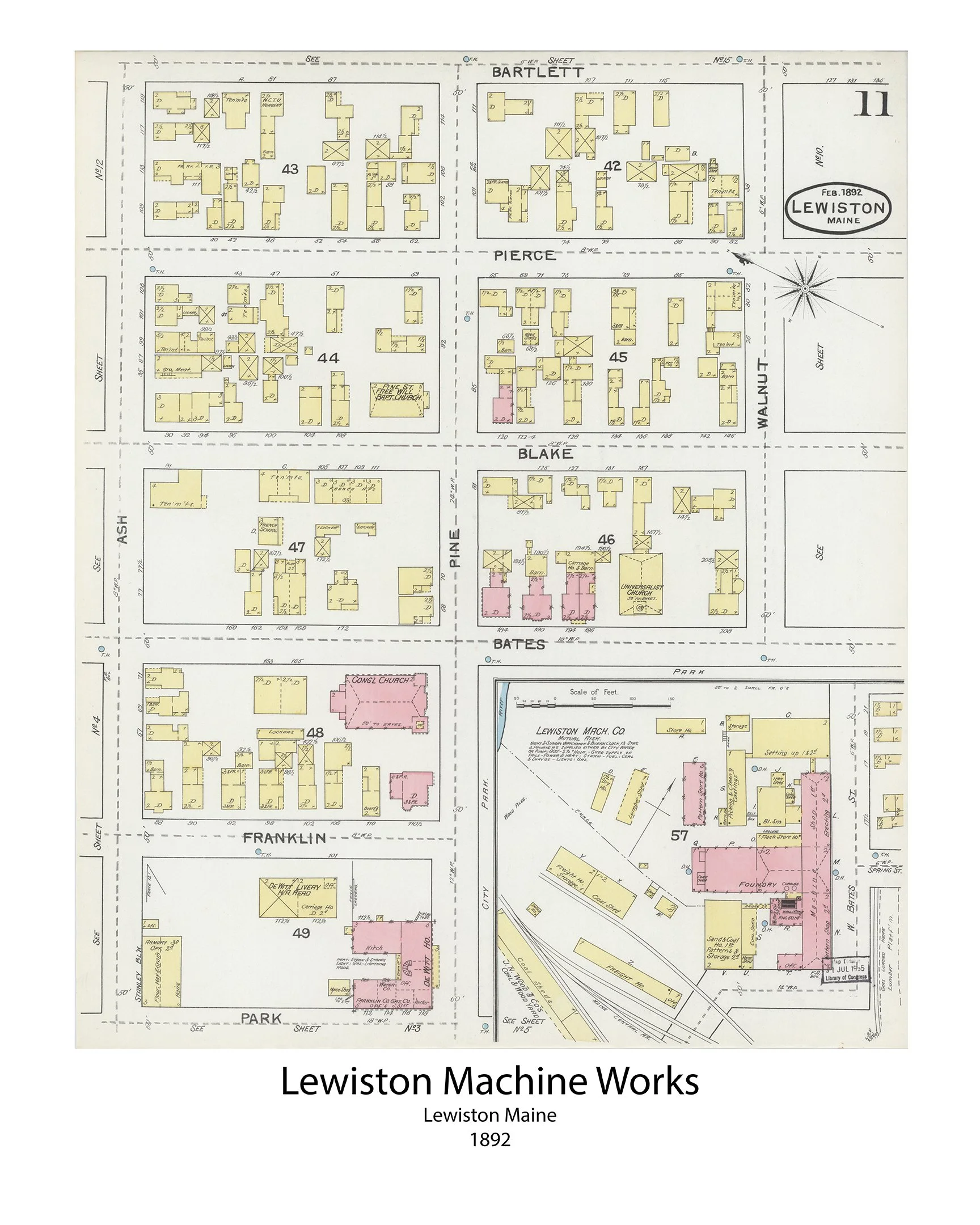
Site Location and Sanborn Map References
The Lewiston Machine Works stood in the industrial district near the Maine Central Railroad depot and the canal system that supplied waterpower to the city’s textile mills. This area developed during the nineteenth century as a cluster of machine shops, warehouses, and foundries supporting Lewiston’s manufacturing economy.²⁵
Sanborn fire insurance maps from the late nineteenth and early twentieth centuries depict large industrial buildings in this district labeled as machine shops, foundries, and pattern shops. These maps indicate the presence of furnaces, casting floors, and machine rooms associated with engineering works such as the Lewiston Machine Works.²⁶
The proximity of the site to both rail transportation and the canal system allowed heavy materials to be transported efficiently to and from the factory while also placing the works within convenient distance of the textile mills that relied upon its machinery and repair services.²⁷
Connections to Bates Mill and the Androscoggin Mill
The Lewiston Machine Works operated within an industrial network created by the Lewiston Water Power Company, which developed the canal and dam system at the Great Falls of the Androscoggin River during the mid-nineteenth century. This waterpower system supported large textile factories including the Bates Manufacturing Company and the Androscoggin Mill.²⁸
Machine shops such as the Lewiston Machine Works were essential to the operation of these factories. Textile mills depended on extensive mechanical systems including turbines, line shafts, gears, looms, and spinning machinery. Because these machines operated continuously and experienced heavy wear, local engineering firms were needed to manufacture replacement parts and perform repairs.²⁹
The Lewiston Machine Works produced iron and brass castings and cotton-mill machinery used in these systems, helping maintain the operation of the Bates mills and other factories throughout the Androscoggin River valley.³⁰
This close relationship between machine shops and textile mills was characteristic of nineteenth-century industrial cities, where engineering firms provided the mechanical infrastructure required for large-scale factory production.³¹
Footnotes
Charles Scontras, Maine in the Industrial Age, 1860–1920 (Orono: University of Maine Bureau of Labor Education, 2006), 72–76.
Douglas I. Hodgkin, Lewiston: The First Century (Lewiston, ME: Lewiston Historical Commission, 1993), 118–121.
Robert G. Doyle, The Industrial History of Maine (Orono: University of Maine Press, 1982), 162–165.
History of Androscoggin County, Maine (Philadelphia: D. W. Ensign & Co., 1891), 629–631.
Ibid., 630.
Ibid., 631.
Doyle, Industrial History of Maine, 167–169.
Ibid., 170–172.
History of Androscoggin County, Maine, 631.
Scontras, Maine in the Industrial Age, 140–142.
Doyle, Industrial History of Maine, 175–177.
John H. Lienhard, Inventing Modern (Oxford: Oxford University Press, 2003), 58–61.
Doyle, Industrial History of Maine, 178–180.
Ibid., 181–182.
Scontras, Maine in the Industrial Age, 126–128.
Ibid., 130–132.
Gerard J. Brault, The French-Canadian Heritage in New England (Hanover, NH: University Press of New England, 1986), 78–80.
Scontras, Maine in the Industrial Age, 132–134.
Hodgkin, Lewiston: The First Century, 146–148.
Doyle, Industrial History of Maine, 182–184.
Scontras, Maine in the Industrial Age, 150–152.
Doyle, Industrial History of Maine, 186–188.
History of Androscoggin County, Maine, 629–631.
Doyle, Industrial History of Maine, 165–167.
Hodgkin, Lewiston: The First Century, 122–125.
Sanborn Map Company, Insurance Maps of Lewiston, Maine (New York: Sanborn Map Company, 1885–1912).
Hodgkin, Lewiston: The First Century, 126–128.
Doyle, Industrial History of Maine, 150–154.
Scontras, Maine in the Industrial Age, 90–95.
Doyle, Industrial History of Maine, 170–173.
Hodgkin, Lewiston: The First Century, 118–120.
Scontras, Maine in the Industrial Age, 84–88.
Doyle, Industrial History of Maine, 175–177.
Brault, French-Canadian Heritage, 80–82.
Scontras, Maine in the Industrial Age, 140–145.
Hodgkin, Lewiston: The First Century, 152–155.
Bibliography
Brault, Gerard J. The French-Canadian Heritage in New England. Hanover, NH: University Press of New England, 1986.
Doyle, Robert G. The Industrial History of Maine. Orono: University of Maine Press, 1982.
Hodgkin, Douglas I. Lewiston: The First Century. Lewiston, ME: Lewiston Historical Commission, 1993.
Lienhard, John H. Inventing Modern: Growing Up with X-Rays, Skyscrapers, and Tailfins. Oxford: Oxford University Press, 2003.
Sanborn Map Company. Insurance Maps of Lewiston, Maine. New York: Sanborn Map Company, 1885–1912.
Scontras, Charles. Maine in the Industrial Age, 1860–1920. Orono: University of Maine Bureau of Labor Education, 2006.
History of Androscoggin County, Maine. Philadelphia: D. W. Ensign & Co., 1891.