Porter Mill, c. 1858
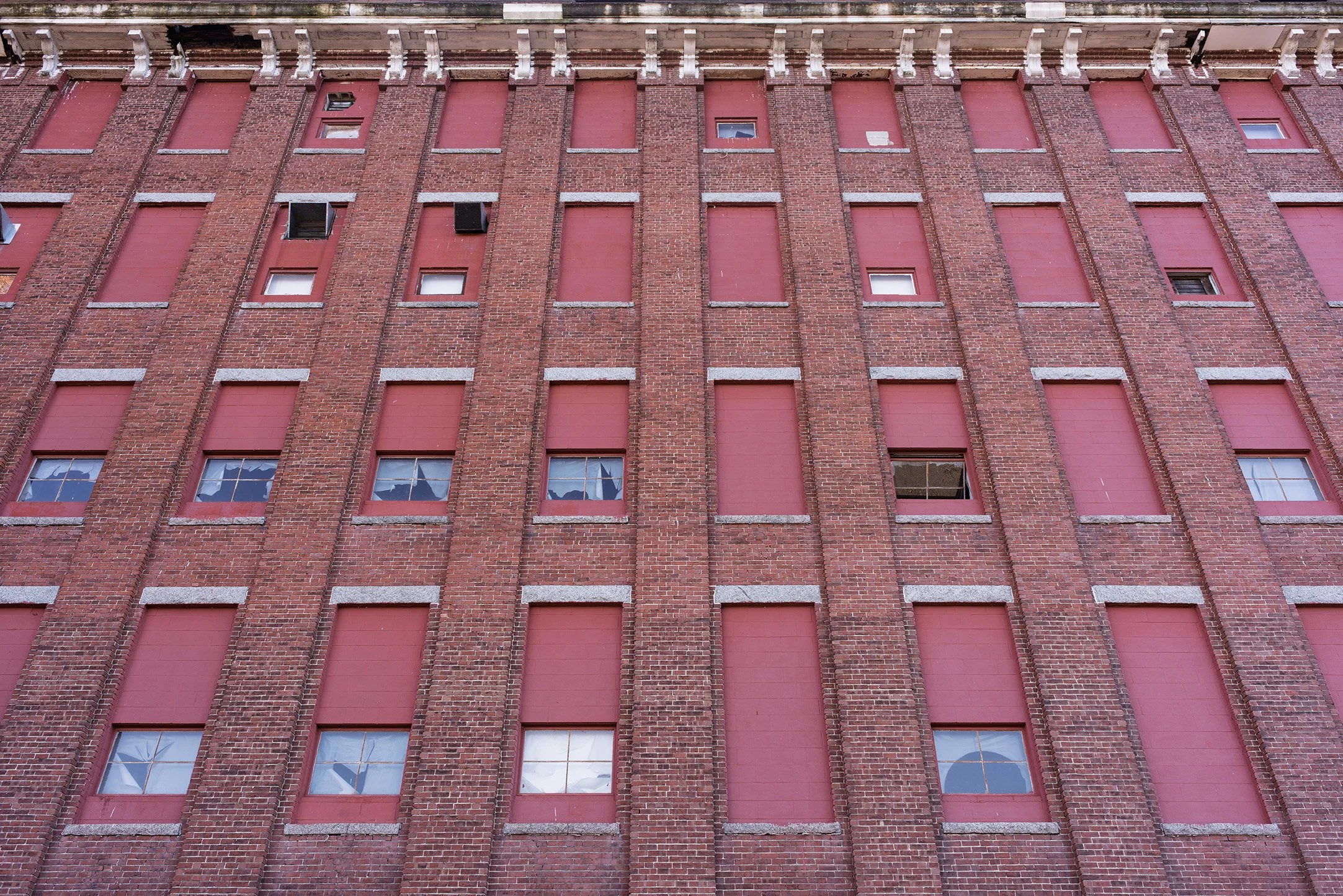
Porter Mill, c. 1858
Main Canal, Great Falls, Androscoggin River
Lewiston, Androscoggin County, Maine
From the Echoes, Still: Maine's Industrial Remnants Collection (2024–2028)
Facades Portfolio
Historical Narrative
Porter Mill: the Making—and Unmaking—of Industrial Lewiston
Kevin LeDuc Pigment print on Hahnemühle Baryta Edition of 5 + 1 Artist's Proof (Portfolio of 40 Images)
Paper Size: 40 × 55 inches Image Size: 31.33 × 37 inches Borders: Approximately 4 inches (All Sides)
Historic Significance
Originally constructed in 1858 as the Porter Mill, the building later known as the Continental Mill stands as a defining symbol of Lewiston's transformation into one of Maine's leading textile manufacturing centers. Powered by the Androscoggin River and the city's engineered canal system, the mill shaped Lewiston's economy, architecture, and community life for nearly a century. Its expansive brick structure reflects both the ambitions of industrial expansion and the experiences of generations of workers whose labor sustained the region's textile industry. Today, the mill remains a powerful reminder of the relationship between waterpower, industry, immigration, labor, and the enduring legacy of Maine's industrial past.
During the nineteenth century, the falls of the Androscoggin River became one of New England's most important sources of industrial power. Construction of the Lewiston canal system enabled manufacturers to harness the river's energy, establishing large-scale textile production along its banks. Mills such as the Porter Mill transformed Lewiston from a small settlement into a thriving manufacturing city connected to regional, national, and international markets.
The rapid growth of the textile industry profoundly reshaped the city's physical and social landscape. Massive brick mill complexes, worker housing, transportation networks, and commercial districts developed to support industrial production. These mills employed thousands of workers and attracted successive generations of immigrants and migrants whose labor and traditions helped define Lewiston's cultural identity.
The Porter Mill—later the Continental Mill—formed an integral part of this larger industrial network, where machinery, waterpower, and human labor combined to manufacture textiles distributed far beyond Maine. More than simply a place of production, the mill served as a center of daily life, where workers forged communities, families established roots, and generations experienced both the opportunities and hardships of industrial labor.
Today, the surviving canals, mill buildings, and altered landscapes preserve the layered history of Lewiston's industrial past. Together, they tell a story of engineering innovation, entrepreneurial ambition, economic growth, immigration, and labor while commemorating the people whose work transformed the city into one of New England's foremost textile centers.
Historical Narrative
-
The vast brick mass of the Continental Mill dominates the Androscoggin Riverfront, a reminder that Lewiston, like Biddeford, was once shaped by the demands of textile production. Originally constructed in 1858 as the Porter Mill, the building emerged during a period when Lewiston was being consciously transformed into an industrial city, designed to harness waterpower and labor with maximum efficiency. Its later acquisition by the Continental Company in 1866 marked the beginning of nearly a century of textile manufacturing that ordered time, work, and community life around cotton production.¹
Lewiston’s rise as a textile center depended on control of natural power. The Continental Mill was built to exploit the immense energy of the Androscoggin River, which was channeled through canals and turbines to drive machinery throughout the building. Early operations relied on water-powered line-shaft systems, with belts and pulleys distributing motion across long mill floors.² As production intensified in the late nineteenth century, steam engines supplemented river power, allowing more consistent operation, while electric motors were gradually introduced in the early twentieth century.³ The evolution of power sources reflects the mill’s constant push for greater output and efficiency.
Inside the Continental Mill, cotton moved through a tightly regimented sequence of machines. Carding machines cleaned and aligned fibers; spinning frames twisted them into yarn; and power looms wove yarn into cloth. Overhead shafting filled the ceilings, transmitting energy and noise throughout the space. The building itself was designed to serve the machinery: thick brick walls to dampen vibration, granite foundations to support weight, cast-iron columns for open floor plans, and expansive windows to provide daylight for precision work.⁴ Like Lincoln Mill in Biddeford, architecture here was not aesthetic—it was industrial logic made permanent.
Yet machines alone did not produce cloth. The Continental Mill depended on human labor, much of it immigrant. Early workers were largely Irish, but by the late nineteenth century French-Canadian families from Quebec formed the core of the workforce. By 1895, the mill employed approximately 1,200 workers, making it one of Lewiston’s largest industrial employers.⁵ Entire neighborhoods developed around mill schedules, Catholic parishes, and extended family labor networks. French was spoken on the shop floor, and generations of families passed through the same departments, binding community identity to industrial work.
Conditions inside the mill were harsh and unforgiving. Employees worked ten to twelve hours a day, six days a week, amid constant noise, heat, and airborne cotton dust. Women and children made up a significant portion of the workforce, particularly in spinning and weaving rooms where wages were lower and labor repetitive. Children changed bobbins, swept floors, and learned obedience to industrial time at an early age, often at the expense of education and health.⁶ As in Biddeford, the rhythms of the mill extended beyond the factory walls, shaping sleep, meals, and social life.
Despite the discipline imposed by mill owners, workers did not remain passive. Labor unrest in Lewiston mirrored broader New England textile struggles, as employees protested wage cuts, layoffs, and unsafe conditions. While mill corporations retained most of the power, these efforts contributed to incremental reforms, including child labor restrictions, shorter workdays, and the early growth of organized labor in Maine’s textile industry.⁷ The Continental Mill thus became not only a site of production but also a space of resistance.
The collapse of textile manufacturing at the Continental Mill followed the same trajectory that doomed mills across northern New England. Beginning in the 1920s and accelerating after World War II, textile production migrated to the southern United States, where lower wages, weaker unions, and reduced costs made northern mills increasingly uncompetitive. Globalization later sealed the industry’s fate. By the mid-twentieth century, textile production at the Continental Mill had ceased, leaving behind a vast industrial structure in search of new purpose.⁸
In the decades that followed, the building housed a succession of secondary industries—shoe manufacturing, stitching operations, and light industrial tenants—before passing into long-term ownership by the Roy family, whose stewardship gave rise to the name “Roy Continental Mill.” Today, the building is recognized as a contributing structure within Lewiston’s historic mill district, acknowledged for its architectural scale and role in the city’s industrial development.
Like Lincoln Mill in Biddeford, the Continental Mill stands as a physical record of industrial ambition and human cost. It was a machine for organizing labor, regulating time, and extracting value from both water and workers. To view it solely as a redevelopment opportunity is to overlook its deeper meaning. The Continental Mill tells the story of how industrial capitalism built cities, shaped immigrant lives, and ultimately abandoned the communities it once sustained. Its walls remain, not as relics of progress, but as evidence of work, endurance, and loss.
Footnotes
Earl F. Niehoff, The Mills of Maine (Augusta: Maine State Museum, 1975).
Robert M. Vogel, Industrial Architecture of the United States (Washington, DC: Smithsonian Institution Press, 1988).
Niehoff, The Mills of Maine.
Carol Poh Miller and Robert A. Wheeler, Lewiston–Auburn: An Industrial Heritage (Charleston, SC: Arcadia Publishing, 2005).
Miller and Wheeler, Lewiston–Auburn.
Thomas Dublin, Women at Work: The Transformation of Work and Community in Lowell, Massachusetts, 1826–1860 (New York: Columbia University Press, 1979).
David Brody, Workers in Industrial America: Essays on the Twentieth-Century Struggle (New York: Oxford University Press, 1980).
Niehoff, The Mills of Maine.
Bibliography
Brody, David. Workers in Industrial America: Essays on the Twentieth-Century Struggle. New York: Oxford University Press, 1980.
Dublin, Thomas. Women at Work: The Transformation of Work and Community in Lowell, Massachusetts, 1826–1860. New York: Columbia University Press, 1979.
Miller, Carol Poh, and Robert A. Wheeler. Lewiston–Auburn: An Industrial Heritage. Charleston, SC: Arcadia Publishing, 2005.
Niehoff, Earl F. The Mills of Maine. Augusta: Maine State Museum, 1975.
Vogel, Robert M. Industrial Architecture of the United States. Washington, DC: Smithsonian Institution Press, 1988.