Mill No. 12 No. 1, c. 1890
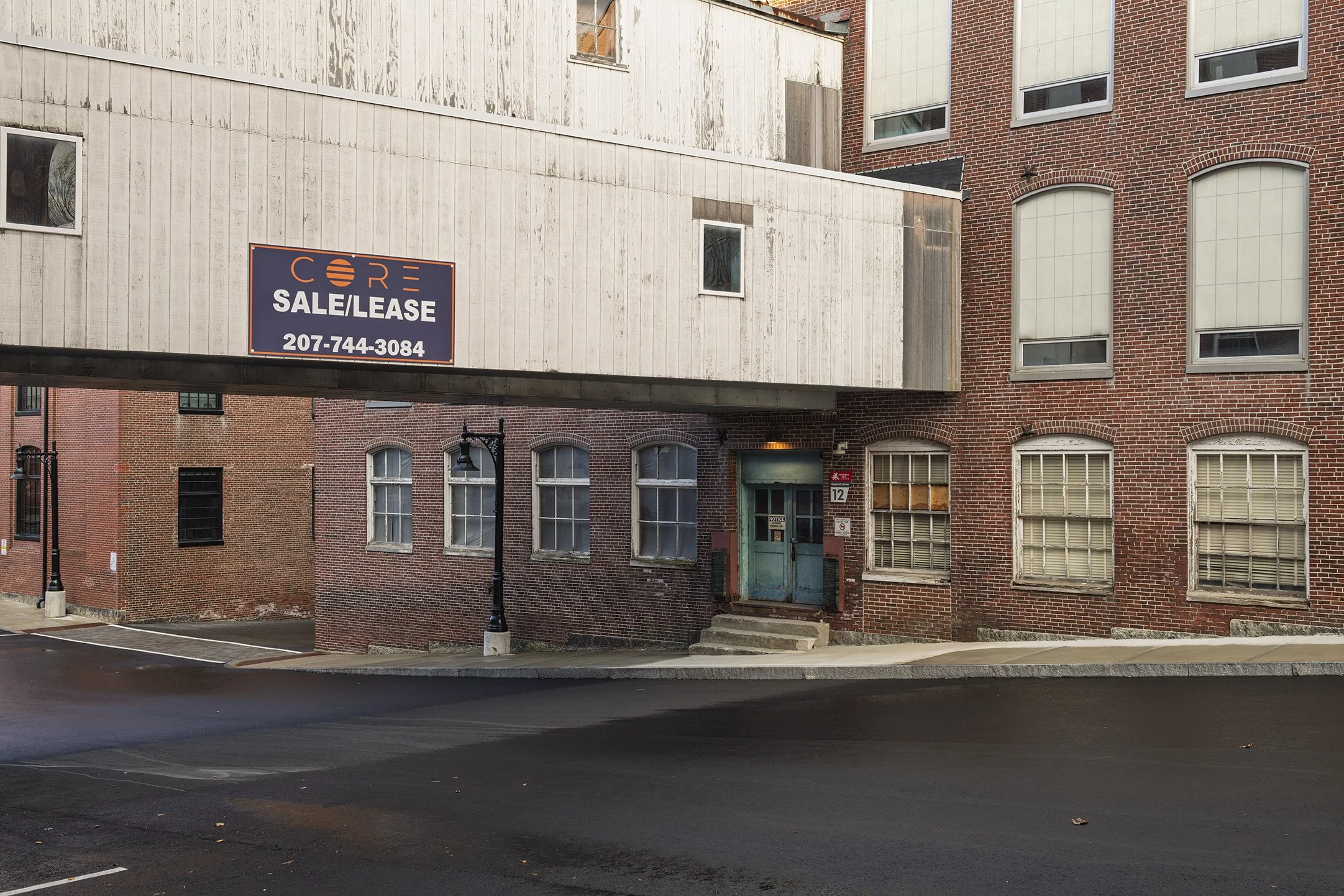
Mill No. 12 No. 1, c. 1890
Pepperell Manufacturing Company
Saco River, Lower Falls
Biddeford, York County, Maine
From the Echoes, Still: Maine's Industrial Remnants Collection (2024–2028)
Exteriors Portfolio
Historical Narrative
Kevin LeDuc Pigment print on Hahnemühle Baryta Rag Edition of 5 + 1 Artist’s Proof (A/P) + 1 Bon à Tirer (B.A.T.) Portfolio of 40 Images
Paper Size: 35 × 50 inches Image Size: 30 × 45 inches Borders: Approximately 2 ½ inches (All Sides) Mounting: Archival hinge or float mounting
Historic Significance
Mill No. 12 at the Pepperell Mill complex in Biddeford, Maine, represents the growth and industrial sophistication of New England’s textile industry during the late nineteenth century. Constructed in 1890 as part of the expanding Pepperell Manufacturing Company, the mill contributed to Biddeford’s development into one of Maine’s leading textile centers. The Pepperell complex, established in 1844 along the Saco River, expanded throughout the nineteenth century with additional mills, canals, power systems, machine shops, and warehouses. Mill No. 12 reflected the increasing scale and specialization of textile manufacturing during the American Industrial Revolution.
The building incorporated many features typical of late nineteenth-century textile mills, including heavy brick construction, large windows for natural lighting and ventilation, and open interior spaces designed to accommodate large amounts of machinery. Textile production was becoming increasingly mechanized during this period, with waterpower supplemented by steam and electrical systems. Mill No. 12 operated as part of Pepperell’s integrated production system, which transformed raw cotton into products such as sheeting, blankets, towels, thread, and industrial fabrics. Advances in spinning, weaving, and electrical equipment allowed manufacturers to increase production and improve efficiency.
The success of Mill No. 12 and the larger Pepperell complex depended heavily on immigrant labor. Irish workers contributed to the early development of the mill infrastructure, while French Canadian immigrants became a major part of the workforce by the late nineteenth century, followed by Italian and eastern European workers. Employees faced long hours, loud machinery, airborne cotton fibers, and repetitive work, but the mills provided steady employment that supported Biddeford’s growing neighborhoods and immigrant communities. By the early twentieth century, thousands of workers were employed throughout the Biddeford-Saco mill district, making textile manufacturing the foundation of the local economy.
During the twentieth century, however, New England’s textile industry declined as southern mills gained advantages through lower labor costs, newer facilities, and closer access to cotton supplies. Despite efforts to modernize, the Pepperell complex gradually lost employment and production, particularly after World War II as textile manufacturing moved south and eventually overseas. Mill No. 12 survived the decline and became part of preservation and redevelopment efforts at the Pepperell Mill Campus. Today, the building serves as a reminder of Biddeford’s industrial heritage and the technological development, immigrant labor, and economic transformation that shaped New England’s textile industry.
Historical Narrative
-
The History of Mill No. 12 at the Pepperell Mill Complex in Biddeford, Maine
Mill No. 12 at the Pepperell Mill complex in Biddeford, Maine, reflects the continued expansion and industrial sophistication of New England textile manufacturing during the late nineteenth and early twentieth centuries. Constructed in 1890 as part of the growing Pepperell Manufacturing Company along the Saco River, Mill No. 12 contributed to the integrated production system that transformed Biddeford into one of Maine’s most important textile centers. Like other buildings within the Biddeford-Saco mill district, Mill No. 12 demonstrates the technological innovation, labor organization, and architectural development associated with large-scale industrial manufacturing during the American Industrial Revolution.
The Pepperell Manufacturing Company was established in 1844 to utilize the extensive waterpower generated by the falls of the Saco River.¹ Investors and industrialists connected to the New England cotton textile industry sought to create a manufacturing complex capable of competing with established industrial cities such as Lowell, Lawrence, and Manchester. During the second half of the nineteenth century, the company steadily expanded through the construction of additional mills, canals, turbine systems, machine shops, and warehouses. Mill No. 12 emerged during this broader period of industrial growth as textile demand increased throughout the United States and foreign markets.²
Mill No. 12 was built during an era when textile manufacturing had become increasingly mechanized and specialized. Earlier factories in the Pepperell complex relied heavily upon direct waterpower systems that transferred energy mechanically through shafts and belts connected to water turbines beneath the buildings.³ By the late nineteenth century, however, steam engines and electrical systems increasingly supplemented hydraulic power, allowing mills such as No. 12 to operate more efficiently and flexibly. The integration of newer power technologies enabled larger production floors and more advanced machinery layouts.
Architecturally, Mill No. 12 reflected common industrial design principles of the late nineteenth-century textile industry. The structure utilized heavy brick construction intended to reduce fire hazards and support large machinery loads.⁴ Large industrial windows provided natural illumination and ventilation, while open interior spaces allowed factory managers to organize rows of spinning frames and weaving machinery for maximum productivity. The building’s design emphasized durability, efficiency, and centralized supervision consistent with industrial management practices of the period.
Mill No. 12 functioned primarily within the textile production system of the Pepperell complex, supporting spinning, weaving, or finishing operations depending upon changing production needs over time.⁵ Raw cotton shipped from the American South entered the manufacturing process through cleaning and carding operations before being spun into yarn and woven into finished cloth products. Pepperell mills manufactured cotton sheeting, blankets, towels, thread, and industrial fabrics distributed throughout national and international markets.⁶ The machinery housed within Mill No. 12 reflected ongoing technological advancements in textile production, including improved spinning frames, mechanized looms, and electrically assisted equipment that increased production speed and efficiency.
The operation of Mill No. 12 depended heavily upon immigrant labor. Irish workers played an important role in the early construction of the canal and mill systems, while French Canadian immigrants became one of the dominant labor groups employed within the Pepperell mills by the late nineteenth century.⁷ Additional immigrant populations, including Italians and eastern Europeans, later contributed to the industrial workforce of Biddeford. Employees inside Mill No. 12 worked long hours in environments characterized by loud machinery, airborne cotton fibers, and repetitive labor.⁸ Despite difficult working conditions, employment in the mills provided steady wages and contributed to the growth of Biddeford’s industrial neighborhoods and ethnic communities.
By the early twentieth century, the Biddeford-Saco mill district had reached the height of its industrial capacity. Thousands of workers were employed throughout the Pepperell complex, making textile manufacturing the economic foundation of the region.⁹ Mill No. 12 operated as part of this extensive integrated system of mills, warehouses, machine shops, and power infrastructure connected through coordinated production methods.
However, the prosperity of New England’s textile industry began to decline during the twentieth century. Southern manufacturers increasingly competed with northern mills through lower labor costs, newer factories, reduced transportation expenses, and proximity to cotton supplies.¹⁰ Although Pepperell attempted to modernize production through electrical systems and new machinery, the economic advantages of southern manufacturing gradually weakened industrial centers such as Biddeford. After World War II, textile production increasingly shifted to the American South and eventually overseas, causing employment throughout the Pepperell complex to decline significantly.¹¹
Like many structures within the mill district, Mill No. 12 experienced reduced industrial activity during the second half of the twentieth century. As textile manufacturing disappeared from Biddeford, the building became part of broader preservation and redevelopment efforts intended to revitalize the city’s historic industrial landscape. Rather than being demolished, the structure survived as part of the Pepperell Mill Campus redevelopment.
Today, Mill No. 12 remains an important reminder of Biddeford’s industrial past. Although the machinery and production floors that once defined the building are gone, the structure continues to symbolize the technological progress, immigrant labor, and economic transformation associated with New England’s textile era.
Footnotes
Maine Historic Preservation Commission, Biddeford-Saco Mills Historic District National Register Nomination Form (Augusta: Maine Historic Preservation Commission, 1978), 8–10.
Pepperell Manufacturing Company, The Romance of Pepperell: A Brief Account of How a Great Industry Developed at Biddeford (Biddeford, ME: Pepperell Manufacturing Company, 1921), 10–15.
Louis C. Hunter, A History of Industrial Power in the United States, 1780–1930, vol. 1, Waterpower in the Century of the Steam Engine (Charlottesville: University Press of Virginia, 1979), 233–240.
Maine Historic Preservation Commission, Biddeford-Saco Mills Historic District National Register Nomination Form, 17–19.
David A. Hounshell, From the American System to Mass Production, 1800–1932 (Baltimore: Johns Hopkins University Press, 1984), 67–74.
Pepperell Manufacturing Company, The Romance of Pepperell, 15–24.
Yves Roby, The Franco-Americans of New England: Dreams and Realities (Montreal: McGill-Queen’s University Press, 2004), 52–61.
Thomas Dublin, Women at Work: The Transformation of Work and Community in Lowell, Massachusetts, 1826–1860 (New York: Columbia University Press, 1979), 121–132.
Maine Historic Preservation Commission, Biddeford-Saco Mills Historic District National Register Nomination Form, 18–21.
Gavin Wright, Old South, New South: Revolutions in the Southern Economy since the Civil War (New York: Basic Books, 1986), 143–150.
William Lazonick, Competitive Advantage on the Shop Floor (Cambridge, MA: Harvard University Press, 1990), 219–254.
Bibliography
Dublin, Thomas. Women at Work: The Transformation of Work and Community in Lowell, Massachusetts, 1826–1860. New York: Columbia University Press, 1979.
Hounshell, David A. From the American System to Mass Production, 1800–1932. Baltimore: Johns Hopkins University Press, 1984.
Hunter, Louis C. A History of Industrial Power in the United States, 1780–1930. Vol. 1, Waterpower in the Century of the Steam Engine. Charlottesville: University Press of Virginia, 1979.
Lazonick, William. Competitive Advantage on the Shop Floor. Cambridge, MA: Harvard University Press, 1990.
Maine Historic Preservation Commission. Biddeford-Saco Mills Historic District National Register Nomination Form. Augusta: Maine Historic Preservation Commission, 1978.
Pepperell Manufacturing Company. The Romance of Pepperell: A Brief Account of How a Great Industry Developed at Biddeford. Biddeford, ME: Pepperell Manufacturing Company, 1921.
Roby, Yves. The Franco-Americans of New England: Dreams and Realities. Montreal: McGill-Queen’s University Press, 2004.
Wright, Gavin. Old South, New South: Revolutions in the Southern Economy since the Civil War. New York: Basic Books, 1986.
-
The history of the Pepperell Mill complex in Biddeford, Maine, illustrates the rise and decline of industrial textile manufacturing in New England during the nineteenth and twentieth centuries. Constructed along the falls of the Saco River, the mills transformed Biddeford from a small river settlement into one of the region’s leading manufacturing centers. For more than 150 years, the Pepperell mills shaped the city’s economy, labor force, immigration patterns, and urban development. Their growth reflected the broader expansion of American industrial capitalism, while their eventual decline mirrored the collapse of New England’s textile industry in the twentieth century.
Industrial development in Biddeford began with the recognition that the Saco River possessed immense waterpower potential. During the early nineteenth century, investors sought to replicate the successful textile manufacturing systems already established in Lowell and Lawrence, Massachusetts. In 1837, local industrialists and Boston investors organized the Saco Water Power Company to develop the river’s falls for large-scale manufacturing.^1 Among the most influential figures was Samuel Batchelder, a prominent textile manufacturer and engineer associated with the early Lowell mills. Batchelder and his associates recognized that the forty-foot drop of the Saco River could support a major textile enterprise.^2
The Pepperell Manufacturing Company was formally incorporated in 1844 as part of this larger industrial initiative.^3 Initial investors included Boston merchants, industrial financiers, and textile entrepreneurs connected to New England’s expanding cotton industry. The company’s leadership drew heavily from established textile manufacturing networks centered in Massachusetts. Their objective was to create a vertically integrated industrial complex capable of spinning, weaving, bleaching, dyeing, and finishing cotton textiles within a single manufacturing district.^4
Construction of the mills required extensive engineering work. Irish immigrant laborers excavated canals and foundations by hand, while skilled stone masons constructed underground granite tunnels and water channels beneath the factory buildings.^5 The waterpower system became one of the defining technological features of the Pepperell mills. Engineers designed a series of canals, turbine chambers, and underground lagoons that directed water from the Saco River through the industrial complex. Water entered upper canals, flowed through turbines beneath the mills, and exited through lower channels back toward the river.^6
The earliest mills relied entirely upon waterpower transmitted mechanically through shafts, gears, and leather belt systems. Massive waterwheels and later iron turbines converted hydraulic energy into rotational motion that powered spinning frames and weaving machinery throughout the buildings.^7 During the late nineteenth century, steam engines supplemented waterpower, particularly during periods of fluctuating river flow. Eventually, electrical systems replaced direct mechanical transmission, allowing machinery to operate more efficiently and independently within the factory complex.^8
The machinery used at Pepperell reflected major technological developments in textile manufacturing during the Industrial Revolution. Early production centered on spinning mules, carding machines, and power looms adapted from English industrial designs.^9 Raw cotton imported primarily from the American South arrived by rail and ship before entering the production process. Workers first cleaned and carded the cotton fibers to align them into continuous strands. These strands were then spun into yarn using mechanized spinning frames before being transferred to weaving rooms containing hundreds of looms.^10
The mills produced a variety of cotton goods, including sheeting, blankets, towels, thread, and woven fabrics. Production methods became increasingly specialized during the late nineteenth and early twentieth centuries. Large weave rooms operated continuously with rows of mechanized looms powered by overhead shaft systems.^11 After weaving, fabrics underwent bleaching, dyeing, washing, and finishing processes that prepared them for commercial sale. Chemical treatments and industrial finishing techniques improved texture, whiteness, and durability. By the early twentieth century, the company also manufactured synthetic and blended fabrics in response to changing consumer demand and technological innovation.^12
The rapid expansion of the Pepperell mills transformed Biddeford into an industrial city. During the second half of the nineteenth century, thousands of workers migrated to the area seeking employment. Irish immigrants formed one of the earliest labor groups, followed by large numbers of French Canadians from Quebec.^13 Additional immigrant communities, including Albanians, Italians, and eastern Europeans, later settled in Biddeford as textile production expanded.^14 Entire neighborhoods developed around the mills, with churches, schools, and boarding houses serving the growing industrial population.
Working conditions inside the mills reflected the realities of nineteenth-century factory labor. Employees typically worked ten- to twelve-hour shifts in noisy weaving rooms filled with cotton dust and airborne fibers.^15 Women and children composed a significant portion of the workforce during the early decades of operation. Supervisors closely monitored production speed and machine efficiency, while workers endured dangerous machinery, poor ventilation, and repetitive labor.^16 Despite these conditions, mill employment provided economic stability for many immigrant families and contributed to the growth of Biddeford’s middle and working classes.
Pepperell Manufacturing expanded significantly during the late nineteenth century through modernization and consolidation. In 1899, the company acquired the neighboring Laconia Mills operation, greatly increasing its production capacity.^17 New buildings incorporated improved industrial architecture, including fire-resistant brick construction and enhanced lighting systems. One of the most distinctive structures was Mill #13, completed in 1911 with a sawtooth roof that maximized natural daylight within weaving spaces before widespread fluorescent lighting.^18
The Biddeford-Saco mill district reached its industrial peak during the early twentieth century. At its height, the mills employed approximately 12,000 workers across multiple complexes along the river.^19 Textile products manufactured at Pepperell were distributed throughout the United States and exported internationally. The mills also stimulated the development of railroads, commercial districts, housing construction, and supporting industries throughout York County.
Despite this prosperity, the textile industry in New England began to decline during the early twentieth century. Southern textile manufacturers increasingly outcompeted northern mills because of lower labor costs, weaker unions, reduced taxes, and proximity to raw cotton supplies.^20 Technological changes also diminished the importance of river-powered manufacturing centers like Biddeford. New southern factories were often more modern, efficient, and easier to expand than the aging multi-story mills of New England.^21
Labor unrest and economic instability further contributed to industrial decline. Textile workers throughout New England organized strikes in response to wage reductions and worsening working conditions during the 1920s and 1930s.^22 Although Pepperell attempted to modernize production and diversify into synthetic materials and nonwoven products, employment steadily decreased after World War II. Increasing global competition and the movement of manufacturing overseas accelerated the collapse of the domestic textile industry during the second half of the twentieth century.^23
The company eventually became associated with larger corporate consolidations, including WestPoint Pepperell. While some textile production continued into the late twentieth century, the mills no longer operated at their historic scale. In 2009, the final textile manufacturing operations ceased in Biddeford, ending more than 150 years of continuous industrial production.^24
Although manufacturing disappeared, the Pepperell mill complex survived as one of the largest historic industrial sites in Maine. During the early twenty-first century, preservationists and developers converted the buildings into apartments, offices, artist studios, restaurants, and commercial spaces.^25 Today, the former mills remain central to Biddeford’s identity and serve as enduring reminders of the industrial era that shaped the city’s economic and cultural history.
Footnotes
Bryant F. Tolles Jr., The Textile Mill in Early New England (Hanover, NH: University Press of New England, 1973), 44–48.
Pepperell Manufacturing Company, The Romance of Pepperell: A Brief Account of How a Great Industry Developed at Biddeford (Biddeford, ME: Pepperell Manufacturing Company, 1921), 3–5.
Maine Historic Preservation Commission, Biddeford-Saco Mills Historic District National Register Nomination Form (Augusta: Maine Historic Preservation Commission, 1978), 8.
Pepperell Manufacturing Company, The Romance of Pepperell, 6–10.
Maine Historic Preservation Commission, Biddeford-Saco Mills Historic District, 11.
Ibid., 12–14.
Louis C. Hunter, A History of Industrial Power in the United States, 1780–1930, vol. 1, Waterpower in the Century of the Steam Engine (Charlottesville: University Press of Virginia, 1979), 233–240.
Patrick M. Malone, The Skulking Way of War: Technology and Tactics among the New England Indians (Baltimore: Johns Hopkins University Press, 1991), 17–18.
Tolles, The Textile Mill in Early New England, 83–91.
David A. Hounshell, From the American System to Mass Production, 1800–1932 (Baltimore: Johns Hopkins University Press, 1984), 67–74.
Pepperell Manufacturing Company, The Romance of Pepperell, 15–22.
Gary Kulik and Julia C. Bonham, Rhode Island: An Inventory of Historic Engineering and Industrial Sites (Washington, DC: Historic American Engineering Record, 1978), 214–216.
Yves Roby, The Franco-Americans of New England: Dreams and Realities (Montreal: McGill-Queen’s University Press, 2004), 52–59.
Maine Historic Preservation Commission, Biddeford-Saco Mills Historic District, 16.
Thomas Dublin, Women at Work: The Transformation of Work and Community in Lowell, Massachusetts, 1826–1860 (New York: Columbia University Press, 1979), 121–127.
Ibid., 128–132.
Maine Historic Preservation Commission, Biddeford-Saco Mills Historic District, 18.
Ibid., 20.
Roby, The Franco-Americans of New England, 61.
Gavin Wright, Old South, New South: Revolutions in the Southern Economy since the Civil War (New York: Basic Books, 1986), 143–150.
William Lazonick, Competitive Advantage on the Shop Floor (Cambridge, MA: Harvard University Press, 1990), 219–226.
Jeremy Brecher, Strike! (Boston: South End Press, 1972), 139–144.
Lazonick, Competitive Advantage on the Shop Floor, 248–254.
Maine Historic Preservation Commission, Biddeford-Saco Mills Historic District, 24.
Richard Candee, Building Portsmouth: The Neighborhood Architecture of New Hampshire’s Oldest City (Charlottesville: University Press of Virginia, 2006), 301–305.
Bibliography
Brecher, Jeremy. Strike!. Boston: South End Press, 1972.
Candee, Richard. Building Portsmouth: The Neighborhood Architecture of New Hampshire’s Oldest City. Charlottesville: University Press of Virginia, 2006.
Dublin, Thomas. Women at Work: The Transformation of Work and Community in Lowell, Massachusetts, 1826–1860. New York: Columbia University Press, 1979.
Hounshell, David A. From the American System to Mass Production, 1800–1932. Baltimore: Johns Hopkins University Press, 1984.
Hunter, Louis C. A History of Industrial Power in the United States, 1780–1930. Vol. 1, Waterpower in the Century of the Steam Engine. Charlottesville: University Press of Virginia, 1979.
Kulik, Gary, and Julia C. Bonham. Rhode Island: An Inventory of Historic Engineering and Industrial Sites. Washington, DC: Historic American Engineering Record, 1978.
Lazonick, William. Competitive Advantage on the Shop Floor. Cambridge, MA: Harvard University Press, 1990.
Maine Historic Preservation Commission. Biddeford-Saco Mills Historic District National Register Nomination Form. Augusta: Maine Historic Preservation Commission, 1978.
Pepperell Manufacturing Company. The Romance of Pepperell: A Brief Account of How a Great Industry Developed at Biddeford. Biddeford, ME: Pepperell Manufacturing Company, 1921.
Roby, Yves. The Franco-Americans of New England: Dreams and Realities. Montreal: McGill-Queen’s University Press, 2004.
Tolles, Bryant F., Jr. The Textile Mill in Early New England. Hanover, NH: University Press of New England, 1973.
Wright, Gavin. Old South, New South: Revolutions in the Southern Economy since the Civil War. New York: Basic Books, 1986.