Burrell, Houghton & Company, Boot & Shoe, c. 1888

Burrell, Houghton & Company, Boot & Shoe, c. 1888
Knowlton Park 401–409 State Street Ellsworth, Hancock County, Maine
From the Echoes, Still: Maine's Industrial Remnants Collection (2024–2028)
Empty Empires Portfolio
Historical Narrative
Industrial Heritage of Ellsworth, Volume I: Burrell, Houghton & Company Boot & Shoe Factory, c. 1888
Kevin LeDuc Pigment print on Hahnemühle Baryta Edition of 5 + 1 Artist's Proof (Portfolio of 40 Images)
Paper Size: 40 × 55 inches Image Size: 31.33 × 37 inches Borders: Approximately 4 inches (All Sides)
Historic Significance
The State Street Factory was one of Ellsworth's most important industrial buildings, serving as a center of manufacturing for nearly seventy years. Constructed between 1884 and 1888 through local initiative, the three-story wood-frame factory illustrates how Maine communities invested in industrial infrastructure to attract manufacturers, create employment, and diversify their local economies. The documented chronology establishes the building's development: the 1884 Sanborn Fire Insurance Map shows no factory at the site; by 1888, a newly completed boot and shoe factory was operating under Burrell, Houghton & Co.; the November 1889 factory floor plans reveal an organized manufacturing operation, with finishing and packing on the first floor, a sole leather room and bottoming department on the second floor, and cutting and stitching on the third floor; and by 1895, the Sanborn Fire Insurance Map identified the same building as B.E. Cole & Company, Boot & Shoe Mfy. This chronology demonstrates that the factory itself predated B.E. Cole & Company and originated as a community-built industrial facility intended to attract manufacturing investment.
Burrell, Houghton & Co. holds particular historical significance as the first documented occupant of the State Street Factory and the company that established organized boot and shoe manufacturing at the site. Rather than constructing its own factory, the Massachusetts firm occupied a purpose-built industrial facility provided by Ellsworth citizens, combining outside manufacturing expertise with local initiative. Its successful operation demonstrated the effectiveness of community-sponsored industrial development, bringing skilled manufacturing, employment opportunities, and commercial investment to Ellsworth while illustrating the broader pattern of late nineteenth-century New England industrial expansion. Although the company's tenure was relatively brief, it established the industrial foundation upon which later manufacturers, including B.E. Cole & Company and the Ellsworth Hardwood Company, continued nearly seventy years of continuous manufacturing at the site.
The State Street Factory reflects the evolution of Ellsworth's industrial economy from community-sponsored boot and shoe manufacturing to diversified industrial production. Its succession of occupants demonstrates the adaptability of a purpose-built factory to changing markets while preserving its role as an important center of employment and manufacturing. Although the building was destroyed by fire in 1957 and the site was later redeveloped as Knowlton Elementary School and, subsequently, Knowlton Park, the factory remains historically significant as an example of local investment in industrial development and as the birthplace of one of Ellsworth's longest-lived manufacturing sites.
Historical Narrative
-
Industrial Heritage of Ellsworth
The History of 401–409 State Street, Ellsworth, Maine
Volume I
Burrell, Houghton & Company Boot & Shoe Factory, c. 1888
The Construction of Ellsworth’s First Modern Shoe Factory
Introduction
On State Street in Ellsworth, Maine, stood a factory that represented the community’s determination to create a modern manufacturing presence at the end of the nineteenth century. Constructed in 1888, the three-story wood-frame building at 401–409 State Street became one of the city’s most significant industrial properties, serving as a manufacturing center for nearly seventy years.¹
Although later generations associated the building primarily with B.E. Cole & Company, the factory’s earliest documented occupant was Burrell, Houghton & Company. The distinction is important because the building itself predates the Cole operation. The State Street Factory was an Ellsworth industrial project that changed operators over time. The 1888 Sanborn Fire Insurance Map identifies the building as “Burrell, Houghton & Co. Boot and Shoe Mfy.,” establishing the company’s role as the first documented manufacturer in the structure.²
The factory represented a different model of industrial development from the older water-powered mills found throughout Maine. Instead of being located beside a river or traditional mill privilege, the State Street Factory was equipped with its own steam-power system. The Sanborn map documents an engine room and associated structures, indicating that the building was designed as a self-powered manufacturing facility.³
The construction of the factory reflected a larger nineteenth-century effort by smaller New England communities to attract manufacturing. Ellsworth was not simply waiting for industry to develop naturally; it invested in the physical infrastructure necessary to bring manufacturing into the community.
Ellsworth’s Industrial Ambition
During the late nineteenth century, manufacturing was widely viewed as a pathway to economic growth. Factories created wage employment, encouraged commercial activity, and provided communities with a stronger industrial identity.
Shoe manufacturing was particularly suited to this period of development. Unlike large textile operations that required extensive water power, shoe factories depended more heavily on skilled labor, specialized machinery, and organized production systems. This allowed communities without major industrial rivers to participate in the industry.
The decision to construct a shoe factory in Ellsworth reflected this changing industrial environment. The town could provide a building, while an experienced shoe manufacturer could provide management, equipment, and production knowledge.
The resulting factory was therefore a partnership between local initiative and outside industrial expertise.
The State Street Site
The location of the factory on State Street represented a deliberate choice. Traditional nineteenth-century mills often followed water resources, but steam-powered factories had greater flexibility in selecting locations.
The State Street property provided space for a large industrial building and supporting structures. The factory required not only production floors but also an engine room, fuel storage, and areas for receiving materials and shipping finished goods.
The use of steam power reduced the need for a river location. Instead, the site could be selected based on available land and suitability for industrial development.
The building’s location also separated heavy industrial activity from the more concentrated commercial areas of Ellsworth. Boilers, coal storage, machinery, and manufacturing materials created safety considerations that made a slightly removed location practical.
The surviving documentation clearly establishes the factory’s location and construction, but the identities of all individuals involved in organizing the project remain uncertain. Any claims regarding specific founders or investors should be made only when supported by additional business records or contemporary accounts.
Construction of the Factory
The 1888 Sanborn Fire Insurance Map provides the earliest detailed description of the State Street Factory. It identifies the building as a boot and shoe manufacturing facility operated by Burrell, Houghton & Company.⁴
The building was a three-story wood-frame factory designed for organized industrial production. Its size and arrangement reflected the requirements of late nineteenth-century shoe manufacturing, where different stages of production were separated into departments.
A major feature of the building was the brick engine room. This structure housed the steam machinery that powered factory operations. The associated coal house provided fuel storage, while the smokestack carried away exhaust from the boiler system.⁵
Together, these features demonstrate that the factory represented modern industrial technology for its period.
The building did not depend on natural water power. Instead, it generated mechanical power on site. This allowed Ellsworth to establish a manufacturing facility without the geographic limitations faced by older mill communities.
Burrell, Houghton & Company
Burrell, Houghton & Company was the first documented manufacturer to occupy the State Street Factory. The company’s presence connected Ellsworth to the larger New England shoe industry.
By the late nineteenth century, Massachusetts had become one of the leading centers of footwear manufacturing in the United States. Companies in the region had developed specialized production systems that relied on machinery, divided labor, and factory organization.
The arrival of Burrell, Houghton & Company allowed Ellsworth to participate in this established industry. The town provided the physical facility; the company brought manufacturing experience.
The available evidence confirms the company’s operation in the building in 1888, but the exact duration of its occupation and the circumstances of its departure require additional documentation.⁶
What can be established is that Burrell, Houghton & Company began the industrial history of the State Street Factory.
Factory Production and Organization
The State Street Factory was designed for the type of organized production that defined late nineteenth-century shoe manufacturing. Unlike a small workshop where a single craftsman completed an entire pair of shoes, the factory system divided production into specialized operations performed by different workers.
This division of labor increased efficiency and allowed manufacturers to produce footwear in larger quantities. Raw materials entered the factory, moved through a series of departments, and emerged as completed products ready for shipment.
The three-story arrangement of the building supported this production system. Although the 1888 Sanborn map does not record every machine or department, the building’s design is consistent with the organization used by New England shoe factories of the period.⁷
The upper floors would have provided space for preparation and assembly work, while lower levels were suited for finishing, storage, offices, and shipping activities. The exact arrangement of departments during the Burrell, Houghton & Company period requires additional company records, but the building itself clearly reflected the needs of industrial footwear production.
The factory’s design reveals an important feature of nineteenth-century manufacturing: the building was not simply a shelter for workers and machinery. It was an organized production system. The arrangement of floors, power equipment, storage areas, and workspaces all contributed to the efficient movement of materials through the manufacturing process.
Steam Power and Industrial Technology
The State Street Factory’s most distinctive feature was its use of steam power.
Many earlier Maine factories were built around water privileges, where rivers supplied mechanical energy. Steam technology changed this relationship between industry and geography. A manufacturer no longer needed to locate beside a waterfall or millstream. Instead, factories could be constructed where land, labor, and community support were available.
The Sanborn map identifies a separate engine room and coal house, providing direct evidence of the factory’s steam-powered operation.⁸ The engine room was constructed of brick, reflecting the safety requirements associated with boilers and industrial machinery.
Coal was essential to this system. Deliveries of fuel supplied the boiler, which produced steam to operate the engine. The smokestack visible in historic photographs was part of this power arrangement, carrying away exhaust from the boiler system.⁹
This technology explains why the State Street location was practical. The factory did not need a river because it carried its own power source within the building complex.
In this respect, the factory represented a transition in Maine industrial history. It combined local initiative with modern manufacturing technology and demonstrated that communities outside traditional mill centers could participate in industrial development.
Workers and Daily Life
The success of Burrell, Houghton & Company depended upon the labor of the people who worked inside the factory.
A shoe factory required a variety of occupations. Workers specialized in different stages of production, including cutting, stitching, assembly, finishing, packing, and shipping. Maintenance workers ensured that machinery continued operating, while supervisors coordinated production.
The factory system changed the nature of industrial work. Instead of completing an entire product independently, workers became part of a larger coordinated process. Their daily activities were determined by production schedules, machinery, and the requirements of the manufacturing system.
The State Street location allowed the factory to draw workers from the surrounding community. Unlike large mill complexes that sometimes developed company housing, Ellsworth’s shoe factory operated within an existing town environment. Employees likely traveled to work from nearby residential neighborhoods.
The factory therefore became part of the daily rhythm of the community. Workers entered the building each day, machinery operated throughout production hours, and the factory became a visible symbol of Ellsworth’s industrial ambitions.
Although the exact number of Burrell, Houghton & Company employees has not yet been established from surviving records, the size of the building indicates an operation significantly larger than a small craft shop.
The Importance of the First Occupant
The historical importance of Burrell, Houghton & Company lies not only in its period of operation but in its position as the first chapter of the factory’s story.
Later memory often focuses on B.E. Cole & Company because that company operated in the building longer and became more closely associated with local identity. However, the building’s industrial history began before Cole arrived.
The distinction matters because it changes the interpretation of the site. The State Street Factory was not created as the Cole factory. It was created as an Ellsworth factory intended to attract manufacturing.
Burrell, Houghton & Company demonstrated that the community’s investment could succeed. The building had been completed, equipped, and placed into operation. A manufacturer had arrived, workers were employed, and Ellsworth had entered the competitive world of New England factory production.
The company’s role was therefore foundational.
Transition to B.E. Cole & Company
The transition from Burrell, Houghton & Company to B.E. Cole & Company occurred soon after the factory opened. The surviving Sanborn records establish the sequence: the building appears as Burrell, Houghton & Company in 1888 and under later shoe manufacturing operation afterward.¹⁰
The exact circumstances of the change remain an area where additional research may provide more detail. It is possible that ownership, leasing arrangements, or business conditions influenced the transition, but the surviving evidence does not yet provide a complete explanation.
What is clear is that the building continued to serve the purpose for which it was constructed: industrial shoe manufacturing.
The arrival of B.E. Cole & Company began the next chapter of the factory’s history. Under Cole, the building became more firmly established in local memory and continued as one of Ellsworth’s important workplaces.
Conclusion
The Burrell, Houghton & Company Boot & Shoe Factory represents the beginning of the industrial history of 401–409 State Street.
Built in 1888, the factory reflected Ellsworth’s effort to create a modern manufacturing economy. Its steam-powered design allowed the town to participate in industrial development without depending upon traditional water-power locations.
The building’s brick engine room, coal house, and smokestack reveal a carefully planned industrial facility. Its three-story construction supported the organized production methods that defined late nineteenth-century shoe manufacturing.
Burrell, Houghton & Company’s occupation of the building established its original purpose and proved that Ellsworth could support factory production. Although the company’s period of operation appears to have been brief, its importance was lasting.
The factory would later become better known through B.E. Cole & Company and would eventually enter a second industrial life under Ellsworth Hardwood Company. Yet the story of 401–409 State Street began with the community that built it and the first manufacturer that operated within its walls.
Volume I
Foototes
Burrell, Houghton & Company Boot & Shoe Factory, c. 1888
Sanborn Map Company, Insurance Map of Ellsworth, Maine (New York: Sanborn Map Company, 1888). The map identifies the State Street building as a boot and shoe manufacturing facility operated by Burrell, Houghton & Co.
Sanborn Map Company, Insurance Map of Ellsworth, Maine (New York: Sanborn Map Company, 1888).
Sanborn Map Company, Insurance Map of Ellsworth, Maine (New York: Sanborn Map Company, 1888). The map documents the factory arrangement, including the engine room and associated industrial structures.
Sanborn Map Company, Insurance Map of Ellsworth, Maine (New York: Sanborn Map Company, 1888).
Ellsworth Historical Society, photographic collection relating to the State Street Factory, Ellsworth, Maine. The historic photograph showing the smokestack and engine-room area supports interpretation of the building’s steam-power system.
Sanborn Map Company, Insurance Map of Ellsworth, Maine (New York: Sanborn Map Company, 1888). The map provides the confirmed evidence of Burrell, Houghton & Co. as the first documented occupant.
Sanborn Map Company, Insurance Map of Ellsworth, Maine (New York: Sanborn Map Company, 1888). The building arrangement provides evidence of an organized multi-story manufacturing facility, although specific departmental assignments require additional company records.
Sanborn Map Company, Insurance Map of Ellsworth, Maine (New York: Sanborn Map Company, 1888).
Ellsworth Historical Society, photographic collection relating to the State Street Factory, Ellsworth, Maine.
Sanborn Map Company, Insurance Map of Ellsworth, Maine (New York: Sanborn Map Company, 1888); Sanborn Map Company, Insurance Map of Ellsworth, Maine (New York: Sanborn Map Company, 1895).
Bibliography
Volume I
Primary Sources
Ellsworth Historical Society. Photographic collections and archival materials relating to the State Street Factory, Ellsworth, Maine.
Sanborn Map Company. Insurance Map of Ellsworth, Maine. New York: Sanborn Map Company, 1888.
Sanborn Map Company. Insurance Map of Ellsworth, Maine. New York: Sanborn Map Company, 1895.
Secondary Sources
Maine Historic Preservation Commission. Industrial resource surveys concerning Maine industrial architecture, manufacturing history, and adaptive reuse.
National Register of Historic Places documentation concerning nineteenth-century Maine industrial buildings and manufacturing development.
Volume II
B.E. Cole & Company Boot & Shoe Factory, c. 1889
Manufacturing, Growth, and Community Memory
Introduction
The factory on State Street between Third and Fourth Streets in Ellsworth entered its best-known period when B.E. Cole & Company began operating in the building in 1889. The structure itself, however, had already been completed the previous year. Built in 1888 through local initiative and first occupied by Burrell, Houghton & Company, the factory represented an established industrial resource that changed operators as economic conditions evolved.¹
The B.E. Cole & Company period became the chapter most closely associated with local memory. Photographs, later references, and community recollections frequently identify the building as the “B.E. Cole shoe factory,” reflecting the company’s importance in Ellsworth’s industrial history.² Yet the full history of the building is broader. The factory belonged first to the community that built it, then to the companies that operated within its walls.
The arrival of B.E. Cole & Company transformed the State Street Factory from a new industrial experiment into a more permanent manufacturing institution. Under Cole’s operation, the building continued to produce footwear using the organized factory system that had become characteristic of New England shoe manufacturing.
The company’s history illustrates the importance of continuity in industrial development. The building, the power system, and the manufacturing infrastructure created in 1888 allowed a new company to continue production without constructing an entirely new facility.
The Arrival of B.E. Cole & Company
The transition from Burrell, Houghton & Company to B.E. Cole & Company occurred soon after the factory opened. The 1888 Sanborn Fire Insurance Map identifies the building as the Burrell, Houghton & Co. Boot and Shoe Manufacturing facility. Later records identify B.E. Cole & Company as the occupant of the same State Street building.³
This sequence is important because it establishes that B.E. Cole & Company inherited an existing industrial facility rather than creating a new factory on the site.
The distinction also explains why the 1889 date associated with B.E. Cole is sometimes misunderstood. The company’s arrival represented the beginning of a new operating period, not the construction date of the building itself.
This was a common pattern in nineteenth-century industrial development. Communities often constructed factories to attract experienced manufacturers. Once the building existed, different companies could occupy the space depending on market conditions, management decisions, and business opportunities.
For Ellsworth, the arrival of B.E. Cole & Company confirmed the success of the original investment. The factory continued operating as a shoe-manufacturing facility, providing employment and contributing to the local economy.
A Modern Shoe Factory
During the B.E. Cole & Company period, the State Street building functioned as a modern shoe factory.
The production of footwear in the late nineteenth century depended upon the organization of labor, machinery, and materials. Workers no longer completed shoes from beginning to end individually. Instead, production was divided among specialized departments.
The factory system increased efficiency by assigning workers specific tasks:
cutting leather components;
stitching shoe uppers;
shaping shoes through lasting;
attaching soles;
finishing completed footwear;
packing and shipping products.
The building’s three floors supported this organization. Materials could move through a sequence of operations as workers and machinery performed specialized functions.
The factory’s original steam-power system remained central to this operation. The engine room, coal house, and smokestack that had supported the building since its construction provided the mechanical foundation for continued manufacturing.⁴
The survival of this infrastructure demonstrates why the building remained useful after the change in ownership. The original design created a flexible industrial space capable of supporting continued production.
B.E. Cole & Company Workers and Employment
The importance of B.E. Cole & Company extended beyond the production of shoes. The factory was a major place of employment and became part of the daily life of Ellsworth residents.
A shoe factory required a broad range of occupations. Skilled workers performed specialized manufacturing tasks, while others supported the operation through maintenance, shipping, and administration.
Employees likely included:
cutters who prepared leather pieces;
stitchers who assembled shoe uppers;
lasting and bottoming workers who shaped and completed shoes;
finishers who prepared products for shipment;
packers and shipping workers;
mechanics responsible for machinery;
supervisors and office employees.
The factory system depended upon cooperation between these departments. Each stage of production relied on the work completed before it, creating a continuous industrial process.
For workers, employment at the State Street Factory represented a different economic opportunity from traditional occupations based on agriculture, maritime activity, or seasonal labor. Manufacturing provided regular wage employment and connected Ellsworth residents to the larger industrial economy of New England.
The location of the factory also influenced daily life. Because Ellsworth remained a compact community, many employees could walk to work from nearby neighborhoods. The factory did not require a separate company town or worker housing district. Instead, it became integrated into the existing community.
The building’s presence along State Street made industrial work visible. Each day, employees entered the factory, machinery operated within the building, and finished products left the site for distribution.
The Factory and Ellsworth’s Economy
The success of B.E. Cole & Company strengthened the role of manufacturing within Ellsworth’s economy.
A factory affected more than the people directly employed inside it. Industrial operations required supporting services, including fuel deliveries, equipment maintenance, transportation, suppliers, and commercial businesses that served workers and management.
The State Street Factory therefore contributed to a larger economic network.
The building also represented civic investment. When Ellsworth citizens supported the construction of the factory in 1888, they were making a statement about the town’s future. The continued operation under B.E. Cole & Company demonstrated that the investment had produced lasting value.
Industrial development was often viewed as a sign of progress during this period. A successful factory brought employment, encouraged population stability, and strengthened the community’s economic identity.
For Ellsworth, the B.E. Cole years became the clearest expression of that industrial ambition.
The Cole Name and Community Memory
The strong association between the building and B.E. Cole & Company developed because the company became the longest remembered occupant of the factory.
Buildings are often remembered through the names of the businesses that operated within them. Over time, the earlier history of a structure can be overshadowed by the company most closely connected to local experience.
This occurred with the State Street Factory.
The building’s complete history includes:
construction by Ellsworth interests in 1888;
operation by Burrell, Houghton & Company;
the long association with B.E. Cole & Company;
later conversion to hardwood manufacturing.
The Cole name became dominant because the company represented the factory’s most recognizable period. Local photographs and memories preserved that association, making the building a familiar landmark in Ellsworth history.¹
Recognizing the earlier Burrell, Houghton & Company period does not diminish the importance of B.E. Cole. Instead, it creates a more accurate understanding of how industrial buildings developed. The factory was not created by one company; it was a community resource used by several generations of manufacturers.
Changes Within the Building
Industrial buildings rarely remained unchanged throughout their lifetimes. As companies expanded, technology developed, and production methods evolved, owners modified interiors and equipment.
The State Street Factory followed this pattern.
The original building had been designed for shoe production, but improvements and adjustments would have been made as B.E. Cole & Company operated the facility. Machinery could be replaced, work areas rearranged, and spaces adapted to changing production needs.
The Sanborn maps provide evidence of the continuing industrial use of the property and allow historians to trace changes over time.² These maps are especially valuable because they record not only ownership and occupancy but also the physical arrangement of industrial structures.
Through these records, the factory can be understood as a living industrial space rather than a fixed building.
The End of Shoe Manufacturing
The B.E. Cole & Company period eventually came to an end, but the building itself continued.
The decline or transition of a manufacturing operation did not necessarily mean the end of an industrial building’s usefulness. Across New England, older factories survived by adapting to new industries.
The State Street Factory followed this broader pattern.
After its years as a shoe factory, the building entered a new phase under the Ellsworth Hardwood Company. The change reflected the economic resources of the region and the flexibility of the original structure.
The same building that had produced footwear would now support woodworking and hardwood manufacturing.
Conclusion
The B.E. Cole & Company Boot & Shoe Factory represents the period when 401–409 State Street became most strongly identified with industrial life in Ellsworth.
B.E. Cole & Company did not construct the factory, but the company gave the building its most familiar identity. During this period, the State Street Factory became a significant workplace, employing local residents and connecting Ellsworth to the larger New England shoe industry.
The company’s history demonstrates the value of the original community investment. Because the factory had been built with modern steam power, durable construction, and industrial flexibility, it could continue serving the community through changing economic conditions.
The full history of the building, however, extends beyond the Cole name. The factory began with Burrell, Houghton & Company and later continued under Ellsworth Hardwood Company. Each occupant represents a different chapter in the life of the same industrial structure.
The B.E. Cole years remain essential because they show the factory at the height of its identity as a shoe-manufacturing center. They also demonstrate how a building created in the nineteenth century could continue adapting to the needs of a changing community.
Volume II
Footnotes
B.E. Cole & Company Boot & Shoe Factory, c. 1889
Sanborn Map Company, Insurance Map of Ellsworth, Maine (New York: Sanborn Map Company, 1888). The map identifies the State Street building as the Burrell, Houghton & Co. Boot and Shoe Manufacturing facility, establishing that the building existed before the B.E. Cole & Company period.
Ellsworth Historical Society, photographic collections and archival materials relating to the State Street Factory, Ellsworth, Maine. Local historical references identify the building with B.E. Cole & Company and preserve the company’s association with the site.
Sanborn Map Company, Insurance Map of Ellsworth, Maine (New York: Sanborn Map Company, 1888); Sanborn Map Company, Insurance Map of Ellsworth, Maine (New York: Sanborn Map Company, 1895). The maps document the transition in occupancy of the same industrial property.
Sanborn Map Company, Insurance Map of Ellsworth, Maine (New York: Sanborn Map Company, 1888). The map records the engine room, coal house, and other structures associated with the factory’s steam-power system.
United States Census Bureau, Eleventh Census of the United States, 1890, manufacturing schedules. These records provide broader context for late nineteenth-century industrial employment patterns, although exact employment figures for the State Street Factory require additional company records.
Maine Historic Preservation Commission, industrial survey materials concerning nineteenth-century Maine manufacturing facilities and shoe production.
Sanborn Map Company, Insurance Map of Ellsworth, Maine (New York: Sanborn Map Company, 1895).
Ellsworth Historical Society, photographic collections and local historical materials relating to B.E. Cole & Company.
Sanborn Map Company, Insurance Map of Ellsworth, Maine (New York: Sanborn Map Company, 1901).
Bibliography
Volume II
Primary Sources
Ellsworth Historical Society. Photographic collections and archival materials relating to the State Street Factory and B.E. Cole & Company, Ellsworth, Maine.
Sanborn Map Company. Insurance Map of Ellsworth, Maine. New York: Sanborn Map Company, 1888.
Sanborn Map Company. Insurance Map of Ellsworth, Maine. New York: Sanborn Map Company, 1895.
Sanborn Map Company. Insurance Map of Ellsworth, Maine. New York: Sanborn Map Company, 1901.
United States Census Bureau. Eleventh Census of the United States, 1890. Manufacturing Schedules.
Secondary Sources
Maine Historic Preservation Commission. Industrial resource surveys concerning Maine shoe manufacturing, industrial architecture, and nineteenth-century economic development.
National Register of Historic Places documentation concerning Maine industrial buildings and manufacturing history.
Volume III
Ellsworth Hardwood Company, c. 1907–1957
The Second Industrial Life of the State Street Factory
Introduction
The factory at 401–409 State Street had already experienced two distinct industrial identities before the beginning of the twentieth century. Constructed in 1888 as a shoe-manufacturing facility, it first housed Burrell, Houghton & Company and later became most closely associated with B.E. Cole & Company. By the early twentieth century, the building entered a new phase as the home of the Ellsworth Hardwood Company.¹
This transition illustrates one of the most important characteristics of historic industrial buildings: their ability to adapt.
The State Street Factory had originally been designed for footwear production, but its basic features—heavy construction, large workspaces, mechanical power, and a central location—allowed it to support a different industry. The building that had once produced shoes became a woodworking facility, continuing its role as a place of employment and economic activity.
The Ellsworth Hardwood Company period represents the second major industrial chapter in the history of the site. The building was no longer part of the shoe industry that had defined its first decades, but it remained an important manufacturing property within the community.
The factory’s history after 1907 demonstrates that industrial heritage is not only about individual companies. It is also about buildings, workers, and communities that repeatedly adapt to economic change.
A New Industrial Era
At the beginning of the twentieth century, manufacturing in New England was changing.
Many nineteenth-century industries faced new competition, changing markets, and shifts in production methods. Communities that had depended on one industry often adapted by finding new uses for existing industrial resources.
Ellsworth’s location within a heavily forested region made woodworking a natural economic activity. The forests of Hancock County had long supported lumber-related industries, and hardwood manufacturing reflected the continuing importance of local natural resources.
The conversion of the State Street Factory from shoe production to hardwood manufacturing followed a broader regional pattern. Older industrial buildings were frequently reused because they already contained valuable infrastructure.
The building did not need to be abandoned simply because the original industry changed.
The Ellsworth Hardwood Company
By 1907, the State Street property was identified as the Ellsworth Hardwood Company on Sanborn Fire Insurance Maps.² This documentation establishes that the former shoe factory had entered a new industrial phase.
The change from footwear production to hardwood manufacturing required adjustments in the building’s operation.
Shoe manufacturing involved the movement of leather, fabric, and small components through a series of specialized processes. Hardwood manufacturing required the handling of heavier materials, machinery, and finished wood products.
The building’s original industrial design allowed this transition.
Large floor areas provided room for equipment and workspaces. The heavy timber structure supported continued industrial use. Existing power arrangements provided the mechanical foundation necessary for manufacturing.
Although the exact machinery and production methods of the Ellsworth Hardwood Company require additional company documentation, the continued use of the building demonstrates that it remained suitable for industrial purposes.
The Adaptability of the State Street Factory
The survival of the State Street Factory into the twentieth century was due largely to its adaptability.
Industrial buildings often outlasted the businesses that first occupied them. Their value came from their physical qualities:
strong construction;
established location;
existing power facilities;
access for materials and shipping;
large interior spaces.
The State Street Factory possessed all of these characteristics.
The building’s original steam-power system, installed during the shoe-manufacturing era, represented a significant investment. Even after the industry changed, the factory continued benefiting from the infrastructure created in 1888.
This continuity connects the three major chapters of the site’s history:
Burrell, Houghton & Company created the original manufacturing purpose.
B.E. Cole & Company expanded the building’s importance.
Ellsworth Hardwood Company extended its industrial life.
The building itself became the connecting element between different eras of Ellsworth’s economy.
Workers and the Hardwood Industry
The transition from shoe manufacturing to hardwood production changed the nature of work inside the State Street Factory, but it did not change the building’s importance as a place of employment.
The workers of the Ellsworth Hardwood Company operated in a different industrial environment from the shoe workers who had occupied the building during the nineteenth century. Instead of cutting leather, stitching uppers, and assembling footwear, employees worked with timber and wood products.
Hardwood manufacturing required a different set of skills and tasks. Workers likely included machine operators, wood finishers, assemblers, laborers, maintenance employees, and shipping workers. The exact occupational structure of the Ellsworth Hardwood Company workforce requires additional company records, but the nature of the industry indicates a production system centered on machinery, material handling, and skilled manual labor.
The factory continued the employment tradition established by the earlier shoe companies. For generations of Ellsworth residents, the State Street building represented a place where industrial work could be found close to home.
This continuity is an important part of the building’s history. Although the product changed from shoes to wood products, the relationship between factory and community remained much the same.
Hardwood Manufacturing and Regional Resources
The Ellsworth Hardwood Company period also reflected the importance of the surrounding landscape.
Unlike footwear manufacturing, which depended primarily on labor and industrial organization, woodworking industries were closely connected to regional forests. Maine’s timber resources supported a wide range of businesses involved in lumber, furniture components, millwork, and related products.
The State Street Factory’s conversion to hardwood manufacturing therefore aligned the building with an industry naturally connected to the region.
The change also demonstrates the flexibility of Ellsworth’s industrial economy. The community was not dependent upon one product or one company. When one manufacturing activity declined, existing infrastructure could support another.
The factory’s continued use helped preserve the economic value of the original 1888 investment.
The Building Through the Twentieth Century
During the first half of the twentieth century, industrial buildings throughout New England underwent constant change.
Machinery improved. Production methods evolved. Companies modified buildings to meet new requirements.
The State Street Factory was no exception.
The building’s long life depended upon adaptation. Spaces that once contained shoe machinery could be reorganized for woodworking equipment. Storage areas, production floors, and utility spaces could be changed as needed.
Sanborn maps provide evidence of the property’s continued industrial character and document changes in the arrangement of the site over time.¹
These records are particularly important because the physical building no longer survives. The maps preserve information about a structure that played a major role in Ellsworth’s industrial history.
The 1957 Fire and the End of the Factory
After nearly seventy years of industrial use, the State Street Factory reached the end of its physical existence in 1957.
The destruction of the building marked the end of one of Ellsworth’s longest-running industrial landmarks. A structure that had begun as a nineteenth-century shoe factory and later served a hardwood manufacturer was gone.
The loss was significant because the building represented several generations of local history:
the community effort to attract industry in the 1880s;
the growth of shoe manufacturing;
the transition to woodworking;
decades of employment for Ellsworth residents.
The fire ended the life of the building, but it did not erase its importance.
Industrial history is preserved not only through surviving structures but also through maps, photographs, documents, and community memory.
The State Street Factory remains historically significant because it illustrates how one building could serve multiple economic purposes over time.
The Legacy of 401–409 State Street
The story of the State Street Factory is ultimately a story of adaptation.
The building began as an ambitious industrial project during the late nineteenth century. Ellsworth citizens invested in a modern factory because they believed manufacturing could strengthen the community.
That investment succeeded.
The building attracted manufacturers, employed local residents, and remained active through changing economic conditions.
Its history can be divided into three major periods:
Burrell, Houghton & Company (1888)
The beginning of industrial shoe manufacturing and the first documented operation of the building.B.E. Cole & Company (c. 1889–early twentieth century)
The period that established the factory as a major local landmark.Ellsworth Hardwood Company (c. 1907–1957)
The second industrial life of the building and its final decades as a manufacturing facility.Each period represents a different chapter, but together they tell one continuous story.
Conclusion
The Ellsworth Hardwood Company period completes the history of 401–409 State Street as an industrial site.
The former shoe factory survived because its design allowed adaptation. Built with modern industrial features in 1888, the building remained useful long after the original purpose changed.
Its conversion to hardwood manufacturing demonstrates the resilience of historic industrial structures and the ability of communities to reuse existing resources.
The factory’s destruction in 1957 ended its physical presence, but its historical importance remains. The site represents Ellsworth’s industrial ambitions, the labor of generations of workers, and the changing economic forces that shaped the community.
The history of the State Street Factory is therefore not simply the history of three companies. It is the history of a place that connected generations of workers and reflected Ellsworth’s changing relationship with industry.
From shoes to hardwood, the building served as a symbol of local enterprise for nearly seventy years.
Volume III
Footnotes
Ellsworth Hardwood Company, c. 1907–1957
Sanborn Map Company, Insurance Map of Ellsworth, Maine (New York: Sanborn Map Company, 1907). The map identifies the former shoe factory property on State Street as the Ellsworth Hardwood Company, documenting the transition from footwear manufacturing to woodworking.
Sanborn Map Company, Insurance Map of Ellsworth, Maine (New York: Sanborn Map Company, 1907).
Sanborn Map Company, Insurance Map of Ellsworth, Maine (New York: Sanborn Map Company, later editions documenting the continued industrial use of the State Street property).
Ellsworth Historical Society, photographic collections and archival materials relating to the State Street Factory, Ellsworth, Maine. These materials document the building’s appearance, industrial use, and later history.
Maine Historic Preservation Commission, industrial survey materials concerning Maine manufacturing buildings, industrial landscapes, and adaptive reuse.
Sanborn Map Company, Insurance Map of Ellsworth, Maine (New York: Sanborn Map Company, 1907).
Ellsworth Historical Society, local historical collections relating to the State Street Factory and the 1957 fire.
Sanborn Map Company, Insurance Map of Ellsworth, Maine (New York: Sanborn Map Company, later editions documenting changes to the property).
Bibliography
Volume III
Primary Sources
Ellsworth Historical Society. Photographic collections and archival materials relating to the State Street Factory, Ellsworth, Maine.
Sanborn Map Company. Insurance Map of Ellsworth, Maine. New York: Sanborn Map Company, 1907.
Sanborn Map Company. Insurance Map of Ellsworth, Maine. New York: Sanborn Map Company, later editions documenting the property.
Secondary Sources
Maine Historic Preservation Commission. Industrial resource surveys concerning Maine manufacturing buildings, industrial landscapes, and historic preservation.
National Register of Historic Places documentation concerning Maine industrial architecture and adaptive reuse.
-
Industrial Heritage of Ellsworth
The History of 401–409 State Street, Ellsworth, Maine
Volume I
Burrell, Houghton & Company Boot & Shoe Factory, c. 1888
The Construction of Ellsworth’s First Modern Shoe Factory
Introduction
On State Street in Ellsworth, Maine, stood a factory that represented the community’s determination to create a modern manufacturing presence at the end of the nineteenth century. Constructed in 1888, the three-story wood-frame building at 401–409 State Street became one of the city’s most significant industrial properties, serving as a manufacturing center for nearly seventy years.¹
Although later generations associated the building primarily with B.E. Cole & Company, the factory’s earliest documented occupant was Burrell, Houghton & Company. The distinction is important because the building itself predates the Cole operation. The State Street Factory was an Ellsworth industrial project that changed operators over time. The 1888 Sanborn Fire Insurance Map identifies the building as “Burrell, Houghton & Co. Boot and Shoe Mfy.,” establishing the company’s role as the first documented manufacturer in the structure.²
The factory represented a different model of industrial development from the older water-powered mills found throughout Maine. Instead of being located beside a river or traditional mill privilege, the State Street Factory was equipped with its own steam-power system. The Sanborn map documents an engine room and associated structures, indicating that the building was designed as a self-powered manufacturing facility.³
The construction of the factory reflected a larger nineteenth-century effort by smaller New England communities to attract manufacturing. Ellsworth was not simply waiting for industry to develop naturally; it invested in the physical infrastructure necessary to bring manufacturing into the community.
Ellsworth’s Industrial Ambition
During the late nineteenth century, manufacturing was widely viewed as a pathway to economic growth. Factories created wage employment, encouraged commercial activity, and provided communities with a stronger industrial identity.
Shoe manufacturing was particularly suited to this period of development. Unlike large textile operations that required extensive water power, shoe factories depended more heavily on skilled labor, specialized machinery, and organized production systems. This allowed communities without major industrial rivers to participate in the industry.
The decision to construct a shoe factory in Ellsworth reflected this changing industrial environment. The town could provide a building, while an experienced shoe manufacturer could provide management, equipment, and production knowledge.
The resulting factory was therefore a partnership between local initiative and outside industrial expertise.
The State Street Site
The location of the factory on State Street represented a deliberate choice. Traditional nineteenth-century mills often followed water resources, but steam-powered factories had greater flexibility in selecting locations.
The State Street property provided space for a large industrial building and supporting structures. The factory required not only production floors but also an engine room, fuel storage, and areas for receiving materials and shipping finished goods.
The use of steam power reduced the need for a river location. Instead, the site could be selected based on available land and suitability for industrial development.
The building’s location also separated heavy industrial activity from the more concentrated commercial areas of Ellsworth. Boilers, coal storage, machinery, and manufacturing materials created safety considerations that made a slightly removed location practical.
The surviving documentation clearly establishes the factory’s location and construction, but the identities of all individuals involved in organizing the project remain uncertain. Any claims regarding specific founders or investors should be made only when supported by additional business records or contemporary accounts.
Construction of the Factory
The 1888 Sanborn Fire Insurance Map provides the earliest detailed description of the State Street Factory. It identifies the building as a boot and shoe manufacturing facility operated by Burrell, Houghton & Company.⁴
The building was a three-story wood-frame factory designed for organized industrial production. Its size and arrangement reflected the requirements of late nineteenth-century shoe manufacturing, where different stages of production were separated into departments.
A major feature of the building was the brick engine room. This structure housed the steam machinery that powered factory operations. The associated coal house provided fuel storage, while the smokestack carried away exhaust from the boiler system.⁵
Together, these features demonstrate that the factory represented modern industrial technology for its period.
The building did not depend on natural water power. Instead, it generated mechanical power on site. This allowed Ellsworth to establish a manufacturing facility without the geographic limitations faced by older mill communities.
Burrell, Houghton & Company
Burrell, Houghton & Company was the first documented manufacturer to occupy the State Street Factory. The company’s presence connected Ellsworth to the larger New England shoe industry.
By the late nineteenth century, Massachusetts had become one of the leading centers of footwear manufacturing in the United States. Companies in the region had developed specialized production systems that relied on machinery, divided labor, and factory organization.
The arrival of Burrell, Houghton & Company allowed Ellsworth to participate in this established industry. The town provided the physical facility; the company brought manufacturing experience.
The available evidence confirms the company’s operation in the building in 1888, but the exact duration of its occupation and the circumstances of its departure require additional documentation.⁶
What can be established is that Burrell, Houghton & Company began the industrial history of the State Street Factory.
Factory Production and Organization
The State Street Factory was designed for the type of organized production that defined late nineteenth-century shoe manufacturing. Unlike a small workshop where a single craftsman completed an entire pair of shoes, the factory system divided production into specialized operations performed by different workers.
This division of labor increased efficiency and allowed manufacturers to produce footwear in larger quantities. Raw materials entered the factory, moved through a series of departments, and emerged as completed products ready for shipment.
The three-story arrangement of the building supported this production system. Although the 1888 Sanborn map does not record every machine or department, the building’s design is consistent with the organization used by New England shoe factories of the period.⁷
The upper floors would have provided space for preparation and assembly work, while lower levels were suited for finishing, storage, offices, and shipping activities. The exact arrangement of departments during the Burrell, Houghton & Company period requires additional company records, but the building itself clearly reflected the needs of industrial footwear production.
The factory’s design reveals an important feature of nineteenth-century manufacturing: the building was not simply a shelter for workers and machinery. It was an organized production system. The arrangement of floors, power equipment, storage areas, and workspaces all contributed to the efficient movement of materials through the manufacturing process.
Steam Power and Industrial Technology
The State Street Factory’s most distinctive feature was its use of steam power.
Many earlier Maine factories were built around water privileges, where rivers supplied mechanical energy. Steam technology changed this relationship between industry and geography. A manufacturer no longer needed to locate beside a waterfall or millstream. Instead, factories could be constructed where land, labor, and community support were available.
The Sanborn map identifies a separate engine room and coal house, providing direct evidence of the factory’s steam-powered operation.⁸ The engine room was constructed of brick, reflecting the safety requirements associated with boilers and industrial machinery.
Coal was essential to this system. Deliveries of fuel supplied the boiler, which produced steam to operate the engine. The smokestack visible in historic photographs was part of this power arrangement, carrying away exhaust from the boiler system.⁹
This technology explains why the State Street location was practical. The factory did not need a river because it carried its own power source within the building complex.
In this respect, the factory represented a transition in Maine industrial history. It combined local initiative with modern manufacturing technology and demonstrated that communities outside traditional mill centers could participate in industrial development.
Workers and Daily Life
The success of Burrell, Houghton & Company depended upon the labor of the people who worked inside the factory.
A shoe factory required a variety of occupations. Workers specialized in different stages of production, including cutting, stitching, assembly, finishing, packing, and shipping. Maintenance workers ensured that machinery continued operating, while supervisors coordinated production.
The factory system changed the nature of industrial work. Instead of completing an entire product independently, workers became part of a larger coordinated process. Their daily activities were determined by production schedules, machinery, and the requirements of the manufacturing system.
The State Street location allowed the factory to draw workers from the surrounding community. Unlike large mill complexes that sometimes developed company housing, Ellsworth’s shoe factory operated within an existing town environment. Employees likely traveled to work from nearby residential neighborhoods.
The factory therefore became part of the daily rhythm of the community. Workers entered the building each day, machinery operated throughout production hours, and the factory became a visible symbol of Ellsworth’s industrial ambitions.
Although the exact number of Burrell, Houghton & Company employees has not yet been established from surviving records, the size of the building indicates an operation significantly larger than a small craft shop.
The Importance of the First Occupant
The historical importance of Burrell, Houghton & Company lies not only in its period of operation but in its position as the first chapter of the factory’s story.
Later memory often focuses on B.E. Cole & Company because that company operated in the building longer and became more closely associated with local identity. However, the building’s industrial history began before Cole arrived.
The distinction matters because it changes the interpretation of the site. The State Street Factory was not created as the Cole factory. It was created as an Ellsworth factory intended to attract manufacturing.
Burrell, Houghton & Company demonstrated that the community’s investment could succeed. The building had been completed, equipped, and placed into operation. A manufacturer had arrived, workers were employed, and Ellsworth had entered the competitive world of New England factory production.
The company’s role was therefore foundational.
Transition to B.E. Cole & Company
The transition from Burrell, Houghton & Company to B.E. Cole & Company occurred soon after the factory opened. The surviving Sanborn records establish the sequence: the building appears as Burrell, Houghton & Company in 1888 and under later shoe manufacturing operation afterward.¹⁰
The exact circumstances of the change remain an area where additional research may provide more detail. It is possible that ownership, leasing arrangements, or business conditions influenced the transition, but the surviving evidence does not yet provide a complete explanation.
What is clear is that the building continued to serve the purpose for which it was constructed: industrial shoe manufacturing.
The arrival of B.E. Cole & Company began the next chapter of the factory’s history. Under Cole, the building became more firmly established in local memory and continued as one of Ellsworth’s important workplaces.
Conclusion
The Burrell, Houghton & Company Boot & Shoe Factory represents the beginning of the industrial history of 401–409 State Street.
Built in 1888, the factory reflected Ellsworth’s effort to create a modern manufacturing economy. Its steam-powered design allowed the town to participate in industrial development without depending upon traditional water-power locations.
The building’s brick engine room, coal house, and smokestack reveal a carefully planned industrial facility. Its three-story construction supported the organized production methods that defined late nineteenth-century shoe manufacturing.
Burrell, Houghton & Company’s occupation of the building established its original purpose and proved that Ellsworth could support factory production. Although the company’s period of operation appears to have been brief, its importance was lasting.
The factory would later become better known through B.E. Cole & Company and would eventually enter a second industrial life under Ellsworth Hardwood Company. Yet the story of 401–409 State Street began with the community that built it and the first manufacturer that operated within its walls.
Volume I
Foototes
Burrell, Houghton & Company Boot & Shoe Factory, c. 1888
Sanborn Map Company, Insurance Map of Ellsworth, Maine (New York: Sanborn Map Company, 1888). The map identifies the State Street building as a boot and shoe manufacturing facility operated by Burrell, Houghton & Co.
Sanborn Map Company, Insurance Map of Ellsworth, Maine (New York: Sanborn Map Company, 1888).
Sanborn Map Company, Insurance Map of Ellsworth, Maine (New York: Sanborn Map Company, 1888). The map documents the factory arrangement, including the engine room and associated industrial structures.
Sanborn Map Company, Insurance Map of Ellsworth, Maine (New York: Sanborn Map Company, 1888).
Ellsworth Historical Society, photographic collection relating to the State Street Factory, Ellsworth, Maine. The historic photograph showing the smokestack and engine-room area supports interpretation of the building’s steam-power system.
Sanborn Map Company, Insurance Map of Ellsworth, Maine (New York: Sanborn Map Company, 1888). The map provides the confirmed evidence of Burrell, Houghton & Co. as the first documented occupant.
Sanborn Map Company, Insurance Map of Ellsworth, Maine (New York: Sanborn Map Company, 1888). The building arrangement provides evidence of an organized multi-story manufacturing facility, although specific departmental assignments require additional company records.
Sanborn Map Company, Insurance Map of Ellsworth, Maine (New York: Sanborn Map Company, 1888).
Ellsworth Historical Society, photographic collection relating to the State Street Factory, Ellsworth, Maine.
Sanborn Map Company, Insurance Map of Ellsworth, Maine (New York: Sanborn Map Company, 1888); Sanborn Map Company, Insurance Map of Ellsworth, Maine (New York: Sanborn Map Company, 1895).
Bibliography
Volume I
Primary Sources
Ellsworth Historical Society. Photographic collections and archival materials relating to the State Street Factory, Ellsworth, Maine.
Sanborn Map Company. Insurance Map of Ellsworth, Maine. New York: Sanborn Map Company, 1888.
Sanborn Map Company. Insurance Map of Ellsworth, Maine. New York: Sanborn Map Company, 1895.
Secondary Sources
Maine Historic Preservation Commission. Industrial resource surveys concerning Maine industrial architecture, manufacturing history, and adaptive reuse.
National Register of Historic Places documentation concerning nineteenth-century Maine industrial buildings and manufacturing development.
-
The State Street Factory:
The History of Ellsworth’s Shoe and Hardwood Mill, 1888–Present
Introduction
For nearly seventy years, a three-story wood-frame factory stood on State Street in Ellsworth, Maine, between Third and Fourth Streets. During its lifetime, the building housed three important industrial operations: the boot and shoe manufacturing firms of Burrell, Houghton & Co. and B.E. Cole & Company, followed by Ellsworth Hardwood Company. After the factory was destroyed by fire in 1957, the property entered a new phase as the location of Knowlton Elementary School and later Knowlton Park.
The history of the State Street Factory demonstrates how a community-created industrial resource could adapt to changing economic conditions. Although later memory often associated the building primarily with B.E. Cole & Company, the documentary record reveals a more complex history. The Sanborn Fire Insurance Maps show that the factory was already standing and operating as a boot and shoe factory in 1888, before B.E. Cole & Company became the documented occupant.¹
This distinction is historically important. B.E. Cole & Company was a major chapter in the factory’s history, but it was not the beginning of the building itself. The factory originated as an Ellsworth industrial development project intended to attract manufacturing investment and employment.
A contemporary industrial account reported that “Ellsworth citizens have built a large new factory” which was occupied by Burrell, Houghton & Co., of Massachusetts, and was operating successfully.² This description indicates that the physical factory was created through local initiative and then leased or made available to an experienced outside manufacturer.
The State Street Factory followed a pattern common in nineteenth-century New England industrial development. Communities seeking economic growth often organized local investment, constructed factory buildings, and recruited established manufacturers capable of operating them. The community supplied the infrastructure; the manufacturer supplied management, machinery, labor organization, and access to markets.
The factory’s history can be reconstructed primarily through the Sanborn Fire Insurance Maps, which provide a dated record of the building’s construction, occupancy, and industrial use. The 1884 map shows no factory at the site. By 1888, a three-story wood-frame boot and shoe factory existed on State Street. Later maps show the same building occupied by B.E. Cole & Company and then Ellsworth Hardwood Company.³
The evidence changes the interpretation of the site. The State Street Factory was not simply the B.E. Cole factory. It was an Ellsworth-built industrial property that supported multiple manufacturing enterprises over time. Its history is therefore a story of continuity through change: a vacant site became a shoe factory, a shoe factory became a hardwood mill, and an industrial property became a public community space.
The State Street Site and Construction of the Factory (1884–1888)
The history of the State Street Factory begins with an empty site. The 1884 Sanborn Fire Insurance Map of Ellsworth shows no factory building at the location later occupied by the shoe and hardwood mill.⁴ At that time, the property had not yet become part of Ellsworth’s industrial landscape.
During the late nineteenth century, Ellsworth and other Maine communities sought new sources of employment and economic growth. Manufacturing offered opportunities beyond traditional occupations and allowed smaller towns to participate in the expanding industrial economy of New England.
The creation of the State Street Factory appears to have been a deliberate community effort. The available evidence indicates that local interests organized the construction of the building and then sought an experienced manufacturer to operate it. This approach was common during the period, when communities competed to attract industrial enterprises by providing factory space.
The strongest contemporary evidence is the description that Ellsworth citizens built a large factory occupied by Burrell, Houghton & Co. of Massachusetts.⁵ The statement identifies two separate actions: the local community created the facility, and an outside company operated the manufacturing enterprise.
The exact individuals responsible for organizing and financing the project have not yet been confirmed. Charles C. Burrill has been suggested as a possible participant because of his known business interests and influence in Ellsworth, including real estate and commercial development. However, available evidence does not conclusively establish that he organized or financed the State Street Factory project.⁶
By 1888, the factory was complete and in operation. The Sanborn Fire Insurance Map for that year identifies a three-story wood-frame building on State Street occupied by: Burrell, Houghton & Co. Boot and Shoe Manufacturing⁷
The map provides several important facts:
the building existed by 1888;
it was three stories high;
it was constructed of wood;
it was designed for shoe manufacturing;
it was already occupied before B.E. Cole & Company’s association with the site.
The factory represented a substantial industrial investment. It was not a small workshop but a purpose-built manufacturing facility designed for organized production. Its three floors allowed different stages of manufacturing to occur in separate departments, creating an efficient workflow.
Wood-frame construction was common for nineteenth-century industrial buildings in Maine because of the availability of local timber. However, it also created a significant fire risk. The same material that made construction practical contributed to the vulnerability that ultimately destroyed the building nearly seventy years later.
The 1888 Sanborn map provides the most important correction to the traditional understanding of the site: the building predates B.E. Cole & Company. The factory was already part of Ellsworth’s industrial landscape before Cole’s arrival.
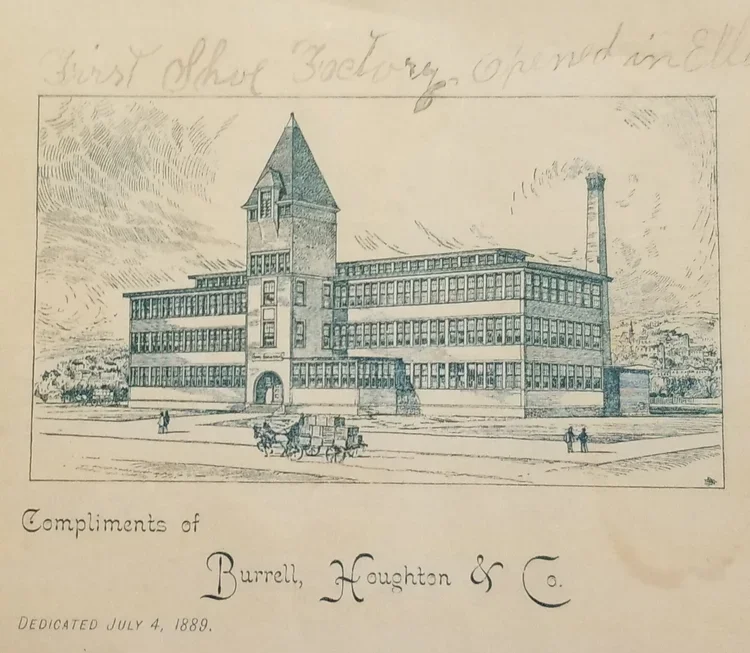
The July 4, 1889 photograph associated with B.E. Cole & Company should therefore be interpreted carefully. Rather than documenting the construction of the building, it most likely represents the beginning of Cole’s operation or a dedication associated with the company’s arrival in Ellsworth. Nineteenth-century communities commonly celebrated the establishment of new industrial enterprises because such events represented employment opportunities and economic progress.
The distinction between the factory and the companies that occupied it is essential. Ellsworth created the industrial resource; different manufacturers used that resource over time.
Burrell, Houghton & Co.:
The First Factory Operator
The first documented occupant of the State Street Factory was Burrell, Houghton & Co., a Massachusetts boot and shoe manufacturer. The company’s presence confirms the original purpose of the building: organized footwear production.
The relationship between Ellsworth and Burrell, Houghton & Co. illustrates the economic strategy behind the project. The town provided the physical facility, while an experienced shoe manufacturer supplied the knowledge and organization needed to operate a modern factory.
Massachusetts was one of the leading centers of American shoe manufacturing during the nineteenth century. Companies from that region possessed experience with mechanized production, specialized labor systems, and distribution networks. Bringing such a company to Ellsworth allowed the community to participate in an established industry.
The company’s tenure at the factory appears to have been relatively brief. By 1895, the Sanborn map identifies B.E. Cole & Company as the occupant.⁸ However, Burrell, Houghton & Co. remains historically significant because it establishes the true beginning of the building’s operating history.
The correct sequence is:
1884 — No factory documented at the site.
1888 — Factory completed and operating under Burrell, Houghton & Co.
1895 — B.E. Cole & Company operating the same building.This chronology demonstrates why contemporary records are essential. Later memory preserved the connection with B.E. Cole, but the Sanborn maps reveal the earlier chapter.
B.E. Cole & Company:
The Shoe Manufacturing Era (1889–1907)
The period of B.E. Cole & Company’s operation represents the most recognized chapter in the history of the State Street Factory. Although the company did not construct the building, it became the manufacturer most closely associated with the site in local memory.
The transition from Burrell, Houghton & Co. to B.E. Cole & Company is not fully documented in the surviving records examined for this study. The Sanborn maps clearly establish the sequence: Burrell, Houghton & Co. occupied the factory in 1888, while B.E. Cole & Company appears as the occupant by 1895.¹ The reason for the change may have involved a transfer of operations, a change in leasing arrangements, or the recruitment of another manufacturer, but the precise circumstances remain unknown.
What is certain is that B.E. Cole & Company inherited an existing industrial facility. The company’s arrival represented a change in operation, not the construction of a new factory.
The July 4, 1889 photograph associated with B.E. Cole & Company has likely contributed to the belief that the factory itself was completed that year. However, the Sanborn record demonstrates that the building already existed in 1888. The most reasonable interpretation is that the 1889 event marked the establishment or dedication of B.E. Cole’s manufacturing operation in Ellsworth rather than the completion of the physical building.
This distinction reflects an important historical difference between a factory and the company operating inside it. In nineteenth-century industrial communities, the opening of a new manufacturing operation was often celebrated because it represented jobs, investment, and economic progress. A dedication ceremony could therefore celebrate the arrival of a company even when the building itself was older.
The Factory Under B.E. Cole & Company
By 1895, the Sanborn Fire Insurance Map identified the building as:
B.E. Cole & Company
Boot & Shoe Mfy.²The same company continued operating at the location on the 1901 Sanborn map.³ Throughout this period, the factory remained a three-story wood-frame structure located on State Street between Third and Fourth Streets.
The building was organized according to the production methods of a late nineteenth-century shoe factory. Each floor served a specialized purpose, allowing raw materials to move through a carefully organized manufacturing process.
The production sequence was typical of industrial footwear manufacturing:
Third Floor
cutting room
stitching room
Second Floor
lasting
bottoming
First Floor
finishing
packing
offices
shipping
This arrangement reflects the factory system that had transformed shoe production throughout New England. Instead of a single craftsperson making a complete pair of shoes, production was divided among specialized workers performing individual tasks.
Third Floor: Cutting and Stitching
Cutting Room
The third floor began the manufacturing process. Here, workers prepared leather pieces according to patterns required for different shoe styles and sizes.
Cutting was one of the most skilled stages of production. Leather represented a significant portion of the cost of manufacturing shoes, so efficient use of material was essential. Experienced cutters arranged patterns carefully to reduce waste while maintaining the quality and appearance of the finished product.
The cutting department also required knowledge of leather characteristics. Workers had to understand differences in thickness, flexibility, and durability to ensure that each piece was appropriate for its intended use.
Stitching Room
After cutting, leather components moved to the stitching room. Here, workers assembled the shoe uppers using specialized sewing machines.
The development of sewing machinery was one of the major technological advances in nineteenth-century footwear manufacturing. Machine stitching increased production speed and allowed factories to produce large quantities of standardized footwear.
However, machinery did not eliminate skilled labor. Stitching operators needed experience handling leather, operating equipment, and maintaining quality standards.
The third floor therefore combined industrial technology with specialized craftsmanship.
Second Floor: Lasting and Bottoming
Lasting
The second floor contained the lasting department, where shoe uppers were shaped around a last.
A last was a form, traditionally made of wood, that determined the final shape and size of a shoe. Workers stretched the upper material over the last and secured it into position, creating the structure of the finished shoe.
Lasting was a critical stage because it determined comfort, appearance, and fit. Errors at this point could affect the entire finished product.
Bottoming
Following lasting, shoes moved to the bottoming department.
Bottoming involved attaching soles and completing the lower portion of the shoe. This stage brought together the work completed in the earlier departments and prepared the footwear for finishing.
The process required coordination between workers, machinery, and materials. A delay or problem in one department affected the entire production line.
First Floor: Finishing, Packing, Offices, and Shipping
The first floor completed the manufacturing process and connected the factory to the outside marketplace.
Finishing
Finishing involved inspecting and preparing completed shoes. Workers corrected imperfections, cleaned surfaces, and prepared footwear for delivery.
Quality control was important because finished products represented the reputation of the company. A poorly finished shoe could damage customer confidence and increase costs.
Packing
After inspection, shoes were packed for shipment. Packaging protected products during transportation and allowed the company to distribute finished goods efficiently.
Offices
The first floor also contained office space for management and administrative work. Records, orders, payroll, and production information would have been coordinated from this area.
The location of offices within the factory allowed managers to remain closely connected to daily operations.
Shipping
The shipping department represented the final stage of production. Finished shoes left the factory and entered regional markets.
The presence of a shipping function demonstrates that the State Street Factory was not merely a production workshop. It was a complete manufacturing enterprise capable of turning raw materials into finished products ready for sale.
Equipment and Manufacturing Technology
The exact equipment inventory of B.E. Cole & Company at Ellsworth has not been located. However, the departments identified on the Sanborn maps correspond with the standard machinery used in late nineteenth-century shoe manufacturing.
A factory of this type would likely have included:
leather cutting equipment;
sewing machines;
lasting machinery;
sole attachment equipment;
finishing tools;
packing equipment;
power systems for operating machinery.
The late nineteenth-century shoe industry depended upon a combination of mechanization and skilled labor. Machinery increased production capacity, but workers remained essential for operating equipment and maintaining quality.
The State Street Factory’s design shows that B.E. Cole & Company operated within this modern industrial system.
Employment and Economic Importance
The factory’s importance extended beyond the production of shoes. It provided employment and contributed to Ellsworth’s economic development.
Industrial shoe manufacturing required workers in multiple departments:
cutters;
stitchers;
lasters;
bottomers;
finishers;
packers;
shipping workers;
maintenance workers;
supervisors;
office employees.
The factory system created a different type of employment from traditional craft production. Workers specialized in particular tasks and participated in a coordinated production process.
Although exact employment numbers have not been confirmed, the size of the building and its departmental organization indicate that it supported a substantial workforce.
The factory also supported the wider community. Workers’ wages circulated through local businesses, while the presence of a manufacturing enterprise strengthened Ellsworth’s position as an industrial center.
The Transition to Ellsworth Hardwood Company (1907–1957)
The State Street Factory entered a new industrial era in the early twentieth century when shoe manufacturing ended and the building was converted to woodworking. By 1907, the Sanborn Fire Insurance Map identified Ellsworth Hardwood Company as the occupant of the same three-story wood-frame factory that had previously housed Burrell, Houghton & Co. and B.E. Cole & Company.¹
The transition demonstrates the adaptability of the building. Rather than being abandoned when the shoe industry operation changed, the factory continued to serve as a manufacturing facility under a new company and for a different product.
The change from shoe production to hardwood manufacturing represented a major transformation in the type of work performed inside the building. The earlier operation processed leather into finished footwear. The new operation processed lumber into finished wood products. Despite this difference, the factory’s basic characteristics remained useful: three floors of industrial space, a central location, and a structure capable of accommodating machinery and workers.
The 1907 Sanborn map records the following arrangement:
First Floor
sawing
Second Floor
lathe room
Third Floor
storing and drying
By 1914, the third floor had been adapted as an assembling room, indicating continued changes in production needs.²
First Floor: Sawing Operations
The first floor became the beginning point of the hardwood manufacturing process.
Sawing operations transformed raw lumber into pieces suitable for additional processing. Locating heavy equipment on the ground floor was practical because materials could be moved more easily and machinery could be supported by the building’s foundation.
This represented a significant change from the shoe factory period. During B.E. Cole & Company’s operation, the first floor had been devoted to finishing, packing, offices, and shipping. Under Ellsworth Hardwood Company, it became the location where raw materials entered the production process.
The change demonstrates that industrial buildings were valuable not because they served only one purpose, but because they could be modified as economic conditions changed.
Second Floor: The Lathe Room
The second floor housed the lathe room.
Woodworking lathes shaped materials by rotating pieces of wood against cutting tools. This process allowed manufacturers to create precisely formed components and finished products.
The presence of a lathe room indicates that Ellsworth Hardwood Company was engaged in more advanced manufacturing than simple lumber processing. The company shaped and prepared wood products rather than merely storing or cutting raw materials.
As with the earlier shoe operation, machinery required skilled workers. Employees needed knowledge of equipment operation, material characteristics, and production standards.
The factory therefore continued the same basic industrial pattern established during the shoe manufacturing era: machinery organized production, but skilled labor remained essential.
Third Floor: Drying, Storage, and Assembly
The third floor was initially identified as a storage and drying area.
Wood products required careful preparation before final use. Moisture content affected the stability and quality of finished wood, making drying an essential part of the manufacturing process.
Proper drying reduced problems such as:
warping;
cracking;
shrinking;
structural instability.
By 1914, the third floor was identified as an assembling room.³ This change suggests that Ellsworth Hardwood Company continued adapting the factory layout to meet changing production requirements.
The ability to modify interior spaces was one of the reasons older industrial buildings could remain useful for decades.
A Second Industrial Life
The history of Ellsworth Hardwood Company demonstrates why the State Street Factory survived for so long. The building was not tied permanently to one industry. It adapted.
The factory’s industrial sequence can be summarized as:
1888–early twentieth century
Boot and shoe manufacturing
Burrell, Houghton & Co.
B.E. Cole & Company
1907–1957
Hardwood manufacturing
Ellsworth Hardwood Company
The building therefore served two major manufacturing industries during its lifetime.
This transition also reflects broader economic changes in Maine. Small communities often experienced shifts in manufacturing as industries expanded, declined, or moved elsewhere. Buildings that could be adapted had a greater chance of survival.
The State Street Factory remained useful because its original design provided flexibility. A large, multi-story industrial building could accommodate different types of production without requiring complete reconstruction.
Fire Risk and the Limits of Adaptation
Although the factory survived changing industries, its original construction method always carried risk.
The building was a wood-frame structure, a common form of nineteenth-century industrial construction in Maine. Wood was affordable and readily available, but it also created serious fire hazards.
Sanborn Fire Insurance Maps were created partly because insurance companies needed detailed information about buildings, materials, machinery, and fire risks. The maps documented exactly the features that influenced insurance decisions, including construction type and industrial activity.⁴
The same vulnerability that had existed since the building’s construction eventually ended its physical existence.
The 1957 Fire
After nearly seventy years of industrial service, the State Street Factory was destroyed by fire in 1957.
The fire marked the end of one of Ellsworth’s oldest industrial buildings. A structure that had witnessed the rise of factory shoe production, the transition to hardwood manufacturing, and generations of local employment was gone.
The loss was significant because the building represented a direct connection to Ellsworth’s nineteenth-century industrial development. Once the factory disappeared, the Sanborn maps, photographs, and written records became the primary evidence preserving its history.
The destruction of the factory also created an opportunity for a new use of the property. The land would continue serving the community, but its purpose would change from manufacturing to education and public recreation.
The Meaning of the Factory’s Industrial Life
The State Street Factory’s history from 1888 to 1957 illustrates several important themes:
Community Investment
The factory began as a local economic development project. Ellsworth citizens created the physical infrastructure needed to attract manufacturing.
Industrial Change
The building reflected two major periods of manufacturing history:
nineteenth-century shoe production;
twentieth-century hardwood manufacturing.
Adaptability
The factory survived because it could be reused. Its value came from its ability to support changing industries.
Community Continuity
Even after the building disappeared, the site continued serving Ellsworth residents.
The factory was therefore more than a workplace. It was a physical representation of the community’s economic ambitions and its ability to adapt over time.
The 1957 Fire, Knowlton Elementary School, and Knowlton Park (1957–Present)
The destruction of the State Street Factory by fire in 1957 ended the building’s industrial history, but it did not end the importance of the property. The site continued to serve Ellsworth, although its role changed from manufacturing to education and eventually to public recreation.
For almost seventy years, the property had been associated with industrial production. Generations of workers had manufactured shoes and hardwood products there. The factory represented Ellsworth’s nineteenth- and early twentieth-century efforts to establish a stable manufacturing economy. After the fire, the community faced the question of how the property could continue to serve local needs.
The answer reflected another major period of community investment: education.
The End of the Factory Era
The 1957 fire removed one of Ellsworth’s longest-standing industrial landmarks. The loss was especially significant because the building itself had survived numerous economic changes.
The factory had passed through several distinct periods:
construction through local initiative;
shoe manufacturing under Burrell, Houghton & Co.;
expansion of the shoe industry under B.E. Cole & Company;
conversion to hardwood production under Ellsworth Hardwood Company;
destruction by fire.
The physical building was gone, but the land remained valuable. As Ellsworth developed during the postwar period, the former industrial property became available for a new public purpose.
The transition from factory to school illustrates a broader pattern in American communities. Industrial sites often became locations for new civic buildings because they were already established, centrally located properties connected to the community.
Knowlton Elementary School (1961–2008)
In 1961, the Dr. Charles C. Knowlton School opened on the former State Street Factory site.¹ The opening of the school marked a complete transformation of the property.
Where workers had once operated machinery, prepared leather, and processed hardwood, students now attended classes. The noise and activity of manufacturing gave way to the daily routines of education.
The school represented a different form of community investment. The original factory had been built to encourage economic opportunity; the school was built to support the education and future of Ellsworth’s children.
The school served the community for nearly five decades. During that time, many residents knew the property primarily as the Knowlton School site rather than as the location of the former shoe factory and hardwood mill.
The disappearance of the factory building created distance between the modern community and the industrial history of the property. However, the land itself remained connected to its earlier use.
A Changing Community Need
By the beginning of the twenty-first century, Ellsworth’s educational facilities required modernization. A new school complex was developed, and the Knowlton School building was no longer needed for elementary education.
The closure of the school created another transition point in the history of the property. As with the factory’s earlier changes, the community had to determine how the site could continue serving public needs.
Rather than returning the property to private industrial or commercial use, Ellsworth chose another public purpose: recreation.
From School Property to Knowlton Park
After the school closed, the former educational property was redeveloped as Knowlton Park. The transformation continued the long tradition of public use at the site.
The property’s sequence of uses now represents three major phases:
Industrial Site (1888–1957)
Burrell, Houghton & Co.
B.E. Cole & Company
Ellsworth Hardwood Company
Educational Site (1961–2008)
Dr. Charles C. Knowlton School
Public Recreation Site (2011–Present)
Knowlton Park
The demolition of the former school building and creation of the park removed the last standing structure associated with the site’s twentieth-century history. However, the property remained a community gathering place.
The transformation from factory to school to park demonstrates a continuing pattern: Ellsworth repeatedly adapted the property to meet changing needs.
Remembering the Industrial Past
Although the factory itself no longer survives, its history remains documented through maps, photographs, and local historical collections.
The Sanborn maps provide the most reliable record of the building’s physical history. They establish that:
the factory existed by 1888;
it was a three-story wood-frame building;
it first operated as a shoe factory;
it later became a hardwood mill;
the same structure continued for decades.
Photographs preserve the appearance of the building and its importance to local memory. However, the Sanborn maps provide the chronological framework necessary to interpret those images correctly.
This distinction is especially important regarding the July 4, 1889 B.E. Cole photograph. The image remains valuable evidence of the factory’s importance, but the maps demonstrate that the building itself was already standing before that date.
The Continuing History of the Site
The history of the State Street property does not end with the destruction of the factory. Instead, it continues through changing forms of public service.
The factory served Ellsworth by providing employment.
The school served Ellsworth by educating children.
The park serves Ellsworth by providing recreation and community space.
Each period reflects the priorities of its time.
The physical buildings changed, but the purpose of the property remained constant: serving the community.
Final Chronology: The State Street Site, 1884–Present
1884
The Sanborn Fire Insurance Map shows no factory at the future State Street industrial site.
1888
A three-story wood-frame boot and shoe factory is documented on State Street. Burrell, Houghton & Co. operates the facility.
1889
B.E. Cole & Company becomes associated with the factory. The July 4 photograph likely commemorates the beginning of Cole’s operation rather than construction of the building.
1895
Sanborn mapping identifies B.E. Cole & Company Boot & Shoe Manufacturing at the site.
1901
B.E. Cole & Company continues shoe manufacturing in the building.
1907
Ellsworth Hardwood Company occupies the former shoe factory. The building is adapted for woodworking.
1914
Ellsworth Hardwood Company continues operation. The building contains woodworking departments including assembly space.
1957
Fire destroys the original State Street Factory.
1961
Dr. Charles C. Knowlton School opens on the former factory property.
2008
Knowlton School closes.
2011
The former school property is redeveloped as Knowlton Park.
Present
Knowlton Park continues as a public community space.
Conclusion: The State Street Factory as an Ellsworth Community Landmark
The history of the State Street Factory is the history of a place that repeatedly adapted to changing circumstances. From its beginnings as a community-supported industrial project in the late nineteenth century to its later uses as a school and public park, the property reflects Ellsworth’s changing economic and civic priorities.
The most important historical correction revealed through this research is that the factory was not built by B.E. Cole & Company in 1889. The Sanborn Fire Insurance Maps establish that a three-story wood-frame shoe factory already existed on State Street in 1888 and was occupied by Burrell, Houghton & Co.¹ B.E. Cole & Company became one of the most important operators of the building, but it inherited a facility that had already been created through Ellsworth’s own industrial initiative.
This distinction changes the way the site should be understood. The State Street Factory was not simply a company building. It was an Ellsworth-built industrial resource designed to attract manufacturing and employment.
The original development followed a common nineteenth-century economic model. Local citizens invested in the construction of a factory and recruited an experienced manufacturer capable of operating it. This approach allowed smaller communities to participate in industries that were expanding throughout New England.
The factory’s physical organization reflected the industrial methods of its era. During the shoe manufacturing period, the three floors created an efficient production system:
the third floor handled cutting and stitching;
the second floor handled lasting and bottoming;
the first floor handled finishing, packing, offices, and shipping.²
The arrangement demonstrated the importance of specialization in modern manufacturing. Instead of one worker producing an entire shoe, many employees performed individual tasks within a coordinated system.
Under Burrell, Houghton & Co. and later B.E. Cole & Company, the factory connected Ellsworth to the regional shoe industry. Workers produced finished footwear for wider markets, while the factory provided employment and contributed to the local economy.
When the shoe industry connection ended, the building did not become obsolete. Ellsworth Hardwood Company transformed the same structure into a woodworking facility. The former shoe factory became a hardwood mill, with sawing on the first floor, a lathe room on the second floor, and storage, drying, and assembly functions on the third floor.³
This second industrial life is one of the most important aspects of the building’s history. The factory survived because it could adapt. Its value was not limited to the products it originally produced; its value came from its ability to serve new purposes.
The 1957 fire ended the physical existence of the factory, but it did not end the significance of the site. The property continued to serve Ellsworth through Knowlton Elementary School and later Knowlton Park.
The history of the property therefore represents three different forms of community investment:
Industry: creating jobs and economic opportunity;
Education: supporting future generations;
Public recreation: maintaining a shared community resource.
The State Street Factory should be remembered as more than a vanished building. It represents Ellsworth’s ability to organize, invest, adapt, and preserve the usefulness of important places.
Although the original structure is gone, the historical record remains. The Sanborn maps preserve the building’s physical story. Photographs preserve its appearance. Local records preserve its connection to the community.
Together, these sources reveal the complete chronology:
1884 — No factory documented at the site.
1888 — Ellsworth-built three-story wood-frame shoe factory operating under Burrell, Houghton & Co.
1889 — B.E. Cole & Company begins operation in the existing factory.
1895–1901 — B.E. Cole & Company continues shoe manufacturing.
1907–1914 — Ellsworth Hardwood Company operates the converted factory.
1957 — Fire destroys the original building.
1961–2008 — Knowlton Elementary School occupies the property.
2011–Present — Knowlton Park continues the site’s public use.The State Street Factory’s story is ultimately one of continuity. The buildings changed, the industries changed, and the needs of the community changed, but the property remained a place where Ellsworth invested in its future.
Footnotes
Sanborn Map Company, Insurance Map of Ellsworth, Maine (New York: Sanborn Map Company, 1888), sheet showing State Street factory.
Contemporary industrial account describing Ellsworth citizens constructing a factory occupied by Burrell, Houghton & Co.; exact publication citation to be confirmed from the original source.
Sanborn Map Company, Insurance Map of Ellsworth, Maine (New York: Sanborn Map Company, 1884, 1888, 1895, 1901, 1907, 1914).
Sanborn Map Company, Insurance Map of Ellsworth, Maine (New York: Sanborn Map Company, 1884).
Contemporary industrial account describing Ellsworth citizens building the factory; exact citation to be added.
Biographical materials concerning Charles C. Burrill’s business activities in Ellsworth; direct connection to the factory project remains unconfirmed.
Sanborn Map Company, Insurance Map of Ellsworth, Maine (New York: Sanborn Map Company, 1888).
Sanborn Map Company, Insurance Map of Ellsworth, Maine (New York: Sanborn Map Company, 1895).
Sanborn Map Company, Insurance Map of Ellsworth, Maine (New York: Sanborn Map Company, 1888 and 1895).
Sanborn Map Company, Insurance Map of Ellsworth, Maine (New York: Sanborn Map Company, 1895).
Sanborn Map Company, Insurance Map of Ellsworth, Maine (New York: Sanborn Map Company, 1901).
Sanborn Map Company, Insurance Map of Ellsworth, Maine (New York: Sanborn Map Company, 1895).
Sanborn Map Company, Insurance Map of Ellsworth, Maine (New York: Sanborn Map Company, 1907), State Street factory, Ellsworth Hardwood Company.
Sanborn Map Company, Insurance Map of Ellsworth, Maine (New York: Sanborn Map Company, 1914), State Street factory, Ellsworth Hardwood Company.
Sanborn Map Company, Insurance Map of Ellsworth, Maine (New York: Sanborn Map Company, 1907 and 1914).
Sanborn Map Company, Insurance Map of Ellsworth, Maine, 1884–1914 editions.
Ellsworth Historical Society, materials relating to the State Street Factory, Knowlton School, and Knowlton Park, Ellsworth, Maine.
Newspaper coverage of the 1957 State Street Factory fire; exact issue citation to be confirmed from original newspaper archives.
City of Ellsworth records concerning Dr. Charles C. Knowlton School.
City of Ellsworth records concerning the redevelopment of the Knowlton property.
Bibliography
Primary Sources
Maps
Sanborn Map Company. Insurance Map of Ellsworth, Maine. New York: Sanborn Map Company, 1884.
Sanborn Map Company. Insurance Map of Ellsworth, Maine. New York: Sanborn Map Company, 1888.
Sanborn Map Company. Insurance Map of Ellsworth, Maine. New York: Sanborn Map Company, 1895.
Sanborn Map Company. Insurance Map of Ellsworth, Maine. New York: Sanborn Map Company, 1901.
Sanborn Map Company. Insurance Map of Ellsworth, Maine. New York: Sanborn Map Company, 1907.
Sanborn Map Company. Insurance Map of Ellsworth, Maine. New York: Sanborn Map Company, 1914.
Newspapers
Ellsworth American. Ellsworth, Maine. Issues from 1887–1889.
(Used for research into the establishment of the Ellsworth shoe factory project, Burrell, Houghton & Co., B.E. Cole & Company, and local industrial development. Exact article citations should be added after review of the original newspaper scans.)
Local Historical Collections
Ellsworth Historical Society. Photographic collections and historical materials relating to the State Street Factory, B.E. Cole & Company, Ellsworth Hardwood Company, Knowlton School, and Knowlton Park. Ellsworth, Maine.
Municipal Records
City of Ellsworth. Annual Reports of the City Government of Ellsworth, Maine. Ellsworth, Maine.
City of Ellsworth. Records concerning Dr. Charles C. Knowlton School and Knowlton Park development. Ellsworth, Maine.
Secondary Sources
Maine Historic Preservation Commission. Studies and reports concerning Maine industrial buildings, shoe manufacturing, and nineteenth-century factory development.
National Register of Historic Places. Documentation concerning Maine shoe factories and community-supported industrial development.
Final Historical Statement
The State Street Factory was an Ellsworth-built industrial facility completed by 1888. It first housed Burrell, Houghton & Co., later became the B.E. Cole & Company shoe factory, and then operated as Ellsworth Hardwood Company until fire destroyed the building in 1957. The site continued serving the community through Knowlton Elementary School and Knowlton Park. The factory’s history demonstrates Ellsworth’s ability to create, adapt, and preserve community resources across changing generations.
Why State Street?
The State Street location did not possess the traditional advantages of Maine's earlier mill towns. It was neither water-powered nor adjacent to the railroad. Instead, the evidence indicates that Ellsworth deliberately built a modern steam-powered factory on a large parcel where a brick engine room, wooden coal house, and three-story manufacturing building could be constructed. The choice reflects the transition from water-powered industrial development to community-financed, steam-powered manufacturing in the late nineteenth century. The exact reasons for selecting the State Street parcel remain uncertain, but the available evidence suggests that land availability, fire safety, and local ownership were more important than proximity to water power.
-
Industrial Heritage of Ellsworth
The History of 401–409 State Street, Ellsworth, Maine
Volume I
Burrell, Houghton & Company Boot & Shoe Factory, c. 1888
The Construction of Ellsworth’s First Modern Shoe Factory
Introduction
On State Street in Ellsworth, Maine, stood a factory that represented the community’s determination to create a modern manufacturing presence at the end of the nineteenth century. Constructed in 1888, the three-story wood-frame building at 401–409 State Street became one of the city’s most significant industrial properties, serving as a manufacturing center for nearly seventy years.¹
Although later generations associated the building primarily with B.E. Cole & Company, the factory’s earliest documented occupant was Burrell, Houghton & Company. The distinction is important because the building itself predates the Cole operation. The State Street Factory was an Ellsworth industrial project that changed operators over time. The 1888 Sanborn Fire Insurance Map identifies the building as “Burrell, Houghton & Co. Boot and Shoe Mfy.,” establishing the company’s role as the first documented manufacturer in the structure.²
The factory represented a different model of industrial development from the older water-powered mills found throughout Maine. Instead of being located beside a river or traditional mill privilege, the State Street Factory was equipped with its own steam-power system. The Sanborn map documents an engine room and associated structures, indicating that the building was designed as a self-powered manufacturing facility.³
The construction of the factory reflected a larger nineteenth-century effort by smaller New England communities to attract manufacturing. Ellsworth was not simply waiting for industry to develop naturally; it invested in the physical infrastructure necessary to bring manufacturing into the community.
Ellsworth’s Industrial Ambition
During the late nineteenth century, manufacturing was widely viewed as a pathway to economic growth. Factories created wage employment, encouraged commercial activity, and provided communities with a stronger industrial identity.
Shoe manufacturing was particularly suited to this period of development. Unlike large textile operations that required extensive water power, shoe factories depended more heavily on skilled labor, specialized machinery, and organized production systems. This allowed communities without major industrial rivers to participate in the industry.
The decision to construct a shoe factory in Ellsworth reflected this changing industrial environment. The town could provide a building, while an experienced shoe manufacturer could provide management, equipment, and production knowledge.
The resulting factory was therefore a partnership between local initiative and outside industrial expertise.
The State Street Site
The location of the factory on State Street represented a deliberate choice. Traditional nineteenth-century mills often followed water resources, but steam-powered factories had greater flexibility in selecting locations.
The State Street property provided space for a large industrial building and supporting structures. The factory required not only production floors but also an engine room, fuel storage, and areas for receiving materials and shipping finished goods.
The use of steam power reduced the need for a river location. Instead, the site could be selected based on available land and suitability for industrial development.
The building’s location also separated heavy industrial activity from the more concentrated commercial areas of Ellsworth. Boilers, coal storage, machinery, and manufacturing materials created safety considerations that made a slightly removed location practical.
The surviving documentation clearly establishes the factory’s location and construction, but the identities of all individuals involved in organizing the project remain uncertain. Any claims regarding specific founders or investors should be made only when supported by additional business records or contemporary accounts.
Construction of the Factory
The 1888 Sanborn Fire Insurance Map provides the earliest detailed description of the State Street Factory. It identifies the building as a boot and shoe manufacturing facility operated by Burrell, Houghton & Company.⁴
The building was a three-story wood-frame factory designed for organized industrial production. Its size and arrangement reflected the requirements of late nineteenth-century shoe manufacturing, where different stages of production were separated into departments.
A major feature of the building was the brick engine room. This structure housed the steam machinery that powered factory operations. The associated coal house provided fuel storage, while the smokestack carried away exhaust from the boiler system.⁵
Together, these features demonstrate that the factory represented modern industrial technology for its period.
The building did not depend on natural water power. Instead, it generated mechanical power on site. This allowed Ellsworth to establish a manufacturing facility without the geographic limitations faced by older mill communities.
Burrell, Houghton & Company
Burrell, Houghton & Company was the first documented manufacturer to occupy the State Street Factory. The company’s presence connected Ellsworth to the larger New England shoe industry.
By the late nineteenth century, Massachusetts had become one of the leading centers of footwear manufacturing in the United States. Companies in the region had developed specialized production systems that relied on machinery, divided labor, and factory organization.
The arrival of Burrell, Houghton & Company allowed Ellsworth to participate in this established industry. The town provided the physical facility; the company brought manufacturing experience.
The available evidence confirms the company’s operation in the building in 1888, but the exact duration of its occupation and the circumstances of its departure require additional documentation.⁶
What can be established is that Burrell, Houghton & Company began the industrial history of the State Street Factory.
Factory Production and Organization
The State Street Factory was designed for the type of organized production that defined late nineteenth-century shoe manufacturing. Unlike a small workshop where a single craftsman completed an entire pair of shoes, the factory system divided production into specialized operations performed by different workers.
This division of labor increased efficiency and allowed manufacturers to produce footwear in larger quantities. Raw materials entered the factory, moved through a series of departments, and emerged as completed products ready for shipment.
The three-story arrangement of the building supported this production system. Although the 1888 Sanborn map does not record every machine or department, the building’s design is consistent with the organization used by New England shoe factories of the period.⁷
The upper floors would have provided space for preparation and assembly work, while lower levels were suited for finishing, storage, offices, and shipping activities. The exact arrangement of departments during the Burrell, Houghton & Company period requires additional company records, but the building itself clearly reflected the needs of industrial footwear production.
The factory’s design reveals an important feature of nineteenth-century manufacturing: the building was not simply a shelter for workers and machinery. It was an organized production system. The arrangement of floors, power equipment, storage areas, and workspaces all contributed to the efficient movement of materials through the manufacturing process.
Steam Power and Industrial Technology
The State Street Factory’s most distinctive feature was its use of steam power.
Many earlier Maine factories were built around water privileges, where rivers supplied mechanical energy. Steam technology changed this relationship between industry and geography. A manufacturer no longer needed to locate beside a waterfall or millstream. Instead, factories could be constructed where land, labor, and community support were available.
The Sanborn map identifies a separate engine room and coal house, providing direct evidence of the factory’s steam-powered operation.⁸ The engine room was constructed of brick, reflecting the safety requirements associated with boilers and industrial machinery.
Coal was essential to this system. Deliveries of fuel supplied the boiler, which produced steam to operate the engine. The smokestack visible in historic photographs was part of this power arrangement, carrying away exhaust from the boiler system.⁹
This technology explains why the State Street location was practical. The factory did not need a river because it carried its own power source within the building complex.
In this respect, the factory represented a transition in Maine industrial history. It combined local initiative with modern manufacturing technology and demonstrated that communities outside traditional mill centers could participate in industrial development.
Workers and Daily Life
The success of Burrell, Houghton & Company depended upon the labor of the people who worked inside the factory.
A shoe factory required a variety of occupations. Workers specialized in different stages of production, including cutting, stitching, assembly, finishing, packing, and shipping. Maintenance workers ensured that machinery continued operating, while supervisors coordinated production.
The factory system changed the nature of industrial work. Instead of completing an entire product independently, workers became part of a larger coordinated process. Their daily activities were determined by production schedules, machinery, and the requirements of the manufacturing system.
The State Street location allowed the factory to draw workers from the surrounding community. Unlike large mill complexes that sometimes developed company housing, Ellsworth’s shoe factory operated within an existing town environment. Employees likely traveled to work from nearby residential neighborhoods.
The factory therefore became part of the daily rhythm of the community. Workers entered the building each day, machinery operated throughout production hours, and the factory became a visible symbol of Ellsworth’s industrial ambitions.
Although the exact number of Burrell, Houghton & Company employees has not yet been established from surviving records, the size of the building indicates an operation significantly larger than a small craft shop.
The Importance of the First Occupant
The historical importance of Burrell, Houghton & Company lies not only in its period of operation but in its position as the first chapter of the factory’s story.
Later memory often focuses on B.E. Cole & Company because that company operated in the building longer and became more closely associated with local identity. However, the building’s industrial history began before Cole arrived.
The distinction matters because it changes the interpretation of the site. The State Street Factory was not created as the Cole factory. It was created as an Ellsworth factory intended to attract manufacturing.
Burrell, Houghton & Company demonstrated that the community’s investment could succeed. The building had been completed, equipped, and placed into operation. A manufacturer had arrived, workers were employed, and Ellsworth had entered the competitive world of New England factory production.
The company’s role was therefore foundational.
Transition to B.E. Cole & Company
The transition from Burrell, Houghton & Company to B.E. Cole & Company occurred soon after the factory opened. The surviving Sanborn records establish the sequence: the building appears as Burrell, Houghton & Company in 1888 and under later shoe manufacturing operation afterward.¹⁰
The exact circumstances of the change remain an area where additional research may provide more detail. It is possible that ownership, leasing arrangements, or business conditions influenced the transition, but the surviving evidence does not yet provide a complete explanation.
What is clear is that the building continued to serve the purpose for which it was constructed: industrial shoe manufacturing.
The arrival of B.E. Cole & Company began the next chapter of the factory’s history. Under Cole, the building became more firmly established in local memory and continued as one of Ellsworth’s important workplaces.
Conclusion
The Burrell, Houghton & Company Boot & Shoe Factory represents the beginning of the industrial history of 401–409 State Street.
Built in 1888, the factory reflected Ellsworth’s effort to create a modern manufacturing economy. Its steam-powered design allowed the town to participate in industrial development without depending upon traditional water-power locations.
The building’s brick engine room, coal house, and smokestack reveal a carefully planned industrial facility. Its three-story construction supported the organized production methods that defined late nineteenth-century shoe manufacturing.
Burrell, Houghton & Company’s occupation of the building established its original purpose and proved that Ellsworth could support factory production. Although the company’s period of operation appears to have been brief, its importance was lasting.
The factory would later become better known through B.E. Cole & Company and would eventually enter a second industrial life under Ellsworth Hardwood Company. Yet the story of 401–409 State Street began with the community that built it and the first manufacturer that operated within its walls.
Volume I
Foototes
Burrell, Houghton & Company Boot & Shoe Factory, c. 1888
Sanborn Map Company, Insurance Map of Ellsworth, Maine (New York: Sanborn Map Company, 1888). The map identifies the State Street building as a boot and shoe manufacturing facility operated by Burrell, Houghton & Co.
Sanborn Map Company, Insurance Map of Ellsworth, Maine (New York: Sanborn Map Company, 1888).
Sanborn Map Company, Insurance Map of Ellsworth, Maine (New York: Sanborn Map Company, 1888). The map documents the factory arrangement, including the engine room and associated industrial structures.
Sanborn Map Company, Insurance Map of Ellsworth, Maine (New York: Sanborn Map Company, 1888).
Ellsworth Historical Society, photographic collection relating to the State Street Factory, Ellsworth, Maine. The historic photograph showing the smokestack and engine-room area supports interpretation of the building’s steam-power system.
Sanborn Map Company, Insurance Map of Ellsworth, Maine (New York: Sanborn Map Company, 1888). The map provides the confirmed evidence of Burrell, Houghton & Co. as the first documented occupant.
Sanborn Map Company, Insurance Map of Ellsworth, Maine (New York: Sanborn Map Company, 1888). The building arrangement provides evidence of an organized multi-story manufacturing facility, although specific departmental assignments require additional company records.
Sanborn Map Company, Insurance Map of Ellsworth, Maine (New York: Sanborn Map Company, 1888).
Ellsworth Historical Society, photographic collection relating to the State Street Factory, Ellsworth, Maine.
Sanborn Map Company, Insurance Map of Ellsworth, Maine (New York: Sanborn Map Company, 1888); Sanborn Map Company, Insurance Map of Ellsworth, Maine (New York: Sanborn Map Company, 1895).
Bibliography
Volume I
Primary Sources
Ellsworth Historical Society. Photographic collections and archival materials relating to the State Street Factory, Ellsworth, Maine.
Sanborn Map Company. Insurance Map of Ellsworth, Maine. New York: Sanborn Map Company, 1888.
Sanborn Map Company. Insurance Map of Ellsworth, Maine. New York: Sanborn Map Company, 1895.
Secondary Sources
Maine Historic Preservation Commission. Industrial resource surveys concerning Maine industrial architecture, manufacturing history, and adaptive reuse.
National Register of Historic Places documentation concerning nineteenth-century Maine industrial buildings and manufacturing development.
-
Industrial Heritage of Ellsworth
The History of 401–409 State Street, Ellsworth, Maine
Volume II
B.E. Cole & Company Boot & Shoe Factory, c. 1889
Manufacturing, Growth, and Community Memory
Introduction
The factory on State Street between Third and Fourth Streets in Ellsworth entered its best-known period when B.E. Cole & Company began operating in the building in 1889. The structure itself, however, had already been completed the previous year. Built in 1888 through local initiative and first occupied by Burrell, Houghton & Company, the factory represented an established industrial resource that changed operators as economic conditions evolved.¹
The B.E. Cole & Company period became the chapter most closely associated with local memory. Photographs, later references, and community recollections frequently identify the building as the “B.E. Cole shoe factory,” reflecting the company’s importance in Ellsworth’s industrial history.² Yet the full history of the building is broader. The factory belonged first to the community that built it, then to the companies that operated within its walls.
The arrival of B.E. Cole & Company transformed the State Street Factory from a new industrial experiment into a more permanent manufacturing institution. Under Cole’s operation, the building continued to produce footwear using the organized factory system that had become characteristic of New England shoe manufacturing.
The company’s history illustrates the importance of continuity in industrial development. The building, the power system, and the manufacturing infrastructure created in 1888 allowed a new company to continue production without constructing an entirely new facility.
The Arrival of B.E. Cole & Company
The transition from Burrell, Houghton & Company to B.E. Cole & Company occurred soon after the factory opened. The 1888 Sanborn Fire Insurance Map identifies the building as the Burrell, Houghton & Co. Boot and Shoe Manufacturing facility. Later records identify B.E. Cole & Company as the occupant of the same State Street building.³
This sequence is important because it establishes that B.E. Cole & Company inherited an existing industrial facility rather than creating a new factory on the site.
The distinction also explains why the 1889 date associated with B.E. Cole is sometimes misunderstood. The company’s arrival represented the beginning of a new operating period, not the construction date of the building itself.
This was a common pattern in nineteenth-century industrial development. Communities often constructed factories to attract experienced manufacturers. Once the building existed, different companies could occupy the space depending on market conditions, management decisions, and business opportunities.
For Ellsworth, the arrival of B.E. Cole & Company confirmed the success of the original investment. The factory continued operating as a shoe-manufacturing facility, providing employment and contributing to the local economy.
A Modern Shoe Factory
During the B.E. Cole & Company period, the State Street building functioned as a modern shoe factory.
The production of footwear in the late nineteenth century depended upon the organization of labor, machinery, and materials. Workers no longer completed shoes from beginning to end individually. Instead, production was divided among specialized departments.
The factory system increased efficiency by assigning workers specific tasks:
cutting leather components;
stitching shoe uppers;
shaping shoes through lasting;
attaching soles;
finishing completed footwear;
packing and shipping products.
The building’s three floors supported this organization. Materials could move through a sequence of operations as workers and machinery performed specialized functions.
The factory’s original steam-power system remained central to this operation. The engine room, coal house, and smokestack that had supported the building since its construction provided the mechanical foundation for continued manufacturing.⁴
The survival of this infrastructure demonstrates why the building remained useful after the change in ownership. The original design created a flexible industrial space capable of supporting continued production.
B.E. Cole & Company Workers and Employment
The importance of B.E. Cole & Company extended beyond the production of shoes. The factory was a major place of employment and became part of the daily life of Ellsworth residents.
A shoe factory required a broad range of occupations. Skilled workers performed specialized manufacturing tasks, while others supported the operation through maintenance, shipping, and administration.
Employees likely included:
cutters who prepared leather pieces;
stitchers who assembled shoe uppers;
lasting and bottoming workers who shaped and completed shoes;
finishers who prepared products for shipment;
packers and shipping workers;
mechanics responsible for machinery;
supervisors and office employees.
The factory system depended upon cooperation between these departments. Each stage of production relied on the work completed before it, creating a continuous industrial process.
For workers, employment at the State Street Factory represented a different economic opportunity from traditional occupations based on agriculture, maritime activity, or seasonal labor. Manufacturing provided regular wage employment and connected Ellsworth residents to the larger industrial economy of New England.
The location of the factory also influenced daily life. Because Ellsworth remained a compact community, many employees could walk to work from nearby neighborhoods. The factory did not require a separate company town or worker housing district. Instead, it became integrated into the existing community.
The building’s presence along State Street made industrial work visible. Each day, employees entered the factory, machinery operated within the building, and finished products left the site for distribution.
The Factory and Ellsworth’s Economy
The success of B.E. Cole & Company strengthened the role of manufacturing within Ellsworth’s economy.
A factory affected more than the people directly employed inside it. Industrial operations required supporting services, including fuel deliveries, equipment maintenance, transportation, suppliers, and commercial businesses that served workers and management.
The State Street Factory therefore contributed to a larger economic network.
The building also represented civic investment. When Ellsworth citizens supported the construction of the factory in 1888, they were making a statement about the town’s future. The continued operation under B.E. Cole & Company demonstrated that the investment had produced lasting value.
Industrial development was often viewed as a sign of progress during this period. A successful factory brought employment, encouraged population stability, and strengthened the community’s economic identity.
For Ellsworth, the B.E. Cole years became the clearest expression of that industrial ambition.
The Cole Name and Community Memory
The strong association between the building and B.E. Cole & Company developed because the company became the longest remembered occupant of the factory.
Buildings are often remembered through the names of the businesses that operated within them. Over time, the earlier history of a structure can be overshadowed by the company most closely connected to local experience.
This occurred with the State Street Factory.
The building’s complete history includes:
construction by Ellsworth interests in 1888;
operation by Burrell, Houghton & Company;
the long association with B.E. Cole & Company;
later conversion to hardwood manufacturing.
The Cole name became dominant because the company represented the factory’s most recognizable period. Local photographs and memories preserved that association, making the building a familiar landmark in Ellsworth history.¹
Recognizing the earlier Burrell, Houghton & Company period does not diminish the importance of B.E. Cole. Instead, it creates a more accurate understanding of how industrial buildings developed. The factory was not created by one company; it was a community resource used by several generations of manufacturers.
Changes Within the Building
Industrial buildings rarely remained unchanged throughout their lifetimes. As companies expanded, technology developed, and production methods evolved, owners modified interiors and equipment.
The State Street Factory followed this pattern.
The original building had been designed for shoe production, but improvements and adjustments would have been made as B.E. Cole & Company operated the facility. Machinery could be replaced, work areas rearranged, and spaces adapted to changing production needs.
The Sanborn maps provide evidence of the continuing industrial use of the property and allow historians to trace changes over time.² These maps are especially valuable because they record not only ownership and occupancy but also the physical arrangement of industrial structures.
Through these records, the factory can be understood as a living industrial space rather than a fixed building.
The End of Shoe Manufacturing
The B.E. Cole & Company period eventually came to an end, but the building itself continued.
The decline or transition of a manufacturing operation did not necessarily mean the end of an industrial building’s usefulness. Across New England, older factories survived by adapting to new industries.
The State Street Factory followed this broader pattern.
After its years as a shoe factory, the building entered a new phase under the Ellsworth Hardwood Company. The change reflected the economic resources of the region and the flexibility of the original structure.
The same building that had produced footwear would now support woodworking and hardwood manufacturing.
Conclusion
The B.E. Cole & Company Boot & Shoe Factory represents the period when 401–409 State Street became most strongly identified with industrial life in Ellsworth.
B.E. Cole & Company did not construct the factory, but the company gave the building its most familiar identity. During this period, the State Street Factory became a significant workplace, employing local residents and connecting Ellsworth to the larger New England shoe industry.
The company’s history demonstrates the value of the original community investment. Because the factory had been built with modern steam power, durable construction, and industrial flexibility, it could continue serving the community through changing economic conditions.
The full history of the building, however, extends beyond the Cole name. The factory began with Burrell, Houghton & Company and later continued under Ellsworth Hardwood Company. Each occupant represents a different chapter in the life of the same industrial structure.
The B.E. Cole years remain essential because they show the factory at the height of its identity as a shoe-manufacturing center. They also demonstrate how a building created in the nineteenth century could continue adapting to the needs of a changing community.
Volume II
Footnotes
B.E. Cole & Company Boot & Shoe Factory, c. 1889
Sanborn Map Company, Insurance Map of Ellsworth, Maine (New York: Sanborn Map Company, 1888). The map identifies the State Street building as the Burrell, Houghton & Co. Boot and Shoe Manufacturing facility, establishing that the building existed before the B.E. Cole & Company period.
Ellsworth Historical Society, photographic collections and archival materials relating to the State Street Factory, Ellsworth, Maine. Local historical references identify the building with B.E. Cole & Company and preserve the company’s association with the site.
Sanborn Map Company, Insurance Map of Ellsworth, Maine (New York: Sanborn Map Company, 1888); Sanborn Map Company, Insurance Map of Ellsworth, Maine (New York: Sanborn Map Company, 1895). The maps document the transition in occupancy of the same industrial property.
Sanborn Map Company, Insurance Map of Ellsworth, Maine (New York: Sanborn Map Company, 1888). The map records the engine room, coal house, and other structures associated with the factory’s steam-power system.
United States Census Bureau, Eleventh Census of the United States, 1890, manufacturing schedules. These records provide broader context for late nineteenth-century industrial employment patterns, although exact employment figures for the State Street Factory require additional company records.
Maine Historic Preservation Commission, industrial survey materials concerning nineteenth-century Maine manufacturing facilities and shoe production.
Sanborn Map Company, Insurance Map of Ellsworth, Maine (New York: Sanborn Map Company, 1895).
Ellsworth Historical Society, photographic collections and local historical materials relating to B.E. Cole & Company.
Sanborn Map Company, Insurance Map of Ellsworth, Maine (New York: Sanborn Map Company, 1901).
Bibliography
Volume II
Primary Sources
Ellsworth Historical Society. Photographic collections and archival materials relating to the State Street Factory and B.E. Cole & Company, Ellsworth, Maine.
Sanborn Map Company. Insurance Map of Ellsworth, Maine. New York: Sanborn Map Company, 1888.
Sanborn Map Company. Insurance Map of Ellsworth, Maine. New York: Sanborn Map Company, 1895.
Sanborn Map Company. Insurance Map of Ellsworth, Maine. New York: Sanborn Map Company, 1901.
United States Census Bureau. Eleventh Census of the United States, 1890. Manufacturing Schedules.
Secondary Sources
Maine Historic Preservation Commission. Industrial resource surveys concerning Maine shoe manufacturing, industrial architecture, and nineteenth-century economic development.
National Register of Historic Places documentation concerning Maine industrial buildings and manufacturing history.
-
Industrial Heritage of Ellsworth
The History of 401–409 State Street, Ellsworth, Maine
Volume III
Ellsworth Hardwood Company, c. 1907–1957
The Second Industrial Life of the State Street Factory
Introduction
The factory at 401–409 State Street had already experienced two distinct industrial identities before the beginning of the twentieth century. Constructed in 1888 as a shoe-manufacturing facility, it first housed Burrell, Houghton & Company and later became most closely associated with B.E. Cole & Company. By the early twentieth century, the building entered a new phase as the home of the Ellsworth Hardwood Company.¹
This transition illustrates one of the most important characteristics of historic industrial buildings: their ability to adapt.
The State Street Factory had originally been designed for footwear production, but its basic features—heavy construction, large workspaces, mechanical power, and a central location—allowed it to support a different industry. The building that had once produced shoes became a woodworking facility, continuing its role as a place of employment and economic activity.
The Ellsworth Hardwood Company period represents the second major industrial chapter in the history of the site. The building was no longer part of the shoe industry that had defined its first decades, but it remained an important manufacturing property within the community.
The factory’s history after 1907 demonstrates that industrial heritage is not only about individual companies. It is also about buildings, workers, and communities that repeatedly adapt to economic change.
A New Industrial Era
At the beginning of the twentieth century, manufacturing in New England was changing.
Many nineteenth-century industries faced new competition, changing markets, and shifts in production methods. Communities that had depended on one industry often adapted by finding new uses for existing industrial resources.
Ellsworth’s location within a heavily forested region made woodworking a natural economic activity. The forests of Hancock County had long supported lumber-related industries, and hardwood manufacturing reflected the continuing importance of local natural resources.
The conversion of the State Street Factory from shoe production to hardwood manufacturing followed a broader regional pattern. Older industrial buildings were frequently reused because they already contained valuable infrastructure.
The building did not need to be abandoned simply because the original industry changed.
The Ellsworth Hardwood Company
By 1907, the State Street property was identified as the Ellsworth Hardwood Company on Sanborn Fire Insurance Maps.² This documentation establishes that the former shoe factory had entered a new industrial phase.
The change from footwear production to hardwood manufacturing required adjustments in the building’s operation.
Shoe manufacturing involved the movement of leather, fabric, and small components through a series of specialized processes. Hardwood manufacturing required the handling of heavier materials, machinery, and finished wood products.
The building’s original industrial design allowed this transition.
Large floor areas provided room for equipment and workspaces. The heavy timber structure supported continued industrial use. Existing power arrangements provided the mechanical foundation necessary for manufacturing.
Although the exact machinery and production methods of the Ellsworth Hardwood Company require additional company documentation, the continued use of the building demonstrates that it remained suitable for industrial purposes.
The Adaptability of the State Street Factory
The survival of the State Street Factory into the twentieth century was due largely to its adaptability.
Industrial buildings often outlasted the businesses that first occupied them. Their value came from their physical qualities:
strong construction;
established location;
existing power facilities;
access for materials and shipping;
large interior spaces.
The State Street Factory possessed all of these characteristics.
The building’s original steam-power system, installed during the shoe-manufacturing era, represented a significant investment. Even after the industry changed, the factory continued benefiting from the infrastructure created in 1888.
This continuity connects the three major chapters of the site’s history:
Burrell, Houghton & Company created the original manufacturing purpose.
B.E. Cole & Company expanded the building’s importance.
Ellsworth Hardwood Company extended its industrial life.
The building itself became the connecting element between different eras of Ellsworth’s economy.
Workers and the Hardwood Industry
The transition from shoe manufacturing to hardwood production changed the nature of work inside the State Street Factory, but it did not change the building’s importance as a place of employment.
The workers of the Ellsworth Hardwood Company operated in a different industrial environment from the shoe workers who had occupied the building during the nineteenth century. Instead of cutting leather, stitching uppers, and assembling footwear, employees worked with timber and wood products.
Hardwood manufacturing required a different set of skills and tasks. Workers likely included machine operators, wood finishers, assemblers, laborers, maintenance employees, and shipping workers. The exact occupational structure of the Ellsworth Hardwood Company workforce requires additional company records, but the nature of the industry indicates a production system centered on machinery, material handling, and skilled manual labor.
The factory continued the employment tradition established by the earlier shoe companies. For generations of Ellsworth residents, the State Street building represented a place where industrial work could be found close to home.
This continuity is an important part of the building’s history. Although the product changed from shoes to wood products, the relationship between factory and community remained much the same.
Hardwood Manufacturing and Regional Resources
The Ellsworth Hardwood Company period also reflected the importance of the surrounding landscape.
Unlike footwear manufacturing, which depended primarily on labor and industrial organization, woodworking industries were closely connected to regional forests. Maine’s timber resources supported a wide range of businesses involved in lumber, furniture components, millwork, and related products.
The State Street Factory’s conversion to hardwood manufacturing therefore aligned the building with an industry naturally connected to the region.
The change also demonstrates the flexibility of Ellsworth’s industrial economy. The community was not dependent upon one product or one company. When one manufacturing activity declined, existing infrastructure could support another.
The factory’s continued use helped preserve the economic value of the original 1888 investment.
The Building Through the Twentieth Century
During the first half of the twentieth century, industrial buildings throughout New England underwent constant change.
Machinery improved. Production methods evolved. Companies modified buildings to meet new requirements.
The State Street Factory was no exception.
The building’s long life depended upon adaptation. Spaces that once contained shoe machinery could be reorganized for woodworking equipment. Storage areas, production floors, and utility spaces could be changed as needed.
Sanborn maps provide evidence of the property’s continued industrial character and document changes in the arrangement of the site over time.¹
These records are particularly important because the physical building no longer survives. The maps preserve information about a structure that played a major role in Ellsworth’s industrial history.
The 1957 Fire and the End of the Factory
After nearly seventy years of industrial use, the State Street Factory reached the end of its physical existence in 1957.
The destruction of the building marked the end of one of Ellsworth’s longest-running industrial landmarks. A structure that had begun as a nineteenth-century shoe factory and later served a hardwood manufacturer was gone.
The loss was significant because the building represented several generations of local history:
the community effort to attract industry in the 1880s;
the growth of shoe manufacturing;
the transition to woodworking;
decades of employment for Ellsworth residents.
The fire ended the life of the building, but it did not erase its importance.
Industrial history is preserved not only through surviving structures but also through maps, photographs, documents, and community memory.
The State Street Factory remains historically significant because it illustrates how one building could serve multiple economic purposes over time.
The Legacy of 401–409 State Street
The story of the State Street Factory is ultimately a story of adaptation.
The building began as an ambitious industrial project during the late nineteenth century. Ellsworth citizens invested in a modern factory because they believed manufacturing could strengthen the community.
That investment succeeded.
The building attracted manufacturers, employed local residents, and remained active through changing economic conditions.
Its history can be divided into three major periods:
Burrell, Houghton & Company (1888)
The beginning of industrial shoe manufacturing and the first documented operation of the building.B.E. Cole & Company (c. 1889–early twentieth century)
The period that established the factory as a major local landmark.Ellsworth Hardwood Company (c. 1907–1957)
The second industrial life of the building and its final decades as a manufacturing facility.Each period represents a different chapter, but together they tell one continuous story.
Conclusion
The Ellsworth Hardwood Company period completes the history of 401–409 State Street as an industrial site.
The former shoe factory survived because its design allowed adaptation. Built with modern industrial features in 1888, the building remained useful long after the original purpose changed.
Its conversion to hardwood manufacturing demonstrates the resilience of historic industrial structures and the ability of communities to reuse existing resources.
The factory’s destruction in 1957 ended its physical presence, but its historical importance remains. The site represents Ellsworth’s industrial ambitions, the labor of generations of workers, and the changing economic forces that shaped the community.
The history of the State Street Factory is therefore not simply the history of three companies. It is the history of a place that connected generations of workers and reflected Ellsworth’s changing relationship with industry.
From shoes to hardwood, the building served as a symbol of local enterprise for nearly seventy years.
Volume III
Footnotes
Ellsworth Hardwood Company, c. 1907–1957
Sanborn Map Company, Insurance Map of Ellsworth, Maine (New York: Sanborn Map Company, 1907). The map identifies the former shoe factory property on State Street as the Ellsworth Hardwood Company, documenting the transition from footwear manufacturing to woodworking.
Sanborn Map Company, Insurance Map of Ellsworth, Maine (New York: Sanborn Map Company, 1907).
Sanborn Map Company, Insurance Map of Ellsworth, Maine (New York: Sanborn Map Company, later editions documenting the continued industrial use of the State Street property).
Ellsworth Historical Society, photographic collections and archival materials relating to the State Street Factory, Ellsworth, Maine. These materials document the building’s appearance, industrial use, and later history.
Maine Historic Preservation Commission, industrial survey materials concerning Maine manufacturing buildings, industrial landscapes, and adaptive reuse.
Sanborn Map Company, Insurance Map of Ellsworth, Maine (New York: Sanborn Map Company, 1907).
Ellsworth Historical Society, local historical collections relating to the State Street Factory and the 1957 fire.
Sanborn Map Company, Insurance Map of Ellsworth, Maine (New York: Sanborn Map Company, later editions documenting changes to the property).
Bibliography
Volume III
Primary Sources
Ellsworth Historical Society. Photographic collections and archival materials relating to the State Street Factory, Ellsworth, Maine.
Sanborn Map Company. Insurance Map of Ellsworth, Maine. New York: Sanborn Map Company, 1907.
Sanborn Map Company. Insurance Map of Ellsworth, Maine. New York: Sanborn Map Company, later editions documenting the property.
Secondary Sources
Maine Historic Preservation Commission. Industrial resource surveys concerning Maine manufacturing buildings, industrial landscapes, and historic preservation.
National Register of Historic Places documentation concerning Maine industrial architecture and adaptive reuse.
-
The State Street Factory:
The History of Ellsworth’s Shoe and Hardwood Mill, 1888–Present
Introduction
For nearly seventy years, a three-story wood-frame factory stood on State Street in Ellsworth, Maine, between Third and Fourth Streets. During its lifetime, the building housed three important industrial operations: the boot and shoe manufacturing firms of Burrell, Houghton & Co. and B.E. Cole & Company, followed by Ellsworth Hardwood Company. After the factory was destroyed by fire in 1957, the property entered a new phase as the location of Knowlton Elementary School and later Knowlton Park.
The history of the State Street Factory demonstrates how a community-created industrial resource could adapt to changing economic conditions. Although later memory often associated the building primarily with B.E. Cole & Company, the documentary record reveals a more complex history. The Sanborn Fire Insurance Maps show that the factory was already standing and operating as a boot and shoe factory in 1888, before B.E. Cole & Company became the documented occupant.¹
This distinction is historically important. B.E. Cole & Company was a major chapter in the factory’s history, but it was not the beginning of the building itself. The factory originated as an Ellsworth industrial development project intended to attract manufacturing investment and employment.
A contemporary industrial account reported that “Ellsworth citizens have built a large new factory” which was occupied by Burrell, Houghton & Co., of Massachusetts, and was operating successfully.² This description indicates that the physical factory was created through local initiative and then leased or made available to an experienced outside manufacturer.
The State Street Factory followed a pattern common in nineteenth-century New England industrial development. Communities seeking economic growth often organized local investment, constructed factory buildings, and recruited established manufacturers capable of operating them. The community supplied the infrastructure; the manufacturer supplied management, machinery, labor organization, and access to markets.
The factory’s history can be reconstructed primarily through the Sanborn Fire Insurance Maps, which provide a dated record of the building’s construction, occupancy, and industrial use. The 1884 map shows no factory at the site. By 1888, a three-story wood-frame boot and shoe factory existed on State Street. Later maps show the same building occupied by B.E. Cole & Company and then Ellsworth Hardwood Company.³
The evidence changes the interpretation of the site. The State Street Factory was not simply the B.E. Cole factory. It was an Ellsworth-built industrial property that supported multiple manufacturing enterprises over time. Its history is therefore a story of continuity through change: a vacant site became a shoe factory, a shoe factory became a hardwood mill, and an industrial property became a public community space.
The State Street Site and Construction of the Factory (1884–1888)
The history of the State Street Factory begins with an empty site. The 1884 Sanborn Fire Insurance Map of Ellsworth shows no factory building at the location later occupied by the shoe and hardwood mill.⁴ At that time, the property had not yet become part of Ellsworth’s industrial landscape.
During the late nineteenth century, Ellsworth and other Maine communities sought new sources of employment and economic growth. Manufacturing offered opportunities beyond traditional occupations and allowed smaller towns to participate in the expanding industrial economy of New England.
The creation of the State Street Factory appears to have been a deliberate community effort. The available evidence indicates that local interests organized the construction of the building and then sought an experienced manufacturer to operate it. This approach was common during the period, when communities competed to attract industrial enterprises by providing factory space.
The strongest contemporary evidence is the description that Ellsworth citizens built a large factory occupied by Burrell, Houghton & Co. of Massachusetts.⁵ The statement identifies two separate actions: the local community created the facility, and an outside company operated the manufacturing enterprise.
The exact individuals responsible for organizing and financing the project have not yet been confirmed. Charles C. Burrill has been suggested as a possible participant because of his known business interests and influence in Ellsworth, including real estate and commercial development. However, available evidence does not conclusively establish that he organized or financed the State Street Factory project.⁶
By 1888, the factory was complete and in operation. The Sanborn Fire Insurance Map for that year identifies a three-story wood-frame building on State Street occupied by: Burrell, Houghton & Co. Boot and Shoe Manufacturing⁷
The map provides several important facts:
the building existed by 1888;
it was three stories high;
it was constructed of wood;
it was designed for shoe manufacturing;
it was already occupied before B.E. Cole & Company’s association with the site.
The factory represented a substantial industrial investment. It was not a small workshop but a purpose-built manufacturing facility designed for organized production. Its three floors allowed different stages of manufacturing to occur in separate departments, creating an efficient workflow.
Wood-frame construction was common for nineteenth-century industrial buildings in Maine because of the availability of local timber. However, it also created a significant fire risk. The same material that made construction practical contributed to the vulnerability that ultimately destroyed the building nearly seventy years later.
The 1888 Sanborn map provides the most important correction to the traditional understanding of the site: the building predates B.E. Cole & Company. The factory was already part of Ellsworth’s industrial landscape before Cole’s arrival.
The July 4, 1889 photograph associated with B.E. Cole & Company should therefore be interpreted carefully. Rather than documenting the construction of the building, it most likely represents the beginning of Cole’s operation or a dedication associated with the company’s arrival in Ellsworth. Nineteenth-century communities commonly celebrated the establishment of new industrial enterprises because such events represented employment opportunities and economic progress.
The distinction between the factory and the companies that occupied it is essential. Ellsworth created the industrial resource; different manufacturers used that resource over time.
Burrell, Houghton & Co.:
The First Factory Operator
The first documented occupant of the State Street Factory was Burrell, Houghton & Co., a Massachusetts boot and shoe manufacturer. The company’s presence confirms the original purpose of the building: organized footwear production.
The relationship between Ellsworth and Burrell, Houghton & Co. illustrates the economic strategy behind the project. The town provided the physical facility, while an experienced shoe manufacturer supplied the knowledge and organization needed to operate a modern factory.
Massachusetts was one of the leading centers of American shoe manufacturing during the nineteenth century. Companies from that region possessed experience with mechanized production, specialized labor systems, and distribution networks. Bringing such a company to Ellsworth allowed the community to participate in an established industry.
The company’s tenure at the factory appears to have been relatively brief. By 1895, the Sanborn map identifies B.E. Cole & Company as the occupant.⁸ However, Burrell, Houghton & Co. remains historically significant because it establishes the true beginning of the building’s operating history.
The correct sequence is:
1884 — No factory documented at the site.
1888 — Factory completed and operating under Burrell, Houghton & Co.
1895 — B.E. Cole & Company operating the same building.This chronology demonstrates why contemporary records are essential. Later memory preserved the connection with B.E. Cole, but the Sanborn maps reveal the earlier chapter.
B.E. Cole & Company:
The Shoe Manufacturing Era (1889–1907)
The period of B.E. Cole & Company’s operation represents the most recognized chapter in the history of the State Street Factory. Although the company did not construct the building, it became the manufacturer most closely associated with the site in local memory.
The transition from Burrell, Houghton & Co. to B.E. Cole & Company is not fully documented in the surviving records examined for this study. The Sanborn maps clearly establish the sequence: Burrell, Houghton & Co. occupied the factory in 1888, while B.E. Cole & Company appears as the occupant by 1895.¹ The reason for the change may have involved a transfer of operations, a change in leasing arrangements, or the recruitment of another manufacturer, but the precise circumstances remain unknown.
What is certain is that B.E. Cole & Company inherited an existing industrial facility. The company’s arrival represented a change in operation, not the construction of a new factory.
The July 4, 1889 photograph associated with B.E. Cole & Company has likely contributed to the belief that the factory itself was completed that year. However, the Sanborn record demonstrates that the building already existed in 1888. The most reasonable interpretation is that the 1889 event marked the establishment or dedication of B.E. Cole’s manufacturing operation in Ellsworth rather than the completion of the physical building.
This distinction reflects an important historical difference between a factory and the company operating inside it. In nineteenth-century industrial communities, the opening of a new manufacturing operation was often celebrated because it represented jobs, investment, and economic progress. A dedication ceremony could therefore celebrate the arrival of a company even when the building itself was older.
The Factory Under B.E. Cole & Company
By 1895, the Sanborn Fire Insurance Map identified the building as:
B.E. Cole & Company
Boot & Shoe Mfy.²The same company continued operating at the location on the 1901 Sanborn map.³ Throughout this period, the factory remained a three-story wood-frame structure located on State Street between Third and Fourth Streets.
The building was organized according to the production methods of a late nineteenth-century shoe factory. Each floor served a specialized purpose, allowing raw materials to move through a carefully organized manufacturing process.
The production sequence was typical of industrial footwear manufacturing:
Third Floor
cutting room
stitching room
Second Floor
lasting
bottoming
First Floor
finishing
packing
offices
shipping
This arrangement reflects the factory system that had transformed shoe production throughout New England. Instead of a single craftsperson making a complete pair of shoes, production was divided among specialized workers performing individual tasks.
Third Floor: Cutting and Stitching
Cutting Room
The third floor began the manufacturing process. Here, workers prepared leather pieces according to patterns required for different shoe styles and sizes.
Cutting was one of the most skilled stages of production. Leather represented a significant portion of the cost of manufacturing shoes, so efficient use of material was essential. Experienced cutters arranged patterns carefully to reduce waste while maintaining the quality and appearance of the finished product.
The cutting department also required knowledge of leather characteristics. Workers had to understand differences in thickness, flexibility, and durability to ensure that each piece was appropriate for its intended use.
Stitching Room
After cutting, leather components moved to the stitching room. Here, workers assembled the shoe uppers using specialized sewing machines.
The development of sewing machinery was one of the major technological advances in nineteenth-century footwear manufacturing. Machine stitching increased production speed and allowed factories to produce large quantities of standardized footwear.
However, machinery did not eliminate skilled labor. Stitching operators needed experience handling leather, operating equipment, and maintaining quality standards.
The third floor therefore combined industrial technology with specialized craftsmanship.
Second Floor: Lasting and Bottoming
Lasting
The second floor contained the lasting department, where shoe uppers were shaped around a last.
A last was a form, traditionally made of wood, that determined the final shape and size of a shoe. Workers stretched the upper material over the last and secured it into position, creating the structure of the finished shoe.
Lasting was a critical stage because it determined comfort, appearance, and fit. Errors at this point could affect the entire finished product.
Bottoming
Following lasting, shoes moved to the bottoming department.
Bottoming involved attaching soles and completing the lower portion of the shoe. This stage brought together the work completed in the earlier departments and prepared the footwear for finishing.
The process required coordination between workers, machinery, and materials. A delay or problem in one department affected the entire production line.
First Floor: Finishing, Packing, Offices, and Shipping
The first floor completed the manufacturing process and connected the factory to the outside marketplace.
Finishing
Finishing involved inspecting and preparing completed shoes. Workers corrected imperfections, cleaned surfaces, and prepared footwear for delivery.
Quality control was important because finished products represented the reputation of the company. A poorly finished shoe could damage customer confidence and increase costs.
Packing
After inspection, shoes were packed for shipment. Packaging protected products during transportation and allowed the company to distribute finished goods efficiently.
Offices
The first floor also contained office space for management and administrative work. Records, orders, payroll, and production information would have been coordinated from this area.
The location of offices within the factory allowed managers to remain closely connected to daily operations.
Shipping
The shipping department represented the final stage of production. Finished shoes left the factory and entered regional markets.
The presence of a shipping function demonstrates that the State Street Factory was not merely a production workshop. It was a complete manufacturing enterprise capable of turning raw materials into finished products ready for sale.
Equipment and Manufacturing Technology
The exact equipment inventory of B.E. Cole & Company at Ellsworth has not been located. However, the departments identified on the Sanborn maps correspond with the standard machinery used in late nineteenth-century shoe manufacturing.
A factory of this type would likely have included:
leather cutting equipment;
sewing machines;
lasting machinery;
sole attachment equipment;
finishing tools;
packing equipment;
power systems for operating machinery.
The late nineteenth-century shoe industry depended upon a combination of mechanization and skilled labor. Machinery increased production capacity, but workers remained essential for operating equipment and maintaining quality.
The State Street Factory’s design shows that B.E. Cole & Company operated within this modern industrial system.
Employment and Economic Importance
The factory’s importance extended beyond the production of shoes. It provided employment and contributed to Ellsworth’s economic development.
Industrial shoe manufacturing required workers in multiple departments:
cutters;
stitchers;
lasters;
bottomers;
finishers;
packers;
shipping workers;
maintenance workers;
supervisors;
office employees.
The factory system created a different type of employment from traditional craft production. Workers specialized in particular tasks and participated in a coordinated production process.
Although exact employment numbers have not been confirmed, the size of the building and its departmental organization indicate that it supported a substantial workforce.
The factory also supported the wider community. Workers’ wages circulated through local businesses, while the presence of a manufacturing enterprise strengthened Ellsworth’s position as an industrial center.
The Transition to Ellsworth Hardwood Company (1907–1957)
The State Street Factory entered a new industrial era in the early twentieth century when shoe manufacturing ended and the building was converted to woodworking. By 1907, the Sanborn Fire Insurance Map identified Ellsworth Hardwood Company as the occupant of the same three-story wood-frame factory that had previously housed Burrell, Houghton & Co. and B.E. Cole & Company.¹
The transition demonstrates the adaptability of the building. Rather than being abandoned when the shoe industry operation changed, the factory continued to serve as a manufacturing facility under a new company and for a different product.
The change from shoe production to hardwood manufacturing represented a major transformation in the type of work performed inside the building. The earlier operation processed leather into finished footwear. The new operation processed lumber into finished wood products. Despite this difference, the factory’s basic characteristics remained useful: three floors of industrial space, a central location, and a structure capable of accommodating machinery and workers.
The 1907 Sanborn map records the following arrangement:
First Floor
sawing
Second Floor
lathe room
Third Floor
storing and drying
By 1914, the third floor had been adapted as an assembling room, indicating continued changes in production needs.²
First Floor: Sawing Operations
The first floor became the beginning point of the hardwood manufacturing process.
Sawing operations transformed raw lumber into pieces suitable for additional processing. Locating heavy equipment on the ground floor was practical because materials could be moved more easily and machinery could be supported by the building’s foundation.
This represented a significant change from the shoe factory period. During B.E. Cole & Company’s operation, the first floor had been devoted to finishing, packing, offices, and shipping. Under Ellsworth Hardwood Company, it became the location where raw materials entered the production process.
The change demonstrates that industrial buildings were valuable not because they served only one purpose, but because they could be modified as economic conditions changed.
Second Floor: The Lathe Room
The second floor housed the lathe room.
Woodworking lathes shaped materials by rotating pieces of wood against cutting tools. This process allowed manufacturers to create precisely formed components and finished products.
The presence of a lathe room indicates that Ellsworth Hardwood Company was engaged in more advanced manufacturing than simple lumber processing. The company shaped and prepared wood products rather than merely storing or cutting raw materials.
As with the earlier shoe operation, machinery required skilled workers. Employees needed knowledge of equipment operation, material characteristics, and production standards.
The factory therefore continued the same basic industrial pattern established during the shoe manufacturing era: machinery organized production, but skilled labor remained essential.
Third Floor: Drying, Storage, and Assembly
The third floor was initially identified as a storage and drying area.
Wood products required careful preparation before final use. Moisture content affected the stability and quality of finished wood, making drying an essential part of the manufacturing process.
Proper drying reduced problems such as:
warping;
cracking;
shrinking;
structural instability.
By 1914, the third floor was identified as an assembling room.³ This change suggests that Ellsworth Hardwood Company continued adapting the factory layout to meet changing production requirements.
The ability to modify interior spaces was one of the reasons older industrial buildings could remain useful for decades.
A Second Industrial Life
The history of Ellsworth Hardwood Company demonstrates why the State Street Factory survived for so long. The building was not tied permanently to one industry. It adapted.
The factory’s industrial sequence can be summarized as:
1888–early twentieth century
Boot and shoe manufacturing
Burrell, Houghton & Co.
B.E. Cole & Company
1907–1957
Hardwood manufacturing
Ellsworth Hardwood Company
The building therefore served two major manufacturing industries during its lifetime.
This transition also reflects broader economic changes in Maine. Small communities often experienced shifts in manufacturing as industries expanded, declined, or moved elsewhere. Buildings that could be adapted had a greater chance of survival.
The State Street Factory remained useful because its original design provided flexibility. A large, multi-story industrial building could accommodate different types of production without requiring complete reconstruction.
Fire Risk and the Limits of Adaptation
Although the factory survived changing industries, its original construction method always carried risk.
The building was a wood-frame structure, a common form of nineteenth-century industrial construction in Maine. Wood was affordable and readily available, but it also created serious fire hazards.
Sanborn Fire Insurance Maps were created partly because insurance companies needed detailed information about buildings, materials, machinery, and fire risks. The maps documented exactly the features that influenced insurance decisions, including construction type and industrial activity.⁴
The same vulnerability that had existed since the building’s construction eventually ended its physical existence.
The 1957 Fire
After nearly seventy years of industrial service, the State Street Factory was destroyed by fire in 1957.
The fire marked the end of one of Ellsworth’s oldest industrial buildings. A structure that had witnessed the rise of factory shoe production, the transition to hardwood manufacturing, and generations of local employment was gone.
The loss was significant because the building represented a direct connection to Ellsworth’s nineteenth-century industrial development. Once the factory disappeared, the Sanborn maps, photographs, and written records became the primary evidence preserving its history.
The destruction of the factory also created an opportunity for a new use of the property. The land would continue serving the community, but its purpose would change from manufacturing to education and public recreation.
The Meaning of the Factory’s Industrial Life
The State Street Factory’s history from 1888 to 1957 illustrates several important themes:
Community Investment
The factory began as a local economic development project. Ellsworth citizens created the physical infrastructure needed to attract manufacturing.
Industrial Change
The building reflected two major periods of manufacturing history:
nineteenth-century shoe production;
twentieth-century hardwood manufacturing.
Adaptability
The factory survived because it could be reused. Its value came from its ability to support changing industries.
Community Continuity
Even after the building disappeared, the site continued serving Ellsworth residents.
The factory was therefore more than a workplace. It was a physical representation of the community’s economic ambitions and its ability to adapt over time.
The 1957 Fire, Knowlton Elementary School, and Knowlton Park (1957–Present)
The destruction of the State Street Factory by fire in 1957 ended the building’s industrial history, but it did not end the importance of the property. The site continued to serve Ellsworth, although its role changed from manufacturing to education and eventually to public recreation.
For almost seventy years, the property had been associated with industrial production. Generations of workers had manufactured shoes and hardwood products there. The factory represented Ellsworth’s nineteenth- and early twentieth-century efforts to establish a stable manufacturing economy. After the fire, the community faced the question of how the property could continue to serve local needs.
The answer reflected another major period of community investment: education.
The End of the Factory Era
The 1957 fire removed one of Ellsworth’s longest-standing industrial landmarks. The loss was especially significant because the building itself had survived numerous economic changes.
The factory had passed through several distinct periods:
construction through local initiative;
shoe manufacturing under Burrell, Houghton & Co.;
expansion of the shoe industry under B.E. Cole & Company;
conversion to hardwood production under Ellsworth Hardwood Company;
destruction by fire.
The physical building was gone, but the land remained valuable. As Ellsworth developed during the postwar period, the former industrial property became available for a new public purpose.
The transition from factory to school illustrates a broader pattern in American communities. Industrial sites often became locations for new civic buildings because they were already established, centrally located properties connected to the community.
Knowlton Elementary School (1961–2008)
In 1961, the Dr. Charles C. Knowlton School opened on the former State Street Factory site.¹ The opening of the school marked a complete transformation of the property.
Where workers had once operated machinery, prepared leather, and processed hardwood, students now attended classes. The noise and activity of manufacturing gave way to the daily routines of education.
The school represented a different form of community investment. The original factory had been built to encourage economic opportunity; the school was built to support the education and future of Ellsworth’s children.
The school served the community for nearly five decades. During that time, many residents knew the property primarily as the Knowlton School site rather than as the location of the former shoe factory and hardwood mill.
The disappearance of the factory building created distance between the modern community and the industrial history of the property. However, the land itself remained connected to its earlier use.
A Changing Community Need
By the beginning of the twenty-first century, Ellsworth’s educational facilities required modernization. A new school complex was developed, and the Knowlton School building was no longer needed for elementary education.
The closure of the school created another transition point in the history of the property. As with the factory’s earlier changes, the community had to determine how the site could continue serving public needs.
Rather than returning the property to private industrial or commercial use, Ellsworth chose another public purpose: recreation.
From School Property to Knowlton Park
After the school closed, the former educational property was redeveloped as Knowlton Park. The transformation continued the long tradition of public use at the site.
The property’s sequence of uses now represents three major phases:
Industrial Site (1888–1957)
Burrell, Houghton & Co.
B.E. Cole & Company
Ellsworth Hardwood Company
Educational Site (1961–2008)
Dr. Charles C. Knowlton School
Public Recreation Site (2011–Present)
Knowlton Park
The demolition of the former school building and creation of the park removed the last standing structure associated with the site’s twentieth-century history. However, the property remained a community gathering place.
The transformation from factory to school to park demonstrates a continuing pattern: Ellsworth repeatedly adapted the property to meet changing needs.
Remembering the Industrial Past
Although the factory itself no longer survives, its history remains documented through maps, photographs, and local historical collections.
The Sanborn maps provide the most reliable record of the building’s physical history. They establish that:
the factory existed by 1888;
it was a three-story wood-frame building;
it first operated as a shoe factory;
it later became a hardwood mill;
the same structure continued for decades.
Photographs preserve the appearance of the building and its importance to local memory. However, the Sanborn maps provide the chronological framework necessary to interpret those images correctly.
This distinction is especially important regarding the July 4, 1889 B.E. Cole photograph. The image remains valuable evidence of the factory’s importance, but the maps demonstrate that the building itself was already standing before that date.
The Continuing History of the Site
The history of the State Street property does not end with the destruction of the factory. Instead, it continues through changing forms of public service.
The factory served Ellsworth by providing employment.
The school served Ellsworth by educating children.
The park serves Ellsworth by providing recreation and community space.
Each period reflects the priorities of its time.
The physical buildings changed, but the purpose of the property remained constant: serving the community.
Final Chronology: The State Street Site, 1884–Present
1884
The Sanborn Fire Insurance Map shows no factory at the future State Street industrial site.
1888
A three-story wood-frame boot and shoe factory is documented on State Street. Burrell, Houghton & Co. operates the facility.
1889
B.E. Cole & Company becomes associated with the factory. The July 4 photograph likely commemorates the beginning of Cole’s operation rather than construction of the building.
1895
Sanborn mapping identifies B.E. Cole & Company Boot & Shoe Manufacturing at the site.
1901
B.E. Cole & Company continues shoe manufacturing in the building.
1907
Ellsworth Hardwood Company occupies the former shoe factory. The building is adapted for woodworking.
1914
Ellsworth Hardwood Company continues operation. The building contains woodworking departments including assembly space.
1957
Fire destroys the original State Street Factory.
1961
Dr. Charles C. Knowlton School opens on the former factory property.
2008
Knowlton School closes.
2011
The former school property is redeveloped as Knowlton Park.
Present
Knowlton Park continues as a public community space.
Conclusion: The State Street Factory as an Ellsworth Community Landmark
The history of the State Street Factory is the history of a place that repeatedly adapted to changing circumstances. From its beginnings as a community-supported industrial project in the late nineteenth century to its later uses as a school and public park, the property reflects Ellsworth’s changing economic and civic priorities.
The most important historical correction revealed through this research is that the factory was not built by B.E. Cole & Company in 1889. The Sanborn Fire Insurance Maps establish that a three-story wood-frame shoe factory already existed on State Street in 1888 and was occupied by Burrell, Houghton & Co.¹ B.E. Cole & Company became one of the most important operators of the building, but it inherited a facility that had already been created through Ellsworth’s own industrial initiative.
This distinction changes the way the site should be understood. The State Street Factory was not simply a company building. It was an Ellsworth-built industrial resource designed to attract manufacturing and employment.
The original development followed a common nineteenth-century economic model. Local citizens invested in the construction of a factory and recruited an experienced manufacturer capable of operating it. This approach allowed smaller communities to participate in industries that were expanding throughout New England.
The factory’s physical organization reflected the industrial methods of its era. During the shoe manufacturing period, the three floors created an efficient production system:
the third floor handled cutting and stitching;
the second floor handled lasting and bottoming;
the first floor handled finishing, packing, offices, and shipping.²
The arrangement demonstrated the importance of specialization in modern manufacturing. Instead of one worker producing an entire shoe, many employees performed individual tasks within a coordinated system.
Under Burrell, Houghton & Co. and later B.E. Cole & Company, the factory connected Ellsworth to the regional shoe industry. Workers produced finished footwear for wider markets, while the factory provided employment and contributed to the local economy.
When the shoe industry connection ended, the building did not become obsolete. Ellsworth Hardwood Company transformed the same structure into a woodworking facility. The former shoe factory became a hardwood mill, with sawing on the first floor, a lathe room on the second floor, and storage, drying, and assembly functions on the third floor.³
This second industrial life is one of the most important aspects of the building’s history. The factory survived because it could adapt. Its value was not limited to the products it originally produced; its value came from its ability to serve new purposes.
The 1957 fire ended the physical existence of the factory, but it did not end the significance of the site. The property continued to serve Ellsworth through Knowlton Elementary School and later Knowlton Park.
The history of the property therefore represents three different forms of community investment:
Industry: creating jobs and economic opportunity;
Education: supporting future generations;
Public recreation: maintaining a shared community resource.
The State Street Factory should be remembered as more than a vanished building. It represents Ellsworth’s ability to organize, invest, adapt, and preserve the usefulness of important places.
Although the original structure is gone, the historical record remains. The Sanborn maps preserve the building’s physical story. Photographs preserve its appearance. Local records preserve its connection to the community.
Together, these sources reveal the complete chronology:
1884 — No factory documented at the site.
1888 — Ellsworth-built three-story wood-frame shoe factory operating under Burrell, Houghton & Co.
1889 — B.E. Cole & Company begins operation in the existing factory.
1895–1901 — B.E. Cole & Company continues shoe manufacturing.
1907–1914 — Ellsworth Hardwood Company operates the converted factory.
1957 — Fire destroys the original building.
1961–2008 — Knowlton Elementary School occupies the property.
2011–Present — Knowlton Park continues the site’s public use.The State Street Factory’s story is ultimately one of continuity. The buildings changed, the industries changed, and the needs of the community changed, but the property remained a place where Ellsworth invested in its future.
Footnotes
Sanborn Map Company, Insurance Map of Ellsworth, Maine (New York: Sanborn Map Company, 1888), sheet showing State Street factory.
Contemporary industrial account describing Ellsworth citizens constructing a factory occupied by Burrell, Houghton & Co.; exact publication citation to be confirmed from the original source.
Sanborn Map Company, Insurance Map of Ellsworth, Maine (New York: Sanborn Map Company, 1884, 1888, 1895, 1901, 1907, 1914).
Sanborn Map Company, Insurance Map of Ellsworth, Maine (New York: Sanborn Map Company, 1884).
Contemporary industrial account describing Ellsworth citizens building the factory; exact citation to be added.
Biographical materials concerning Charles C. Burrill’s business activities in Ellsworth; direct connection to the factory project remains unconfirmed.
Sanborn Map Company, Insurance Map of Ellsworth, Maine (New York: Sanborn Map Company, 1888).
Sanborn Map Company, Insurance Map of Ellsworth, Maine (New York: Sanborn Map Company, 1895).
Sanborn Map Company, Insurance Map of Ellsworth, Maine (New York: Sanborn Map Company, 1888 and 1895).
Sanborn Map Company, Insurance Map of Ellsworth, Maine (New York: Sanborn Map Company, 1895).
Sanborn Map Company, Insurance Map of Ellsworth, Maine (New York: Sanborn Map Company, 1901).
Sanborn Map Company, Insurance Map of Ellsworth, Maine (New York: Sanborn Map Company, 1895).
Sanborn Map Company, Insurance Map of Ellsworth, Maine (New York: Sanborn Map Company, 1907), State Street factory, Ellsworth Hardwood Company.
Sanborn Map Company, Insurance Map of Ellsworth, Maine (New York: Sanborn Map Company, 1914), State Street factory, Ellsworth Hardwood Company.
Sanborn Map Company, Insurance Map of Ellsworth, Maine (New York: Sanborn Map Company, 1907 and 1914).
Sanborn Map Company, Insurance Map of Ellsworth, Maine, 1884–1914 editions.
Ellsworth Historical Society, materials relating to the State Street Factory, Knowlton School, and Knowlton Park, Ellsworth, Maine.
Newspaper coverage of the 1957 State Street Factory fire; exact issue citation to be confirmed from original newspaper archives.
City of Ellsworth records concerning Dr. Charles C. Knowlton School.
City of Ellsworth records concerning the redevelopment of the Knowlton property.
Bibliography
Primary Sources
Maps
Sanborn Map Company. Insurance Map of Ellsworth, Maine. New York: Sanborn Map Company, 1884.
Sanborn Map Company. Insurance Map of Ellsworth, Maine. New York: Sanborn Map Company, 1888.
Sanborn Map Company. Insurance Map of Ellsworth, Maine. New York: Sanborn Map Company, 1895.
Sanborn Map Company. Insurance Map of Ellsworth, Maine. New York: Sanborn Map Company, 1901.
Sanborn Map Company. Insurance Map of Ellsworth, Maine. New York: Sanborn Map Company, 1907.
Sanborn Map Company. Insurance Map of Ellsworth, Maine. New York: Sanborn Map Company, 1914.
Newspapers
Ellsworth American. Ellsworth, Maine. Issues from 1887–1889.
(Used for research into the establishment of the Ellsworth shoe factory project, Burrell, Houghton & Co., B.E. Cole & Company, and local industrial development. Exact article citations should be added after review of the original newspaper scans.)
Local Historical Collections
Ellsworth Historical Society. Photographic collections and historical materials relating to the State Street Factory, B.E. Cole & Company, Ellsworth Hardwood Company, Knowlton School, and Knowlton Park. Ellsworth, Maine.
Municipal Records
City of Ellsworth. Annual Reports of the City Government of Ellsworth, Maine. Ellsworth, Maine.
City of Ellsworth. Records concerning Dr. Charles C. Knowlton School and Knowlton Park development. Ellsworth, Maine.
Secondary Sources
Maine Historic Preservation Commission. Studies and reports concerning Maine industrial buildings, shoe manufacturing, and nineteenth-century factory development.
National Register of Historic Places. Documentation concerning Maine shoe factories and community-supported industrial development.
Final Historical Statement
The State Street Factory was an Ellsworth-built industrial facility completed by 1888. It first housed Burrell, Houghton & Co., later became the B.E. Cole & Company shoe factory, and then operated as Ellsworth Hardwood Company until fire destroyed the building in 1957. The site continued serving the community through Knowlton Elementary School and Knowlton Park. The factory’s history demonstrates Ellsworth’s ability to create, adapt, and preserve community resources across changing generations.
Why State Street?
The State Street location did not possess the traditional advantages of Maine's earlier mill towns. It was neither water-powered nor adjacent to the railroad. Instead, the evidence indicates that Ellsworth deliberately built a modern steam-powered factory on a large parcel where a brick engine room, wooden coal house, and three-story manufacturing building could be constructed. The choice reflects the transition from water-powered industrial development to community-financed, steam-powered manufacturing in the late nineteenth century. The exact reasons for selecting the State Street parcel remain uncertain, but the available evidence suggests that land availability, fire safety, and local ownership were more important than proximity to water power.
-
Wood, Brick, and Industrial Choice: Why Downeast Maine’s Factories Were Often Wooden While Southern Maine’s Industrial Buildings Became Brick
The industrial landscape of nineteenth- and early twentieth-century Maine reveals a sharp regional contrast in the construction of factories. In cities such as Lewiston, Auburn, Biddeford, Saco, and Portland, large textile, shoe, and manufacturing complexes were frequently built of brick and masonry. In contrast, many industrial buildings in Downeast Maine—including lumber mills, small shoe factories, knitting mills, and woodworking operations—were constructed primarily of wood. This difference was not the result of inferior technology or a lack of ambition among Downeast manufacturers. Rather, it reflected differences in capital investment, industrial organization, transportation networks, available materials, labor markets, and the economic purpose of the industries themselves.
The most important factor was the economic foundation of each region. Southern and central Maine developed a more urbanized industrial economy based on large-scale manufacturing. Lewiston, for example, became one of New England’s major textile centers after the development of its canal system and water-power resources in the nineteenth century. Boston investors helped finance large textile complexes that transformed Lewiston into an industrial city.¹ These mills were designed as permanent manufacturing centers requiring enormous investments in buildings, machinery, worker housing, and transportation infrastructure.² Brick construction was therefore considered a logical investment because it protected expensive equipment, reduced fire risk, and represented permanence.
Downeast Maine developed along a different economic path. The region’s economy remained closely tied to natural resources, especially forests, fisheries, shipbuilding, and coastal trade. Lumber mills were often built where timber resources and water transportation were readily available rather than where large urban labor forces existed. A sawmill’s success depended less on creating a permanent industrial complex and more on efficiently processing local resources. Wood construction was inexpensive, adaptable, and available directly from the industry’s own output.³ A lumber company could often produce the very material needed to construct or repair its own buildings.
The abundance of timber was one of Downeast Maine’s greatest advantages. Forest resources covered much of eastern Maine, and lumber production was central to the regional economy throughout the nineteenth century.⁴ Building a factory with wooden framing required fewer imported materials and less specialized labor than constructing a brick structure. Local carpenters could erect timber buildings quickly, and additions could be made as production changed. For smaller companies operating on narrow profit margins, these advantages outweighed the benefits of masonry construction.
Brick, by contrast, required a more developed industrial supply chain. Although Maine had significant brick production, especially in the Lewiston-Auburn area and along certain river systems, brick manufacturing was concentrated in particular locations rather than evenly distributed throughout the state.⁵ A factory owner in southern Maine could obtain brick more easily because of nearby brickyards, rail connections, and established construction trades. A manufacturer in Washington or Hancock County might need to transport large quantities of brick by rail or vessel, increasing costs.⁶
The difference also reflected the scale of manufacturing. Southern Maine’s shoe and textile industries developed into highly organized factory systems. Auburn, for example, became nationally recognized for shoe manufacturing, with large factories employing thousands of workers during the industry’s peak.⁷ These companies required substantial factory buildings capable of housing specialized machinery and maintaining continuous production. A fire could destroy not only a building but also a complex industrial operation involving machinery, inventories, and trained workers. Brick construction therefore became an important form of risk management.
Downeast shoe and knitting factories were generally smaller operations. Many served regional markets rather than national ones and often operated in communities where industrial employment supplemented traditional occupations such as farming, fishing, and lumbering. Their owners frequently lacked the financial resources of corporations operating in Lewiston or Auburn. A wooden factory building could meet their needs without requiring the large investment associated with masonry construction.
Fire safety was an important consideration, but attitudes toward risk varied by region and industry. Large urban industrial centers experienced devastating fires during the nineteenth century, encouraging stricter building practices and greater use of brick. Portland’s Great Fire of 1866, for example, accelerated reconstruction with more fire-resistant materials.⁸ Southern Maine cities also developed denser commercial districts where neighboring buildings increased the danger of fire spreading. Brick construction became increasingly desirable because it protected not only individual factories but entire urban areas.
Downeast communities generally had lower population densities and fewer concentrated industrial districts. A fire at a small lumber mill or woodworking operation could be financially devastating, but it was less likely to threaten an entire commercial district. In addition, many resource-based industries accepted rebuilding as part of their operating reality. The lower initial cost of wooden construction often appeared more practical than investing heavily in fire-resistant buildings.
Transportation also influenced architectural choices. Southern Maine benefited from railroads, ports, financial connections, and proximity to Boston markets. These advantages allowed manufacturers to import building materials and attract specialized contractors.⁹ Downeast manufacturers often operated farther from major transportation centers. While coastal shipping provided important connections, inland transportation could be expensive and seasonal. Local materials therefore remained economically preferable.
The distinction between the two regions should not be overstated. Downeast Maine did contain brick industrial buildings, particularly where companies achieved significant size or where specialized facilities required masonry construction. Likewise, southern Maine industries sometimes began in wooden buildings before expanding into larger brick complexes. Industrial architecture often reflected a company’s stage of development rather than a simple regional preference.¹⁰
The transition from wood to brick also demonstrates changing ideas about industrial permanence. Early factories often began as practical structures designed to meet immediate production needs. As companies became larger and more established, they invested in brick buildings that projected stability and protected valuable assets. The evolution of Maine’s industrial architecture therefore mirrors the transformation of the economy itself—from small-scale resource extraction toward corporate manufacturing.
Ultimately, the prevalence of wooden factories in Downeast Maine was not evidence of economic backwardness. It represented a rational response to local conditions. Abundant forests, smaller industrial enterprises, limited capital, and resource-based production favored flexible wooden buildings. Southern Maine’s larger manufacturing centers, with their concentrated labor forces, expensive machinery, and access to capital, favored brick construction. The architecture of Maine’s factories was therefore a visible expression of the different economic systems that shaped the state’s regions during industrialization.
Footnotes
Alan Cluck, “Lewiston Mills and Water Power System Historic District, Lewiston, Androscoggin County, 1850–1950,” Maine Historic Preservation Commission, National Register of Historic Places documentation.
Maine Museum of Innovation, Learning and Labor, “About Us,” Lewiston, Maine.
Richard W. Judd, Maine: The Pine Tree State from Prehistory to the Present (Orono: University of Maine Press, 1995).
David C. Smith, A History of Lumbering in Maine, 1820–1861 (Orono: University of Maine Press, 1972).
Maine Museum of Innovation, Learning and Labor, “Bricks + Brick Making.”
Charles E. Nash, The History of Augusta, from the Earliest Settlement to the Present Time (Augusta: Clapp and North, 1904).
Maine Museum of Innovation, Learning and Labor, “Shoes + Shoemaking.”
Alan Hall, Portland: A History of the City and Its People (Portland: Casco Bay Books, 2005).
Charles S. Colby, Economic Geography of Maine (Orono: University of Maine Press, 1930).
Betsy Bradley, The Works: The Industrial Architecture of the United States (New York: Oxford University Press, 1999).
Bibliography
Bradley, Betsy. The Works: The Industrial Architecture of the United States. New York: Oxford University Press, 1999.
Cluck, Alan. “Lewiston Mills and Water Power System Historic District, Lewiston, Androscoggin County, 1850–1950.” Maine Historic Preservation Commission, National Register of Historic Places documentation.
Colby, Charles S. Economic Geography of Maine. Orono: University of Maine Press, 1930.
Hall, Alan. Portland: A History of the City and Its People. Portland: Casco Bay Books, 2005.
Judd, Richard W. Maine: The Pine Tree State from Prehistory to the Present. Orono: University of Maine Press, 1995.
Maine Museum of Innovation, Learning and Labor. “About Us.” Lewiston, Maine.
Maine Museum of Innovation, Learning and Labor. “Bricks + Brick Making.”
Maine Museum of Innovation, Learning and Labor. “Shoes + Shoemaking.”
Nash, Charles E. The History of Augusta, from the Earliest Settlement to the Present Time. Augusta: Clapp and North, 1904.
Smith, David C. A History of Lumbering in Maine, 1820–1861. Orono: University of Maine Press, 1972.
-
Wood, Brick, and Industrial Choice: Why Downeast Maine’s Factories Were Often Wooden While Southern Maine’s Industrial Buildings Became Brick
The industrial landscape of nineteenth- and early twentieth-century Maine reveals a significant regional contrast in factory construction. In cities such as Lewiston, Auburn, Biddeford, Saco, and Portland, large textile, shoe, and manufacturing complexes were frequently constructed of brick and masonry. In contrast, many industrial buildings in Downeast Maine—including lumber mills, small shoe factories, knitting mills, and woodworking operations—were constructed primarily of wood. This difference was not the result of inferior technology or a lack of ambition among Downeast manufacturers. Rather, it reflected differences in capital investment, industrial organization, transportation networks, available materials, labor markets, and the economic purpose of the industries themselves.¹
The most important factor was the economic foundation of each region. Southern and central Maine developed a more urbanized industrial economy based on large-scale manufacturing. Lewiston, for example, became one of New England’s major textile centers after the development of its canal system and water-power resources in the nineteenth century. Boston investors helped finance large textile complexes that transformed Lewiston into an industrial city.² These mills were designed as permanent manufacturing centers requiring enormous investments in buildings, machinery, worker housing, and transportation infrastructure. Brick construction was therefore considered a logical investment because it protected expensive equipment, reduced fire risk, and represented permanence.³
Downeast Maine developed along a different economic path. The region’s economy remained closely tied to natural resources, especially forests, fisheries, shipbuilding, and coastal trade. Lumber mills were often built where timber resources and water transportation were readily available rather than where large urban labor forces existed. A sawmill’s success depended less on creating a permanent industrial complex and more on efficiently processing local resources. Wood construction was inexpensive, adaptable, and available directly from the industry’s own output.⁴ A lumber company could often produce the very material needed to construct or repair its own buildings.
The abundance of timber was one of Downeast Maine’s greatest advantages. Forest resources covered much of eastern Maine, and lumber production was central to the regional economy throughout the nineteenth century.⁵ Building a factory with wooden framing required fewer imported materials and less specialized labor than constructing a brick structure. Local carpenters could erect timber buildings quickly, and additions could be made as production changed. For smaller companies operating on narrow profit margins, these advantages outweighed the benefits of masonry construction.
Brick, by contrast, required a more developed industrial supply chain. Although Maine had significant brick production, especially in the Lewiston-Auburn area and along certain river systems, brick manufacturing was concentrated in particular locations rather than evenly distributed throughout the state.⁶ A factory owner in southern Maine could obtain brick more easily because of nearby brickyards, rail connections, and established construction trades. A manufacturer in Washington or Hancock County might need to transport large quantities of brick by rail or vessel, increasing costs.⁷
The difference also reflected the scale of manufacturing. Southern Maine’s shoe and textile industries developed into highly organized factory systems. Auburn became nationally recognized for shoe manufacturing, with large factories employing thousands of workers during the industry’s peak.⁸ These companies required substantial factory buildings capable of housing specialized machinery and maintaining continuous production. A fire could destroy not only a building but also a complex industrial operation involving machinery, inventories, and trained workers. Brick construction therefore became an important form of risk management.
Downeast shoe and knitting factories were generally smaller operations. Many served regional markets rather than national ones and often operated in communities where industrial employment supplemented traditional occupations such as farming, fishing, and lumbering. Their owners frequently lacked the financial resources of corporations operating in Lewiston or Auburn. A wooden factory building could meet their needs without requiring the large investment associated with masonry construction.⁹
Fire safety was an important consideration, but attitudes toward risk varied by region and industry. Large urban industrial centers experienced devastating fires during the nineteenth century, encouraging stricter building practices and greater use of brick. Portland’s Great Fire of 1866, for example, accelerated reconstruction with more fire-resistant materials.¹⁰ Southern Maine cities also developed denser commercial districts where neighboring buildings increased the danger of fire spreading. Brick construction became increasingly desirable because it protected not only individual factories but entire urban areas.
Downeast communities generally had lower population densities and fewer concentrated industrial districts. A fire at a small lumber mill or woodworking operation could be financially devastating, but it was less likely to threaten an entire commercial district. In addition, many resource-based industries accepted rebuilding as part of their operating reality. The lower initial cost of wooden construction often appeared more practical than investing heavily in fire-resistant buildings.
Transportation also influenced architectural choices. Southern Maine benefited from railroads, ports, financial connections, and proximity to Boston markets. These advantages allowed manufacturers to import building materials and attract specialized contractors.¹¹ Downeast manufacturers often operated farther from major transportation centers. While coastal shipping provided important connections, inland transportation could be expensive and seasonal. Local materials therefore remained economically preferable.
The distinction between the two regions should not be overstated. Downeast Maine did contain brick industrial buildings, particularly where companies achieved significant size or where specialized facilities required masonry construction. Likewise, southern Maine industries sometimes began in wooden buildings before expanding into larger brick complexes. Industrial architecture often reflected a company’s stage of development rather than a simple regional preference.¹²
The transition from wood to brick also demonstrates changing ideas about industrial permanence. Early factories often began as practical structures designed to meet immediate production needs. As companies became larger and more established, they invested in brick buildings that projected stability and protected valuable assets. The evolution of Maine’s industrial architecture therefore mirrors the transformation of the economy itself—from small-scale resource extraction toward corporate manufacturing.¹³
Ultimately, the prevalence of wooden factories in Downeast Maine was not evidence of economic backwardness. It represented a rational response to local conditions. Abundant forests, smaller industrial enterprises, limited capital, and resource-based production favored flexible wooden buildings. Southern Maine’s larger manufacturing centers, with their concentrated labor forces, expensive machinery, and access to capital, favored brick construction. The architecture of Maine’s factories was therefore a visible expression of the different economic systems that shaped the state’s regions during industrialization.
Complete Footnotes
Alan Cluck, “Lewiston Mills and Water Power System Historic District, Lewiston, Androscoggin County, 1850–1950,” National Register of Historic Places Registration Form (Augusta: Maine Historic Preservation Commission, 2015).
Cluck, “Lewiston Mills and Water Power System Historic District.”
Betsy Hunter Bradley, The Works: The Industrial Architecture of the United States (New York: Oxford University Press, 1999).
Richard W. Judd, Maine: The Pine Tree State from Prehistory to the Present (Orono: University of Maine Press, 1995).
David C. Smith, A History of Lumbering in Maine, 1820–1861 (Orono: University of Maine Press, 1972).
Maine Museum of Innovation, Learning and Labor, “Bricks + Brick Making.”
Charles S. Colby, Economic Geography of Maine (Orono: University of Maine Press, 1930).
Maine Museum of Innovation, Learning and Labor, “Shoes + Shoemaking.”
Judd, Maine: The Pine Tree State from Prehistory to the Present.
Alan Hall, Portland: A History of the City and Its People (Portland, ME: Casco Bay Books, 2005).
Colby, Economic Geography of Maine.
Bradley, The Works: The Industrial Architecture of the United States.
Bradley, The Works: The Industrial Architecture of the United States.
Bibliography
Bradley, Betsy Hunter. The Works: The Industrial Architecture of the United States. New York: Oxford University Press, 1999.
Cluck, Alan. “Lewiston Mills and Water Power System Historic District, Lewiston, Androscoggin County, 1850–1950.” National Register of Historic Places Registration Form. Augusta: Maine Historic Preservation Commission, 2015.
Colby, Charles S. Economic Geography of Maine. Orono: University of Maine Press, 1930.
Hall, Alan. Portland: A History of the City and Its People. Portland, ME: Casco Bay Books, 2005.
Judd, Richard W. Maine: The Pine Tree State from Prehistory to the Present. Orono: University of Maine Press, 1995.
Maine Museum of Innovation, Learning and Labor. “Bricks + Brick Making.”
Maine Museum of Innovation, Learning and Labor. “Shoes + Shoemaking.”
Smith, David C. A History of Lumbering in Maine, 1820–1861. Orono: University of Maine Press, 1972.
-
Description text goes here