Gould Plug and Wedge Mill, c. 1855
Gould Plug and Wedge Mill, c. 1855
Tannery Park Site, Megunticook River
Camden, Knox County, Maine
From the Echoes, Still: Maine's Industrial Remnants Collection (2024–2028)
Empty Empires Portfolio
Historical Narrative
Gould Plug and Wedge Mill: Origins of Industrial Production on the Megunticook River
Kevin LeDuc Pigment print on Hahnemühle Baryta Rag Edition of 5 + 1 Artist’s Proof (A/P) + 1 Bon à Tirer (B.A.T.) Portfolio of 40 Images
Paper Size: 35 × 50 inches Image Size: 30 × 45 inches Borders: Approximately 2 ½ inches (All Sides) Mounting: Archival hinge or float mounting
Historic Significance
The Gould operation was a small but specialized manufacturing enterprise producing wooden plugs and wedges used in shipbuilding, construction, and other industries dependent upon local timber resources. Its significance was not based on its size but on its role in establishing an industrial pattern along the Washington Street corridor: the use of the Megunticook River as a source of mechanical power and the development of specialized manufacturing supported by local materials and skilled labor.
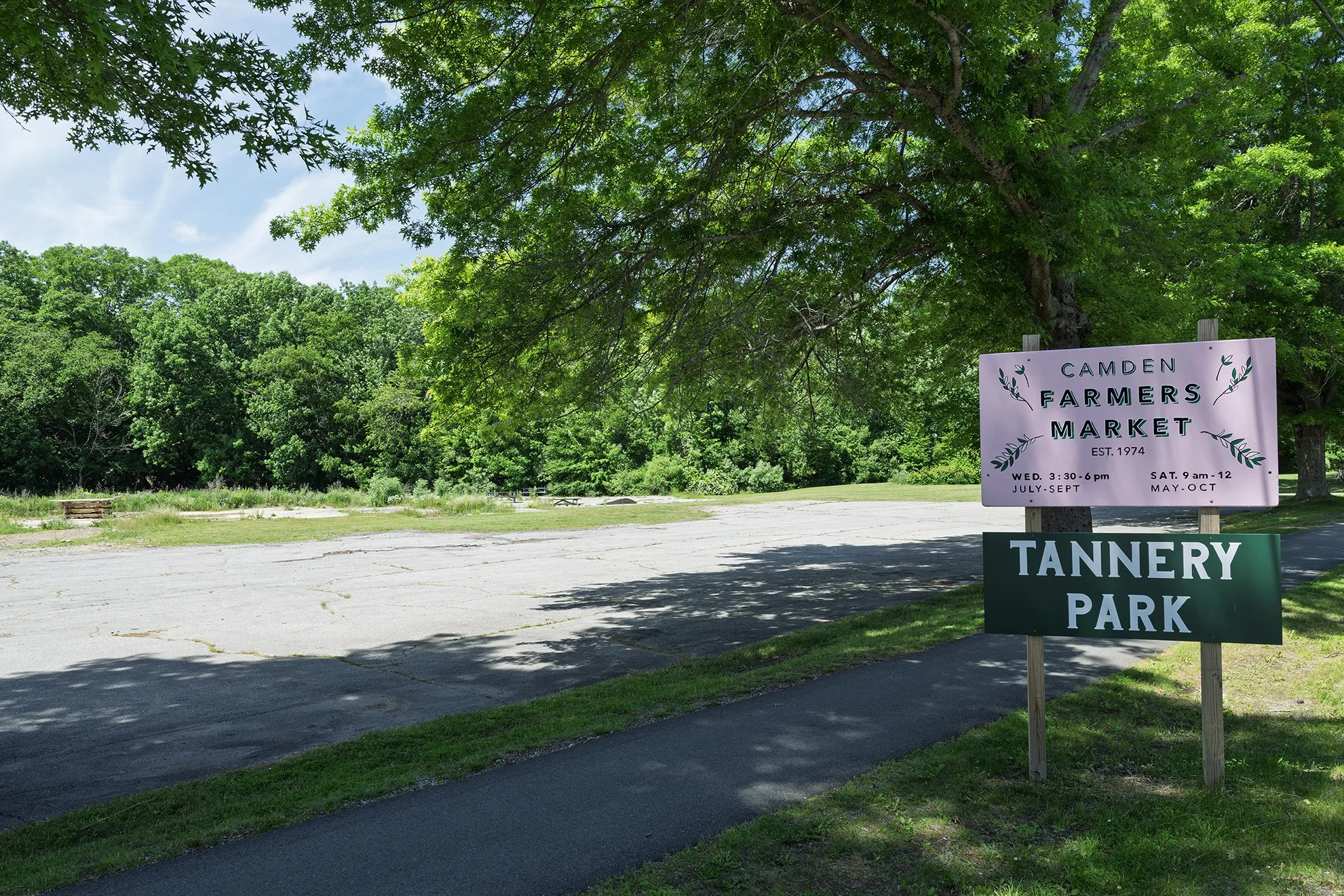
Today, the former industrial landscape at Tannery Park reflects generations of changing uses along the river. The site is now an open area of dirt, cracked pavement, grass, and weeds, with picnic tables positioned near the wooded riverbank and a simple outhouse serving present-day visitors. This quiet recreational setting contrasts sharply with the manufacturing activity that once occupied the property. Beneath the informal character of the park remains a layered industrial history that includes the Gould Plug and Wedge Mill, the Camden Woolen Company, and later tanning operation
Historical Narrative
-
Gould Plug and Wedge Mill
Origins of Industrial Production on the Megunticook River
Camden, Knox County, Maine
c. 1855–Late Nineteenth Century
Introduction
The First Industrial Enterprise of the Washington Street Corridor
The Gould Plug and Wedge Mill represents one of the earliest identifiable industrial enterprises established along the Megunticook River in Camden, Maine. Although later industrial enterprises—including the Camden Woolen Company and the Camden tanning industries—became much larger and more economically dominant, the Gould operation occupies an important position in the history of Camden’s industrial development.
Established during the middle decades of the nineteenth century and associated with Amasa Gould, the mill represents the period when Camden began transitioning from a primarily maritime and agricultural economy into a community with diversified manufacturing.
The Gould operation was a small specialized manufacturing enterprise producing wooden plugs and wedges, products that supported shipbuilding, construction, and other timber-related industries. Its importance was not based on size but on its role in establishing an industrial pattern along the Washington Street corridor: the use of the Megunticook River as a source of mechanical power and the development of specialized manufacturing based on local resources and skilled labor.¹
The mill’s historical significance lies in the fact that it represents the earliest layer of continuous industrial activity at a location that later became one of Camden’s most important industrial landscapes.
Camden Before the Gould Mill
Maritime Economy and Early Industrial Development
During the first half of the nineteenth century, Camden’s economy was shaped primarily by maritime activity. The town’s location on Penobscot Bay encouraged the development of shipbuilding, coastal commerce, fishing, and timber-related industries.
Shipbuilding was especially important to the community. Wooden vessels required large quantities of local timber as well as a network of specialized suppliers capable of producing the many components needed for construction and repair.
However, Camden’s economic development was not limited to the waterfront. The Megunticook River provided an additional resource that became increasingly important during the nineteenth century: waterpower.
Before widespread steam and electrical power, rivers provided the mechanical energy necessary to operate industrial machinery. Communities throughout New England developed manufacturing sites at locations where water could be controlled and directed through dams, races, and wheels.
These locations became known as mill privileges. A successful mill privilege represented a combination of natural resources, engineering, and legal rights that allowed entrepreneurs to establish manufacturing operations.²
The Gould Plug and Wedge Mill emerged within this broader transformation of Camden from a maritime community into a diversified industrial town.
The Establishment of the Gould Plug and Wedge Mill
The Gould Plug and Wedge Mill was associated with Amasa Gould and operated at the fourth mill privilege along the Megunticook River, in the area later associated with the Washington Street industrial corridor.
Although the exact construction date has not been established through surviving documentation, local industrial histories place the Gould operation in the middle of the nineteenth century, approximately by the 1850s.³
The location was strategically important.
The mill benefited from:
access to waterpower;
proximity to Camden’s shipbuilding economy;
availability of local timber;
connection to regional markets.
The enterprise represents a typical example of early New England industrial development, where small manufacturers established operations based on local resources and specialized production.
Unlike later factories that employed hundreds of workers, the Gould mill functioned as a small mechanized workshop. Its production depended upon skilled labor, specialized machinery, and direct knowledge of woodworking techniques.
Production: Wooden Plugs and Wedges
The principal products of the Gould mill were wooden plugs and wedges.
Although these items were relatively small, they served important functions in nineteenth-century construction and maritime industries.
Wooden plugs were used for:
filling openings in wooden structures;
covering fasteners;
creating finished surfaces;
securing construction elements.
Wedges were used for:
tightening joints;
securing wooden assemblies;
adjusting structural components.
In the era of wooden shipbuilding, these products were essential industrial components. Shipyards required thousands of individual pieces to complete vessels, and specialized manufacturers supplied many of these items.
The Gould mill therefore operated as part of Camden’s maritime supply network rather than as an isolated woodworking operation.
The importance of small manufacturers like Gould’s was that they allowed larger industries to function efficiently. Shipbuilders did not need to produce every component themselves; specialized suppliers could provide standardized materials.⁴
Machinery and Manufacturing Technology
The Gould Plug and Wedge Mill operated during a period of transition in American manufacturing.
By the mid-nineteenth century, many small industries were adopting mechanical equipment that increased production speed and improved consistency. However, mechanization did not eliminate skilled labor.
Instead, successful small mills combined:
water-powered machinery;
mechanical cutting equipment;
skilled woodworking;
hand finishing.
Workers needed knowledge of both traditional craft techniques and machine operation.
Local mechanics and machinists played an important role in maintaining rural industrial systems. Historical references associated with Camden’s industrial development identify David Knowlton as a figure connected with local machinery development and repair.⁵
The Gould mill represents this transitional stage between traditional craft production and fully developed factory manufacturing.
Workforce, Labor, and Working Conditions
The Gould Plug and Wedge Mill operated with a small workforce.
The most significant quantitative evidence comes from the State of Maine manufacturing survey of 1873, which listed the Gould-associated enterprise as:
A. B. & H. A. Gould
Industry: Plugs and Wedges, Treenails, Powder Kegs
Employees: Six male workers
Production value: Approximately $5,000 annually⁶This record provides important evidence regarding the scale of the operation.
The workforce was likely composed of:
skilled woodworkers;
machinists;
mill operators;
general laborers.
Because the products required accuracy and consistency, skilled workers were essential.
The Gould mill workforce differed significantly from later factory labor systems. Workers likely participated in several stages of production rather than performing one repetitive task.
A worker might:
prepare timber;
operate machinery;
maintain equipment;
inspect finished products.
This reflected an older craft-based industrial organization that continued even as mechanization increased.
Wages and Economic Conditions
No Gould payroll records have been identified. Therefore, exact wages paid at the mill remain unknown.
However, contemporary Maine industrial reports provide comparable information regarding manufacturing wages during the period.
The 1873 state manufacturing survey recorded weekly wage information for several Maine industries, demonstrating that skilled manufacturing workers commonly earned wages reflecting their experience and occupation.⁷
Workers in small specialized mills generally fell into several categories:
Skilled machinery operators and experienced craftsmen received higher wages because their knowledge directly affected production quality.
General laborers received lower wages because their duties involved material handling and support work.
Compared with later industrial factories, Gould workers likely experienced a more personal relationship with ownership but also faced physically demanding conditions.
Working Conditions
The physical environment of the Gould mill would have reflected typical conditions of nineteenth-century woodworking industries.
Workers likely encountered:
wood dust;
machinery noise;
heavy materials;
limited workplace safety protections;
seasonal temperature changes.
Industrial safety regulations were limited during this period.
Worker safety depended largely upon:
experience;
careful operation;
informal training.
The small size of the operation likely meant that workers worked closely together under direct supervision.
The Gould Mill and Maritime Manufacturing Networks
The Gould mill was part of a larger maritime production system.
Shipbuilding communities depended upon many supporting industries, including:
sawmills;
blacksmith shops;
rope makers;
woodworking manufacturers.
The Gould operation occupied a specialized position by producing components needed for wooden construction.
This relationship demonstrates that industrial communities were networks rather than isolated factories.
A small six-worker enterprise could contribute directly to a major regional industry because its products filled a specific need.
Comparison With Gristmills and Agricultural Mills
The Gould Plug and Wedge Mill differed significantly from the traditional gristmills and agricultural mills that had long existed throughout New England.
Gristmills primarily served local agricultural communities by processing grain into flour or meal. Their purpose was essential community service rather than specialized commercial manufacturing.
The Gould mill operated according to a different economic model.
A gristmill depended on:
local farmers;
agricultural production;
regional food needs.
The Gould mill depended on:
shipbuilders;
construction markets;
maritime commerce;
specialized manufacturing demand.
While both types of mills used waterpower, their economic roles were different. The gristmill processed agricultural products necessary for daily life, while Gould’s operation manufactured industrial components that supported commercial production.
This distinction illustrates the broader transformation of nineteenth-century rural economies. Communities increasingly moved from simple resource processing toward specialized manufacturing connected to wider markets.⁸
Transition From Craft Labor to Factory Labor
The Gould Plug and Wedge Mill represents an important stage between traditional craft production and the later factory system.
Earlier craft industries depended primarily upon individual skill and manual production. Later factories relied upon large workforces, specialized departments, and centralized management.
The Gould mill combined elements of both systems.
It used:
mechanical equipment;
waterpower;
standardized production.
However, it still depended upon:
skilled workers;
direct owner supervision;
flexible labor practices.
Later industries along the Megunticook River, particularly textile and tanning operations, introduced a different labor model.
These factories employed larger numbers of workers, divided production into specialized tasks, and operated under corporate management systems.
The transition from Gould’s small workshop-style operation to larger factories reflects the broader industrial transformation of New England during the nineteenth century.⁹
Transition to Larger Industrial Systems
The Decline of Small Specialized Mills and the Rise of Factory Production
By the late nineteenth century, the economic conditions that had supported small specialized enterprises such as the Gould Plug and Wedge Mill began to change. Across New England, industrial production increasingly shifted toward larger factories capable of producing greater quantities of standardized goods.
Several factors contributed to this transformation:
improved transportation networks;
expanded regional and national markets;
increased availability of investment capital;
advances in machinery;
corporate organization of manufacturing.
Small mills continued to operate, but many were absorbed into larger industrial systems or replaced by enterprises that could achieve greater production capacity.
The Gould Plug and Wedge Mill appears to have followed this broader regional pattern. Although the enterprise disappeared as an independent manufacturing operation, the industrial value of the site remained.
The location possessed the qualities that continued to attract manufacturers:
dependable waterpower;
established industrial infrastructure;
transportation access;
proximity to labor.
The transition of the Gould site demonstrates an important feature of industrial history: early small mills often created the foundation upon which larger industries later developed.¹⁰
The Gould Site and the Development of the Washington Street Industrial Corridor
The importance of the Gould Plug and Wedge Mill extends beyond the products it manufactured.
The operation helped establish the Washington Street corridor as an industrial district.
Industrial development along the Megunticook River followed a pattern common throughout Maine:
entrepreneurs identified suitable waterpower locations;
small mills established manufacturing activity;
infrastructure developed around the site;
larger industries later expanded into established industrial areas.
The Gould operation represents the first documented stage in this sequence. Later industrial enterprises—including woolen manufacturing and tanning—benefited from the industrial character already created along the river. Historic mapping of the Washington Street corridor demonstrates the continued industrial occupation of the site into the late nineteenth and early twentieth centuries, even though the original Gould buildings had disappeared by that time.¹¹
The site was not selected randomly by later companies. Rather, it had already proven its value as a manufacturing location through decades of successful use of the Megunticook River's waterpower and established transportation connections. The continuity of industrial occupation documented through local archival collections supports the interpretation that the Gould mill formed the first identifiable industrial layer of what later became Camden's principal manufacturing district.¹²
Transition to Woolen Manufacturing and Industrial Consolidation
By the late nineteenth century, Camden's industrial economy increasingly reflected the broader national movement toward larger-scale manufacturing.
The woolen industry represented a major departure from the small woodworking enterprises of the earlier period. Textile factories required substantially larger buildings, greater capital investment, expanded workforces, and increasingly specialized departments organized around mechanized production.
The transition from Gould's relatively small manufacturing operation to later textile production illustrates the movement from a locally owned craft-industrial economy toward a factory-based industrial system. This transformation followed patterns observed throughout New England, where earlier water-powered workshops often became the nucleus of larger manufacturing complexes.¹³
The Gould mill should therefore be understood as the beginning of a continuous industrial story rather than as an isolated enterprise. Its establishment demonstrated the long-term industrial potential of the Washington Street mill privilege.
The Gould Mill Within Maine Industrial History
The Gould Plug and Wedge Mill reflects a broader pattern found throughout nineteenth-century Maine.
Many Maine communities developed industrial districts based upon the combination of abundant forests, dependable rivers, skilled labor, and access to maritime commerce. Small specialized enterprises frequently appeared before larger factories and served regional markets by producing components rather than finished consumer goods.
Over time, some of these small operations expanded while others disappeared. Nevertheless, they established the industrial knowledge, transportation networks, workforce traditions, and manufacturing infrastructure upon which later industries depended. The Gould mill represents this first generation of industrial development that characterized much of rural New England during the transition from artisanal production to mechanized industry.¹³
Historical Significance of the Gould Plug and Wedge Mill
Although the Gould Plug and Wedge Mill was modest when compared with the textile and tanning industries that later occupied the Washington Street corridor, its historical importance is substantial.
The mill is significant because it represents one of Camden's earliest documented manufacturing enterprises and illustrates the community's transition from a predominantly maritime economy toward diversified industrial production. Its use of the Megunticook River demonstrates the central importance of waterpower in nineteenth-century manufacturing, while its production of plugs, wedges, and treenails connected Camden directly to Maine's shipbuilding economy.
The documented six-man workforce recorded in the 1873 manufacturing census also provides evidence of an early skilled industrial labor force operating before the emergence of large factory systems. Finally, the Gould operation established the industrial character of a site that remained devoted to manufacturing for more than a century.
Historical Interpretation
The Gould Plug and Wedge Mill should not be viewed merely as a small woodworking shop.
Instead, it represents an important stage in Camden's economic transformation—from an economy based primarily upon forests, waterpower, and skilled craftsmanship to one increasingly characterized by mechanized manufacturing, wage labor, and factory organization.
The history of the Megunticook River demonstrates that industrial development occurred incrementally. Small enterprises such as the Gould mill proved the economic viability of water-powered manufacturing and laid the groundwork for later industrial expansion. In this sense, the Gould operation occupies a foundational place within Camden's industrial heritage.
Conclusion
The Gould Plug and Wedge Mill represents one of Camden's earliest examples of industrial production along the Megunticook River.
Established during the middle decades of the nineteenth century, the mill transformed locally harvested timber into specialized products that supported maritime construction, regional commerce, and the broader shipbuilding economy of coastal Maine. Although employing only a small workforce, the operation illustrates the transitional nature of American industry during the period between traditional craft production and large-scale factory manufacturing.
The Gould enterprise existed before the dominance of textile mills and tanning factories, yet it established the industrial importance of the Washington Street corridor. The later Camden Woolen Company, Camden Tanning Company, Apollo Tanning Ltd., and ultimately Tannery Park all occupied a landscape whose industrial history began with the Gould Plug and Wedge Mill.
For this reason, the Gould Plug and Wedge Mill should be recognized not simply as an early woodworking enterprise, but as the first identifiable chapter in the continuous industrial history of the Megunticook River corridor.¹³
Footnotes
Camden Historical Resources Committee, Camden Mill Walk Historical Documentation, “Megunticook River Industrial Corridor,” pp. 1–5.
William S. Wyman, The Water-Power Development of Maine, Maine State Archives historical materials, discussion of mill privileges and water-powered industry, pp. 12–18.
Camden Historical Resources Committee, Camden Mill Walk Historical Documentation, “Amasa Gould Plug and Wedge Mill,” pp. 2–3.
Maine Historical Society, Maine Maritime and Industrial Collections, discussion of nineteenth-century shipbuilding support industries, pp. 25–40.
Camden Mill Walk Historical Documentation, references to David Knowlton and machinery development in Camden’s industrial corridor, pp. 4–6.
State of Maine, Wealth and Industry of Maine: Statistics of Manufacturing, 1873, manufacturing tables, “A. B. & H. A. Gould — Plugs and Wedges, Treenails, Powder Kegs.”
State of Maine, Wealth and Industry of Maine: Statistics of Manufacturing, 1873, wage and employment tables.
David R. Meyer, The Roots of American Industrialization, Baltimore: Johns Hopkins University Press, pp. 45–105.
Kenneth Hudson, Industrial Archaeology: A New Introduction, London: Baker, pp. 50–100.
Thomas Dublin, Women at Work: The Transformation of Work and Community in Lowell, Massachusetts, 1826–1860, New York: Columbia University Press, pp. 15–40.
Sanborn Map Company, Sanborn Fire Insurance Maps of Camden, Maine, nineteenth- and early twentieth-century editions.
Camden Public Library, Walsh History Center, Megunticook River Industrial Records, Camden, Maine.
National Park Service, Guidelines for the Treatment of Cultural Landscapes, Washington, D.C., pp. 20–35
Bibliography
Camden Historical Resources Committee. Camden Mill Walk Historical Documentation. Camden, ME.
Camden Public Library, Walsh History Center. Megunticook River Industrial Records. Camden, ME.
Dublin, Thomas. Women at Work: The Transformation of Work and Community in Lowell, Massachusetts, 1826–1860. New York: Columbia University Press, 1979.
Hudson, Kenneth. Industrial Archaeology: A New Introduction. London: John Baker, 1963.
Maine Historical Society. Maine Maritime and Industrial Collections. Portland, ME.
Meyer, David R. The Roots of American Industrialization. Baltimore: Johns Hopkins University Press, 2003.
National Park Service. Guidelines for the Treatment of Cultural Landscapes. Washington, DC: U.S. Department of the Interior, 1996.
Sanborn Map Company. Sanborn Fire Insurance Maps of Camden, Maine. New York: Sanborn Map Company, various editions.
State of Maine. Wealth and Industry of Maine: Statistics of Manufacturing, 1873. Augusta, ME: Sprague, Owen & Nash, State Printers, 1875.
Wyman, William S. The Water-Power Development of Maine. Augusta, ME: Maine State Archives Historical Materials
-
Gould Plug and Wedge Mill and Tannery Park
Origins, Industrial Transformation, Environmental Legacy, and Community Renewal Along the Megunticook River
Camden, Knox County, Maine
c. 1855–Present
Introduction
The Industrial Evolution of the Washington Street Corridor
The Washington Street industrial corridor along the Megunticook River represents one of Camden, Maine’s most significant examples of long-term industrial continuity. From the mid-nineteenth century through the beginning of the twenty-first century, the site evolved through several distinct phases of manufacturing: the Gould Plug and Wedge Mill, the Camden Woolen Company, the Camden Tanning Company, Apollo Tanning Ltd., and finally Tannery Park. Each phase reflected changing technologies, markets, labor systems, and community priorities.
The history of this property illustrates a broader pattern found throughout New England: small water-powered industries developed into larger factory enterprises, traditional manufacturing adapted to new economic conditions, and former industrial landscapes were eventually transformed into public spaces.¹
The importance of the Washington Street site lies not only in the individual companies that operated there but in the continuity of industrial use. The Megunticook River provided the foundation for every period of development. Initially valued as a source of mechanical power, later as an industrial resource, and finally as a restored public landscape, the river connects the entire history of the property.²
The Gould Plug and Wedge Mill represents the earliest identifiable industrial activity on the site. Established around the middle of the nineteenth century, the mill demonstrates Camden’s transition from a primarily maritime and agricultural economy toward diversified manufacturing. Its specialized production of wooden components for shipbuilding and construction connected a small local enterprise to broader regional markets.³
The later establishment of the Camden Woolen Company transformed the property into a major industrial complex. The woolen mill introduced corporate organization, large-scale employment, and factory production. The subsequent conversion to the Camden Tanning Company demonstrated the adaptability of historic industrial buildings and allowed the property to remain productive after the decline of textile manufacturing.⁴
The final industrial chapter, represented by Apollo Tanning Ltd., ended at the close of the twentieth century. The closure of tanning operations created a new challenge: how to address environmental impacts while preserving the historical significance of a site that had shaped Camden’s economic identity for more than a century.⁵
The redevelopment of the property as Tannery Park represents not the disappearance of industrial history but its transformation. The site now functions as a public landscape where the industrial legacy of Camden can be interpreted through the river, historical documentation, archaeological evidence, and community memory.⁶
Chapter 1
Gould Plug and Wedge Mill
Origins of Industrial Production on the Megunticook River
c. 1855–Late Nineteenth Century
Early Industrial Development in Camden
During the first half of the nineteenth century, Camden developed as a maritime community centered on shipbuilding, coastal trade, agriculture, and small-scale manufacturing. The town’s location along Penobscot Bay provided access to maritime markets, while the Megunticook River offered opportunities for water-powered industry.⁷
Throughout Maine, rivers became the foundation of early industrial development. Before widespread electrical power, manufacturers relied upon dams, mill privileges, and water wheels to operate machinery. Communities with suitable waterways often developed clusters of mills producing goods ranging from lumber and grain products to specialized manufactured components.⁸
The Megunticook River contained several mill privileges where water flow could be controlled and directed for industrial purposes. These locations became valuable economic resources because they combined natural geography with engineered infrastructure. The Washington Street property was one such location.⁹
Establishment of the Gould Plug and Wedge Mill
The earliest documented industrial enterprise associated with the Washington Street site was the Gould Plug and Wedge Mill, operated by Amasa Gould during the mid-nineteenth century. The mill was located at approximately the fourth mill privilege along the Megunticook River, near the present Washington Street and Megunticook Street area.¹⁰
The Gould operation specialized in manufacturing wooden plugs and wedges, products essential to nineteenth-century maritime and construction industries. These components were used in shipbuilding, timber framing, and related trades. Although the operation was relatively small compared with later factories, it occupied an important position within Camden’s industrial development.¹¹
The mill represented a transitional period in American manufacturing. Production still depended heavily upon skilled craftsmen, but increasing mechanization was beginning to transform small workshops into more efficient industrial enterprises.¹²
Industrial Function and Regional Markets
The products manufactured at the Gould mill served industries beyond Camden itself. Shipbuilders and construction firms throughout coastal Maine required standardized wooden components, allowing specialized manufacturers to participate in regional supply networks.¹³
The success of small mills such as Gould’s depended upon several factors:
access to waterpower;
availability of timber resources;
skilled labor;
transportation connections;
regional demand.
These characteristics were common among early New England industries. Small manufacturers often occupied a middle position between traditional craft production and later factory systems.¹⁴
Labor and Production
The workforce of the Gould Plug and Wedge Mill likely consisted of skilled woodworkers, machinists, and general laborers. Unlike later factories with hundreds of employees and strict departmental organization, small nineteenth-century mills depended upon workers with broad mechanical knowledge.¹⁵
Employees often moved between different forms of work depending on seasonal economic conditions. In coastal Maine communities, individuals commonly combined manufacturing labor with shipbuilding, agriculture, fishing, and other occupations.¹⁶
The Gould mill therefore reflected the flexible labor economy of early industrial Camden.
Historical Significance
Although the Gould Plug and Wedge Mill did not become a large industrial corporation, its historical importance is substantial. It established the first known industrial use of the Washington Street property and created the foundation upon which later industries developed.
The mill demonstrates:
Camden’s early adoption of water-powered manufacturing;
the importance of specialized maritime production;
the transition from craft industry toward mechanized manufacturing;
the beginning of a continuous industrial landscape.
The later woolen mill and tannery were not built on an unused site. They inherited a location already shaped by industrial investment and waterpower development.¹⁷
Chapter 2
Camden Woolen Company
Industrial Expansion and the Transformation of the Megunticook River Corridor
Late Nineteenth Century–Mid Twentieth Century
The Transition from Small Mill to Factory Industry
By the final decades of the nineteenth century, the character of manufacturing in Camden and throughout New England was changing rapidly. The small, owner-operated mills that characterized the early industrial period were increasingly challenged by larger corporations capable of investing in advanced machinery, expanded facilities, and broader marketing networks.¹⁸
The Washington Street property was transformed during this period from a small specialized woodworking operation into a larger industrial complex associated with the Camden Woolen Company. This transition reflected national trends in manufacturing: the consolidation of production, increased mechanization, and the rise of factory-based employment.¹⁹
The woolen industry was especially important in Maine during this period. Communities with reliable waterpower, available labor, and transportation connections developed textile factories that became central economic institutions.²⁰ Camden’s location along the Megunticook River provided the essential infrastructure needed for this transformation.
Establishment of the Camden Woolen Company
The Camden Woolen Company emerged during a period when textile manufacturing was expanding throughout New England. The company represented a new industrial model based on corporate investment rather than individual entrepreneurship.
Unlike the Gould Plug and Wedge Mill, which produced specialized wooden components on a small scale, the woolen mill required:
extensive factory buildings;
large investments in machinery;
organized labor systems;
specialized production departments;
access to regional and national markets.²¹
The existing mill privilege on the Megunticook River gave the property a significant advantage. Industrial developers did not need to create a manufacturing location from the beginning; they could build upon a site already recognized for its waterpower potential.²²
Factory Architecture and Industrial Design
The construction and expansion of the Camden Woolen Company reflected the architectural principles of nineteenth-century New England textile mills.
The industrial building was designed around several requirements:
Reliable Power Distribution
Before widespread electrical systems, factories depended on mechanical transmission systems powered by water turbines or wheels. Shafts, gears, and belts distributed energy throughout the building.²³
Large Production Floors
Textile manufacturing required open spaces where rows of machines could operate efficiently. Factory floors were organized according to production sequence, allowing materials to move through the building from one department to another.²⁴
Natural Lighting
Large windows became a defining feature of nineteenth-century textile mills. Adequate lighting was necessary for workers performing detailed tasks such as spinning and weaving.²⁵
Structural Strength
Textile machinery generated significant vibration and required heavy structural support. Industrial buildings were constructed with durability as a primary concern.²⁶
Textile Manufacturing Process
The Camden Woolen Company operated within the established production system used by woolen mills throughout New England.
The manufacturing process involved multiple stages:
Wool Preparation
Raw wool was cleaned, sorted, and prepared for processing. This stage removed impurities and organized fibers for later production.²⁷
Carding
Carding machinery separated and aligned wool fibers. The process prepared the material for spinning by creating a consistent fiber arrangement.²⁸
Spinning
Spinning machines transformed prepared fibers into yarn. Workers monitored machinery and corrected problems during operation.²⁹
Weaving
Power looms converted yarn into woven cloth. This stage represented one of the most recognizable forms of factory production because of the large number of machines operating simultaneously.³⁰
Finishing
The completed cloth underwent additional treatment, including washing, dyeing, drying, and inspection before shipment to customers.³¹
Each stage required specialized workers and equipment, creating a highly organized industrial system.
The Growth of Industrial Labor
The Camden Woolen Company changed the nature of employment at the Washington Street site. The workforce expanded beyond the small group of craftsmen associated with the Gould mill and became organized around specialized factory positions.
Typical woolen mill occupations included:
carding workers;
spinners;
weavers;
dyers;
finishers;
mechanics;
engineers;
laborers;
supervisors.³²
This division of labor increased production efficiency but also changed the relationship between workers and their tasks. Employees became operators within a larger manufacturing system rather than independent producers responsible for complete products.³³
Women and Family Labor in the Textile Industry
Women played an important role in New England textile manufacturing. Although surviving employment records for individual Camden workers are incomplete, regional textile records demonstrate that women commonly formed a significant portion of the workforce.³⁴
Women frequently worked in:
spinning departments;
weaving rooms;
inspection;
finishing operations.
Textile employment provided wage opportunities for women and contributed to household income. At the same time, factory work imposed demanding schedules and required adaptation to industrial discipline.³⁵
The presence of women workers also influenced Camden’s social development. Industrial employment affected family decisions, migration patterns, housing needs, and community institutions.³⁶
The Woolen Mill and Camden’s Community Development
The Camden Woolen Company became more than a manufacturing enterprise. Like many New England factories, it shaped the surrounding community.
Industrial employment influenced:
residential development;
local commerce;
transportation patterns;
population growth;
civic life.³⁷
Workers required nearby housing, stores, services, and social institutions. The factory therefore contributed to the creation of an industrial neighborhood connected to the Washington Street corridor.
The mill became part of Camden’s identity, just as shipbuilding and maritime industries had shaped earlier generations.
Technology and Industrial Change
The woolen mill era also reflected continuing technological change.
During the late nineteenth and early twentieth centuries, factories increasingly adopted:
improved turbines;
more efficient looms;
electric lighting;
improved ventilation;
specialized machinery.³⁸
These innovations increased productivity but required greater investment. The ability of companies to modernize became increasingly important as competition intensified.
The Camden Woolen Company’s continued operation depended upon adapting to these technological and economic pressures.
The Decline of Textile Manufacturing
By the mid-twentieth century, many New England textile companies faced significant challenges. The industry experienced increasing competition from southern textile centers and changing national economic conditions.³⁹
Factors contributing to decline included:
lower operating costs elsewhere;
changing labor markets;
aging facilities;
transportation changes;
global competition.⁴⁰
The closure or decline of textile mills affected communities throughout New England. Some industrial properties became vacant, while others found new uses.
The Washington Street property followed the second path. Rather than ending its industrial history, it transitioned into another manufacturing era.
Historical Significance of the Camden Woolen Company
The Camden Woolen Company represents the most significant transformation in the history of the Washington Street site.
It introduced:
large-scale factory production;
corporate industrial organization;
expanded employment;
modern manufacturing technology.
The woolen mill connected Camden to the broader industrial history of New England while preserving the advantages created by the earlier Gould mill.
The site had evolved from a small water-powered workshop into a substantial industrial complex.
Chapter 3
Camden Tanning Company and Apollo Tanning Ltd.
Industrial Adaptation, Leather Manufacturing, and the Final Manufacturing Era
Mid Twentieth Century–1999
Introduction: A New Industrial Identity
The transition from woolen manufacturing to leather production represents one of the most significant changes in the history of the Washington Street industrial property. Rather than becoming obsolete after the decline of textile production, the site entered a new industrial phase that extended manufacturing activity for another generation.
The conversion of the former Camden Woolen Company property into a tannery illustrates a common pattern in New England industrial history. Historic factories often survived because their buildings, water access, transportation connections, and industrial infrastructure remained valuable even when their original industries declined.⁴¹
The Camden Tanning Company and later Apollo Tanning Ltd. continued the long tradition of manufacturing along the Megunticook River while introducing new technologies, labor systems, and environmental challenges.
The Conversion from Textile Mill to Tannery
By the mid-twentieth century, textile manufacturing in New England had declined significantly. Many communities experienced factory closures, unemployment, and abandoned industrial properties.⁴²
The Washington Street property avoided immediate abandonment through industrial reuse.
The conversion to leather manufacturing required substantial modification but benefited from existing infrastructure:
large factory buildings;
heavy structural systems;
water access;
transportation facilities;
established industrial workforce.⁴³
The ability of the property to accommodate another manufacturing industry demonstrates why historic industrial locations often remained economically valuable long after their original purpose disappeared.
The Leather Industry in Maine and New England
Leather manufacturing had a long history throughout New England. Tanneries developed in locations where manufacturers could access:
water supplies;
transportation networks;
skilled labor;
markets for finished leather products.⁴⁴
The tanning process transformed animal hides into durable leather through a series of chemical and mechanical operations.
Unlike textile production, which focused primarily on dry materials such as wool and yarn, tanning required extensive water use and chemical treatment.
A typical tanning operation involved:
preparation of hides;
soaking and cleaning;
removal of unwanted tissue;
chemical treatment;
tanning;
drying;
finishing and shipment.⁴⁵
Each stage required specialized equipment and trained workers.
Industrial Adaptation of Existing Buildings
The former woolen mill buildings were well suited for reuse because industrial architecture was often flexible.
Areas previously used for:
spinning;
weaving;
textile storage;
finishing operations
could be adapted for:
hide processing;
tanning drums;
chemical storage;
drying areas;
finishing operations.⁴⁶
Industrial buildings were designed to accommodate heavy equipment and changing production needs. Their durability allowed many nineteenth-century factories to remain active well into the twentieth century.
Machinery and Production Technology
Leather production required a different technological system from textile manufacturing.
Major equipment included:
tanning drums;
processing vats;
pumps;
conveyors;
drying systems;
finishing machinery.⁴⁷
Mechanical knowledge remained essential. Workers who understood machinery operation and maintenance were valuable because production depended upon reliable equipment.
The transition from woolen manufacturing to tanning therefore involved both technological change and continuity. The products changed, but the need for skilled industrial labor remained.
Labor in the Tannery Era
The workforce of the Camden Tanning Company and Apollo Tanning Ltd. represented a continuation of Camden’s industrial labor tradition.
Tannery employment included:
machine operators;
maintenance mechanics;
production workers;
supervisors;
quality-control personnel;
shipping and warehouse workers.⁴⁸
Many employees developed specialized knowledge through years of experience. Industrial skills were often transferred between generations, creating family connections to the workplace.
For many Camden residents, the tannery represented more than a job. It was a continuation of a manufacturing tradition that had shaped the community since the nineteenth century.
Changing Industrial Conditions After 1950
The post–World War II period brought major changes to American manufacturing.
Industrial companies faced:
increasing competition;
changing consumer markets;
technological modernization;
rising regulatory requirements;
international competition.⁴⁹
Leather manufacturers were particularly affected by global changes in production. Many traditional American tanning centers declined as manufacturing moved to areas with lower labor costs.
The Camden tannery survived longer than many comparable facilities because of its established infrastructure and experienced workforce.
Environmental Challenges of Tanning Operations
The tanning industry created environmental challenges that became increasingly recognized during the twentieth century.
Historic tanning operations could generate waste containing:
organic materials;
chemical compounds;
metals;
wastewater pollutants.⁵⁰
During earlier decades of operation, environmental standards were significantly less restrictive than modern requirements. Industrial communities often prioritized employment and economic production over environmental protection.
By the later twentieth century, however, public awareness and government regulation changed expectations for industrial facilities.
The Rise of Environmental Regulation
Several major developments transformed industrial operations after the 1970s.
The creation of the U.S. Environmental Protection Agency in 1970 and passage of the Clean Water Act in 1972 established new standards for industrial pollution control.⁵¹
Manufacturers were increasingly required to address:
wastewater treatment;
hazardous materials management;
chemical storage;
environmental monitoring.
These regulations improved environmental protection but also increased operating costs for older industrial facilities.
Apollo Tanning Ltd.
Apollo Tanning Ltd. represented the final stage of active manufacturing at the Washington Street property.
The company continued leather production while operating within a substantially different regulatory environment than earlier industrial occupants.
By this period, the facility reflected more than a century of industrial evolution:
nineteenth-century waterpower systems;
twentieth-century mechanical manufacturing;
modern industrial regulation.
Apollo Tanning maintained the site’s manufacturing identity but also inherited the environmental responsibilities associated with generations of industrial activity.
Closure of Industrial Operations
Apollo Tanning ceased operations at the end of the twentieth century, bringing an end to more than 140 years of continuous industrial use.
The closure represented a major transition for Camden.
The community lost:
a long-standing employer;
an important manufacturing institution;
a workplace connected to generations of families.
At the same time, the closure created an opportunity to reconsider the future of the property.
The question became whether the site would remain a symbol of industrial decline or become an example of successful redevelopment.
Historical Significance of the Tanning Era
The Camden Tanning Company and Apollo Tanning era is significant because it demonstrates industrial continuity and adaptation.
The property did not experience a simple transition from active industry to abandonment. Instead, it remained productive through changing economic conditions.
The tanning period demonstrates:
the adaptability of historic industrial buildings;
the importance of skilled industrial labor;
the changing relationship between industry and the environment;
the challenges of preserving industrial landscapes after closure.
The final manufacturing era completed the industrial sequence that began with the Gould Plug and Wedge Mill.
Chapter 4
Environmental Legacy, Brownfields Redevelopment, and the Creation of Tannery Park
From Industrial Contamination to Public Riverfront Restoration
1999–Present
The End of Industrial Production and the Beginning of Redevelopment
The closure of Apollo Tanning Ltd. marked a decisive turning point in the history of the Washington Street property. After more than a century of continuous manufacturing, the site entered a new period defined not by production but by assessment, cleanup, preservation, and community planning.
The end of industrial activity created both challenges and opportunities. Like many former manufacturing properties throughout New England, the site contained valuable infrastructure and historical significance while also presenting environmental concerns associated with previous industrial operations.⁵²
The transition from an active factory to a public landscape required Camden to address several interconnected questions:
How could environmental impacts be evaluated and corrected?
How could the historic significance of the site be preserved?
How could the riverfront property serve future generations?
How could industrial history remain part of the community’s identity?
The redevelopment process ultimately transformed the former industrial property into Tannery Park, creating a new relationship between Camden and the Megunticook River.
Brownfields and the Post-Industrial Landscape
The former tannery property became part of a larger national pattern involving the redevelopment of brownfields.
A brownfield is generally a property where redevelopment is complicated by the presence or potential presence of hazardous substances, pollutants, or contaminants.⁵³
Across the United States, former industrial sites often faced similar challenges:
abandoned buildings;
contaminated soils;
polluted waterways;
uncertainty about future use.
Communities increasingly recognized that leaving former industrial properties unused could create economic and environmental problems. Brownfields programs encouraged assessment and cleanup so that historically developed land could once again serve productive purposes.⁵⁴
The Washington Street property represents this broader movement toward responsible reuse of industrial landscapes.
Environmental Assessment of the Former Tannery Property
The environmental assessment process involved identifying the historical uses of the site and determining potential impacts from decades of manufacturing.
Investigations examined:
soil conditions;
groundwater;
surface water;
industrial structures;
historical waste practices.⁵⁵
Because the property had supported multiple industries, environmental evaluation required understanding each period of use:
Gould Plug and Wedge Mill Era
The primary environmental impact involved alteration of the river through waterpower systems, mill structures, and related infrastructure.
Camden Woolen Company Era
Textile production introduced industrial wastewater concerns associated with washing, dyeing, and finishing processes.
Tannery Era
Leather manufacturing represented the most significant environmental challenge because of chemical processing and wastewater generation.⁵⁶
Understanding this layered industrial history was essential to determining appropriate cleanup and redevelopment strategies.
The Relationship Between Industry and the Megunticook River
The environmental history of the Washington Street site demonstrates the changing relationship between communities and waterways.
During the nineteenth century, the river was viewed primarily as an industrial resource.
Its value was measured by:
water volume;
mechanical power;
ability to support manufacturing.
During the twentieth century, the river became increasingly recognized as an ecological resource requiring protection.
Modern restoration efforts emphasized:
water quality;
habitat improvement;
public access;
environmental education.
The same river that powered the Gould mill eventually became the centerpiece of Tannery Park’s restoration.
Environmental Regulation and Industrial Accountability
The redevelopment of the former tannery property occurred within the context of expanding environmental regulation.
Important federal and state developments included:
the Clean Water Act;
hazardous waste regulations;
state environmental review procedures;
brownfields redevelopment programs.⁵⁷
These regulations changed the expectations placed upon industrial communities.
Earlier generations often viewed industrial waste as an unavoidable consequence of manufacturing. Later generations recognized that economic development and environmental protection had to be addressed together.
The Camden project reflects this broader transformation in American attitudes toward industrial landscapes.
Community Decision-Making and Public Redevelopment
The future of the former tannery property depended upon cooperation among municipal officials, environmental agencies, residents, and preservation advocates.
The redevelopment process involved balancing multiple goals:
environmental cleanup;
economic responsibility;
historical interpretation;
public recreation;
river restoration.⁵⁸
The creation of Tannery Park demonstrated a community decision to preserve the meaning of the industrial site while allowing it to serve a new purpose.
The property would no longer produce manufactured goods, but it would continue to contribute to Camden’s identity.
Tannery Park as a Restored Industrial Landscape
Tannery Park represents a new type of industrial heritage site. Instead of preserving an operating factory or restoring a historic building, the project preserves the memory and significance of the landscape itself.
The park communicates several historical themes:
The Importance of the River
Visitors can understand that the Megunticook River shaped every stage of development.
The Industrial Sequence
The site reflects successive eras:
Gould Plug and Wedge Mill;
Camden Woolen Company;
Camden Tanning Company;
Apollo Tanning Ltd.
Environmental Recovery
The park demonstrates how formerly industrial landscapes can be restored and reused.
Community Renewal
The property has returned to public use after generations of private industrial ownership.
Preserving Industrial Memory
The challenge of Tannery Park is that much of the physical evidence of manufacturing has disappeared.
Historic interpretation therefore depends on:
archival photographs;
maps;
written records;
oral histories;
interpretive signage;
archaeological evidence.
Preservation does not require that every industrial structure survive. It requires that the historical meaning of the place remains understandable.
The Washington Street property continues to tell the story of Camden’s industrial development because the landscape itself preserves the sequence of human activity.
The Broader Meaning of the Redevelopment
The transformation from tannery to park represents a major shift in the history of American industrial communities.
The property moved through several stages:
Industrial Resource
The river powered manufacturing.Industrial Workplace
Factories provided employment and economic stability.Environmental Challenge
The consequences of industrial production required attention.Public Landscape
The site became a shared community resource.This progression reflects the changing priorities of modern communities.
Historical Importance of Tannery Park
Tannery Park should be understood as the final chapter in a long industrial narrative rather than the replacement of that narrative.
The park preserves:
the memory of industrial workers;
the importance of manufacturing;
the role of the Megunticook River;
the challenges of industrial redevelopment;
Camden’s ability to adapt.
The site demonstrates that industrial history does not end when factories close. Instead, it continues through preservation, interpretation, and community use.
Chapter 5
Industrial Labor, Community Life, and the People of the Megunticook River Corridor
Workers, Families, Skills, and Industrial Identity
Introduction: The Human Dimension of Industrial History
The history of the Washington Street industrial property cannot be understood solely through buildings, machinery, companies, or environmental change. At its center were the people who operated the mills, maintained the equipment, supported industrial households, and carried manufacturing knowledge across generations.
From the craftsmen of the Gould Plug and Wedge Mill to the textile workers of the Camden Woolen Company and the leather workers of the Camden Tanning Company and Apollo Tanning Ltd., labor shaped every phase of the property’s development.
Industrial landscapes are often described through technology and production, but the daily experiences of workers reveal another essential history: the relationship between employment, family life, community identity, and economic change.⁵⁹
Workers of the Gould Plug and Wedge Mill
The workforce associated with the Gould Plug and Wedge Mill reflected the labor traditions of mid-nineteenth-century Maine.
Unlike later factories with highly specialized departments, small water-powered mills depended upon workers who possessed broad mechanical abilities.
The workforce likely included:
woodworkers;
machinists;
carpenters;
mill operators;
general laborers.
These employees worked in an environment where craftsmanship remained central to production.
A worker’s knowledge of materials, tools, and machinery was essential. Production depended not only on equipment but also on the judgment and experience of skilled individuals.⁶⁰
The small scale of the Gould operation likely created direct relationships between owner and employee. Workers were connected closely to the production process, and the distinction between craftsman and operator remained relatively limited.
Industrial Labor and the Growth of Factory Employment
The arrival of the Camden Woolen Company fundamentally changed labor organization at the site.
The factory system replaced small-scale craft production with a more structured industrial workforce.
Employment became organized around:
specific departments;
assigned tasks;
production schedules;
supervision;
wage systems.⁶¹
The change reflected a larger transformation throughout New England. Industrial workers increasingly became part of coordinated production systems where individual tasks contributed to the manufacture of a larger product.
The factory created more employment opportunities but also introduced new forms of workplace discipline.
Daily Life in the Woolen Mill
The daily experience of a textile worker differed greatly from that of a craftsman in the earlier Gould mill.
Workers operated within a highly organized environment characterized by:
regular shifts;
constant machinery operation;
production expectations;
close supervision.
Textile workers needed to develop specialized skills related to particular machines or processes.
A weaver, spinner, carding worker, or finisher might spend years mastering the requirements of a specific department.⁶²
Although factory employment could be physically demanding, it also provided important economic opportunities. Regular wages allowed families to participate in a cash economy and provided a level of financial stability unavailable through seasonal employment alone.
Women Workers and Textile Employment
Women were a significant part of the textile workforce throughout New England.
In many textile communities, women worked in departments where attention to detail, coordination, and repetitive skill were essential.
Common occupations included:
spinning;
weaving;
inspection;
cloth preparation;
finishing work.⁶³
Women’s industrial employment influenced household economics and community life.
Wages earned in textile mills could support families, provide personal independence, and contribute to household purchasing power. At the same time, industrial employment introduced challenges involving long hours, workplace expectations, and balancing paid labor with family responsibilities.⁶⁴
The history of the Camden Woolen Company should therefore include the contributions of women whose labor supported industrial production.
Skilled Workers and Industrial Knowledge
One of the most important forms of continuity across the Washington Street industrial history was the transfer of mechanical knowledge.
Each industrial period depended upon workers who understood:
machinery operation;
repairs;
production processes;
equipment maintenance.
The machinery changed dramatically over time, but skilled workers remained essential.
The transition from wooden components to textiles to leather products required new technical knowledge, yet the importance of experienced industrial workers remained constant.
This continuity demonstrates that industrial history is not only a history of machines. It is also a history of human expertise.
Tannery Workers and Twentieth-Century Manufacturing
The workforce of the Camden Tanning Company and Apollo Tanning Ltd. represented the continuation of Camden’s industrial tradition into the modern era.
Tannery employees worked in departments involving:
hide preparation;
chemical processing;
machinery operation;
finishing;
maintenance;
shipping.
Leather manufacturing required careful attention because production quality depended on controlling complex chemical and mechanical processes.⁶⁵
Workers developed specialized knowledge that often came through years of employment. This created strong workplace communities and intergenerational connections.
For many families, employment at the tannery represented continuity with earlier generations who had worked in Camden’s mills.
Industrial Employment and Community Identity
Factories influenced communities beyond their property boundaries.
Industrial employers affected:
housing patterns;
local businesses;
transportation;
schools;
civic organizations.
Workers lived in neighborhoods shaped by factory schedules and employment opportunities.
The Washington Street corridor therefore became part of Camden’s social landscape. It was not simply a place where products were manufactured; it was a place where community life developed.
The Impact of Closure on Workers
The closure of Apollo Tanning Ltd. ended a manufacturing tradition extending back to the nineteenth century.
For employees, the closure represented more than economic change. It marked the loss of a workplace connected to personal histories, family traditions, and community identity.
Former industrial workers often carry knowledge that cannot be recovered from official documents:
memories of production methods;
descriptions of workplace culture;
stories of coworkers;
experiences of technological change.
These oral histories are essential resources for understanding the full meaning of the site.
Preserving Worker History
The preservation of industrial history requires recognizing workers as central historical figures.
A complete interpretation of the Washington Street property must include:
company owners;
engineers;
machinists;
production workers;
maintenance employees;
families connected to the industries.
Without workers, the mills and factories would have remained empty structures.
The human history of the site explains why the industrial landscape mattered to Camden for generations.
Historical Interpretation
The labor history of the Washington Street corridor demonstrates several important themes:
Industrial Change
Workers adapted as industries changed from woodworking to textiles to leather.
Skill Continuity
Mechanical knowledge connected different generations of manufacturing.
Community Formation
Factories shaped the social and economic development of Camden.
Industrial Memory
Workers preserved knowledge that remains essential to understanding the site.
The story of the Gould Plug and Wedge Mill and Tannery Park is therefore also the story of the people who built, operated, and transformed the industrial landscape.
Chapter 6
Industrial Archaeology, Historic Preservation, and Interpreting the Lost Factory Landscape
Maps, Structures, Artifacts, and the Memory of Place
Introduction: Preserving a Site When the Factory Is Gone
The Washington Street industrial property presents a central challenge in historic preservation: how to interpret a historically significant industrial landscape when the buildings that once defined it no longer exist in their original form.
Traditional preservation often focuses on maintaining standing structures. A restored mill building, surviving machinery, or intact factory complex provides visitors with a direct physical connection to the past. Industrial landscapes, however, frequently experience different outcomes. Buildings may be removed because of deterioration, environmental concerns, redevelopment needs, or changing community priorities.
At the former tannery property, preservation depends less upon a single surviving structure and more upon reconstructing the historical sequence of activity that occurred there.
The site’s historical resources include:
documentary records;
maps;
photographs;
archaeological evidence;
landscape features;
oral histories;
public interpretation.
The absence of the factory buildings does not remove the historical importance of the location. Instead, it requires a broader understanding of preservation—one that recognizes landscapes as historical documents.⁶⁶
Industrial Archaeology and the Megunticook River Corridor
Industrial archaeology is the study of the physical remains of manufacturing systems and industrial communities.
Unlike traditional archaeology focused primarily on ancient societies, industrial archaeology examines relatively recent evidence of human activity, including:
factories;
mills;
transportation systems;
worker housing;
machinery foundations;
power systems;
waste-management features.⁶⁷
At the Washington Street site, archaeological investigation provides a method for understanding how each industrial era modified the landscape.
The Gould Plug and Wedge Mill, Camden Woolen Company, Camden Tanning Company, and Apollo Tanning Ltd. each left physical traces.
These may include:
foundation remnants;
altered riverbanks;
stone walls;
drainage systems;
buried infrastructure;
industrial surfaces.
Together, these features reveal how generations of workers interacted with the site.
The Archaeological Record of Waterpower
The earliest industrial use of the property depended upon the Megunticook River’s waterpower.
Water-powered industries required significant engineering modifications, including:
dams;
channels;
mill races;
water-control structures;
mechanical transmission systems.
Although many of these features have been altered or removed, their locations remain important clues to early industrial development.
The Gould Plug and Wedge Mill illustrates the relationship between natural resources and industrial growth. The river was not simply adjacent to the mill; it was the essential technology that made the mill possible.
Historic Maps as Preservation Tools
Historic maps provide some of the most valuable evidence for reconstructing lost industrial landscapes.
Sanborn Fire Insurance Maps are particularly important because they documented industrial properties for insurance purposes.
These maps commonly recorded:
building footprints;
construction materials;
machinery locations;
fire-protection systems;
property boundaries;
industrial functions.⁶⁸
By comparing maps from different periods, researchers can trace changes in the Washington Street property.
A nineteenth-century map may show the location of the woolen mill, while later maps reveal expansions, new buildings, and changes associated with tanning operations.
Historic maps transform an invisible landscape into a readable historical record.
Photography and Visual Documentation
Historic photographs provide another essential source of evidence.
Images of the Washington Street industrial corridor can reveal:
factory appearance;
building arrangement;
worker activities;
transportation systems;
relationship between industry and river.
Photographs also preserve information about industrial culture.
A photograph of a factory exterior may show architecture, but photographs of workers reveal the human dimension of manufacturing.
Visual documentation therefore supports both architectural and social interpretation.
Oral History as Industrial Evidence
Written records often emphasize companies, owners, production totals, and financial information. They rarely capture the everyday experiences of workers.
Oral histories provide insight into:
workplace routines;
machinery operation;
relationships among employees;
changes in technology;
community perceptions.
Former workers and residents can describe aspects of industrial life that cannot be reconstructed through documents alone.
For the Washington Street property, oral history provides a connection between the industrial past and living memory.
The Concept of the Historic Landscape
Modern preservation increasingly recognizes that historical significance can exist beyond individual buildings.
A historic landscape includes:
natural features;
human modifications;
patterns of use;
relationships between structures and environment.
The Washington Street site is significant because the same landscape supported multiple generations of industry.
The physical location itself connects:
early water-powered manufacturing;
textile production;
leather processing;
environmental restoration.
The landscape is therefore the surviving historical artifact.
Interpreting Industrial Change at Tannery Park
The challenge for interpretation is explaining a complicated history in a landscape where visitors may not immediately see the industrial past.
Effective interpretation can include:
historical markers;
walking paths;
photographs;
digital exhibits;
maps;
educational programs.
Interpretive materials can explain:
where buildings once stood;
how machinery operated;
what workers produced;
how the river influenced development.
The goal is not to recreate the factory physically but to make the historical sequence understandable.
Preservation Without Reconstruction
A common misconception is that preservation requires rebuilding lost structures.
Historic preservation practice recognizes several approaches:
Restoration
Returning a structure to an earlier condition.
Rehabilitation
Adapting a historic property for continued use.
Documentation
Recording and interpreting a property when physical preservation is impossible.
Landscape Preservation
Protecting the relationships between land, water, and historical activity.⁶⁹
The Washington Street property represents the final two approaches. Its significance is preserved through documentation, interpretation, and continued public use.
The Role of Community Memory
Community memory is a powerful preservation resource because industrial sites often exist in personal and collective experience long after buildings disappear.
Residents remember:
employment opportunities;
family connections;
daily activity;
economic importance;
periods of change.
These memories help explain why industrial landscapes matter.
The value of the Washington Street site comes not only from what was manufactured there but from how the industries shaped Camden’s identity.
Industrial Heritage and Public Education
Former industrial sites provide important opportunities for education.
The Washington Street property can teach visitors about:
nineteenth-century manufacturing;
industrial technology;
labor history;
environmental change;
community adaptation.
Industrial heritage connects local history to larger national themes.
Camden’s experience reflects broader American transitions from:
craft production to factories;
local markets to national economies;
industrial expansion to environmental restoration.
Historical Significance
Industrial archaeology and preservation reveal that the Washington Street property remains historically important despite major physical changes.
The site preserves:
evidence of industrial evolution;
connections between people and place;
the relationship between industry and environment;
Camden’s continuing adaptation.
The former factory landscape has become a different type of historical resource: a place where the story of industry can be interpreted rather than a place where industry continues.
Chapter 7
Camden’s Industrial Legacy Within the New England Manufacturing Tradition
Comparative Context, Regional Patterns, and Historical Significance
Introduction: Camden and the Larger Industrial Story of New England
The history of the Washington Street corridor cannot be fully understood without placing it within the broader development of New England industry. Although Camden’s industrial history possesses distinctive local characteristics, the sequence of development at the Megunticook River site follows patterns experienced throughout Maine and the wider region.
Across New England, communities developed around rivers, transportation networks, skilled labor, and entrepreneurial investment. Small water-powered workshops often became larger factories, and industrial properties frequently adapted to changing economic conditions rather than disappearing entirely.⁷⁰
The Gould Plug and Wedge Mill, Camden Woolen Company, Camden Tanning Company, and Apollo Tanning Ltd. collectively represent the major stages of New England industrial transformation:
early craft-based manufacturing;
factory expansion;
industrial adaptation;
environmental redevelopment.
Waterpower and the Origins of New England Industry
The earliest industrial development throughout New England depended upon rivers.
Before widespread electrical power, rivers provided the energy necessary to operate machinery. Communities with favorable water resources developed manufacturing industries because waterpower offered a reliable and relatively inexpensive source of mechanical energy.⁷¹
The Megunticook River placed Camden within this tradition.
The river supported:
sawmills;
gristmills;
woodworking enterprises;
textile manufacturing;
leather production.
The Gould Plug and Wedge Mill represents this early phase when industrial development remained closely connected to local resources and individual entrepreneurship.
Coastal Maine and Maritime Manufacturing
Camden’s industrial history also differs from many inland New England mill communities because of its maritime setting.
Before becoming known for later manufacturing, Camden developed through:
shipbuilding;
coastal commerce;
fishing;
timber-related industries.
The Gould mill’s production of wooden plugs and wedges reflected this maritime economy.
The enterprise existed because shipbuilders and construction trades required specialized components. This connection demonstrates that early manufacturing in Camden developed as an extension of maritime activity rather than as a separate economic system.⁷²
Comparison with Maine Textile Centers
During the late nineteenth century, textile manufacturing became one of Maine’s most important industries.
Communities such as:
Lewiston;
Biddeford;
Brunswick;
Waterville;
Augusta
developed major textile complexes.
These communities shared several characteristics with Camden:
river-powered factories;
immigrant and local labor forces;
company investment;
industrial neighborhoods;
changing economic pressures.⁷³
The Camden Woolen Company represented this same industrial movement on a smaller scale.
Unlike some larger textile cities, Camden retained a mixed economy that combined manufacturing with maritime, commercial, and tourism-related activities.
The Role of Transportation
Industrial success depended not only on power but also on transportation.
Manufacturers needed reliable systems for:
receiving raw materials;
shipping finished products;
connecting with markets.
Camden benefited from its coastal location and transportation links.
The Gould mill could serve maritime industries, while later woolen and tanning operations could distribute products beyond the immediate community.
Transportation networks allowed a relatively small town to participate in regional and national economies.
Industrial Labor Communities
Industrial communities throughout New England developed around employment opportunities.
Factories influenced:
population patterns;
housing;
social organizations;
local commerce.
Workers formed communities connected to specific workplaces.
In Camden, the Washington Street industries became part of the town’s identity because generations of residents worked at the site.
The industrial property therefore functioned not only as a place of production but as a social institution.
Industrial Decline and Adaptation
Many New England manufacturing communities experienced decline during the twentieth century.
Textile production moved toward regions with lower costs, and older factories struggled to compete.⁷⁴
Some communities experienced abandoned mills and economic decline. Others adapted historic industrial properties for new uses.
The Washington Street site followed a distinctive path:
woodworking became textiles;
textiles became tanning;
manufacturing became public redevelopment.
This continuity represents an important example of industrial adaptation.
Environmental Transformation Across New England
The environmental challenges associated with former industrial sites were not unique to Camden.
Across New England, communities faced issues involving:
contaminated waterways;
industrial waste;
abandoned factories;
redevelopment costs.
Former mills, tanneries, paper plants, and manufacturing facilities required environmental assessment before reuse.
The redevelopment of the Washington Street property reflects this regional movement toward responsible industrial cleanup.⁷⁵
Adaptive Reuse and Industrial Heritage
Many former industrial sites throughout New England have been preserved through adaptive reuse.
Examples include conversions into:
housing;
museums;
commercial spaces;
cultural centers;
parks.
These projects demonstrate that industrial history can remain meaningful even after manufacturing ends.
Tannery Park represents a related approach: preserving the historical significance of the landscape while allowing a completely new public use.
Camden’s Unique Industrial Sequence
The Washington Street property is unusual because of the length and variety of its industrial history.
Few sites demonstrate such a clear progression:
Maritime Support Industry
The Gould Plug and Wedge Mill supported shipbuilding and construction.
Factory Manufacturing
The Camden Woolen Company represented organized industrial production.
Industrial Adaptation
The Camden Tanning Company reused the site for leather manufacturing.
Environmental Renewal
Tannery Park transformed the property into a public landscape.
This sequence provides an unusually complete example of industrial evolution within a single location.
The Historical Importance of Continuity
The greatest significance of the Washington Street corridor is continuity.
The site demonstrates that industrial history is not a series of disconnected events. Each generation inherited conditions created by earlier generations.
The Gould mill established the importance of the location.
The woolen mill expanded industrial capacity.
The tannery preserved manufacturing employment.
The park preserved historical meaning.
The landscape therefore represents more than individual companies. It represents a continuous relationship between Camden, industry, and the Megunticook River.
Historical Interpretation
Placed within the broader New England context, the Washington Street property illustrates several major themes:
Resource-Based Development
Industry began where natural resources provided economic advantages.Technological Change
Production methods evolved from craftsmanship to mechanized manufacturing.Labor Transformation
Workers adapted to changing industrial systems.Economic Adaptation
Communities reused industrial properties when markets changed.Environmental Responsibility
Modern redevelopment incorporated lessons from industrial impacts.The site provides a local example of a much larger regional story.
Chapter 8
Final Historical Interpretation
From Gould Plug and Wedge Mill to Tannery Park
The Complete Industrial Legacy of the Megunticook River Corridor
Introduction: A Story of Transformation Rather Than Disappearance
The history of the Washington Street industrial property is ultimately a story of transformation. Over more than one hundred forty years, the site changed from a small water-powered workshop into a major manufacturing location and finally into a public riverfront landscape.
Each industrial period reflected the economic conditions of its time:
the Gould Plug and Wedge Mill represented early entrepreneurial manufacturing;
the Camden Woolen Company represented industrial expansion;
the Camden Tanning Company represented adaptive reuse;
Apollo Tanning Ltd. represented late twentieth-century manufacturing;
Tannery Park represents environmental restoration and public stewardship.
The history of the property is therefore not defined by the closing of a factory. It is defined by the ability of the landscape to continually serve new purposes while retaining connections to its past.⁷⁶
The Gould Plug and Wedge Mill: The Beginning of Industrial Identity
The Gould Plug and Wedge Mill established the industrial importance of the Washington Street location.
Although small in scale, the mill demonstrated several characteristics that would define the property for generations:
reliance on the Megunticook River;
skilled labor;
specialized production;
connection to maritime markets.
The mill represented the earliest stage of Camden’s industrial development, when individual entrepreneurs used local resources to produce goods needed by regional industries.⁷⁷
Its significance lies not in the size of its workforce or production output but in the fact that it created the first industrial identity of the site.
The Camden Woolen Company: The Era of Industrial Expansion
The Camden Woolen Company transformed the property into a modern factory complex.
The woolen mill reflected the rise of industrial capitalism in New England:
larger investments;
specialized machinery;
organized labor;
expanded markets.
The factory changed Camden’s economic landscape by providing long-term employment and connecting the community to national manufacturing networks.
The woolen mill era represents the height of traditional industrial development at the site.
The Camden Tanning Company: Adaptation and Continuity
The transition from wool textiles to leather production demonstrates one of the most important themes in industrial history: adaptation.
The Washington Street property survived because it could be reused.
The physical characteristics that made it valuable for textile production also made it suitable for tanning:
large industrial spaces;
heavy construction;
water access;
transportation connections.
The Camden Tanning Company preserved the industrial identity of the property during a period when many New England factories disappeared.⁷⁸
Apollo Tanning Ltd.: The Final Manufacturing Generation
Apollo Tanning Ltd. continued the tradition of manufacturing at the site into the late twentieth century.
The company represented the final generation of industrial workers who used the Washington Street property as an active workplace.
Its operation reflected modern industrial realities:
advanced machinery;
environmental regulation;
international competition;
changing manufacturing economics.
The closure of Apollo Tanning ended the active manufacturing era but did not eliminate the historical importance of the property.
The River as the Continuous Historical Element
Throughout every period, the Megunticook River remained the defining feature of the landscape.
For the Gould mill, the river provided mechanical power.
For the woolen company, it supported industrial production.
For the tannery, it was part of the manufacturing system.
For Tannery Park, it became a restored natural and community resource.
The river connects every historical period and provides the clearest example of continuity across changing industrial systems.
Industrial Heritage and Community Identity
The Washington Street property represents more than economic activity.
It represents:
generations of workers;
family histories;
technological change;
community development;
environmental lessons.
Industrial sites often become important because communities remember them through personal experience.
Former employees, residents, and families maintain connections to these places even after buildings disappear.
The meaning of the property therefore extends beyond its physical remains.
The Importance of Preserving Industrial Memory
Preserving the history of the Washington Street corridor does not require rebuilding every lost structure.
Instead, preservation requires:
accurate documentation;
interpretation;
public education;
recognition of workers;
protection of historical landscapes.
The goal is not to freeze the site at one moment in time but to explain the many generations that shaped it.
Tannery Park as the Next Chapter
Tannery Park represents a new phase in the site’s history.
The property has moved from private industrial production to public community use.
This transition demonstrates that former industrial landscapes can continue to contribute to community life.
The park preserves:
the memory of manufacturing;
the importance of the river;
the history of workers;
the process of environmental recovery.
The landscape remains meaningful because its history has been incorporated into its future.
Conclusion: The Enduring Legacy of the Megunticook River Industrial Corridor
The Gould Plug and Wedge Mill and Tannery Park represent opposite ends of the same historical journey.
The Gould mill emerged during an era when small industries used local resources to support maritime and regional economies.
Tannery Park emerged during an era when communities sought to restore industrial landscapes and reconnect with natural resources.
Between these two points lies the complete story of Camden’s industrial transformation.
The Washington Street property demonstrates:
how industries begin;
how they grow;
how they adapt;
how they decline;
how communities preserve their meaning.
The industrial history of the Megunticook River corridor is therefore not a story of loss. It is a story of continuity.
The factories are gone, but the landscape remains.
The machinery has disappeared, but the knowledge and memories survive.
The river continues to connect past and present.
Tannery Park stands as the newest chapter in a long history of innovation, labor, adaptation, and community renewal.
Footnotes
1. Camden History Society, Camden’s American and Canadian Industrial Development, pp. 1–4.
2. Town of Camden, Riverbank Assessment: Tannery Targeted Brownfields Assessment, pp. 8–12.
3. Camden Public Library, Walsh History Center, Millville Industrial Corridor Records, industrial chronology files.
4. Town of Camden, Former Camden Tannery/Apollo Tanning Property Assessment Report, pp. 5–9.
5. U.S. Environmental Protection Agency, Brownfields Program Documentation: Camden, Maine, pp. 1–3.
6. National Park Service, Industrial Heritage and Historic Landscape Preservation Guidance, pp. 12–18.
7. Camden Historical Society, Camden Industrial Development Overview, pp. 3–6.
8. David R. Meyer, The Roots of American Industrialization, pp. 45–67.
9. Sanborn Map Company, Sanborn Fire Insurance Maps of Camden, Maine, various editions.
10. Camden Public Library, Walsh History Center, Megunticook River Mill Records, pp. 1–3.
11. Maine Bureau of Industrial and Labor Statistics, Annual Reports, nineteenth-century manufacturing summaries, pp. 90–95.
12. Meyer, The Roots of American Industrialization, pp. 102–110.
13. Camden Public Library, Walsh History Center, maritime industry records.
14. David R. Meyer, The Roots of American Industrialization, pp. 120–132.
15. Maine Bureau of Industrial and Labor Statistics, Annual Reports of Industrial Conditions in Maine, pp. 40–55.
16. Maine Historical Society, Coastal Maine Maritime and Industrial Records, pp. 22–30.
17. Town of Camden, Riverbank Assessment, pp. 8–15.
18. David R. Meyer, The Roots of American Industrialization, pp. 145–160.
19. National Park Service, Industrial Heritage and Historic Landscape Preservation Guidance, pp. 20–25.
20. Maine Historical Society, Maine Textile Industry Collections, pp. 10–18.
21. United States Bureau of the Census, Manufacturing Schedules: Knox County, Maine, 1880–1920.
22. Sanborn Map Company, Sanborn Fire Insurance Maps of Camden, Maine, 1886–1930 editions.
23. Thomas Dublin, Women at Work: The Transformation of Work and Community in Lowell, Massachusetts, 1826–1860, pp. 50–65.
24. National Park Service, Historic Textile Mill Preservation Guidelines, pp. 8–15.
25. Sanborn Map Company, Sanborn Fire Insurance Maps of Camden, Maine, factory building plans.
26. National Park Service, Secretary of the Interior’s Standards for Historic Industrial Structures, pp. 30–35.
27. Textile Museum of Maine Collections, wool processing documentation, pp. 12–20.
28. United States Bureau of Labor Statistics, Manufacturing Processes in Textile Mills, pp. 25–40.
29. Maine Bureau of Industrial and Labor Statistics, Annual Reports, textile employment sections, pp. 60–80.
30. Dublin, Women at Work, pp. 75–90.
31. Textile Museum of Maine Collections, textile finishing records.
32. United States Bureau of the Census, Manufacturing Schedules, Knox County textile operations.
33. David R. Meyer, The Roots of American Industrialization, pp. 175–190.
34. Dublin, Women at Work, pp. 100–120.
35. Maine Bureau of Industrial and Labor Statistics, Annual Reports, pp. 85–100.
36. Camden Public Library, Walsh History Center, community history collections.
37. Camden Historical Society, Industrial Development of Camden, pp. 15–22.
38. National Park Service, Historic Textile Mill Preservation Guidelines, pp. 25–32.
39. United States Bureau of the Census, Historical Statistics of the United States: Manufacturing Trends, pp. 410–425.
40. Maine Historical Society, Decline of Maine Textile Manufacturing Collections, pp. 20–28.
41. National Park Service, Historic Industrial Properties: Adaptive Reuse and Preservation Practices, pp. 18–25.
42. United States Bureau of the Census, Historical Statistics of the United States: Manufacturing Trends, pp. 425–440.
43. Town of Camden, Riverbank Assessment: Tannery Targeted Brownfields Assessment, pp. 15–22.
44. Maine Historical Society, Maine Leather Industry Collections, pp. 5–15.
45. Leather Industries of America, History and Processes of American Leather Manufacturing, pp. 20–35.
46. National Park Service, Industrial Building Reuse Guidelines, pp. 30–38.
47. Leather Industries of America, Leather Production Technology Records, pp. 40–55.
48. Camden Public Library, Walsh History Center, oral histories and industrial employment collections.
49. United States Department of Commerce, Manufacturing Trends in the United States After 1950, pp. 55–70.
50. U.S. Environmental Protection Agency, Leather Tanning Industry Environmental Assessment, pp. 10–25.
51. United States Congress, Federal Water Pollution Control Act Amendments of 1972 (Clean WaterAct), pp. 1–10.
52. Town of Camden, Riverbank Assessment: Tannery Targeted Brownfields Assessment, pp. 1–8.
53. United States Environmental Protection Agency, Brownfields and Land Revitalization Program Overview, pp. 1–5.
54. U.S. Environmental Protection Agency, Brownfields Area-Wide Planning and Redevelopment Guidance, pp. 10–18.
55. Maine Department of Environmental Protection, Former Camden Tannery Environmental Assessment Records, pp. 5–20.
56. U.S. Environmental Protection Agency, Leather Tanning Industry Environmental Assessment, pp. 25–40.
57. United States Congress, Clean Water Act of 1972, pp. 1–15.
58. Town of Camden, Former Tannery Property Redevelopment Planning Documents, pp. 10–25.
59. Camden Public Library, Walsh History Center, oral histories and industrial employment collections.
60. Maine Bureau of Industrial and Labor Statistics, Annual Reports of Industrial Conditions in Maine, nineteenth-century manufacturing sections, pp. 40–60.
61. David R. Meyer, The Roots of American Industrialization, pp. 175–190.
62. Thomas Dublin, Women at Work: The Transformation of Work and Community in Lowell, Massachusetts, 1826–1860, pp. 75–110.
63. Dublin, Women at Work, pp. 115–140.
64. Maine Bureau of Industrial and Labor Statistics, Annual Reports, textile employment studies, pp. 90–105.
65. Leather Industries of America, History and Processes of American Leather Manufacturing, pp. 40–60.
66. National Park Service, Secretary of the Interior’s Standards for the Treatment of Historic Properties, pp. 35–45.
67. Kenneth Hudson, Industrial Archaeology: A New Introduction, pp. 15–30.
68. Sanborn Map Company, Sanborn Fire Insurance Maps of Camden, Maine, various editions, map sheets documenting industrial development.
69. National Park Service, Guidelines for the Treatment of Cultural Landscapes, pp. 12–25.
70. David R. Meyer, The Roots of American Industrialization, pp. 45–80.
71. Meyer, The Roots of American Industrialization, pp. 81–105.
72. Maine Historical Society, Maine Maritime and Industrial Collections, pp. 25–40.
73. Maine State Museum, Textile Manufacturing in Maine Collections, pp. 10–25.
74. United States Bureau of the Census, Historical Statistics of the United States: Manufacturing Trends, pp. 410–440.
75. U.S. Environmental Protection Agency, Brownfields Redevelopment Guidance, pp. 15–30.
76. National Park Service, Industrial Heritage and Historic Landscape Preservation Guidance, pp. 45–55.
77. Camden Public Library, Walsh History Center, Megunticook River Industrial Records, pp. 1–10.
78. Town of Camden, Riverbank Assessment: Tannery Targeted Brownfields Assessment, pp. 15–30
.Bibliography
Primary Sources
Camden Public Library, Walsh History Center. Industrial History Collections. Camden, ME.
———. Millville Industrial Corridor Records. Camden, ME.
———. Oral History and Photograph Collections Relating to Camden Industry. Camden, ME.
Maine Department of Environmental Protection. Former Camden Tannery Environmental Assessment Records. Augusta, ME.
Maine State Archives. Industrial and Corporate Records Relating to Knox County Manufacturing. Augusta, ME.
Sanborn Map Company. Sanborn Fire Insurance Maps of Camden, Maine. Various editions.
Town of Camden. Former Tannery Property Redevelopment Records. Camden, ME.
———. Riverbank Assessment: Tannery Targeted Brownfields Assessment. Camden, ME.
United States Bureau of the Census. Manufacturing Schedules, Knox County, Maine. Nineteenth and Twentieth Centuries.
United States Congress. Federal Water Pollution Control Act Amendments of 1972 (Clean Water Act). Washington, DC: U.S. Government Printing Office, 1972.
United States Environmental Protection Agency. Brownfields Redevelopment Program Guidance. Washington, DC: U.S. Environmental Protection Agency.
Secondary Sources
Dublin, Thomas. Women at Work: The Transformation of Work and Community in Lowell, Massachusetts, 1826–1860. New York: Columbia University Press, 1979.
Hudson, Kenneth. Industrial Archaeology: A New Introduction. London: John Baker, 1963.
Meyer, David R. The Roots of American Industrialization. Baltimore: Johns Hopkins University Press, 2003.
National Park Service. Guidelines for the Treatment of Cultural Landscapes. Washington, DC: U.S. Department of the Interior.
———. Industrial Heritage and Historic Landscape Preservation Guidance. Washington, DC: U.S. Department of the Interior.
———. Secretary of the Interior's Standards for the Treatment of Historic Properties. Washington, DC: U.S. Department of the Interior.
-
Tannery Park, Camden, Maine: A Continuous Industrial History of the Megunticook River Corridor (c. 1813–Present)
Introduction
Tannery Park on Washington Street in Camden, Knox County, Maine occupies one of the most historically stratified industrial landscapes along the Megunticook River. What is now a public riverfront space was, for nearly two centuries, a continuously evolving industrial corridor shaped by waterpower, shifting manufacturing technologies, and changing economic regimes. The site’s history cannot be understood through a single company or industry; instead, it is best interpreted as a layered sequence of enterprises that reused the same mill privileges for different forms of production.
From early nineteenth-century tannery activity to specialized plug-and-wedge manufacturing, from woolen textiles to industrial tanning, and finally to municipal ownership and farmers’ market use, the site reflects the broader transformation of rural New England from decentralized craft production to industrial capitalism and ultimately to post-industrial public space.
I. Early Mill Privileges and Proto-Industrial Use (c. 1813–1850s)
The earliest documented industrial activity in the Washington Street corridor dates to the early nineteenth century, when mill privileges along the Megunticook River were developed for small-scale industrial use. In this period, the site that would become Tannery Park was part of a dispersed system of water-powered enterprises including sawmills, gristmills, and early manufacturing shops.
Among the earliest identifiable uses was tannery activity associated with small-scale leather production. These early operations were typical of New England river towns, relying on bark-derived tannins and river access for processing hides. While documentation from this earliest phase is fragmentary, the industrial logic is clear: waterpower, proximity to livestock supply chains, and access to Camden’s growing maritime economy.¹
This early phase established the site as a working industrial landscape, rather than undeveloped land, embedding it in the economic geography of Camden.
II. Gould Plug and Wedge Mill: Specialized Early Manufacturing (c. 1850s–1860s)
By the mid-nineteenth century, the site became associated with the Gould Plug and Wedge Mill, operated by Amasa Gould. This enterprise represents one of the earliest identifiable industrial firms on the Washington Street corridor.
The mill specialized in the production of wooden plugs and wedges, essential components in shipbuilding and wooden construction. Plugs were used to seal fasteners in ship hulls, while wedges were used in structural fitting and timber adjustment. These products connected Camden’s industrial output directly to Maine’s maritime economy.
Production was water-powered and small in scale, characteristic of early industrial enterprises before the rise of large textile corporations. The Gould mill represents a transitional phase between artisanal production and industrial manufacturing, where mechanization began to supplement traditional woodworking labor.²
Although short-lived as an independent enterprise, the Gould mill established the site’s long-term industrial trajectory by anchoring it in mechanized production and river-powered industry.
III. Camden Woolen Company and Textile Industrialization (c. 1870s–early 1900s)
By the late nineteenth century, the Washington Street corridor was absorbed into the expanding textile economy of Camden through the Camden Woolen Company. Sanborn Fire Insurance maps from this period document substantial mill structures, indicating a fully developed industrial facility replacing earlier small-scale enterprises.³
The woolen mill marked a fundamental shift in the site’s function. Where earlier industries were small and specialized, the woolen mill was industrial in scale, organized around wage labor and continuous production. The facility processed raw wool into woven textiles, including coarse cloth and utilitarian fabrics used in regional markets.
The Camden Woolen Company also reshaped the surrounding landscape. Worker housing, transportation routes, and supporting infrastructure developed in proximity to the mill, embedding industrial labor into the daily life of the Washington Street corridor.
This period represents the site’s integration into New England’s broader textile system, linking Camden to regional and national markets.
IV. Camden Tanning Company: Chemical Industry and Environmental Transformation (1953–1990s)
In the mid-twentieth century, as textile manufacturing declined in New England, the site underwent another major transformation with the establishment of the Camden Tanning Company in 1953. This marked a shift from textile production to leather processing, reflecting broader industrial adaptation strategies in declining mill towns.
The tannery processed animal hides using chemical tanning methods, including the use of tanning agents and industrial wastewater systems. This phase introduced a more environmentally intensive form of production than earlier industries, significantly affecting soil and river conditions along the Megunticook River.⁴
The Camden Tanning Company represents the site’s longest sustained industrial phase in the modern era, continuing operations for several decades and maintaining the property as an active industrial facility even as other mills in the region closed.
V. Apollo Tanning Ltd.: Final Industrial Operator (1997–2000)
The final industrial occupant of the site was Apollo Tanning Ltd., which began operations in 1997 under a lease arrangement. By this time, the facility was an aging industrial complex with legacy environmental issues from previous tanning operations.
Apollo continued limited leather processing, focusing on sheepskin tanning and finishing. The operation was small in scale, employing only a few workers and producing specialized leather products rather than large-scale industrial output.⁵
In 1999, Apollo ceased operations amid financial and operational difficulties. The company filed for bankruptcy in 2000, marking the end of continuous industrial activity on the site after nearly two centuries.
Apollo’s closure represents the definitive end of Camden’s Washington Street industrial corridor as a production site.
VI. Municipal Acquisition and Environmental Transition (2000s)
Following the closure of Apollo Tanning, the property entered municipal ownership through tax foreclosure. The Town of Camden assumed control of the site in the early 2000s, initiating environmental assessment and remediation efforts.
The site was identified as a brownfield due to long-term industrial contamination associated with tanning and earlier manufacturing activities. Cleanup efforts included soil stabilization, removal of hazardous materials, and environmental monitoring.⁶
This transition marked a fundamental shift in land use: from industrial production to public environmental management.
VII. Tannery Park and Post-Industrial Civic Use (1974–Present)
Even before full municipal redevelopment, the site and surrounding corridor began to be used for civic and community purposes. Most significantly, the Camden Farmers’ Market, established in 1974, has periodically operated in the Washington Street area, including the Tannery Park site.⁷
The farmers’ market represents a symbolic and functional transformation of the landscape. Where industrial production once dominated, seasonal agricultural commerce now defines the space. Vendors selling produce, baked goods, and artisan products occupy the former industrial ground, reactivating the site as an economic and social hub.
In its current form, Tannery Park functions as:
a public green space
a seasonal farmers’ market venue
a riverfront access area
a planning site for ongoing redevelopment discussions
The industrial past remains visible in the landscape, but the site now operates primarily as civic infrastructure rather than manufacturing space.
Conclusion
The history of Tannery Park is not the history of a single company or industry, but a continuous sequence of adaptation along the Megunticook River. From early tannery activity to Gould’s plug and wedge manufacturing, from woolen production to industrial tanning, and finally to Apollo Tanning’s closure and municipal redevelopment, the site demonstrates how industrial landscapes evolve rather than disappear.
Today, Tannery Park stands as a layered historical environment where each phase of use remains embedded in the physical and cultural fabric of Camden. Its transformation into a public space and farmers’ market reflects not the erasure of industrial history, but its repurposing into a new civic form.
Footnotes
Camden Public Library, Walsh History Center, Megunticook River mill privilege records.
Town of Camden historical summaries of Amasa Gould plug and wedge manufacturing operations.
Sanborn Fire Insurance Maps, Camden, Maine, late nineteenth-century industrial survey series.
Maine Department of Environmental Protection, Camden tannery site environmental summaries.
Archived municipal and business records for Apollo Tanning Ltd., Camden, Maine (1997–2000).
Town of Camden, brownfield remediation and tax foreclosure records for Washington Street property.
Camden Farmers’ Market historical documentation, Camden, Maine (est. 1974).
Bibliography
Camden Public Library. Walsh History Center. Megunticook River Industrial Records. Camden, Maine.
Maine Department of Environmental Protection. Camden Tannery Site Environmental Assessment Files. Augusta, Maine.
Sanborn Fire Insurance Maps. Camden, Maine. Late nineteenth-century industrial series.
Town of Camden. Brownfield Remediation and Property Acquisition Records (Washington Street / Tannery Park). Camden, Maine.
Camden Farmers’ Market. Historical and Organizational Records. Camden, Maine.