Bowdoin Paper Manufacturing Company, C. 1875
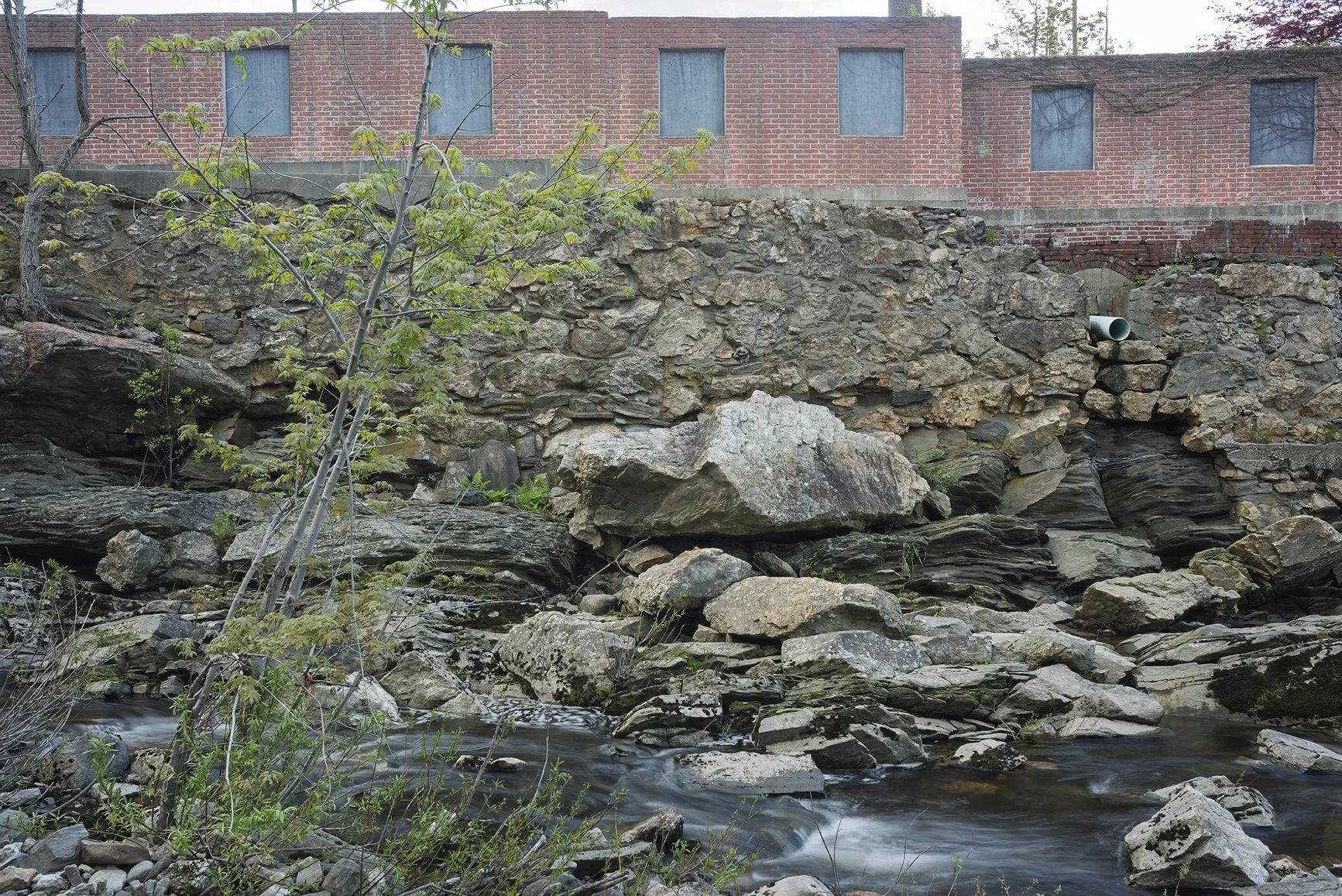
Bowdoin Paper Manufacturing Company, C. 1875
Mill Race, Androscoggin River Main Street
Topsham, SagdahocCounty, Maine
From the Echoes, Still: Maine's Industrial Remnants Collection (2024–2028)
Empty Empires Portfolio
Historical Narrative
The Bowdoin Paper Manufacturing Company: The Industrial Transformation of Brunswick–Topsham, Maine, 1868–1895
Kevin LeDuc Pigment print on Hahnemühle Baryta Edition of 5 + 1 Artist's Proof (Portfolio of 40 Images)
Paper Size: 40 × 55 inches Image Size: 31.33 × 37 inches Borders: Approximately 4 inches (All Sides)
Historic Significance
The Bowdoin Paper Manufacturing Company was an important nineteenth-century industrial enterprise located along the Androscoggin River between Brunswick and Topsham, Maine. Established in 1875 after the earlier Topsham Paper Company failed, the company inherited a valuable industrial site with access to water power, transportation routes, and the abundant forest resources of Maine. The mill represented the growth of the wood-pulp paper industry, a major technological transformation that replaced traditional rag-based papermaking with large-scale mechanical production using spruce pulp.
During its years of operation, the Bowdoin Paper Manufacturing Company developed into a substantial manufacturing complex. The mill included a main paper manufacturing building, boiler house, engine room, machine shop, bleach house, pulp storage areas, railroad connections, and hydraulic power systems. The 1895 Sanborn Fire Insurance Map provides a detailed record of this industrial landscape, revealing how buildings, machinery, transportation, and fire-protection systems were organized into an integrated production facility. The map demonstrates the complexity of late nineteenth-century paper manufacturing and the importance of careful industrial planning.
The company also played a significant role in the social and economic life of Brunswick and Topsham. The mill employed skilled papermakers, engineers, machinists, and laborers whose work supported both the production process and the wider community economy. Industrial employment changed local patterns of daily life by creating steady wage opportunities, supporting related businesses, and connecting the region more closely with national markets. The history of the mill therefore includes not only technological achievement but also the experiences of the workers who operated it.
Although the Bowdoin Paper Manufacturing Company ceased operating under its original name in 1887, the industrial value of the site continued. The Pejepscot Paper Company succeeded the Bowdoin company and maintained paper production at the location, demonstrating that industrial landscapes often outlast the corporations that create them. The Bowdoin mill remains significant as an example of Maine’s transition from traditional river-based industries to modern industrial manufacturing and as a lasting record of the relationship between natural resources, technology, labor, and community development.
Historical Narrative
-
FROM WATER POWER TO WOOD PULP
The Bowdoin Paper Manufacturing Company and the Industrial Transformation of Brunswick–Topsham, Maine, 1868–1895
Abstract
The Bowdoin Paper Manufacturing Company represents an important chapter in the industrial history of Brunswick and Topsham, Maine. Established in 1875 following the earlier Topsham Paper Company enterprise, the company transformed an existing water-power location on the Androscoggin River into a modern wood-pulp paper manufacturing complex. Through investment in Fourdrinier paper machines, refining equipment, hydraulic power, steam generation, and railroad connections, the company became one of Cumberland County's significant nineteenth-century industrial employers.
This study examines the development, operation, and historical significance of the Bowdoin Paper Manufacturing Company through the combined interpretation of local histories, legislative records, industrial literature, census information, and the 1895 Sanborn Fire Insurance Map of Brunswick, Maine. The Sanborn map provides a detailed record of the physical organization of the mill, documenting production buildings, power systems, transportation facilities, and fire-protection features.
Although the corporation experienced financial difficulties and ceased operation under its original name in 1887, the industrial complex continued under the Pejepscot Paper Company and remained an important manufacturing site for decades. The surviving structures preserve evidence of Maine's transition from traditional water-powered industries to modern industrial production based upon wood resources, mechanization, and national markets.
Introduction
The history of the Bowdoin Paper Manufacturing Company illustrates the transformation of Maine's river valleys into centers of modern industrial production during the late nineteenth century. Located along the Androscoggin River between Brunswick and Topsham, Maine, the mill occupied a site whose economic value had long been recognized because of its dependable water power. During the nineteenth century, however, the meaning of that resource changed. Where earlier generations had used the river primarily for sawmills and small manufacturing operations, industrial entrepreneurs increasingly harnessed its energy for large-scale paper production.¹
The Bowdoin Paper Manufacturing Company emerged during a period when Maine's forests, rivers, and transportation networks combined to create favorable conditions for the growth of the paper industry. The introduction of mechanical wood-pulp production allowed manufacturers to replace traditional rag fibers with inexpensive spruce pulp, dramatically lowering production costs and increasing the availability of printed materials throughout the United States.²
The company was incorporated in 1875 after the failure of the earlier Topsham Paper Company, preserving an established industrial site while introducing new capital, equipment, and management. During its period of operation, the Bowdoin Paper Manufacturing Company expanded its facilities, increased production capacity, and became a significant employer in the Brunswick–Topsham region.³
The 1895 Sanborn Fire Insurance Map provides a rare and detailed view of the mill at the height of its nineteenth-century development. Although created for insurance purposes rather than historical documentation, the map records the organization of the industrial complex with remarkable precision. It identifies building materials, manufacturing spaces, power facilities, transportation connections, and fire risks, allowing modern researchers to reconstruct the operation of the mill in detail.⁴
The Industrial Setting of Brunswick and Topsham
The development of the Bowdoin Paper Manufacturing Company cannot be separated from the geography and economic history of the Androscoggin River. For generations, the falls between Brunswick and Topsham had provided one of the most valuable industrial locations in Cumberland County. The river supplied both the physical power necessary for manufacturing and the transportation route through which raw materials and finished products moved. During the nineteenth century, these advantages encouraged a succession of enterprises that transformed the area from a primarily agricultural and maritime community into a center of industrial production.⁵
The importance of water power shaped settlement patterns throughout New England. Before the widespread availability of electrical generation, manufacturers depended upon rivers capable of producing reliable mechanical energy. The Androscoggin River possessed the necessary combination of volume, elevation change, and accessibility. At Brunswick Falls, engineers constructed channels, dams, and raceways that directed water toward turbines and wheels capable of operating increasingly complex machinery.⁶
The earliest industries at the falls were associated with lumber processing and other basic manufacturing activities. Timber from Maine's interior forests could be floated downstream during seasonal river drives and converted into boards and other products at mills located along the river. As forest resources and transportation systems developed, however, entrepreneurs recognized that the same resources could support a more advanced industry: the manufacture of paper from wood pulp.⁷
The emergence of the paper industry represented a major technological change. Traditional paper production depended upon cotton and linen rags, materials that were expensive and limited in supply. During the nineteenth century, inventors and manufacturers developed methods for transforming wood fibers into usable pulp. Maine's extensive spruce forests provided an abundant source of raw material, and the state's rivers provided the energy required for large-scale production.⁸
The location of the Brunswick–Topsham mill was especially favorable because it combined several essential
Origins of the Topsham Paper Company
The immediate predecessor of the Bowdoin Paper Manufacturing Company was the Topsham Paper Company, established in 1868. The company reflected the growing confidence among Maine investors that wood-pulp technology could create profitable manufacturing enterprises by combining the state's natural resources with recently developed industrial machinery.¹¹
Construction of the paper mill at Brunswick Falls represented a significant investment. Unlike earlier small-scale mills, a modern paper factory required extensive buildings, specialized machinery, skilled labor, and a dependable power system. The Fourdrinier paper machine alone represented a substantial technological commitment because it transformed a formerly slow craft process into continuous mechanical production.¹²
The original Topsham Paper Company mill included equipment designed for the production of paper from wood pulp. Logs were reduced to fiber, the pulp was processed through refining equipment, and the resulting material was formed into sheets by mechanical paper machines. The process required not only manufacturing expertise but also careful coordination among numerous departments.¹³
Despite its technological promise, the Topsham Paper Company encountered financial difficulties. Nineteenth-century industrial ventures frequently struggled with the high cost of construction, fluctuating markets, and the need for continual investment in machinery improvements. The paper industry was especially competitive because manufacturers were constantly required to increase efficiency and reduce production costs.¹⁴
By 1874, the company had failed financially, and its property was offered for sale. The industrial value of the site, however, remained evident. Rather than allowing the mill to disappear, investors purchased the property and reorganized the enterprise under a new corporate structure. This transition preserved both the physical plant and the manufacturing potential of the location.¹⁵
On September 16, 1874, the property was sold at auction to W. H. and A. W. Parsons for approximately $80,000. The following year, the Maine Legislature incorporated the Bowdoin Paper Manufacturing Company, beginning a new chapter in the history of the Brunswick Falls paper industry.¹⁶
Creation and Expansion of the Bowdoin Paper Manufacturing Company
The organization of the Bowdoin Paper Manufacturing Company in 1875 represented both a continuation and a reinvention of the paper-making enterprise established at Brunswick Falls during the previous decade. The new corporation inherited an existing industrial site, but its leaders understood that survival within the increasingly competitive paper industry required expansion, improved machinery, and greater production capacity.¹⁷
The Maine Legislature formally incorporated the Bowdoin Paper Manufacturing Company on February 4, 1875. The act authorized the company to hold property, construct and operate manufacturing facilities, and issue capital stock necessary for the development of the enterprise. The corporation was organized shortly afterward, with Adna T. Denison serving as treasurer and F. C. Whitehouse as clerk.¹⁸
Denison was among the many nineteenth-century industrial entrepreneurs who sought to consolidate manufacturing operations through investment, expansion, and improved management. During the post–Civil War period, industrialists increasingly recognized that successful manufacturing required not only machinery but also access to capital, transportation, skilled labor, and reliable markets. The Bowdoin Paper Manufacturing Company reflected this broader transformation from small local enterprises toward larger corporate organizations.¹⁹
When the Bowdoin company began operation, it possessed a substantial industrial foundation. The existing plant included a Fourdrinier paper machine, four roll engines, one Jordan engine, bleaching equipment, and associated machinery. Contemporary descriptions estimated that the mill could produce approximately two and one-half tons of paper per day.²⁰
The Fourdrinier machine was the central element of the manufacturing process. Unlike earlier methods in which sheets of paper were individually formed by hand, the Fourdrinier system produced a continuous web of paper. A suspension of pulp flowed onto a moving wire screen, where water drained away and the fibers formed a continuous sheet. Pressing, drying, and finishing operations then converted the fragile pulp sheet into a usable commercial product.²¹
The roll engines and Jordan engine were equally important components of the production system. Roll engines prepared the pulp mixture by combining fibers with water, fillers, and sizing materials. The Jordan engine refined the fibers, improving their ability to bond together during sheet formation. These machines represented the advanced technology of the period and demonstrated that the Bowdoin mill was equipped according to contemporary industrial standards.²²
Following the reorganization, the company undertook a program of expansion. Additional machinery was installed, production facilities were enlarged, and improvements were made throughout the complex. A second Fourdrinier machine was eventually added, allowing production capacity to increase to approximately five tons of paper per day.²³
This expansion required not only machinery but also a larger workforce. Paper manufacturing depended upon a combination of skilled mechanical occupations and general labor. Engineers maintained power systems, machinists repaired equipment, papermakers operated production machinery, and laborers handled raw materials and finished products. The growth of the mill therefore contributed significantly to the economic development of Brunswick and Topsham.²⁴
By the 1880s, the Bowdoin Paper Manufacturing Company ranked among the more important manufacturing establishments in the region. A contemporary description of Brunswick noted that the mill employed approximately 125 workers, making it a major source of industrial employment.²⁵
The company's growth also reflected the increasing importance of transportation infrastructure. Railroad connections allowed the mill to receive coal, chemicals, machinery, and other supplies while distributing finished paper beyond the local market. The combination of river power and railroad access gave the Bowdoin mill advantages that many smaller competitors lacked.²⁶
The physical expansion of the mill during this period established the industrial arrangement later documented by the 1895 Sanborn Fire Insurance Map. Although ownership would change before the map was prepared, the major buildings, production systems, and transportation relationships visible in 1895 originated largely during the Bowdoin company's period of development.²⁷
Manufacturing Technology and Mill Operations
The Bowdoin Paper Manufacturing Company represented a complete industrial system in which raw forest products were transformed into finished paper through a carefully organized sequence of operations. The arrangement of departments within the mill reflected the logic of nineteenth-century factory design: each stage of production occurred in a specialized area, and materials moved continuously from one process to the next.²⁸
The process began with spruce wood, the preferred raw material for groundwood pulp. Spruce possessed long fibers suitable for paper production and was abundant throughout Maine's forests. Logs arrived at the mill by river and later by railroad, where they were cut into manageable sections and prepared for processing.²⁹
The first manufacturing stage involved reducing wood to pulp. Mechanical grinders pressed the wood against rotating stones while water carried away the resulting fibers. This process created groundwood pulp, which became the foundation for many nineteenth-century printing and newsprint papers.³⁰
After grinding, the pulp was washed and bleached. The bleaching department improved the appearance of the material and prepared it for use in higher-quality paper production. Because bleaching chemicals presented special hazards, these facilities were carefully located and identified on industrial insurance maps.³¹
The prepared pulp then entered the refining stage. Roll engines mixed and conditioned the pulp, while Jordan engines further separated and improved the fibers. Additional materials—including sizing agents, clay, and coloring substances—could be added during this stage to achieve desired qualities in the final paper.³²
Finally, the pulp reached the paper machines. Here the liquid mixture was transformed into a continuous sheet, dried, pressed, smoothed, and prepared for shipment. The operation required constant attention because variations in pulp consistency, water removal, temperature, or machine speed could affect the quality of the finished product.³³
The complexity of the process explains why paper mills required a highly skilled workforce. The Bowdoin mill was not simply a collection of machines; it was an integrated technological environment requiring cooperation among engineers, mechanics, supervisors, and production workers.³⁴
The 1895 Sanborn Fire Insurance Map: A Reconstruction of the Bowdoin Mill Complex
The 1895 Sanborn Fire Insurance Map provides the most complete surviving visual record of the Bowdoin Paper Manufacturing Company complex during the final years of the nineteenth century. Although created for insurance purposes, the map offers historians an unusually detailed picture of the mill's organization, construction, machinery, transportation connections, and fire-safety measures. It reveals not merely a group of buildings but a carefully arranged industrial system in which every structure served a specific role in converting forest resources into finished paper.³⁵
The Sanborn surveyor approached the mill from the perspective of risk assessment. Insurance companies needed to know where fires were most likely to begin, how quickly flames could spread, what materials had been used in construction, and what equipment existed to control emergencies. Consequently, the map records information that ordinary architectural plans often omitted, including wall construction, roof materials, boiler locations, heating systems, machinery arrangements, and fire-protection equipment.³⁶
At the center of the complex stood the main paper mill building, the largest and most important structure on the property. This building contained the principal stages of paper production and represented the economic heart of the enterprise. Constructed primarily of substantial masonry, the main mill reflected the industry's movement away from earlier timber factories toward more fire-resistant industrial architecture. The heavy brick walls provided structural strength for large machinery while reducing the danger posed by the highly combustible materials handled throughout the building.³⁷
Within the main mill were the paper machines, finishing areas, and associated production departments. The Fourdrinier machines occupied large open spaces because their operation required considerable length and clearance. Raw pulp entered the manufacturing area, passed through forming, pressing, and drying stages, and emerged as finished paper ready for cutting, wrapping, and shipment. The scale of the building demonstrates the importance of continuous production: any interruption of the paper machines could create significant financial losses.³⁸
Adjacent to the manufacturing rooms was the boiler house, one of the most carefully documented areas on the Sanborn map. Steam boilers provided supplemental power and heat for the drying process. Although the Bowdoin mill continued to benefit from the hydraulic power of the Androscoggin River, steam technology allowed the factory to operate more consistently despite seasonal changes in water flow.³⁹
The boiler house represented one of the greatest hazards within the entire complex. Coal fires, high-pressure steam, combustible materials, and nearby paper stock created conditions requiring careful separation from the main manufacturing areas. Sanborn surveyors paid particular attention to boiler locations because explosions or boiler fires were among the most destructive events possible in a nineteenth-century industrial establishment.⁴⁰
Connected to the boiler facilities was the engine room, where mechanical power was generated and distributed throughout the mill. Large stationary engines supplied energy to machinery through systems of shafts, belts, pulleys, and gears. Before the widespread adoption of individual electric motors, a factory's power system functioned as an integrated mechanical network in which a single engine could operate numerous machines throughout a building.⁴¹
The engine room represented the transitional character of the 1890s industrial environment. Water power remained essential because the Androscoggin River provided a dependable energy source, but steam engines offered flexibility and reliability. The combination of hydraulic and steam power allowed the Bowdoin complex to maintain production during periods when river conditions were less favorable.⁴²
Another important component of the complex was the machine shop. Although less visible than the large production rooms, the machine shop was essential to the daily operation of the mill. Paper machinery was complicated, and worn parts, broken shafts, damaged gears, and other mechanical problems could halt production. Maintaining an in-house repair facility allowed the company to respond quickly to breakdowns rather than waiting for outside manufacturers to supply replacement parts.⁴³
The machine shop employed skilled workers including machinists, mechanics, blacksmiths, and millwrights. These occupations represented the increasingly specialized character of industrial labor during the late nineteenth century. The success of the paper mill depended not only upon investment in machinery but also upon the knowledge of workers capable of operating and maintaining that machinery.⁴⁴
The bleach house formed another specialized department within the manufacturing process. After wood was reduced to pulp, chemical treatment improved the appearance and quality of the material. Because bleaching involved potentially dangerous substances, these facilities were often separated from other manufacturing spaces and carefully identified on insurance maps.⁴⁵
The location of the bleach house demonstrates the careful planning required in industrial design. Manufacturers had to balance efficiency of movement with safety considerations. Materials needed to pass smoothly from one stage of production to another, but hazardous operations could not be allowed to endanger the entire factory. The arrangement shown on the Sanborn map reflects these competing requirements.⁴⁶
The mill's pulp storage areas served as the connection between raw materials and active production. Before entering the paper-making process, large quantities of prepared pulp had to be stored and protected from contamination or deterioration. Storage facilities also provided a buffer between irregular deliveries of raw materials and the continuous operation of the paper machines.⁴⁷
Raw material storage was especially important because paper manufacturing depended upon reliable supplies of wood fiber. The mill's location near Maine's forest resources gave it a competitive advantage, but transportation conditions and seasonal variations required careful management of inventory. Maintaining adequate pulp supplies ensured that production could continue even when deliveries were interrupted.⁴⁸
The railroad facilities shown on the Sanborn map demonstrate the importance of transportation infrastructure to the mill's success. Railroad connections allowed the company to receive coal, machinery, chemicals, and other supplies while shipping finished paper to distant customers. The railroad transformed the Bowdoin mill from a local water-powered factory into a participant in a national manufacturing economy.⁴⁹
The relationship between railroad and river transportation illustrates the changing nature of Maine industry during the late nineteenth century. The river remained the source of power, but the railroad became the primary connection between the mill and national markets. Together they created a transportation system that supported large-scale industrial production.⁵⁰
Beneath and beside the visible buildings lay the hydraulic works that had made industrial development possible at Brunswick Falls. Canals, raceways, dams, and wheel pits directed the energy of the Androscoggin River toward turbines and other mechanical systems. These structures represented generations of engineering adaptation to the river environment.⁵¹
The hydraulic system was more than a power source; it was the foundation upon which the entire industrial landscape developed. The location of the mill, the arrangement of buildings, and the investment in machinery all depended upon the ability to convert the river's movement into mechanical energy. Even after steam became increasingly important, the hydraulic works remained a defining feature of the site.⁵²
Finally, the Sanborn map documents the mill's fire-protection system, a critical feature in an industry where fire represented a constant threat. Paper mills contained enormous quantities of dry paper, wood fibers, oils, chemicals, and fuel. A small fire could quickly become a disaster unless detected and controlled immediately.⁵³
Fire protection measures included the use of masonry construction, separation of hazardous buildings, water supplies, hydrants, and organized placement of equipment. These features were not merely technical details; they represented the insurance industry's attempt to manage the enormous risks associated with industrial manufacturing.⁵⁴
Taken together, the buildings and systems recorded on the 1895 Sanborn map reveal the Bowdoin mill as a complete industrial organism. The main paper mill, power facilities, repair shops, storage areas, transportation connections, and safety systems functioned together as parts of a single manufacturing environment. The map preserves a moment when nineteenth-century engineering, natural resources, and human labor combined to create one of Maine's important paper-producing enterprises.⁵⁵
Workers and Community Life at the Bowdoin Paper Manufacturing Company
The history of the Bowdoin Paper Manufacturing Company cannot be fully understood through buildings, machinery, and corporate records alone. The mill was also a workplace and a community institution that shaped the daily lives of the people who lived in Brunswick and Topsham. Like other nineteenth-century industrial enterprises, the Bowdoin mill depended upon a diverse workforce whose skills, labor, and experience transformed raw materials into finished products. The history of the company is therefore also a history of workers and the communities that supported them.⁵⁶
During the late nineteenth century, industrial employment represented a significant change from the agricultural and maritime occupations that had traditionally dominated much of coastal Maine. The paper mill offered year-round employment and provided opportunities for workers with mechanical skills, manufacturing experience, or willingness to perform physically demanding labor. As the company expanded, it became one of the region's important sources of industrial employment.⁵⁷
The workforce of a paper mill was highly specialized. Unlike some industries in which workers performed repetitive tasks with limited mechanical knowledge, papermaking required close cooperation between operators, mechanics, engineers, and supervisors. Each stage of production depended upon the successful completion of the previous one. A failure in pulp preparation, machine operation, drying, or finishing could interrupt the entire manufacturing process.⁵⁸
The most skilled workers were the papermakers and machine operators who controlled the Fourdrinier machines. These workers were responsible for maintaining the delicate balance of pulp flow, machine speed, water removal, and drying conditions necessary to produce consistent paper. Their knowledge was often acquired through years of experience and was essential to the economic success of the mill.⁵⁹
Mechanical workers formed another important group. Engineers, machinists, and millwrights maintained the systems that powered the factory. The engine room, boiler house, and machine shop required employees who understood steam technology, hydraulic systems, and increasingly complex industrial equipment. Their work was critical because even brief machinery failures could result in substantial production losses.⁶⁰
General laborers performed many of the physically demanding tasks associated with the mill. They moved raw materials, handled pulp, loaded finished products, maintained buildings, and assisted skilled workers. Although these positions required less specialized training, they were essential to the operation of the factory.⁶¹
The census records of the period provide evidence of the occupational diversity associated with industrial communities. Workers listed occupations such as papermaker, machinist, engineer, laborer, carpenter, teamster, and mill hand. These occupations demonstrate that the paper industry supported not only direct production jobs but also a wider network of related trades and services.⁶²
The growth of the mill influenced residential patterns in Brunswick and Topsham. Industrial workers often lived within convenient distance of their workplaces, creating neighborhoods shaped by the location of factories and transportation routes. Although the Bowdoin mill did not create a company town in the strict sense, its employment opportunities contributed to the development of a community increasingly connected to industrial production.⁶³
Industrial employment also affected family life. Many households depended upon wages earned by men working in factories, while women and children often contributed through domestic labor, agricultural work, or employment in other local industries. The economic stability provided by mill employment could allow families to remain in the area and participate in the growing commercial life of Brunswick and Topsham.⁶⁴
The paper mill also influenced local commerce. Workers required housing, food, clothing, transportation, and other services. Businesses benefited from the economic activity generated by the industrial workforce, while the company itself required suppliers, contractors, and skilled tradespeople. The Bowdoin mill therefore functioned as part of a larger economic network rather than as an isolated factory.⁶⁵
Working conditions inside nineteenth-century paper mills were demanding. The manufacturing environment included constant machinery noise, heat, moisture, chemical exposure, and the dangers associated with moving equipment. Workers operated in close proximity to belts, shafts, rollers, boilers, and other mechanical systems. Industrial safety regulations were limited compared with later standards, and accidents remained a significant concern.⁶⁶
The presence of fire hazards was particularly important. Paper, pulp, oils, and wooden materials created conditions in which flames could spread rapidly. Workers were therefore expected to maintain awareness of potential dangers and respond quickly to emergencies. Fire protection systems documented on the Sanborn map were not merely insurance features; they were essential elements of daily industrial life.⁶⁷
Despite these challenges, employment in the paper industry provided workers with valuable skills. Experience gained in the mill could lead to advancement into supervisory or technical positions. Skilled papermakers and mechanics were highly valued because their knowledge could not easily be replaced. The industrial workforce developed a specialized identity connected to the operation of the mill.⁶⁸
The Bowdoin Paper Manufacturing Company also reflected broader patterns of nineteenth-century labor mobility. Industrial communities throughout New England attracted workers from surrounding rural areas and, increasingly, from immigrant populations seeking employment opportunities. These workers brought new skills, languages, and cultural traditions that contributed to the changing character of industrial towns.⁶⁹
The relationship between the mill and the community was therefore complex. The company provided employment and economic opportunity, but it also shaped the rhythms of daily life through shift schedules, production demands, and industrial hazards. The sound of machinery, movement of freight, and presence of workers traveling between homes and factory created a landscape defined by industrial activity.⁷⁰
By the time the 1895 Sanborn map documented the Bowdoin-era complex, the mill represented far more than a manufacturing facility. It was a central institution within the Brunswick–Topsham region, connecting natural resources, transportation networks, corporate investment, and the labor of hundreds of individuals. The physical structures shown on the map were the visible expression of a much larger social system created by the paper industry.⁷¹
Financial Failure, Reorganization, and the Transition to the Pejepscot Paper Company
The history of the Bowdoin Paper Manufacturing Company demonstrates an important characteristic of nineteenth-century industrial development: a corporation could fail financially while the industrial property it created continued to operate and retain economic value. The failure of the Bowdoin company in 1887 did not represent the collapse of paper manufacturing at Brunswick Falls. Instead, it marked a transition from one corporate organization to another and illustrates the financial pressures faced by manufacturers during a period of rapid technological and economic change.⁷²
During the decades following the Civil War, industrial companies throughout New England faced a difficult environment. Expanding production required continual investment in machinery, buildings, transportation improvements, and working capital. Paper manufacturers were particularly vulnerable because they operated in a competitive national market where prices, raw material costs, and technological requirements changed rapidly.⁷³
The Bowdoin Paper Manufacturing Company had expanded successfully during its first decade of operation. The addition of machinery, increased production capacity, and growth of employment demonstrated that the enterprise possessed substantial industrial potential. However, expansion also required significant financial commitments. The costs associated with maintaining a large manufacturing complex could place considerable pressure on corporate finances.⁷⁴
The paper industry of the late nineteenth century was characterized by constant technological competition. Companies that failed to modernize risked losing market share, while companies that invested heavily in improvements could become burdened by debt. The Bowdoin company existed during precisely this period of industrial transition, when older water-powered traditions were being combined with newer steam technology, mechanical improvements, and increasingly complex business organization.⁷⁵
The financial difficulties of the Bowdoin Paper Manufacturing Company must therefore be understood within this larger national context. The company's failure was not simply the result of local problems but reflected broader challenges affecting industrial enterprises throughout New England. Manufacturing success depended upon maintaining efficient operations while responding to changing markets and technological expectations.⁷⁶
In 1887, the Bowdoin Paper Manufacturing Company ceased operation under its original corporate identity. The property was subsequently reorganized and transferred to the Pejepscot Paper Company, which continued paper manufacturing at the same location. The transition preserved the value of the industrial complex, including its buildings, machinery, power systems, transportation connections, and skilled workforce.⁷⁷
This pattern was common in nineteenth-century industrial history. Factories represented enormous investments of capital and labor, and when corporations failed, the physical plant often remained valuable. New owners could acquire an existing facility at a lower cost than constructing a new mill, while retaining access to experienced workers and established transportation networks.⁷⁸
The emergence of the Pejepscot Paper Company demonstrates the durability of the Brunswick Falls industrial site. Although the corporate name changed, the fundamental advantages of the location remained unchanged. The Androscoggin River continued to provide power, Maine's forests continued to supply raw materials, and railroad connections continued to link the mill with broader markets.⁷⁹
The 1895 Sanborn Fire Insurance Map therefore captures a moment of continuity rather than complete change. The company name associated with the property had changed, but many of the physical features visible on the map represented investments made during the Bowdoin period. The large manufacturing buildings, power systems, storage areas, and transportation facilities embodied decades of industrial development.⁸⁰
The survival of the mill also demonstrates that industrial history cannot be understood only through corporate success or failure. A company may disappear, yet its buildings, technologies, and influence upon a community may continue for generations. The Bowdoin Paper Manufacturing Company contributed to the creation of an industrial landscape that outlasted the corporation itself.⁸¹
The Pejepscot Paper Company and Industrial Continuity
Under the Pejepscot Paper Company, the Brunswick–Topsham paper mill entered a new phase of operation. The successor company inherited an established manufacturing complex and continued to benefit from the infrastructure developed during earlier decades. The transition illustrates how industrial properties frequently evolved through changes in ownership while maintaining their fundamental economic purpose.⁸²
The Pejepscot company continued to operate within the same industrial environment shaped by the Bowdoin company: a river-powered manufacturing site supported by mechanical equipment, railroad connections, and an experienced workforce. The continued operation of the mill confirms that the failure of the Bowdoin corporation was a financial event rather than the failure of the location itself.⁸³
The ability of the site to continue operating depended upon several factors. First, the physical plant represented a substantial investment that remained valuable. Second, the workforce possessed specialized knowledge of paper manufacturing. Third, the surrounding region continued to provide the resources necessary for production. Together, these factors allowed the mill to remain an important industrial enterprise.⁸⁴
The continuity between the Bowdoin and Pejepscot periods is especially significant from a preservation perspective. Historic industrial sites frequently represent multiple generations of ownership and technology. A surviving mill should therefore be interpreted not as the product of a single company but as a landscape shaped by successive periods of adaptation and change.⁸⁵
The 1895 Sanborn map serves as evidence of this continuity. The map documents the arrangement of a mature paper-manufacturing complex at a moment when the site reflected both nineteenth-century traditions and emerging twentieth-century industrial practices. The combination of water power, steam technology, railroad transportation, and specialized production buildings reveals a facility capable of adapting to changing economic conditions.⁸⁶
The story of the Bowdoin and Pejepscot companies is therefore a story of industrial resilience. Although corporations changed, the mill remained a center of production, employment, and technological activity. Its continued operation preserved the connection between Brunswick–Topsham's natural environment and its industrial economy.⁸⁷
Architectural Significance, Preservation, and Historical Interpretation
The surviving industrial landscape associated with the Bowdoin Paper Manufacturing Company represents more than the remains of a nineteenth-century factory. It is a physical record of technological change, corporate development, labor history, and the relationship between natural resources and industrial production. The buildings, foundations, power systems, and transportation features associated with the Brunswick–Topsham paper mill preserve evidence of how nineteenth-century manufacturers adapted the landscape to meet the demands of modern industry.⁸⁸
Historic industrial buildings differ from many other forms of architecture because their design was determined primarily by production requirements. The appearance of a paper mill was not shaped only by aesthetic considerations but by the movement of materials, placement of machinery, transmission of power, and need for worker access. Every major architectural decision reflected the practical requirements of manufacturing.⁸⁹
The principal mill building documented on the 1895 Sanborn map demonstrates this relationship between architecture and industrial function. Its large interior spaces accommodated continuous paper production machinery, while its substantial construction materials provided the strength and fire resistance required for industrial use. The building was not simply a container for machinery; it was part of the manufacturing process itself.⁹⁰
The arrangement of supporting buildings further illustrates the organization of the industrial complex. The boiler house, engine room, machine shop, storage facilities, and specialized production areas were positioned according to the movement of materials and energy through the manufacturing process. The entire site functioned as a coordinated system rather than as a collection of independent structures.⁹¹
The preservation value of the Bowdoin–Pejepscot complex lies partly in this relationship between individual buildings and the larger industrial landscape. A surviving boiler house, raceway, railroad spur, or foundation fragment gains historical meaning because it remains connected to the production system of which it was once a part. Industrial archaeology seeks to preserve these relationships rather than focusing only on individual structures.⁹²
The study of industrial archaeology has demonstrated that factories contain multiple layers of historical information. Physical evidence can reveal changes in machinery, production methods, ownership, and labor organization. Foundations may identify the locations of earlier equipment, while alterations to buildings can show how companies adapted to new technologies.⁹³
For the Bowdoin mill, the Sanborn maps provide an important chronological framework. By comparing maps from different years, historians can identify additions, demolitions, and changes in building use. Such comparisons reveal how the complex evolved in response to changing markets and technological demands.⁹⁴
The architectural significance of the mill also reflects broader patterns in New England industrial history. During the nineteenth century, communities throughout Maine developed around manufacturing sites located near rivers and transportation corridors. These industrial landscapes shaped local identity and contributed to the economic development of towns that had previously depended upon agriculture, fishing, and small-scale commerce.⁹⁵
The Bowdoin Paper Manufacturing Company therefore represents a larger historical transformation. Its buildings embody the shift from traditional craft production toward mechanized manufacturing, from local markets toward national distribution networks, and from individual ownership toward corporate industrial organization.⁹⁶
Preserving such sites is important because industrial history is often underrepresented in traditional historic preservation. While houses, churches, and civic buildings have long received recognition, factories and working landscapes have sometimes been overlooked. Yet industrial sites provide essential evidence of the economic forces that shaped communities during the nineteenth and twentieth centuries.⁹⁷
The Brunswick–Topsham paper mill demonstrates why industrial preservation matters. The site connects environmental history, technological history, architectural history, and social history in one location. The river that powered the machinery, the buildings that housed production, and the workers who operated the mill together form a complete historical landscape.⁹⁸
Conclusion
The Bowdoin Paper Manufacturing Company occupies an important place in the industrial history of Maine because it represents a period when natural resources, technological innovation, and corporate investment combined to transform local economies. Established during the expansion of the American paper industry, the company developed a major manufacturing complex along the Androscoggin River and contributed significantly to the economic life of Brunswick and Topsham.⁹⁹
The company's history reflects both opportunity and uncertainty. The availability of spruce forests, river power, and railroad transportation created favorable conditions for industrial growth, but competition, financial pressures, and technological demands made survival difficult. The failure of the Bowdoin corporation in 1887 illustrates the challenges faced by nineteenth-century manufacturers attempting to operate in an increasingly competitive national economy.¹⁰⁰
Nevertheless, the physical achievements of the company endured. The mill buildings, power systems, transportation connections, and industrial infrastructure continued under the Pejepscot Paper Company, demonstrating that industrial landscapes often survive beyond the corporations that created them.¹⁰¹
The 1895 Sanborn Fire Insurance Map provides a remarkable window into this industrial world. Through its detailed documentation of buildings, machinery, fire protection, and transportation systems, the map allows historians to reconstruct the operation of the mill and understand the relationship between technology and architecture.¹⁰²
The significance of the Bowdoin Paper Manufacturing Company lies not only in the paper it produced but also in the larger historical processes it represents. The company connected Maine forests with national markets, transformed river power into industrial energy, created employment opportunities, and helped shape the identity of the Brunswick–Topsham region.¹⁰³
Today, the surviving industrial landscape serves as a reminder that communities are shaped not only by political events or famous individuals but also by the factories, workers, engineers, and natural resources that sustain everyday life. The Bowdoin Paper Manufacturing Company remains an important example of Maine's industrial heritage and a valuable record of the transition from water-powered manufacturing to modern industrial production.¹⁰⁴
Footnotes
George Augustus Wheeler and Henry Warren Wheeler, History of Brunswick, Topsham and Harpswell, Maine, Including the Ancient Territory Known as Pejepscot (Boston: Alfred Mudge & Son, 1878).
Dard Hunter, Papermaking: The History and Technique of an Ancient Craft, 2nd ed. (New York: Dover Publications, 1978).
Wheeler and Wheeler, History of Brunswick, Topsham and Harpswell, Maine.
Sanborn Map Company, Insurance Maps of Brunswick, Cumberland County, Maine (New York: Sanborn Map Company, November 1895), sheet 7.
Wheeler and Wheeler, History of Brunswick, Topsham and Harpswell, Maine, discussion of the Androscoggin River industries.
Terry S. Reynolds, Stronger Than a Hundred Men: A History of the Vertical Water Wheel (Baltimore: Johns Hopkins University Press, 1983).
Wheeler and Wheeler, History of Brunswick, Topsham and Harpswell, Maine.
Hunter, Papermaking.
Lyman Horace Weeks, A History of Paper-Manufacturing in the United States, 1690–1916 (New York: Lockwood Trade Journal Company, 1916).
Weeks, A History of Paper-Manufacturing in the United States.
Wheeler and Wheeler, History of Brunswick, Topsham and Harpswell, Maine.
Hunter, Papermaking.
Ibid.
Alfred D. Chandler Jr., The Visible Hand: The Managerial Revolution in American Business (Cambridge: Harvard University Press, 1977).
Wheeler and Wheeler, History of Brunswick, Topsham and Harpswell, Maine.
Maine, Private and Special Laws of the State of Maine, Passed by the Legislature at the Session of 1875 (Augusta: Sprague, Owen & Nash, 1875).
Wheeler and Wheeler, History of Brunswick, Topsham and Harpswell, Maine.
Maine, Private and Special Laws of the State of Maine, 1875.
Chandler, The Visible Hand.
Wheeler and Wheeler, History of Brunswick, Topsham and Harpswell, Maine.
Hunter, Papermaking.
Ibid.
Wheeler and Wheeler, History of Brunswick, Topsham and Harpswell, Maine.
United States Bureau of the Census, Tenth Census of the United States, 1880, Population Schedules, Cumberland County, Maine.
Brunswick: A Sketch of the Town, Its Advantages as a Place of Residence and Its Attractions as a Summer Resort (Brunswick, Maine, 1887).
Sanborn Map Company, Insurance Maps of Brunswick, sheet 7.
Ibid.
Hunter, Papermaking.
Weeks, A History of Paper-Manufacturing in the United States.
Hunter, Papermaking.
Sanborn Map Company, Insurance Maps of Brunswick, sheet 7.
Hunter, Papermaking.
Ibid.
Betsy Hunter Bradley, The Works: The Industrial Architecture of the United States (New York: Oxford University Press, 1999).
Sanborn Map Company, Insurance Maps of Brunswick, sheet 7.
Sanborn Map Company, map conventions and industrial classifications.
Bradley, The Works.
Hunter, Papermaking.
Sanborn Map Company, Insurance Maps of Brunswick, sheet 7.
Ibid.
Reynolds, Stronger Than a Hundred Men.
Ibid.
Wheeler and Wheeler, History of Brunswick, Topsham and Harpswell, Maine.
United States Bureau of the Census, Tenth Census of the United States, 1880.
Hunter, Papermaking.
Bradley, The Works.
Weeks, A History of Paper-Manufacturing in the United States.
Ibid.
Sanborn Map Company, Insurance Maps of Brunswick, sheet 7.
Cumberland County railroad and industrial records.
Reynolds, Stronger Than a Hundred Men.
Ibid.
Sanborn Map Company, Insurance Maps of Brunswick, sheet 7.
Bradley, The Works.
Sanborn Map Company, Insurance Maps of Brunswick, sheet 7.
Wheeler and Wheeler, History of Brunswick, Topsham and Harpswell, Maine.
Brunswick: A Sketch of the Town, 1887.
Hunter, Papermaking.
Ibid.
Reynolds, Stronger Than a Hundred Men.
United States Bureau of the Census, Tenth Census of the United States, 1880.
Ibid.
Wheeler and Wheeler, History of Brunswick, Topsham and Harpswell, Maine.
United States Bureau of the Census, Twelfth Census of the United States, 1900, Population Schedules, Cumberland County, Maine.
Chandler, The Visible Hand.
Bradley, The Works.
Sanborn Map Company, Insurance Maps of Brunswick, sheet 7.
Hunter, Papermaking.
United States Bureau of the Census, Population Schedules, Cumberland County, Maine, 1870–1900.
Bradley, The Works.
Sanborn Map Company, Insurance Maps of Brunswick, sheet 7.
Chandler, The Visible Hand.
Weeks, A History of Paper-Manufacturing in the United States.
Chandler, The Visible Hand.
Weeks, A History of Paper-Manufacturing in the United States.
Ibid.
National Register of Historic Places, “Pejepscot Paper Company,” National Park Service documentation.
Bradley, The Works.
Wheeler and Wheeler, History of Brunswick, Topsham and Harpswell, Maine.
Sanborn Map Company, Insurance Maps of Brunswick, sheet 7.
Bradley, The Works.
National Register of Historic Places, “Pejepscot Paper Company.”
Ibid.
Weeks, A History of Paper-Manufacturing in the United States.
Bradley, The Works.
Sanborn Map Company, Insurance Maps of Brunswick, sheet 7.
National Register of Historic Places, “Pejepscot Paper Company.”
Marilyn Palmer and Peter Neaverson, Industrial Archaeology: Principles and Practice (London: Routledge, 1998).
Bradley, The Works.
Sanborn Map Company, Insurance Maps of Brunswick, sheet 7.
Bradley, The Works.
Palmer and Neaverson, Industrial Archaeology.
Ibid.
Sanborn Map Company, revised editions of Insurance Maps of Brunswick, 1884–1924.
Wheeler and Wheeler, History of Brunswick, Topsham and Harpswell, Maine.
Chandler, The Visible Hand.
Palmer and Neaverson, Industrial Archaeology.
Bradley, The Works.
Wheeler and Wheeler, History of Brunswick, Topsham and Harpswell, Maine.
Weeks, A History of Paper-Manufacturing in the United States.
National Register of Historic Places, “Pejepscot Paper Company.”
Sanborn Map Company, Insurance Maps of Brunswick, sheet 7.
Weeks, A History of Paper-Manufacturing in the United States.
National Register of Historic Places, “Pejepscot Paper Company.”
Illustration List
Figure 1.
Sanborn Map Company, Insurance Maps of Brunswick, Cumberland County, Maine, November 1895, Sheet 7. Detail showing the Bowdoin–Pejepscot paper mill complex.Figure 2.
Detail of the main paper mill building and associated production spaces.Figure 3.
Diagram of nineteenth-century paper manufacturing sequence: wood preparation, pulping, refining, paper formation, drying, and finishing.Figure 4.
Historic view of Brunswick Falls industrial development.Figure 5.
Map showing relationship between the Androscoggin River, railroad facilities, and the mill complex.Figure 6.
Comparative Sanborn map study showing changes in the industrial complex over time.Bibliography
Primary Sources
Government Documents
Maine. Private and Special Laws of the State of Maine, Passed by the Legislature at the Session of 1875. Augusta: Sprague, Owen & Nash, 1875.
United States Bureau of the Census. Tenth Census of the United States, 1880. Population and Manufacturing Schedules, Cumberland County, Maine.
United States Bureau of the Census. Twelfth Census of the United States, 1900. Population Schedules, Cumberland County, Maine.
Maps and Plans
Sanborn Map Company. Insurance Maps of Brunswick, Cumberland County, Maine. New York: Sanborn Map Company, November 1895.
Sanborn Map Company. Insurance Maps of Brunswick, Cumberland County, Maine. Revised editions, 1884–1924.
Newspapers and Contemporary Publications
Brunswick Telegraph. Brunswick, Maine. Various issues, nineteenth century.
Portland Daily Press. Portland, Maine. Various issues, nineteenth century.
Lewiston Evening Journal. Lewiston, Maine. Various issues, nineteenth century.
Brunswick: A Sketch of the Town, Its Advantages as a Place of Residence and Its Attractions as a Summer Resort. Brunswick, Maine, 1887.
Secondary Sources
Bradley, Betsy Hunter. The Works: The Industrial Architecture of the United States. New York: Oxford University Press, 1999.
Chandler, Alfred D., Jr. The Visible Hand: The Managerial Revolution in American Business. Cambridge: Harvard University Press, 1977.
Hunter, Dard. Papermaking: The History and Technique of an Ancient Craft. 2nd ed. New York: Dover Publications, 1978.
Palmer, Marilyn, and Peter Neaverson. Industrial Archaeology: Principles and Practice. London: Routledge, 1998.
Reynolds, Terry S. Stronger Than a Hundred Men: A History of the Vertical Water Wheel. Baltimore: Johns Hopkins University Press, 1983.
Weeks, Lyman Horace. A History of Paper-Manufacturing in the United States, 1690–1916. New York: Lockwood Trade Journal Company, 1916.
Wheeler, George Augustus, and Henry Warren Wheeler. History of Brunswick, Topsham and Harpswell, Maine, Including the Ancient Territory Known as Pejepscot. Boston: Alfred Mudge & Son, 1878.
Institutional and Archival Sources
Bowdoin College Special Collections and Archives. Historical materials relating to Brunswick, Topsham, and regional industry.
Cumberland County Registry of Deeds. Property records relating to the Brunswick Falls industrial complex.
Maine Historic Preservation Commission. Historic industrial resource files.
Maine State Archives. Legislative records, corporate filings, and industrial records.
National Register of Historic Places. “Pejepscot Paper Company.” National Park Service documentation.
Index
A
Accidents, industrial
working conditions, 66–67Androscoggin River
industrial development, 5–7, 19, 51–52
hydraulic power, 41–42
transportation system, 49–50Architecture, industrial
brick construction, 37
factory design, 88–91
preservation significance, 95–98B
Bleach house
chemical processing, 45–46Boiler house
steam power, 39–40
fire risk, 53–54Bowdoin Paper Manufacturing Company
incorporation, 17–18
expansion, 20–27
machinery, 20–22
workforce, 56–71
financial difficulties, 72–77
historical significance, 99–104
Brunswick, Maine
industrial growth, 5–7
community development, 63–65
paper industry, 95–98
C
Census records
occupational information, 61–62
workforce analysis, 68–69
Chandler, Alfred D.
industrial organization studies, 14, 19, 65, 72, 96
E
Engine room
mechanical power systems, 41–42
F
Fire protection
Sanborn documentation, 53–55
industrial risk, 36, 67H
Hydraulic works
river power, 51–52
Hunter, Dard
papermaking technology, 2, 5, 8, 11–13, 21, 28–33, 43, 58–59, 68
I
Industrial archaeology
preservation methods, 92–94, 97
Industrial labor
occupations, 56–71
M
Machine shop
maintenance operations, 43–44
Manufacturing technology
Fourdrinier machines, 21
wood pulp production, 28–33P
Paper manufacturing
history, 8–10
production process, 28–33Pejepscot Paper Company
successor corporation, 77–87
historical continuity, 101Pulp storage
raw materials, 47–48
R
Railroads
transportation, 26, 49–50
Reynolds, Terry S.
water power history, 6, 19, 41–42
S
Sanborn Fire Insurance Maps
1895 Sheet 7, 4
building documentation, 35–55
industrial interpretation, 102Steam power
boilers, 39–42
T
Topsham Paper Company
origins, 11–15
W
Water power
Androscoggin River, 5–7
industrial development, 51–52Weeks, Lyman Horace
paper industry history, 9–10, 29, 47–48, 73, 75–76, 84, 100, 103
Workers
employment, 56–71
skills, 58–60