Goodall Worsted Spinning Factory, c. 1867
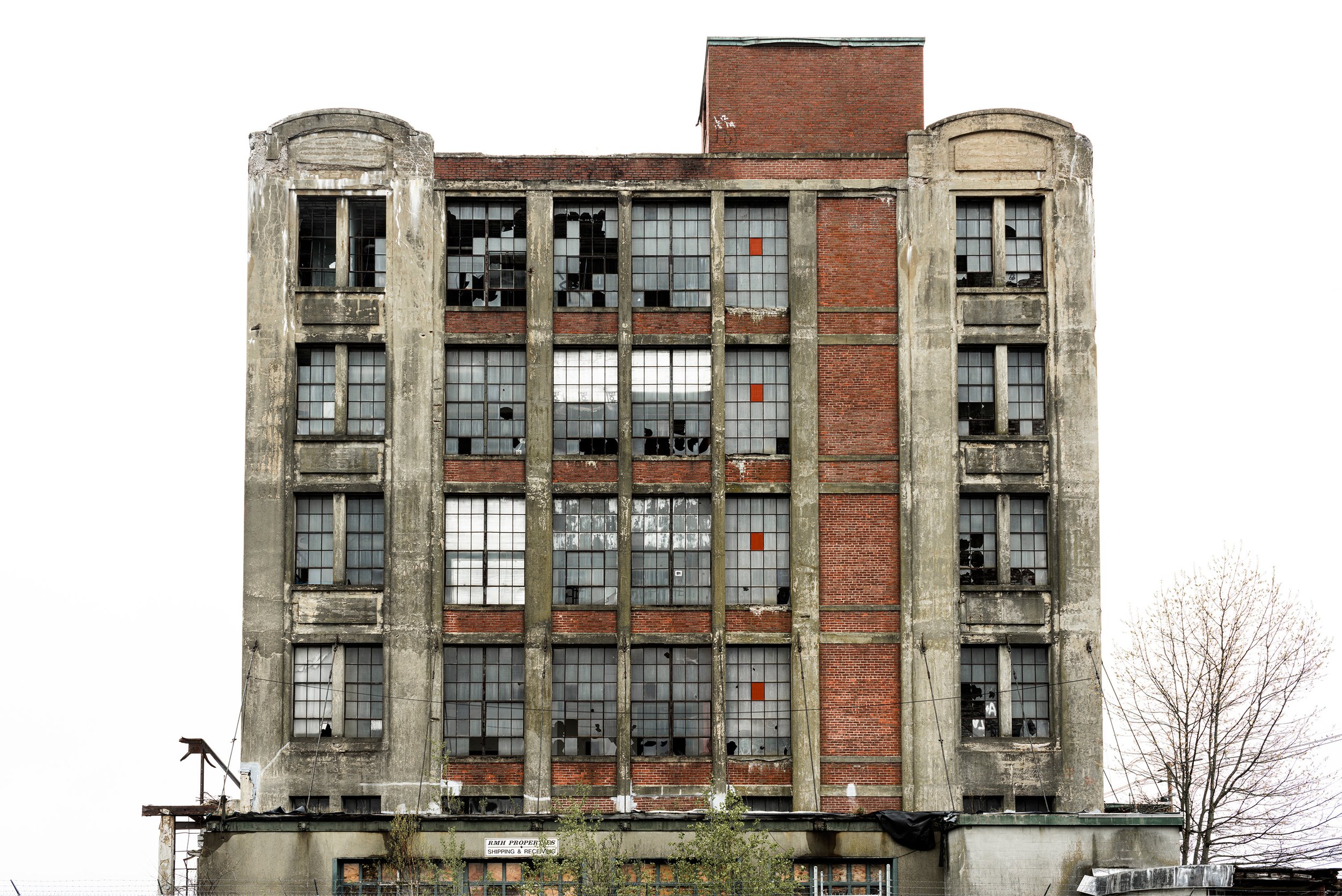
Goodall Worsted Spinning Factory, c. 1867
Mousam River
Sanford, York County, Maine
From the Echoes, Still: Maine's Industrial Remnants Collection (2024–2028)
Clocks, Cupolas, Towers Portfolio
Historical Narrative
Kevin LeDuc Pigment print on Hahnemühle Baryta Rag Edition of 5 + 1 Artist’s Proof (A/P) + 1 Bon à Tirer (B.A.T.) Portfolio of 40 Images
Paper Size: 35 × 50 inches Image Size: 30 × 45 inches Borders: Approximately 2 ½ inches (All Sides) Mounting: Archival hinge or float mounting
Historic Significance
Sanford, Maine, developed into an important industrial center through the growth of woolen textile manufacturing, beginning with the establishment of Goodall Mills along the Mousam River in 1867. Located at Number One Falls, the mill used the river’s natural waterpower, supported by dams and mill races, to operate textile machinery and support large-scale production. The availability of mechanical power and rail transportation allowed the company to expand rapidly, creating the foundation for Sanford’s long-term economic growth and establishing the city as a major woolen manufacturing center in Maine.
The Goodall Worsted Wool Company emerged from this early success and became a highly specialized, vertically integrated textile producer. During the late nineteenth and early twentieth centuries, the company expanded its facilities, added advanced machinery, and produced high-value goods such as mohair plush, upholstery fabrics, carriage and automobile robes, blankets, and specialty wool textiles. The complex included multiple brick mill buildings, dye houses, warehouses, and finishing facilities where raw wool was processed through every stage of production, from cleaning and spinning to weaving and final finishing.
At its peak, Goodall employed hundreds of workers and played a central role in Sanford’s social and economic development. The company relied on a diverse workforce, with women often employed in weaving and finishing departments and men concentrated in skilled trades, mechanical work, and supervision. Supported by family ownership, outside investors, and regional financial institutions, the company grew into one of Maine’s significant textile enterprises, reflecting the broader expansion of New England’s woolen industry.
Following World War II, the Goodall Worsted Wool Company faced increasing challenges from southern textile competition, synthetic fibers, and changing national markets. Large-scale textile operations declined during the early 1950s, leading to the company’s closure and eventual reuse of portions of the industrial site. Today, the surviving mill structures serve as reminders of Sanford’s industrial heritage and the technological innovation, investment, and labor that shaped the city’s development for nearly a century
Historical Narrative
-
The Foundations of Sanford’s Textile Economy
Sanford, Maine, emerged as an industrial city through the manufacture of woolen textiles. The foundations of this development were laid in 1867 with the establishment of Goodall Mills along the Mousam River, at Number One Falls. Harnessing waterpower and rail access, the enterprise rapidly expanded into a vertically integrated woolen manufacturing complex that anchored the city’s economic growth for decades.¹
The falls at Number One provided a vertical drop of approximately 12–18 feet, which, when combined with dams and controlled mill races, concentrated the river’s flow to drive waterwheels and, later, turbines.² Historical calculations suggest that a single mill race with a 15-foot head and a flow of roughly 500 cubic feet per minute could generate about 300 horsepower, sufficient to operate spinning frames, power looms, dye vats, and finishing machinery.³ Multiple mill races and peak seasonal flows could easily raise total available power to 500–800 horsepower, providing the mechanical energy necessary for large-scale woolen production at Sanford.⁴
By the late nineteenth century, Sanford’s mills specialized in high-value woolen and worsted goods—particularly mohair plush, upholstery fabrics, carriage and automobile robes, blankets, and dyed cloth sold to national markets.⁵ This early success established the industrial, financial, and labor infrastructure that would sustain Sanford’s textile economy well into the twentieth century.⁶
The Goodall Worsted Wool Company: A Corporate History
The rise of the Goodall Worsted Wool Company marked the consolidation and maturation of Sanford’s textile industry. Emerging from the earlier Goodall Mills enterprise, the company formalized its specialization in worsted spinning and high-value finished goods during the late nineteenth and early twentieth centuries.⁷
Founding and Capital Structure
Goodall Mills was organized in 1867 by members of the Goodall family, textile manufacturers of English descent with prior experience in woolen production.⁸ Incorporation records identify William Goodall as president, Thomas Goodall as treasurer, and Isaac Goodall as a principal director and capital subscriber.⁹ Initial capitalization ranged between $150,000 and $250,000, consistent with comparable Maine woolen firms in the post–Civil War period.¹⁰
Although the Goodall family retained controlling interest, expansion required additional outside investment. Minority shares were subscribed by Portland merchants, Boston-area textile financiers, and regional banking interests.¹¹ This blended capital structure—family control supplemented by outside investors—was typical of New England textile corporations seeking to scale production beyond water-powered beginnings.
Expansion and Specialization
Between the 1880s and 1900, the firm expanded substantially, installing combing machinery for worsted processing and enlarging weaving and finishing departments.¹² Capital stock reportedly increased to between $500,000 and $1,000,000 during this period.¹³ Sanborn Fire Insurance Maps from the early twentieth century depict a sprawling complex of interconnected brick mill buildings, dye houses, boiler plants, picker rooms, and warehouses along River and High Streets.¹⁴
By the early 1900s, state business directories refer to the enterprise as the Goodall Worsted Wool Company, reflecting its emphasis on combed wool yarns and specialty fabrics.¹⁵ The plant operated as a vertically integrated facility: raw wool was scoured, carded, combed, spun, woven, dyed, and finished within a single industrial yard.¹⁶
Among its most significant products were mohair plush fabrics used in railroad cars, theaters, hotels, and early automobiles, as well as upholstery textiles and finished dyed cloth.¹⁷ Production required advanced finishing equipment, including gigging and nap-raising machines capable of producing the dense pile associated with plush goods.¹⁸
Corporate Governance and Labor Structure
Corporate officers in the early twentieth century typically included a president, treasurer, clerk, superintendent, and a board of directors composed of family members and outside investors.¹⁹ Capitalization during the 1910s exceeded $1 million, placing the company among Maine’s larger textile manufacturers.²⁰ Financing during this era included Maine savings banks, Boston textile capital, and trust companies holding secured interests during refinancing and modernization phases.²¹
The company employed several hundred workers within a citywide textile labor force that peaked between 2,000 and 3,600 individuals.²² Women predominated in weaving and finishing rooms, while men were concentrated in dye houses, mechanical repair, and supervisory positions.²³ Wage data from the Maine Bureau of Industrial and Labor Statistics indicate weekly earnings for textile operatives generally ranged from $10 to $15 in the early twentieth century, with higher compensation for skilled trades.²⁴
Decline and Corporate Dissolution
After World War II, competitive pressures from southern mills and synthetic fiber production sharply reduced the viability of northern woolen manufacturing.²⁵ By the early 1950s, Sanford’s textile industry contracted rapidly, and large-scale operations of the Goodall Worsted Wool Company ceased.²⁶ Subsequent deed records reflect asset liquidation, refinancing arrangements, and partial industrial reuse before final closure.²⁷
The corporate history of the Goodall enterprise reflects the broader arc of New England’s textile industry: post–Civil War expansion, late nineteenth-century capitalization and specialization, early twentieth-century industrial maturity, and mid-century decline. Surviving mill structures within Sanford’s historic mill yard remain material evidence of the capital investment, technological sophistication, and labor organization that once defined the city’s industrial identity.
Footnotes
Maine Historic Preservation Commission, National Register of Historic Places Registration Form: Sanford Mill Yard Historic District (Augusta, ME, 2009).
Ibid.
Calculated based on H = 15 ft, Q = 500 cfm, turbine efficiency = 65%; see engineering principles in Henry R. Worthington, Waterpower Engineering for Mills (New York: McGraw-Hill, 1899), 112–114.
Ibid.
Ibid.
Sanborn Fire Insurance Company, Sanborn Maps: Sanford, Maine, 1884–1901 editions.
Maine Register and State Year-Book, various editions, 1905–1915.
Maine Historic Preservation Commission, Sanford Mill Yard Historic District.
Maine Secretary of State, Corporate Records, York County filings, 1867–1875.
Maine Bureau of Industrial and Labor Statistics, Annual Report, 1870s.
Ibid.
Maine Bureau of Industrial and Labor Statistics, Annual Reports, 1890s.
Ibid.
Sanborn Fire Insurance Company, Sanborn Maps: Sanford, Maine, 1901 edition.
Maine Register and State Year-Book, 1905–1915 editions.
Maine Historic Preservation Commission, Sanford Mill Yard Historic District.
Ibid.
Ibid.
Maine Register and State Year-Book, various years.
Maine Bureau of Industrial and Labor Statistics, Annual Reports, 1910s.
York County Registry of Deeds, mortgage and refinancing records, early twentieth century.
Maine Department of Labor, historical employment summaries.
Maine Bureau of Industrial and Labor Statistics, Annual Reports, 1900–1920.
Ibid.
Maine Department of Economic Development, mid-twentieth-century industry reports.
Ibid.
York County Registry of Deeds, property transfer records, 1950–1970.
Bibliography
Henry R. Worthington. Waterpower Engineering for Mills. New York: McGraw-Hill, 1899.
Maine Bureau of Industrial and Labor Statistics. Annual Reports. Augusta, ME, various years.
Maine Department of Economic Development. Mid-twentieth-century industry reports.
Maine Department of Labor. Historical employment summaries.
Maine Historic Preservation Commission. National Register of Historic Places Registration Form: Sanford Mill Yard Historic District. Augusta, ME, 2009.
Maine Register and State Year-Book. Portland, various years.
Maine Secretary of State. Corporate Records, York County filings.
Sanborn Fire Insurance Company. Sanborn Maps: Sanford, Maine. Various editions.
York County Registry of Deeds. Mortgage and property transfer records.