Brunswick Cotton Manufactory Company, c. 1809

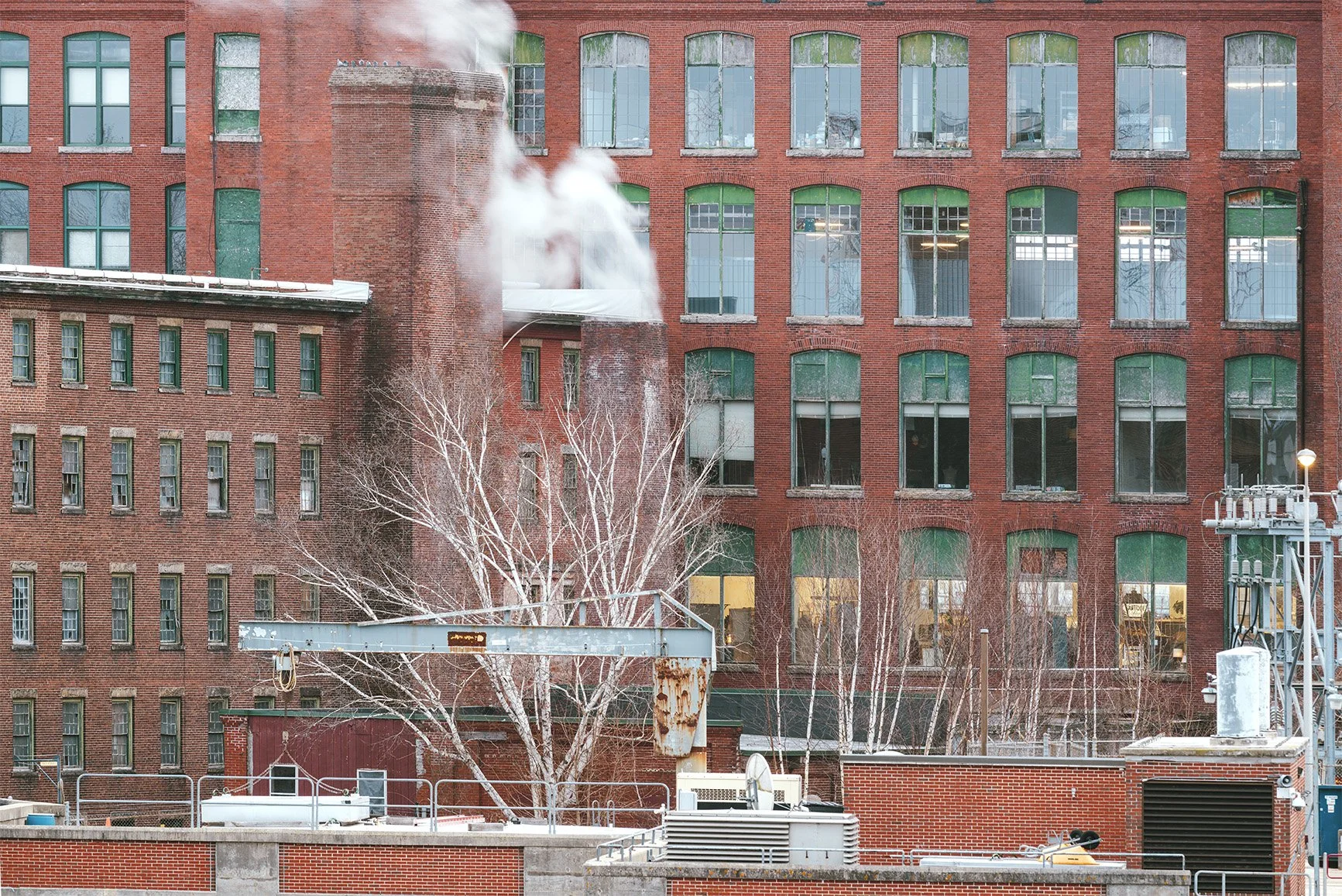


Brunswick Cotton Manufactory Company, c. 1809
Androscoggin River, Pejepscot Falls
Brunswick, Cumberland County, Maine
Portfolio Narrative
Brunswick Cotton Manufactory Company, c. 1809 presents a layered portrait of one of Maine's earliest textile manufacturing sites. Through views of the tower, industrial landscape, architectural details, mechanical systems, and contemporary adaptations, the sequence traces nearly two centuries of change. The photographs reveal not only what remains, but how historic industrial spaces continue to carry evidence of labor, innovation, and memory.
Historical Narrative
Brunswick Cotton Manufactory Company: Production, Labor, and Community
Kevin LeDuc Pigment print on Hahnemühle Baryta Edition of 5 + 1 Artist's Proof (Portfolio of 5 Images)
Paper Size: 40 × 55 inches Image Size: 31.33 × 37 inches Borders: Approximately 4 inches (All Sides)
From the Echoes, Still: Maine's Industrial Remnants Collection (2024–2028) Singnature Portfolio
1. Brunswick Cotton Manufactory Company No. 2 (1809)
Clocks, Cupolas, Towers Portfolio
Emerging through the fog above the Androscoggin River, the mill's upper stories and bell tower stand as a lasting landmark of Maine's early textile industry. The Cabot building below and the American flag above create a connection between past and present, while the mist rising from Pejepscot Falls recalls the river that powered the mill's original production. The clock tower and cupola remain symbols of industry, order, and civic pride, transforming a functional structure into an enduring monument to Maine's industrial heritage.
2. Brunswick Cotton Manufactory Company No. 1 (1809)
Exteriors Portfolio
A view from the rear of the mill complex places the historic structure within its working industrial environment. The dam, crane, and drifting smoke recall the site's manufacturing history, while the resting pigeons introduce a subtle contrast between industry, nature, and the passage of time. The image reveals the continued relationship between the mill, the river, and the industrial landscape that shaped its existence.
3. Brunswick Cotton Manufactory Company (1809)
Renaissance Portfolio
Captured at night, this view reveals the quiet presence of the historic workshop. A Christmas wreath glowing through the glass entrance creates a moment of warmth and reflection, contrasting the industrial character of the nineteenth-century building with its continued life in the present. The image explores the intersection of memory, architecture, and the human gestures that keep historic spaces connected to contemporary life.
4. York Ventilation Air Duct
Machinery Portfolio
A juxtaposition of old and new, where a contemporary ventilation system meets the weathered surfaces of a nineteenth-century factory wall. The modern ductwork reflects the ongoing adaptation of industrial spaces, while the surrounding masonry preserves the physical memory of the building's manufacturing past.
5. Brunswick Cotton Manufactory Company No. 2, c. 1809
Renaissance Portfolio
The full four-story façade reveals the enduring presence of the historic mill within its contemporary surroundings. A reserved employee parking area, antique storefront windows, and green steel storage containers occupying the upper levels create a layered portrait of adaptation and change. The image captures the tension between the building's industrial origins and its continued life as a place shaped by new uses, preserving the echoes of its manufacturing past while reflecting the realities of the present.
Historic Significance
Established in 1809, the Brunswick Cotton Manufactory Company became Maine’s first cotton mill and one of the earliest textile factories in the United States, initiating a new era of industrial growth that transformed Brunswick from a small commercial village into a manufacturing center connected to expanding national textile markets. Harnessing the power of Pejepscot Falls on the Androscoggin River, the mill reshaped Brunswick’s landscape, economy, and identity by demonstrating how waterpower, technological innovation, and organized labor could transform local communities into centers of industrial production.
By 1855, the mill had developed into a significant industrial operation, using the power of Pejepscot Falls to operate 5,120 spindles and employ approximately 900 workers. The factory produced between 35,840 and 51,200 yards of cotton goods each day, including sheeting, shirting, drill cloth, and cotton duck, supplying both regional and national markets. Its growth reflected the broader expansion of New England’s textile economy, where rivers, technological innovation, investment capital, and a growing industrial workforce combined to reshape communities and create new patterns of production and labor. The Brunswick manufactory’s success illustrates how early textile mills became more than places of manufacturing; they served as engines of economic growth that reorganized daily life, attracted new populations, and connected Maine communities to the rapidly expanding industrial economy of the nineteenth century.
Historical Narrative
-
Introduction
The early nineteenth century marked the emergence of mechanized textile production as a transformative force in New England’s economic development. In Maine, the Brunswick Cotton Manufactory Company, incorporated in 1809, pioneered cotton manufacturing along the Androscoggin River at Pejepscot Falls, harnessing waterpower to spin and weave cotton yarn for domestic markets.¹ As the first cotton mill in Maine and one of the earliest in the United States, the Brunswick manufactory played a foundational role in the region’s industrialization, reshaping Brunswick from a modest commercial village into a manufacturing center integrated into national textile networks.²
The mill’s history reflects broader patterns in American industrialization: subscription-based local capitalism, technological adaptation, labor stratification, immigration, and eventual corporate consolidation. From its founding investors to its acquisition by the Cabot Manufacturing Company in 1857, the Brunswick mill exemplifies the evolution of textile manufacturing in northern New England.³
I. Founding, Investors, and Technical Leadership (1809–1857)
The Brunswick Cotton Manufactory Company was incorporated on March 4, 1809, by a coalition of Brunswick merchants, landholders, and civic leaders.⁴ According to Wheeler, the original investors were motivated by the potential of Pejepscot Falls to power large-scale textile machinery, and included Samuel Melcher, Robert H. Bowker, and members of the Wadsworth and Bowdoin-connected families who dominated Brunswick’s commercial and civic life.⁵
The company operated under a subscription capital model, in which investors purchased shares to fund mill construction, hydraulic improvements, and machinery acquisition.⁶ Wheeler emphasizes that this approach tied the manufactory closely to the town’s mercantile and shipping interests, ensuring local engagement and support.⁷
Bowdoin College and Elite Networks
Bowdoin College, founded in 1794, significantly influenced Brunswick’s intellectual and economic climate. Faculty members, trustees, and affiliated families were among the town’s wealthiest citizens, many of whom participated in or supported early industrial ventures.⁸ While the college itself did not invest directly, its networks facilitated modernization initiatives and technical knowledge transfer.⁹
Engineers and Millwrights
The mill relied on skilled millwrights and hydraulic engineers to construct waterpower systems at Pejepscot Falls.¹⁰ Wheeler documents the installation of waterwheels, dams, and gearing systems designed to power Arkwright-style spinning frames.¹¹ Following a destructive fire in 1825, the company rebuilt in granite during the 1830s, incorporating improved water-control systems and expanded spindle capacity.¹²
II. Production, Products, and Raw Material Sources
By 1855, shortly before the Brunswick Cotton Manufactory’s acquisition by the Cabot Manufacturing Company, the granite mill had reached its mid-nineteenth-century production peak. The facility housed approximately 5,120 spindles and employed roughly 900 workers, reflecting its status as one of Maine’s largest textile operations at the time.¹³ Each spindle produced an estimated seven to ten yards of cotton cloth per day, resulting in a daily output that ranged between 35,840 and 51,200 yards of finished fabric. Operating six days per week over fifty weeks per year, the mill’s annual production totaled an estimated 10,752,000 to 15,360,000 yards of cotton cloth.¹⁴
Wheeler’s contemporary account confirms that the Brunswick manufactory produced utilitarian textiles—such as sheeting, shirting, drill cloth, and heavier industrial fabrics like cotton duck—which were sold regionally and to Boston markets.¹⁵ By the 1840s and 1850s, the mill increasingly standardized production to include bleached and unbleached sheeting, a product line Wheeler notes as central to the company’s commercial strategy.¹⁶
Raw cotton was primarily sourced from the American South, including Georgia, Alabama, and Mississippi, then shipped via Boston from ports such as Charleston and Savannah.⁷ This supply chain connected Brunswick directly to the southern plantation economy and the labor system producing raw cotton, reflecting the intertwined regional and national nature of the textile trade.¹⁷
III. Labor Structure and Workforce Composition
Labor at the Brunswick mill was hierarchical and skill-based. Skilled male employees served as overseers, mechanics, machinists, and waterpower engineers, receiving the highest wages.¹⁸
Women comprised a large share of spinning and weaving operatives. Although pay was formally based on skill set rather than gender, occupational segmentation concentrated women in lower-paid positions.¹⁹
Children worked as doffers and assistants. Workdays commonly lasted twelve to thirteen hours, six days per week, with child wages representing a small fraction of adult earnings.²⁰
The 1881 Strike
In 1881, young Franco-American operatives initiated a strike after discovering that child laborers in Lewiston mills earned slightly higher wages. The walkout lasted approximately three days and temporarily halted production.²¹
Management granted modest wage increases but reportedly issued housing notices to company-tenement occupants during the dispute, revealing the intertwined nature of employment and domestic dependency.²²
IV. Industrial Infrastructure and Community Development
Industrial growth reshaped Brunswick’s physical landscape. Wheeler records that early mill housing was clustered near Pejepscot Falls and connected to the main factory by footbridges, providing safe and efficient access for workers.²³ These early structures prefigure the later Androscoggin Swinging Bridge, constructed in 1892, which allowed employees to traverse the river safely between residential and industrial areas.²⁴
Company-owned tenements reinforced industrial geography but also produced overcrowding concerns. During the 1885 diphtheria outbreak, sanitation conditions in mill housing drew scrutiny from public health authorities.²⁵
By the early twentieth century, the Cabot Mill employed over 1,100 workers, making it one of Maine’s largest textile employers.²⁶
V. Corporate Transition and Decline
Financial pressures and competitive shifts led to Brunswick’s acquisition by the Cabot Manufacturing Company in 1857.²⁷ Boston-based investors centralized management and expanded labor recruitment, particularly among French-Canadian immigrants.²⁸
By the early twentieth century, competition from southern textile centers reduced northern mills’ dominance. In 1941, the Cabot Manufacturing Company sold the Brunswick mill to the Verney Corporation.²⁹ Operations ceased in the mid-1950s, ending nearly 150 years of textile production at Pejepscot Falls.
Today, the granite mill complex—Fort Andross—remains as a preserved testament to Brunswick’s industrial heritage.³⁰
Footnotes
Wheeler, History of Brunswick, Topsham, and Harpswell, Maine, 214.
Ibid., 217.
Ibid., 218.
Brunswick Company, Corporate Reorganization Documents, 1856–1857, Brunswick Historical Society Archives.
Wheeler, History of Brunswick, Topsham, and Harpswell, 214–218.
Brunswick Company, Mill Records and Spindle Inventory, 1855, Brunswick Historical Society Archives.
Wheeler, History of Brunswick, 221–222.
Bowdoin College Trustee Records, 1800–1830, Brunswick Historical Society Archives.
Wheeler, History of Brunswick, 218.
Brunswick Company employment ledgers, 1855.
Wheeler, History of Brunswick, 225.
Brunswick Company rebuilding records, 1830s.
Brunswick Company, Mill Records and Spindle Inventory, 1855.
Jonathan Prude, The Coming of Industrial Order, 52–55.
Wheeler, History of Brunswick, 221–222.
Ibid., 223.
Sven Beckert, Empire of Cotton, 103–109.
Brunswick Company employment ledgers, 1855.
Ibid.
Ibid.
“The Brunswick Children Strike the Cabot Mill,” 1881 Labor Report.
Ibid.
Wheeler, History of Brunswick, 225.
Androscoggin Swinging Bridge National Register Nomination, 1892.
Maine State Board of Health, Annual Report, 1885.
Cabot Manufacturing Company, Employment Summary, 1930.
Brunswick Company, Corporate Reorganization Documents, 1856–1857.
Cabot Manufacturing Company, Annual Report, 1858, 3–6.
Verney Corporation acquisition records, 1941.
Fort Andross Preservation Records, Brunswick Historical Society Archives.
Bibliography
Beckert, Sven. Empire of Cotton: A Global History. New York: Alfred A. Knopf, 2014. pp. 103–109.
Brunswick Company. Corporate Reorganization Documents, 1856–1857. Brunswick Historical Society Archives.
———. Mill Records and Spindle Inventory, 1855. Brunswick Historical Society Archives.
Cabot Manufacturing Company. Annual Report, 1858. pp. 3–6.
———. Employment Summary, 1930. Brunswick Historical Society Archives.
Maine State Board of Health. Annual Report, 1885. Augusta: State of Maine, 1886. pp. 22–24.
Prude, Jonathan. The Coming of Industrial Order: Town and Factory Life in Rural Massachusetts, 1810–1860. Cambridge: Cambridge University Press, 1983. pp. 52–55.
“The Brunswick Children Strike the Cabot Mill,” 1881 Labor Report. Brunswick Historical Society Archives.
Wheeler, George Augustus. History of Brunswick, Topsham, and Harpswell, Maine. Brunswick, ME: George A. Wheeler, 1837. pp. 214–225.
Androscoggin Swinging Bridge National Register Nomination. National Park Service, 1892. pp. 1–6.
Verney Corporation. Acquisition Records for Brunswick Mill, 1941. Brunswick Historical Society Archives.
Brunswick Company Employment Ledgers, 1855. Brunswick Historical Society Archives.