Mayo & Son Woolen Mill, c. 1844l
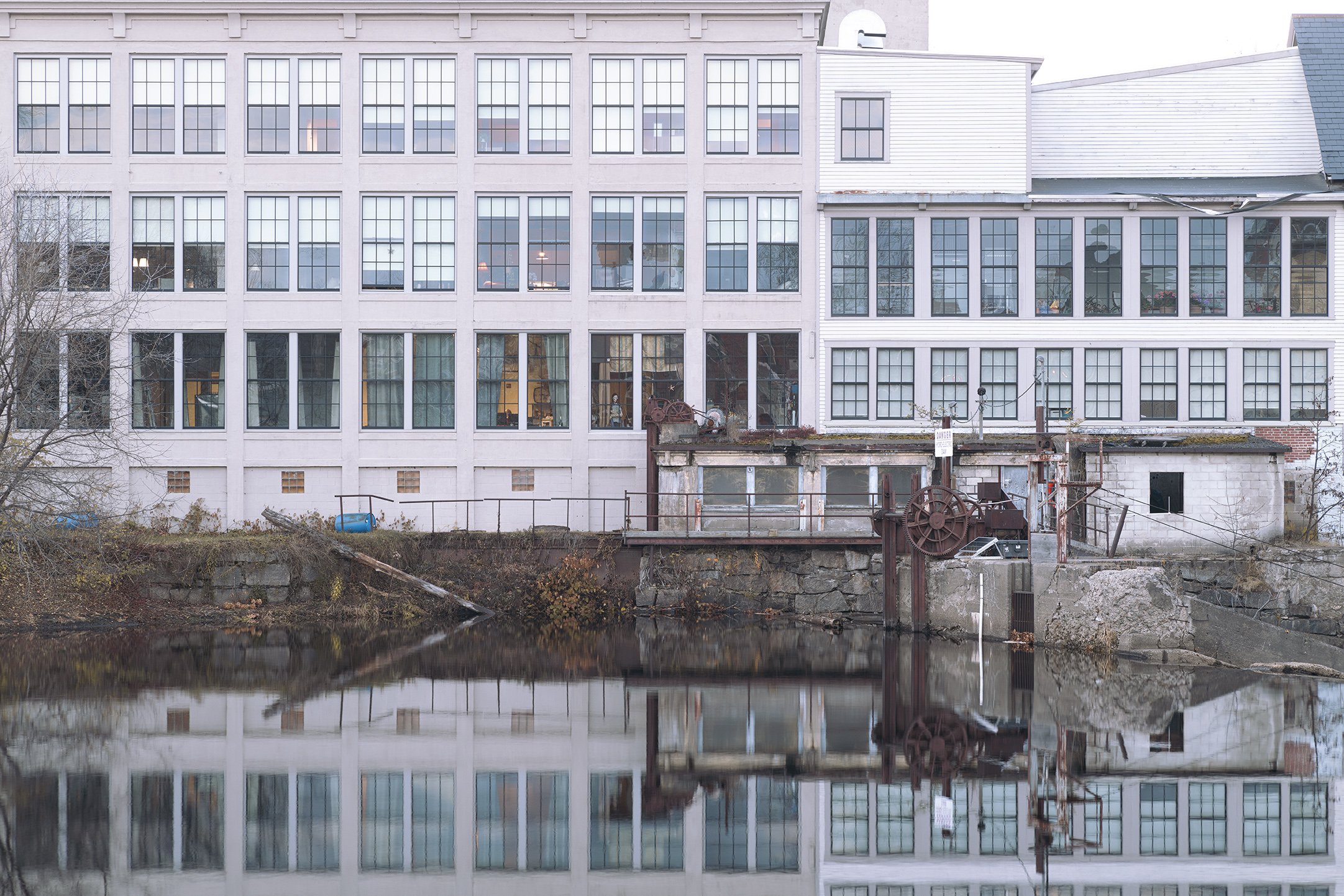
Mayo & Son Woolen Mill, c. 1844l
Piscataquis River
Dover-Foxcroft, Piscataquis County, Maine
From the Echoes, Still: Maine's Industrial Remnants Collection (2024–2028)
Cotton, Woolens Portfolio
Historical Narrative
Kevin LeDuc Pigment print on Hahnemühle Baryta Rag Edition of 5 + 1 Artist’s Proof (A/P) + 1 Bon à Tirer (B.A.T.) Portfolio of 40 Images
Paper Size: 35 × 50 inches Image Size: 30 × 45 inches Borders: Approximately 2 ½ inches (All Sides) Mounting: Archival hinge or float mounting
Historic Significance
The Mayo & Son Woolen Mill, later known as the American Woolen Company Foxcroft Mill, was one of the most important textile manufacturing facilities in Dover-Foxcroft, Maine. Established in 1844 by John G. Mayo along the Piscataquis River, the mill relied on abundant waterpower to support the production of high-quality woolen textiles, including broadcloth, flannels, coatings, and blankets. By the early 1850s, the Mayo family had assumed full ownership, building a reputation for producing quality fabrics that supplied markets throughout Maine and New England.
During the late nineteenth century, the mill expanded significantly, increasing both its production capacity and workforce. Equipped with carding machines, spinning frames, power looms, and specialized finishing equipment, the facility carried out every stage of woolen textile manufacturing. Water wheels and later water turbines powered the machinery before steam and electric power were introduced, allowing the mill to modernize while continuing to rely on the Piscataquis River as its primary energy source.
In 1914, the Mayo family sold the operation to the American Woolen Company, one of the nation's largest textile corporations. Under its ownership, the Foxcroft Mill became part of a larger manufacturing network and remained one of Dover-Foxcroft's leading employers until textile production ended in 1953 as New England's woolen industry declined. The site then entered a new phase of industrial use when Moosehead Manufacturing Company converted the complex to furniture and wood-product manufacturing, extending its productive life for more than fifty additional years.
Today, the former Foxcroft Mill is recognized as an important example of Maine's industrial heritage. Listed on the National Register of Historic Places, the complex preserves a collection of historic mill buildings and structures that illustrate the evolution of rural textile manufacturing, the importance of hydropower, and the adaptability of historic industrial sites to changing economic conditions over more than 150 years.
Historical Narrative
-
The Mayo & Son Woolen Mill, later known as the American Woolen Company Foxcroft Mill, occupies a prominent place in the industrial history of Dover-Foxcroft, Piscataquis County, Maine, representing more than a century of manufacturing shaped by hydropower, mechanization, and changing national markets. Located along the Piscataquis River, the site was deliberately chosen for its waterpower potential, which supported continuous textile production from the mid-nineteenth century into the postwar period.¹
The mill was established in 1844 by John G. Mayo, initially in partnership with James Bush and E. J. Hale. By the early 1850s, Mayo consolidated ownership and operated the facility with his son under the name Mayo & Son. The firm specialized in the production of woolen cloth, supplying regional and New England markets with finished textiles including broadcloth, flannels, coatings, and blanket wool. These products earned the Mayo operation a reputation for quality within Maine’s woolen industry.²
By the late nineteenth century, the mill had expanded significantly in both physical capacity and employment. A Maine state industrial report from 1884 records that “Foxcroft: Mayo & Sons… doubled the capacity of the old mill and employ 60 extra hands,” indicating a substantial increase in machinery and labor.³ Textile production followed the standard woolen manufacturing sequence of the era, incorporating raw wool scouring, picking, carding, spinning, weaving, and finishing. The mill was equipped with carding machines, roving frames, spinning frames or self-acting mules, power looms, and a full complement of finishing machinery, including fulling, shearing, pressing, folding, and inspection equipment. Ancillary systems such as bobbin winders, twisters, doublers, and doffing machinery supported continuous operation.
Power for these machines was transmitted through line shafting and belt systems, driven initially by water wheels and later turbines utilizing the flow of the Piscataquis River. Historic records document turbine installations capable of producing approximately 386 horsepower, confirming the mill’s status as a medium-scale industrial operation by New England standards.⁴ As technology advanced, water power was supplemented by steam and later electric drive, ensuring reliable production into the twentieth century.
In 1914, the Mayo family sold the mill to the American Woolen Company, a dominant national textile corporation that integrated the Foxcroft facility into its broader manufacturing network. Under American Woolen ownership, textile production continued at an expanded scale, and by 1941 the complex had reached its mature architectural form, incorporating buildings dating from the mid-nineteenth through early twentieth centuries. The mill remained one of Dover-Foxcroft’s principal employers during this period.
Despite its industrial prominence, textile manufacturing at the Foxcroft mill ceased in 1953, reflecting broader postwar shifts in American manufacturing and the accelerating decline of New England’s woolen textile industry. The complex was subsequently repurposed by Moosehead Manufacturing Company, which operated a wood and furniture manufacturing business at the site from 1953 until 2007, extending the mill’s industrial use for more than half a century beyond the end of textile production.⁵
Recognition of the site’s historical and architectural significance culminated in its listing on the National Register of Historic Places in 2012–2013. The designation acknowledges the mill’s long association with Maine’s textile industry, its reliance on hydropower, and its architectural integrity. The listed property includes seven contributing buildings and three contributing structures, dating from the mid-nineteenth to the mid-twentieth century, which collectively document the evolution of industrial construction and manufacturing practices in rural Maine.⁶
Footnotes
Maine Historic Preservation Commission, American Woolen Company Foxcroft Mill, National Register of Historic Places documentation.
Dover-Foxcroft Historical Society, Shiretown Conserver, Spring 2015.
Maine Legislature, Public Documents of the State of Maine, 1884, industrial reports.
U.S. Geological Survey, Water-Supply Paper 279, documentation of industrial water power in Maine.
U.S. Environmental Protection Agency, R1 Success Story: Mayo Mill, Dover-Foxcroft, Maine.
Maine Historic Preservation Commission, American Woolen Company Foxcroft Mill, NRHP listing (2012–2013).
Bibliography
Dover-Foxcroft Historical Society. Shiretown Conserver. Spring 2015.
Maine Historic Preservation Commission. American Woolen Company Foxcroft Mill. National Register of Historic Places documentation, 2012–2013.
Maine Legislature. Public Documents of the State of Maine. 1884.
U.S. Environmental Protection Agency. R1 Success Story: Mayo Mill, Dover-Foxcroft, Maine.
U.S. Geological Survey. Water-Supply Paper 279.