Lincoln Mill, c. 1853
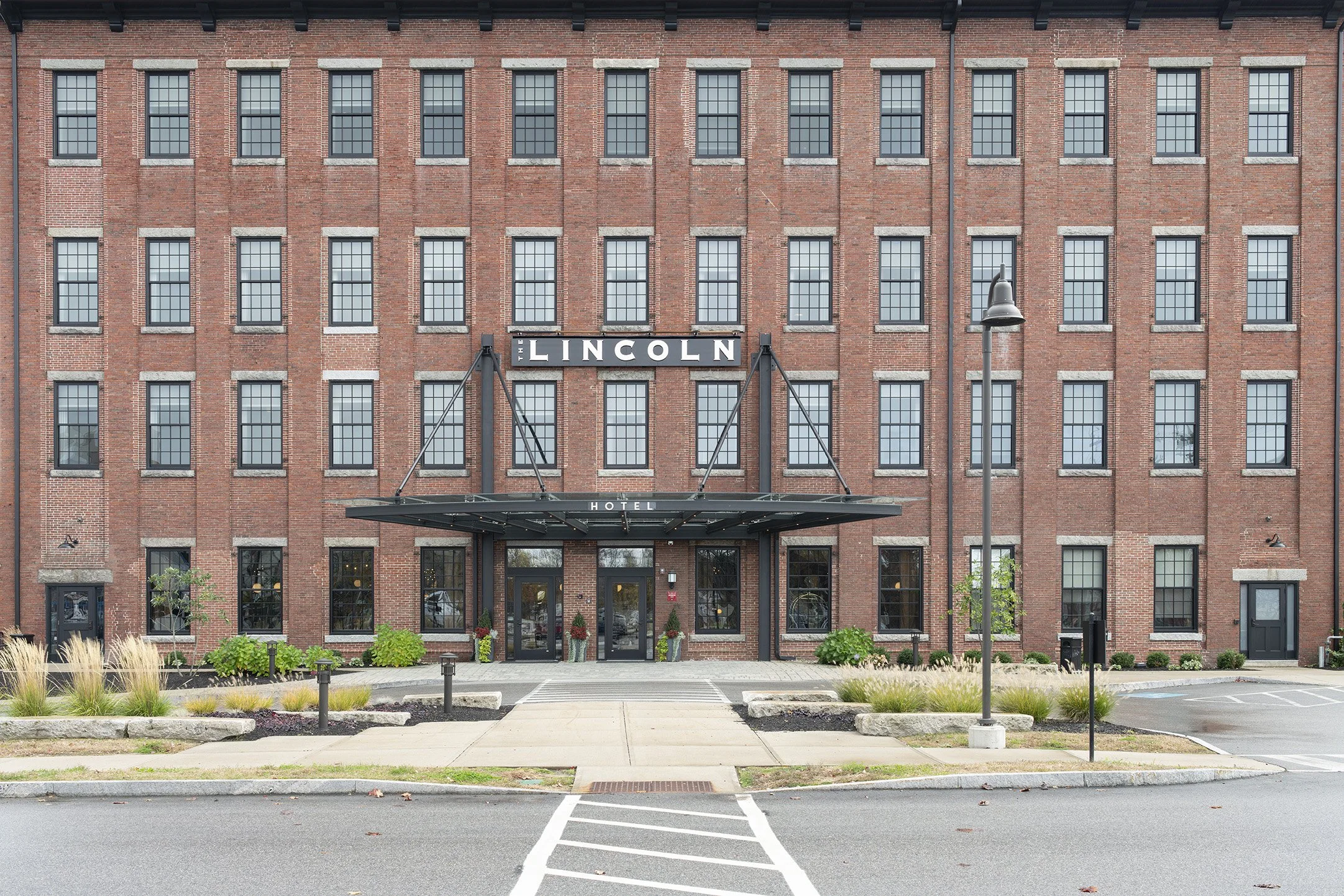
Lincoln Mill, c. 1853
Peppernell Mill Complex, c.1844 Lower Falls, Saco River
Biddeford, York County, Maine
From the Echoes, Still: Maine's Industrial Remnants Collection (2024–2028)
Cotton, Woolens Portfolio
Historical Narrative
Kevin LeDuc Pigment print on Hahnemühle Baryta Edition of 5 + 1 Artist's Proof (Portfolio of 40 Images)
Paper Size: 40 × 55 inches Image Size: 31.33 × 37 inches Borders: Approximately 4 inches (All Sides)
Historic Significance
The Lincoln Mill in Biddeford, Maine, stands as one of the most significant reminders of the city’s nineteenth- and early twentieth-century textile economy. Constructed beginning in 1853 as part of the Pepperell Manufacturing Company, the mill was built along the Saco River to take advantage of available waterpower and became a major center for cotton textile production. Over time, the mill transitioned from water-powered systems to steam and electric power, reflecting broader technological changes that allowed factories to increase efficiency and expand production.
Inside the Lincoln Mill, cotton production followed a highly organized industrial process involving carding, spinning, and weaving machinery powered by complex systems of shafts, belts, and later electric motors. The mill’s architecture, with its brick construction, large windows, and heavy structural supports, was designed to accommodate machinery while creating efficient workspaces. However, the success of the mill depended not only on technology but also on a large immigrant workforce, particularly Irish and French-Canadian laborers who shaped Biddeford’s neighborhoods, culture, and community institutions.
Life in the Lincoln Mill was defined by both economic opportunity and difficult working conditions. Employees often worked long hours in noisy, hot, and hazardous environments, with women and children playing important roles in spinning and weaving operations. The mill influenced nearly every aspect of community life, with work schedules controlling daily routines and labor struggles contributing to broader movements for improved wages, shorter hours, and worker protections.
By the mid-twentieth century, competition from southern and international textile producers led to the decline and eventual closure of the Lincoln Mill’s textile operations. Although manufacturing ended, the surviving structure remains an important symbol of Biddeford’s industrial heritage. The mill represents both the economic power of New England’s textile industry and the experiences of the workers and families whose lives were shaped by industrial production.
Historical Narrative
-
Lincoln Mill: the Making—and Unmaking—of Industrial Biddeford
Rising along the Saco River, the Lincoln Mill stands as one of the most enduring physical reminders of Biddeford’s textile past. Constructed beginning in 1853, the mill was built during the city’s rapid transformation into Maine’s leading textile center. Developed as part of the expanding Pepperell Manufacturing Company, the Lincoln Mill was designed not simply as a factory but as an instrument of industrial discipline—one that ordered time, labor, and community life around the production of cotton textiles.¹
The choice of location was deliberate. The Saco River provided reliable water power, initially harnessed through canals, water wheels, and later turbines, which drove line-shaft systems distributing mechanical energy across the mill floors.² By the late nineteenth century, the Lincoln Mill—like other Biddeford mills—had transitioned to steam power and eventually electric motors, allowing longer operating hours and greater production capacity independent of river flow.³ This evolution mirrored broader industrial trends and marked the mill’s peak efficiency.
Inside the Lincoln Mill, cotton moved through a carefully organized sequence of machinery. Carding machines cleaned and aligned raw fibers; spinning frames twisted them into yarn; and power looms wove yarn into cloth. Overhead belts and pulleys transferred energy from central shafts to individual machines, filling the building with constant motion and noise. The mill’s architecture—thick brick walls, cast-iron columns, and long rows of oversized windows—was engineered to support heavy machinery while maximizing daylight for workers performing precision tasks.⁴
Yet machinery alone did not produce cloth. The mill depended on human labor, much of it immigrant. In its early decades, Lincoln Mill employed primarily Irish immigrants, soon followed by large numbers of French-Canadian workers arriving from Quebec in the late nineteenth century. By 1900, French Canadians made up the majority of Biddeford’s textile workforce.⁵ Entire families worked in the mill, often across generations, embedding industrial labor into the structure of daily life. French was widely spoken on the shop floor, while nearby neighborhoods developed around Catholic parishes, schools, and social organizations tied to mill schedules.
Working conditions inside the Lincoln Mill were harsh. Employees labored ten to twelve hours a day, six days a week, amid intense noise, heat, and airborne cotton dust. Women and children formed a significant portion of the workforce, especially in weaving and spinning departments, where employers could pay lower wages. Children performed tasks such as bobbin changing and floor sweeping, exposing them early to industrial discipline and danger.⁶ The mill’s now-lost clock tower regulated time for the entire community, its bell dictating when workers rose, labored, and rested.
Despite exploitation, mill work provided a fragile stability for immigrant families, a fact that both bound workers to the mill and fueled resistance. Lincoln Mill workers participated in labor strikes and organizing efforts during the late nineteenth and early twentieth centuries, aligning with broader New England textile labor movements. These struggles—often met with employer retaliation—contributed to reforms including shorter hours, child labor restrictions, and early unionization efforts.⁷
The decline of the Lincoln Mill was driven by structural economic forces beyond Biddeford’s control. Beginning in the 1920s and accelerating after World War II, textile manufacturing migrated to the southern United States, where wages were lower, unions weaker, and operating costs reduced. Later, global competition further eroded northern mills’ viability. By the 1950s, textile production at Lincoln Mill had ceased, ending nearly a century of continuous industrial use.⁸
In recognition of its historical significance, the Lincoln Mill was later included as part of Biddeford’s historic mill district, reflecting its role in Maine’s industrial development and immigrant labor history. The building’s survival forces a confrontation with the realities of industrial capitalism: the wealth it generated, the lives it consumed, and the communities it shaped and abandoned.
To view the Lincoln Mill merely as a reused industrial shell is to misunderstand its meaning. It was a machine for organizing human life—measuring time, extracting labor, and binding families to production. Its history as a textile mill reveals how industrial progress carried both opportunity and profound human cost. In the shadow of its brick walls, Biddeford’s past remains visible, demanding remembrance rather than erasure.
Footnotes
Earl F. Niehoff, The Mills of Maine (Augusta: Maine State Museum, 1975).
Robert M. Vogel, Industrial Architecture of the United States (Washington, DC: Smithsonian Institution Press, 1988).
Niehoff, The Mills of Maine.
Carol Poh Miller and Robert A. Wheeler, Biddeford and Saco: An Industrial Heritage (Charleston, SC: Arcadia Publishing, 1998).
Tamara K. Hareven, Family Time and Industrial Time (Cambridge: Cambridge University Press, 1982).
Thomas Dublin, Women at Work (New York: Columbia University Press, 1979).
David Brody, Workers in Industrial America (New York: Oxford University Press, 1980).
Niehoff, The Mills of Maine.
Bibliography
Brody, David. Workers in Industrial America: Essays on the Twentieth Century Struggle. New York: Oxford University Press, 1980.
Dublin, Thomas. Women at Work: The Transformation of Work and Community in Lowell, Massachusetts, 1826–1860. New York: Columbia University Press, 1979.
Hareven, Tamara K. Family Time and Industrial Time: The Relationship Between the Family and Work in a New England Industrial Community. Cambridge: Cambridge University Press, 1982.
Miller, Carol Poh, and Robert A. Wheeler. Biddeford and Saco: An Industrial Heritage. Charleston, SC: Arcadia Publishing, 1998.
Niehoff, Earl F. The Mills of Maine. Augusta: Maine State Museum, 1975.
Vogel, Robert M. Industrial Architecture of the United States. Washington, DC: Smithsonian Institution Press, 1988.