Robinson Manufacturing Company, c. 1840
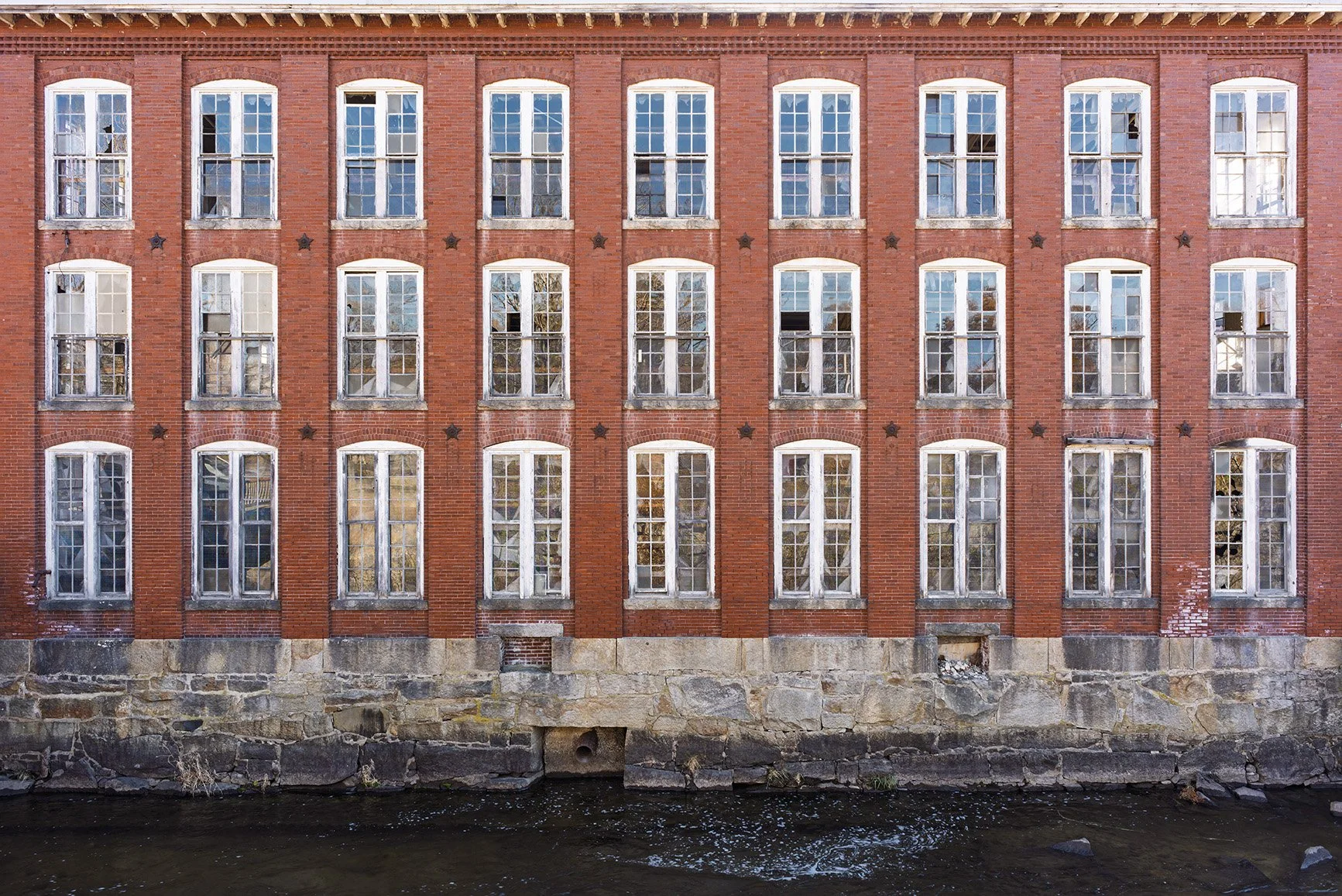
Robinson Manufacturing Company, c. 1840
Thompson Lake Outlet
Oxford, Oxford County, Maine
From the Echoes, Still: Maine's Industrial Remnants Collection (2024–2028)
Cotton, Woolens Portfolio
Historical Narrative
Kevin LeDuc Pigment print on Hahnemühle Baryta Rag Edition of 5 + 1 Artist’s Proof (A/P) + 1 Bon à Tirer (B.A.T.) Portfolio of 40 Images
Paper Size: 35 × 50 inches Image Size: 30 × 45 inches Borders: Approximately 2 ½ inches (All Sides) Mounting: Archival hinge or float mounting
Historic Significance
The Robinson Mills in Oxford, Maine, represents one of the state’s longest-running woolen textile operations, with a history dating back to its construction in 1840 along the Thompson Lake Outlet. The site was chosen for its reliable waterpower, which supported early textile manufacturing and allowed the mill to grow into a major local industry. In 1849, John Robinson and his family acquired the property, and in 1863 the operation was reorganized as the Robinson Manufacturing Company, establishing a formal business structure that supported expansion and long-term production.
For more than 150 years, Robinson Mills played a central role in Oxford’s economy and community life. The mill employed generations of local workers who produced woolen fabrics through a series of specialized processes, including carding, spinning, weaving, dyeing, and finishing. Workers often labored long hours in demanding conditions, with entire families participating in mill operations. The company became known for high-quality wool textiles, including blue woolen twill used for Union military uniforms during the Civil War, demonstrating the mill’s importance within regional and national manufacturing networks.
The mill’s success depended on continued technological adaptation. Early production relied on waterpower from the Thompson Lake Outlet, but steam engines and later electric power were added to increase reliability and expand capacity. Machinery such as carding machines, spinning frames, power looms, fulling mills, and dyeing equipment allowed Robinson Mills to produce durable specialty fabrics, including its well-known indigo and navy blue woolens.
Textile production ended in 2004 as the mill faced the same economic challenges affecting many New England manufacturers, including competition from southern and overseas producers. After periods of vacancy and ownership changes, the historic complex entered redevelopment efforts focused on preserving its architectural significance while adapting the site for new uses. The ongoing transformation of Robinson Mills reflects the broader story of New England’s industrial heritage: a transition from water-powered manufacturing to modern reuse while maintaining the legacy of the workers and industries that shaped local communities.
Historical Narrative
-
The Robinson Mills, located in Oxford, Oxford County, Maine, was one of the state’s most enduring woolen textile manufacturing enterprises. The historic mill was built in 1840 on the Thompson Lake Outlet, a waterway that provided essential waterpower for early industrial operations.¹ The original builder is not clearly documented, but early records suggest it was a local entrepreneur or small partnership seeking to capitalize on the outlet’s waterpower potential.²
In 1849, the property was purchased by John Robinson and his family, who would guide its operations for generations and cement the mill’s identity as Robinson Mills.³ By 1863, Joseph Robinson, an English-born wool expert, allied with partners H.J. and F.O. Libby to incorporate the business as the Robinson Manufacturing Company, formalizing its corporate structure and enabling systematic expansion of operations.⁴ The mill became a cornerstone of Oxford’s local economy, employing hundreds of workers and shaping community life for decades.⁵
Workers at Robinson Mills labored long shifts in noisy, dusty environments, with tasks ranging from carding and spinning to weaving, dyeing, and finishing woolen fabrics. Entire families often worked side by side, illustrating the mill’s centrality to village life.⁶
Robinson Manufacturing Company and Workforce
The mill drew labor primarily from the surrounding communities, fostering a multi-generational workforce skilled in woolen production.⁷ Over time, Robinson Mills developed a reputation for high-quality fabrics, attracting skilled artisans and producing specialty woolens, including those used for Civil War Union uniforms.⁸
The mill employed standard textile departments, including picking, carding, spinning, weaving, dyeing, finishing, and shipping. Supervisors oversaw each department to ensure productivity and safety. Children and teenagers often worked in lighter tasks such as spooling and carding, while adults operated heavier machinery. Wages were modest, typically paid in cash on payday, reflecting the industrial norms of 19th- and early-20th-century New England textile mills.⁹
Industrial Operations and Machinery
Robinson Mills’ operations evolved alongside technological advances in the textile industry. The mill initially relied on waterpower from the Thompson Lake Outlet, using a dam to regulate flow for consistent mechanical operation.¹⁰ Later, steam engines and eventually electric power supplemented waterpower, allowing expanded production and increased operational reliability.¹¹
Machinery at the mill included carding machines for aligning fibers, spinning frames to twist fibers into yarn, power looms to weave yarn into cloth, fulling mills and presses to refine texture and durability, and dyeing vats that allowed the production of rich indigo and navy blue fabrics, which became the mill’s signature product.¹²
During the American Civil War, Robinson Mills produced blue woolen twill for Union uniforms, demonstrating its integration into wartime manufacturing and its reputation for quality cloth.¹³ The combination of skilled labor, advanced machinery, and high-quality dyeing established the mill as a leading textile producer in Maine.¹⁴
Decline, Closure, and Redevelopment
After over 150 years of continuous operation, Robinson Mills ceased textile production in 2004, reflecting broader regional declines in New England textile manufacturing due to competition from southern U.S. and overseas producers.¹⁵ Financial difficulties led the town of Oxford to foreclose on the mill in 2009 due to unpaid taxes.¹⁶
In 2013, the property was sold to developer Chuck Starbird, who planned to convert the site for mixed-use purposes.¹⁷ By the mid-2020s, The Caleb Group, a nonprofit housing developer, acquired the property to redevelop the historic mill buildings into affordable senior housing, while preserving architecturally significant structures. Demolition and abatement work began in 2026, coordinated with the Oxford Historical Society to maintain the mill’s industrial heritage.¹⁸
Robinson Mills’ history illustrates the trajectory of New England’s textile industry: reliance on natural waterpower, adoption of mechanized textile technology, contribution to wartime production, and eventual decline and adaptive reuse. Its legacy remains a cornerstone of Oxford’s industrial heritage.
Footnotes
Robinson Manufacturing Company Records, 1823–1994, Collection 2452, Maine Historical Society, Portland, Maine, 1.
Ibid., 3.
Ibid., 5.
Ibid., 7.
Ibid., 8.
Ibid., 10.
Ibid., 12.
Ibid., 14.
Ibid., 16.
Ibid., 18.
Ibid., 20.
Ibid., 22.
Ibid., 24.
Ibid., 26.
Sun Journal, “Oxford to Foreclose on Robinson Mill,” January 12, 2009, 4.
Ibid., 4.
Sun Journal, “Oxford Sells Former Robinson Mill Property for $32,000,” February 8, 2013, 6.
Sun Journal, “Demolition of Former Oxford Mill Underway,” January 29, 2026, 2.
Bibliography
Robinson Manufacturing Company Records, 1823–1994. Collection 2452. Maine Historical Society, Portland, Maine.
Sun Journal. “Oxford to Foreclose on Robinson Mill.” January 12, 2009.
Sun Journal. “Oxford Sells Former Robinson Mill Property for $32,000.” February 8, 2013.
Sun Journal. “Demolition of Former Oxford Mill Underway.” January 29, 2026.