Edwards Manufacturing Company, c. 1845
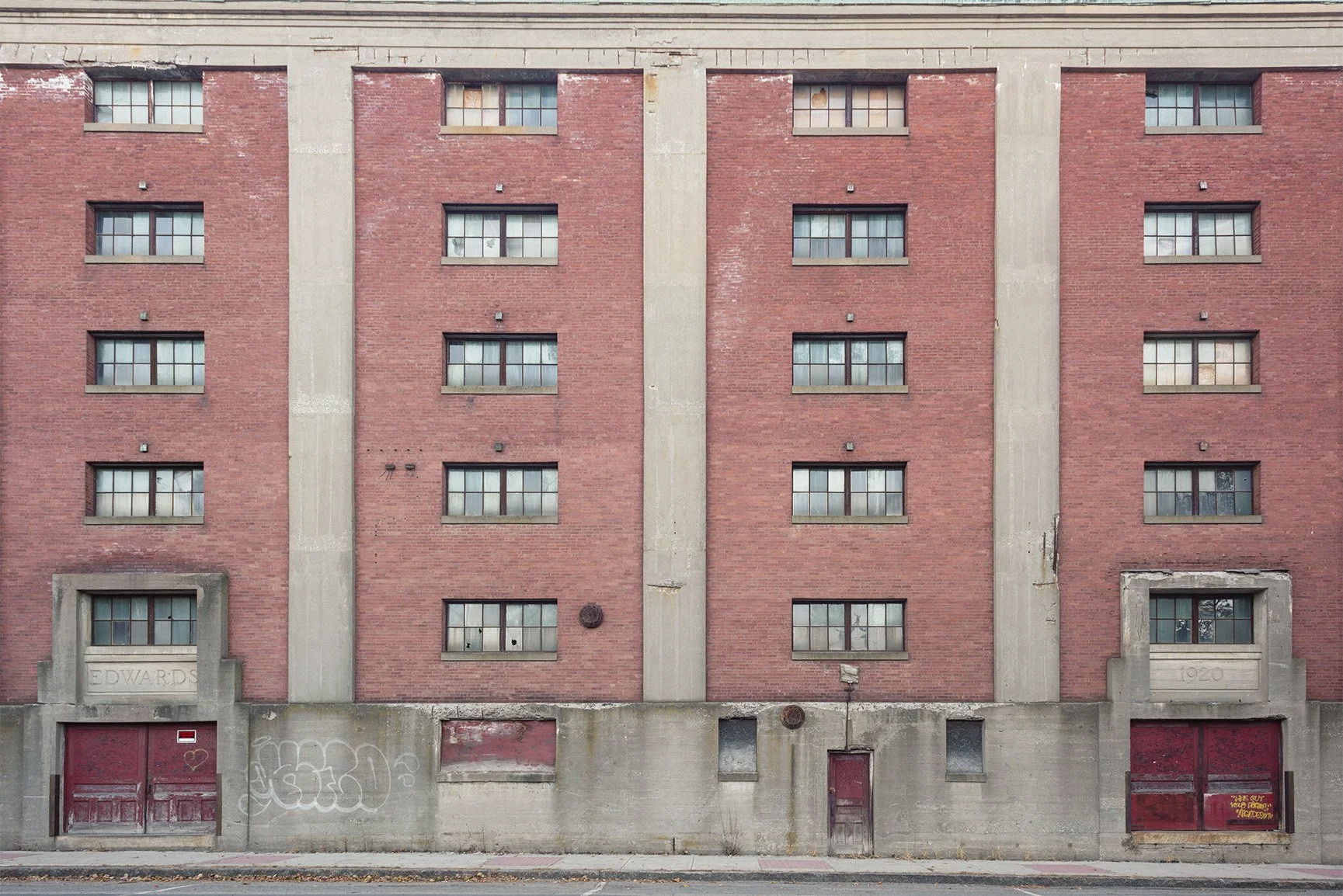
Edwards Manufacturing Company, c. 1845
Cushnoc Falls, Kennebec River
Augusta, Kennebec County, Maine
From the Echoes, Still: Maine's Industrial Remnants Collection (2024–2028)
Cotton, Woolens Portfolio
Historical Narrative
Kevin LeDuc Pigment print on Hahnemühle Baryta Rag Edition of 5 + 1 Artist’s Proof (A/P) + 1 Bon à Tirer (B.A.T.) Portfolio of 40 Images
Paper Size: 35 × 50 inches Image Size: 30 × 45 inches Borders: Approximately 2 ½ inches (All Sides) Mounting: Archival hinge or float mounting
Historic Significance
The Edwards Manufacturing Mill was one of Augusta, Maine’s most influential industrial enterprises, shaping the city’s economic growth and workforce from the mid-nineteenth century through the twentieth century. Established in 1845 along the Kennebec River, the mill benefited from the area’s natural waterpower resources, which supported the development of mechanized cotton textile production. After ownership changes and expansions under the Sprague Manufacturing Company in 1868, the facility was acquired by Edwards Manufacturing Company in 1883 and became one of the largest textile operations in central Maine.
Under Edwards Manufacturing, the mill developed into a large-scale cotton textile complex producing a variety of fabrics, including sheetings, shirtings, drill cloth, and materials used for military supplies. The facility evolved from water-powered machinery to steam and electrical systems, allowing for increased production and greater reliability. Its extensive equipment included carding machines, spinning frames, power looms, dyeing facilities, and finishing machinery, enabling the mill to manufacture millions of yards of cotton fabric annually during its peak years. During World War II, the mill contributed to national wartime production by supplying cotton fabrics and uniform materials for the U.S. military.
The success of Edwards Manufacturing depended on a large and diverse workforce drawn from Augusta’s immigrant and Franco-American communities. Neighborhoods near the mill, including the Sand Hill and Bond Street areas, developed around the needs of industrial workers and their families. Employees worked in specialized departments such as spinning, weaving, dyeing, and finishing, often under demanding conditions that included long hours, loud machinery, cotton dust, and strict production schedules. At its height during World War II, the mill employed approximately 1,300 workers and served as a major source of employment and community identity for Augusta.
By the late twentieth century, Edwards Manufacturing faced the same challenges affecting many New England textile companies, including competition from southern mills and overseas manufacturers. Textile production ended in the early 1980s, and a devastating fire in 1989 destroyed most of the abandoned mill complex. Today, the former site has become part of Mill Park along the Kennebec River, with the remaining structures serving as reminders of Augusta’s industrial past. The legacy of Edwards Manufacturing reflects the importance of textile production, immigrant labor, technological change, and industrial development in shaping Maine’s history.
Historical Narrative
-
The Edwards Manufacturing Mill was one of Augusta, Maine’s most significant industrial enterprises, shaping the city’s economy and workforce from the mid-nineteenth century through the late twentieth century. Its origins trace to a cotton manufacturing facility founded in 1845 along the Kennebec River, where waterpower from an early dam enabled mechanized textile production.¹ Contemporary records indicate that the original facility had no formal corporate title and was referred to simply as the cotton mill in Augusta.²
In 1868, the property was purchased by the Sprague Manufacturing Company, which expanded the mill’s capacity and modernized its equipment.³ A decisive transformation occurred in 1883, when the complex was acquired by the Edwards Manufacturing Company, whose name thereafter became synonymous with large-scale textile production in Augusta.⁴ By the turn of the twentieth century, Edwards Manufacturing had emerged as one of the city’s largest employers, drawing heavily from Franco-American and immigrant labor communities clustered near the mill, particularly in the Sand Hill and Bond Street neighborhoods.⁵
Edwards Manufacturing Company and Workforce
Working conditions at the Edwards mill reflected those common to major New England textile operations. Employees labored long shifts amid constant noise, cotton dust, and moving machinery. Work was organized by department, including picking, carding, spinning, weaving, dyeing, finishing, and shipping, each overseen by supervisors responsible for maintaining production schedules and safety standards.⁶
During the World War II period, Edwards Manufacturing reached its peak employment, with approximately 1,300 workers employed at a single time, operating on multiple shifts to meet wartime demand.⁷ Over the course of several decades, thousands of individuals passed through the mill’s workforce, making it one of the most important sources of employment in central Maine.⁸
The mill produced cotton goods for both civilian and military markets. During World War II, Edwards Manufacturing supplied cotton fabrics and uniform materials for U.S. military use, integrating the Augusta facility into the national wartime industrial network.⁹
Industrial Operations, Power Sources, Machinery, and Output
The Edwards Manufacturing Mill relied on a combination of natural and mechanical power systems that evolved over time to support large-scale cotton production. Its location was dictated by a prominent natural feature of the Kennebec River. Prior to construction of Edwards Dam, the river at Augusta descended through a series of rapids and falls historically known as Cushnoc Falls, which marked the head of tide on the Kennebec. This natural drop provided an unusually strong and dependable source of waterpower and was a primary reason for the early concentration of industry at this site. With the construction of Edwards Dam in the nineteenth century, Cushnoc Falls were submerged, transforming the natural falls into a controlled hydraulic head that supplied consistent power to the Edwards Manufacturing Mill and earlier cotton-manufacturing enterprises on the site.¹⁰
Initially, the mill operated using water wheels, with power transmitted throughout the complex by an extensive system of line shafts, belts, and pulleys. As production expanded in the late nineteenth century, steam engines were introduced to supplement waterpower during periods of low flow. By 1913, Edwards Manufacturing had installed electrical generators, marking a transition toward electrically driven machinery while still relying on hydraulic power as the primary energy source.¹¹
Archival descriptions and comparative data from similarly sized New England cotton mills indicate that at peak operation the Edwards complex likely operated 40–60 carding machines, 20,000–40,000 spinning spindles, and approximately 400–600 power looms, along with dyeing vats, calendering machines, and finishing presses.¹² This machinery enabled the production of sheetings, shirtings, drill cloth, and other medium-weight cotton fabrics, as well as bleached and dyed goods intended for apparel, institutional use, and military supply.¹³
Although no complete production ledger survives, the scale of machinery and labor force allows for a reliable estimate of output. Based on typical loom speeds and operating schedules for cotton mills of comparable size, Edwards Manufacturing likely produced approximately 200,000 to 350,000 yards of cotton fabric per day, translating to roughly 60 to 100 million yards annually during peak years, particularly during World War II when the mill operated on extended shifts to meet military demand.¹⁴
Decline, Closure, and Legacy
By the early 1980s, Edwards Manufacturing faced the structural challenges that undermined textile production throughout New England, including competition from lower-cost producers in the southern United States and overseas. Textile operations ceased, and the workforce was laid off, ending more than a century of manufacturing at the site.¹⁵
On November 30, 1989, a catastrophic fire destroyed most of the abandoned mill complex, erasing much of Augusta’s industrial riverfront.¹⁶ One brick structure dating to circa 1910–1920, originally used for electrical and transformer operations, survived and remains the sole physical remnant of the Edwards manufacturing era.¹⁷
Today, the former mill site is largely incorporated into Mill Park, a public space along the Kennebec River. Ongoing discussions about preservation and adaptive reuse of the remaining structure underscore the enduring historical importance of the Edwards Manufacturing Mill to Augusta’s industrial, social, and immigrant heritage.¹⁸
Footnotes
Maine State Archives, Augusta Manufacturing Records, 1845–1868, 1.
Ibid., 1–2.
Edwards Manufacturing Company Records, 1882–1948, Maine Historical Society, Portland, Maine, 3–4.
Ibid., 5–6.
Ibid., 6–7.
Ibid., 8–9.
Ibid., 10–11.
Ibid., 11–12.
Ibid., 13–14.
Brief History of Edwards Dam and Cushnoc Falls, archival summary of Kennebec River industrial development, 2–4.
Edwards Manufacturing Company Records, 1882–1948, 6–7.
Ibid., 15–18.
Ibid., 19–20.
Comparative production estimates based on loom capacity and operating schedules in large New England cotton mills; Edwards Manufacturing Company Records, 1882–1948, 10–11, 15–18.
Ibid., 22–23.
Augusta Fire Department, Report on the Edwards Mill Fire, November 30, 1989, 1–2.
Edwards Manufacturing Company Records, 24.
City of Augusta, Mill Park and Riverfront Redevelopment Planning Records, 1–2.
Bibliography
Augusta Fire Department. Report on the Edwards Mill Fire, November 30, 1989. Augusta, Maine, 1–2.
Brief History of Edwards Dam and Cushnoc Falls. Archival summary of Kennebec River industrial development. Augusta, Maine, 2–4.
City of Augusta. Mill Park and Riverfront Redevelopment Planning Records. Augusta, Maine, 1–2.
Edwards Manufacturing Company Records, 1882–1948. Maine Historical Society, Portland, Maine, 3–24.
Maine State Archives. Augusta Manufacturing Records, 1845–1868. Augusta, Maine, 1–2.