Mary, Queen of Saints Catholic Parish
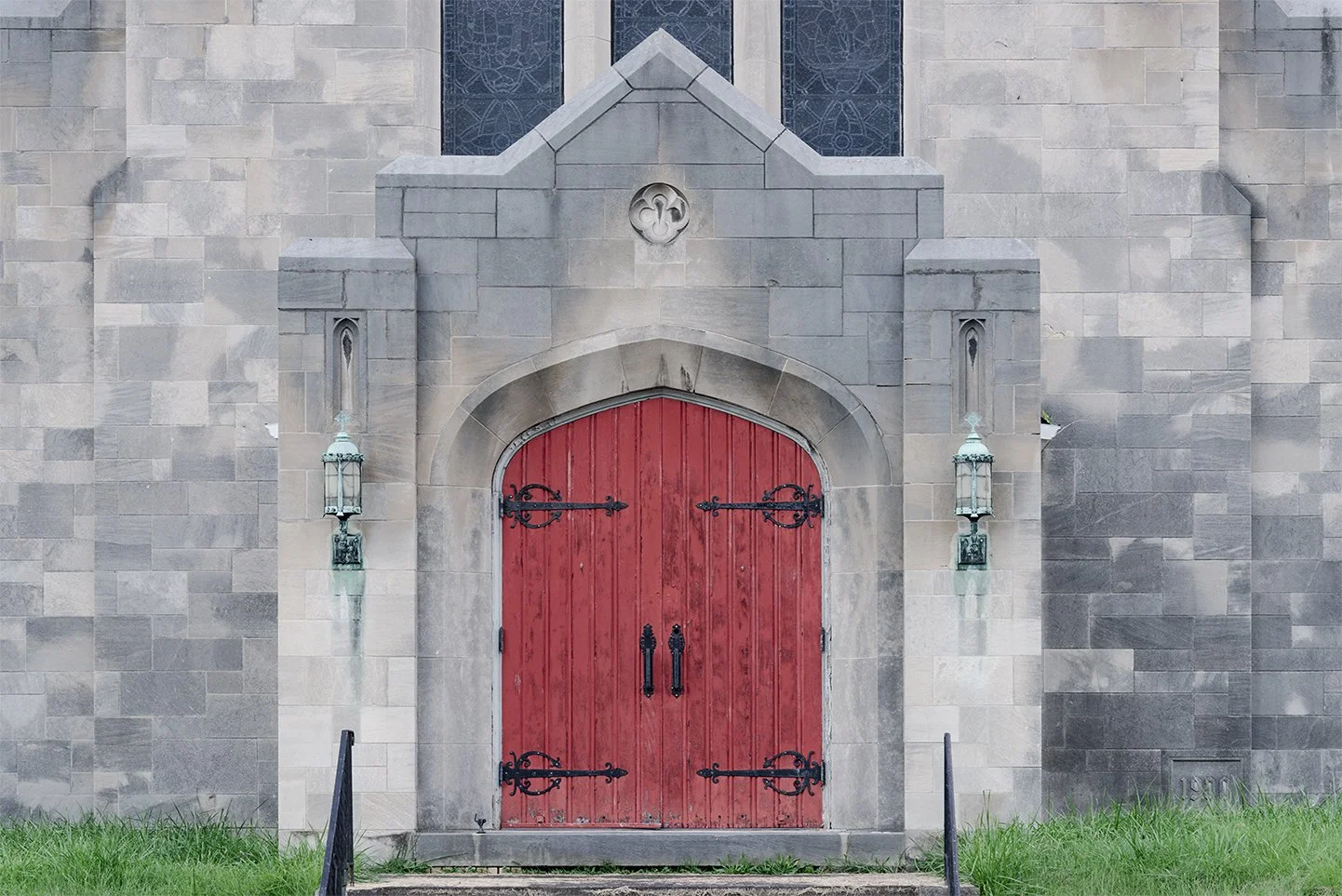
Mary, Queen of Saints Catholic Parish
Kevin LeDuc
Mary, Queen of Saints Catholic Parish, c. 1888
Aliquippa, Beaver County, Pennsylvania from the Ballyshannon’s Rustland (2021–2024) – Flesh and Furnace Portfolio
Pigment print on Hahnemühle Baryta
Artist’s proof + edition of 5 (portfolio of 40 images)
30 × 45 inches
-
Mary, Queen of Saints Catholic Parish, Aliquippa, Pennsylvania: Catholic Consolidation and Community Continuity in Beaver County
Introduction
Mary, Queen of Saints Catholic Parish is one of the newest Roman Catholic parishes in western Pennsylvania, yet its history encompasses more than a century of Catholic life in the industrial communities of Beaver County. Formally established on July 1, 2021, by the Diocese of Pittsburgh, the parish emerged from the merger of four historic congregations: St. Titus in Aliquippa, St. John the Baptist in Monaca, St. Frances Cabrini in Center Township, and Our Lady of Fatima in Hopewell Township.¹
Although Mary, Queen of Saints is a recent institution, it represents the continuation of Catholic traditions that began in the Beaver Valley during the nineteenth century. Its creation reflects broader developments affecting American Catholicism in the twenty-first century, including population shifts, declining numbers of clergy, changing patterns of parish participation, and diocesan restructuring. At the same time, the parish preserves the religious heritage of communities shaped by steelmaking, immigration, ethnic identity, and industrial labor.
The Beaver Valley and the Rise of Catholicism
The history of Mary, Queen of Saints cannot be understood without examining the industrial development of Beaver County. During the nineteenth and twentieth centuries, communities such as Aliquippa, Monaca, and Hopewell became centers of manufacturing, transportation, and heavy industry. The expansion of railroads and steel production attracted thousands of immigrants from Ireland, Italy, Slovakia, Croatia, Poland, Hungary, Germany, and other European nations.²
These immigrants brought with them strong Catholic traditions. As population increased, new parishes were established to serve growing ethnic and territorial communities. Churches became centers not only of worship but also of education, social life, and cultural preservation.
By the early twentieth century, Catholicism had become one of the defining religious traditions of the Beaver Valley.
St. John the Baptist Parish, Monaca (1888)
The oldest parish eventually incorporated into Mary, Queen of Saints was St. John the Baptist in Monaca.
Before 1888, Catholics living in what was then known as Phillipsburg often traveled to Beaver or Rochester to attend Mass. Recognizing the growing Catholic population, church leaders organized a new parish and began construction of a church building during the autumn of 1888.³
Initially a mission of St. Cecilia Parish in Rochester, St. John the Baptist received a resident pastor in 1891. The parish served Monaca's expanding population of industrial workers, railroad employees, and immigrant families. The first church remained in use until 1913, when a larger facility was established to accommodate continued growth.⁴
Throughout the twentieth century, St. John the Baptist became one of Beaver County's most significant Catholic institutions, educating generations of parishioners and sponsoring numerous religious and social organizations.
St. Titus Parish, Aliquippa (1910)
The industrial boom that transformed Aliquippa created conditions for the establishment of St. Titus Parish.
Historical records indicate that Catholics in the Aliquippa area were originally served through mission churches associated with St. John the Baptist and St. Joseph Parish. The situation changed dramatically after Jones & Laughlin Steel began construction of its massive Aliquippa works in 1906.⁵
The steel plant attracted thousands of workers from across Europe and the United States. Entire neighborhoods developed almost overnight, creating an urgent need for additional Catholic institutions.
The first Mass associated with St. Titus was celebrated on Christmas Day 1910 in a converted storeroom located in the Woodlawn Trust Building on Franklin Avenue.⁶ From these humble beginnings emerged one of Aliquippa's most important Catholic parishes.
St. Titus became particularly associated with the immigrant communities that settled near the steel mills. Parish life reflected the ethnic diversity of Aliquippa, where Slovak, Croatian, Italian, Polish, and Irish families often worshiped together while maintaining distinct cultural traditions.
Our Lady of Fatima Parish, Hopewell Township (1954)
Following World War II, suburban development transformed portions of Beaver County. Population growth in Hopewell Township led the Diocese of Pittsburgh to establish Our Lady of Fatima Parish on June 9, 1954.⁷
The first Mass was celebrated on June 13, 1954, in the dining room of Sheffield Towers. Because no church building yet existed, parishioners initially gathered in temporary locations while plans were developed for permanent facilities.
Land was purchased later that year, and construction began on a school-auditorium complex that served as both educational facility and temporary church. The building was dedicated in March 1956.⁸
The parish reflected the postwar suburban expansion that reshaped many American communities. Unlike the ethnic urban parishes of earlier generations, Our Lady of Fatima primarily served families moving into newly developed residential neighborhoods.
St. Frances Cabrini Parish, Center Township (1961)
The youngest of the four predecessor parishes was St. Frances Cabrini.
Established on May 24, 1961, by Bishop John J. Wright of Pittsburgh, the parish was created to serve the rapidly growing population of Center Township.⁹ The territory was drawn largely from sections of St. Titus and St. John the Baptist parishes.
When the parish was founded, a census identified approximately 480 families within its boundaries. Early Masses were celebrated in private homes and at Center Bowling Lanes before a temporary church could be completed.¹⁰
The first parish buildings were dedicated in 1964. Additional educational and social facilities followed in the early 1970s, reflecting continued population growth throughout the township.
Like many postwar Catholic parishes, St. Frances Cabrini combined religious worship, education, recreation, and community service within a single parish complex.
Workforce and Community Composition
The communities that eventually formed Mary, Queen of Saints were deeply connected to the industrial economy of western Pennsylvania.
Parishioners commonly worked as:
steelworkers
blast furnace operators
machinists
railroad employees
electricians
miners
construction workers
teachers
nurses
clerical workers
small business owners
For much of the twentieth century, Jones & Laughlin Steel dominated economic life in Aliquippa. At its peak, the Aliquippa Works employed tens of thousands of workers and ranked among the largest steel facilities in the United States.¹¹
The Catholic parishes of the region reflected the ethnic diversity of the industrial workforce. Congregations included descendants of Irish, Italian, Slovak, Croatian, Polish, Hungarian, German, and Eastern European immigrants who had settled in the Beaver Valley during the steel industry's expansion.
Probable Employment Scale of the Parish Communities
Because Mary, Queen of Saints did not exist before 2021, workforce estimates must be derived from the combined communities served by its predecessor parishes.
Approximate Employment Base by Era
PeriodEstimated Catholic Workforce Served1890–19101,500–3,000 workers1910–19458,000–15,000 workers1945–197512,000–20,000 workers1975–20005,000–10,000 workers2000–20212,500–5,000 workers
These figures reflect the broader economic history of the Beaver Valley, including the rise and decline of heavy industry.
Industrial Decline and Parish Challenges
Beginning in the 1970s, the Beaver Valley experienced severe economic disruption as steel production declined throughout western Pennsylvania.
Mill closures, workforce reductions, and population loss affected nearly every Catholic parish in the region. Younger residents increasingly relocated elsewhere in search of employment opportunities.¹²
As parish membership declined, maintaining separate administrative structures, schools, rectories, and church buildings became increasingly difficult.
The Diocese of Pittsburgh faced these challenges throughout its territory. Declining Mass attendance and a shrinking number of priests accelerated the need for new models of parish organization.
The On Mission Initiative and Formation of Mary, Queen of Saints
In 2015, Bishop David Zubik initiated the diocesan planning process known as On Mission for The Church Alive!. The program sought to create sustainable parish structures capable of serving future generations of Catholics.¹³
On April 28, 2018, the Diocese announced that:
St. Titus (Aliquippa)
St. John the Baptist (Monaca)
St. Frances Cabrini (Center Township)
Our Lady of Fatima (Hopewell Township)
would form a parish grouping.¹⁴
Following several years of planning and consultation, Bishop Zubik officially announced on May 29, 2021, that the merged parish would be known as Mary, Queen of Saints.
The merger became effective on July 1, 2021. Importantly, all four church buildings remained open as worship sites within the new parish structure.¹⁵
This approach allowed communities to preserve local traditions while benefiting from shared administration and clergy.
Historical Significance
Mary, Queen of Saints represents an important chapter in the history of Catholicism in western Pennsylvania. Unlike earlier parishes founded by immigrant communities, it emerged from a process of consolidation designed to address contemporary demographic and institutional realities.
The parish embodies more than 130 years of Catholic history in the Beaver Valley. Through its predecessor congregations, it preserves connections to:
industrial immigration
steelworker communities
ethnic parish traditions
Catholic education
suburban expansion
postindustrial adaptation
Its creation demonstrates how religious institutions evolve while maintaining continuity with the past.
Conclusion
Although formally established only in 2021, Mary, Queen of Saints Parish rests upon foundations laid by generations of Catholics in Aliquippa, Monaca, Center Township, and Hopewell Township. The histories of St. John the Baptist, St. Titus, Our Lady of Fatima, and St. Frances Cabrini reflect the growth of industry, immigration, and community life throughout Beaver County.
The formation of Mary, Queen of Saints marks not an ending but a continuation of Catholic presence in the Beaver Valley. By uniting four historic congregations into a single parish, the Diocese of Pittsburgh sought to preserve the spiritual heritage of the region while adapting to the realities of the twenty-first century.
Footnotes
Mary, Queen of Saints Parish, "Parish History."
Joseph F. Rishel, The Pennsylvania Industrial Experience (Harrisburg: Pennsylvania Historical and Museum Commission, 1999).
Mary, Queen of Saints Parish, "St. John the Baptist History."
Ibid.
Mary, Queen of Saints Parish, "St. Titus History."
Ibid.
Mary, Queen of Saints Parish, "Our Lady of Fatima History."
Ibid.
Mary, Queen of Saints Parish, "St. Frances Cabrini History."
Ibid.
Thomas White, Aliquippa: The Company Town and the Steel Era (Aliquippa Historical Society, 2006).
Steven High, Industrial Sunset: The Making of North America's Rust Belt, 1969–1984 (Toronto: University of Toronto Press, 2003).
Diocese of Pittsburgh, "Mary, Queen of Saints Parish."
Mary, Queen of Saints Parish, "Parish History."
Diocese of Pittsburgh, "Mary, Queen of Saints Parish."
Bibliography
High, Steven. Industrial Sunset: The Making of North America's Rust Belt, 1969–1984. Toronto: University of Toronto Press, 2003.
Mary, Queen of Saints Parish. Parish History. Mary, Queen of Saints Parish Official Website
Mary, Queen of Saints Parish. St. Frances Cabrini History.
Mary, Queen of Saints Parish. St. John the Baptist History.
Mary, Queen of Saints Parish. St. Titus History.
Mary, Queen of Saints Parish. Our Lady of Fatima History.
Rishel, Joseph F. The Pennsylvania Industrial Experience. Harrisburg: Pennsylvania Historical and Museum Commission, 1999.
White, Thomas. Aliquippa: The Company Town and the Steel Era. Aliquippa Historical Society, 2006.
Diocese of Pittsburgh. Mary, Queen of Saints Parish Profile
Interesting local fact
The predecessor parish of St. Titus grew directly because of the construction of the giant Jones & Laughlin Steel plant in Aliquippa. At its peak, Aliquippa was one of America's classic company towns, where entire neighborhoods, schools, churches, and business districts were built around the steel industry. Many families who later belonged to Mary, Queen of Saints can trace their roots to immigrant steelworkers recruited from southern and eastern Europe during the early twentieth century.
-
Jones & Laughlin (J&L) Steel Aliquippa Works: Industrial Growth, Labor, and Decline in Beaver County, Pennsylvania
Introduction
Few industrial facilities exerted a greater influence on a community than the Jones & Laughlin Steel Corporation's Aliquippa Works in Beaver County, Pennsylvania. Constructed beginning in 1905 and placed into production in 1909, the Aliquippa Works evolved into one of the largest integrated steel plants in the United States and for many years was regarded as the largest integrated steel mill in the world.¹
The history of the Aliquippa Works is inseparable from the history of Aliquippa itself. The mill not only provided employment for thousands of workers but also shaped the city's neighborhoods, ethnic communities, labor organizations, schools, churches, and political culture. For much of the twentieth century, Aliquippa was a classic company town whose existence revolved around the fortunes of a single industrial employer. The rise and fall of the Aliquippa Works mirrors the broader history of American heavy industry, immigration, organized labor, wartime production, deindustrialization, and urban decline.
Origins of Jones & Laughlin Steel
Jones & Laughlin was founded in Pittsburgh in 1853 by Bernard Lauth and Benjamin Franklin Jones as an iron manufacturing enterprise. Under the leadership of Jones and later James Laughlin, the company expanded into steel production during the late nineteenth century, becoming one of the largest steel manufacturers in the United States.²
By the turn of the twentieth century, company executives sought additional land for expansion beyond Pittsburgh's crowded Monongahela River facilities. The Ohio River valley in Beaver County offered abundant transportation connections, access to railroads and river shipping, and large tracts of relatively undeveloped land.
In 1905 J&L began acquiring property near Woodlawn and Aliquippa. Construction soon commenced on what would become the Aliquippa Works, a massive integrated steel-making complex extending approximately seven miles along the Ohio River.³
Construction of the Aliquippa Works, 1905–1909
The scale of the project was unprecedented in western Pennsylvania. Existing communities, riverfront lands, and transportation corridors were transformed as construction crews erected blast furnaces, coke handling facilities, rolling mills, open-hearth furnaces, rail connections, power plants, and support buildings.
Production began in 1909. The plant quickly became the centerpiece of J&L's steel operations and one of the most technologically advanced steel facilities in North America.⁴
Unlike smaller specialty mills, the Aliquippa Works functioned as a fully integrated steel operation. Raw materials entered one end of the plant and emerged as finished steel products through a continuous sequence of industrial processes.
Major facilities included:
Blast furnaces
Open-hearth furnaces
Rolling mills
Blooming mills
Coke-handling operations
Rail yards
Power generation facilities
Fabricating departments
Maintenance shops
The scale of operations made the plant a dominant feature of the Ohio River landscape.
Building a Company Town
Perhaps the most remarkable aspect of the Aliquippa Works was its role in creating an entire urban community.
As production expanded, thousands of workers arrived from Europe and from other parts of the United States. To house them, J&L developed extensive residential districts around the mill. Woodlawn Borough expanded rapidly and became the nucleus of a company-controlled community.⁵
The company divided residential areas into numbered "Plans," including Plan 6, Plan 11, Plan 12, and others. These districts often reflected ethnic and racial segregation policies common in industrial America during the early twentieth century. Different immigrant groups frequently occupied distinct neighborhoods, creating a patchwork of ethnic communities surrounding the mill.⁶
Among the largest groups were:
Slovaks
Croatians
Serbians
Italians
Poles
Hungarians
Irish
Germans
African Americans migrating from the South
Churches, schools, stores, and social organizations emerged within these neighborhoods, producing one of the most diverse industrial communities in western Pennsylvania.
Workforce and Employment
The Aliquippa Works ranked among the largest employers in Pennsylvania for much of the twentieth century.
Historical estimates vary by period, but available evidence demonstrates the immense scale of employment. During its peak years, the plant employed between 14,000 and 15,000 workers. Historical markers erected at the site report that more than 14,000 persons worked at the facility, while wartime and labor sources place employment at approximately 11,000–15,000 workers.⁷
Probable Employment Scale
PeriodEstimated Employment1909–19153,000–6,0001915–19308,000–12,0001930–19459,000–14,0001945–196512,000–15,0001965–197510,000–13,0001975–19846,000–10,0001984 ClosureApproximately 8,000 layoffs
These figures represent one of the largest concentrations of industrial employment in western Pennsylvania outside Pittsburgh itself.⁸
Types of Jobs
The integrated nature of steel production required a vast and highly specialized workforce.
Occupations included:
Production Workers
Blast furnace operators
Open-hearth furnace workers
Rollers
Millwrights
Cranemen
Pourers
Slag handlers
Laborers
Skilled Trades
Electricians
Machinists
Pipefitters
Welders
Carpenters
Blacksmiths
Pattern makers
Transportation Workers
Railroad engineers
Switchmen
Yard conductors
Locomotive mechanics
Professional and Administrative Employees
Engineers
Metallurgists
Chemists
Draftsmen
Clerks
Managers
Accountants
The mill effectively functioned as a self-contained industrial city.
Ethnic Composition of the Workforce
The Aliquippa Works became one of the most ethnically diverse industrial workplaces in the nation.
Large-scale immigration from southern and eastern Europe supplied much of the labor force during the early decades of operation. Local historians have documented substantial populations of Slovaks, Croatians, Serbians, Italians, Poles, Hungarians, and other immigrant groups. African Americans arriving during the Great Migration also became an important part of the workforce.⁹
While precise percentages changed over time, employment patterns often reflected both ethnic specialization and company hiring practices. Certain departments developed reputations for employing particular immigrant groups, while neighborhoods surrounding the plant frequently corresponded to ethnic identity.
Women and the Aliquippa Works
Women generally did not occupy heavy production positions within the steel mill during its early decades. However, they played critical roles in the broader industrial economy.
Women worked as:
Clerical employees
Secretaries
Payroll staff
Laboratory assistants
Nurses
Cafeteria workers
Retail employees serving mill communities
During World War II, labor shortages created additional opportunities for women in industrial support roles.¹⁰
Equally important were the unpaid contributions of women in immigrant households. They managed family finances, maintained boarding houses, raised children, and supported community organizations that sustained life in the company town.
Labor Relations and the Wagner Act
The Aliquippa Works occupies a significant place in American labor history.
Throughout the early twentieth century, steel companies resisted unionization. J&L was no exception. Yet labor activism steadily increased during the Great Depression as workers sought greater economic security and workplace protections.
The Aliquippa Works became central to the legal struggle that produced one of the most important labor decisions in American history: National Labor Relations Board v. Jones & Laughlin Steel Corporation (1937).¹¹
In that landmark case, the United States Supreme Court upheld the constitutionality of the Wagner Act and affirmed the federal government's authority to protect collective bargaining rights.
The decision transformed labor relations nationwide and established legal foundations for modern unionism.
Aliquippa workers subsequently became active participants in the Steel Workers Organizing Committee (SWOC) and later the United Steelworkers of America. Local 1211 emerged as one of the most influential steelworker organizations in the nation.¹²
World War II and Industrial Peak
World War II marked the height of the Aliquippa Works.
The plant operated continuously to meet military demands for steel used in:
Tanks
Ships
Armor plate
Weapons systems
Industrial equipment
During the war years Aliquippa's population approached 27,000 residents while mill employment reached some of its highest levels. Contemporary accounts described the mill operating around the clock, illuminating the Ohio River valley with the glow of blast furnaces and rolling mills.¹³
Steelworkers took immense pride in their contribution to the Allied war effort, regarding themselves as essential participants in the struggle against fascism.
Postwar Prosperity
The decades following World War II represented a period of relative prosperity.
Union contracts improved wages and benefits. Home ownership expanded. New schools, hospitals, churches, and businesses appeared throughout the Beaver Valley.
Many second-generation children of steelworkers entered colleges, professional careers, and management positions. Economic stability encouraged social mobility and transformed Aliquippa into one of western Pennsylvania's most prosperous industrial communities.¹⁴
The Aliquippa Works remained a dominant economic force throughout the 1950s and 1960s.
Decline and Closure
Beginning in the 1970s, the American steel industry entered a prolonged crisis.
Competition from foreign producers, aging facilities, technological change, and declining domestic demand reduced profitability. Like many integrated steel plants, the Aliquippa Works struggled to modernize rapidly enough to remain competitive.
The crisis culminated in 1984 when LTV Corporation, successor to J&L Steel, announced the closure of most operations at the Aliquippa Works. Approximately 8,000 workers lost their jobs.¹⁵
The closure represented one of the most devastating economic events in Beaver County history.
Population declined dramatically. Businesses closed. Downtown Aliquippa experienced severe economic contraction. Neighborhoods that had once housed thousands of steelworkers entered prolonged decline.
The plant itself was largely demolished by 1988.
Historical Significance and Legacy
The Aliquippa Works remains one of the most important industrial sites in Pennsylvania history.
Its significance rests upon several factors:
One of the largest integrated steel mills in the world
Employer of more than 14,000 workers
Center of major immigration and ethnic settlement
Birthplace of important labor struggles
Key producer of wartime steel during World War II
Symbol of the rise and fall of American heavy industry
Although little of the mill survives physically, its impact remains visible throughout Aliquippa and Beaver County. Churches, schools, neighborhoods, labor organizations, and family histories all reflect the influence of the steel industry.
Conclusion
The Jones & Laughlin Aliquippa Works was far more than a steel mill. It was the economic, social, and cultural foundation of an entire community. From its construction in 1905 through its closure in 1984, the plant shaped the lives of tens of thousands of workers and their families.
Its history encompasses immigration, industrial growth, labor activism, wartime production, postwar prosperity, and deindustrialization. Few industrial facilities so completely defined the character of a city. Even decades after its demolition, the Aliquippa Works remains one of the most important symbols of America's industrial age and one of the most consequential steel-making enterprises ever constructed in Pennsylvania.
Notes
City of Aliquippa, “History of Aliquippa”; Beaver County Historical Research and Landmarks Foundation, “Aliquippa Works” historical marker.
National Register documentation for the Jones & Laughlin Steel Company Building, Pittsburgh.
City of Aliquippa, “History of Aliquippa.”
Beaver County Historical Research and Landmarks Foundation, “Aliquippa Works” historical marker.
City of Aliquippa, “History of Aliquippa.”
Joseph Makarewicz, “Aliquippa—The Ethnic Experience, 1920–1970.”
Beaver County Historical Research and Landmarks Foundation, “Aliquippa Works” historical marker; Penn State University, “Forged in Steel.”
City of Aliquippa, “History of Aliquippa”; Penn State University, “Forged in Steel.”
Makarewicz, “Aliquippa—The Ethnic Experience, 1920–1970.”
United States Steel and wartime labor studies of western Pennsylvania.
National Labor Relations Board v. Jones & Laughlin Steel Corp., 301 U.S. 1 (1937).
National Park Service, “United Steelworkers Local 1211 Union Hall.”
City of Aliquippa, “History of Aliquippa.”
Robert Hilliard, “Union Beginnings in Aliquippa.”
City of Aliquippa, “History of Aliquippa.”
Bibliography
City of Aliquippa. “History of Aliquippa.” Municipal historical records.
Hilliard, Robert. “Union Beginnings in Aliquippa.” Milestones 22, no. 2 (1997).
Makarewicz, Joseph. “Aliquippa—The Ethnic Experience, 1920–1970.” Milestones 4, no. 2 (1978).
National Park Service. “United Steelworkers Local 1211 Union Hall.”
Penn State University. “Forged in Steel.”
United States Supreme Court. National Labor Relations Board v. Jones & Laughlin Steel Corporation, 301 U.S. 1 (1937).
Beaver County Historical Research and Landmarks Foundation. “Aliquippa Works” Historical Marker.
Intresting Facts
Key documented facts include that production began in 1909, the mill stretched roughly seven miles along the Ohio River, employment exceeded 14,000 workers at peak levels, and the 1937 NLRB v. Jones & Laughlin Steel case originating from labor disputes at J&L became one of the most important constitutional and labor-law decisions in American history.