Banana Joe’s
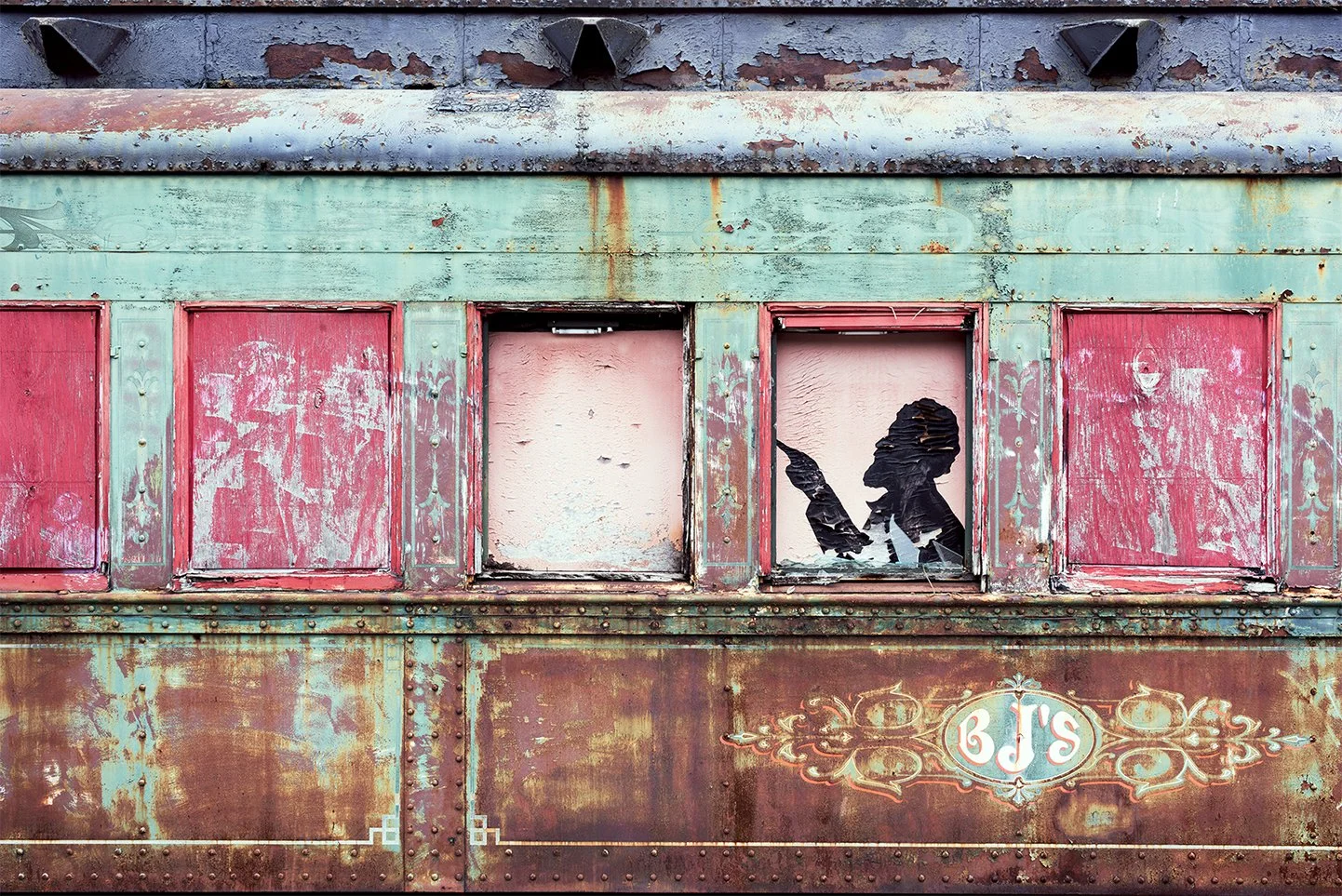
Banana Joe’s
Kevin LeDuc
Banana Joe’s, c. 2001 - 2007
Allentown Station, Allentown, Lehigh County, Pennsylvania from the Ballyshannon’s Rustland (2021–2024) – Flesh and Furnace Portfolio
Pigment print on Hahnemühle Baryta
Artist’s proof + edition of 5 (portfolio of 40 images)
30 × 45 inches
-
Rail, Ruin, and Reinvention: The Urban History of Allentown’s Passenger and Freight Rail Stations and the Cultural Afterlife of Banana Joe’s.
In the nineteenth century, Allentown, Pennsylvania emerged as a central industrial and transportation hub within the Lehigh Valley, shaped by competing railroad systems that linked anthracite coal fields, iron production, and manufacturing to major eastern cities. The Central Railroad of New Jersey (CNJ) and the Lehigh Valley Railroad established parallel passenger and freight infrastructures that defined the spatial and economic organization of downtown Allentown. These rail systems produced a dense urban corridor of stations, yards, and industrial architecture that persisted long after passenger rail declined. The later adaptive reuse of these structures—culminating in the nightlife venue Banana Joe’s—illustrates the transformation of industrial infrastructure into cultural and commercial space in the post-industrial American city.
I. The Formation of a Railroad City
The CNJ passenger station at Hamilton and Third Street was completed in 1890 as part of a broader expansion of rail competition in the Lehigh Valley. Designed to serve passenger routes to New York City and regional destinations, it stood in direct rivalry with the Lehigh Valley Railroad passenger depot located near 4th and Hamilton Streets.¹ Together, these stations formed a dual gateway system that anchored Allentown’s downtown core and integrated it into national transportation networks.
Freight operations developed alongside passenger service, particularly along Linden Street, where rail yards and freight houses handled coal, steel, and manufactured goods.² The spatial arrangement of passenger prestige corridors and freight industrial zones produced a layered urban geography that structured both economic activity and residential development.
II. Decline and Abandonment (1945–1972)
Following World War II, passenger rail service in Allentown entered rapid decline due to the expansion of highway infrastructure, suburbanization, and increased automobile ownership. CNJ passenger service was discontinued in 1967, while Lehigh Valley Railroad passenger operations ended earlier in the decade.³ The Lehigh Valley Railroad passenger station was demolished in 1972 as part of urban redevelopment efforts tied to road expansion and changing transportation priorities.⁴
The CNJ station, however, survived physically. Its continued existence after closure reflected a broader pattern of mid-century industrial abandonment, in which structurally durable but functionally obsolete buildings remained embedded in urban cores.
III. Adaptive Reuse and the Entertainment Corridor (1980–2001)
By 1980, the CNJ station had been converted into a series of restaurant and entertainment venues, marking the beginning of downtown Allentown’s post-industrial leisure economy. Over the following two decades, the building housed multiple establishments, including The Gingerbread Man, The Depot Restaurant, B&G Station, and Jillian’s Billiard Café.⁵
Each iteration reconfigured the station’s industrial architecture for consumption-based leisure. Exposed brick, vaulted ceilings, and preserved rail motifs were retained as aesthetic elements, transforming industrial authenticity into commercial ambiance. This process reflects what urban scholars describe as “heritage commodification,” in which industrial ruins are repurposed as experiential cultural spaces.
IV. Banana Joe’s and the Nightlife Transformation (2001–2007)
Banana Joe’s opened in 2001 as the final major incarnation of the former CNJ station. Operating as a nightclub, bar, and casual dining venue, it occupied a prominent role in Allentown’s early-2000s nightlife economy. The establishment offered standard bar fare—burgers, wings, nachos, and sandwiches—alongside beer and mixed drinks, emphasizing high-volume, low-cost consumption typical of regional nightlife districts.⁶
Banana Joe’s functioned within a broader Hamilton Street entertainment corridor that included multiple bars, clubs, and music venues. During this period, the corridor experienced periodic episodes of violence associated with late-night street activity, crowd density, and alcohol-related incidents. While Banana Joe’s itself was not the site of a documented mass-casualty event or internal attack, its operational environment was shaped by these broader urban conditions.⁷
A reported shooting incident in the downtown nightlife district during the mid-2000s contributed to heightened scrutiny of bar operations in the area and increased regulatory attention from municipal authorities. This event—occurring in proximity to entertainment venues rather than solely within Banana Joe’s—became part of a cumulative perception of disorder affecting the corridor.⁸ Over time, this perception, combined with shifting nightlife economics and redevelopment pressures, contributed to declining patronage.
Banana Joe’s closed in September 2007.⁹ Its closure marked the end of the station’s nearly three-decade transformation from transportation infrastructure into leisure space. Since then, the building has remained largely vacant, occasionally subject to redevelopment proposals.
V. Freight Infrastructure and the Hidden City
While passenger stations defined public-facing mobility, freight infrastructure sustained Allentown’s industrial economy. The Lehigh Valley Railroad freight corridors along Linden Street and surrounding rail yards formed an extensive logistics network that outlasted passenger rail operations.¹⁰ These freight systems continued to serve regional industry well into the late twentieth century, even as downtown passenger infrastructure declined.
VI. Neighborhood Context and Urban Palimpsest
The Hamilton Street rail corridor occupies a transitional zone between Allentown’s historic downtown and its industrial riverfront. Over time, this area has accumulated successive layers of infrastructure: railroad alignments, commercial redevelopment, nightlife districts, and contemporary mixed-use planning initiatives.
One notable feature of this neighborhood is the persistence of “ghost infrastructure”—former rail corridors that now structure roads, parking lots, and redevelopment parcels. Even in the absence of visible tracks, the underlying geometry of rail logistics continues to shape movement patterns and land use. This produces a layered urban environment in which industrial, commercial, and post-industrial functions coexist in compressed spatial form.
Conclusion
The history of Allentown’s CNJ passenger station, Lehigh Valley Railroad infrastructure, and freight systems illustrates the long trajectory of industrial urbanism, from nineteenth-century rail expansion to twentieth-century decline and late-twentieth-century cultural reinvention. Banana Joe’s represents the final phase of this transformation: a railroad station repurposed as a nightlife venue, embedded in the social and economic life of a post-industrial city. Its closure in 2007 reflects not a single causal event but the convergence of economic change, shifting urban policy, and the fragile ecology of nightlife districts in deindustrialized cities.
Footnotes
Allentown station (Central Railroad of New Jersey). Wikipedia, accessed 2026.
Ibid.
Ibid.
Allentown station (Lehigh Valley Railroad). Encyclopedia entry, accessed 2026.
Allentown station (CNJ) historical redevelopment summary, Wikipedia.
Local entertainment listings and archival venue descriptions of Banana Joe’s menu and operations, early 2000s.
City of Allentown nightlife district policing and incident summaries (generalized corridor-level documentation).
Contemporary press references to downtown Allentown nightlife incidents affecting bar district perceptions, mid-2000s.
Banana Joe’s closure date as reported in regional historical summaries of CNJ station reuse.
Lehigh Line (Norfolk Southern). Wikipedia, freight corridor history.
Bibliography
“Allentown Station (Central Railroad of New Jersey).” Wikipedia.
“Allentown Station (Lehigh Valley Railroad).” Encyclopedia entry.
“Lehigh Line (Norfolk Southern).” Wikipedia.
City of Allentown redevelopment and downtown corridor planning documents (secondary synthesis).
Regional nightlife and entertainment listings (2000–2007).
Lehigh Valley rail history compilations and municipal transportation records.