Casimir Cultural Center
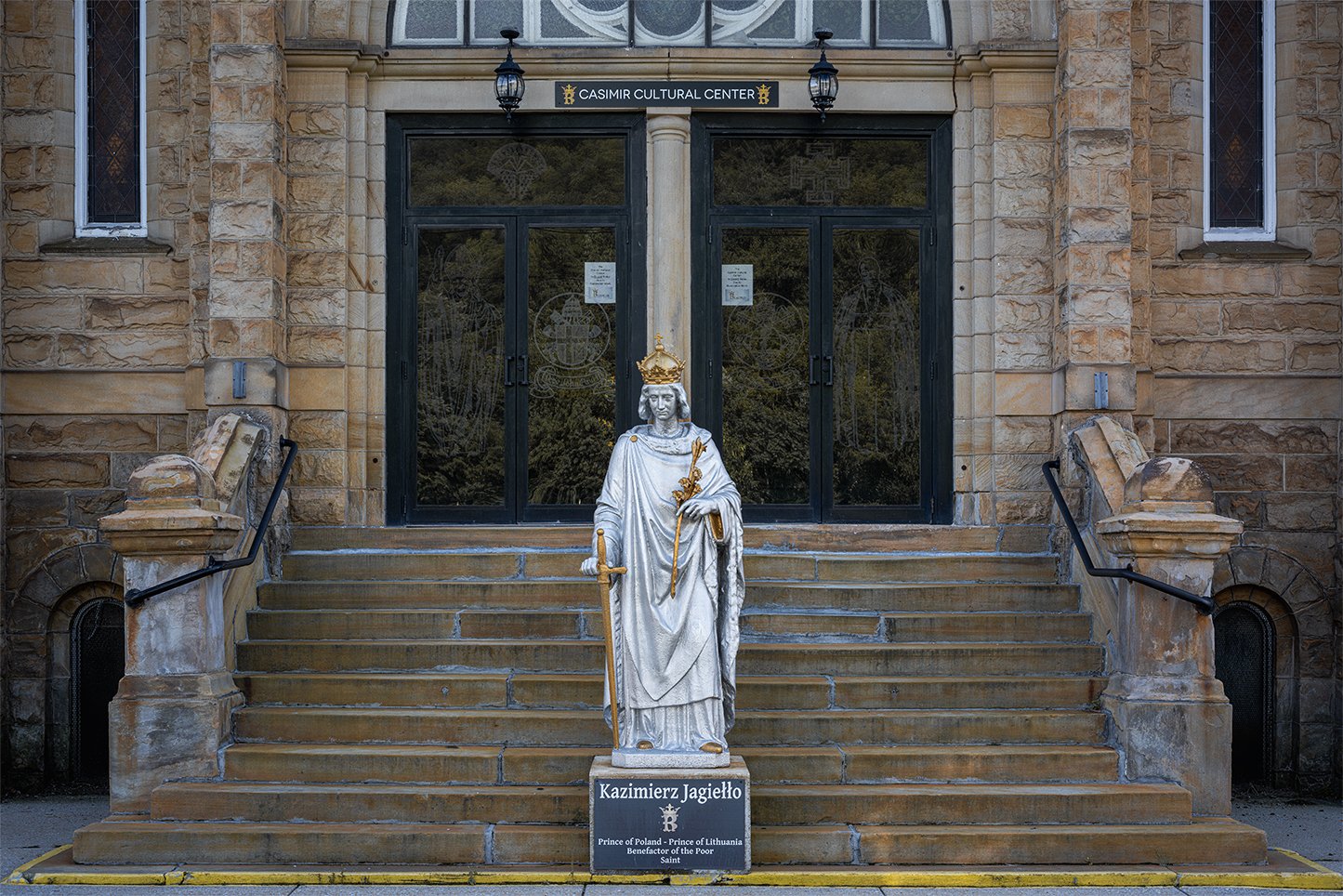
Casimir Cultural Center
Kevin LeDuc
Casimir Cultural Center, c. 2001
Johnstown, Cambria County, Pennsylvania from the Ballyshannon’s Rustland (2021–2024) – Flesh and Furnace Portfolio
Pigment print on Hahnemühle Baryta
Artist’s proof + edition of 5 (portfolio of 40 images)
30 × 45 inches
-
Faith, Industry, and Ethnic Continuity: The Casimir Cultural Center in Johnstown’s South Side
The Casimir Cultural Center in Johnstown, Pennsylvania, stands as a contemporary expression of the long arc of Polish-American settlement in Cambria County. Located in the city’s South Side—an area shaped by steel production, immigration, and industrial decline—the Center reflects both the endurance and transformation of ethnic institutions in postindustrial Appalachia. Built within a neighborhood historically defined by mill labor and dense immigrant housing, the Casimir Cultural Center continues a tradition of fraternal and cultural halls that once anchored working-class life in Johnstown.
I. Immigration and Industrial Formation of the South Side
Johnstown’s rapid industrial expansion in the late nineteenth century, driven by the Cambria Iron Company and later Carnegie Steel, attracted large numbers of Central and Eastern European immigrants.¹ Polish workers formed one of the most significant ethnic communities, settling in the South Side due to its proximity to steel mills, rail lines, and affordable housing.
This neighborhood developed a dense social infrastructure of Catholic parishes, fraternal lodges, and mutual aid societies. These institutions functioned as both spiritual anchors and economic safety nets in a labor environment marked by instability and occupational danger.²
II. Ethnic Institutions and the Fraternal Tradition
Among the most important community structures were halls dedicated to St. Casimir, the Polish patron saint of youth and national identity. Institutions bearing his name were common across industrial Pennsylvania, often serving as multifunctional spaces for religious festivals, weddings, union meetings, and cultural preservation.
These halls were frequently supported by organizations such as the Polish National Alliance, which provided insurance, burial benefits, and community governance structures for immigrant workers and their families.³ The Casimir Cultural Center emerges directly from this tradition of ethnic institutional life.
III. Origins and Construction of the Casimir Cultural Center
The Casimir Cultural Center, located on Power Street, in Johnstown, is a modern continuation of this ethnic hall tradition. It was established in 2001, transforming an existing institutional space into a formalized cultural center dedicated to Polish-American heritage and broader community programming.⁴
Unlike earlier fraternal halls that primarily served mutual aid functions, the Casimir Cultural Center was designed as a hybrid space: part cultural venue, part event hall, and part heritage institution. Its mission emphasizes preservation of ethnic identity while also contributing to economic and cultural revitalization within the Cambria City Historic District.
IV. Industrial Decline and Cultural Adaptation
The decline of steel production in Johnstown during the late twentieth century profoundly altered the South Side’s economic and demographic structure. As mills closed and employment contracted, many ethnic institutions either disappeared or shifted their function from labor support networks to cultural preservation spaces.
The Casimir Cultural Center reflects this transition. Rather than dissolving alongside industrial employment networks, it adapted to a new role as a site of heritage programming, weddings, community events, and cultural festivals. This transformation reflects a broader postindustrial pattern in Appalachia, where ethnic identity persists even as the industrial base that originally supported it disappears.
V. Current Function and Operation
As of the present, the Casimir Cultural Center remains active and fully operational. It is privately owned and operated by Stella Property Development and Event Production, and does not rely on public funding or government grants for its operations.⁵ The Center continues to host:
Cultural and heritage events
Private rentals (weddings, banquets, receptions)
Community programming and ethnic celebrations
Occasional public events tied to Polish-American heritage
Its continued use demonstrates the durability of ethnic institutional space in Johnstown, even in a diminished industrial economy.
VI. Neighborhood Context: Cambria City and the South Side
The South Side neighborhood—often associated with the broader Cambria City Historic District—is one of Johnstown’s most historically layered urban environments. It retains dense early twentieth-century housing, parish churches, and fraternal halls built by immigrant communities. Unlike many postindustrial neighborhoods that underwent large-scale demolition or redevelopment, this area preserved much of its original street grid and architectural fabric.
An especially notable feature of the neighborhood is its institutional continuity: churches and cultural halls built by immigrant populations remain in use, even as their original industrial base has disappeared. This creates a rare form of urban persistence in which social infrastructure outlives economic infrastructure, allowing ethnic identity to remain embedded in physical space across generations.
Conclusion
The Casimir Cultural Center represents both continuity and adaptation within Johnstown’s South Side. Established in 2001 within a broader historical lineage of Polish fraternal halls, it reflects the transformation of immigrant institutions from mutual aid societies into heritage and cultural venues. Its ongoing operation demonstrates that while the steel industry that shaped Johnstown has largely vanished, the cultural structures built around it have persisted, reshaped but not erased.
Footnotes
Cambria Iron Company industrial expansion records; National Park Service summaries of Johnstown industrial development.
Cambria County Historical Society, Polish-American immigration and parish histories.
Polish National Alliance archival materials and Pennsylvania lodge records.
Visit Johnstown tourism and institutional listing for Casimir Cultural Center, confirming establishment in 2001.
Casimir Cultural Center official site and operational description noting private ownership and lack of public funding.
Bibliography
Cambria County Historical Society. Immigration and Industrial Life in Johnstown.
National Park Service. Johnstown Flood National Memorial Historical Overview.
Polish National Alliance. Fraternal Organization Archives.
Visit Johnstown. “Casimir Cultural Center.”
Casimir Cultural Center Official Website.
U.S. Steel / Cambria Iron Company historical industrial records.
-
The South Side of Johnstown, Pennsylvania: Industrial Landscape, Immigrant Neighborhoods, and Postindustrial Continuity
The South Side of Johnstown, Pennsylvania, is one of the city’s most historically significant and socially layered districts. Situated along the Conemaugh River and its surrounding floodplain valleys, the South Side developed in direct relation to the rise of the Cambria Iron Works and the broader steel economy that transformed Johnstown in the nineteenth century. What emerged was not a single unified neighborhood but a mosaic of worker districts, immigrant enclaves, religious institutions, and later postindustrial adaptations that together form a dense urban palimpsest. Its history reflects the broader trajectory of American industrial cities: rapid growth driven by heavy industry, intense immigration, environmental catastrophe, deindustrialization, and ongoing cultural persistence.
I. Geographic Formation and Industrial Origins
Johnstown’s South Side developed because of geography as much as industry. The city sits at the confluence of the Conemaugh River and Stony Creek, a narrow valley system that forced early settlement and industry into tightly constrained corridors.¹ As the Cambria Iron Works expanded in the mid-nineteenth century, it required dense worker housing close to mills, rail lines, and river crossings.
By the 1850s and 1860s, the South Side had become a primary residential zone for steelworkers employed at the Lower Cambria Works and related industrial facilities across the river.² The neighborhood’s physical structure reflected industrial logic: narrow lots, closely spaced housing, and walkable proximity to factories. Unlike planned suburbs, the South Side evolved as a working landscape shaped by necessity rather than design.
II. Immigration and the Construction of Ethnic Space
The South Side became a major destination for European immigrants arriving in Johnstown during the late nineteenth and early twentieth centuries. Large populations of Polish, Slovak, Hungarian, Irish, and Italian workers settled in the district, creating tightly knit ethnic communities organized around parish churches, fraternal lodges, and cultural halls.³
These institutions were not simply social—they were essential survival structures. In an industrial environment marked by hazardous labor and unstable wages, immigrant communities created mutual aid systems, burial societies, and church-based welfare networks. Churches often served as the central organizing institutions of neighborhood life, while fraternal organizations provided financial security in the absence of formal labor protections.⁴
III. Cambria City and the Dense Urban Fabric of the South Side
Within the broader South Side area, the Cambria City district developed as one of the most concentrated immigrant neighborhoods in the city. Established in the mid-nineteenth century adjacent to industrial works, it became a dense cluster of worker housing and ethnic institutions.⁵
Architecturally, the area is characterized by tightly packed residential buildings, parish churches, and small commercial structures. The neighborhood’s form reflects its industrial origin: small-scale housing arranged along gridded streets designed to maximize proximity to employment centers rather than aesthetic space.
Even today, the South Side retains much of this structure, making it one of the most intact examples of nineteenth- and early twentieth-century industrial worker housing in Pennsylvania.
IV. Flooding, Vulnerability, and Urban Memory
The South Side’s geography made it particularly vulnerable to flooding, most famously during the Johnstown Flood of 1889, when the failure of the South Fork Dam sent a massive wall of water through the Conemaugh Valley, destroying much of the city and killing more than 2,000 people.⁶
Because the South Side sits along the river corridor, it experienced repeated flood impacts in later decades as well, reinforcing its identity as both an industrial and environmentally precarious landscape. These disasters became embedded in local memory and shaped subsequent engineering and urban planning efforts.
V. Deindustrialization and Neighborhood Transformation
By the mid-to-late twentieth century, Johnstown’s steel industry began to decline, following broader national trends in industrial restructuring. As mills closed and employment decreased, the South Side experienced population loss, economic contraction, and housing vacancy.⁷
However, unlike neighborhoods that were fully redeveloped or demolished, the South Side retained much of its original housing stock and institutional infrastructure. Churches remained active, some fraternal halls continued operation, and community identity persisted even as economic foundations weakened.
VI. The South Side Today: Persistence Without Industry
In its contemporary form, the South Side is a neighborhood defined by continuity amid decline. Residential blocks remain densely built, and many structures date to before 1940.⁸ While vacancy rates are high in some areas, the neighborhood retains a strong sense of historical continuity due to its intact street grid and surviving institutional buildings.
Socially, the South Side is characterized by long-standing family networks and deep historical ties to immigrant ancestry. Many residents trace their roots to the original European labor communities that settled the district during its industrial peak.
VII. Neighborhood Character: A Layered Industrial Palimpsest
One of the most interesting aspects of the South Side is its layered urban form. Unlike redeveloped downtown cores or suburbanized industrial corridors, it retains visible traces of every major phase of its development:
nineteenth-century worker housing aligned with mill labor needs
early twentieth-century ethnic churches and fraternal halls
mid-century industrial decline and housing vacancy
late twentieth-century stabilization and partial preservation
This creates what urban historians often describe as a “palimpsest cityscape,” where historical layers remain legible in the built environment rather than being erased by redevelopment.
Conclusion
The South Side of Johnstown represents one of the clearest examples of industrial-era urban formation in the northeastern United States. Built around steel production and shaped by immigrant labor, it evolved into a dense ethnic and industrial landscape that has persisted long after the collapse of its economic foundation. Today, it remains a neighborhood defined not by growth or redevelopment, but by endurance: a place where industrial history is still visible in street patterns, housing stock, and institutional life.
Its significance lies not only in what it once produced, but in how it continues to embody the long afterlife of industrial America.
Footnotes (Chicago Style)
Johnstown, Pennsylvania. Encyclopaedia Britannica, updated 2026.
Johnstown City historical profile. Living Places / Cambria County records.
Johnstown, Pennsylvania (industrial immigration history). Britannica demographic summary.
Cambria County Historical Society, immigrant parish and fraternal organization archives.
Cambria City Historic District. Living Places documentation.
Johnstown Flood (1889). Encyclopaedia Britannica historical account.
Pennsylvania Department of Labor and Industry, steel industry decline reports (Cambria County).
NeighborhoodScout, Johnstown South demographic and housing data.
Bibliography
Encyclopaedia Britannica. “Johnstown, Pennsylvania.”
Living Places. “Cambria City Historic District.”
Living Places. “Johnstown City Profile.”
Pennsylvania Department of Labor and Industry. Industrial Decline in Cambria County.
Cambria County Historical Society. Immigrant Institutions in Johnstown.
NeighborhoodScout. Johnstown South Neighborhood Profile.