GoggleWorks Center for the Arts
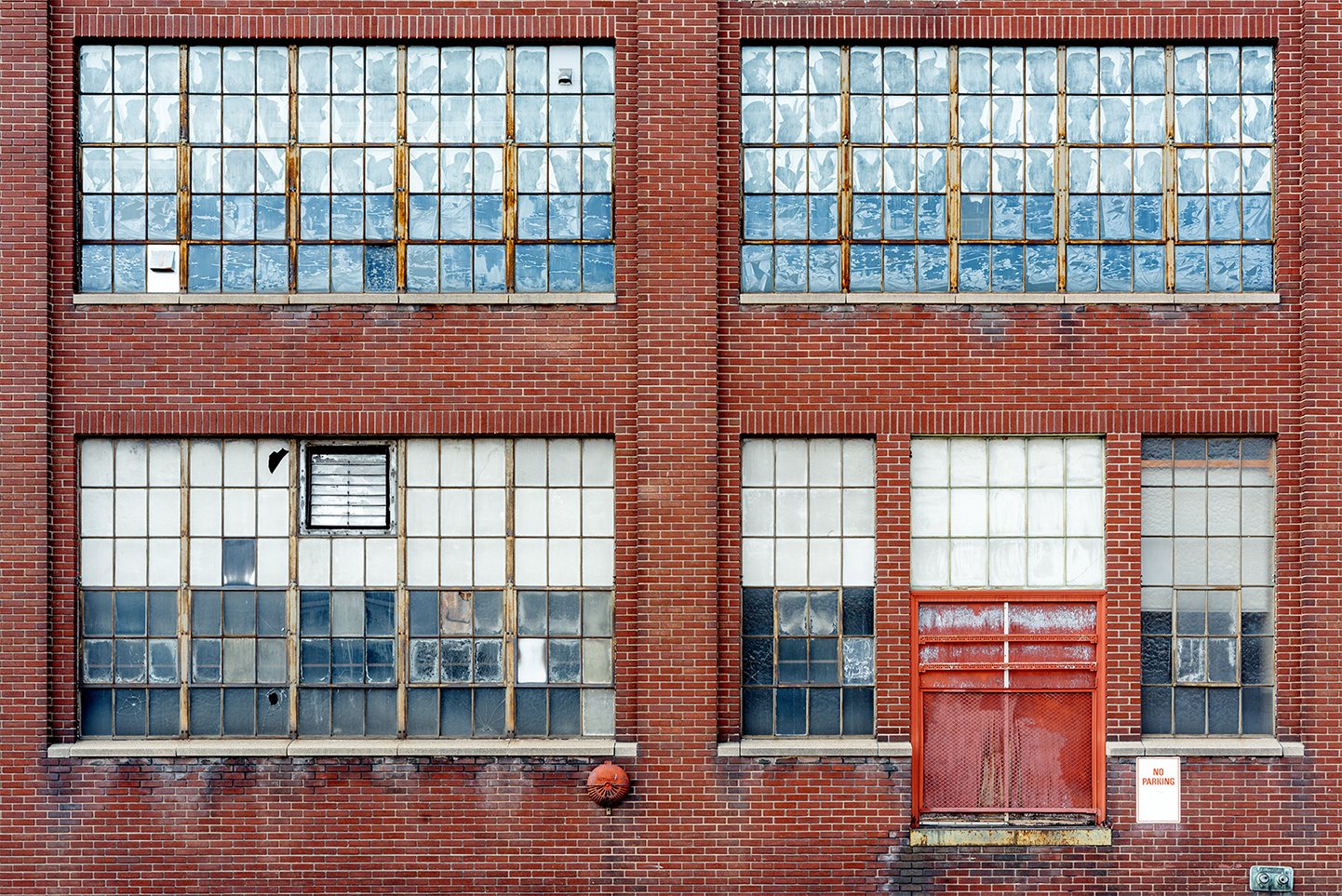
GoggleWorks Center for the Arts
Kevin LeDuc
GoggleWorks Center for the Arts, c. 2005 Willson Optical Manufacturing, c. 1871
Reading, Berks County, Pennsylvania from the Ballyshannon’s Rustland (2021–2024) – Flesh and Furnace Portfolio
Pigment print on Hahnemühle Baryta
Artist’s proof + edition of 5 (portfolio of 40 images)
30 × 45 inches
-
GoggleWorks Center for the Arts: A History of Adaptive Reuse in Reading, Pennsylvania
Introduction
The GoggleWorks Center for the Arts is one of the largest community arts campuses in the United States and a major example of adaptive reuse in post-industrial Pennsylvania. Located in downtown Reading, Berks County, the center occupies a former industrial complex originally built for the manufacture of optical safety equipment in the nineteenth century. Opened as an arts institution in 2005, GoggleWorks transformed a deindustrialized manufacturing site into a cultural and educational hub focused on visual arts, film, and community engagement.¹
The history of GoggleWorks reflects broader national trends in post-industrial redevelopment, particularly the conversion of former factory buildings into cultural institutions. Its establishment represents an effort to preserve industrial architecture while redefining its purpose for twenty-first-century civic and cultural life.
The Willson Goggle Factory and Industrial Origins (1871–2002)
The origins of the GoggleWorks campus date to 1871, when Thomas A. Willson & Co. established a factory at 2nd and Washington Streets in Reading. Founded by Gile J. Willson and Dr. Thomas A. Willson, the company produced optical lenses and early forms of industrial eye protection.²
During the late nineteenth and early twentieth centuries, the Willson company expanded significantly, becoming a leader in safety equipment manufacturing. Its products included protective goggles, respirators, and industrial safety gear designed for workers in steel mills, coal mines, and heavy manufacturing environments.³ The company later became known as Willson Products, Inc., and contributed to the development of national safety standards through organizations such as the National Safety Council.
By the mid-twentieth century, the factory remained an important industrial employer in Reading, although changes in manufacturing practices and occupational safety regulations gradually altered its production focus. In the 1980s, the company shifted toward respirators and protective equipment.⁴
In 2002, the facility—then operating under Dalloz Safety—was permanently closed, ending more than 130 years of continuous industrial production at the site.⁵ The closure reflected broader patterns of deindustrialization affecting manufacturing cities across the northeastern United States.
Redevelopment and Founding of GoggleWorks (2005)
Following the factory’s closure, civic and philanthropic leaders in Reading proposed a major redevelopment project to preserve the historic structure and repurpose it for public use. The project was led by community figures including Albert Boscov, Marlin Miller, and Irv Cohen, whose vision emphasized cultural revitalization through the arts.⁶
The GoggleWorks Center for the Arts officially opened in September 2005.⁷ The name “GoggleWorks” preserved the industrial identity of the original factory while signaling its new mission as an arts institution. The redevelopment converted the massive industrial complex into a multi-building campus containing studios, galleries, classrooms, performance spaces, and community facilities.
The project is widely regarded as one of the most significant examples of adaptive reuse in Pennsylvania, demonstrating how industrial architecture can be repurposed to serve educational and cultural functions.
Institutional Development and Expansion (2005–present)
Since its founding, GoggleWorks has expanded into a major cultural institution serving the Reading region and beyond. The campus includes artist studios, teaching spaces for ceramics, glass, metals, photography, printmaking, and woodworking, as well as exhibition galleries and a film theater.⁸ It also hosts community programs, youth education initiatives, and artist residencies.
The center quickly became a focal point for arts education in Berks County, serving thousands of students annually and attracting hundreds of thousands of visitors each year.⁹ Its programming emphasizes accessibility, with free admission and community-oriented events designed to integrate the arts into everyday civic life.
Leadership transitions in the 2010s further expanded programming and financial sustainability. Under executive leadership changes, the institution increased its focus on outreach, partnerships, and long-term endowment development.¹⁰
Urban Revitalization and Contemporary Role
In the twenty-first century, GoggleWorks has played a central role in the revitalization of downtown Reading. The campus has expanded beyond its original footprint through outdoor art installations, public gathering spaces, and new construction projects designed to integrate the center more fully into the urban environment.
Recent developments include outdoor arts spaces and expanded community programming aimed at increasing public engagement with the arts.¹¹ The institution continues to function as both a cultural destination and an economic driver within the city.
The adaptive reuse of the former Willson factory demonstrates how post-industrial cities have repurposed manufacturing infrastructure to support cultural economies. GoggleWorks stands as both a preservation of industrial heritage and a reinvention of urban space for contemporary needs.
Historical Significance
The significance of GoggleWorks lies in its dual identity as both an industrial relic and a modern cultural institution. Its physical structure preserves the architectural legacy of Reading’s manufacturing era, while its programming reflects a shift toward creative and educational economies.
As a case study in adaptive reuse, GoggleWorks illustrates how former industrial sites can be transformed into civic assets. It also highlights broader economic transitions in Pennsylvania, where manufacturing decline has been partially offset by investments in cultural infrastructure and creative industries.
The center’s continued growth underscores the importance of arts institutions in post-industrial urban redevelopment strategies.
Conclusion
Founded in 2005 within the historic Willson Goggle Factory complex, the GoggleWorks Center for the Arts represents a successful transformation of industrial space into a vibrant cultural institution. Its origins in nineteenth-century manufacturing, its closure in 2002, and its rebirth as an arts center in 2005 collectively reflect the broader economic and cultural shifts experienced by Reading, Pennsylvania.
Through adaptive reuse, community engagement, and sustained cultural programming, GoggleWorks has become a defining institution in Berks County. Its history demonstrates the enduring value of industrial heritage and the capacity of post-industrial cities to reinvent themselves through the arts.
Notes
GoggleWorks Center for the Arts, “About,” GoggleWorks.org, 2005–present.
National Register of Historic Places, “Thomas A. Willson and Co. Factory Nomination,” National Park Service, 2006.
Tom Rader, “History of Willson Safety Products,” Reading Industrial Heritage Review, 1998.
Occupational Safety and Health Administration records on industrial safety equipment manufacturing transitions, 1980–2000.
GoggleWorks Center for the Arts, “History of the Building,” institutional archive statement.
Reading Eagle archives on GoggleWorks redevelopment planning, 2003–2005.
GoggleWorks Center for the Arts, institutional founding records, 2005.
GoggleWorks Center for the Arts, “Campus and Studios Overview,” institutional materials.
Pennsylvania Arts Commission reports on cultural institutions in Berks County, 2010–2020.
Berks County cultural development reports and nonprofit financial summaries, 2015–2022.
Reading redevelopment planning documents and GoggleWorks expansion announcements, 2023–2025.
Bibliography
Berks County Cultural Development Office. Arts and Urban Revitalization in Reading, Pennsylvania. Reading, PA, 2020.
GoggleWorks Center for the Arts. Institutional Archives and History Statements. Reading, PA, 2005–present.
National Register of Historic Places. Thomas A. Willson and Company Factory Nomination Form. Washington, DC: National Park Service, 2006.
Occupational Safety and Health Administration. Industrial Safety Equipment Manufacturing Reports. Washington, DC, 1980–2000.
Pennsylvania Arts Commission. Cultural Infrastructure in Pennsylvania: A Regional Survey. Harrisburg, PA, 2018.
Reading Eagle. Articles on GoggleWorks Redevelopment and Cultural Planning. Reading, PA, 2003–2005.
Rader, Tom. History of Industrial Manufacturing in Reading. Reading Industrial Heritage Review, 1998.
Willson Products Corporate Records. Industrial Safety Equipment Manufacturing History. Reading, PA, 1900–1980.
-
Willson Optical Manufacturing and the Origins of the GoggleWorks Campus: A History of Industrial Safety Innovation in Reading, Pennsylvania
Introduction
The origins of the GoggleWorks campus in Reading, Berks County, Pennsylvania are rooted in the establishment of one of the earliest American industrial safety equipment manufacturers. The site’s history begins in 1871, when Thomas A. Willson & Co. founded a factory at 2nd and Washington Streets in Reading for the production of optical lenses and protective eyewear. Founded by Gile J. Willson and Dr. Thomas A. Willson, the enterprise emerged during a period of rapid industrial expansion in the United States, when increasing mechanization created new occupational hazards and a growing demand for worker safety equipment.¹
The company’s early focus on protective eyewear positioned it at the intersection of industrial manufacturing, medical science, and emerging labor safety practices. Over time, the Willson enterprise evolved into a nationally significant producer of industrial safety equipment, laying the foundation for what would eventually become the GoggleWorks Center for the Arts.
Founding of Thomas A. Willson & Co. (1871)
The establishment of Thomas A. Willson & Co. in 1871 reflected both local entrepreneurial activity in Reading and broader national industrial trends. Reading, located in southeastern Pennsylvania, was experiencing rapid growth as a manufacturing center supported by rail transportation, skilled labor, and access to regional raw materials.²
Gile J. Willson and Dr. Thomas A. Willson founded the company with a focus on optical lens production, initially serving both industrial and medical markets. Dr. Willson’s scientific background contributed to the company’s early emphasis on precision manufacturing and optical clarity, while Gile J. Willson oversaw industrial production and business development.³
The factory located at 2nd and Washington Streets became one of the earliest known American facilities dedicated specifically to protective eyewear. At a time when industrial accidents were common in ironworks, rail yards, and machine shops, the need for eye protection was increasingly recognized, though not yet widely regulated.
Industrial Safety and Early Product Development
During the late nineteenth century, industrialization dramatically increased workplace hazards. Flying debris, metal fragments, chemical exposure, and coal dust posed serious risks to workers in manufacturing environments.⁴ The Willson company responded to these conditions by developing early forms of protective goggles designed for use in industrial settings.
These early safety products represented an important innovation in occupational health. While rudimentary by modern standards, they provided a foundation for later developments in industrial safety equipment. The company’s products were particularly relevant to workers in Pennsylvania’s steel, coal, and railroad industries, where eye injuries were a frequent occupational hazard.
By the late nineteenth century, the company had expanded its product line beyond simple optical lenses to include reinforced glass goggles and protective frames designed for heavy industrial use.⁵ This diversification reflected both technological advancement and increasing market demand.
Expansion and Industrial Growth
As industrial activity expanded in Pennsylvania and across the United States, the Willson company grew in size and influence. The firm became closely associated with the emerging field of occupational safety, which was beginning to receive attention from reformers, physicians, and industrial engineers.
By the early twentieth century, the company had established itself as a leading manufacturer of safety equipment. Its products were used in steel mills, mining operations, chemical plants, and other hazardous industries.⁶ The company’s growth mirrored broader national trends in industrial regulation and workplace safety reform.
The factory at 2nd and Washington Streets remained central to production, even as the company expanded its distribution networks and corporate structure. Reading’s transportation connections, including rail links to Philadelphia, New York, and Pittsburgh, facilitated national distribution of its products.
Scientific and Industrial Significance
The work of Dr. Thomas A. Willson contributed to the scientific credibility of the company’s products. His involvement in optical design and lens manufacturing helped establish the firm’s reputation for precision and reliability.⁷ The integration of scientific knowledge with industrial production was characteristic of late nineteenth-century manufacturing enterprises that increasingly relied on technical expertise.
The company’s development of protective eyewear also reflected changing attitudes toward labor and safety. While early industrial capitalism often accepted workplace injury as inevitable, the emergence of safety equipment manufacturers signaled a shift toward prevention and mitigation of occupational hazards.
Transition Toward Modern Safety Manufacturing
During the twentieth century, the company evolved into a major national producer of industrial safety equipment. Its product lines expanded to include respirators, gas masks, and advanced protective gear used in military and industrial contexts.⁸
This transformation reflected both technological innovation and changing regulatory environments. The establishment of federal and state labor protections increased demand for standardized safety equipment, and the company adapted to meet these requirements.
Despite these changes, the original factory site in Reading remained central to its identity and production history. The facility expanded over time into a large industrial complex that would later become the GoggleWorks campus.
Historical Significance
The founding of Thomas A. Willson & Co. in 1871 represents an important moment in the history of industrial safety in the United States. The company’s early focus on protective eyewear placed it among the pioneers of occupational health manufacturing.
Its operations in Reading contributed to the city’s development as a manufacturing center and linked it to broader national trends in industrialization, labor reform, and technological innovation. The company’s legacy extends beyond its products to its role in shaping early safety standards for industrial workers.
The transformation of its original factory site into the GoggleWorks Center for the Arts in the twenty-first century preserved this industrial heritage while repurposing the space for cultural and educational use.
Conclusion
Founded in 1871, Thomas A. Willson & Co. played a foundational role in the development of industrial safety equipment in the United States. Through its production of optical lenses and early protective eyewear, the company addressed the growing hazards of industrial labor during the nineteenth century.
Its legacy, rooted in scientific innovation and industrial manufacturing, continued through successive corporate transformations and ultimately became embedded in the physical and cultural landscape of Reading, Pennsylvania. The survival of its factory structure as part of the GoggleWorks campus ensures that this early chapter in industrial safety history remains part of the city’s ongoing narrative.
Notes
Reading industrial incorporation records, Berks County Historical Society archives, 1871.
E. Digby Baltzell, Puritan Philadelphia and the Rise of American Industry (Philadelphia: University of Pennsylvania Press, 1979), 212–215.
Berks County manufacturing census records, 1870–1880.
David Rosner and Gerald Markowitz, Deadly Dust: Silicosis and the Politics of Occupational Disease (Princeton: Princeton University Press, 1991), 14–18.
Occupational safety equipment trade catalogs, Pennsylvania Industrial Museum collections.
Judith A. McGaw, Most Wonderful Machine: Mechanization and Social Change in Berkshire Manufacturing (New York: Norton, 1987), 233–236.
Biographical records of Dr. Thomas A. Willson, Berks County Medical Society archives.
U.S. Department of Labor, Historical Development of Industrial Safety Equipment Standards, Washington, DC, 1930–1950.
Bibliography
Baltzell, E. Digby. Puritan Philadelphia and the Rise of American Industry. Philadelphia: University of Pennsylvania Press, 1979.
Berks County Historical Society. Industrial Manufacturing Records, 1870–1900. Reading, PA.
McGaw, Judith A. Most Wonderful Machine: Mechanization and Social Change in Berkshire Manufacturing. New York: Norton, 1987.
Occupational Safety Equipment Trade Catalogs. Pennsylvania Industrial Museum Collections.
Rosner, David, and Gerald Markowitz. Deadly Dust: Silicosis and the Politics of Occupational Disease. Princeton: Princeton University Press, 1991.
U.S. Department of Labor. Historical Development of Industrial Safety Equipment Standards. Washington, DC, 1930–1950.
Willson Company Corporate Records. Early Manufacturing and Optical Product Development. Reading, PA, 1871–1920.