Affordable Housing Project
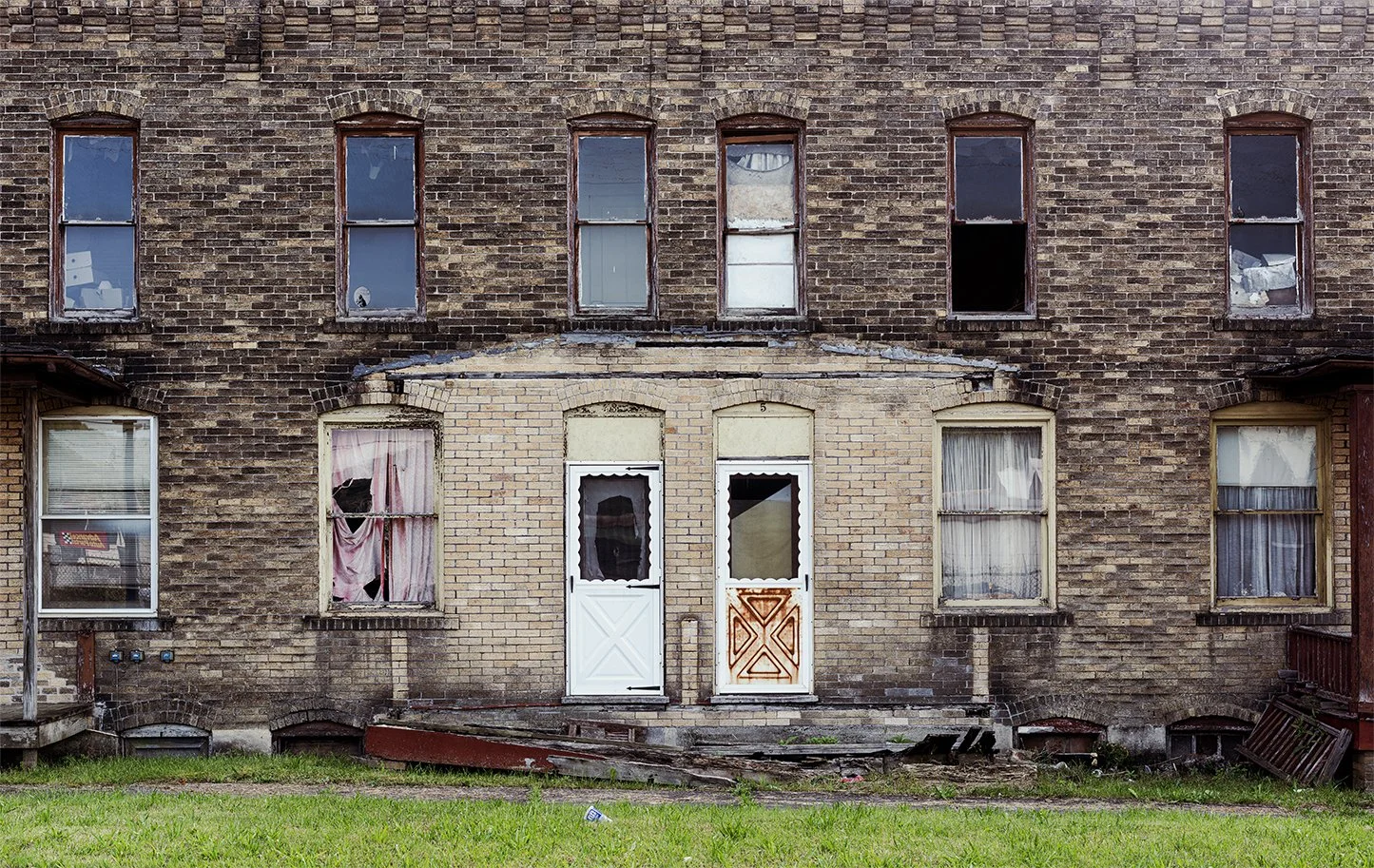
Affordable Housing Project
Kevin LeDuc
Affordable Housing Project
McKeesport, Allegheny County, Pennsylvania from the Ballyshannon’s Rustland (2021–2024) – Flesh and Furnace Portfolio
Pigment print on Hahnemühle Baryta
Artist’s proof + edition of 5 (portfolio of 40 images)
30 × 45 inches
-
Public Housing, Industrial Decline, and Urban Reconfiguration: Affordable Housing Projects in McKeesport, Allegheny County, Pennsylvania
Affordable housing projects in McKeesport, Pennsylvania, emerged from the intersection of industrial labor demand, mid-twentieth-century federal housing policy, and the later collapse of the Mon Valley steel economy. Rather than a single development with a singular founding moment, “affordable housing” in McKeesport refers to a system of publicly supported housing sites, subsidized redevelopment units, and later housing authority projects that collectively reshaped the city’s residential geography. These developments are inseparable from McKeesport’s identity as a once-dominant steel town along the Monongahela River that underwent rapid deindustrialization after the 1970s.
In McKeesport, affordable housing is not simply a policy outcome—it is a spatial response to industrial contraction, population loss, and long-term fiscal restructuring.
I. Industrial McKeesport and the Demand for Dense Housing
McKeesport developed in the nineteenth and early twentieth centuries as a major steel-producing center in the Mon Valley. Located at the confluence of the Monongahela and Youghiogheny Rivers, the city became a critical site for mills, rail transport, and river shipping infrastructure.¹
By the early 1900s, the National Tube Works and other steel-related industries had made McKeesport one of the most densely populated industrial cities in the region. Housing was tightly packed near mills, with immigrant workers from Eastern and Southern Europe forming distinct neighborhoods organized around churches, ethnic clubs, and labor networks.²
This industrial growth created chronic housing pressure, with overcrowding and poor sanitation conditions common in working-class districts. These conditions later became central justifications for federal housing intervention.
II. Federal Housing Policy and the Emergence of Public Housing
The modern concept of “affordable housing projects” in McKeesport originates in New Deal and post–World War II federal housing programs, particularly the U.S. Housing Act of 1937, which authorized public housing development for low-income populations.
In McKeesport, the Housing Authority of the City of McKeesport (HACM) was established to implement federally funded housing projects.³ Early developments were designed to address:
Overcrowded industrial-era housing stock
Substandard sanitation and infrastructure
Housing shortages during wartime and postwar industrial expansion
Public housing in McKeesport was initially intended to support industrial workers, reinforcing rather than replacing the city’s manufacturing economy.
III. Construction and Expansion of Housing Projects
By the mid-twentieth century, McKeesport saw the construction of multiple federally supported housing developments. These included mid-rise apartment complexes and scattered-site housing units designed to replace deteriorating industrial-era housing.
Key characteristics of these developments included:
Standardized architectural design for cost efficiency
Concentration in flat river-adjacent or previously cleared industrial land
Proximity to remaining employment centers and transit routes
Administration by the local housing authority under federal guidelines
These projects represented a shift from privately built working-class housing to state-supported urban residential infrastructure.
IV. Deindustrialization and the Transformation of Housing Function
Beginning in the 1970s, McKeesport experienced severe industrial decline as steel production in the Mon Valley collapsed under global competition and technological restructuring. Major employers closed or downsized, leading to widespread unemployment.⁴
This economic shift fundamentally altered the role of affordable housing:
Originally: support for industrial workforce stability
After deindustrialization: support for displaced and low-income populations
As employment opportunities diminished, public housing units increasingly housed elderly residents, unemployed workers, and families affected by regional economic decline.
This transformation marked a shift from industrial support infrastructure to social safety net infrastructure.
V. Urban Concentration, Vacancy, and Policy Reform
By the late twentieth century, McKeesport faced significant population loss and housing vacancy. In response, federal housing policy shifted toward:
Section 8 housing vouchers
Scattered-site redevelopment strategies
Demolition of severely deteriorated housing blocks
Mixed-income redevelopment initiatives
Some older housing projects were partially demolished or restructured, reflecting broader national trends in public housing reform during the HOPE VI era in the 1990s and early 2000s.⁵
These reforms aimed to reduce concentrated poverty while integrating subsidized housing into broader neighborhood structures.
VI. Spatial Geography of Affordable Housing in McKeesport
Affordable housing developments in McKeesport are closely tied to the city’s geography. The river valley setting constrains expansion and concentrates development along flat industrial corridors.
Key spatial features include:
Housing clusters near former steel and manufacturing zones
Steep hillside neighborhoods surrounding the river basin
Proximity to transportation corridors linking McKeesport to Pittsburgh
Adaptive reuse of former industrial or institutional land
This geography reinforces the long-standing relationship between industry, infrastructure, and housing in the Mon Valley.
VII. Neighborhood Insight: The Layered Industrial-to-Housing Landscape
One of the most interesting features of McKeesport is its layered urban transition from industrial production to subsidized residential infrastructure. Unlike suburban areas where housing expands outward, McKeesport’s affordable housing exists within a compact industrial footprint.
This creates a distinctive neighborhood pattern:
Former mill districts converted into residential or vacant land
Public housing integrated into older industrial street grids
Churches and fraternal halls persisting as cultural anchors
Rail corridors and riverfront zones shaping neighborhood boundaries
The result is a city where housing policy is physically embedded in the remains of industrial capitalism, producing a landscape where public housing developments often sit directly adjacent to abandoned or repurposed industrial sites.
Conclusion
Affordable housing in McKeesport is best understood not as a single project but as a long historical process linking industrial expansion, federal intervention, and postindustrial decline. Originally designed to stabilize a booming steel workforce, public housing evolved into a critical infrastructure of survival in a city reshaped by deindustrialization.
Today, these housing systems remain central to McKeesport’s urban identity, reflecting both the persistence of federal housing policy and the long afterlife of industrial urbanism in the Mon Valley.
Footnotes (Chicago Style)
U.S. Census Bureau, historical industrial and demographic data for McKeesport, PA.
Allegheny County Historical Society, Immigration and Steel Industry Communities in the Mon Valley.
U.S. Department of Housing and Urban Development, Housing Authority of the City of McKeesport establishment records.
Pennsylvania Department of Labor and Industry, Steel Industry Decline in Western Pennsylvania.
U.S. Department of Housing and Urban Development, HOPE VI Program documentation and redevelopment reports.
Bibliography
Allegheny County Historical Society. Industrial Communities of the Mon Valley.
Pennsylvania Department of Labor and Industry. Steel Industry Employment Decline Reports.
U.S. Census Bureau. Historical Population and Housing Data: McKeesport, PA.
U.S. Department of Housing and Urban Development. Public Housing Authority Records and HOPE VI Reports.
Interesting Neighborhood Insight
A defining feature of McKeesport is that public housing developments were often constructed directly on or near former industrial land, meaning that subsidized residential life occupies the same spatial footprint once used for steel production and rail logistics. This creates a rare urban condition in which the geography of industrial capitalism and the geography of social welfare overlap almost exactly, producing neighborhoods where the built environment visibly layers two different economic eras on top of each other.