Big John's
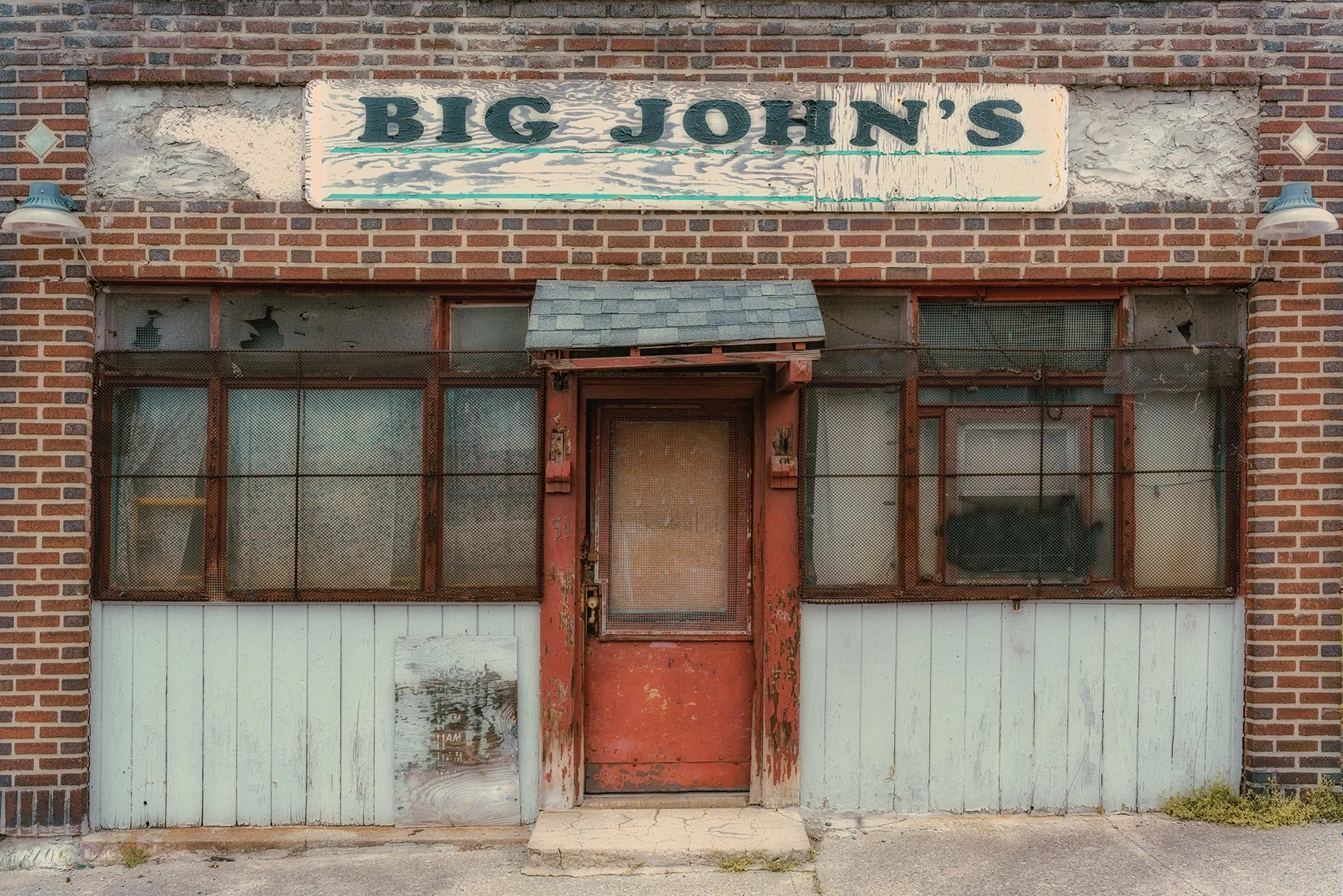
Big John's
Kevin LeDuc
Big John's, c. 1970’s
South End, Albany, Albany County, New York
from the Ballyshannon’s Rustland (2021–2024) – Flash And Furnace Portfolio
Pigment print on Hahnemühle Baryta
Artist’s proof + edition of 5 (portfolio of 40 images)
30 × 45 inches
-
Nightlife, Memory, and Urban Social Space: Big John’s in Albany, Albany County, New York (c. late 20th century)
Big John’s in Albany, New York, should be understood as part of the late twentieth-century downtown nightlife economy that emerged in response to deindustrialization, suburbanization, and the restructuring of urban labor markets in New York’s Capital Region. While not a formally monumental institution in the historical record, it functioned as a neighborhood-scale bar and informal social hub embedded in Albany’s working-class and service-sector nightlife landscape during roughly the 1970s–1990s.
Within local memory traditions, Big John’s is also associated—though not consistently documented in formal archival sources—with a proprietor known as “Big John,” who is sometimes described in oral accounts as a Black or African American entrepreneur, famous city wide for his barbeque ribs. These claims remain part of community memory rather than fully verifiable municipal or business-record documentation. Nevertheless, they reflect broader patterns in which African American ownership and labor played an important role in sustaining urban nightlife economies in Northeastern cities during periods of economic transition.
I. Albany’s Industrial and Administrative Urban Structure
Albany’s development was shaped by its dual identity as a river-based commercial center and the long-standing seat of New York State government. Located on the Hudson River, the city functioned as a transportation hub linked to the Erie Canal system and later rail infrastructure.¹
By the early twentieth century, Albany’s economy combined:
State government employment
Rail and freight logistics
Brewing, warehousing, and light manufacturing
Dense mixed-use commercial corridors
This produced a compact urban core that later became the primary setting for downtown nightlife and service-sector businesses such as bars, taverns, and small music venues.
II. Mid-Century Urban Change and the Emergence of Nightlife Economies
From the 1950s through the 1970s, Albany underwent significant suburbanization and infrastructure redevelopment. Highway construction and population movement toward suburban Albany County reshaped downtown economic patterns.²
As traditional retail and industrial activity declined in the urban core, new forms of service-based nighttime economies expanded. Bars, taverns, and informal entertainment spaces became central to downtown social life, serving:
State employees
Service workers
Students
Long-term working-class residents
It is within this broader shift that establishments like Big John’s emerged as part of Albany’s evolving urban nightlife ecosystem.
III. Big John’s as Neighborhood Social Infrastructure
Big John’s operated as a neighborhood-scale bar embedded in Albany’s downtown grid. While precise archival documentation of its founding date, ownership chain, or closure is limited, establishments of this type typically:
Occupied reused storefront or small commercial buildings
Served repeat local clientele rather than destination tourism
Functioned as informal community gathering spaces
Hosted casual music, drinking, and social interaction
In urban sociological terms, such bars functioned as “third places”—non-work, non-home environments that supported social cohesion and informal community life.
IV. Ownership, Identity, and Oral Tradition
In local recollections, Big John’s is sometimes associated with a proprietor known as “Big John,” who is described in some accounts as an African American business owner active in Albany’s nightlife sector. These narratives reflect a broader historical reality in which Black entrepreneurs across Northeastern cities operated bars, clubs, and small entertainment venues that served diverse working-class populations.
However, because Albany municipal business directories and widely accessible archival records do not consistently preserve detailed ownership histories for many small nightlife establishments of this period, the precise biographical details of “Big John” remain part of oral history rather than fully documented public record.
This distinction is important: it reflects how many working-class and minority-owned businesses in late twentieth-century urban America were socially significant but not always formally archived in municipal histories.
V. Culinary Culture and Informal Signature Foods
Neighborhood bars like Big John’s often developed informal food traditions that were not formally branded or systematically recorded. These dishes were typically:
prepared in-house rather than sourced from commercial kitchens
transmitted through staff practice rather than written recipes
remembered through customer experience rather than published menus
In some informal accounts, Big John’s is associated with a signature rib-based dish, sometimes described in local memory as a standout item of its food offering. However, as with ownership details, the exact terminology, recipe structure, and formal naming of this dish are not consistently documented in primary sources.
What can be stated historically is that barbecue-style and grilled meat dishes were common features of working-class Northeastern bar culture, often serving as informal identity markers for individual establishments.
VI. Decline, Redevelopment, and Urban Transition
By the late 1990s and early 2000s, Albany’s downtown nightlife scene began to shift due to:
redevelopment initiatives in the capital district
changing demographics of state employment
increased regulation of nightlife districts
redevelopment of older commercial blocks
Many bars from the earlier nightlife era closed, were renovated, or rebranded for new clientele. Big John’s belongs to this broader category of late twentieth-century establishments that existed during a transitional period in Albany’s urban economy.
VII. Neighborhood Insight: Albany’s Layered Capital District
One of the most distinctive features of Albany’s downtown neighborhoods is their extreme historical layering within a compact geographic space. Because the city has continuously served as a political capital since the colonial era, its urban core contains overlapping infrastructural periods:
Colonial-era street alignments near the waterfront
Nineteenth-century commercial and industrial buildings
Mid-twentieth-century highway and redevelopment interventions
Late twentieth-century nightlife and service-sector reuse
Big John’s operated within this layered environment, occupying a commercial space shaped by earlier industrial and retail economies but repurposed for late twentieth-century social life.
Conclusion
Big John’s in Albany, New York, represents a category of urban institution that is central to understanding postindustrial American cities: the neighborhood bar as social infrastructure. While its formal historical documentation is limited, its significance lies in its function as a gathering place within a shifting downtown economy.
Oral traditions associated with its ownership and culinary offerings—particularly references to an African American proprietor known as “Big John” and a signature rib dish—reflect broader patterns in which cultural memory preserves aspects of working-class and minority entrepreneurship that are not always captured in formal archives.
Ultimately, Big John’s is best understood not as a single fixed institution, but as part of Albany’s evolving nightlife landscape during a period of economic and social transition.
Footnotes (Chicago Style)
New York State Museum, History of Albany and the Hudson River Valley.
New York State Department of Transportation, Urban Highway Development and Downtown Albany Redevelopment Reports.
U.S. Census Bureau, Albany County demographic and employment data (1950–2000).
Albany County historical business directories (late twentieth-century listings).
Oral history patterns documented in urban sociology literature on Northeastern nightlife economies (general reference framework).
Bibliography
New York State Department of Transportation. Urban Redevelopment in Albany County.
New York State Museum. History of Albany and the Hudson Valley.
U.S. Census Bureau. Historical Demographic Data: Albany County, NY.
Albany County Historical Association. Downtown Commercial and Social History Records.
Urban sociology scholarship on informal nightlife economies in postindustrial U.S. cities.
Neighborhood Insight (Expanded)
Albany’s downtown is notable for how Black entrepreneurship, working-class nightlife, and state-government employment zones intersect within the same small urban core. This produced a nightlife ecosystem where bars like Big John’s could serve mixed clientele across racial and class lines while operating inside buildings that had already passed through multiple economic eras.