Rab's Garage
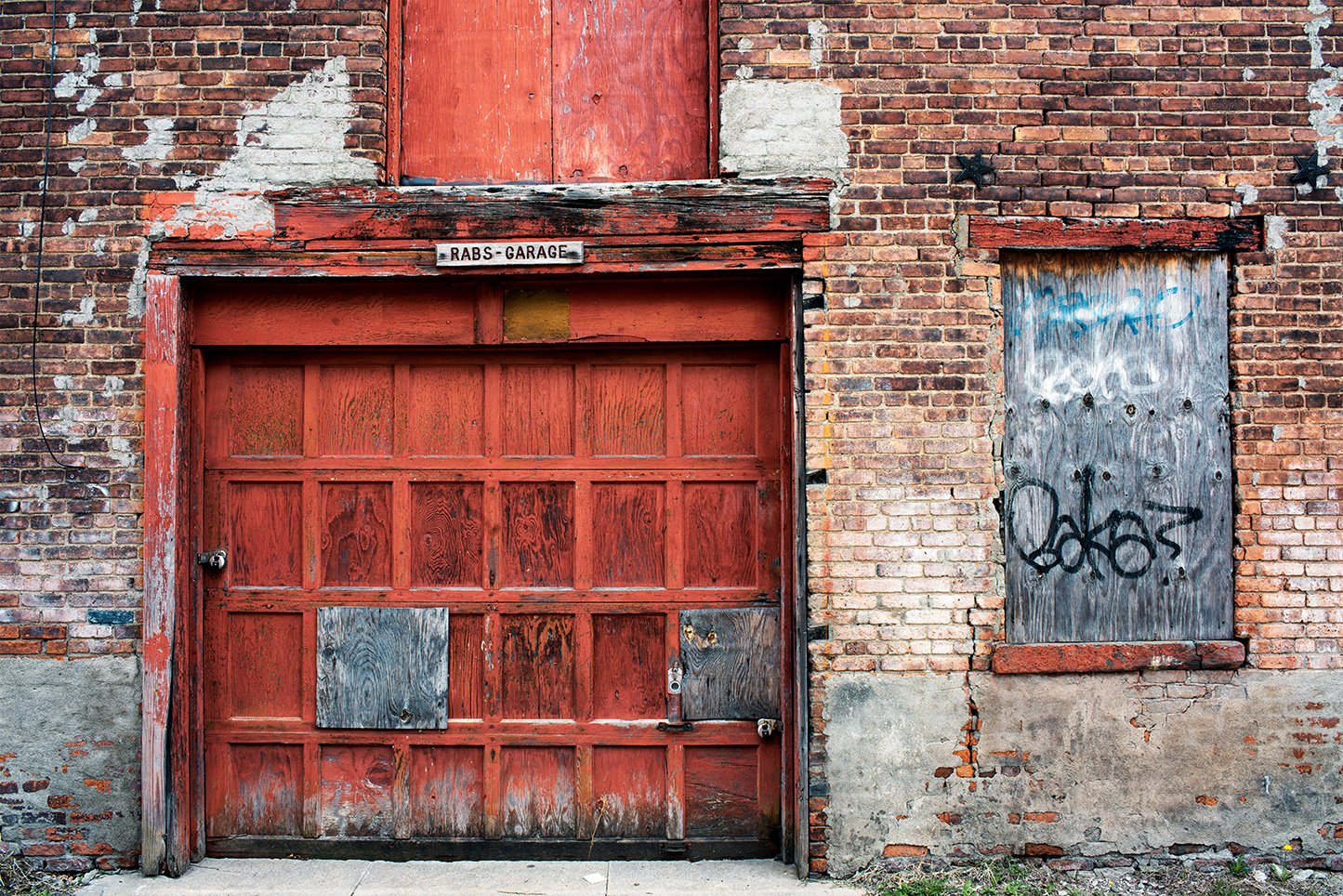
Rab's Garage
Kevin LeDuc
Rab’s Garage, c. 1970’s
Troy, Rensselaer County, New York from the Ballyshannon’s Rustland (2021–2024) – Flesh and Furnace Portfolio
Pigment print on Hahnemühle Baryta
Artist’s proof + edition of 5 (portfolio of 40 images)
30 × 45 inches
-
Automotive Infrastructure and Small-City Commercial Life: The History of Rab’s Garage in Troy, Rensselaer County, New York
Rab’s Garage in Troy, New York, represents a category of American urban infrastructure often overlooked in formal histories of cities: the neighborhood-scale automobile repair shop. Situated in a city shaped by nineteenth-century textile manufacturing, ironworks, and river commerce, Rab’s Garage reflects the twentieth-century transformation of Troy’s urban economy from industrial production to dispersed service and maintenance labor. Its history is inseparable from the broader evolution of the Capital Region’s transportation networks, suburbanization patterns, and the changing material culture of automobile ownership.
Unlike major industrial plants or civic institutions, small garages such as Rab’s functioned as “micro-infrastructures” of urban life—spaces where transportation systems were repaired, local knowledge circulated, and neighborhood economies were sustained. In Troy, a city long defined by its dense mixed-use blocks and walkable street grid, these garages became essential intermediaries between industrial-era urban form and automobile-era mobility.
I. Troy’s Industrial Urban Foundation
Troy developed in the nineteenth century as one of the most important manufacturing centers in New York State, particularly known for textile production, ironworks, and collar and shirt manufacturing.¹ Its location along the Hudson River and near the confluence with the Mohawk River system made it a key node in regional transportation and commerce.
By the late nineteenth century, Troy’s urban form was characterized by dense rowhouse neighborhoods, streetcar lines, and mixed industrial-commercial corridors. Unlike later suburbanized cities, Troy maintained a tightly integrated relationship between housing, industry, and small-scale retail. This urban structure later proved significant in the development of neighborhood automotive services, including repair garages embedded within residential and commercial blocks.
II. The Rise of the Automobile and Neighborhood Garages
The widespread adoption of the automobile in the early twentieth century fundamentally altered Troy’s built environment. As streetcars declined and car ownership expanded after the 1920s, new infrastructure demands emerged: fuel stations, repair shops, and parts suppliers became essential components of urban life.
Garages such as Rab’s emerged in this context as locally owned, neighborhood-scale repair facilities. While large dealerships and regional service centers existed, smaller garages provided:
Routine maintenance and repairs
Informal diagnostics and mechanical advice
Tire, exhaust, and brake services
Emergency roadside assistance
These businesses were often embedded in residential blocks or small commercial strips, reflecting Troy’s existing urban density.²
III. Rab’s Garage and the Local Service Economy
Rab’s Garage, located in Troy’s urban grid (historically associated with the city’s North or East Side residential-industrial corridors), functioned as a typical mid-to-late twentieth-century independent auto repair shop. While specific founding documentation is limited in public archival records, garages of this type in Troy generally emerged between the 1940s and 1970s, during the postwar expansion of automobile ownership and the decentralization of industrial employment.³
These garages were often family-owned or independently operated, relying on:
Long-term neighborhood clientele
Informal reputation networks
Proximity to residential streets
Adapted industrial or warehouse-style buildings
Rab’s Garage fits within this broader typology of small urban repair businesses that sustained local mobility in older industrial cities during the decline of streetcar systems and heavy manufacturing employment.
IV. Deindustrialization and Urban Adaptation in Troy
By the mid-to-late twentieth century, Troy experienced the decline of its traditional manufacturing base. Textile mills and related industries either closed or relocated, resulting in population loss and economic restructuring.⁴
However, unlike entirely abandoned industrial cities, Troy retained a significant portion of its built environment and residential density. In this context, small businesses like Rab’s Garage became part of a transitional urban economy characterized by:
Service-based labor replacing industrial production
Adaptive reuse of older industrial and commercial buildings
Continued reliance on automobiles for regional commuting
Persistence of neighborhood-scale commerce
Garages remained particularly important because they supported the mobility required in a post-industrial regional economy increasingly dependent on commuting to Albany, Schenectady, and surrounding suburbs.
V. Urban Form and the Neighborhood Ecology of Troy
Troy’s neighborhood structure is one of its most distinctive features. Unlike many postindustrial cities that experienced suburban sprawl, Troy retained a compact urban grid with walkable neighborhoods and closely spaced commercial corridors.
Rab’s Garage operated within this environment, where:
Residential blocks were often adjacent to commercial workshops
Mixed-use zoning emerged informally through historical land use
Former industrial buildings were repurposed for small businesses
Automobile infrastructure integrated into dense urban streets rather than isolated suburban strips
This created a hybrid urban form in which nineteenth-century industrial density and twentieth-century automobile culture coexisted.
VI. The Contemporary Condition of Small Urban Garages
In the present era, many independent garages in cities like Troy face economic pressure from:
Corporate auto service chains
Increasing vehicle technological complexity
Rising property values in redeveloping urban cores
Shifts toward suburban automotive infrastructure
Nevertheless, garages such as Rab’s remain culturally significant as remnants of a more localized and mechanically intimate economy, where repair knowledge was often transmitted informally and embedded in neighborhood relationships.
VII. Neighborhood Insight: Troy’s Layered Industrial Grid
One of the most interesting aspects of Troy’s neighborhoods is their layered continuity of industrial-era infrastructure within a modern service economy. Unlike cities that demolished older industrial and commercial buildings, Troy retains a high degree of architectural continuity.
In many neighborhoods:
Former industrial buildings now house small businesses, studios, or garages
Residential brownstones sit within blocks originally designed for factory workers
Street patterns reflect nineteenth-century industrial planning rather than modern suburban design
This creates a “stacked history” effect in which automotive infrastructure like Rab’s Garage exists not as an external suburban service node but as part of a continuous urban fabric stretching back to Troy’s industrial peak.
Conclusion
Rab’s Garage in Troy, New York, represents more than a local automotive repair business. It is part of a broader historical transformation in which industrial cities adapted to the rise of automobile culture and the decline of manufacturing. Embedded within Troy’s dense urban grid, such garages functioned as essential infrastructure for mobility in a post-industrial economy.
Its significance lies in its scale: not monumental, but ordinary; not industrial in the nineteenth-century sense, but infrastructural in the twentieth-century sense. In cities like Troy, these small garages form the connective tissue between industrial past and postindustrial present.
Footnotes (Chicago Style)
New York State Museum, Industrial Development of Troy and the Upper Hudson Valley.
Rensselaer County historical transportation and urban development summaries.
U.S. Census Bureau, mid-twentieth-century occupational and transportation data for Troy, NY.
New York State Department of Labor, Manufacturing Decline in the Capital Region.
Bibliography
New York State Museum. Industrial Development of Troy and the Hudson Valley.
New York State Department of Labor. Manufacturing Employment Trends in the Capital Region.
Rensselaer County Historical Society. Urban Development and Transportation in Troy.
U.S. Census Bureau. Historical Population and Employment Data: Troy, New York.
Interesting Neighborhood Insight (Expanded)
A particularly notable feature of Troy is that its nineteenth-century industrial grid remains unusually intact, meaning that modern businesses like auto garages, cafés, and studios often operate inside buildings originally constructed for manufacturing or warehouse use. This creates a rare urban condition where the physical infrastructure of the industrial revolution was never fully erased—only repurposed—allowing contemporary service economies to function inside a continuous historical shell of industrial architecture.