St. John's Roman Catholic Church
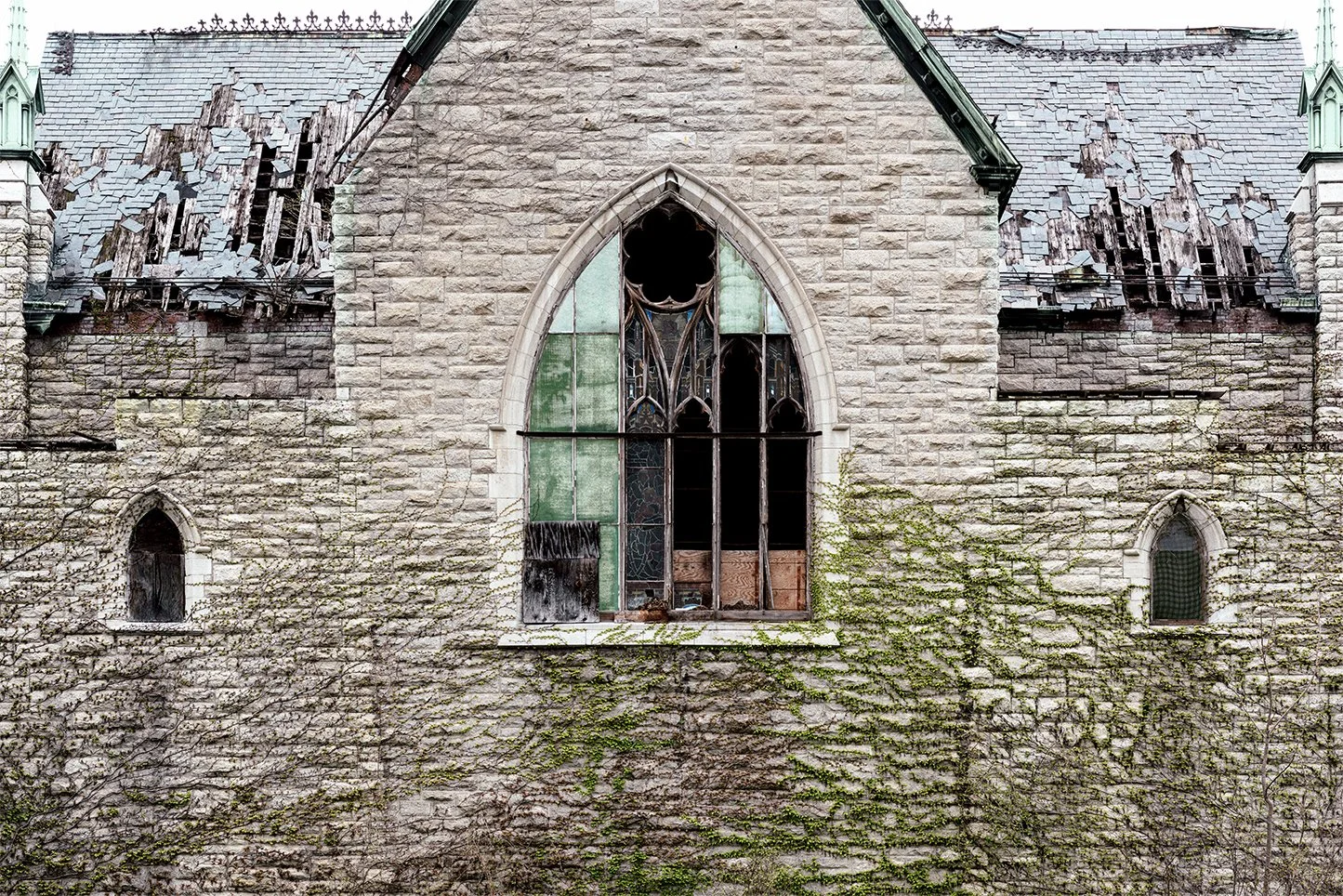
St. John's Roman Catholic Church
Kevin LeDuc
St. John's Roman Catholic Church, c. 1837
South End (Pastures) neighborhood, Albany,Albany County, New York from the Ballyshannon’s Rustland (2021–2024) – Flesh and Furnace Portfolio
Pigment print on Hahnemühle Baryta
Artist’s proof + edition of 5 (portfolio of 40 images)
30 × 45 inches
-
St. John's Roman Catholic Church, Albany, New York: A Historical Narrative
Introduction
The former St. John's Roman Catholic Church at 133 Green Street in Albany, New York, occupies a significant place in the religious and social history of the city. Located in Albany's historic Pastures neighborhood, the parish served generations of working-class Catholics, primarily of Irish descent, whose lives were closely connected to the commercial and industrial activity of the Hudson River waterfront. Established during the rapid growth of Albany's Catholic population in the nineteenth century, St. John's reflected both the expansion of immigrant communities and the central role of parish institutions in urban life.
Founding of the Parish
St. John's Parish was established in 1837 as one of the earliest Roman Catholic congregations in Albany outside of St. Mary's Church, the city's first Catholic parish. The creation of the parish was prompted by the substantial increase in Irish immigration to Albany during the first half of the nineteenth century. As canal construction, railroad development, and river commerce expanded, immigrant laborers settled in neighborhoods near the city's waterfront, creating a demand for additional Catholic churches and schools.¹
The parish quickly became a focal point for Catholic residents living in the southern portion of Albany. Like many urban parishes of the period, St. John's functioned as more than a place of worship. It provided education, charitable assistance, social activities, and a strong sense of communal identity for immigrant families adapting to life in the United States.
The Pastures Neighborhood
The history of St. John's cannot be separated from the development of Albany's Pastures district. Originally common grazing land during the colonial era, the neighborhood gradually transformed into a densely settled residential district during the nineteenth century. By the 1840s and 1850s, the area had become home to large numbers of Irish immigrants employed on the Erie Canal, the Hudson River docks, railroads, warehouses, and related industries.²
The neighborhood developed a reputation as a working-class enclave characterized by row houses, tenements, small businesses, and religious institutions. Catholic churches such as St. John's served as stabilizing institutions within a community often facing economic hardship and social discrimination. Parish records, census schedules, and city directories indicate that many residents worked in occupations connected to transportation, manufacturing, and laboring trades.
Construction of the Present Church
The present church building was constructed between 1903 and 1908. Designed by Albany architect Charles Ogden, the structure replaced an earlier parish church and reflected the aspirations of a congregation that had become well established within the city.³
Architecturally, the building represented a significant investment by the parish. Unlike many nineteenth-century churches built entirely of masonry, St. John's utilized a steel-frame structural system covered by stone and masonry exterior walls. This modern engineering approach provided greater structural stability and allowed for a larger interior space. Historical accounts suggest that the completed structure was smaller than originally proposed, likely reflecting financial limitations encountered during construction.⁴
The church's design demonstrated the confidence of Albany's Catholic community during the early twentieth century, a period when Catholic institutions throughout the city were expanding schools, convents, and parish facilities.
Parish Life in the Twentieth Century
During the first half of the twentieth century, St. John's remained an important religious center for residents of the Pastures and nearby South End neighborhoods. The parish sponsored religious societies, educational programs, charitable organizations, and social events that strengthened community ties.
Although precise membership figures require examination of diocesan records, the parish served hundreds of families during its peak decades. Baptisms, marriages, funerals, and religious festivals marked the rhythms of neighborhood life. The church also reflected broader changes in Albany's Catholic population as newer immigrant groups joined communities originally dominated by Irish Americans.
The parish school and associated organizations provided educational and social opportunities for generations of local residents. Such institutions reinforced the role of the parish as the center of neighborhood identity.
Decline and Closure
Following World War II, demographic changes significantly altered the neighborhood. Population movement to suburban communities reduced the number of residents living within the parish boundaries. At the same time, urban renewal projects transformed large portions of Albany's South End and downtown districts.
The construction of the Empire State Plaza during the 1960s displaced thousands of residents and accelerated changes already underway in the surrounding neighborhoods. As population declined, many urban parishes experienced financial difficulties and shrinking congregations. St. John's was among the churches affected by these trends.⁵
By the 1970s the parish had ceased functioning as an active congregation, and the church building was closed. The structure subsequently stood vacant for decades.
Preservation and Contemporary Significance
Despite prolonged abandonment, the church survives as one of Albany's most recognizable historic religious structures. Preservation advocates have frequently cited the building as an important example of early twentieth-century ecclesiastical architecture and as a symbol of the city's immigrant past.
The steel-frame construction that distinguished the building at the time of its construction has contributed significantly to its survival. Although numerous redevelopment proposals have been advanced, including residential and mixed-use conversions, the costs associated with rehabilitation have complicated preservation efforts.
Today the former St. John's Church remains a landmark within Albany's historic urban landscape. Its presence recalls the experiences of generations of immigrant families whose labor contributed to the growth of the city and whose religious institutions helped shape neighborhood identity.
Conclusion
The history of St. John's Roman Catholic Church reflects larger patterns in the development of Albany and American urban Catholicism. Founded in 1837 to serve a growing immigrant population, the parish became a central institution within the Pastures neighborhood and remained active for more than a century. The construction of the present church between 1903 and 1908 symbolized the maturity and confidence of the congregation, while its later decline mirrored demographic shifts that transformed many northeastern cities during the twentieth century. Although no longer functioning as a parish church, the building remains an important historical resource and a visible reminder of Albany's Catholic heritage.
Footnotes
Stefan Bielinski, St. Mary's Catholic Church, Colonial Albany Social History Project (Albany: New York State Museum, 2001).
George Rogers Howell and Jonathan Tenney, Bi-Centennial History of Albany: History of the County of Albany, New York, from 1609 to 1886 (New York: W. W. Munsell & Co., 1886), 742–749.
Historic Albany Foundation, The Dirty Dozen: St. John's Roman Catholic Church (Albany, NY: Historic Albany Foundation, 2019).
Ibid.
William Kennedy, O Albany! (New York: Viking Press, 1983), 195–220.
Bibliography
Bielinski, Stefan. St. Mary's Catholic Church. Colonial Albany Social History Project. Albany: New York State Museum, 2001.
Historic Albany Foundation. The Dirty Dozen: St. John's Roman Catholic Church. Albany, NY: Historic Albany Foundation, 2019.
Howell, George Rogers, and Jonathan Tenney. Bi-Centennial History of Albany: History of the County of Albany, New York, from 1609 to 1886. New York: W. W. Munsell & Co., 1886.
Kennedy, William. O Albany!. New York: Viking Press, 1983.
New York State Museum. Colonial Albany Social History Project. Albany, NY: New York State Education Department.
Roman Catholic Diocese of Albany. Parish Records and Historical Materials Relating to St. John's Church. Albany, NY.
-
The Pastures Neighborhood of Albany, New York: Immigration, Urban Development, and Community Life in New York's Capital City
Introduction
The Pastures neighborhood is among the oldest continuously inhabited sections of Albany, New York. Located immediately south of downtown Albany and east of South Pearl Street, the neighborhood occupies land that was once open pasture beyond the limits of the colonial Dutch settlement. Over the course of three centuries, The Pastures evolved from communal grazing land into a densely populated immigrant neighborhood, becoming one of Albany's most important working-class districts. Its history reflects broader themes in American urban development, including immigration, industrialization, religious life, transportation, urban renewal, and historic preservation. Today, despite population loss and redevelopment pressures, The Pastures remains one of Albany's most historically significant neighborhoods and preserves a remarkable architectural record of nineteenth-century city life.¹
Colonial Origins
The origins of The Pastures date to the seventeenth century, when Albany was still a small Dutch colonial settlement known as Beverwijck. Outside the fortified village lay common lands used by residents for grazing livestock. These communal fields became known simply as "the pastures," a name that survived long after the land was urbanized.²
During the Dutch and later English colonial periods, the area remained largely undeveloped. The neighborhood occupied part of the vast patroonship established by Kiliaen van Rensselaer, whose feudal-style landholdings dominated much of the Hudson Valley. As Albany expanded during the eighteenth century, former agricultural lands gradually gave way to streets, residences, and commercial development.³
The transformation accelerated after the American Revolution as Albany emerged as an important center of government, trade, and transportation. The Pastures' proximity to the Hudson River made it attractive for residential settlement and commercial investment.
Nineteenth-Century Growth and Urbanization
The nineteenth century witnessed the rapid urbanization of The Pastures. Albany's strategic location along the Hudson River and its connections to the Erie Canal transformed the city into one of the principal transportation hubs of the northeastern United States. The opening of the Erie Canal in 1825 stimulated commerce and population growth, generating demand for housing near the city's waterfront industries and transportation facilities.⁴
The Pastures developed as a densely built residential district characterized by brick row houses, narrow streets, boarding houses, and small commercial establishments. Its location between downtown Albany and the riverfront made it particularly attractive to working-class families employed in transportation, manufacturing, warehousing, and shipping.
Unlike Albany's wealthier neighborhoods, which featured detached residences and landscaped avenues, The Pastures developed as a compact urban environment where families often lived within walking distance of their workplaces. This pattern reflected the realities of nineteenth-century city life before widespread automobile ownership.
Immigration and Ethnic Communities
One of the defining features of The Pastures was its role as an immigrant neighborhood. During the mid- and late nineteenth century, large numbers of Irish immigrants settled in the area, particularly following the Great Famine of 1845–1852. Many newcomers found employment on the docks, railroads, canals, and construction projects that fueled Albany's growth.⁵
The neighborhood soon acquired a strong Irish identity. Catholic churches, schools, social organizations, and benevolent societies became central institutions in community life. Among the most important was St. John's Roman Catholic Church on Green Street, which served generations of Irish-American families and became a prominent neighborhood landmark.⁶
Although the Irish formed the largest ethnic group, they were not the only immigrant population in The Pastures. German immigrants also settled in the neighborhood during the nineteenth century, followed later by Italian and Eastern European residents. By the early twentieth century, The Pastures had become a diverse working-class community united by shared economic circumstances and neighborhood ties.
Religion and Community Life
Religious institutions played a crucial role in shaping the social fabric of The Pastures. Churches functioned not only as places of worship but also as centers of education, charity, recreation, and cultural preservation.
St. John's Roman Catholic Church emerged as one of the neighborhood's most important institutions. Founded in the nineteenth century and rebuilt in monumental form between 1903 and 1908, the church reflected the growing confidence and prosperity of Albany's Irish Catholic community.⁷ The parish operated schools, sponsored social organizations, and provided assistance to immigrant families adapting to life in America.
Church-centered social life helped create strong community bonds. Neighborhood residents participated in religious festivals, charitable activities, parish schools, and ethnic celebrations that reinforced a sense of collective identity.
Industrial and Waterfront Connections
The development of The Pastures was closely tied to Albany's industrial and transportation economy. The nearby Hudson River waterfront provided employment for thousands of workers involved in shipping, warehousing, rail transportation, and commerce.⁸
Residents commonly worked as:
Longshoremen
Freight handlers
Railroad employees
Warehouse laborers
Teamsters
Construction workers
Factory workers
The neighborhood's location enabled workers to reach their jobs on foot, reinforcing the close relationship between residence and employment characteristic of nineteenth-century urban life.
The economic importance of the waterfront also exposed residents to periodic hardship. Economic downturns, changes in transportation technology, and fluctuations in industrial activity could significantly affect neighborhood employment levels.
Architecture and the Built Environment
One of the most remarkable aspects of The Pastures is the survival of its historic architecture. While many American cities lost large portions of their nineteenth-century neighborhoods to urban renewal and highway construction, substantial sections of The Pastures endured.
The neighborhood contains examples of:
Federal architecture
Greek Revival architecture
Italianate row houses
Victorian residential structures
Religious architecture
Many buildings date from the first half of the nineteenth century, making The Pastures one of Albany's most intact historic urban landscapes.⁹
The surviving streetscape offers valuable insight into the daily lives of working-class residents during the nineteenth and early twentieth centuries.
Twentieth-Century Challenges
The twentieth century brought significant changes to The Pastures. Industrial decline, suburbanization, population loss, and urban renewal projects altered the neighborhood's character.
Construction of highways and large-scale redevelopment projects severed portions of Albany from the Hudson River and disrupted historic neighborhood patterns. Population declined as many residents moved to suburban communities following World War II.¹⁰
Despite these challenges, The Pastures retained much of its historic character. Unlike some neighborhoods that experienced wholesale demolition, enough buildings survived to preserve the area's architectural and historical integrity.
Historic Preservation and Modern Significance
In recent decades, preservationists have increasingly recognized the importance of The Pastures as a historic district. Efforts to document and protect its architectural heritage have highlighted the neighborhood's significance within Albany's broader urban history.¹¹
Today, The Pastures serves as a living reminder of Albany's immigrant past. Its streets, churches, and row houses illustrate how generations of working-class families contributed to the growth and development of New York's capital city.
The neighborhood also provides historians with a valuable case study of urban continuity. While many nineteenth-century immigrant districts have disappeared, The Pastures retains enough of its historic fabric to allow modern observers to understand the physical and social landscape of an earlier era.
Conclusion
The Pastures occupies a unique place in Albany's history. Originating as colonial grazing land, it evolved into one of the city's most important immigrant neighborhoods and became home to generations of Irish, German, Italian, and other working-class families. Through its churches, schools, homes, and businesses, the neighborhood played a central role in Albany's development during the nineteenth and twentieth centuries.
Although economic change and urban redevelopment altered portions of the district, The Pastures remains one of the best surviving examples of Albany's historic urban landscape. Its continued existence provides a tangible connection to the city's colonial origins, immigrant heritage, and industrial past.
Footnotes
William Kennedy, O Albany! (New York: Viking Press, 1983), 87–94.
Stefan Bielinski, Colonial Albany Social History Project (Albany: New York State Museum, 2002), 112–115.
David E. Schuyler, The New Urban Landscape: The Redefinition of City Form in Nineteenth-Century America (Baltimore: Johns Hopkins University Press, 1986), 41–43.
Carol Sheriff, The Artificial River: The Erie Canal and the Paradox of Progress, 1817–1862 (New York: Hill and Wang, 1996), 176–180.
Tyler Anbinder, Five Points (New York: Free Press, 2001), 288–292.
Alice Begley and Philip Schuyler, The Albany Architecture Guide (Albany: Mount Ida Press, 2009), 152–154.
Ibid.
John F. Bauman, Gateway to the Promised Land: Ethnic Cultures in New York's Capital City (Albany: State University of New York Press, 1985), 64–70.
Begley and Schuyler, Albany Architecture Guide, 145–160.
Charles M. Tiebout, Urban Renewal and Community Change in Albany (Albany: SUNY Press, 1974), 92–104.
Historic Albany Foundation, The Pastures Historic District Survey (Albany, NY, 2010).
Bibliography
Anbinder, Tyler. Five Points. New York: Free Press, 2001.
Bauman, John F. Gateway to the Promised Land: Ethnic Cultures in New York's Capital City. Albany: State University of New York Press, 1985.
Begley, Alice, and Philip Schuyler. The Albany Architecture Guide. Albany: Mount Ida Press, 2009.
Bielinski, Stefan. Colonial Albany Social History Project. Albany: New York State Museum, 2002.
Historic Albany Foundation. The Pastures Historic District Survey. Albany, NY, 2010.
Kennedy, William. O Albany!. New York: Viking Press, 1983.
Schuyler, David E. The New Urban Landscape: The Redefinition of City Form in Nineteenth-Century America. Baltimore: Johns Hopkins University Press, 1986.
Sheriff, Carol. The Artificial River: The Erie Canal and the Paradox of Progress, 1817–1862. New York: Hill and Wang, 1996.
Tiebout, Charles M. Urban Renewal and Community Change in Albany. Albany: SUNY Press, 1974.