Casco Mill, c. 1674
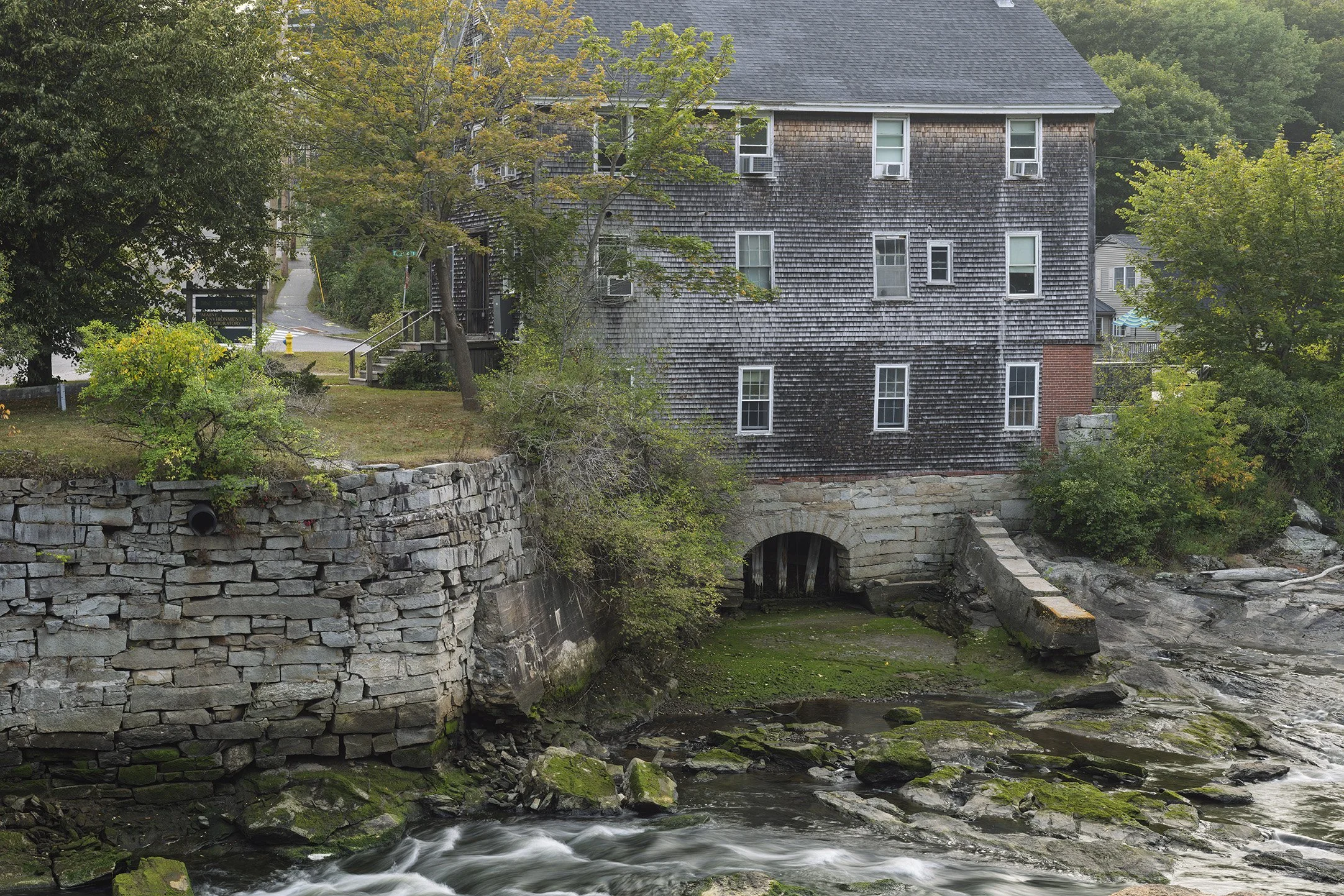
Casco Mill, c. 1674
First Falls, Royal River
Yarmouth, Cumberland County, Maine
From the Echoes, Still: Maine's Industrial Remnants Collection (2024–2028)
Grain, Leather, Pulp Portfolio
Historical Narrative
Kevin LeDuc Pigment print on Hahnemühle Baryta Edition of 5 + 1 Artist's Proof (Portfolio of 40 Images)
Paper Size: 40 × 55 inches Image Size: 31.33 × 37 inches Borders: Approximately 4 inches (All Sides)
Historic Significance
The Casco Mill, located at the First Falls of the Royal River in present-day Yarmouth, Maine, represents one of the earliest industrial enterprises in northern New England. Established in 1674 and rebuilt in 1681 under the direction of Walter Gendall, the mill played a significant role in the transition of the region from a frontier settlement into a more permanent agricultural and commercial community. Its location at the Royal River’s tidal head provided a reliable source of waterpower, making it an ideal site for early milling operations.
The original mill was primarily a water-powered sawmill, producing lumber from local forests to support the construction of homes, barns, and other structures needed by settlers. After the disruptions of King Philip’s War forced the abandonment of many early settlements, Walter Gendall restored and expanded the site in 1681, transforming it into a combined sawmill and gristmill. The mill produced both lumber and cornmeal, which was a critical food source for early residents. Using a toll system, the miller received a portion of the grain or lumber processed, allowing the operation to function within the limited cash economy of colonial Maine.
Technologically, the Casco Mill relied on waterpower systems typical of early colonial industry, using a vertical waterwheel connected to saws and millstones. Although small in scale, the mill provided essential services that supported settlement growth and helped establish a local economy. Beyond its industrial purpose, the mill became a gathering place where residents exchanged information, organized work, and participated in community life, making it an important social center as well as an economic one.
Although the original buildings no longer survive, archaeological remains of foundations, dams, and water channels remain at Grist Mill Park, preserving the memory of the site’s early industrial significance. The Casco Mill represents the beginnings of water-powered manufacturing in Maine and demonstrates how early mills served as foundations for settlement, economic development, and community formation in colonial New England.
Historical Narrative
-
The mill later known as the Casco Mill, located at the First Falls of the Royal River in present-day Yarmouth, Maine, represents one of the earliest industrial enterprises in northern New England. First established in 1674, and substantially rebuilt and expanded in 1681 under Walter Gendall, the mill played a central role in transforming the region from a frontier settlement into a permanent agricultural and commercial community.
The original mill site was selected for its exceptional natural advantages. At First Falls, the Royal River descends sharply near its tidal head, creating a reliable source of waterpower. Early English settlers recognized this location as ideal for milling operations, particularly sawmills, which were essential for constructing dwellings, barns, and other structures necessary for long-term settlement.¹ The earliest mill, attributed to Henry Sayward and associates, functioned primarily as a water-powered sawmill, converting local pine timber into boards and clapboards.²
This initial enterprise was short-lived. During King Philip’s War (1675–1676), hostilities forced settlers to abandon much of the Casco Bay region, and the mill fell into disuse.³ Following the war and the gradual resettlement of the area, Walter Gendall emerged as a leading figure in reestablishing economic activity at First Falls. On July 12, 1681, Gendall acquired property associated with the earlier mill site and undertook the rebuilding and expansion of the operation.⁴
Under Gendall’s management, the Casco Mill became a dual-purpose sawmill and gristmill. In addition to lumber, the mill ground locally grown grain—primarily corn—into meal. Corn meal formed the dietary staple of early settlers and was used to make foods such as johnnycake, hasty pudding, porridge, and ash cakes.⁵ The mill operated on a customary toll system, whereby the miller retained a portion of the grain or sawn lumber as payment, an arrangement well suited to the largely cashless frontier economy.⁶
Technologically, the mill relied on a vertical waterwheel—likely an overshot or breast wheel—driving wooden gearing connected either to a vertical sash saw or to millstones. Although output was limited by modern standards, the mill’s productivity was sufficient to meet local needs and sustain settlement growth.⁷ Gendall resided near the mill and constructed additional buildings, including worker housing, further emphasizing the site’s role as a small industrial and social hub.⁸
Beyond its economic importance, the Casco Mill functioned as a focal point of community life. Settlers gathered there to exchange news, resolve disputes, and coordinate labor. Its vulnerability during periods of conflict also underscored its significance: mills were frequent targets in frontier warfare because their destruction could cripple an entire settlement’s food supply.⁹
Although the original 17th-century structures no longer survive, archaeological remnants of mill foundations, dams, and raceways remain visible today at Grist Mill Park. The Casco Mill thus stands as a foundational institution in the history of Yarmouth, illustrating how early water-powered industry enabled permanent settlement, economic stability, and community formation in colonial Maine.¹⁰
Footnotes
Maine Historical Society, Grist Mill Park and the First Falls of the Royal River, Maine Memory Network.
William Hutchinson Rowe, Ancient North Yarmouth and Yarmouth (Portland: Press of Loring, Short & Harmon, 1880), 23–25.
James Phinney Baxter, The Popham Colony (Portland: Maine Historical Society, 1888), 212–214.
York County Deeds, Book IV (1684–1699), deed dated July 12, 1681, Walter Gendall and Bartholomew Gedney.
Sarah Josepha Hale, The New England Housekeeper (Boston: Munroe and Francis, 1839), 45–48.
Percy Wells Bidwell and John I. Falconer, History of Agriculture in the Northern United States (Washington, DC: Carnegie Institution, 1925), 112–113.
Terry S. Reynolds, Stronger Than a Hundred Men: A History of the Vertical Water Wheel (Baltimore: Johns Hopkins University Press, 1983), 34–36.
Collections of the Maine Historical Society, vol. 3 (Portland: Maine Historical Society, 1853), 189–191.
Emerson W. Baker, The Devil of Great Island (New York: Palgrave Macmillan, 2007), 97–99.
Yarmouth Historical Society, Interpretive Materials for Grist Mill Park, Yarmouth, Maine.
Bibliography
Baker, Emerson W. The Devil of Great Island. New York: Palgrave Macmillan, 2007.
Baxter, James Phinney. The Popham Colony. Portland: Maine Historical Society, 1888.
Bidwell, Percy Wells, and John I. Falconer. History of Agriculture in the Northern United States. Washington, DC: Carnegie Institution, 1925.
Hale, Sarah Josepha. The New England Housekeeper. Boston: Munroe and Francis, 1839.
Maine Historical Society. Collections of the Maine Historical Society. Vol. 3. Portland: Maine Historical Society, 1853.
Maine Historical Society. Grist Mill Park and the First Falls of the Royal River. Maine Memory Network.
Reynolds, Terry S. Stronger Than a Hundred Men: A History of the Vertical Water Wheel. Baltimore: Johns Hopkins University Press, 1983.
Rowe, William Hutchinson. Ancient North Yarmouth and Yarmouth. Portland: Press of Loring, Short & Harmon, 1880.
York County Deeds. Book IV (1684–1699). York County Registry of Deeds.