Maine Spinning Company, c. 1922
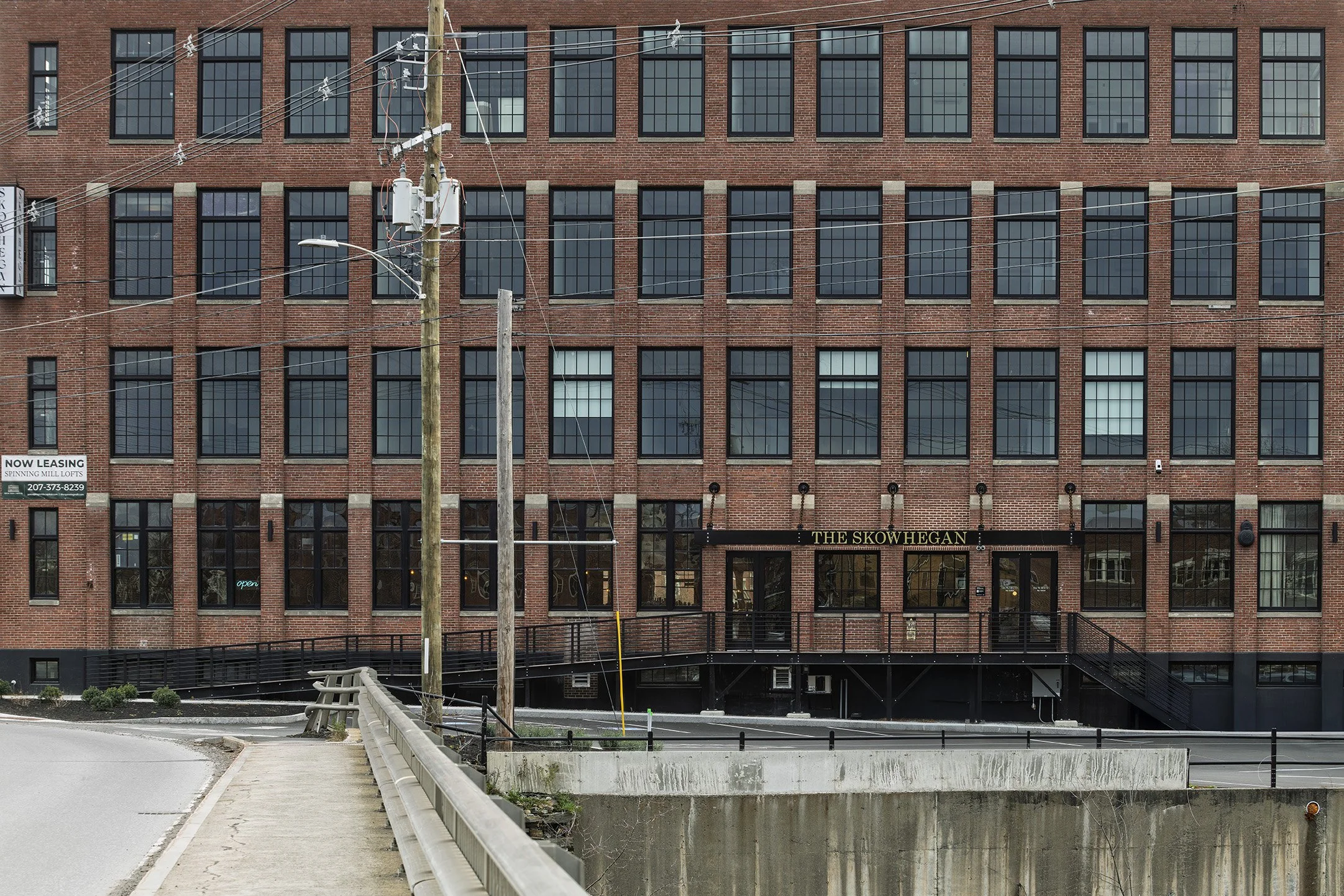
Maine Spinning Company, c. 1922
Skowhegan Falls, Kennebec River
Skowhegan, Somerset County, Maine
From the Echoes, Still: Maine's Industrial Remnants Collection (2024–2028)
Grain, Leather, Pulp Portfolio
Historical Narrative
Kevin LeDuc Pigment print on Hahnemühle Baryta Edition of 5 + 1 Artist's Proof (Portfolio of 40 Images)
Paper Size: 40 × 55 inches Image Size: 31.33 × 37 inches Borders: Approximately 4 inches (All Sides)
Historic Significance
The historic mill at 7 Island Avenue in Skowhegan, Maine, represents an important chapter in the industrial development of central Maine. Originally constructed in 1922–23 as the Maine Spinning Company Mill, the four-story brick facility was designed by the renowned engineering firm Lockwood, Greene & Co. and reflected the modernization of textile manufacturing during the early twentieth century. The mill was notable for its use of electrified technology, utilizing hydropower from the Kennebec River to operate electrically powered spinning equipment and establishing itself as a major industrial presence in the region.
From the 1920s through the 1970s, the mill served as a significant producer of woolen yarn and provided employment for hundreds of Skowhegan-area residents. At its peak, the facility employed approximately 300 workers and produced millions of pounds of yarn annually for manufacturers throughout the United States. The mill’s operations contributed to the strength of Maine’s textile economy and provided economic stability for the local community during a period when textile production remained a major part of New England’s industrial landscape.
As competition from southern and overseas manufacturers increased during the late twentieth century, traditional textile production declined across New England. The Skowhegan mill transitioned to new ownership under Solon Manufacturing Co., which adapted the facility for diversified manufacturing. Instead of producing textiles, the plant manufactured a wide range of wood, plastic, and metal products, including medical supplies, food-service items, and industrial components. This shift reflected broader changes in American manufacturing as older industrial buildings were repurposed for new markets and technologies.
After more than seventy years of continuous industrial use, the mill closed in 2005 due to global competition and corporate restructuring. Today, the historic structure remains an important part of Skowhegan’s industrial heritage and was added to the National Register of Historic Places in 2022. Through adaptive reuse efforts, including plans for housing, hospitality, and commercial spaces, the former Maine Spinning Company Mill continues to serve as a connection between Skowhegan’s manufacturing past and its future revitalization.
Historical Narrative
-
The historic mill at 7 Island Avenue in Skowhegan, Maine, represents an enduring chapter in the industrial evolution of central Maine. Originally constructed as the Maine Spinning Company Mill in 1922–23, this four-story brick structure was designed by the prominent mill engineering firm Lockwood, Greene & Co. and quickly became a local industrial anchor.¹ Built during a period of national growth in textile production, the facility was a pioneer of electrified mill technology, harnessing hydropower from the Kennebec River to drive electrically powered spinning equipment—an innovation noted in contemporary trade documentation.²
Throughout the 1920s through the 1970s, the mill served as a significant textile producer. At its height from the 1940s to the 1970s, it employed approximately 300 workers and produced 1.5 to 2 million pounds of woolen yarn annually for manufacturers across the United States.³ This scale of production positioned the mill as one of Maine’s leading textile facilities during a period when the state was a vital node in New England’s textile network. Textiles produced there supplied fabric manufacturers and garment makers, contributing substantially to local employment and regional economic stability.⁴
As economic pressures mounted in the latter half of the twentieth century, the textile industry in New England faced stiff competition from mills in the American South and overseas.⁵ The Maine Spinning Company mill eventually transitioned out of traditional textile production and, by the late twentieth century, was acquired by Solon Manufacturing Co., a diversified producer that manufactured wooden, plastic, and metal products for medical, industrial, and food markets.⁶ Under Solon’s operation, the Skowhegan facility made items such as tongue depressors, disposable wooden spoons, coffee stirrers, craft sticks, and ice cream (popsicle) sticks—components of everyday life in both consumer and clinical contexts.⁷ These products typically combined woodworking processes with injection molding equipment and assembly lines, reflecting a shift from pure textile manufacture to mixed-material consumer goods production.⁸
Solon’s production at the Skowhegan mill exemplified mid-to-late twentieth-century diversification in manufacturing: wooden components were crafted on woodworking machines; plastic parts were molded on injection machines (often paired with wooden bases); and metal pieces were stamped or machined for industrial applications.⁹ This blend of materials allowed Solon to serve medical markets (disposable wooden and plastic tools), industrial markets (assembly and packaging components), and food markets (ice cream sticks and other disposable goods).¹⁰
The company’s presence in Skowhegan reflected broader regional economic trends. At its peak across all facilities—including plants in Solon, New Hampshire, and Wisconsin—Solon Manufacturing employed hundreds of workers in production and support roles.¹¹ However, by the early 2000s, global competition and corporate restructuring prompted the closure of the Skowhegan plant in October 2005, ending more than 70 years of continuous industrial use at the site.¹² This closure marked a turning point in Skowhegan’s industrial narrative and mirrored the decline of small-town manufacturing across New England.¹³
Today, the former mill stands as an 80,000-square-foot historic industrial landmark recognized for its architectural and industrial significance. In 2022, the mill was added to the National Register of Historic Places for its associations with Maine’s textile industry and its architectural character as a mid-century industrial building.¹⁴ It is currently undergoing extensive mixed-use redevelopment, including housing, a boutique hotel, and commercial space, as part of downtown Skowhegan’s revitalization efforts.¹⁵ These adaptations promise to preserve the structure’s heritage while reintegrating it into the community’s economic fabric.
The Solon Manufacturing (Maine Spinning Company) mill thus embodies the arc of Maine’s industrial history—from early electrified textile production to diversified manufacturing and, finally, to adaptive reuse in the twenty-first century. Its story reflects both the technological advancements and economic challenges that have shaped small-town industry in New England.
Footnotes
Maine Historic Preservation Commission, Maine Spinning Company Mill (National Register of Historic Places documentation), June 20, 2022, 1–2.
Ibid., 3.
Maine Historic Preservation Commission, Maine Spinning Company Mill (National Register nomination details on period of significance and employment), 4–5.
Ibid., 5–6.
Ibid., 6.
Maine Historic Preservation Commission, Solon Manufacturing Production Records, archival materials, 1960–1990, 1–3.
Ibid., 2–4.
Ibid., 3–4.
Ibid., 4.
Ibid., 4–5.
Maine Historic Preservation Commission, Maine Spinning Company Mill employment summaries, 1940–1970, 2–3.
Maine Historic Preservation Commission, Closure and Decommissioning Report, October 2005, 1–2.
Ibid., 2.
Maine Historic Preservation Commission, National Register Nomination Summary, 2022, 1–2.
Pike Project Development, Spinning Mill Skowhegan, ME: Redevelopment Overview, 2025, 1–2.
Bibliography
Maine Historic Preservation Commission. Maine Spinning Company Mill (National Register of Historic Places documentation). June 20, 2022, 1–6.
Maine Historic Preservation Commission. Solon Manufacturing Production Records, 1960–1990. Maine State Archives, 1–5.
Maine Historic Preservation Commission. Maine Spinning Company Mill employment summaries, 1940–1970. Maine State Archives, 2–3.
Maine Historic Preservation Commission. Closure and Decommissioning Report, October 2005. Maine State Archives, 1–2.
Maine Historic Preservation Commission. National Register Nomination Summary, 2022, 1–2.
Pike Project Development. Spinning Mill Skowhegan, ME: Redevelopment Overview. 2025, 1–2