Lewiston Bleachery & Dye Works, c. 1860
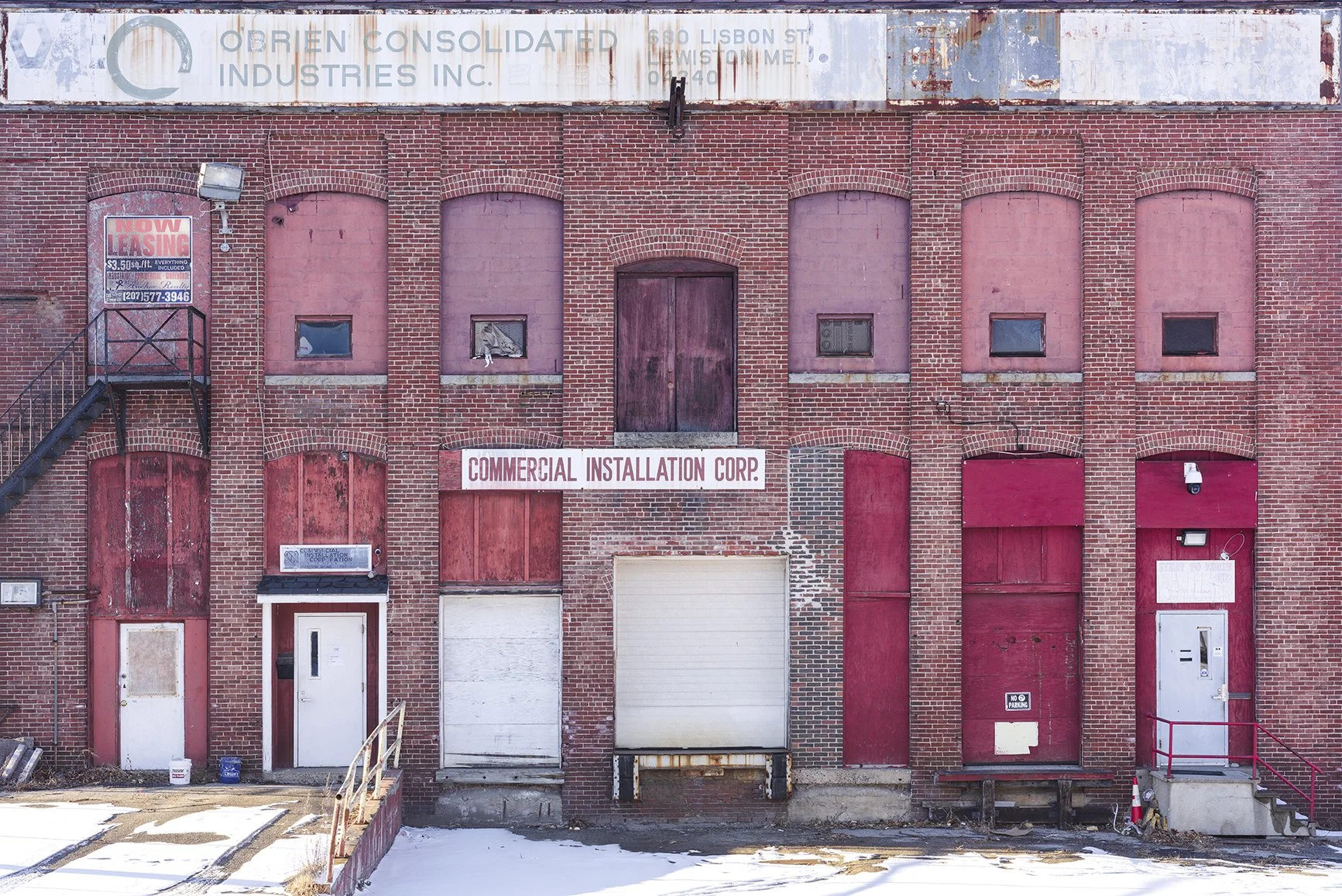
Lewiston Bleachery & Dye Works, c. 1860
Lisbon Street
Lewiston, Androscoggin County, Maine
From the Echoes, Still: Maine's Industrial Remnants Collection (2024–2028)
Cotton, Woolens Portfolio
Historical Narrative
Lewiston Bleachery & Dye Works, c.1860: Industrial Development and Legacy
Kevin LeDuc Pigment print on Hahnemühle Baryta Edition of 5 + 1 Artist's Proof (Portfolio of 40 Images)
Paper Size: 40 × 55 inches Image Size: 31.33 × 37 inches Borders: Approximately 4 inches (All Sides)
Historic Significance
The Lewiston Bleachery & Dye Works played a vital role in the development of Lewiston, Maine, transforming the city’s textile industry from a system of spinning and weaving mills into a fully integrated manufacturing network. Established during a period of rapid industrial expansion, the bleachery provided the essential finishing processes required to convert raw cotton cloth into finished products for regional and national markets. Located along the Androscoggin River and connected to Lewiston’s extensive canal and mill infrastructure, the facility reflected the city’s broader industrial ambitions and its reliance on waterpower, technological innovation, and skilled labor.
Beginning with bleaching operations in 1860 and formal incorporation in 1872, the Lewiston Bleachery & Dye Works became one of Maine’s most significant textile finishing facilities. While the city’s large cotton mills produced the bulk of its woven goods, the bleachery completed the manufacturing process through washing, bleaching, dyeing, drying, pressing, and finishing operations. Its large-scale facilities, advanced machinery, and specialized workforce allowed it to serve not only Lewiston’s textile mills but also manufacturers throughout New England and beyond, making the company an important link within the region’s industrial economy.
The history of the Lewiston Bleachery & Dye Works reflects the larger story of industrial growth, labor, and change in New England. For decades, the facility supported hundreds of workers, contributed to Lewiston’s economic prosperity, and helped establish the city as a major textile center. Although changing markets and the decline of domestic textile manufacturing eventually transformed the site’s role, the bleachery remains an important reminder of the interconnected systems of waterpower, manufacturing, and human labor that shaped Lewiston’s industrial landscape.
Historical Narrative
-
The rise of the Lewiston Bleachery & Dye Works mirrors the industrial ambition that transformed Lewiston from a small river town into one of New England’s most important textile centers. Rooted in waterpower from the Androscoggin River and the vision of nineteenth-century industrialists, the bleachery became an essential—if often overlooked—component of the city’s manufacturing system.¹
Origins and Early Development (1860–1872)
Bleaching operations in Lewiston began in 1860, at a moment when the city’s cotton mills were expanding rapidly along canals fed by the Androscoggin River. While spinning and weaving defined Lewiston’s industrial identity, the finishing of cloth—bleaching and dyeing—was equally critical. As mills produced increasing volumes of cotton goods, the need for a large, centralized finishing facility became unavoidable. State industrial reports make clear that the bleachery emerged directly from this demand, serving both local manufacturers and a wider New England textile network.²
Although active for more than a decade, the enterprise was formally incorporated in 1872 as the Lewiston Bleachery & Dye Works.³ This incorporation reflected both the success of the operation and its growing permanence within Lewiston’s industrial economy. By this point, bleaching and dyeing were no longer peripheral activities but integral to the city’s role as a full-scale textile producer.
Physical Plant and Operations
The scale of the bleachery set it apart. Occupying approximately ten acres along Lisbon Street near the Androscoggin Mills, the facility was described in state documents as unique within Maine for its size and specialization.⁴ Its location allowed close integration with nearby mills while maintaining access to the water resources essential for finishing textiles.
The company’s capitalization of $300,000—a substantial investment in the nineteenth century—underscored its industrial importance.⁵ Practically all cotton cloth manufactured in the state was sent to Lewiston for bleaching, along with large quantities from Massachusetts and other New England states, and some from southern cotton mills. The range of fabrics processed was extensive, including shirtings, sheetings, nightgown cotton, cambrics, sateens, linings, and duck.⁶
Each piece of cloth processed at the bleachery was distinctly marked to track it through each stage. White cloth was first washed thoroughly, then drawn through overhead loop holes to a keir or bleaching vat, where it was boiled briefly before moving to another vat to complete the bleaching. The goods were then starched and passed over steam-heated rollers until thoroughly dry. Next, the cloth was sprinkled and pressed between hot rollers, producing a surface as smooth and polished as if ironed by hand. Finally, the cloth was folded by machinery into yard folds, labeled with type and yardage, and sent to the packing room for shipment.⁷
Dyed cloth followed a similar path, passing through washing and bleaching before entering dyeing mixtures in the desired shades. Singeing, one of the finishing processes, removed surface fuzz by drawing the cloth rapidly over a heated copper bar or burning gas jets, leaving the fibers smooth while the main fabric remained intact. In the finishing room, fabrics were folded into neat, compact forms familiar to dry goods customers.⁸
The bleachery was fully integrated, including its own machine shop, box-making department, and pattern shop. Most finished goods were shipped directly via the Maine Central Railroad to customers across New England and the West. At any moment, the exact location and stage of processing of each piece of cloth could be tracked. From receipt to final shipment, the process was continuous and efficient, typically taking seven to ten days per batch.⁹
The works were primarily water-powered, but a complete steam plant allowed instant conversion, while an automatic monitoring system in the engineer’s room ensured machinery ran at optimal speed. The facility also maintained a dedicated fire department capable of fully manning the plant’s fire apparatus in moments, ensuring both personnel and production remained safe.¹⁰
By 1901, the Lewiston Bleachery & Dye Works processed about 200 tons of cotton cloth each week and employed approximately 625 workers, roughly 10 percent of whom were women, paying out about $28,000 in monthly wages.¹¹ One of the facility’s most valuable assets was its supply of pure spring water drawn from company-owned land, a critical factor in bleaching and dyeing processes where water quality directly affected fabric appearance and market value.¹²
Role in Lewiston’s Textile Economy
By the late nineteenth century, Lewiston stood among Maine’s leading textile cities, and the bleachery played a quiet but indispensable role in that dominance. It transformed unfinished cloth into market-ready goods, completing the manufacturing cycle begun in the spinning and weaving rooms.¹³
Its operations were embedded within the broader Lewiston Mills and Water Power System Historic District, a coordinated landscape of canals, dams, and mill buildings that ranked among the largest textile complexes in Maine.¹⁴
Later History and Legacy
Like much of the American textile industry, the bleachery faced mounting challenges in the twentieth century. Competition from southern mills, changing manufacturing technologies, and the globalization of textile production gradually eroded Lewiston’s industrial base. While detailed records of the bleachery’s later decades are limited, it clearly shared in the broader contraction that reshaped the city’s economy.¹⁵
Yet the legacy of the Lewiston Bleachery & Dye Works endures. Its historical importance is preserved through recognition of the Lewiston Mills and Water Power System Historic District, which includes dedicated bleachery structures alongside canals and mill complexes, acknowledging the vital role played by finishing works alongside spinning and weaving mills.¹⁶ Together, these facilities tell the story of a city built on water, labor, and industrial ingenuity.
Footnotes
Public Documents of the State of Maine, vol. 2 (Augusta: Maine State Printer, 1901), general industrial overview.
Ibid., context for textile manufacturing in Maine.
Maine. Private and Special Laws of the State of Maine, 1872–1874 (Augusta: Owen & Nash, 1874), “An Act to Incorporate the Lewiston Bleachery and Dye Works,” 6.
Public Documents of the State of Maine, vol. 2 (Augusta: Maine State Printer, 1911), “Lewiston Bleachery and Dye Works,” 19; and 1901 volume, 123–126.
Maine State Legislature, Statistics of the Manufactures of Maine (Augusta: Maine State Printer, 1873).
Ibid., 123–126.
Public Documents of the State of Maine, 1911, 19–22.
Ibid., 20–21.
Ibid., 123–126.
Ibid., 125.
Ibid., 123–126.
Ibid., 19.
Public Documents of the State of Maine, vol. 2 (1901), 123.
Lewiston Textile Mills and Waterpower System Historic District nomination materials, Maine Historic Preservation Commission.
Ibid.
Ibid.
Bibliography
Lewiston Textile Mills and Waterpower System Historic District nomination materials. Maine Historic Preservation Commission.
Maine. Private and Special Laws of the State of Maine, 1872–1874. Augusta: Owen & Nash, 1874. — “An Act to Incorporate the Lewiston Bleachery and Dye Works,” 6.
Maine State Legislature. Public Documents of the State of Maine. Vol. 2. Augusta: Maine State Printer, 1901. — General industrial overview; “The Lewiston Bleachery and Dye Works,” 123–126.
———. Public Documents of the State of Maine. Vol. 2. Augusta: Maine State Printer, 1911. — “Lewiston Bleachery and Dye Works,” 19–22.
Maine State Legislature. Statistics of the Manufactures of Maine. Augusta: Maine State Printer, 1873. — Bleaching and dyeing industry statistics.