Bates Weave Shed, Mill No. 5 c. 1914
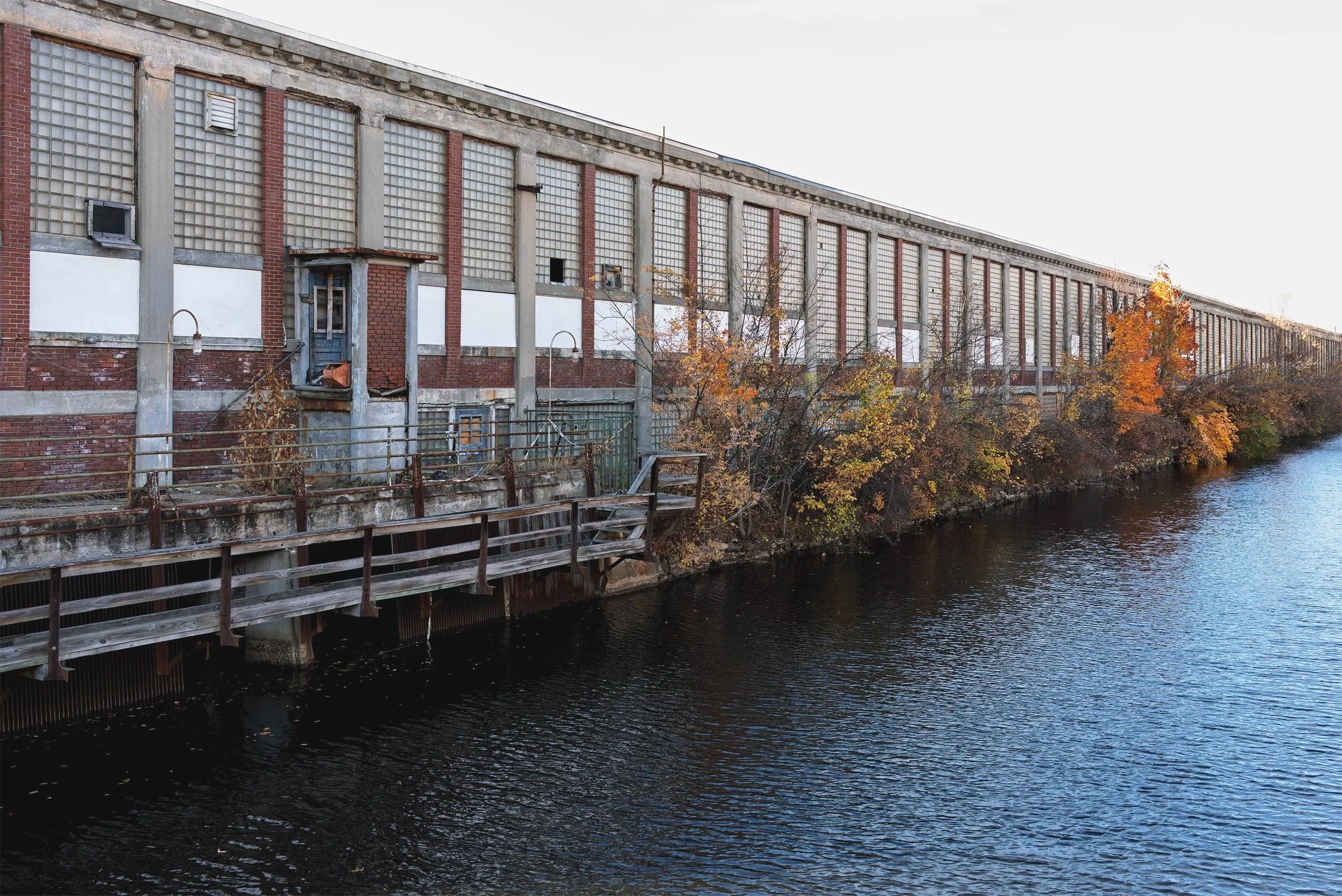
Bates Weave Shed, Mill No. 5 c. 1914
Bates Mill Complex, c. 1850 Main Canal, Great Falls, Androscoggin River
Lewiston, Androscoggin County, Maine
From the Echoes, Still: Maine's Industrial Remnants Collection (2024–2028)
Cotton, Woolens Portfolio
Historical Narrative
Bates Weave Shed, Mill No. 5: Looms, Labor, and Lewiston’s Textile Legacy
Kevin LeDuc Pigment print on Hahnemühle Baryta Rag Edition of 5 + 1 Artist’s Proof (A/P) + 1 Bon à Tirer (B.A.T.) Portfolio of 40 Images
Paper Size: 35 × 50 inches Image Size: 30 × 45 inches Borders: Approximately 2 ½ inches (All Sides) Mounting: Archival hinge or float mounting
Historic Significance
The Bates Weave Shed, Mill No. 5, represents the expansion and modernization of Lewiston’s textile industry during the early twentieth century. Designed by architect Albert Kahn in 1912 and completed in 1914 by the Bates Manufacturing Company, the mill was built as part of the city’s extensive canal-powered industrial district along the Androscoggin River. The site itself had an earlier industrial history: it was developed as a planing mill and lumber yard in 1856 and was occupied by storehouses serving the surrounding mills by the 1890s. The 1899–1900 Lewiston City Directory therefore provides useful evidence for the period immediately preceding construction of Mill No. 5, but does not date the construction of the weave shed.
Designed as a large reinforced-concrete industrial building with broad, open interior spaces and a distinctive sawtooth monitor roof, Mill No. 5 reflected emerging modern approaches to factory design. Its structural system allowed for large unobstructed weaving floors, while extensive glazing and the monitor roof provided natural light to the production areas. These features reflected contemporary priorities of improving ventilation, illumination, production efficiency, and the organization of industrial labor. The construction of Mill No. 5 demonstrated Bates Manufacturing’s continued investment in textile production and its adoption of new architectural and structural technologies.
The mill formed part of Bates Manufacturing’s larger vertically integrated textile complex, in which spinning, weaving, finishing, storage, and shipping operations were coordinated across the company’s Lewiston facilities. Mill No. 5 served primarily as a large-scale weaving facility, accommodating textile machinery and workers within its expansive production floors. Its construction illustrates the continuing evolution of textile manufacturing in Lewiston from the nineteenth-century mill system toward the technologically advanced industrial facilities of the early twentieth century.
The operation of Mill No. 5 depended on a large industrial workforce, including many women and members of Lewiston’s French-Canadian and Irish immigrant communities. Workers operated looms, prepared yarn, maintained machinery, and performed other specialized tasks within a highly organized factory environment. Although mill employment provided important income for immigrant and working-class families, factory labor could be demanding, characterized by long hours, constant machinery noise, and exposure to textile dust. The surrounding neighborhoods, boarding houses, and tenement housing reinforced the close relationship between industrial employment and community life in Lewiston.
Like many New England textile facilities, Bates Manufacturing faced increasing challenges during the twentieth century as textile production shifted to the American South and, later, overseas. Competition, changing markets, labor costs, technological changes, and the broader decline of New England textile manufacturing contributed to reductions in production and employment. The Bates Weave Shed eventually ceased textile operations. Today, Mill No. 5 remains an important component of Lewiston’s industrial heritage, preserving the history of technological innovation, immigrant labor, and the textile economy that shaped the city’s development.
Historical Narrative
-
The Bates Weave Shed, Mill No. 5 in Lewiston, Androscoggin County, exemplifies the expansion of the textile industry in Lewiston during the late nineteenth and early twentieth centuries. As one of the later weave sheds constructed by the Bates Manufacturing Company, Mill No. 5 reflects both industrial innovation and the labor dynamics of a growing mill town.
Origins and Construction (1880s–1900)
The Bates Manufacturing Company expanded steadily in the late 1800s, responding to increased demand for cotton and wool textiles.¹ Mill No. 5, known as the Bates Weave Shed, was constructed between 1912 and 1914 along Lewiston's canal system. The site had an earlier industrial history: developed as a planing mill and lumber yard in 1856, it was occupied by storehouses serving the surrounding mills by the 1890s.² The building was a long, narrow, brick structure designed to maximize light and air circulation, typical of late nineteenth-century weave sheds.³ Its open-floor plan accommodated rows of power looms, while large windows provided natural lighting to reduce dependence on gas or electric lamps.⁴
Investment came from local entrepreneurs and the company’s board, including key figures such as Benjamin Bates III and associates from Lewiston’s industrial elite.⁵ The machinery installed included Northrop and Draper power looms, which automated shuttle movement and increased fabric production rates, as well as warp-tying and beam-winding equipment to prepare threads for weaving.⁶ These innovations allowed Mill No. 5 to expand output without proportionally increasing labor costs.
Operations and Labor (1900–1930)
Mill No. 5 employed several hundred workers, predominantly young women from Lewiston’s French-Canadian and Irish immigrant communities.⁷ Typical jobs included loom operation, warp preparation, maintenance, and supervisory roles.⁸ Wages were modest but steady, averaging $8–$12 per week for female weavers and up to $20 per week for male supervisors, reflecting contemporary industrial norms.⁹
Workers lived in nearby tenements and boarding houses, often within walking distance of the mill.¹⁰ Their standard of living was modest; families could afford household necessities but rarely luxuries. Despite the hard work, mill employment provided a measure of stability and upward mobility, particularly for immigrant women entering the labor force.¹¹
The weave shed operated on water power supplemented by steam engines, ensuring continuous loom operation even during low-flow periods.¹² Safety and fire prevention were ongoing concerns, and the mill maintained a dedicated fire-fighting team for emergencies.¹³
Production and Industrial Significance
Mill No. 5 specialized in woven cotton and wool fabrics, producing broadcloths, shirtings, and fine worsted materials for both domestic and regional markets.¹⁴ The scale of operations, combined with mechanized looms, allowed the Bates Manufacturing Company to compete effectively with mills in Massachusetts and other New England textile centers.¹⁵
The weave shed was integral to the company’s vertically integrated system, connecting spinning, weaving, finishing, and shipping. Finished fabrics were sent via the Maine Central Railroad to customers throughout New England and the Midwest.¹⁶
Twentieth-Century Changes and Decline (1930–1970s)
Like much of Lewiston’s textile industry, Mill No. 5 faced competition from southern mills, labor unrest, and technological change in the mid-twentieth century.¹⁷ Some looms were modernized, but economic pressures led to gradual workforce reductions. Strikes and labor negotiations reflected broader tensions in the textile industry over wages, hours, and working conditions.¹⁸
By the 1970s, production had slowed considerably. The shed was eventually decommissioned, reflecting the wider decline of New England textile manufacturing.¹⁹
Legacy
The Bates Weave Shed, Mill No. 5, remains an important part of Lewiston’s industrial heritage. Its brick walls and long, windowed façade exemplify nineteenth-century mill architecture, while its history illustrates the contributions of immigrant labor, technological innovation, and industrial entrepreneurship to the city’s growth.²⁰
Footnotes
Edward P. Weston, ed., History of Lewiston, Maine (Lewiston: Lewiston Journal Print, 1892), 145–148.
Lewiston City Directory, 1900, 312.
Sanborn Map Company, Insurance Maps of Lewiston, Maine, 1901, sheet 7.
Ibid.
Benjamin Bates III papers, Bates College Archives, Lewiston, Maine, 1898–1902.
American Textile Machinery Review, vol. 12, no. 3 (1900), 45–47.
Maine Bureau of Labor Statistics, Annual Report, 1910, 118–121.
Ibid.
Ibid., 119.
Weston, History of Lewiston, 162–164.
Ralph D. Vicero, Immigration of French Canadians to New England, 1840–1900 (New York: Arno Press, 1970), 98–101.
Sanborn Map Company, 1901, sheet 7.
Maine Department of Labor, Wage and Safety Survey, 1925, 22.
American Textile Journal, vol. 18, no. 5 (1905), 10–12.
Ibid.
Maine Central Railroad Annual Freight Report, 1910, 33.
Maine Bureau of Labor Statistics, Annual Report, 1935, 78–80.
Ibid., 81–83.
Lewiston Sun Journal, 1975, 6.
National Register of Historic Places, Lewiston Mills and Water Power System Nomination Form, 1979, 18–20.
Bibliography
Bates College Archives. Benjamin Bates III papers, Lewiston, Maine, 1898–1902.
Edward P. Weston, ed. History of Lewiston, Maine. Lewiston: Lewiston Journal Print, 1892.
Lewiston City Directory, 1900. Lewiston: Edward Johnson & Co., 1900.
Lewiston Sun Journal. Coverage of mill closures, 1975.
Maine Bureau of Labor Statistics. Annual Reports. Augusta, 1910–1935.
Maine Central Railroad. Annual Freight Reports, 1910.
Maine Department of Labor. Wage and Safety Survey, 1925.
National Register of Historic Places. Lewiston Mills and Water Power System Nomination Form. Washington, D.C.: U.S. Department of the Interior, 1979.
Ralph D. Vicero. Immigration of French Canadians to New England, 1840–1900. New York: Arno Press, 1970.
Sanborn Map Company. Insurance Maps of Lewiston, Maine, 1901.
American Textile Journal. Vol. 18, no. 5 (1905).
American Textile Machinery Review. Vol. 12, no. 3 (1900).
-
Founders, Early Growth, and Community Transformation
Benjamin E. Bates was the prime mover behind the Bates Manufacturing Company. A Boston financier and investor, Bates was introduced to the industrial potential of Lewiston through his association with eastern investors and local efforts to develop waterpower. He rallied capital from Boston and, with co‑investors including Alexander DeWitt and others, established the Bates Manufacturing Company to take advantage of the river’s energy and the region’s access to transportation networks.¹
The location of Bates Mill was strategically chosen for its proximity to Great Falls on the Androscoggin River, one of the most powerful natural drops in Maine. Great Falls had long been recognized for its potential to generate waterpower, and its presence prompted early settlers and entrepreneurs to build sawmills and other water‑powered operations before the formal industrialization of the 1850s. The engineering of an extensive canal system around the falls in the late 1840s and early 1850s harnessed this energy, providing a reliable and abundant source of hydraulic power for textile manufacture.²
Bates Mill was a major catalyst for population growth and community development. Thousands of Irish immigrants were recruited to work on canal construction in 1850, and later, waves of French‑Canadian and other European immigrants arrived seeking employment in the expanding textile mills.³ The mill’s early profitability not only fueled further industrial investment but also helped provide initial funding for Bates College, a liberal arts institution founded nearby as part of the Bates family’s philanthropic legacy.⁴
By 1857, Bates Mill was operating 36,000 spindles, employing approximately 1,000 workers, and producing 5.7 million yards of cotton goods per year, a capacity that placed it among the nation’s leading textile producers.⁵ During the American Civil War, the mill’s owners anticipated a prolonged conflict and purchased substantial stocks of cotton prior to the outbreak, enabling the mills to continue operating at high capacity and to supply goods for Union needs while competitors faltered.⁶
Industrial Operations and Machinery
The industrial infrastructure of the Bates Mill Complex reflected the scale of its ambitions. Mechanical power was supplied by water driven through the canal system and directed to waterwheels and turbines that in turn powered line shafts throughout the mill buildings. The complex eventually incorporated tens of thousands of spindles, hundreds of looms, and specialized machinery for carding, weaving, dyeing, and finishing cotton cloth.⁷
The canal system itself was an engineering feat, composed of upper and lower canals and a series of cross canals, each designed to maximize waterpower availability for multiple mill buildings.⁸
Mill No. 4 and Mill No. 5, among the largest structures in the complex, were constructed in the late 19th and early 20th centuries. Mill No. 4 was built around 1880 and expanded in 1915, while Mill No. 5 was completed in 1914 as a purpose‑built weave shed, designed to house advanced textile machinery and to leverage reinforced concrete construction for expansive work floors.⁹ These buildings embodied both the industrial scale and architectural ambition of the Bates operations and were among the largest industrial spaces in Maine.
Peak Employment, Products, and Economic Role
At its height in the mid‑20th century, Bates Manufacturing was Maine’s largest employer, with estimates of over 5,000 workers engaged in textile production, making it the largest single employer in the state.¹⁰ The mill produced a wide array of products over its long history, including cotton yard goods, duck cloth, parachute fabrics, bedspreads, and other specialty textile products.¹¹ By the 1950s, the mill’s operations and sales had diversified, with products such as nylon parachute cloth, airplane wing fabric, and high‑quality bedspreads, reflecting both wartime and peacetime markets.¹¹
Decline, Closure, and Adaptive Reuse
Like many New England textile enterprises, the Bates Mill Complex declined in the latter half of the 20th century due to competition from lower‑cost production in the U.S. South and overseas. By the 1970s and 1980s, employment had fallen sharply, and parts of the complex were underused or vacant.¹² The company ultimately ceased major textile production by the early 2000s.
In the early 1990s, the City of Lewiston acquired the mill buildings through tax foreclosures and began planning for their redevelopment. By the 2000s and 2010s, portions of the complex were rehabilitated for mixed use, including housing, offices, museums, and commercial space, helping to revitalize downtown Lewiston.¹³ The Bates Mill Historic District, encompassing the surviving buildings and canal system developed between 1850 and 1960, was listed on the National Register of Historic Places in 2010 in recognition of its industrial and architectural significance.¹⁴
Today, the Bates Mill Complex stands as a testament to the industrial heritage of Lewiston and New England’s textile era, its buildings repurposed for 21st‑century uses while preserving the legacy of a manufacturing powerhouse that shaped the region’s economy and community life for more than a century.
Footnotes
Local incorporation records, Bates Manufacturing Company, August 16, 1850; Maine Governor’s incorporation act for Bates Manufacturing, 1850, 1.
Maine Historic Preservation Commission, Bates Mill Historic District, Lewiston, 1850–1960 (National Register of Historic Places nomination), 1–2.
Lewiston Textile Mills and Waterpower System Historic District overview, SAH Archipedia, 1–2.
Ibid., 2.
Lewiston textile production data, Lewiston Falls Journal, 1857, 1–2.
SAH Archipedia overview, 2.
Bates Mill Historic District, Lewiston, 1850–1960, Maine Historic Preservation Commission, 2–3.
Ibid., 2–3.
SAH Archipedia documentation of Bates Mill buildings, including Mill No. 5 weave shed completed 1914, 1–2.
Historical employment records summarized in Maine Preservation redevelopment context, 1–2.
Mid‑20th‑century product range and operations summary, 1–2.
Maine Preservation redevelopment context, 1–2.
Ibid., 1–2.
Bates Mill Historic District, Lewiston, 1850–1960, Maine Historic Preservation Commission, 1–3.
Bibliography
Maine Historic Preservation Commission.Bates Mill Historic District, Lewiston, 1850–1960. National Register of Historic Places documentation. Androscoggin County, Maine, 2010.
Lewiston Textile Mills and Waterpower System Historic District Overview. SAH Archipedia documentation, 1–2.
Lewiston Falls Journal. Industrial production data, 1857, 1–2.
Maine Preservation.The Lofts at Bates Mill. Redevelopment and adaptive reuse context, 1–2.
Mid‑20th‑century industrial product summaries for Bates Mill. Period records, 1–2.