National Tube Works
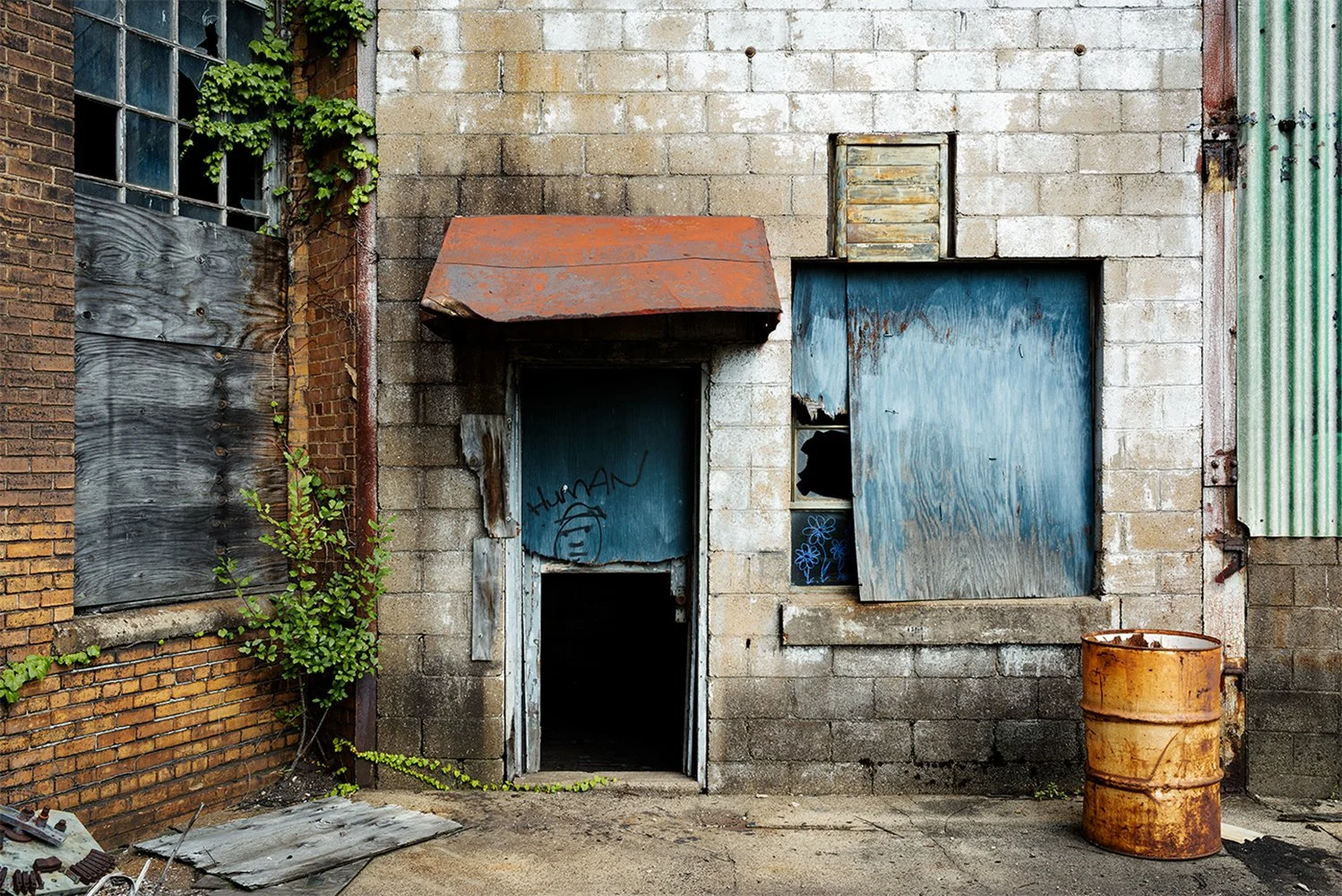
National Tube Works
Kevin LeDuc
National Tube Works, c. 1872
McKeesport, Allegheny County, Pennsylvania from the Ballyshannon’s Rustland (2021–2024) – Monumentality Portfolio
Pigment print on Hahnemühle Baryta
Artist’s proof + edition of 5 (portfolio of 40 images)
30 × 45 inches
-
From Iron Pipe to Industrial Empire: The History of National Tube Works in McKeesport, Allegheny County, Pennsylvania, 1872–1987
Introduction
The history of National Tube Works in McKeesport, Pennsylvania, represents one of the most significant chapters in the industrial development of the United States. Established in 1872 along the Monongahela River, National Tube evolved from a specialized wrought-iron pipe manufacturer into one of the largest tube-producing facilities in the world. For more than a century, the works served as the economic foundation of McKeesport and a critical component of America's industrial infrastructure.
Located in McKeesport, Allegheny County, Pennsylvania, the plant shaped the city's physical landscape, labor force, immigrant communities, and economic fortunes. Through periods of technological innovation, corporate consolidation, labor conflict, wartime production, and eventual decline, National Tube mirrored the broader trajectory of American heavy industry. Its history demonstrates how industrial enterprises transformed communities while supplying the materials necessary for urbanization, transportation, energy distribution, and economic growth.
Allegheny County and the Rise of Industrial Pennsylvania
National Tube Works emerged within one of the most important industrial regions in the world. Allegheny County, established in 1788, benefited from abundant coal resources, navigable waterways, and expanding railroad networks. By the mid-nineteenth century, the Pittsburgh district had become the center of American iron and steel production.
The Monongahela River Valley offered ideal conditions for industrial development. Coal mines supplied fuel, railroads linked manufacturers to national markets, and nearby ironworks provided essential raw materials. Communities such as Homestead, Braddock, Duquesne, Clairton, and McKeesport developed into specialized industrial centers whose economies revolved around steel production.
McKeesport's location at the confluence of the Monongahela and Youghiogheny Rivers made it particularly attractive for manufacturing enterprises. National Tube's founders recognized these advantages and selected the city as the site for a major pipe-producing operation.
Founding of National Tube Works, 1872
National Tube Company was organized in 1872 during a period of rapid industrial expansion following the Civil War. Investors sought to capitalize on increasing demand for wrought-iron pipe used in municipal water systems, gas distribution networks, steam heating systems, and industrial applications.
Among the most important early financial backers was David Herbert Hostetter (1834–1888), a prominent Pittsburgh businessman and industrial investor. Hostetter's involvement provided access to capital and business networks that facilitated the company's early growth.
The initial plant occupied riverfront property in McKeesport where transportation infrastructure allowed efficient movement of raw materials and finished products. Early production focused on wrought-iron tubing and pipe manufactured through rolling and welding processes that required considerable skill and labor.
The company's success was immediate. As American cities expanded and infrastructure systems became increasingly complex, demand for durable pipe products grew rapidly. National Tube quickly emerged as one of the nation's leading manufacturers.
Corporate Expansion and Integration into United States Steel
The company's growth accelerated during the late nineteenth century as pipe production became increasingly important to modern industrial society. National Tube expanded its facilities, adopted improved manufacturing technologies, and developed national distribution networks.
A transformative moment occurred in 1901 when National Tube Company became part of the newly organized United States Steel Corporation. Created through the consolidation of numerous iron and steel enterprises under the leadership of financier J. P. Morgan, U.S. Steel became the world's largest industrial corporation.
Within the U.S. Steel system, National Tube operated as a specialized subsidiary responsible for pipe and tubular products. The McKeesport works benefited from integrated access to ore supplies, coal resources, transportation systems, and financial capital. The company's incorporation into U.S. Steel reflected broader trends toward corporate consolidation that characterized American industry during the Progressive Era.
Technological Innovation and Tube Manufacturing
National Tube's importance derived from its specialization. Unlike general steel mills, the company focused on the production of pipe and tubular products requiring specialized manufacturing techniques.
Early production relied upon wrought iron, but the company gradually transitioned to steel as metallurgical technology improved. By the twentieth century, National Tube produced a wide variety of products used in:
Municipal water systems
Natural gas distribution networks
Petroleum pipelines
Industrial manufacturing plants
Electrical generating stations
Military infrastructure
The adoption of modern rolling mills, welding technologies, piercing mills, and finishing operations enabled the company to maintain a competitive position within the steel industry for decades.
Workforce and Occupational Structure
One of the most significant aspects of National Tube's history was its workforce. At its peak, the McKeesport works employed between 8,000 and 12,000 workers directly, making it one of the largest employers in western Pennsylvania.
The plant required a highly diversified labor force consisting of both skilled craftsmen and unskilled laborers.
Iron and Steel Production Workers
The earliest workforce included:
Blast furnace workers
Furnace keepers
Puddlers
Heaters
Rollers
Foundrymen
These workers transformed raw materials into iron and steel suitable for pipe manufacturing.
Tube Mill Specialists
National Tube's defining occupational group consisted of tube-production specialists, including:
Tube rollers
Pipe welders
Piercing-mill operators
Straightening-machine operators
Hydrostatic testing specialists
Pipe inspectors
These employees possessed specialized knowledge rarely found outside the tube-manufacturing industry.
Skilled Mechanical Trades
The plant also employed large numbers of:
Machinists
Millwrights
Electricians
Boiler makers
Pipefitters
Pattern makers
Tool-and-die makers
These craftsmen maintained and repaired the complex machinery required for continuous production.
Transportation Workers
Because the works operated on an immense scale, transportation personnel were essential:
Railroad engineers
Switchmen
Yard crews
Crane operators
Hoisting engineers
The internal railroad system functioned as an industrial transportation network in its own right.
Professional and Technical Personnel
As manufacturing became increasingly sophisticated, the company employed:
Metallurgical engineers
Chemists
Draftsmen
Industrial engineers
Accountants
Purchasing agents
Safety inspectors
The growth of these occupations reflected the professionalization of industrial management during the twentieth century.
Immigration and Community Formation
The expansion of National Tube transformed McKeesport into a major immigrant city. Workers arrived from across Europe, particularly from:
Slovakia
Croatia
Hungary
Poland
Ukraine
Italy
Germany
Ireland
Wales
These communities established churches, schools, ethnic halls, and fraternal organizations that shaped the social character of the city.
Different ethnic groups often entered specific occupations. Welsh and English immigrants frequently possessed prior ironworking experience and occupied skilled positions. Southern and Eastern European immigrants often began as laborers before advancing into skilled trades. Over time, second-generation workers increasingly moved into supervisory and technical roles.
The city's demographic development cannot be separated from the growth of National Tube.
Women and Industrial Employment
Although steel production remained overwhelmingly male during much of the company's history, women played important roles within the National Tube economy.
Women worked as:
Secretaries
Clerks
Bookkeepers
Payroll specialists
Laboratory assistants
During both World Wars, women entered industrial production in greater numbers, filling positions vacated by military service members. Their contributions helped sustain wartime production and demonstrated the changing role of women within industrial labor markets.
Labor Relations and Unionization
Industrial labor at National Tube was often difficult and dangerous. Workers faced extreme temperatures, heavy machinery, long hours, and significant accident risks.
During the late nineteenth century, labor relations were characterized by management control and limited worker protections. Conditions gradually changed during the labor movements of the 1930s.
The rise of the Congress of Industrial Organizations (CIO) and the United Steelworkers of America transformed labor relations throughout the steel industry. Unionization brought:
Collective bargaining
Seniority systems
Improved safety standards
Health insurance
Pension programs
Wage stabilization
These developments contributed significantly to the emergence of a stable industrial middle class in McKeesport during the mid-twentieth century.
World War II and Industrial Peak
The Second World War represented the high point of National Tube's productive capacity. The plant supplied materials essential to military and civilian infrastructure projects.
Employment reached historic levels, and production operated continuously to support wartime requirements. National Tube's products contributed to shipbuilding, military construction, transportation systems, and energy infrastructure.
The war reinforced the strategic importance of steel manufacturing and demonstrated the capacity of American industry to mobilize on an unprecedented scale.
Industrial Landscape and Archaeology
At its height, the National Tube complex occupied hundreds of acres along the Monongahela River.
The facility included:
Blast furnaces
Open-hearth furnaces
Tube mills
Rolling mills
Machine shops
Warehouses
Power plants
Rail yards
Administrative offices
The works functioned as a self-contained industrial city. Internal rail systems transported materials between departments, while massive structures dominated the McKeesport skyline.
Today, much of the complex has disappeared through demolition and redevelopment. Nevertheless, the surviving landscape remains one of the most important industrial archaeological sites associated with the American steel industry.
Decline and Closure
Beginning in the 1960s, National Tube faced increasing challenges from foreign competition, technological change, and shifts in global steel markets.
Employment declined steadily during the 1970s and 1980s. Despite modernization efforts, portions of the plant became economically unsustainable. Major operations ceased during the 1980s, ending more than a century of large-scale tube manufacturing in McKeesport.
The consequences for the city were profound. Population declined, unemployment increased, and the community entered a prolonged period of economic restructuring.
Historical Significance
National Tube Works occupies a central position in American industrial history. The company supplied essential materials for water systems, gas networks, pipelines, power generation, and industrial development. Its products contributed directly to the infrastructure that supported modern urban life.
Equally important was its social impact. National Tube shaped immigration patterns, created opportunities for skilled labor, fostered labor organization, and defined the identity of McKeesport for generations.
The history of National Tube demonstrates how industrial enterprises could simultaneously function as manufacturers, employers, community builders, and engines of economic growth.
Conclusion
Founded in 1872 and located in McKeesport, Allegheny County, Pennsylvania, National Tube Works became one of the most influential pipe-manufacturing enterprises in American history. Through technological innovation, corporate expansion, and the labor of thousands of workers drawn from diverse ethnic backgrounds, the company helped build the infrastructure of modern America.
Its rise reflected the extraordinary growth of American industry during the nineteenth and twentieth centuries, while its decline illustrated the challenges facing traditional manufacturing in a global economy. Although much of the physical plant has vanished, the legacy of National Tube remains embedded in the history of Allegheny County, the city of McKeesport, and the industrial development of the United States.
Notes
Samuel P. Hays, The Pittsburgh Region: A Historical Perspective (Pittsburgh: University of Pittsburgh Press, 1989).
George Swetnam, The History of the National Tube Company in McKeesport (McKeesport Historical Society Publications).
John N. Ingham, Biographical Dictionary of American Business Leaders (Westport, CT: Greenwood Press, 1983).
John Bodnar, Roger Simon, and Michael Weber, Lives of Their Own: Blacks, Italians, and Poles in Pittsburgh, 1900–1960 (Urbana: University of Illinois Press, 1982).
Ron Chernow, The House of Morgan (New York: Atlantic Monthly Press, 1990).
Kenneth Warren, The American Steel Industry, 1850–1970 (Oxford: Clarendon Press, 1973).
David Brody, Labor in Crisis: The Steel Strike of 1919 (Philadelphia: J. B. Lippincott, 1965).
United Steelworkers of America historical records and labor archives.
Thomas J. Misa, A Nation of Steel: The Making of Modern America, 1865–1925 (Baltimore: Johns Hopkins University Press, 1995).
Bibliography
Bodnar, John, Roger Simon, and Michael Weber. Lives of Their Own: Blacks, Italians, and Poles in Pittsburgh, 1900–1960. Urbana: University of Illinois Press, 1982.
Brody, David. Labor in Crisis: The Steel Strike of 1919. Philadelphia: J. B. Lippincott, 1965.
Chernow, Ron. The House of Morgan. New York: Atlantic Monthly Press, 1990.
Hays, Samuel P. The Pittsburgh Region: A Historical Perspective. Pittsburgh: University of Pittsburgh Press, 1989.
Ingham, John N. Biographical Dictionary of American Business Leaders. Westport, CT: Greenwood Press, 1983.
Misa, Thomas J. A Nation of Steel: The Making of Modern America, 1865–1925. Baltimore: Johns Hopkins University Press, 1995.
Swetnam, George. The History of the National Tube Company in McKeesport. McKeesport Historical Society Publications.
Warren, Kenneth. The American Steel Industry, 1850–1970. Oxford: Clarendon Press, 1973.
United States Steel Corporation. Annual Reports and Historical Publications.
United Steelworkers of America. Historical Records and Archives.