Bethlehem Steel Johnstown Works
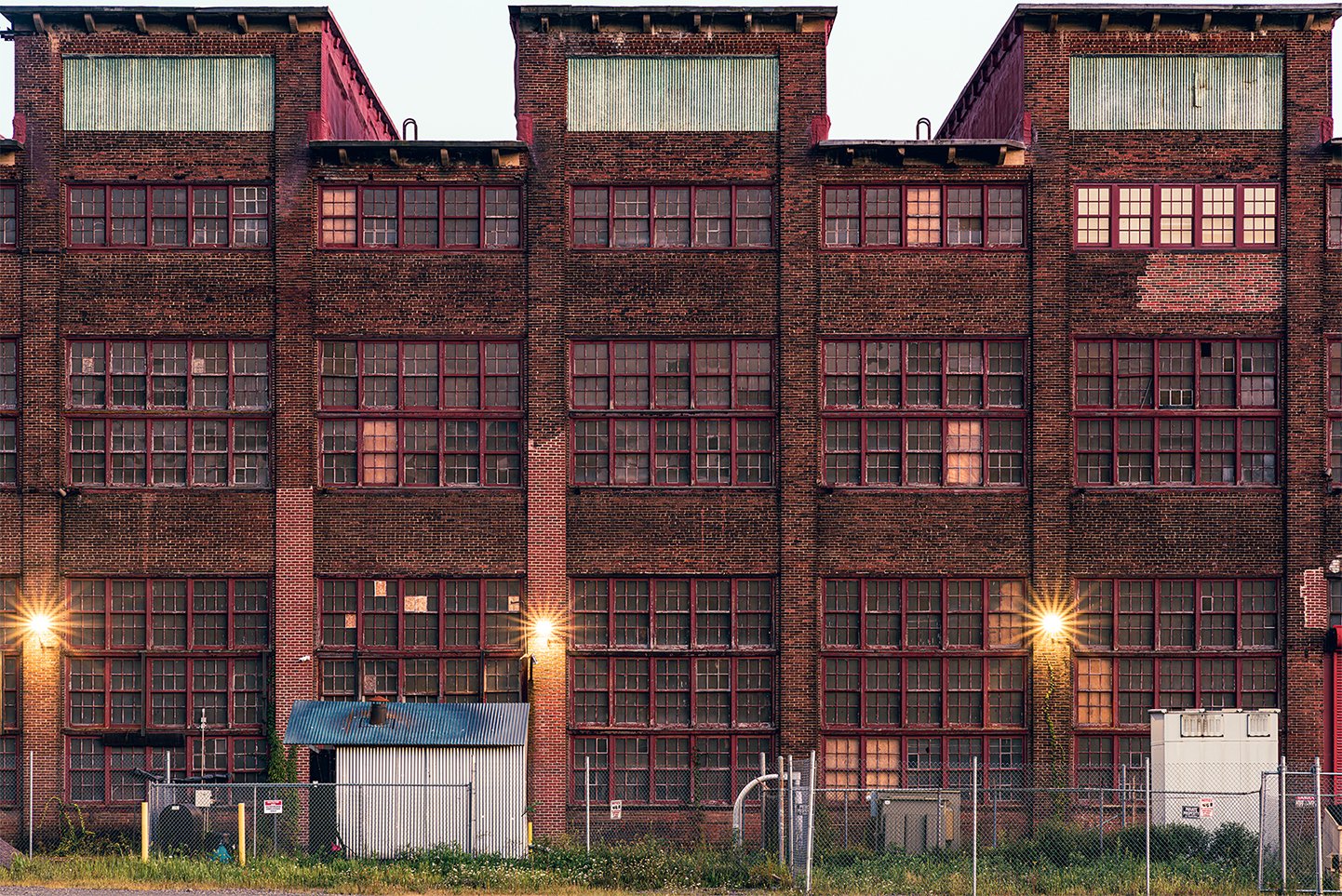
Bethlehem Steel Johnstown Works
Kevin LeDuc
Bethlehem Steel Johnstown Works, c. 1852
Johnstown, Cambria County, Pennsylvania
from the Ballyshannon’s Rustland (2021–2024) – Monumentality Portfolio
Pigment print on Hahnemühle Baryta
Artist’s proof + edition of 5 (portfolio of 40 images)
30 × 45 inches
-
From Cambria Iron to Bethlehem Steel: The Historical Development of the Johnstown Works, c. 1852–1977
Introduction
The industrial complex later known as Bethlehem Steel's Johnstown Works occupies a central place in the history of American iron and steel manufacturing. Established during the formative years of the nation's industrial expansion, the works originated with the founding of the Cambria Iron Company in 1852 and evolved into one of the most important steel-producing facilities in the United States. Over more than a century, the Johnstown Works contributed to railroad expansion, military production, urban growth, technological innovation, and labor organization. Its history reflects broader transformations in American industrial capitalism, including the rise of vertically integrated corporations, the expansion of heavy manufacturing, and the eventual decline of traditional steelmaking in the twentieth century.
Located in Johnstown, Pennsylvania, at the confluence of the Stonycreek and Little Conemaugh Rivers, the works became both the economic foundation of the city and one of the nation's most influential industrial enterprises. The development of the Johnstown Works illustrates the relationship between natural resources, transportation infrastructure, immigrant labor, and technological innovation in shaping the American industrial landscape.
The Founding of Cambria Iron Company
The origins of the Johnstown Works date to 1852 with the organization of the Cambria Iron Company. The company emerged during a period of rapid industrialization in Pennsylvania, when expanding railroad networks created unprecedented demand for iron rails and structural materials. Investors selected Johnstown because of its strategic location within the rich coal and iron-producing region of western Pennsylvania.¹
The founders included several prominent businessmen, among them Daniel J. Morrell, who would become the most influential figure in the company's early development. Morrell transformed the enterprise from a regional iron producer into one of the nation's leading industrial concerns.²
The company's early facilities consisted primarily of blast furnaces, rolling mills, and supporting industrial infrastructure designed to manufacture iron rails. At a time when railroad construction was accelerating throughout the United States, the production of rails became one of the most profitable sectors of the iron industry.
Daniel J. Morrell and Industrial Expansion
The rise of Cambria Iron Company was closely associated with the leadership of Daniel Johnson Morrell (1821–1885). Born in North Berwick, Maine, Morrell entered the iron industry at a young age and became the driving force behind the company's expansion after joining its management in the 1850s.³
Under Morrell's leadership, Cambria became one of the most technologically advanced iron producers in the United States. The company adopted new production methods, expanded its rolling capacity, and invested heavily in worker housing, transportation infrastructure, and community institutions.
Morrell also recognized the importance of scientific management and engineering expertise. During his tenure, Cambria employed some of the nation's leading metallurgists and engineers, helping establish the company as an innovator within the American iron industry.⁴
The Transition from Iron to Steel
The decades following the Civil War witnessed profound changes in metal production technology. The development of the Bessemer process transformed steel from a luxury material into a mass-produced industrial commodity. Cambria Iron Company became one of the earliest American firms to adopt Bessemer steel production.⁵
This transition significantly increased production capacity and enabled the company to compete in national and international markets. By the late nineteenth century, the Johnstown Works had become a major producer of steel rails, structural components, and industrial materials.
The company's technological leadership was especially evident in rail production. As railroad mileage expanded across North America, demand for durable steel rails increased dramatically. Cambria's products became integral to the construction of transportation networks that linked the United States economically and geographically.
Immigration and Labor
The growth of the Johnstown Works depended heavily upon immigrant labor. During the late nineteenth and early twentieth centuries, thousands of workers arrived from Ireland, Wales, Germany, Slovakia, Hungary, Poland, Croatia, Italy, and other regions of Europe.⁶
These immigrant communities transformed Johnstown into one of the most ethnically diverse industrial cities in Pennsylvania. Workers settled in neighborhoods near the mills and developed churches, schools, fraternal organizations, and mutual aid societies that reflected their cultural backgrounds.
The demanding nature of steel production created difficult working conditions. Long hours, dangerous machinery, and intense heat characterized daily life within the mills. Labor conflicts emerged periodically as workers sought improved wages and safer conditions. Nevertheless, generations of immigrant families remained connected to the steel industry, making the Johnstown Works the economic heart of the region.
The Johnstown Flood and Industrial Resilience
One of the defining events in the history of the city and the works was the Great Johnstown Flood of 1889. On May 31, 1889, the failure of the South Fork Dam released millions of tons of water into the Conemaugh Valley, devastating Johnstown and surrounding communities.⁷
More than 2,200 people died, making it one of the deadliest disasters in American history. Although the flood caused enormous damage to industrial facilities, the Cambria Iron Company played a critical role in relief and reconstruction efforts. Company resources, engineers, and workers were mobilized to rebuild infrastructure and restore economic activity.
The rapid recovery of the mills demonstrated the resilience of both the company and the city. Within a relatively short period, production resumed and expansion continued.
Corporate Consolidation and Bethlehem Steel
The early twentieth century brought increasing consolidation within the American steel industry. In 1923, Cambria Steel became part of the Midvale Steel and Ordnance Company, and subsequent mergers eventually brought the Johnstown Works into the expanding corporate structure of Bethlehem Steel Corporation.⁸
Under Bethlehem Steel ownership, the facility became known as the Johnstown Works. During the Second World War, the plant contributed significantly to military production, supplying steel products essential to wartime manufacturing. The works remained among Bethlehem's major facilities and continued producing steel rails and specialty products for domestic and international markets.
By the mid-twentieth century, Bethlehem Steel had become one of the largest steel producers in the world, and the Johnstown Works constituted an important component of its industrial network.
Industrial Decline and Closure
The postwar decades witnessed increasing challenges for American steel producers. Foreign competition, aging facilities, changing technologies, and shifting markets gradually undermined the profitability of traditional integrated steel mills.⁹
The Johnstown Works experienced repeated reductions in employment during the 1960s and 1970s. Although modernization efforts were undertaken, economic pressures continued to mount. In 1977, Bethlehem Steel ended steelmaking operations at the Johnstown Works, marking the conclusion of more than 125 years of continuous iron and steel production.¹⁰
The closure had profound consequences for the regional economy. Thousands of jobs were lost, and the city entered a period of economic restructuring that continues to shape Johnstown's development.
Historical Significance
The Johnstown Works occupies a distinguished place within American industrial history. The facility contributed to the construction of railroads, bridges, buildings, military equipment, and infrastructure that facilitated the nation's economic growth. Its technological innovations helped advance steel production, while its workforce embodied the experiences of immigrant labor and industrial communities.
The surviving industrial landscape associated with the works serves as a material reminder of the era when steel manufacturing dominated the American economy. Historic preservation efforts have sought to interpret the site's significance through museums, archives, and heritage tourism initiatives.
The history of the Johnstown Works demonstrates how industrial enterprises shaped communities, influenced migration patterns, and transformed the physical environment. Its legacy extends beyond steel production to encompass broader themes of industrialization, labor, technology, and urban development.
Conclusion
From its founding as the Cambria Iron Company in 1852 to its final years under Bethlehem Steel ownership, the Johnstown Works played a critical role in American industrial development. The facility's evolution from iron production to large-scale steel manufacturing mirrored broader changes within the nation's economy and technological systems.
Through the leadership of figures such as Daniel J. Morrell, the adoption of innovative steelmaking techniques, the labor of immigrant workers, and its contributions to transportation and military production, the Johnstown Works became one of the most influential industrial complexes in American history. Although steelmaking ceased in 1977, the historical legacy of the works remains central to understanding the industrial transformation of the United States.
Notes
John N. Ingham and Lynne B. Feldman, Biographical Dictionary of American Business Leaders (Westport, CT: Greenwood Press, 1983), 915–917.
Eileen Mountjoy Cooper, Johnstown, Pennsylvania: A History, Part II (Sunbury, PA: Northumberland County Historical Society, 1989), 45–58.
James H. Lamb, The Amazing Growth of the Cambria Iron Company (Johnstown, PA: Johnstown Area Heritage Association, 1975), 12–18.
Walter Licht, Working for the Railroad: The Organization of Work in the Nineteenth Century (Princeton: Princeton University Press, 1983), 201–205.
Kenneth Warren, The American Steel Industry, 1850–1970 (Oxford: Clarendon Press, 1973), 42–48.
John Bodnar, Immigration and Industrialization: Ethnicity in an American Mill Town, 1870–1940 (Pittsburgh: University of Pittsburgh Press, 1977), 65–94.
David G. McCullough, The Johnstown Flood (New York: Simon and Schuster, 1968), 1–25.
Joseph Frazier Wall, Andrew Carnegie (New York: Oxford University Press, 1970), 742–748.
Thomas J. Misa, A Nation of Steel: The Making of Modern America, 1865–1925 (Baltimore: Johns Hopkins University Press, 1995), 287–301.
Johnstown Area Heritage Association, The Johnstown Steel Heritage Story (Johnstown, PA, 2002).
Bibliography
Bodnar, John. Immigration and Industrialization: Ethnicity in an American Mill Town, 1870–1940. Pittsburgh: University of Pittsburgh Press, 1977.
Cooper, Eileen Mountjoy. Johnstown, Pennsylvania: A History, Part II. Sunbury, PA: Northumberland County Historical Society, 1989.
Ingham, John N., and Lynne B. Feldman. Biographical Dictionary of American Business Leaders. Westport, CT: Greenwood Press, 1983.
Johnstown Area Heritage Association. The Johnstown Steel Heritage Story. Johnstown, PA, 2002.
Lamb, James H. The Amazing Growth of the Cambria Iron Company. Johnstown, PA: Johnstown Area Heritage Association, 1975.
McCullough, David G. The Johnstown Flood. New York: Simon and Schuster, 1968.
Misa, Thomas J. A Nation of Steel: The Making of Modern America, 1865–1925. Baltimore: Johns Hopkins University Press, 1995.
Wall, Joseph Frazier. Andrew Carnegie. New York: Oxford University Press, 1970.
Warren, Kenneth. The American Steel Industry, 1850–1970. Oxford: Clarendon Press, 1973