Central Warehouse
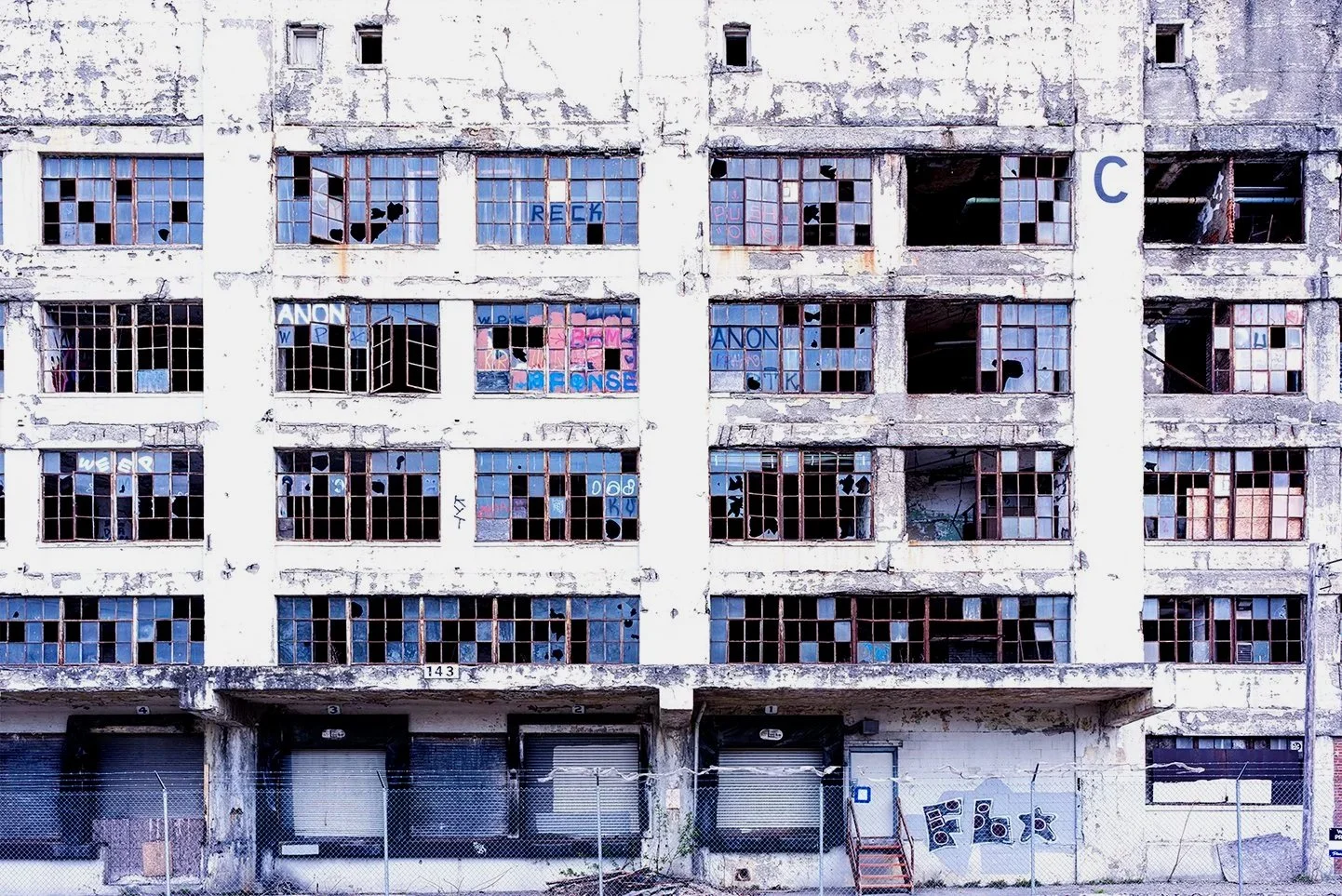
Central Warehouse
Kevin LeDuc
Central Warehouse, c 1927
Albany, Albany County, New York from the Ballyshannon’s Rustland (2021–2024) – Monumentality Portfolio
Pigment print on Hahnemühle Baryta
Artist’s proof + edition of 5 (portfolio of 40 images)
30 × 45 inches
-
The Rise, Decline, and Demolition of the Central Warehouse in Albany, New York
The towering concrete structure known as the Central Warehouse stands as one of the most recognizable remnants of Albany’s industrial past. Constructed in 1927 by the New York Central Railroad, the building was designed as a state-of-the-art refrigerated storage facility serving the rail-based distribution economy of the early twentieth century.¹ Located in Albany’s North Albany railroad district at the intersection of Colonie and Montgomery Streets, the warehouse featured an eleven-story reinforced concrete frame, with walls reportedly up to three feet thick.² A rail spur entered directly onto the second floor, facilitating transfer of goods from train to storage, while ground-level truck bays allowed regional distribution.³ Its refrigeration system employed ammonia, a standard but hazardous coolant at the time, providing millions of cubic feet of storage space for perishable goods such as potatoes, dairy, and meat.⁴
In its early decades, Central Warehouse was among the largest cold storage facilities in the northeastern United States.⁵ During the Great Depression, its cold storage space was repurposed to assist in relief efforts, distributing food to urban populations in need.⁶ At its operational peak, the warehouse employed several hundred workers, reflecting its significance within Albany’s rail-age distribution economy.⁷
Ownership of the warehouse shifted multiple times. In 1969, Connecticut Cold Storage acquired the facility but later faced financial difficulties, resulting in foreclosure.⁸ Subsequently, the New York State Teachers Retirement System assumed control in 1978.⁹ In 1980, developer Richard Gerrity purchased the property, but occupancy declined, and the building functioned at roughly two-thirds capacity by the early 1980s.¹⁰ During this period, the warehouse also became a visible roadside landmark and advertising space, signaling a transition from industrial hub to urban spectacle.¹¹
By the early 1990s, rail-based refrigerated distribution had largely been supplanted by trucking and decentralized storage closer to population centers. Central Warehouse ceased operations and was abandoned, initiating a prolonged period of neglect.¹² Ice accumulation on the upper floors in 1996 revealed persistent risks associated with obsolete refrigeration systems, which were subsequently deactivated.¹³ A major fire in 2010 further damaged the interior, emphasizing the building’s deteriorating condition.¹⁴
The property continued to change hands over the following decades, often for nominal sums with unpaid taxes, reflecting the financial burden of maintenance and the challenges of repurposing such a specialized industrial facility.¹⁵ Portions of the concrete structure began to fail, leading to a 2022 state of emergency declaration after debris fell onto adjacent Amtrak tracks, temporarily disrupting service.¹⁶ That same year, the property entered foreclosure and was acquired by Albany County, marking a pivotal transition from private to public stewardship.¹⁷
Following legal proceedings in 2025, the New York State Supreme Court authorized demolition, overcoming barriers that had previously prevented removal of one of Albany’s most prominent urban blights.¹⁸ In August 2025, demolition commenced under the supervision of Governor Kathy Hochul, with careful attention to asbestos abatement and the building’s proximity to active rail lines.¹⁹ The process is expected to continue into 2026–2027 due to its technical complexity.²⁰
The trajectory of Central Warehouse reflects broader narratives in American industrial history: the rise of rail-centric logistics infrastructure in the interwar period, mid-century shifts to trucking and decentralized storage, and contemporary challenges of preserving industrial heritage while accommodating urban redevelopment.²¹ Once celebrated for its modern construction and strategic function, the warehouse ultimately became a symbol of economic transition and urban decay, necessitating a carefully managed removal that balances historical significance with public safety.²²
Footnotes
Albany’s Central Warehouse Demolition OK’d: Once a Modern Cold Storage Facility, New York Almanack, July 13, 2025, 1–2.
Albany’s Central Warehouse Demolition OK’d, 1.
Albany’s Central Warehouse Demolition OK’d, 1.
Albany’s Central Warehouse Demolition OK’d, 2.
Albany County Department of Public Works, Central Warehouse Structural Assessment Report (Albany, NY: Albany County, 2023).
William H. Wilson, The City Beautiful Movement (Baltimore: Johns Hopkins University Press, 1989), 214–216.
Albany County Legislature, Proceedings and Property Records Relating to Central Warehouse (Albany, NY, 2022).
Albany’s Central Warehouse Demolition OK’d, 2.
Albany’s Central Warehouse Demolition OK’d, 2.
Albany’s Central Warehouse Demolition OK’d, 2.
Albany’s Central Warehouse Demolition OK’d, 2.
New York State Department of Environmental Conservation, Environmental Site Review: Central Warehouse (Albany, NY, 2019).
Albany’s Central Warehouse Demolition OK’d, 2.
Albany Fire Department, Incident Report: Central Warehouse Fire (Albany, NY, 2010).
Albany’s Central Warehouse Demolition OK’d, 2–3.
New York State Department of Transportation, Emergency Infrastructure Report: Rail Disruption near Central Warehouse (Albany, NY, 2022).
Albany’s Central Warehouse Demolition OK’d, 3.
Albany’s Central Warehouse Demolition OK’d, 1.
Office of the Governor of New York, Press Release on Central Warehouse Demolition Initiative (Albany, NY, August 19, 2025).
Albany County executive says Central Warehouse won’t come down until 2027, WAMC Northeast Public Radio, December 29, 2025.
Albany’s Central Warehouse Demolition OK’d, 2.
Wilson, The City Beautiful Movement, 214–216.
Bibliography
Albany County Department of Public Works. Central Warehouse Structural Assessment Report. Albany, NY: Albany County, 2023.
Albany County Legislature. Proceedings and Property Records Relating to Central Warehouse. Albany, NY, 2022.
Albany Fire Department. Incident Report: Central Warehouse Fire. Albany, NY, 2010.
New York State Department of Environmental Conservation. Environmental Site Review: Central Warehouse. Albany, NY, 2019.
New York State Department of Transportation. Emergency Infrastructure Report: Rail Disruption near Central Warehouse. Albany, NY, 2022.
Office of the Governor of New York. Press Release on Central Warehouse Demolition Initiative. Albany, NY, August 19, 2025.
Albany’s Central Warehouse Demolition OK’d: Once a Modern Cold Storage Facility. New York Almanack. July 13, 2025.
Albany County executive says Central Warehouse won’t come down until 2027. WAMC Northeast Public Radio. December 29, 2025.
Wilson, William H. The City Beautiful Movement. Baltimore: Johns Hopkins University Press, 1989.