H.M. & B. Hall's Mill Complex, c. 1884
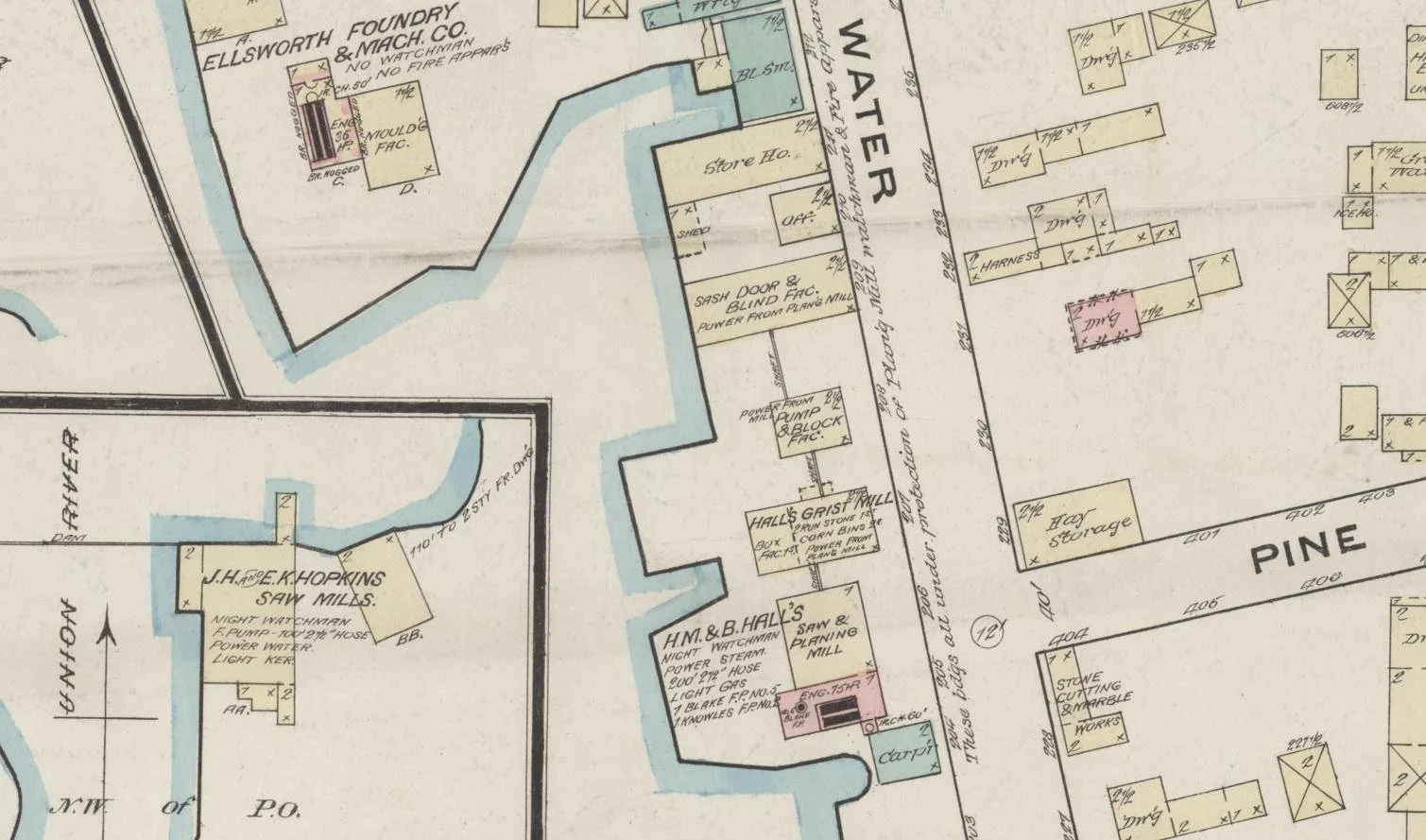
H.M. & B. Hall's Mill Complex, c. 1884
205-211 Water & Pine Street Block Ellsworth, Hancock County, Maine
From the Echoes, Still: Maine's Industrial Remnants Collection (2024–2028)
Empty Empires Portfolio
Historical Narrative
H. M. & B. Hall’s Grist Mill: A Water Street Milling Enterprise in Ellsworth, Hancock County, Maine
Kevin LeDuc Pigment print on Hahnemühle Baryta Edition of 5 + 1 Artist's Proof (Portfolio of 40 Images)
Paper Size: 40 × 55 inches Image Size: 31.33 × 37 inches Borders: Approximately 4 inches (All Sides)
Historic Significance
Albert H. Davis identifies Barlow Hall (1797–1884) as the father of the Hall brothers and states that "his sons constituted the firm of H. M. & B. Hall." This establishes that the "B." in H. M. & B. Hall was Barlow Hall, Jr., and that the partnership was a family business rather than an unrelated commercial partnership.
Davis also documents the scale of the Hall enterprise. By the 1870s the firm had become the largest industrial concern in Ellsworth, operating multiple mills, stores, and coastal vessels while employing approximately 500 workmen. In 1870 alone, H. M. & B. Hall manufactured approximately 14 million board feet of lumber and paid roughly $90,000 in wages, illustrating the financial resources available to support subsidiary operations such as the Water Street grist mill.
One additional source records that the Hall firm also owned a stave mill, which suffered a fire loss in 1885 valued at $6,000. This further demonstrates that the partnership diversified into multiple wood-processing industries in addition to lumber and grain milling
Historical Narrative
-
H. M. & B. Hall’s Grist Mill: A Water Street Milling Enterprise in Ellsworth, Hancock County, Maine
Part I — Founding, Hall Ownership, and Industrial Development
The H. M. & B. Hall Grist Mill on Water Street in Ellsworth, Hancock County, Maine, was an important grain-processing operation that existed within one of the town’s largest nineteenth-century industrial complexes. Unlike a small rural grist mill serving only nearby farms, the Hall mill was part of a diversified manufacturing enterprise that combined lumber production, woodworking, grain processing, storage, and transportation. Its history reflects the transition of Maine industry from locally operated mills into larger business organizations capable of managing several related manufacturing operations.¹
The origins of the Water Street grist mill preceded the Hall partnership. According to Albert H. Davis’s History of Ellsworth, Maine, the mill was established by brothers Sewall T. Royal and Samuel Royal. Sewall T. Royal had previously worked at sea before returning to Ellsworth, where he and his brother developed the grist mill enterprise. The Royal brothers operated the mill before eventually selling the business to H. M. & B. Hall.²
After the sale, Sewall T. Royal continued managing the mill for H. M. & B. Hall for many years. This arrangement provided continuity between the original local operators and the new ownership group. Royal’s continued involvement indicates that the Hall partnership valued his experience and knowledge of the milling trade, even after acquiring ownership of the property.³
The purchasers, H. M. & B. Hall, were among the most prominent industrial businessmen in nineteenth-century Ellsworth. The partnership consisted of Henry Martyn Hall and Barlow Hall, members of a well-established Hancock County family. The firm became one of the largest industrial enterprises in the region, operating lumber mills, vessels, stores, and other manufacturing interests.⁴
The acquisition of the grist mill fit into the Hall partnership’s larger business strategy. Their operations depended upon a large workforce and extensive transportation networks, and the addition of grain processing created another year-round commercial activity. The grist mill supplied flour, meal, and feed products while the firm’s lumber operations produced building materials and manufactured wood products.⁵
The 1884 Sanborn Fire Insurance Map of Ellsworth, Sheet 1, provides important evidence of the scale of the Hall Water Street complex. The map identifies a group of related buildings including:
Saw Mill
Grist Mill
Pump & Block Factory
Sash, Door & Blind Factory
Store House
The grist mill was therefore not an isolated structure but one component of a large integrated manufacturing property.⁶
The same 1884 Sanborn map also identifies Ellsworth Foundry & Machine Company operating separately along the Union River. This distinction is important because the foundry was not created after the decline of the Hall complex; it was already an established neighboring industrial operation. The Water Street area contained multiple independent businesses operating alongside one another.⁷
The 1889 Sanborn Fire Insurance Map, Sheet 3, confirms that the Hall industrial complex continued operating during the late nineteenth century. The grist mill remained part of the active manufacturing property, alongside the lumber and woodworking facilities. At this time, the Hall enterprise represented the continuation of an older Maine industrial model based on river transportation, mechanical power, and processing of locally available resources.⁸
The grist mill’s primary function was converting grain into usable food products. Typical products of this type of mill included wheat flour, corn meal, and animal feed. Farmers and merchants could purchase finished products, while local agricultural customers could bring grain for custom processing. The mill provided an essential service before large centralized flour producers dominated regional markets.⁹
The technology of the Hall grist mill would have reflected common nineteenth-century milling practices, including grain cleaning, grinding, and bolting. Grain was reduced by millstones and then passed through bolting machinery to separate different grades of flour and meal. The surviving Sanborn maps confirm the continued presence of the mill but do not identify the exact nineteenth-century machinery installed before the twentieth-century modernization documented later.¹⁰
By the end of the nineteenth century, the Hall industrial complex began to separate into individual businesses. The large integrated operation created by H. M. & B. Hall did not remain intact indefinitely. Ownership changes and changing industrial conditions resulted in different parts of the property being operated by separate firms.¹¹
By 1901, the Sanborn Fire Insurance Map, Sheet 3, identifies Greely & Brady as operating the former Hall Saw & Planing Mill and Grist Mill. The grist mill itself had been modernized and was recorded as a 2½-story building powered by an electric motor. Its equipment included one roller mill, one run of stones, one bolting machine, and corn bins located on the second floor.¹²
This equipment demonstrates that the grist mill had adapted to changing milling technology. The combination of a roller mill with traditional millstones shows a transitional operation that used newer equipment while retaining older methods where practical. The bolting machine and grain storage facilities indicate that the mill remained a commercial grain-processing facility rather than a small custom farm mill.¹³
Part II — Greely & Brady, H. F. Bailey & Company, Decline, and Closure
The beginning of the twentieth century marked a period of transition for the Water Street industrial complex. Although the original H. M. & B. Hall enterprise had once combined numerous manufacturing operations under one ownership, the property had gradually been divided among separate businesses. The grist mill survived this transition longer than several of the associated lumber operations, continuing as an active milling business after the decline of the Saw & Planing Mill.¹⁴
The 1901 Sanborn Fire Insurance Map, Sheet 3, identifies Greely & Brady as operators of the former Hall Saw & Planing Mill and Grist Mill. The map provides unusually detailed information about the grist mill itself. The building was listed as a 2½-story structure powered by an electric motor, showing that the operation had adopted modern power technology by the beginning of the twentieth century.¹⁵
The machinery listed for the 1901 grist mill included:
one roller mill,
one run of stones,
one bolting machine,
corn bins located on the second floor.¹⁶
This combination of machinery illustrates a transitional period in milling technology. The roller mill represented newer industrial milling methods that were becoming common throughout the United States, while the continued use of a run of stones shows that traditional grinding methods still remained useful for certain products. The bolting machine allowed the mill to separate ground material into grades, while second-floor corn bins provided storage and gravity-fed movement of grain through the milling process.¹⁷
At the same time that the grist mill continued operating, the Saw & Planing Mill began to decline. The 1901 map still identifies Greely & Brady as operating the Saw & Planing Mill, but by the 1907 Sanborn Fire Insurance Map, Sheet 3, the building at 204–205 Water Street was listed as vacant. This indicates that the lumber-processing branch of the former Hall complex ended between 1901 and 1907.¹⁸
The decline of the Saw & Planing Mill occurred before the closure of the grist mill. The two businesses followed different paths: lumber production ended first, while grain milling continued under new ownership. This distinction is important because it demonstrates that the Water Street industrial complex did not disappear all at once; individual operations survived or declined according to their own economic conditions.¹⁹
By 1907, the Sanborn map identifies the Grist Mill under new ownership of H. F. Bailey & Company. This establishes that Greely & Brady no longer controlled the milling operation, but the grist mill itself remained active after the disappearance of the Saw & Planing Mill. The change demonstrates continued demand for local grain processing even as the older lumber economy weakened.²⁰
The H. F. Bailey & Company period represents the final documented operating phase of the Water Street grist mill. The available Sanborn evidence does not provide production totals, employee numbers, or detailed ownership records for Bailey’s operation, but it confirms that the building continued functioning as a grist mill after 1907.²¹
By September 1914, however, the Sanborn Fire Insurance Map, Sheet 5, records the end of the milling operation. The former grist mill building at 207 Water Street was listed as vacant. The former Saw & Planing Mill at 204–205 Water Street was also vacant, as were several associated buildings:
208 Water Street — Carriage Shop
209 Water Street — Carriage Repository and Paint Shop
210 Water Street — Lumber Storage
211 Water Street — Grain Storage.²²
The 1914 map demonstrates that the decline of the former Hall industrial complex was complete by this time. The grist mill had survived longer than the lumber-processing operation, but by 1914 grain milling had ended at the site. The building remained standing, but it no longer served its original manufacturing purpose.²³
The decline of the Water Street grist mill occurred during a broader transformation of the industrial district. Importantly, Ellsworth Foundry & Machine Company was not a replacement for the grist mill. The foundry had already existed as an independent industrial operation along the Union River since at least the 1884 Sanborn map and continued operating throughout the period when the Hall complex declined.²⁴
The 1907 Sanborn map shows Ellsworth Foundry continuing in essentially the same location and size as earlier maps. By 1914, the Sanborn map identifies the company as Ellsworth Foundry & Machine Works, reflecting an expanded industrial operation rather than a new business. The company occupied a larger complex that included foundry facilities, machine shops, pattern-making areas, woodworking space, offices, boat storage, and marine railways.²⁵
The history of H. M. & B. Hall’s Grist Mill therefore represents a gradual transition in Ellsworth manufacturing. Founded by Sewall and Samuel Royal, expanded under H. M. & B. Hall, operated by Greely & Brady in 1901, transferred to H. F. Bailey & Company by 1907, and vacant by September 1914, the mill followed a long path of ownership changes and technological adaptation. Its decline occurred alongside, but not because of, the growth of Ellsworth Foundry & Machine Works. Instead, the Sanborn maps reveal a changing industrial landscape in which older lumber and grain-processing businesses declined while newer machine and marine industries expanded.
Footnotes
Albert H. Davis, History of Ellsworth, Maine (Ellsworth, ME: published by the author, 1927), account of the Royal brothers, H. M. & B. Hall, and the Water Street industrial complex.
Ibid., biographical sketch of Sewall Tenney Royal, describing his establishment of the grist mill with his brother Samuel Royal and the later sale of the mill to H. M. & B. Hall.
Ibid., noting that Sewall T. Royal continued operating the grist mill for H. M. & B. Hall after the ownership transfer.
Ibid., biographical sketch of Henry Martyn Hall and Barlow Hall, describing the formation and growth of the H. M. & B. Hall partnership.
Ibid.; discussion of H. M. & B. Hall’s diversified business interests, including lumber mills, vessels, stores, and other manufacturing operations.
Sanborn Map Company, Insurance Map of Ellsworth, Maine (New York: Sanborn Map Company, 1884), Sheet 1, identifying the Water Street complex containing the Saw Mill, Grist Mill, Pump & Block Factory, Sash, Door & Blind Factory, and Store House.
Ibid., identifying Ellsworth Foundry & Machine Company as a separate industrial operation along the Union River.
Sanborn Map Company, Insurance Map of Ellsworth, Maine (New York: Sanborn Map Company, 1889), Sheet 3, showing the continued operation of the Water Street industrial complex.
Albert H. Davis, History of Ellsworth, Maine, discussion of nineteenth-century Ellsworth industries and commercial activity.
General descriptions of nineteenth-century New England grist milling technology; see also Sanborn Map Company, Insurance Map of Ellsworth, Maine, 1884, Sheet 1.
Comparison of Sanborn Map Company maps of Ellsworth, 1884, 1889, and 1901, showing the transition from a unified Hall industrial complex to separate business operations.
Sanborn Map Company, Insurance Map of Ellsworth, Maine (New York: Sanborn Map Company, 1901), Sheet 3, identifying Greely & Brady as operators of the Saw & Planing Mill and Grist Mill and documenting the grist mill’s 2½-story structure, electric motor power, roller mill, run of stones, bolting machine, and corn bins.
Ibid., documenting the modernization of the grist mill equipment and its continued operation as a commercial milling facility.
Albert H. Davis, History of Ellsworth, Maine (Ellsworth, ME, 1927), historical account of Sewall T. Royal and the Water Street grist mill.
Sanborn Map Company, Insurance Map of Ellsworth, Maine, 1901, Sheet 3.
Ibid.
General milling technology references; Sanborn Map Company, Insurance Map of Ellsworth, Maine, 1901, Sheet 3.
Sanborn Map Company, Insurance Map of Ellsworth, Maine, 1901, Sheet 3; Sanborn Map Company, Insurance Map of Ellsworth, Maine, 1907, Sheet 3.
Comparison of Sanborn maps, 1901 and 1907.
Sanborn Map Company, Insurance Map of Ellsworth, Maine, 1907, Sheet 3.
Ibid.
Sanborn Map Company, Insurance Map of Ellsworth, Maine, 1914, Sheet 5.
Ibid.
Sanborn Map Company, Insurance Map of Ellsworth, Maine, 1884, Sheet 1; 1889, Sheet 3; 1907, Sheet 3.
Sanborn Map Company, Insurance Map of Ellsworth, Maine, 1914, Sheet 5.
Bibliography
Primary Sources
Davis, Albert H. History of Ellsworth, Maine. Ellsworth, Maine, 1927.
Sanborn Map Company. Insurance Map of Ellsworth, Maine. New York: Sanborn Map Company, 1884.
Sanborn Map Company. Insurance Map of Ellsworth, Maine. New York: Sanborn Map Company, 1889.
Sanborn Map Company. Insurance Map of Ellsworth, Maine. New York: Sanborn Map Company, 1901.
Sanborn Map Company. Insurance Map of Ellsworth, Maine. New York: Sanborn Map Company, 1907.
Sanborn Map Company. Insurance Map of Ellsworth, Maine. New York: Sanborn Map Company, 1914.
United States Census Records, Ellsworth, Hancock County, Maine.
Secondary Sources
Maine Historic Preservation Commission. Publications on Maine industrial history and nineteenth-century manufacturing.
Studies of New England milling, lumber production, and industrial development.
-
Albert H. Davis identifies Barlow Hall (1797–1884) as the father of the Hall brothers and states that "his sons constituted the firm of H. M. & B. Hall." This establishes that the "B." in H. M. & B. Hall was Barlow Hall, Jr., and that the partnership was a family business rather than an unrelated commercial partnership.
Davis also documents the scale of the Hall enterprise. By the 1870s the firm had become the largest industrial concern in Ellsworth, operating multiple mills, stores, and coastal vessels while employing approximately 500 workmen. In 1870 alone, H. M. & B. Hall manufactured approximately 14 million board feet of lumber and paid roughly $90,000 in wages, illustrating the financial resources available to support subsidiary operations such as the Water Street grist mill.
One additional source records that the Hall firm also owned a stave mill, which suffered a fire loss in 1885 valued at $6,000. This further demonstrates that the partnership diversified into multiple wood-processing industries in addition to lumber and grain milling