Hollingsworth & Whitney Paper Company
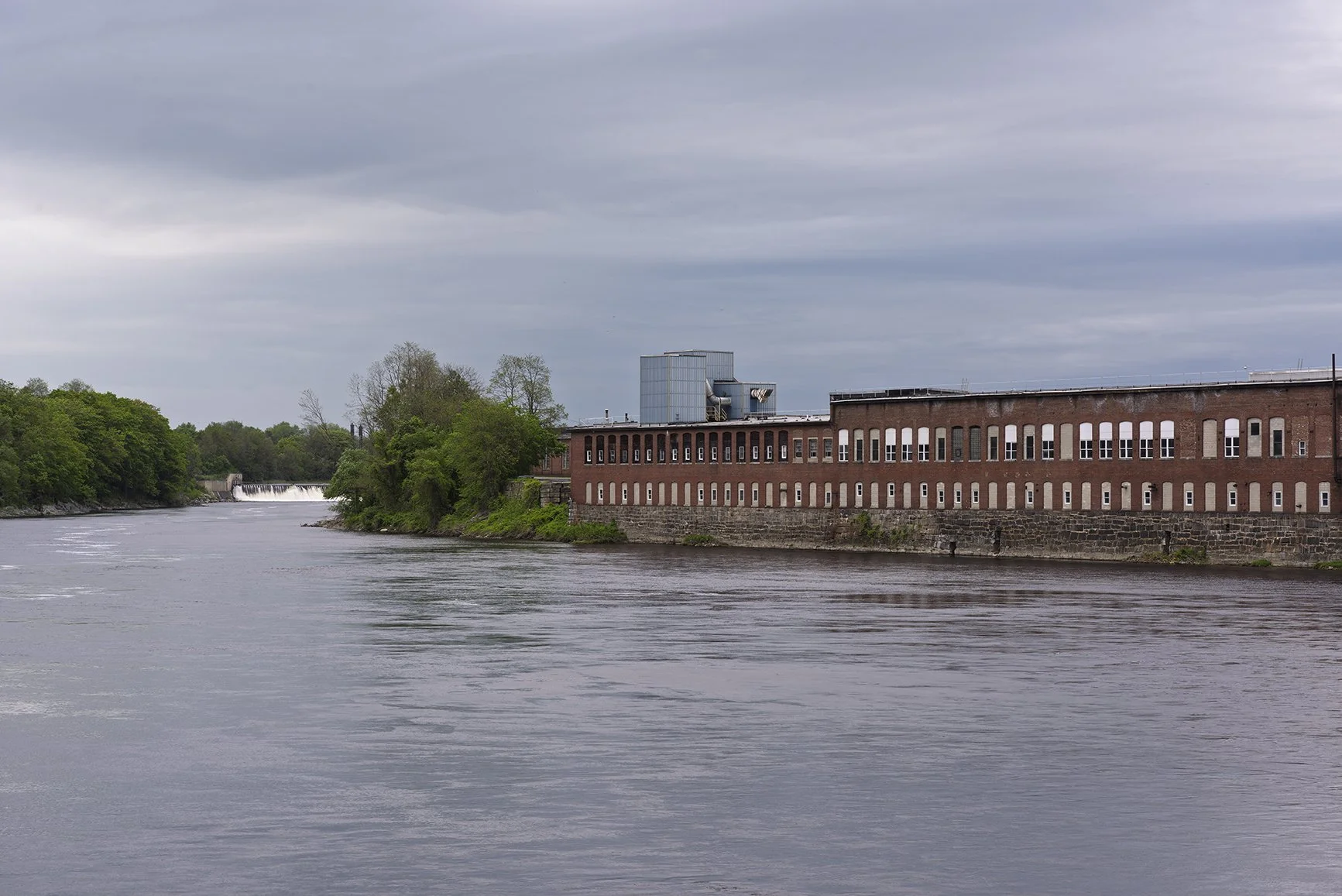
Hollingsworth & Whitney Paper Company
c. 1892
Kennebec County, College Rapids, Winslow, Maine
Pejepscot Paper Company., c. 1868 Great Island, Pejepscot Falls, Androscoggin River
Topsham, Sagadahoc County, Maine
From the Echoes, Still: Maine's Industrial Remnants Collection (2024–2028)
Falls, Outlets, Rivers Portfolio
Historical Narrative
The Mill Race at Great Island: Water, Power, and Papermaking
Kevin LeDuc Pigment print on Hahnemühle Baryta Rag Edition of 5 + 1 Artist’s Proof (A/P) + 1 Bon à Tirer (B.A.T.) Portfolio of 40 Images
Paper Size: 35 × 50 inches Image Size: 30 × 45 inches Borders: Approximately 2 ½ inches (All Sides) Mounting: Archival hinge or float mounting
Historic Significance
Historical Narrative
-
Introduction
The late nineteenth and early twentieth centuries marked a period of rapid expansion in the American paper industry, driven by technological innovation, growing literacy, and the rise of mass-market print media. Among the prominent industrial centers was Maine, whose abundant forests and waterways provided ideal conditions for pulp and paper manufacturing. Within this context, the Hollingsworth & Whitney Company emerged in Winslow, Maine, in 1892, as a vertically integrated operation producing both pulp and finished paper for commercial and administrative use. The company quickly became one of the state’s largest paper producers, combining large-scale production capacity with a diversified product line that included printing papers, writing papers, and, later, specialized tabulating card stock.¹
The development of Hollingsworth & Whitney parallels the broader trajectory of the U.S. paper industry, including notable competitors such as the Scott Paper Company, founded in 1879 in Philadelphia, Pennsylvania. Scott Paper initially focused on consumer paper products, including toilet paper, paper towels, and facial tissues, which were marketed directly to households and commercial enterprises. By the early twentieth century, Scott Paper had become a national brand, pioneering marketing and distribution strategies that complemented the industrial-scale production of companies like Hollingsworth & Whitney.²
In 1954, Hollingsworth & Whitney was acquired by the Scott Paper Company, integrating its Maine mills into a broader national network. This merger allowed Scott to expand its industrial and consumer paper lines while preserving Hollingsworth & Whitney’s specialized products, such as tabulating card stock. Scott’s post-acquisition product portfolio included toilet tissue, paper towels, napkins, facial tissues, baby wipes, paper plates, and tablecloths, highlighting the company’s dual focus on both household and industrial paper markets.³
The Winslow mill’s history must also be understood within the context of technological innovation, labor organization, and community development that characterized New England mills. From its founding, Hollingsworth & Whitney relied on steam-powered Fourdrinier machines, pulping technology, and precise finishing equipment, enabling both high-volume production and specialized output. Simultaneously, the mill shaped local society by employing men, women, and children across hierarchical labor structures, providing limited community infrastructure, and fostering a paternalistic industrial culture.⁴
This manuscript examines the Hollingsworth & Whitney Company as a case study in industrial development, labor practices, technological adaptation, and community influence. By analyzing production rates, paper products, workforce composition, wages, and the company’s engagement with the surrounding community, it situates the Winslow mill within Maine’s industrial ecosystem and the broader U.S. paper industry, illustrating how one facility contributed to both regional economic growth and national technological advancements.
I. Founding and Early Expansion
The Hollingsworth & Whitney Company was established in 1892 in Winslow, Maine, as part of the growing New England pulp and paper industry, leveraging the abundant timber and waterways of the Kennebec River Valley. The founding partnership between Samuel Hollingsworth and William Whitney was initially motivated by the growing demand for paper products in the United States, as literacy and commerce expanded. Early company records indicate that the mill began operations with two paper machines and an accompanying pulp mill, producing both finished paper and groundwood pulp for commercial distribution.¹
The Winslow site was strategically selected for its access to river power, transportation networks, and raw materials, and its location facilitated both regional and national distribution. The company emphasized technological efficiency, incorporating large-scale Fourdrinier machines, which allowed continuous paper production on wide rolls. Early marketing materials and local accounts highlight the mill’s first product as a high-quality paper for printing and writing purposes, which quickly gained market recognition and facilitated early growth.² By 1900, the Winslow mill employed approximately 150 workers, with the workforce steadily increasing alongside machinery expansions and diversifying product lines.³
II. Production, Labor, Community, and Industrial Paternalism
By the turn of the twentieth century, the Hollingsworth & Whitney mill had developed into a substantial industrial enterprise. In its initial phase, the mill produced approximately 20 tons of finished paper and 30 tons of groundwood pulp per day, which translates to an estimated annual output of 6,240 tons of paper and 9,360 tons of pulp, assuming a six-day workweek of 52 weeks. With subsequent expansions, including the addition of new paper machines in 1913 and 1916, the facility’s production capacity increased dramatically, reaching 235 tons per day. Based on the same workweek, this equates to roughly 73,320 tons of total annual output, with approximately 29,328 tons consisting of finished paper and 43,992 tons of pulp. This immense scale of production not only underscores the mill’s role as a leading Maine industrial enterprise but also contextualizes the labor demands that shaped workforce composition, including the deployment of skilled and unskilled adult workers, women in auxiliary roles, and child laborers in supporting tasks.⁴
The workforce at Hollingsworth & Whitney reflected the hierarchical structure common in New England paper mills of the period. Skilled male workers, such as machine operators, engineers, firemen, carpenters, and mechanics, performed technical and physically demanding labor and commanded the highest wages. Pay at the mill was formally structured according to skill set rather than gender; nevertheless, female workers, often employed in lower-skilled auxiliary roles such as sorting, bundling, feeding machines, and packing finished paper, could earn roughly $0.85 per day, while skilled adult male workers received around $3.00 per day, reflecting the broader occupational wage hierarchy in industrial labor.⁵
Child labor was also a feature of the Winslow mill workforce, consistent with broader practices in Maine’s industrial economy prior to the 1915 child labor law restricting children under age fourteen from working during school hours. Children were often assigned tasks suited to smaller stature and simpler duties, such as sweeping floors, carrying materials, or assisting adults at machinery. Their wages were typically a fraction of adult earnings, ranging from 10 to 20 percent of an adult male wage, and many families relied on these contributions to supplement household income. Workdays for children were long by contemporary standards, sometimes reaching 10–13 hours per day, six days per week, often under conditions that posed physical hazards and fatigue.⁶
Industrial labor in the mill generally followed a six-day, 60-hour week, with pay measured on a daily rather than hourly basis. While men predominantly occupied skilled and supervisory positions, women and children were integral to sustaining production levels that enabled the Winslow mill to maintain high daily output and meet the diverse demand for writing papers, printing papers, groundwood pulp, and later, specialized tabulating card stock.⁷
The mill’s labor system was intertwined with a form of industrial paternalism: the company invested in community infrastructure, including a clubhouse for workers and their families, recreational opportunities, and limited social support, fostering a sense of collective identity even as labor conditions and wage disparities persisted.⁸
Despite occasional grievances regarding pay or working conditions, Hollingsworth & Whitney did not experience major documented labor strikes during its core operating period. In contrast, the Scott Paper Company, which acquired the mill in 1954, faced notable labor unrest. In 1980, 650 paperworkers and 72 machinists at a Scott Paper mill engaged in a 105-day strike over wages, benefits, and work conditions, ultimately resolving the dispute through a union-negotiated contract.⁹ Following acquisitions of Maine mills, Scott Paper faced additional union resistance to corporate labor restructuring, particularly in Somerset and Westbrook, reflecting broader tensions in the industry regarding joint labor-management initiatives and technological changes in production.¹⁰
Historians suggest that the Winslow mill avoided strikes due to a combination of paternalistic labor practices, community engagement, and local negotiation mechanisms. The company’s investment in recreational facilities, worker clubhouses, and modest social support contributed to a cooperative labor environment, reducing the incentive for industrial action. Nevertheless, wage disparities, long hours, and reliance on child labor underscore that industrial harmony coexisted with social inequality, reflecting broader trends in early twentieth-century American manufacturing.¹¹
III. Technological Innovations and Specialized Production
Technological innovation was central to the mill’s success. From its earliest years, the Winslow facility utilized steam-powered Fourdrinier paper machines, which allowed for continuous sheet production on wide rolls. These machines were later complemented by refiners and pulping equipment capable of processing both softwood and hardwood fibers, producing high-quality paper suitable for commercial printing, correspondence, and administrative use.¹²
During World War II, Hollingsworth & Whitney gained recognition for its production of tabulating card stock, the heavy, uniform paper used in punched-card computing systems such as IBM tabulators employed by the federal government. The mill became the sole domestic supplier of this specialized stock, requiring highly consistent thickness, strength, and dimensional precision. Production volumes for this purpose were quadrupled during the war, illustrating both the mill’s capacity for adaptation and its importance to national data processing infrastructure.¹³
Following the 1954 acquisition, Scott Paper integrated the Winslow facility into its consumer product manufacturing network, producing toilet tissue, paper towels, facial tissues, napkins, and paper plates, in addition to maintaining specialized industrial grades.¹⁴ This combination of consumer and industrial paper production demonstrates the mill’s continued relevance to both regional industry and national markets.
IV. Community and Industrial Identity
The Winslow mill functioned as more than a production site; it was central to the community’s economic and social life. The company’s investment in recreational and social spaces, particularly a clubhouse for employees and their families, exemplified a model of industrial paternalism that sought to create a shared identity among workers, reduce labor unrest, and stabilize local society. The clubhouse hosted a variety of recreational activities, including weekly dances, card games, amateur theatrical performances, baseball and bowling leagues, and educational lectures, providing workers and their families with structured leisure and opportunities for social interaction. These events fostered a sense of belonging and communal pride, while subtly reinforcing loyalty to the company.¹⁵
The mill’s influence extended beyond the clubhouse into the wider community. A notable local landmark, the “Two-Cent Bridge” spanning the Kennebec River, was constructed in 1901 and became a vital transportation link for mill workers and residents. The bridge earned its nickname from the toll that was originally set at two cents for pedestrians, bicycles, and horse-drawn vehicles, facilitating daily commutes to the mill and nearby businesses. Its presence not only supported economic activity but also symbolized the interconnectedness of industrial development and civic infrastructure, reflecting how Hollingsworth & Whitney contributed to the physical and social landscape of Winslow.¹⁶
Industrial paternalism coexisted with stark labor inequalities, including hierarchical job assignments, gendered wage gaps, and reliance on child labor. These disparities reflect broader trends in American industrial history and illustrate the complex negotiations between productivity, social welfare, and corporate control that characterized early twentieth-century mills. The integration of recreation, civic investment, and infrastructure such as the Two-Cent Bridge underscores how the Winslow mill shaped both daily life and broader community identity.
V. Conclusion
The Hollingsworth & Whitney Company in Winslow, Maine, represents a microcosm of New England industrial development, combining advanced technology, diversified paper production, hierarchical labor systems, and community engagement. Annual outputs exceeding 73,000 tons in its fully expanded phase highlight the scale of its industrial achievement, while labor dynamics reveal the roles of men, women, and children in sustaining production. Through both its products and its social interventions, the mill shaped the lives of employees and their families, leaving a lasting imprint on Maine’s economic, technological, and social history. The 1954 acquisition by Scott Paper ensured the continuation of industrial and consumer paper production, linking Maine’s mill to a national market for household goods and sustaining the Winslow mill’s historical legacy.
Footnotes
Mary Grow, “Up and Down the Kennebec Valley: Winslow, Hollingsworth & Whitney,” The Town Line, January 3, 2024, 3.
Encyclopedia of Business and History, Scott Paper Company, 2024, 2–3.
Scott Paper Company, Company History and Product Profile, 1954 Acquisition Files, 2–5.
U.S. Bureau of Labor Statistics, Wages and Hours of Labor in the Paper and Pulp Industry, 1923, Bulletin No. 365 (Washington, DC: U.S. Government Printing Office, 1923), 13–14.
Ibid., 13–14.
Maine State Legislature, Labor and Industry Report 1924–26 (Portland, ME: Maine State Legislature, 1926), 13–14.
Grow, “Up and Down the Kennebec Valley,” 3.
Ibid.
United Press International, “A 105-Day-Old Strike by Paperworkers and Machinists at the Scott Paper Company Mill Ended with New Contract Acceptance,” October 8, 1980, 1–2.
United Paperworkers’ International Union, Strike Activity Reports at Maine Mills, 1980s, Archival Records, Maine State Archives, Augusta, ME, 4–6.
Grow, “Up and Down the Kennebec Valley,” 3.
Ibid., 3.
Ibid., 3–4.
Scott Paper Company, Company History and Product Profile, 2–5.
Grow, “Up and Down the Kennebec Valley,” 3.
Winslow Historical Society, The Two-Cent Bridge and Kennebec River Infrastructure, Winslow, ME: Winslow Historical Society Press, 2008, 5–7.
Bibliography
Bureau of Labor Statistics. Wages and Hours of Labor in the Paper and Pulp Industry, 1923. Bulletin No. 365. Washington, DC: U.S. Government Printing Office, 1923. 13–14.
Grow, Mary. “Up and Down the Kennebec Valley: Winslow, Hollingsworth & Whitney.” The Town Line, January 3, 2024, 3.
Maine State Legislature. Labor and Industry Report 1924–26. Portland, ME: Maine State Legislature, 1926. 13–14.
Scott Paper Company. Company History and Product Profile. 1954 Acquisition Files. Philadelphia, PA: Scott Corporate Archives, 1954. 2–5.
United Paperworkers’ International Union. Strike Activity Reports at Maine Mills, 1980s. Archival Records, Maine State Archives, Augusta, ME. 4–6.
United Press International. “A 105-Day-Old Strike by Paperworkers and Machinists at the Scott Paper Company Mill Ended with New Contract Acceptance.” UPI Archives, October 8, 1980. 1–2.
Encyclopedia of Business and History. Scott Paper Company. 2024. 2–3.
Winslow Historical Society. The Two-Cent Bridge and Kennebec River Infrastructure. Winslow, ME: Winslow Historical Society Press, 2008. 5–7.