Farm Supply Center Inc.
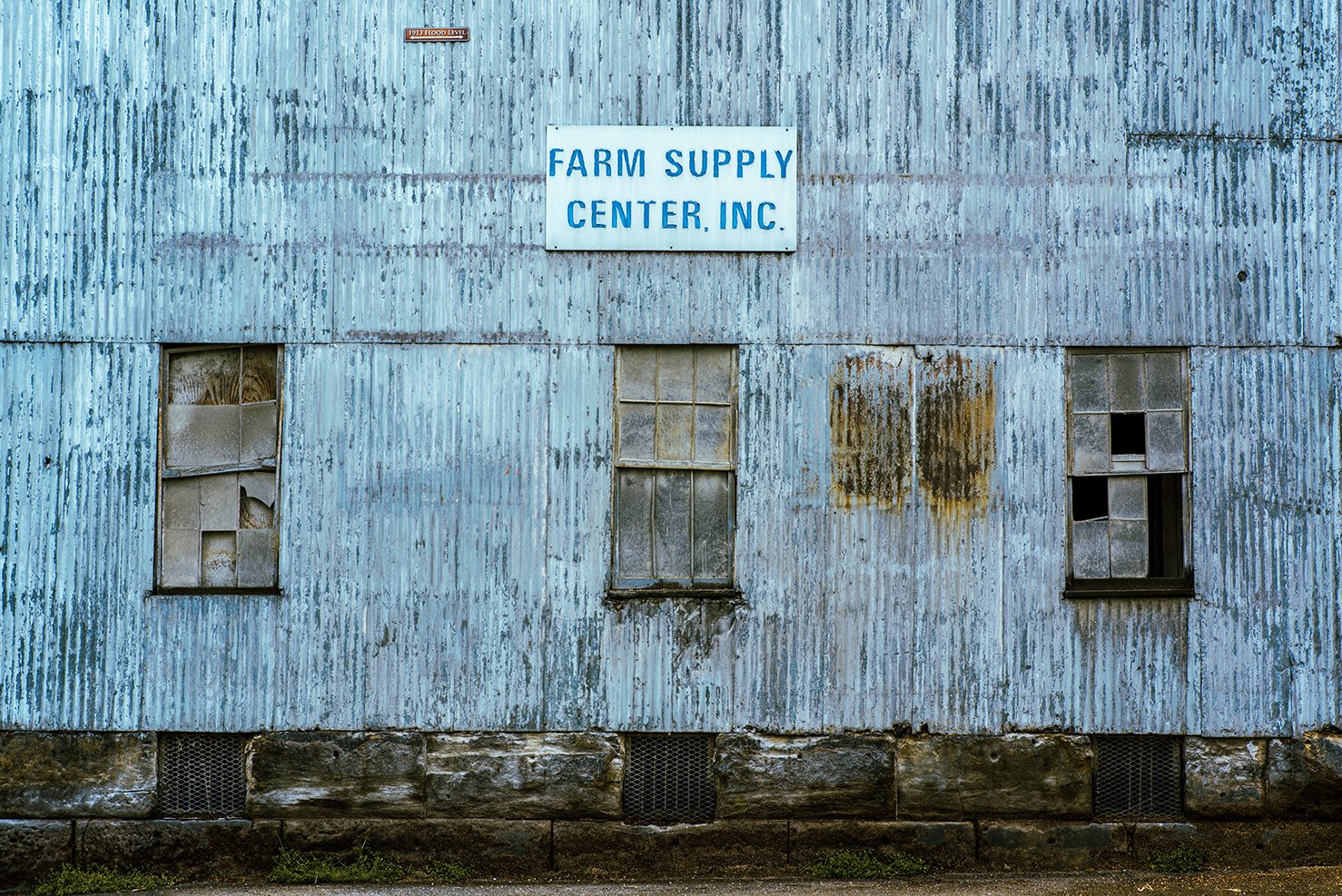
Farm Supply Center Inc.
Kevin LeDuc
Farm Supply Center Inc., c. 1859
Zanesville, Muskingum County, Ohio
from the Ballyshannon’s Rustland (2021–2024) – Monumentality Portfolio
Pigment print on Hahnemühle Baryta
Artist’s proof + edition of 5 (portfolio of 40 images)
30 × 45 inches
-
From Agricultural Commerce to Rural Service: The History of Farm Supply Center, Inc., Zanesville, Muskingum County, Ohio
Introduction
Farm Supply Center, Inc., located at 411 Linden Avenue in Zanesville, Ohio, represents a long-standing component of the agricultural economy of Muskingum County and eastern Ohio. Although the origins of the present corporation remain somewhat obscure, the company has operated as a supplier of feed, grain, fertilizer, fencing materials, animal-health products, and related agricultural goods for several decades. Various business records suggest that the modern corporate entity emerged during the late twentieth century, while the company itself has claimed a much deeper historical heritage extending to 1859. The relationship between this nineteenth-century date and the present corporation remains uncertain, but the claim suggests continuity with earlier agricultural enterprises in Zanesville's commercial and industrial districts.
The history of Farm Supply Center illustrates broader patterns in Midwestern agricultural commerce, including the transition from local grain dealers and feed merchants to diversified agricultural service companies. Situated within Muskingum County, one of Ohio's historically important agricultural regions, the company reflects the changing needs of farmers and rural communities from the nineteenth century through the modern era.
Muskingum County and Agricultural Development
The historical context of Farm Supply Center begins with the agricultural development of Muskingum County. Established in 1804, Muskingum County became one of eastern Ohio's most productive agricultural regions during the nineteenth century. Fertile soils, access to transportation networks, and proximity to growing urban markets encouraged the development of diversified farming operations that produced grain, livestock, dairy products, and other agricultural commodities.¹
Zanesville served as the commercial center of this agricultural landscape. Located along the Muskingum River and connected to the Ohio Canal system and later railroad networks, the city developed as a regional marketing and distribution hub. Grain dealers, feed mills, warehouses, and agricultural merchants clustered near transportation corridors, creating an infrastructure that supported farm production throughout eastern Ohio.²
By the mid-nineteenth century, agricultural commerce had become one of the foundations of the local economy. Businesses specializing in grain storage, livestock feed, fertilizer distribution, and farm supplies emerged to serve a growing rural population. It is within this environment that the origins of Farm Supply Center's claimed nineteenth-century heritage must be understood.
The Question of 1859
One of the most intriguing aspects of Farm Supply Center's history is the company's reported claim that it has been "in business since 1859."³ No surviving evidence currently links the modern corporation directly to a business founded in that year. Nevertheless, the claim is historically plausible when considered within the context of nineteenth-century Zanesville.
The year 1859 falls within a period of rapid agricultural expansion in Muskingum County. Grain warehouses, flour mills, feed dealers, and farm merchants were common features of the local economy. Many agricultural businesses operated as partnerships or family-owned enterprises whose identities changed over time through mergers, succession, and reorganization. Consequently, it is possible that Farm Supply Center traces its lineage to an earlier grain or feed enterprise that later evolved into the modern corporation.
At present, however, no documentary evidence has been located establishing an unbroken chain of ownership between an 1859 enterprise and Farm Supply Center, Inc. The date should therefore be regarded as a company tradition requiring further archival verification.
The Linden Avenue Property
The physical center of Farm Supply Center's operations is located at 411 Linden Avenue in Zanesville. Property records indicate that the principal industrial structure on the site dates to approximately 1913.⁴
This date is significant because it demonstrates that the present building cannot itself be the original 1859 facility. Rather, if the company's nineteenth-century claim is accurate, operations must either have been conducted at another location prior to 1913 or have been inherited from an earlier business whose facilities no longer survive.
The Linden Avenue corridor developed as an industrial and transportation district during the late nineteenth and early twentieth centuries. Warehouses, grain-handling facilities, manufacturing establishments, and railroad-related businesses occupied the area, making it a logical location for agricultural commerce. The placement of Farm Supply Center within this district reflects the importance of transportation access to the agricultural supply industry.
Corporate Formation and Modern Development
Business records provide conflicting information regarding the formal establishment of Farm Supply Center, Inc. Some sources identify 1976 as the company's founding year, while others indicate a date of 1984.⁵ These discrepancies likely reflect differences between the establishment of a business operation and the incorporation of the present corporate entity.
Whatever the precise date, the available evidence suggests that the modern corporation emerged during a period of significant change within American agriculture. During the 1970s and 1980s, many independent feed mills and agricultural suppliers expanded their services in response to changing farm practices, increased mechanization, and the consolidation of agricultural production.
Farm Supply Center appears to have adapted to these developments by diversifying its offerings. Rather than functioning solely as a grain dealer or feed supplier, the company expanded into fertilizer distribution, fencing products, livestock supplies, animal-health products, and other agricultural services. Such diversification reflected broader trends within rural commerce, where agricultural suppliers increasingly operated as comprehensive service centers for farmers.
The Michel Family and Local Leadership
Available records associate Farm Supply Center with members of the Michel family, particularly Regis E. Michel and Paul Michel.⁶ Although the precise duration of the family's involvement remains unclear, their presence suggests that the company operated as a locally managed and family-oriented enterprise during the late twentieth and early twenty-first centuries.
Family ownership has historically played a significant role in agricultural commerce throughout Ohio. Unlike large corporate agribusiness firms, local farm-supply companies often depended upon personal relationships with farmers and rural communities. Trust, reputation, and long-term service frequently determined commercial success as much as price or product availability.
The Michel family's association with Farm Supply Center therefore places the company within a long tradition of locally controlled agricultural businesses that served as intermediaries between national suppliers and regional producers.
Grain, Feed, and Agricultural Services
The principal economic function of Farm Supply Center has been the provision of agricultural goods and services. Business descriptions consistently identify the company as a supplier of livestock feed, fertilizer, fencing materials, grain marketing services, and animal-health products.⁷
Such activities place the company within a long-established category of Midwestern agricultural enterprises. Historically, grain dealers and feed merchants performed essential functions within rural economies by connecting producers with larger commodity markets. They supplied inputs necessary for production while simultaneously providing marketing channels for harvested crops.
By the late twentieth century, companies like Farm Supply Center increasingly combined traditional grain-handling operations with retail agricultural services. This transformation reflected the changing needs of modern farming, which required access to specialized feeds, veterinary products, fencing systems, and technical expertise.
Transportation and Regional Distribution
The importance of transportation to Farm Supply Center's operations is demonstrated by federal records indicating the company's participation in commercial trucking activities by 1998.⁸ Agricultural supply businesses depend heavily upon transportation infrastructure for the movement of grain, feed, fertilizer, and other bulk commodities.
This trucking capacity allowed Farm Supply Center to extend its influence beyond Zanesville itself, serving farmers throughout Muskingum County and neighboring regions. The integration of transportation services into agricultural commerce represents a continuation of patterns established during the canal and railroad eras, adapted to the realities of modern highway transportation.
Historical Significance
Farm Supply Center occupies an important place within the agricultural history of Muskingum County. Although it may not possess the architectural prominence associated with major industrial landmarks, its significance derives from its role in sustaining the economic infrastructure of rural Ohio.
The company represents continuity within an agricultural economy that has undergone profound changes since the nineteenth century. Whether or not its claimed 1859 origin can ultimately be verified, Farm Supply Center clearly embodies traditions of grain marketing, feed distribution, and agricultural service that have long characterized the economy of eastern Ohio.
Its continued operation also highlights the persistence of locally oriented agricultural businesses despite increasing consolidation within American agribusiness. In this respect, Farm Supply Center serves as an example of how regional enterprises have adapted to changing economic conditions while maintaining connections to their rural communities.
Conclusion
The history of Farm Supply Center reflects broader developments in Ohio agriculture, from nineteenth-century grain commerce to modern agricultural service industries. Located within the agricultural heartland of Muskingum County, the company evolved as part of a commercial infrastructure that linked farmers to markets, suppliers, and transportation networks.
Although many aspects of its early history remain uncertain, available evidence indicates a company rooted in the traditions of agricultural commerce that have shaped Zanesville and eastern Ohio for generations. The survival of Farm Supply Center into the twenty-first century demonstrates the enduring importance of local agricultural suppliers within America's rural economy.
Footnotes
Muskingum County government historical records concerning county formation and agricultural development.
Historical accounts of Zanesville's commercial and transportation development.
Business profile identifying Farm Supply Center as operating "since 1859."
Property records for 411 Linden Avenue, Zanesville, Ohio.
Business registration and corporate profile databases reporting founding dates of 1976 and 1984.
Business directories identifying Regis E. Michel and Paul Michel as company principals.
Agricultural business profiles describing company operations and services.
United States Department of Transportation motor carrier registration records, 1998.
Bibliography
Primary Sources
United States Department of Transportation. Motor Carrier Registration Records for Farm Supply Center, Inc., 1998.
Secondary Sources
Business profile records for Farm Supply Center, Inc.
Corporate registration and business directory records relating to Farm Supply Center, Inc.
Historical accounts of Muskingum County and Zanesville economic development.
Property records for 411 Linden Avenue, Zanesville, Ohio.
Local Historical Sources
Muskingum County historical records.
Muskingum County property and tax records.
Zanesville city historical and economic development records.
Zanesville city directories and business listings.