St. Mary's Greek Byzantine Catholic Church
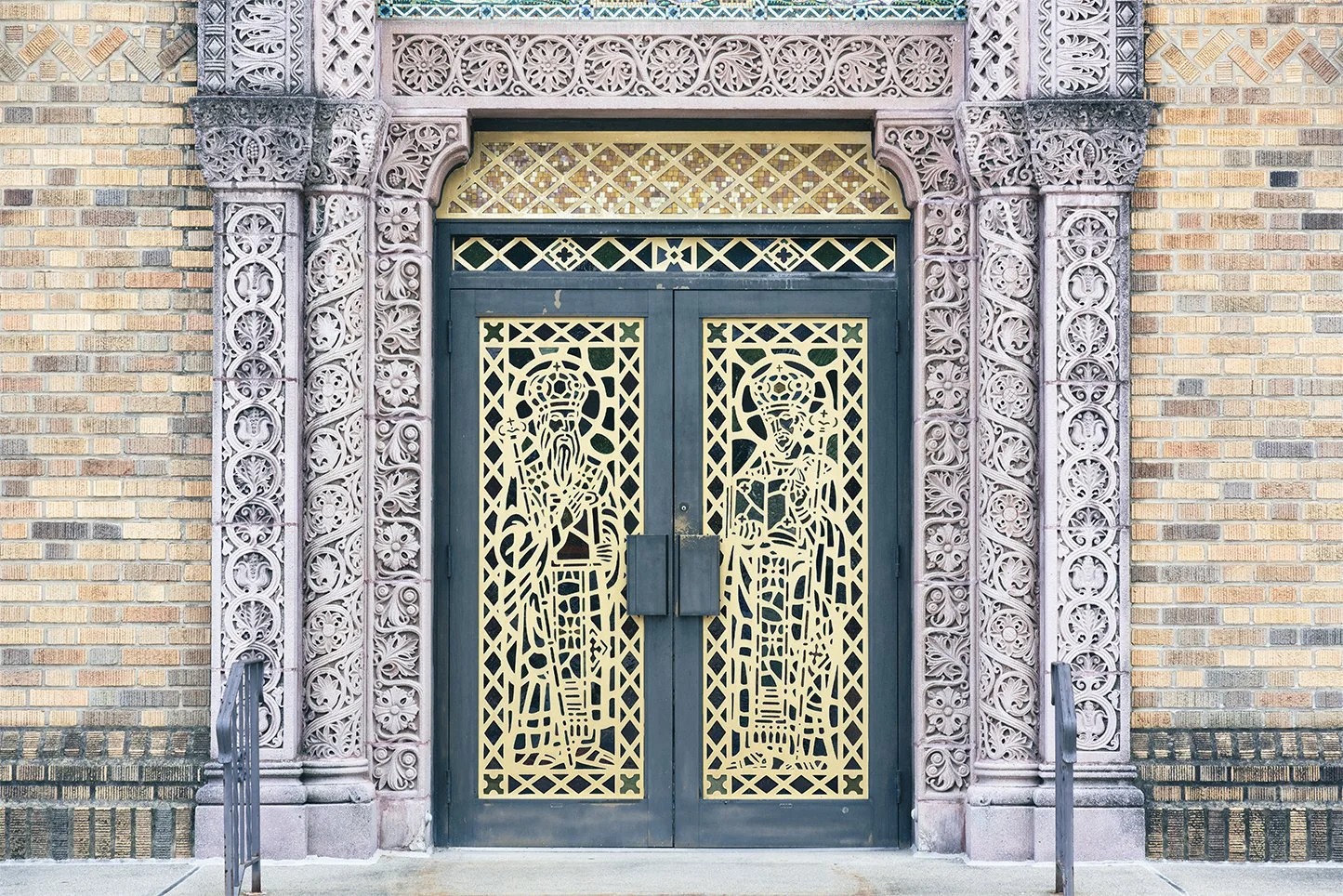
St. Mary's Greek Byzantine Catholic Church
Kevin LeDuc
St. Mary’s Greek Byzantine Catholic Church, c. 1895
Cambria City, Johnstown, Cambria County, Pennsylvania from the Ballyshannon’s Rustland (2021–2024) – Rust Alchemy Portfolio
Pigment print on Hahnemühle Baryta
Artist’s proof + edition of 5 (portfolio of 40 images)
30 × 45 inches
-
St. Mary’s Greek Byzantine Catholic Church, Johnstown, Pennsylvania: Immigration, Faith, and Ethnic Identity in the Cambria City Community
Introduction
St. Mary’s Greek Catholic Church in Johnstown, Cambria County, Pennsylvania, occupies an important place in the religious, ethnic, and industrial history of western Pennsylvania. Established during the great wave of Eastern European immigration that transformed the Cambria City section of Johnstown in the late nineteenth century, the parish became a spiritual, cultural, and social center for Rusyn (Ruthenian), Slovak, and other Byzantine Catholic immigrants who came to the region to work in coal mines, railroads, and the steel mills of the Cambria Iron Company.
The parish emerged during a period when thousands of immigrants from the Austro-Hungarian Empire settled in Johnstown seeking economic opportunity. These newcomers brought with them the traditions of the Byzantine Rite, creating religious institutions that preserved language, customs, and communal identity while adapting to life in industrial America. St. Mary’s became one of the earliest and most influential Greek Catholic parishes in the Johnstown region and remains an important symbol of the city's immigrant heritage.¹
Immigration and the Growth of Cambria City
The origins of St. Mary’s Greek Catholic Church are inseparable from the development of Cambria City, the immigrant neighborhood west of downtown Johnstown. During the late nineteenth century, the rapid expansion of the Cambria Iron Company created an enormous demand for labor.²
Beginning in the 1880s, immigrants arrived in increasing numbers from what are today:
Slovakia
Ukraine (then part of Austria-Hungary)
Poland
Hungary
Croatia
Serbia
Carpathian Rus' (Ruthenia)
Many settled in Cambria City, where ethnic neighborhoods formed around churches, fraternal organizations, and mutual aid societies.
For Greek Catholics, existing Roman Catholic parishes did not fully satisfy their liturgical traditions. Byzantine Catholics followed the Eastern Rite while remaining in communion with Rome. Consequently, immigrants sought to establish their own parish where they could worship according to the traditions of the Byzantine Church.
Founding of the Parish
St. Mary’s Greek Catholic Church was established in the late nineteenth century, generally dated to 1895, making it among the earliest Byzantine Catholic parishes in Cambria County.³
The parish was organized by Rusyn and Slovak immigrants who desired a church reflecting their religious heritage. Early services were held in temporary facilities while parish leaders raised funds for a permanent church.
The founding generation consisted largely of industrial workers employed in:
steel mills
iron works
railroad shops
coal mines
construction trades
Despite modest incomes, parishioners contributed substantial amounts toward church construction through donations, fundraising events, and volunteer labor.
Construction of the Church
The first permanent church building was erected shortly after the parish's organization. Like many immigrant churches, construction proceeded in stages as financial resources permitted.
The church became one of the most visible landmarks in Cambria City. Architecturally, it reflected traditions common to Byzantine Catholic churches in the United States, incorporating elements derived from Eastern European ecclesiastical design while adapting to local building materials and American construction practices.⁴
Characteristic features included:
domed or towered roof elements
iconographic decoration
Byzantine liturgical arrangement
iconostasis separating the sanctuary from the nave
richly decorated interior religious artwork
The church's appearance reinforced ethnic identity and distinguished it from neighboring Roman Catholic and Protestant congregations.
Religious and Cultural Life
St. Mary’s served functions extending far beyond worship.
The parish became the center of:
language preservation
ethnic celebrations
religious education
mutual aid activities
community social events
Church festivals, holy day observances, and traditional Byzantine liturgies maintained connections to ancestral homelands.
The parish also operated educational and cultural programs that helped immigrant families adapt to American life while preserving aspects of their Eastern European heritage.⁵
Parish Membership and Demographics
During the early twentieth century, St. Mary’s drew members primarily from Rusyn and Slovak immigrant communities. Parishioners generally lived within walking distance of the church in Cambria City and nearby industrial neighborhoods.
The congregation included:
First Generation Immigrants
laborers
steelworkers
railroad workers
miners
Second Generation Americans
clerks
teachers
skilled tradesmen
business owners
Membership expanded significantly between 1900 and 1920 as immigration reached its peak.
Like many ethnic parishes, St. Mary’s functioned as a bridge between immigrant culture and American society.
The Johnstown Flood and Community Resilience
The famous Johnstown Flood of 1889 occurred before the formal establishment of St. Mary’s parish but profoundly shaped the city in which the church developed.⁶
The disaster killed more than 2,200 people and devastated large portions of Johnstown. Reconstruction efforts created renewed demand for labor and attracted additional immigrants to the region during the 1890s.
As a result, the growth of immigrant parishes such as St. Mary’s occurred partly within the context of post-flood rebuilding and industrial expansion.
The parish later endured other regional disasters, including:
the St. Patrick’s Day Flood of 1936
the Johnstown Flood of 1977
Each event tested the resilience of the parish community.
Relationship to the Steel Industry
The history of St. Mary’s cannot be separated from the industrial economy of Johnstown.
Most parish members worked directly or indirectly for:
Cambria Iron Company
and later
Bethlehem Steel Corporation.
Steel industry employment provided the wages that financed church construction, parish expansion, and community institutions.
The rhythms of parish life often mirrored the rhythms of industrial employment. Economic downturns, strikes, and layoffs affected membership and financial stability, while periods of industrial prosperity supported growth.
Education and Parish Organizations
Like many Byzantine Catholic parishes, St. Mary’s developed organizations that strengthened community ties.
These included:
church societies
women's organizations
youth groups
choir programs
religious instruction classes
Parish schools and catechetical programs helped preserve both religious and ethnic traditions among younger generations.
The church also served as a venue for weddings, baptisms, funerals, and social events that reinforced community identity.
Mid-Twentieth-Century Changes
After World War II, the parish experienced significant demographic changes.
Several factors affected membership:
suburbanization
declining immigration
intermarriage
movement of families away from Cambria City
changes in the regional economy
The decline of the steel industry after the 1960s further reduced the population base that had sustained ethnic parishes for generations.⁷
Despite these challenges, St. Mary’s continued to preserve Byzantine Catholic traditions while adapting to changing demographics.
Architectural and Historical Significance
St. Mary’s Greek Catholic Church remains one of the most important surviving symbols of the Eastern European immigrant experience in Johnstown.
Its significance derives from several factors:
association with Eastern European immigration
role in preserving Byzantine Catholic traditions
contribution to the development of Cambria City
connection to Johnstown’s industrial workforce
architectural representation of immigrant religious culture
The church stands as a physical reminder of the communities that helped build Johnstown’s steel economy.
Legacy
Today, St. Mary’s represents more than a religious institution. It embodies the story of immigration, adaptation, and community formation in industrial Pennsylvania.
The parish preserves traditions brought from villages across the Carpathian Mountains and Eastern Europe while illustrating how immigrant communities used religion to maintain identity in an unfamiliar industrial environment.
Its history reflects broader themes in American history:
immigration
industrialization
ethnic identity
religious diversity
community resilience
Conclusion
Founded in 1895 amid the industrial expansion of Johnstown, St. Mary’s Greek Catholic Church became a center of religious and cultural life for generations of Eastern European immigrants and their descendants. Supported by workers employed in steel mills, railroads, and mines, the parish helped preserve Byzantine Catholic traditions while fostering integration into American society.
Through floods, industrial change, and demographic transformation, St. Mary’s remained a vital institution within Cambria City. Its continuing presence serves as a testament to the faith, labor, and perseverance of the immigrant communities that helped shape the history of Johnstown and western Pennsylvania.
Notes
Nicholas E. Evangelinos, Byzantine Catholic Churches of Pennsylvania (Pittsburgh: Byzantine Seminary Press, 1998), 45–49.
Ronald L. Lewis, Johnstown and the Great Steel Industry (University Park: Pennsylvania State University Press, 2000), 52–59.
Diocese of Passaic, historical parish records of Ruthenian Greek Catholic churches in Pennsylvania.
John Bilan, The History of the Byzantine Catholic Church in America (Pittsburgh: Byzantine Catholic Metropolitan Church, 1989), 77–84.
Bilan, History of the Byzantine Catholic Church in America, 91–95.
David McCullough, The Johnstown Flood (New York: Simon & Schuster, 1968).
Ronald L. Lewis, Transforming the Appalachian Countryside: Railroads, Deforestation, and Social Change in West Virginia, 1880–1920 (Chapel Hill: University of North Carolina Press, 1998), comparative discussion of industrial migration and ethnic communities.
Bibliography
Bilan, John. The History of the Byzantine Catholic Church in America. Pittsburgh: Byzantine Catholic Metropolitan Church, 1989.
Evangelinos, Nicholas E. Byzantine Catholic Churches of Pennsylvania. Pittsburgh: Byzantine Seminary Press, 1998.
Lewis, Ronald L. Johnstown and the Great Steel Industry. University Park: Pennsylvania State University Press, 2000.
Lewis, Ronald L. Transforming the Appalachian Countryside: Railroads, Deforestation, and Social Change in West Virginia, 1880–1920. Chapel Hill: University of North Carolina Press, 1998.
McCullough, David McCullough. The Johnstown Flood. New York: Simon & Schuster, 1968.
Diocese of Passaic. Historical Records of Ruthenian Greek Catholic Parishes in Pennsylvania.
Research Note
For a definitive scholarly monograph on St. Mary’s, the next archival sources to consult would be:
parish anniversary books,
sacramental registers,
Cambria County deed records,
Johnstown city directories,
Johnstown Tribune archives,
records of the Ruthenian Greek Catholic Diocese of Passaic,
Sanborn Fire Insurance Maps of Cambria City
-
St. Mary's Greek Byzantine Catholic Church and the Cambria City Neighborhood
Introduction
St. Mary's Greek Byzantine Catholic Church occupies a prominent place in the history of Johnstown, Pennsylvania, and the immigrant communities that shaped the city's development during the late nineteenth and early twentieth centuries. Located in the Cambria City neighborhood, the church emerged as both a religious institution and a cultural center for Carpatho-Rusyn, Slovak, Hungarian, and other Eastern European immigrants who arrived in western Pennsylvania during the height of industrial expansion. Its history reflects broader themes in American immigration, ethnic identity, religious life, and industrialization.
The church's development was closely tied to the growth of Cambria City, one of the most ethnically diverse industrial neighborhoods in Pennsylvania. Situated near the Cambria Iron Company and later Bethlehem Steel's Johnstown Works, the neighborhood became home to thousands of immigrant workers and their families. Within this environment, St. Mary's provided spiritual guidance, educational opportunities, social support, and cultural continuity for generations of parishioners.¹
The Development of Cambria City
The origins of Cambria City can be traced to the establishment of the Cambria Iron Company in 1852. As iron and steel production expanded in Johnstown, residential neighborhoods developed around the mills to accommodate a growing labor force. Cambria City emerged as one of the most important of these communities due to its proximity to industrial employment and transportation networks.²
During the late nineteenth century, immigration transformed the neighborhood. Workers arrived from Ireland, Germany, Wales, Poland, Hungary, Slovakia, Croatia, Ukraine, and other regions of Europe. These immigrants brought with them distinct languages, religious traditions, and cultural customs that contributed to the neighborhood's unique character. Churches quickly became the most visible institutions within the community, serving as centers of worship as well as gathering places for ethnic and social activities.³
By the beginning of the twentieth century, Cambria City contained an extraordinary concentration of ethnic churches representing Roman Catholic, Byzantine Catholic, Orthodox, and Protestant congregations. The neighborhood's commercial district, social organizations, and religious institutions created a vibrant community that reflected the diversity of industrial America.⁴
The Founding of St. Mary's Greek Byzantine Catholic Church
Among the immigrant groups settling in Cambria City were Carpatho-Rusyn and other Byzantine Catholic peoples from the Austro-Hungarian Empire. Many originated in villages located in present-day eastern Slovakia, western Ukraine, and neighboring regions. Although they shared a Catholic identity, they practiced the Byzantine Rite and sought to preserve their liturgical traditions in their new homeland.⁵
Recognizing the need for a parish that reflected their religious heritage, local Byzantine Catholics organized St. Mary's Greek Byzantine Catholic Church on October 7, 1895. The founding pastor, Father Hilarion Dzubay, played a critical role in establishing the congregation and guiding its early development.⁶
The parish grew rapidly as immigration continued. The first church building soon proved inadequate for the expanding membership, leading to the construction of larger facilities during the early twentieth century. By the 1910s, parish leaders recognized the need for a permanent structure that would accommodate future growth and symbolize the community's stability and aspirations.⁷
Construction of the Present Church
Plans for a new church culminated in the construction of the present St. Mary's building, completed and dedicated in 1922. The congregation selected Pittsburgh architect John T. Comes, one of the leading church architects of the period, to design the structure. Comes was widely recognized for his ability to incorporate traditional Byzantine and Eastern Christian architectural forms into modern American church design.⁸
The resulting church became one of the most distinctive religious structures in Johnstown. Inspired by Byzantine architectural traditions, the building featured domes, decorative brickwork, and a monumental design that reflected the heritage of its parishioners. Architectural historians have identified St. Mary's as one of the most significant ethnic churches in Cambria City and among the finest examples of Byzantine Catholic architecture in western Pennsylvania.⁹
The construction of such an ambitious building demonstrated the economic progress achieved by immigrant families who had arrived only a generation earlier. Through their contributions and labor, parishioners created a lasting symbol of faith and community within Cambria City.
Parish Life and Community Identity
Throughout the twentieth century, St. Mary's served as the center of religious and social life for Byzantine Catholics in Johnstown. Parish organizations sponsored educational programs, religious festivals, charitable activities, and cultural celebrations that reinforced ethnic traditions while helping immigrants adapt to American society.¹⁰
Education became an important component of parish life. In 1938 the congregation established a parochial school staffed by the Sisters of Saint Basil the Great. The school provided religious instruction and academic education for generations of children while helping preserve Byzantine Catholic traditions and cultural identity.¹¹
The church also became known for its annual festivals, liturgical celebrations, and community gatherings. These events attracted parishioners from throughout the region and strengthened connections among families whose roots extended to Eastern Europe.
Challenges and Change
Like the city of Johnstown itself, St. Mary's experienced periods of hardship and transformation. The community endured economic downturns, industrial restructuring, and the devastating floods that periodically affected the region. Although demographic changes altered the composition of Cambria City during the second half of the twentieth century, the parish remained an important institution within the neighborhood.¹²
The decline of the steel industry after World War II resulted in population loss throughout Johnstown. Many descendants of immigrant families relocated to suburban communities or other regions of the country. Nevertheless, St. Mary's continued to preserve its Byzantine Catholic traditions and maintain its historic role within the city.
Historical Significance
The significance of St. Mary's extends beyond its role as a local parish. The church represents the experiences of Eastern European immigrants who contributed to the industrial development of Pennsylvania and the United States. Through its architecture, religious traditions, and community life, the parish illustrates how immigrant groups maintained cultural identities while participating in American society.¹³
The church also contributes to the historical importance of the Cambria City Historic District, which was listed on the National Register of Historic Places in 1991. Together with other ethnic churches and historic buildings, St. Mary's helps preserve the architectural and cultural landscape of one of Pennsylvania's most significant industrial neighborhoods.¹⁴
Today, the church remains an enduring landmark within Cambria City. Its domes continue to define the neighborhood skyline and serve as a reminder of the generations of immigrants whose labor, faith, and perseverance shaped Johnstown's history.
Conclusion
The history of St. Mary's Greek Byzantine Catholic Church is inseparable from the history of Cambria City and the industrial development of Johnstown. Founded by Eastern European immigrants seeking to preserve their religious traditions, the parish grew alongside the steel industry and became one of the neighborhood's most important institutions.
Through its architectural significance, educational programs, cultural activities, and religious mission, St. Mary's provided stability and identity for generations of Byzantine Catholic families. The church stands today as a monument to the immigrant experience and to the enduring influence of faith and community in the development of industrial America.
Notes
Patricia Lowry and Howard B. Slaughter, National Register of Historic Places Registration Form: Cambria City Historic District (Washington, DC: National Park Service, 1991).
Eileen Mountjoy Cooper, Johnstown, Pennsylvania: A History, Part II (Sunbury, PA: Northumberland County Historical Society, 1989), 45–58.
John Bodnar, Immigration and Industrialization: Ethnicity in an American Mill Town, 1870–1940 (Pittsburgh: University of Pittsburgh Press, 1977), 65–94.
Lowry and Slaughter, Cambria City Historic District.
Nicholas P. Fedoryka, The Byzantine Catholic Church in America (Pittsburgh: Byzantine Seminary Press, 1991), 112–118.
Holy Protection of St. Mary Byzantine Catholic Church, Parish History (Johnstown, PA).
Ibid.
Franklin Toker and Gabriel P. Weisberg, “St. Mary's Greek Catholic Church,” SAH Archipedia.
Ibid.
Holy Protection of St. Mary Byzantine Catholic Church, Parish History.
Ibid.
Cooper, Johnstown, Pennsylvania, 201–223.
Fedoryka, The Byzantine Catholic Church in America, 145–156.
Lowry and Slaughter, Cambria City Historic District.
Bibliography
Bodnar, John. Immigration and Industrialization: Ethnicity in an American Mill Town, 1870–1940. Pittsburgh: University of Pittsburgh Press, 1977.
Cooper, Eileen Mountjoy. Johnstown, Pennsylvania: A History, Part II. Sunbury, PA: Northumberland County Historical Society, 1989.
Fedoryka, Nicholas P. The Byzantine Catholic Church in America. Pittsburgh: Byzantine Seminary Press, 1991.
Holy Protection of St. Mary Byzantine Catholic Church. Parish History. Johnstown, PA.
Lowry, Patricia, and Howard B. Slaughter. National Register of Historic Places Registration Form: Cambria City Historic District. Washington, DC: National Park Service, 1991.
Toker, Franklin, and Gabriel P. Weisberg. “St. Mary's Greek Catholic Church.” SAH Archipedia.