Color Park No. 2
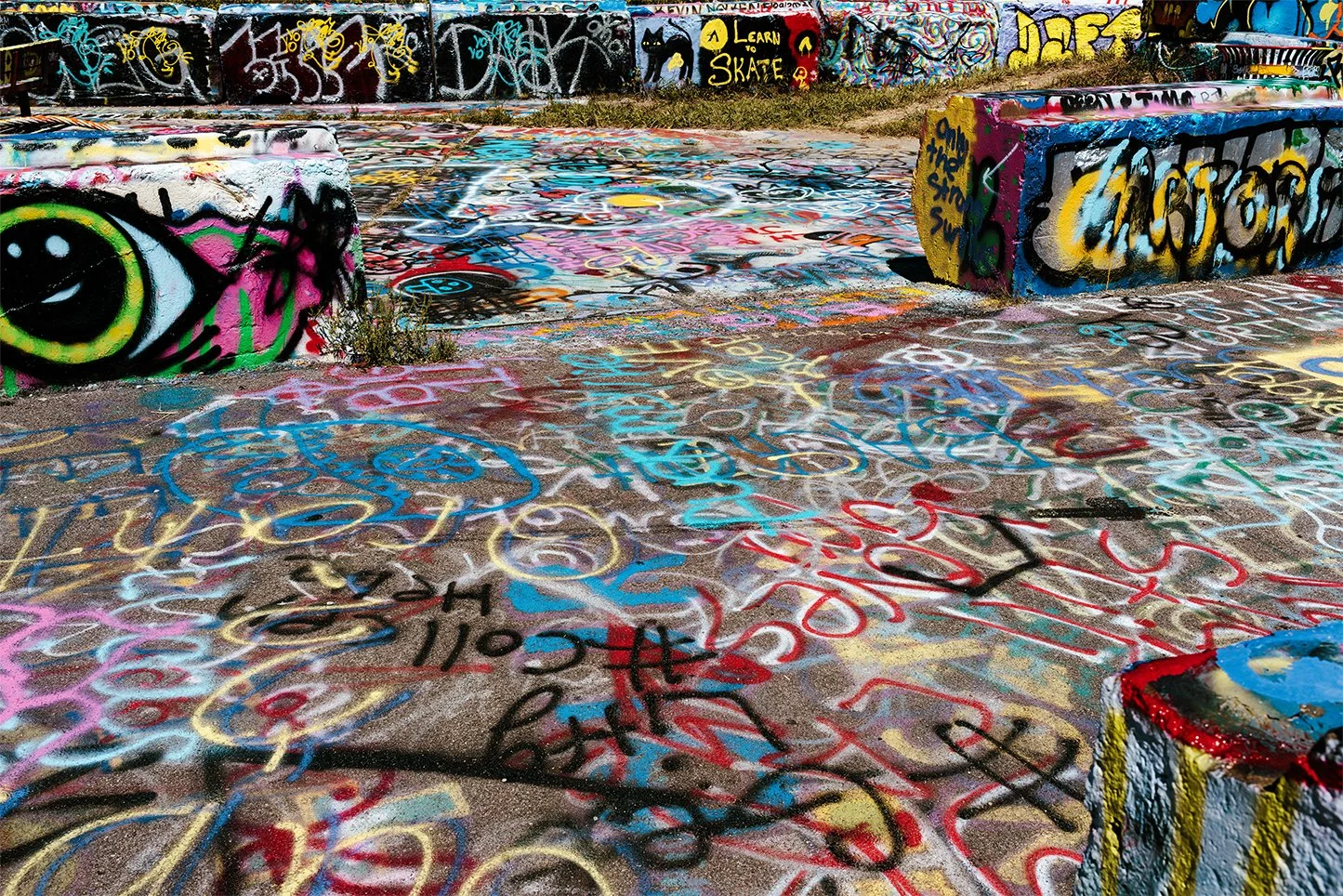
Color Park No. 2
Kevin LeDuc
Color Park, No. 2, c.1990’s
Jones and Laughlin South Side Works, c. 1852 South Side Flats Neighborhood, Pittsburgh, Allegheny County, Pennsylvania
from the Ballyshannon’s Rustland (2021–2024) – Afterlife Portfolio
Pigment print on Hahnemühle Baryta
Artist’s proof + edition of 5 (portfolio of 40 images)
30 × 45 inches
-
Color Park and SouthSide Works, Pittsburgh, Pennsylvania: A Historical Narrative of Postindustrial Riverfront Reclamation
Introduction
Color Park, located along the Monongahela River within the SouthSide Works district of Pittsburgh, Pennsylvania, represents a contemporary phase of postindustrial urban transformation in Allegheny County. Situated on former steel mill and industrial riverfront land once occupied by the Jones and Laughlin Steel Company, the site has been reimagined as a public art and recreation space where graffiti, murals, and rotating visual installations are legally permitted.
Unlike traditional parks designed as fixed landscapes of leisure, Color Park functions as a dynamic cultural infrastructure, continuously reshaped by artists, residents, and visitors. Its existence reflects broader processes of deindustrialization, urban redevelopment, and the revaluation of formerly industrial land as cultural and experiential space.¹
This essay argues that Color Park is best understood as a third-generation reuse landscape: a spatial form that emerges after industrial production and commercial redevelopment, characterized by cultural improvisation, informal authorship, and open-ended visual production within reclaimed industrial terrain.
The Industrial Foundations of the South Side Riverfront
The land now occupied by Color Park was once part of one of the most heavily industrialized corridors in the United States. Beginning in the mid-nineteenth century, the South Side Flats developed as a major steel production zone due to its direct access to the Monongahela River, rail infrastructure, and nearby coal resources.
By the late nineteenth and early twentieth centuries, the Jones and Laughlin Steel Company had consolidated much of the riverfront into the South Side Works, a massive integrated steel complex producing iron and steel products for national distribution. This industrial system included blast furnaces, rolling mills, rail yards, and riverside loading docks that extended across more than one hundred acres of riverfront property.²
The river edge was not a recreational space but a tightly controlled industrial zone, defined by restricted access, heavy freight movement, and environmental degradation associated with steel production.
Deindustrialization and the Collapse of the South Side Works
The decline of American steel manufacturing in the late twentieth century profoundly altered the South Side riverfront. Following corporate restructuring, mergers, and foreign competition, Jones and Laughlin’s successor operations under LTV Steel gradually reduced production and dismantled large portions of the South Side Works.
By the 1980s and 1990s, much of the steel infrastructure had been demolished or abandoned, leaving behind a fragmented landscape of contaminated soil, vacant warehouses, and underutilized rail corridors.³
This period of industrial collapse created the physical and economic conditions necessary for later redevelopment. The riverfront shifted from a zone of production to a zone of vacancy, characterized by liminal industrial remnants and open land parcels awaiting reintegration into the urban economy.
SouthSide Works Redevelopment and Planned Urban Reuse
Beginning in the late 1990s, the Urban Redevelopment Authority of Pittsburgh and private developers initiated the SouthSide Works redevelopment project. The goal was to convert former steel mill land into a mixed-use district combining residential housing, retail corridors, office space, and public riverfront access.
The redevelopment introduced a new urban logic to the riverfront:
Planned retail and entertainment districts
Corporate and medical office facilities
Residential loft developments
Designed pedestrian corridors and riverfront promenades
This transformation marked a shift from industrial production to consumption-oriented urbanism, replacing steel infrastructure with lifestyle architecture and curated public space.⁴
However, not all portions of the riverfront were fully absorbed into this redevelopment framework. Certain residual parcels—particularly those adjacent to transportation corridors and underutilized infrastructure—remained open to informal or semi-formal uses.
The Emergence of Color Park
Color Park emerged from this residual landscape as a public art initiative that transformed an underused riverfront wall and adjacent space into a legal graffiti and mural zone. Unlike conventional parks, Color Park was not designed as a static landscape but as an evolving surface for artistic expression.
Its defining features include:
Legal graffiti walls that are continuously repainted
Rotating mural installations by local and visiting artists
Open access to the public without formal curation barriers
Direct visual and spatial connection to the Monongahela River
The park’s creation reflects a shift in urban policy toward embracing creative reuse of leftover industrial infrastructure rather than fully erasing it.⁵
Graffiti, Informal Aesthetics, and Cultural Reclamation
Color Park is part of a broader tradition of graffiti and street art as mechanisms of spatial reclamation. In postindustrial cities, graffiti often functions as both aesthetic practice and territorial inscription, marking the transformation of abandoned or semi-abandoned infrastructure into cultural space.
At Color Park, this process is formalized rather than criminalized. The legalization of mural painting converts what was once considered vandalism into sanctioned cultural production. This shift reflects broader changes in urban governance, where cities increasingly incorporate street art into redevelopment strategies as a form of cultural branding and placemaking.
The result is a hybrid space where institutional permission and informal artistic expression coexist.⁶
Spatial Relationship to SouthSide Works
Color Park is physically and conceptually embedded within the broader SouthSide Works redevelopment district. While SouthSide Works represents a curated, commercialized form of postindustrial redevelopment, Color Park occupies a more open and fluid edge of the same transformation process.
This spatial relationship highlights a key tension in postindustrial urbanism:
SouthSide Works emphasizes controlled consumption, retail experience, and architectural uniformity
Color Park emphasizes spontaneity, visual change, and participatory cultural production
Together, they illustrate the dual nature of postindustrial redevelopment: one oriented toward economic capitalization, the other toward cultural experimentation.⁷
The Riverfront as Public Space and Ecological Memory
The transformation of the Monongahela River edge from industrial infrastructure to public space also carries ecological and symbolic significance. During the steel era, the riverfront was heavily polluted and physically inaccessible to the public. Industrial operations dominated the shoreline, restricting both ecological function and recreational use.
In the postindustrial period, remediation efforts and redevelopment projects have gradually restored public access to the riverfront, allowing for walking paths, green space, and cultural installations like Color Park.
However, the park does not erase the industrial past. Instead, it overlays it, preserving visual and spatial traces of the steel infrastructure that once defined the site. This layering produces what urban theorists describe as postindustrial ecological memory, in which environmental restoration and historical residue coexist.⁸
Conclusion
Color Park at SouthSide Works represents a significant evolution in the reuse of postindustrial landscapes in Pittsburgh. Emerging from the remnants of the Jones and Laughlin Steel Company’s South Side Works complex, the site embodies a shift from industrial production to commercial redevelopment and finally to open cultural expression.
As a third-generation reuse space, Color Park exists beyond both industrial function and formal redevelopment logic. It operates as an adaptive cultural infrastructure where artistic production continuously reshapes the physical environment. Its legal graffiti walls and evolving murals transform former industrial space into an open-ended public canvas.
Ultimately, Color Park illustrates how postindustrial cities do not simply erase their industrial pasts but reconfigure them into layered cultural environments where history, memory, and creativity remain visibly intertwined.
Footnotes
Allen J. Scott, The Cultural Economy of Cities (London: Sage, 2000), 112–130.
John N. Ingham, Making Iron and Steel: Independent Mills in Pittsburgh, 1820–1920 (Columbus: Ohio State University Press, 1991), 95–120.
Patrick Vitale, Steel Town: The Rise and Fall of the Industrial Midwest (New York: Routledge, 2017), 92–108.
Allen Dieterich-Ward, Beyond Rust: Metropolitan Pittsburgh and the Fate of Industrial America (Philadelphia: University of Pennsylvania Press, 2016), 181–210.
City of Pittsburgh Department of City Planning, “South Side Riverfront Public Art Initiatives and Park Development Reports,” 2015–2024.
Jeff Ferrell, Crime and Culture (Boston: Northeastern University Press, 1999), 145–168.
Franklin Toker, Pittsburgh: An Urban Portrait (University Park: Pennsylvania State University Press, 1986), 310–318.
Timothy Cresswell, Place: An Introduction (Oxford: Blackwell, 2004), 82–110.
Bibliography
Cresswell, Timothy. Place: An Introduction. Oxford: Blackwell, 2004.
Dieterich-Ward, Allen. Beyond Rust: Metropolitan Pittsburgh and the Fate of Industrial America. Philadelphia: University of Pennsylvania Press, 2016.
Ferrell, Jeff. Crime and Culture. Boston: Northeastern University Press, 1999.
Ingham, John N. Making Iron and Steel: Independent Mills in Pittsburgh, 1820–1920. Columbus: Ohio State University Press, 1991.
Scott, Allen J. The Cultural Economy of Cities. London: Sage, 2000.
Toker, Franklin. Pittsburgh: An Urban Portrait. University Park: Pennsylvania State University Press, 1986.
Vitale, Patrick. Steel Town: The Rise and Fall of the Industrial Midwest. New York: Routledge, 2017.
City of Pittsburgh Department of City Planning. “South Side Riverfront Public Art Initiatives and Park Development Reports.” Pittsburgh, 2015–2024.