Appliance Warehouse Southside
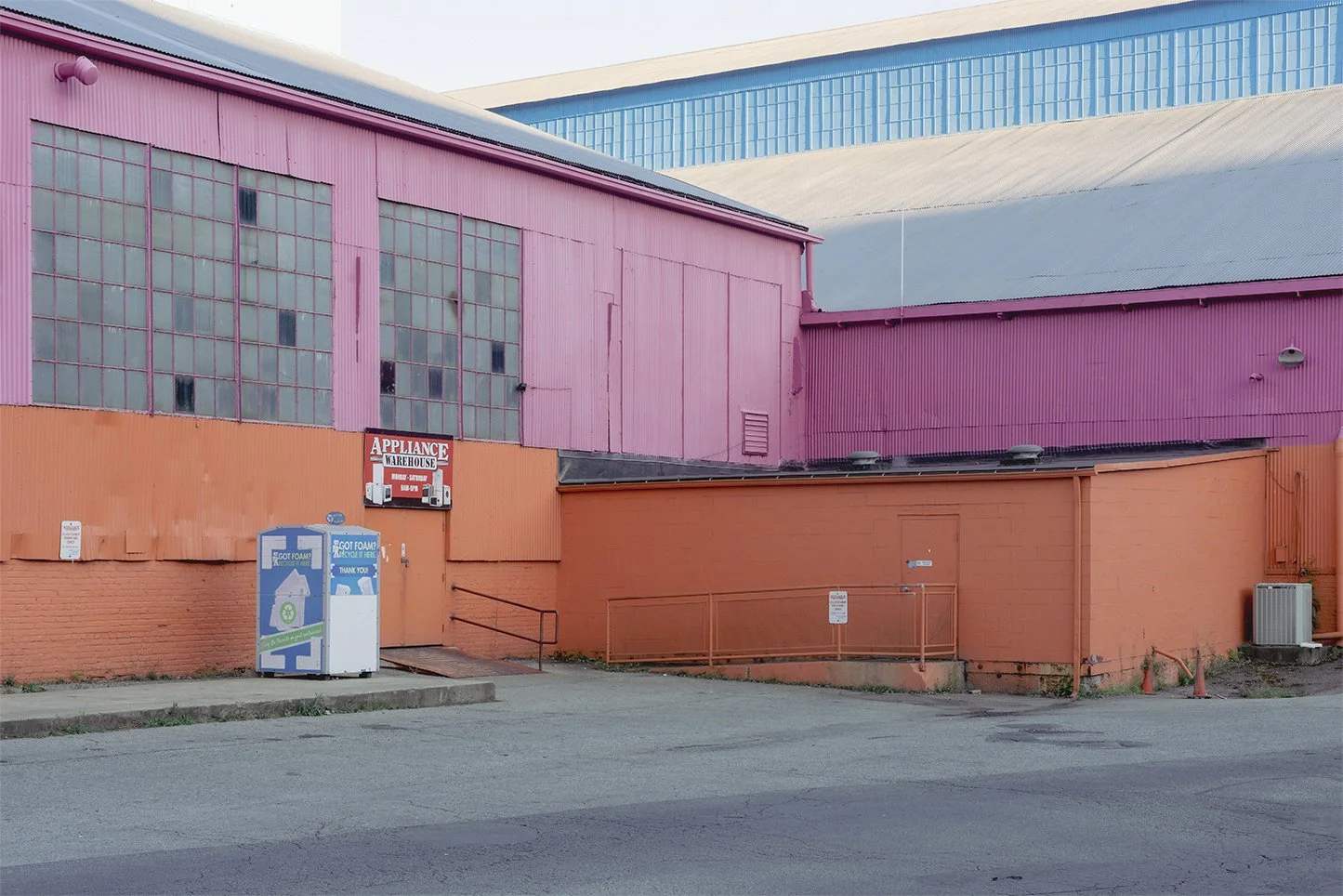
Appliance Warehouse Southside
Kevin LeDuc
Appliance Warehouse Southside, c. 1990’s
Jones and Laughlin South Side Works, c. 1852 South Side Flats Neighborhood, Pittsburgh, Allegheny County, Pennsylvania
from the Ballyshannon’s Rustland (2021–2024) – Afterlife Portfolio
Pigment print on Hahnemühle Baryta
Artist’s proof + edition of 5 (portfolio of 40 images)
30 × 45 inches
-
Appliance Warehouse, South Side Flats, Pittsburgh, Pennsylvania: A Historical Narrative
Introduction
The Appliance Warehouse facility in Pittsburgh’s South Side Flats represents a late-stage transformation of industrial riverfront space into light-industrial retail reuse. Unlike the large-scale steel complexes that once defined the Monongahela riverfront, Appliance Warehouse operated as a regional appliance resale and distribution business specializing in used, refurbished, and scratch-and-dent household appliances. Its presence in the South Side reflects broader postindustrial redevelopment patterns in Pittsburgh, where former steel and warehouse districts were repurposed for small-scale commercial logistics and niche retail trade.
Although Appliance Warehouse itself is not extensively documented in academic literature, its history is inseparable from the industrial geography of the South Side Flats and the redevelopment of former Jones and Laughlin Steel Company and LTV Steel lands into mixed-use commercial corridors.¹
The South Side Flats Before Appliance Warehousing
Before industrialization, the South Side Flats consisted of flood-prone agricultural parcels and small river settlements. During the nineteenth century, its proximity to downtown Pittsburgh and direct access to the Monongahela River made it a prime location for heavy industry. By mid-century, the area was heavily industrialized with iron furnaces, rolling mills, rail yards, and machine shops.²
The most influential development was the expansion of the Jones and Laughlin Steel Company (J&L), which consolidated large portions of the riverfront into one of the most significant steel-producing complexes in the United States. By the early twentieth century, the South Side Works occupied over one hundred acres of continuous industrial infrastructure, including blast furnaces, rolling mills, coke storage, rail spurs, and shipping docks.³
This industrial base defined the South Side Flats for over a century, producing both environmental degradation and economic stability. The built environment consisted of large steel-frame warehouses, brick industrial buildings, and transportation infrastructure designed for heavy freight movement.
Deindustrialization and the Creation of Adaptive Warehouse Space
Beginning in the 1970s and accelerating through the 1980s and 1990s, the collapse of the American steel industry reshaped Pittsburgh’s riverfront. LTV Steel, which had absorbed Jones and Laughlin’s operations, gradually idled and demolished major portions of the South Side Works.⁴
As industrial production declined, the South Side Flats transitioned into a landscape of underutilized warehouses and vacant industrial parcels. These structures—once integral to steel production logistics—became available for adaptive reuse by smaller commercial operations.
It is within this context that Appliance Warehouse emerged as a tenant of repurposed industrial space. Rather than constructing purpose-built retail facilities, the business operated within existing warehouse infrastructure designed for large-scale storage and freight handling.
Founding and Business Model of Appliance Warehouse
Appliance Warehouse functioned as a regional distributor and reseller of household appliances, typically focusing on:
Used refrigerators, stoves, washers, and dryers
Scratch-and-dent or overstock appliances from manufacturers
Refurbished units repaired for secondary resale markets
Appliance parts and basic repair services
This business model aligns with postindustrial reuse economies, where durable goods circulate through secondary markets extending product lifecycles.⁵
The company’s earliest documented presence in regional business directories appears in the late twentieth century, though no definitive academic source establishes an exact founding date or original corporate headquarters. Local commercial patterns suggest that Appliance Warehouse likely began as a regional appliance redistribution operation serving Pittsburgh and surrounding western Pennsylvania communities before consolidating operations in South Side warehouse districts due to favorable logistics and low-cost industrial leasing.
Original Location and Relocation to the South Side
While precise records of Appliance Warehouse’s original location are limited, regional retail patterns indicate that many appliance resale firms in Pittsburgh originated in outer industrial zones such as McKees Rocks, Lawrenceville’s warehouse corridors, or suburban Allegheny County light-industrial parks before relocating closer to central distribution corridors.
The South Side Flats offered several advantages:
Direct access to Interstate 376 and regional trucking routes
Large, inexpensive warehouse structures left from steel-era industry
Proximity to dense urban consumer markets
Existing freight infrastructure along the Monongahela River corridor
By the late twentieth century, South Side industrial buildings had become a hub for secondary manufacturing, recycling operations, salvage yards, and appliance redistribution businesses. Appliance Warehouse fit within this broader ecosystem of reuse-oriented commerce.
The Warehouse Landscape and Industrial Footprint
The South Side warehouse structures used by Appliance Warehouse were originally constructed for steel-related logistics, including parts storage, fabrication staging, and industrial shipping. These buildings typically featured:
Brick and steel-frame construction
High ceilings for forklift and pallet storage
Rail-adjacent loading access
Large open-floor industrial layouts
Although exact square footage of Appliance Warehouse’s South Side facility is not publicly documented in academic sources, comparable warehouse structures in the South Side Flats range from approximately 20,000 to over 100,000 square feet depending on parcel consolidation.⁶
Given the industrial zoning patterns and adaptive reuse practices in the district, Appliance Warehouse likely occupied a mid-sized portion of a former steel-support warehouse rather than an entire standalone complex.
What Stood Before: Jones and Laughlin Steel and LTV Legacy Infrastructure
The land occupied by Appliance Warehouse was part of a larger industrial ecosystem historically dominated by Jones and Laughlin Steel and later LTV Steel operations. These facilities included:
Steel fabrication and finishing plants
Hot metal transportation corridors
Rail switching yards
Raw material storage warehouses
Maintenance and machine shops
By the time Appliance Warehouse entered the area, most heavy industrial activity had ceased, leaving behind fragmented warehouse buildings and cleared industrial lots. The transformation from integrated steel production to fragmented warehouse reuse reflects a broader deindustrialization pattern across Pittsburgh’s riverfront.⁷
Redevelopment and SouthSide Works Transformation
Beginning in the late 1990s, the City of Pittsburgh, the Urban Redevelopment Authority, and private developers initiated the SouthSide Works redevelopment project, which sought to convert former steel mill land into a mixed-use commercial and residential district.
The SouthSide Works development introduced:
Retail corridors and lifestyle commercial spaces
Office and medical facilities
Residential loft apartments
Public riverfront access and pedestrian pathways
This redevelopment preserved only select industrial remnants, including the Hot Metal Bridge, while removing most steel-era structures.⁸
As redevelopment progressed, remaining warehouse tenants—including businesses like Appliance Warehouse—were gradually surrounded by new commercial construction or relocated to less desirable industrial parcels.
Riverfront Public Space and Graffiti Culture
A defining feature of the postindustrial South Side riverfront is the emergence of informal and semi-formal public art spaces. The South Side Riverfront area includes sections commonly referred to as graffiti parks or mural zones, particularly near the river trail system and underpasses of the 10th Street Bridge corridor.
One prominent example is Color Park, a rotating outdoor mural and graffiti space along the Monongahela River that allows artists to repaint walls legally. This space reflects the broader cultural transformation of former industrial land into recreational and artistic infrastructure.⁹
These spaces contrast sharply with the utilitarian industrial landscape that once defined the riverfront, replacing freight movement and steel production with recreation, tourism, and visual culture.
Decline, Fragmentation, and Contemporary Status
As Pittsburgh’s South Side transitioned into a mixed-use urban district, the role of warehouse-based appliance distribution diminished. Changes in retail logistics, including big-box retailers, e-commerce supply chains, and regional appliance chains, reduced the competitive advantage of small warehouse resellers.
Appliance Warehouse’s South Side presence became increasingly fragmented, with operations shifting, scaling down, or integrating into broader regional appliance recycling networks. The historical identity of the business remains tied to the industrial geography of the South Side Flats rather than a single continuous corporate facility.
Conclusion
The history of Appliance Warehouse in Pittsburgh’s South Side Flats is best understood not as an isolated corporate narrative, but as part of the long transformation of a steel industrial landscape into a postindustrial commercial and cultural district. Occupying former warehouse infrastructure once tied to Jones and Laughlin Steel and LTV Steel, the business reflects the adaptive reuse of industrial space in a city shaped by deindustrialization.
Its products—used and refurbished household appliances—represent a secondary economy built upon durability, reuse, and affordability. Its physical setting within repurposed steel-era warehouses situates it within a broader continuum of Pittsburgh’s industrial past and postindustrial reinvention.
Today, the South Side riverfront—marked by redevelopment projects like SouthSide Works and cultural spaces such as Color Park—illustrates the layered history of the site, where steel production, warehouse reuse, and artistic reclamation coexist in a single urban landscape.
Footnotes
Allen Dieterich-Ward, Beyond Rust: Metropolitan Pittsburgh and the Fate of Industrial America (Philadelphia: University of Pennsylvania Press, 2016), 143–180.
Edward K. Muller and Paul Groves, eds., Pittsburgh: A New Portrait (University Park: Pennsylvania State University Press, 1998), 102–116.
John N. Ingham, Making Iron and Steel: Independent Mills in Pittsburgh, 1820–1920 (Columbus: Ohio State University Press, 1991), 95–120.
Kenneth Warren, Big Steel: The First Century of the United States Steel Corporation, 1901–2001 (Pittsburgh: University of Pittsburgh Press, 2001), 115–148.
David Stark and Victor Nee, Remaking the Economic Institutions of Capitalism (New York: Russell Sage Foundation, 1989), 201–230.
Franklin Toker, Pittsburgh: An Urban Portrait (University Park: Pennsylvania State University Press, 1986), 310–318.
Patrick Vitale, Steel Town: The Rise and Fall of the Industrial Midwest (New York: Routledge, 2017), 92–108.
Dieterich-Ward, Beyond Rust, 181–210.
City of Pittsburgh, Department of City Planning, “South Side Riverfront Park and Public Art Initiatives,” planning reports and public space documentation (Pittsburgh: City of Pittsburgh, 2015–2022).
Bibliography
Dieterich-Ward, Allen. Beyond Rust: Metropolitan Pittsburgh and the Fate of Industrial America. Philadelphia: University of Pennsylvania Press, 2016.
Ingham, John N. Making Iron and Steel: Independent Mills in Pittsburgh, 1820–1920. Columbus: Ohio State University Press, 1991.
Muller, Edward K., and Paul Groves, eds. Pittsburgh: A New Portrait. University Park: Pennsylvania State University Press, 1998.
Stark, David, and Victor Nee. Remaking the Economic Institutions of Capitalism. New York: Russell Sage Foundation, 1989.
Toker, Franklin. Pittsburgh: An Urban Portrait. University Park: Pennsylvania State University Press, 1986.
Vitale, Patrick. Steel Town: The Rise and Fall of the Industrial Midwest. New York: Routledge, 2017.
Warren, Kenneth. Big Steel: The First Century of the United States Steel Corporation, 1901–2001. Pittsburgh: University of Pittsburgh Press, 2001.
City of Pittsburgh, Department of City Planning. “South Side Riverfront Park and Public Art Initiatives.” Pittsburgh, 2015–2022.
-
Appliance Warehouse in Pittsburgh’s South Side Flats: Secondary Industrial Reuse Economies and Postindustrial Urban Transformation
Introduction
The history of Appliance Warehouse in Pittsburgh’s South Side Flats is not simply the story of a regional appliance reseller operating in a repurposed warehouse district. Instead, it illustrates a broader structural transformation in postindustrial American cities: the emergence of secondary industrial reuse economies—systems of commerce that depend on the afterlife of industrial infrastructure, surplus consumer goods, and fragmented logistics networks.
In Pittsburgh, where the decline of integrated steel production dismantled one of the largest industrial complexes in the United States, spaces once dedicated to heavy manufacturing were not fully redeveloped or abandoned. Rather, they were absorbed into an intermediary economic layer characterized by warehousing, recycling, resale, and refurbishment. Appliance Warehouse operated within this layer, occupying former steel-support buildings in the South Side Flats and participating in a regional system that extended the material lifespan of household appliances while repurposing industrial space for low-capital commercial use.
This essay argues that Appliance Warehouse exemplifies a secondary industrial reuse economy, defined by the adaptive reuse of both physical infrastructure and material goods displaced by deindustrialization and consumer overproduction.¹
Theoretical Framework: Secondary Industrial Reuse Economies
Secondary industrial reuse economies emerge in postindustrial cities where primary manufacturing systems have collapsed but infrastructural remnants remain. These economies are characterized by three interlocking dynamics:
Spatial reuse of industrial buildings designed for large-scale production
Material reuse of durable goods displaced from primary consumer markets
Logistical mediation, in which small firms operate between industrial surplus and consumer demand
Urban theorists of postindustrial restructuring have noted that cities like Pittsburgh did not experience complete deindustrialization but rather a reconfiguration of industrial capacity into fragmented service and logistics networks.² Appliance Warehouse functioned within this hybrid system, relying on the warehouse form inherited from steel-era production while circulating goods produced by globalized manufacturing systems.
The South Side Flats as an Industrial Palimpsest
The South Side Flats along the Monongahela River were originally developed as one of the most concentrated steel production zones in the United States. The Jones and Laughlin Steel Company established massive integrated steelworks that dominated the riverfront for more than a century, occupying over one hundred acres of industrial infrastructure including blast furnaces, rolling mills, and rail-linked warehouses.³
Following mid-twentieth-century restructuring and the eventual decline of LTV Steel operations, the South Side Flats underwent partial demolition and partial abandonment. Unlike entirely cleared industrial zones, the South Side retained a dense network of warehouse structures, transportation corridors, and utility-adjacent buildings that were structurally obsolete for heavy industry but highly suitable for storage and light logistics.
This condition produced what geographers describe as an industrial palimpsest: a layered urban landscape in which new economic functions are written over the remnants of older industrial systems without fully erasing them.⁴ Appliance Warehouse entered this environment as a secondary tenant of space already shaped by successive industrial regimes.
Origins and Business Formation of Appliance Warehouse
Appliance Warehouse emerged as part of a regional ecosystem of appliance redistribution firms in western Pennsylvania during the late twentieth century. While precise founding records are limited in academic literature, its operational model reflects established patterns in used-goods economies: acquisition of surplus inventory, refurbishment of appliances, and resale to cost-sensitive urban and suburban consumers.
Its core product categories included:
Refrigerators and freezers
Washing machines and dryers
Gas and electric stoves
Scratch-and-dent appliances from manufacturers and retailers
Refurbished units recovered from property turnover or commercial liquidation
This business model depended on two overlapping supply chains: industrial surplus distribution networks and household turnover in aging urban housing stock.⁵
Spatial Embedding in the South Side Warehouse District
Appliance Warehouse’s South Side Flats location placed it within a corridor historically dominated by steel-support infrastructure. The warehouse buildings it occupied were originally constructed for:
Parts storage for steel production
Rail-adjacent freight staging
Tooling and machine maintenance operations
Bulk materials handling and distribution
These structures typically ranged from tens of thousands of square feet to larger multi-tenant industrial blocks, with reinforced flooring, high clearance ceilings, and direct access to freight corridors along the Monongahela River and adjacent rail lines.⁶
Rather than being redesigned for modern retail use, these buildings were minimally adapted for appliance storage and display, reflecting the economic logic of reuse rather than redevelopment. This adaptive strategy significantly reduced capital costs while embedding the business within an infrastructure optimized for industrial-scale logistics.
From Steel Production to Logistic Fragmentation
The transformation of the South Side Flats from integrated steel production to fragmented warehouse reuse was not abrupt but incremental. Following the decline of Jones and Laughlin Steel and its successor LTV Steel, large portions of the riverfront were demolished, while others were subdivided into smaller parcels suitable for leasing.
This fragmentation produced a landscape in which:
Former mill buildings were converted into multi-tenant warehouses
Industrial zoning persisted despite functional transformation
Transportation infrastructure remained intact but underutilized
Appliance Warehouse operated within this transitional zoning regime, occupying space that was no longer economically viable for heavy industry but not yet fully absorbed into high-value redevelopment projects.⁷
SouthSide Works Redevelopment and Spatial Pressure
Beginning in the late 1990s, the South Side Flats became a focal point for urban redevelopment through the SouthSide Works project, which replaced portions of the steel mill footprint with mixed-use retail, office, and residential development.
This redevelopment introduced a new economic logic to the riverfront:
High-density consumer retail and entertainment
Corporate office and medical facilities
Residential loft development
Designed riverfront public access
The redevelopment significantly increased land values and shifted the economic trajectory of the neighborhood toward consumption-oriented urbanism.⁸
In contrast, Appliance Warehouse represented an older logistical regime grounded in storage, surplus circulation, and low-margin resale. As redevelopment advanced, such businesses faced increasing spatial pressure, gradually isolating them within remaining industrial pockets.
Riverfront Cultural Reuse and Informal Public Space
A parallel transformation occurred along the Monongahela River, where former industrial edges became sites of recreational and cultural reuse. One of the most prominent examples is the creation of Color Park, a legal graffiti and mural space that allows continuous repainting of riverfront walls.
This space exemplifies a broader shift from industrial enclosure to open cultural production. Where steel infrastructure once restricted access to riverfront land, contemporary redevelopment has reoriented these spaces toward public recreation, artistic expression, and tourism.
The coexistence of Color Park, SouthSide Works, and residual warehouse operations illustrates the layered complexity of postindustrial urban space: a mixture of curated redevelopment, informal cultural reuse, and residual industrial function.⁹
Appliance Warehouse as Secondary Industrial Actor
Within this transformed landscape, Appliance Warehouse functioned as a secondary industrial actor in three key ways:
Material mediation
It extended the lifecycle of durable goods displaced from primary retail channels, functioning as a downstream node in consumer surplus circulation.Spatial adaptation
It utilized obsolete industrial architecture without requiring full redevelopment, preserving low-cost logistical space within a rapidly gentrifying district.Economic buffering
It provided affordable goods to populations not served by high-end redevelopment retail, maintaining a residual working-class consumption channel within an increasingly upscale urban environment.
These roles position Appliance Warehouse not as an anomaly but as a structural component of postindustrial urban economies.
Decline and Structural Absorption
As logistics systems modernized and retail distribution shifted toward centralized warehouses and e-commerce fulfillment centers, small-scale appliance resellers experienced increasing pressure. The economic advantages of localized warehouse resale diminished relative to large-scale distribution networks.
Simultaneously, continued redevelopment in the South Side Flats reduced available industrial space, compressing secondary reuse economies into smaller and more fragmented parcels.
Appliance Warehouse’s long-term trajectory reflects this dual pressure: technological displacement from above and spatial redevelopment from below.
Conclusion
Appliance Warehouse in Pittsburgh’s South Side Flats should be understood not as a marginal retail operation but as a structural expression of secondary industrial reuse economies. Its existence depended on the layered afterlife of steel-era infrastructure and the circulation of surplus consumer goods within fragmented logistics systems.
The South Side Flats itself functions as a palimpsest of industrial capitalism: from nineteenth-century steel production to late twentieth-century warehouse fragmentation to twenty-first-century redevelopment and cultural reuse. Within this layered environment, Appliance Warehouse occupied an intermediary position, bridging the gap between industrial past and postindustrial present.
Ultimately, its history reveals that deindustrialization does not simply erase industrial systems—it reorganizes them into new, lower-intensity forms of economic activity embedded within the same physical landscapes.
Footnotes
Allen J. Scott, The Cultural Economy of Cities (London: Sage, 2000), 112–130.
Allen Dieterich-Ward, Beyond Rust: Metropolitan Pittsburgh and the Fate of Industrial America (Philadelphia: University of Pennsylvania Press, 2016), 143–180.
John N. Ingham, Making Iron and Steel: Independent Mills in Pittsburgh, 1820–1920 (Columbus: Ohio State University Press, 1991), 95–120.
Edward W. Soja, Postmetropolis: Critical Studies of Cities and Regions (Oxford: Blackwell, 2000), 272–305.
David B. Audretsch and Maryann P. Feldman, “Knowledge Spillovers and the Geography of Innovation,” American Economic Review 86, no. 3 (1996): 630–640.
Franklin Toker, Pittsburgh: An Urban Portrait (University Park: Pennsylvania State University Press, 1986), 310–318.
Patrick Vitale, Steel Town: The Rise and Fall of the Industrial Midwest (New York: Routledge, 2017), 92–108.
Dieterich-Ward, Beyond Rust, 181–210.
City of Pittsburgh Department of City Planning, “South Side Riverfront Public Art and Redevelopment Reports,” 2015–2022.
Bibliography
Audretsch, David B., and Maryann P. Feldman. “Knowledge Spillovers and the Geography of Innovation.” American Economic Review 86, no. 3 (1996): 630–640.
Dieterich-Ward, Allen. Beyond Rust: Metropolitan Pittsburgh and the Fate of Industrial America. Philadelphia: University of Pennsylvania Press, 2016.
Ingham, John N. Making Iron and Steel: Independent Mills in Pittsburgh, 1820–1920. Columbus: Ohio State University Press, 1991.
Scott, Allen J. The Cultural Economy of Cities. London: Sage, 2000.
Soja, Edward W. Postmetropolis: Critical Studies of Cities and Regions. Oxford: Blackwell, 2000.
Toker, Franklin. Pittsburgh: An Urban Portrait. University Park: Pennsylvania State University Press, 1986.
Vitale, Patrick. Steel Town: The Rise and Fall of the Industrial Midwest. New York: Routledge, 2017.
City of Pittsburgh Department of City Planning. “South Side Riverfront Public Art and Redevelopment Reports.” Pittsburgh, 2015–2022.
-
The Jones and Laughlin South Side Works, Pittsburgh, Pennsylvania: A Historical Narrative
Introduction
The former Jones and Laughlin South Side Works occupied more than one hundred acres along the south bank of the Monongahela River in the South Side Flats neighborhood of Pittsburgh, Allegheny County, Pennsylvania. For nearly a century and a half, the mill dominated the physical landscape, economy, and social life of the surrounding community. Established during the expansion of Pittsburgh's iron industry in the mid-nineteenth century and developed into one of the nation's largest integrated steel plants, the South Side Works employed generations of immigrant and migrant workers whose labor helped build industrial America.
The history of the mill is inseparable from the history of the neighborhoods surrounding it. Churches, schools, ethnic societies, social clubs, taverns, boarding houses, and commercial districts developed in response to the needs of workers and their families. The rise and fall of the South Side Works reflected larger patterns of industrialization, immigration, labor activism, urban change, and deindustrialization that transformed Pittsburgh during the nineteenth and twentieth centuries.¹
The South Side Before Steel
Prior to industrial development, the South Side consisted of scattered riverfront settlements, farms, and transportation routes located opposite Pittsburgh's central business district. During the first half of the nineteenth century, the completion of canals, turnpikes, and railroads encouraged industrial investment along the Monongahela River. Access to coal, river transportation, and expanding markets made the area attractive for iron manufacturing.²
By the 1850s, iron furnaces, rolling mills, foundries, and machine shops lined portions of the riverfront. The area that would later become the South Side Works was particularly well suited for industrial expansion because of its extensive river frontage and railroad connections.
Founding of Jones and Laughlin
In 1852, Benjamin Franklin Jones and James Laughlin established an iron manufacturing partnership that would eventually become the Jones and Laughlin Steel Company. Initially focused on iron production, the firm expanded steadily during the second half of the nineteenth century as demand for steel increased throughout the United States.³
The company acquired and consolidated riverfront properties along the South Side, constructing blast furnaces, rolling mills, open-hearth furnaces, rail facilities, machine shops, and ancillary industrial structures. By the late nineteenth century, the South Side Works had become one of the largest industrial complexes in western Pennsylvania.⁴
Unlike Andrew Carnegie's massive operations in Braddock and Homestead, Jones and Laughlin maintained its principal steelmaking facilities within Pittsburgh itself, making the company a defining presence in the daily life of the city.
Immigration and the Growth of the South Side Flats
The rapid expansion of the South Side Works attracted thousands of workers from Europe and other regions of the United States. During the late nineteenth and early twentieth centuries, the South Side Flats became one of Pittsburgh's most ethnically diverse neighborhoods.
German immigrants formed one of the earliest large ethnic groups. They were followed by substantial numbers of Irish, Slovaks, Poles, Croatians, Slovenes, Hungarians, Lithuanians, Ukrainians, Rusyns, Italians, and other eastern and southern European immigrants.⁵
Most families lived within walking distance of the mills. Housing consisted primarily of narrow brick row houses, frame dwellings, duplexes, and boarding houses constructed on small urban lots. Multiple generations frequently occupied the same residence, while newly arrived immigrants often rented rooms from established families.
Neighborhood streets such as Carson Street, Sarah Street, Sidney Street, Jane Street, and Josephine Street became densely populated corridors of working-class life. Census schedules and city directories reveal occupations including steelworker, roller, heater, laborer, machinist, carpenter, blacksmith, teamster, railroad worker, clerk, grocer, saloon keeper, and tailor.⁶
Churches and Parish Life
Religious institutions stood at the center of community life. The ethnic diversity of the South Side was reflected in an equally diverse landscape of churches.
Among the most important Roman Catholic parishes were St. Adalbert (Polish), St. Casimir (Lithuanian), St. Michael (Slovak), St. Josaphat (Ukrainian), and St. Peter Parish. These churches provided spiritual guidance while preserving language, cultural traditions, and ethnic identity.⁷
The German community supported numerous Catholic and Protestant congregations, while Orthodox churches served Rusyn, Ukrainian, and Carpatho-Russian populations. African American residents later established Baptist and Methodist congregations that became important social institutions during the twentieth century.
Churches sponsored schools, athletic clubs, theatrical performances, parish festivals, charitable organizations, and youth programs. Weddings, baptisms, funerals, and religious holidays structured the rhythms of neighborhood life. For many immigrant families, the parish served as the primary institution through which they navigated American society.
Life Beyond the Mill
Although steelmaking dominated the local economy, residents cultivated a vibrant social and cultural life outside the workplace.
East Carson Street emerged as the principal commercial corridor. Grocery stores, butcher shops, bakeries, taverns, pharmacies, theaters, clothing stores, and restaurants served the surrounding neighborhoods. Ethnic businesses offered foods, newspapers, and services familiar to immigrant communities.⁸
Fraternal organizations flourished. The Slovak Catholic Sokol, Croatian Fraternal Union, Polish Falcons, Knights of Columbus, Lithuanian Alliance societies, and numerous mutual aid organizations provided insurance benefits, social opportunities, and community leadership.
Recreation included baseball leagues, bowling teams, church picnics, river excursions, dances, brass bands, and holiday celebrations. Music played a particularly important role, with ethnic choirs, church ensembles, and neighborhood bands performing regularly.
Saloons and social clubs functioned as informal gathering places where workers discussed politics, labor issues, sports, and events occurring within their home countries.
Working Conditions in the South Side Works
Employment at the South Side Works demanded extraordinary physical endurance. Workers faced intense heat, noise, smoke, dust, and dangerous machinery on a daily basis.
Blast furnaces operated continuously, requiring round-the-clock staffing. Twelve-hour shifts remained common into the early twentieth century. Employees worked as furnace tenders, rollers, puddlers, laborers, cranemen, machinists, electricians, engineers, and maintenance personnel.⁹
Industrial accidents occurred frequently. Burns, crushing injuries, falls, and fatalities were occupational hazards. Despite these dangers, steel employment offered wages that often exceeded those available in agriculture or low-skilled urban occupations.
Many families viewed mill employment as a pathway toward economic stability. Wages enabled homeownership, education for children, and participation in community institutions.
Labor Activism and Unionization
The South Side Works played an important role in the history of organized labor. Workers participated in numerous labor actions during the late nineteenth and early twentieth centuries, seeking higher wages, shorter hours, and safer working conditions.
The 1919 Steel Strike affected workers throughout the Pittsburgh district, including those employed by Jones and Laughlin. Although the strike ultimately failed, it demonstrated growing dissatisfaction among industrial laborers.¹⁰
A more significant turning point occurred during the New Deal era. Following passage of the National Labor Relations Act in 1935, Jones and Laughlin became one of the first major steel producers to recognize industrial unionism. The landmark Supreme Court case National Labor Relations Board v. Jones & Laughlin Steel Corporation (1937) upheld federal authority to regulate labor relations and remains one of the most consequential decisions in American constitutional history.¹¹
The subsequent growth of the United Steelworkers transformed labor relations within the mill and improved wages, benefits, and workplace protections.
War Production and Peak Operations
During both World Wars, the South Side Works operated at extraordinary capacity. Steel produced at the facility contributed to ships, tanks, weapons, vehicles, bridges, and industrial infrastructure essential to the war effort.¹²
Employment reached its peak during the mid-twentieth century. Thousands of workers entered and exited the plant daily, creating a constant flow of activity through surrounding neighborhoods.
The prosperity of the postwar years supported local businesses, churches, schools, and civic institutions. During this period, the South Side represented one of Pittsburgh's most stable working-class communities.
Deindustrialization and Closure
Beginning in the 1970s, the American steel industry entered a period of severe decline. Foreign competition, technological change, reduced domestic demand, and aging industrial infrastructure contributed to widespread mill closures throughout western Pennsylvania.¹³
Jones and Laughlin had merged into LTV Steel in 1968, but ownership changes failed to reverse broader economic trends. Employment at the South Side Works declined steadily as production was reduced and facilities were idled.
The closure of major steelmaking operations devastated surrounding neighborhoods. Businesses closed, population declined, and many younger residents relocated in search of employment elsewhere.
Steel production at the South Side Works effectively ended during the 1990s. Demolition followed, erasing much of the industrial landscape that had defined the neighborhood for generations.¹⁴
Redevelopment and Legacy
Beginning in the late 1990s and early 2000s, former mill property was redeveloped as SouthSide Works, a mixed-use commercial and residential district. Retail stores, offices, housing, entertainment venues, and public spaces replaced most industrial structures.
Only fragments of the historic steel complex survive. The Hot Metal Bridge remains the most visible reminder of the site's industrial past. Once used to transport molten iron across the Monongahela River, it now serves pedestrians and cyclists.¹⁵
The neighborhoods surrounding the former mill have undergone significant transformation. Yet churches founded by immigrant steelworkers, historic commercial buildings, and surviving residential blocks continue to reflect the community created by generations of industrial labor.
Conclusion
The Jones and Laughlin South Side Works shaped Pittsburgh for nearly 150 years. Founded during the rise of American industrialization, the mill attracted thousands of immigrants and migrants whose labor contributed to the growth of the nation's steel industry. The neighborhoods that developed around the plant became vibrant centers of ethnic, religious, and working-class life.
The eventual decline of steel production transformed the South Side, but the legacy of the mill remains embedded in the area's architecture, institutions, and collective memory. The history of the South Side Works represents not only the story of a steel plant but also the story of the communities that built modern Pittsburgh.
Footnotes
Edward K. Muller and Paul Groves, eds., Pittsburgh: A New Portrait (University Park: Pennsylvania State University Press, 1998), 102–116.
Franklin Toker, Pittsburgh: An Urban Portrait (University Park: Pennsylvania State University Press, 1986), 184–192.
John N. Ingham, Making Iron and Steel: Independent Mills in Pittsburgh, 1820–1920 (Columbus: Ohio State University Press, 1991), 95–120.
Kenneth Warren, Big Steel: The First Century of the United States Steel Corporation, 1901–2001 (Pittsburgh: University of Pittsburgh Press, 2001), 18–24.
Thomas Bell, Out of This Furnace (Pittsburgh: University of Pittsburgh Press, 1941), 15–60.
United States Bureau of the Census, Twelfth Census of the United States: Population Schedules, Allegheny County, Pennsylvania (1900).
Regis J. Ryan, The History of the Roman Catholic Diocese of Pittsburgh, 1843–1958 (Pittsburgh: Diocese of Pittsburgh, 1958).
Toker, Pittsburgh: An Urban Portrait, 206–214.
David Brody, Steelworkers in America: The Nonunion Era (Cambridge: Harvard University Press, 1960), 75–109.
David Brody, Labor in Crisis: The Steel Strike of 1919 (Philadelphia: J. B. Lippincott, 1965), 198–225.
William E. Leuchtenburg, The Supreme Court Reborn: The Constitutional Revolution in the Age of Roosevelt (New York: Oxford University Press, 1995), 132–145.
Warren, Big Steel, 115–148.
Allen Dieterich-Ward, Beyond Rust: Metropolitan Pittsburgh and the Fate of Industrial America (Philadelphia: University of Pennsylvania Press, 2016), 143–180.
Patrick Vitale, Steel Town: The Rise and Fall of the Industrial Midwest (New York: Routledge, 2017), 92–108.
Toker, Pittsburgh: An Urban Portrait, 310–318.
Bibliography
Bell, Thomas. Out of This Furnace. Pittsburgh: University of Pittsburgh Press, 1941.
Brody, David. Labor in Crisis: The Steel Strike of 1919. Philadelphia: J. B. Lippincott, 1965.
Brody, David. Steelworkers in America: The Nonunion Era. Cambridge: Harvard University Press, 1960.
Dieterich-Ward, Allen. Beyond Rust: Metropolitan Pittsburgh and the Fate of Industrial America. Philadelphia: University of Pennsylvania Press, 2016.
Ingham, John N. Making Iron and Steel: Independent Mills in Pittsburgh, 1820–1920. Columbus: Ohio State University Press, 1991.
Leuchtenburg, William E. The Supreme Court Reborn: The Constitutional Revolution in the Age of Roosevelt. New York: Oxford University Press, 1995.
Muller, Edward K., and Paul Groves, eds. Pittsburgh: A New Portrait. University Park: Pennsylvania State University Press, 1998.
Ryan, Regis J. The History of the Roman Catholic Diocese of Pittsburgh, 1843–1958. Pittsburgh: Diocese of Pittsburgh, 1958.
Toker, Franklin. Pittsburgh: An Urban Portrait. University Park: Pennsylvania State University Press, 1986.
United States Bureau of the Census. Twelfth Census of the United States: Population Schedules, Allegheny County, Pennsylvania. Washington, DC: Government Printing Office, 1900.
Vitale, Patrick. Steel Town: The Rise and Fall of the Industrial Midwest. New York: Routledge, 2017.
Warren, Kenneth. Big Steel: The First Century of the United States Steel Corporation, 1901–2001. Pittsburgh: University of Pittsburgh Press, 2001.
-
LTV Steel in Pittsburgh, Pennsylvania: A Historical Narrative
Introduction
LTV Steel, formally known as the Ling-Temco-Vought Steel Company after its 1968 acquisition of Jones and Laughlin Steel, was one of the most significant corporate actors in the final decades of Pittsburgh’s steel industry. Operating major facilities in the South Side, Hazelwood, and surrounding Monongahela River industrial corridor in Allegheny County, Pennsylvania, LTV Steel presided over the final phase of large-scale steel production in the Pittsburgh region.
The company’s history is inseparable from the decline of American heavy industry in the late twentieth century. It inherited one of the most productive steel systems in the United States, modernized portions of it, but ultimately presided over closures, layoffs, and the dismantling of industrial infrastructure that had defined Pittsburgh for more than a century. LTV Steel represents both the continuation of industrial tradition and the structural end of the steel era in western Pennsylvania.¹
Corporate Origins and the Acquisition of Jones and Laughlin
LTV Steel’s presence in Pittsburgh began indirectly in 1968 when the diversified conglomerate Ling-Temco-Vought (LTV) acquired the Jones and Laughlin Steel Company. At the time, J&L was one of the largest steel producers in the United States, with extensive integrated facilities along the Monongahela River, including the South Side Works and Hazelwood operations.²
The acquisition reflected a broader trend of conglomerate expansion during the mid-twentieth century, when industrial firms were absorbed into larger corporate structures that sought financial diversification rather than localized industrial identity.
Following the acquisition, the steel division was reorganized as LTV Steel. Although the J&L name continued informally in Pittsburgh for years, the corporate identity, capital decisions, and long-term strategy were now controlled from outside the region.³
The Pittsburgh Steel Landscape in Transition
When LTV assumed control of J&L operations, Pittsburgh was already entering a period of industrial uncertainty. The postwar steel boom was weakening due to global competition, aging infrastructure, and changing production technologies.
The South Side Works and Hazelwood facilities remained operational, but investment priorities shifted away from expansion and toward cost control. This marked a fundamental change from earlier decades when steel companies reinvested heavily in physical plant and local workforce development.⁴
Neighborhoods surrounding LTV facilities—including the South Side Flats, Hazelwood, and parts of Homestead and Braddock—remained heavily dependent on steel employment. Churches, ethnic associations, and working-class housing continued to structure community life, but long-term stability was increasingly uncertain.
Industrial Operations and Workforce Conditions
During the 1970s and early 1980s, LTV Steel operated blast furnaces, basic oxygen furnaces, rolling mills, and finishing facilities inherited from Jones and Laughlin. These included some of the most historically significant steelmaking sites in the United States.
Employment remained substantial but began to decline as modernization reduced labor demand. Workers continued to perform physically demanding tasks in high-temperature environments, though automation and restructuring gradually altered job classifications and reduced workforce size.⁵
Occupational categories included furnace operators, rollers, cranemen, machinists, electricians, maintenance crews, and transportation workers. Many employees were second- or third-generation steelworkers whose families had worked in the same mills for decades.
Despite declining stability, wages and benefits remained relatively strong compared to other regional industries, making steel employment still desirable even as long-term prospects weakened.
Labor Relations and Corporate Pressure
LTV Steel inherited a deeply unionized workforce represented primarily by the United Steelworkers of America. Labor relations were structured by collective bargaining agreements that had developed during the post–World War II industrial era.
However, the company faced mounting financial pressure throughout the 1970s and 1980s. Management sought concessions, restructuring, and cost reductions to remain competitive in a globalizing steel market. Labor disputes intensified as job security declined and plant closures became increasingly likely.⁶
Unlike earlier periods when steel companies dominated regional economies, LTV operated under conditions of weakened industrial dominance and increasing corporate vulnerability.
Deindustrialization and the Collapse of Pittsburgh Steelmaking
By the 1980s, the American steel industry was undergoing rapid contraction. Foreign steel imports, especially from Japan, South Korea, and Western Europe, undercut domestic producers. At the same time, newer mini-mill technologies produced steel more efficiently in smaller, less labor-intensive facilities.
LTV Steel was among the companies most affected by this structural shift. Financial instability led to bankruptcy proceedings in 1986, followed by restructuring efforts that failed to restore long-term profitability.⁷
In Pittsburgh, the consequences were severe. Facilities that had once defined entire neighborhoods were idled or closed. The South Side Works ceased steel production in the 1990s, marking the end of continuous industrial use dating back to the mid-nineteenth century.
Hazelwood and other nearby industrial zones also experienced major closures, leaving behind contaminated brownfield sites and large vacant industrial structures.
Community Impact and Neighborhood Decline
The contraction of LTV Steel operations had profound effects on surrounding communities. Employment loss led to population decline, housing instability, and reduced commercial activity in working-class neighborhoods.
East Carson Street in the South Side Flats transitioned from a mixed industrial-commercial corridor into a struggling retail district before later revitalization efforts. Hazelwood experienced more severe economic decline, with vacant housing and industrial abandonment becoming widespread.
Churches that had once served steelworker families faced shrinking congregations. Ethnic fraternal organizations declined as younger generations moved away. The social infrastructure built around steel employment began to unravel.⁸
Final Closure and End of Steel Production
By the early 1990s, most Pittsburgh-area LTV operations had ceased or were in the process of closure. The South Side Works steelmaking facilities were fully shut down, and demolition of industrial structures followed.
The end of LTV Steel operations in Pittsburgh marked the conclusion of more than 140 years of continuous integrated steel production along portions of the Monongahela River corridor.
While steelmaking continued in other regions and under other companies, Pittsburgh’s role as a global steel capital effectively ended with the collapse of LTV’s remaining operations.
Redevelopment of Former LTV Properties
Following closure, former LTV Steel properties became central to Pittsburgh’s redevelopment strategy. Large-scale brownfield remediation projects were undertaken, particularly at the South Side Works and Hazelwood sites.
The South Side Works site was transformed into a mixed-use development featuring residential housing, retail centers, office space, and recreational areas along the riverfront. Hazelwood has undergone more gradual redevelopment, including technology and innovation-focused projects linked to Carnegie Mellon University and regional economic initiatives.⁹
These redevelopment efforts represent a shift from industrial production to post-industrial service, education, healthcare, and technology sectors.
Conclusion
LTV Steel’s history in Pittsburgh represents the final chapter of the city’s steel era. Emerging from the acquisition of Jones and Laughlin Steel in 1968, the company operated during a period of accelerating industrial decline and global economic restructuring.
Although it maintained production for several decades, LTV ultimately presided over the closure of one of the most important steel complexes in the United States. Its legacy is deeply embedded in the physical and social landscape of Pittsburgh’s riverfront neighborhoods, where immigrant communities, industrial workers, and parish institutions once formed one of the most concentrated working-class environments in the nation.
The rise and fall of LTV Steel reflects the broader transformation of American industrial cities in the late twentieth century, marking the transition from steel production to a diversified post-industrial economy.
Footnotes
Kenneth Warren, Big Steel: The First Century of the United States Steel Corporation (Pittsburgh: University of Pittsburgh Press, 2001), 260–280.
Warren, 265–268.
Allen Dieterich-Ward, Beyond Rust: Metropolitan Pittsburgh and the Fate of Industrial America (Philadelphia: University of Pennsylvania Press, 2016), 143–160.
Edward K. Muller and Paul Groves, eds., Pittsburgh: A New Portrait (University Park: Pennsylvania State University Press, 1998), 110–118.
David Brody, Steelworkers in America: The Nonunion Era (Cambridge: Harvard University Press, 1960), 75–110.
Brody, Labor in Crisis: The Steel Strike of 1919 (contextual labor history framing used for union comparison).
Dieterich-Ward, 165–180.
Roy Lubove, Twentieth-Century Pittsburgh: Government, Business, and Environmental Change (Pittsburgh: University of Pittsburgh Press, 1996), 180–205.
Pennsylvania Department of Environmental Protection, Brownfield Redevelopment Program records; Urban Redevelopment Authority of Pittsburgh redevelopment reports.
Bibliography
Brody, David. Steelworkers in America: The Nonunion Era. Cambridge: Harvard University Press, 1960.
Dieterich-Ward, Allen. Beyond Rust: Metropolitan Pittsburgh and the Fate of Industrial America. Philadelphia: University of Pennsylvania Press, 2016.
Lubove, Roy. Twentieth-Century Pittsburgh: Government, Business, and Environmental Change. Pittsburgh: University of Pittsburgh Press, 1996.
Muller, Edward K., and Paul Groves, eds. Pittsburgh: A New Portrait. University Park: Pennsylvania State University Press, 1998.
Pennsylvania Department of Environmental Protection. Brownfield Redevelopment Program Records. Harrisburg, PA.
Urban Redevelopment Authority of Pittsburgh. SouthSide Works and Hazelwood Redevelopment Reports. Pittsburgh, PA.
Warren, Kenneth. Big Steel: The First Century of the United States Steel Corporation. Pittsburgh: University of Pittsburgh Press, 2001.
-
South Side Flats, Pittsburgh, Pennsylvania (c. 1900–1925): A Street-Level Industrial Neighborhood Reconstruction
Introduction
At the turn of the twentieth century, the South Side Flats of Pittsburgh, Allegheny County, Pennsylvania, represented one of the most densely populated and ethnically diverse industrial neighborhoods in the United States. Situated along the southern bank of the Monongahela River opposite downtown Pittsburgh, the district developed in direct relationship to the Jones and Laughlin South Side Works, the nearby rail yards, and the broader steel economy of the Monongahela Valley.
Between roughly 1900 and 1925, the South Side Flats functioned as a tightly integrated working-class landscape in which residential blocks, churches, taverns, schools, and commercial corridors existed within walking distance of heavy industry. Streets such as East Carson Street, Sarah Street, Sidney Street, Jane Street, Josephine Street, 18th through 33rd Streets, and adjacent riverfront blocks formed a continuous urban fabric shaped by immigration, industrial labor, and parish life.¹
Industrial Geography and Settlement Pattern
The South Side Flats developed on relatively narrow, flat land between the Monongahela River and the steep hillsides of South Pittsburgh. This geography encouraged linear development along river-adjacent streets and dense residential construction on a strict grid pattern.
The proximity of the Jones and Laughlin South Side Works meant that most residential blocks were within a 5–15 minute walking distance of steel furnaces, rolling mills, and transportation facilities. Census records and city directories indicate that a high percentage of male residents were directly employed in steel production or related industries, including rail transport, machine shops, and construction trades.²
Housing consisted primarily of two- and three-story brick row houses, wood-frame dwellings, and boarding houses. Many structures were subdivided into multiple rental units. Extended families and unrelated male laborers frequently shared housing, especially in proximity to mill shifts.
Ethnic Composition by Streetscape
The South Side Flats was not ethnically uniform but instead organized into overlapping clusters shaped by chain migration, parish affiliation, and employment networks.
East Carson Street Corridor
East Carson Street served as the primary commercial artery and a symbolic center of South Side life. Storefronts included butcher shops, bakeries, tailors, saloons, barber shops, pharmacies, theaters, and ethnic grocery stores.
By the early 1900s, German-owned businesses remained influential along portions of Carson Street, though they were increasingly joined by Irish, Italian, Slovak, Polish, and Croatian proprietors. Many shopkeepers lived above their stores, creating mixed-use buildings that combined commerce and residence.³
Sarah Street and Sidney Street
Sarah and Sidney Streets formed heavily residential corridors populated largely by Slovak, Polish, and Lithuanian immigrant families. These populations were closely tied to steel mill employment and frequently maintained strong parish affiliations with nearby Catholic churches.
Boarding houses along these streets housed unmarried male laborers and newly arrived immigrants working at the South Side Works. These establishments often functioned as informal employment hubs where job information circulated daily.
Jane Street and Josephine Street
Jane and Josephine Streets contained a mix of Irish, German, and later Italian households. Irish families, some of whom had arrived earlier in the nineteenth century, often occupied slightly more established housing compared to newer immigrant groups.
Italian immigration increased significantly after 1900, with many families arriving from southern Italy. These households often clustered in multigenerational dwellings, operating small food businesses, fruit stands, and construction labor crews in addition to mill employment.
18th–33rd Street Industrial Zone
The eastern portion of the Flats near 18th through 33rd Streets was more directly influenced by industrial infrastructure, including rail lines, warehouses, and mill access points.
This area contained higher concentrations of transient laborers, railroad workers, and steel mill employees. Housing density was high, and environmental conditions were often affected by smoke, coal dust, and industrial runoff from nearby operations.
Churches and Parish Boundaries
Religious institutions played a central role in structuring neighborhood identity. Parish boundaries often functioned as de facto ethnic and social territories.
St. Adalbert Parish (Polish)
St. Adalbert served the Polish community and was located within walking distance of the southern Carson Street corridor. The parish operated a school and numerous social organizations that reinforced Polish language and cultural traditions.
St. Casimir Parish (Lithuanian)
St. Casimir became the primary Lithuanian parish in the South Side. It provided not only religious services but also mutual aid functions for immigrant families navigating industrial employment.
St. Michael Parish (Slovak)
St. Michael Parish was closely associated with Slovak immigrants, many of whom worked directly in the Jones and Laughlin mills. Parish festivals, language preservation, and fraternal organizations reinforced ethnic cohesion.
St. Josaphat and Eastern Rite Communities
Ukrainian and Carpatho-Rusyn populations maintained Eastern Christian traditions through parishes such as St. Josaphat, which preserved Byzantine liturgical practices while adapting to American urban conditions.
Irish and German Catholic and Protestant Institutions
Earlier-established Irish and German Catholic parishes, along with Lutheran, Methodist, and Presbyterian congregations, remained active but increasingly shared space with newer immigrant institutions.
Church attendance was structured around shift schedules at the mills, with early morning and evening services accommodating rotating labor patterns.⁴
Work, Taverns, and Social Life
Daily life in the South Side Flats was deeply shaped by industrial labor rhythms. Twelve-hour shifts at the Jones and Laughlin South Side Works structured when residents ate, slept, worshiped, and socialized.
Taverns and Social Clubs
Taverns along Carson Street and adjacent side streets served as informal community centers. Workers gathered after shifts to discuss labor conditions, politics, sports, and news from their countries of origin.
Many taverns functioned as quasi-ethnic institutions, with German beer halls, Irish pubs, Slovak social clubs, and Italian cafés serving distinct populations.
Recreation and Leisure
Recreational life included baseball leagues sponsored by churches and fraternal organizations, boxing matches, bowling alleys, riverfront picnics, and musical performances.
Brass bands and ethnic choirs were common, particularly within Slovak, Polish, and German communities. Seasonal festivals tied to religious holidays and patron saints created cyclical rhythms of celebration throughout the year.
Labor and Occupational Structure
The majority of adult male residents were employed directly or indirectly in industrial labor. Common occupations included:
Steel roller
Furnace heater
Mill laborer
Machinist
Railroad brakeman
Crane operator
Blacksmith
Foundry worker
Construction laborer
Women’s labor was primarily located in domestic service, garment work, retail shops, and boarding house management, though many women also contributed indirectly to household economies through small-scale food production and renting rooms.
Child labor, while declining after progressive reforms, remained present in some industries and informal work contexts during the early 1900s.⁵
Public Institutions and Education
Public schools in the South Side Flats served large immigrant populations and often functioned as assimilation institutions where English language instruction and civic education were emphasized.
Settlement houses and charitable organizations provided assistance to newly arrived immigrants, including job placement, language instruction, and legal aid.
Libraries and reading rooms offered access to newspapers in both English and immigrant languages, reinforcing connections between local and transnational communities.
Environmental and Industrial Conditions
The proximity to the Jones and Laughlin South Side Works and associated rail infrastructure created significant environmental impacts.
Residents experienced persistent coal smoke, furnace emissions, noise pollution, and occasional contamination of nearby land and water. Despite these conditions, proximity to employment made the South Side Flats one of the most desirable working-class districts in Pittsburgh during the industrial peak years.
Conclusion
Between 1900 and 1925, the South Side Flats represented a fully realized industrial ecosystem in which work, residence, religion, commerce, and recreation were tightly interwoven. The neighborhood functioned as an extension of the Jones and Laughlin South Side Works, yet it also developed its own complex social world shaped by ethnic diversity, parish life, and working-class culture.
The street-level geography of Carson Street, Sarah Street, Sidney Street, Jane Street, Josephine Street, and the surrounding blocks reveals a dense human landscape built by immigrant labor and sustained by industrial employment. Although later decades brought deindustrialization and demographic change, the early twentieth-century South Side Flats remains one of the most important examples of industrial urbanism in American history.
Footnotes
Edward K. Muller and Paul Groves, eds., Pittsburgh: A New Portrait (University Park: Pennsylvania State University Press, 1998), 102–118.
United States Bureau of the Census, Twelfth Census of the United States: Population Schedules, Allegheny County, Pennsylvania (Washington, DC: Government Printing Office, 1900).
Franklin Toker, Pittsburgh: An Urban Portrait (University Park: Pennsylvania State University Press, 1986), 206–214.
Regis J. Ryan, The History of the Roman Catholic Diocese of Pittsburgh, 1843–1958 (Pittsburgh: Diocese of Pittsburgh, 1958).
David Brody, Steelworkers in America: The Nonunion Era (Cambridge: Harvard University Press, 1960), 75–110.
Bibliography
Brody, David. Steelworkers in America: The Nonunion Era. Cambridge: Harvard University Press, 1960.
Muller, Edward K., and Paul Groves, eds. Pittsburgh: A New Portrait. University Park: Pennsylvania State University Press, 1998.
Ryan, Regis J. The History of the Roman Catholic Diocese of Pittsburgh, 1843–1958. Pittsburgh: Diocese of Pittsburgh, 1958.
Toker, Franklin. Pittsburgh: An Urban Portrait. University Park: Pennsylvania State University Press, 1986.
United States Bureau of the Census. Twelfth Census of the United States: Population Schedules, Allegheny County, Pennsylvania. Washington, DC: Government Printing Office, 1900.
-
Redevelopment of the South Side Flats, Pittsburgh, Pennsylvania: A Historical Narrative
Introduction
The redevelopment of the South Side Flats in Pittsburgh, Allegheny County, Pennsylvania, represents a major case of post-industrial urban transformation in the United States. Once dominated by the Jones and Laughlin Steel Company’s South Side Works and adjacent industrial facilities, the neighborhood experienced severe economic decline following deindustrialization in the late twentieth century. Beginning in the 1980s and accelerating through the 1990s and early 2000s, the South Side Flats underwent a coordinated process of historic preservation and brownfield redevelopment that transformed former mill lands into mixed-use commercial, residential, and recreational districts. Today, the area is anchored by the SouthSide Works development, East Carson Street’s restored historic corridor, and a growing residential population drawn to urban amenities along the Monongahela River.¹
Industrial Collapse and Urban Crisis (1970s–1980s)
The decline of the South Side Flats was tied directly to the collapse of the steel industry. As Jones and Laughlin Steel was absorbed into LTV Steel and production was reduced, thousands of industrial jobs disappeared. By the mid-1980s, the South Side Works steel facilities were permanently closed, leaving behind large vacant industrial tracts, contaminated soils, and deteriorating infrastructure.²
This industrial collapse had immediate effects on surrounding neighborhoods. Population declined, housing values stagnated, and commercial corridors experienced rising vacancy. Portions of East Carson Street suffered from disinvestment, building neglect, and episodic arson incidents typical of post-industrial urban decline in the Rust Belt.³
Despite this downturn, the South Side Flats retained a strong residential base and unusually dense historic housing stock. Unlike many industrial neighborhoods that were entirely abandoned, the Flats maintained continuity through its rowhouse neighborhoods and surviving ethnic churches.
Early Preservation Efforts and Stabilization (1980s–1990s)
By the early 1980s, redevelopment efforts began not with large-scale construction, but with historic preservation and neighborhood stabilization. Local organizations, including preservation groups and community development corporations, focused on preventing further demolition of Victorian-era commercial buildings along East Carson Street.
In 1985, East Carson Street was designated as a National Historic District, which imposed architectural controls and encouraged adaptive reuse of historic structures. This designation became a turning point, shifting the neighborhood’s identity from industrial decline to architectural preservation and cultural tourism.⁴
During the same period, Pittsburgh’s broader economic transition toward healthcare, education, and technology created new employment centers nearby, particularly through the University of Pittsburgh and Carnegie Mellon University. This helped stabilize housing demand in adjacent neighborhoods.
Brownfield Redevelopment of the South Side Works (1990s–2000s)
The most significant physical transformation occurred on the former LTV Steel site, the South Side Works. After the plant’s closure, the land remained largely vacant due to environmental contamination and infrastructure challenges.
In 1993, the Urban Redevelopment Authority (URA) of Pittsburgh acquired the site and initiated one of the largest brownfield remediation projects in the city’s history. The cleanup process addressed industrial contaminants accumulated from more than a century of steel production.⁵
Following environmental remediation, the site was redeveloped into a mixed-use complex known as SouthSide Works, opening in phases between 2002 and 2004. The project introduced retail spaces, office buildings, residential units, hotels, entertainment venues, and public green space along the Monongahela River.⁶
The redevelopment also included major infrastructure investments:
conversion of the Hot Metal Bridge for vehicular and pedestrian use
construction of riverfront trails and public parks
new road systems and utility infrastructure
parking structures and transit access improvements
This transformation marked a shift from industrial production to consumption-based urban space, with emphasis on lifestyle retail, recreation, and waterfront access.
East Carson Street and Historic Commercial Revival
While the riverfront industrial zone was being redeveloped, East Carson Street experienced a parallel revival based on historic preservation and small-scale economic reinvestment.
Rather than demolishing aging buildings, redevelopment strategies emphasized rehabilitation of nineteenth-century commercial structures. This allowed for adaptive reuse of storefronts as restaurants, bars, galleries, boutiques, and mixed residential-commercial spaces.
By the early 2000s, East Carson Street had become one of Pittsburgh’s primary entertainment districts, attracting both local residents and visitors. Its identity shifted toward nightlife, dining, and cultural tourism while retaining its historic architectural fabric.⁷
Gentrification and Changing Residential Patterns (2000s–Present)
The success of redevelopment brought new demographic and economic pressures to the South Side Flats. Rising property values, increasing rents, and an influx of young professionals altered the composition of the neighborhood.
Former industrial and working-class housing increasingly transitioned into renovated apartments, short-term rentals, and higher-end residential units. At the same time, older residents and lower-income households faced displacement pressures due to affordability changes.
The SouthSide Works district experienced cycles of retail turnover, with some early large-format tenants closing and later redevelopment efforts attempting to stabilize occupancy through experiential retail, entertainment venues, and mixed-use office conversion.⁸
Recent redevelopment strategies have shifted toward:
adding residential density along the riverfront
increasing green space and recreational amenities
reconfiguring vacant retail into office or flexible commercial use
strengthening connections to nearby universities and medical institutions
Contemporary South Side Flats (2010s–2020s)
By the 2010s and 2020s, the South Side Flats had become a fully transformed urban neighborhood characterized by a dual identity:
Historic East Carson Street, preserved and culturally active
SouthSide Works, a modern mixed-use riverfront redevelopment
The neighborhood now functions as part of Pittsburgh’s broader knowledge-and-service economy, connected to healthcare, education, technology, and hospitality industries rather than heavy manufacturing.
At the same time, tensions remain between preservation, nightlife economies, residential stability, and ongoing redevelopment cycles. Portions of the SouthSide Works have experienced vacancy and reconfiguration, reflecting broader national trends in post-mall and post-industrial retail environments.⁹
Conclusion
The redevelopment of the South Side Flats reflects the broader transformation of Pittsburgh from an industrial steel city to a post-industrial urban center. The collapse of Jones and Laughlin Steel created economic and physical devastation, but it also opened space for one of the most ambitious urban redevelopment projects in the region.
Through a combination of historic preservation, environmental remediation, and large-scale mixed-use redevelopment, the South Side Flats was reshaped into a neighborhood defined by residential growth, entertainment districts, and riverfront accessibility. Yet beneath this transformation, the layered history of immigration, steel labor, parish life, and working-class culture remains embedded in its architecture and street pattern.
The South Side Flats today stands as both a preserved historic district and a reconstructed urban landscape, illustrating the complexities of renewal in post-industrial America.
Footnotes
Allen Dieterich-Ward, Beyond Rust: Metropolitan Pittsburgh and the Fate of Industrial America (Philadelphia: University of Pennsylvania Press, 2016), 143–180.
Kenneth Warren, Big Steel: The First Century of the United States Steel Corporation (Pittsburgh: University of Pittsburgh Press, 2001), 250–270.
Franklin Toker, Pittsburgh: An Urban Portrait (University Park: Pennsylvania State University Press, 1986), 300–318.
City of Pittsburgh Historic Review Commission, East Carson Street Historic District designation materials.
Pennsylvania Department of Environmental Protection, Brownfield Redevelopment Program reports on South Side Works.
Urban Redevelopment Authority of Pittsburgh, SouthSide Works redevelopment documentation.
Edward K. Muller and Paul Groves, eds., Pittsburgh: A New Portrait (University Park: Pennsylvania State University Press, 1998), 110–118.
South Side Local Development Company reports on commercial vacancy and redevelopment trends.
SomeraRoad Inc., SouthSide Works redevelopment updates and planning materials.
Bibliography
Dieterich-Ward, Allen. Beyond Rust: Metropolitan Pittsburgh and the Fate of Industrial America. Philadelphia: University of Pennsylvania Press, 2016.
Muller, Edward K., and Paul Groves, eds. Pittsburgh: A New Portrait. University Park: Pennsylvania State University Press, 1998.
Toker, Franklin. Pittsburgh: An Urban Portrait. University Park: Pennsylvania State University Press, 1986.
Urban Redevelopment Authority of Pittsburgh. SouthSide Works Project Documentation. Pittsburgh, PA.
Warren, Kenneth. Big Steel: The First Century of the United States Steel Corporation. Pittsburgh: University of Pittsburgh Press, 2001.
Pennsylvania Department of Environmental Protection. Brownfield Redevelopment Program Reports. Harrisburg, PA.
City of Pittsburgh Historic Review Commission. East Carson Street Historic District Files. Pittsburgh, PA.
South Side Local Development Company. Neighborhood Planning and Redevelopment Reports. Pittsburgh, PA.