St. Michael’s Mädchen Schule
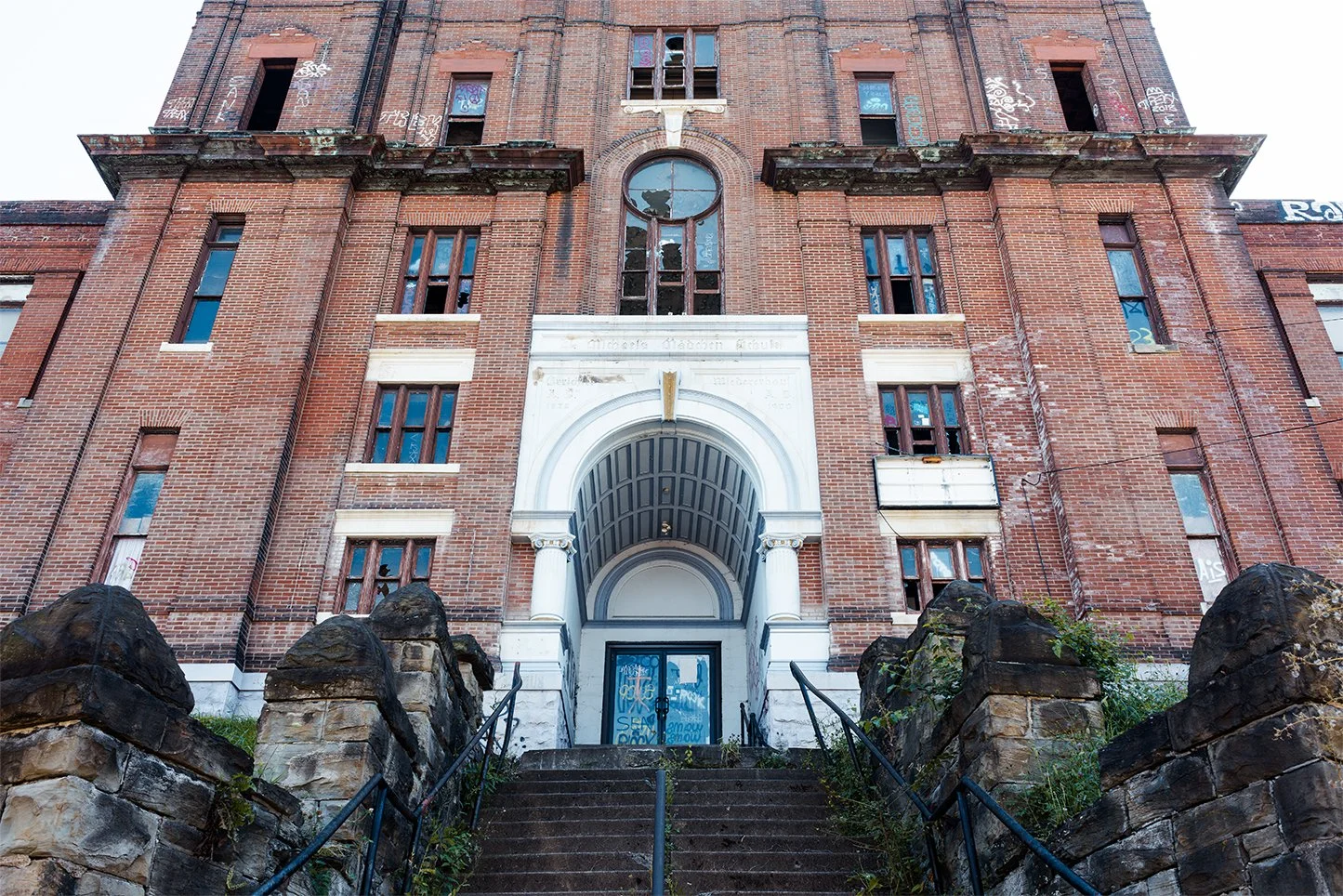
St. Michael’s Mädchen Schule
Kevin LeDuc
St. Michael’s Mädchen Schule, c. Errichtet A.D. 1872
South Side Slopes, Pittsburgh, Allegheny County, Pennsylvania from the Ballyshannon’s Rustland (2021–2024) – Flesh and Furnace Portfolio
Pigment print on Hahnemühle Baryta
Artist’s proof + edition of 5 (portfolio of 40 images)
30 × 45 inches
-
St. Michael’s Mädchen Schule and the German Catholic World of Pittsburgh’s South Side Slopes, 1848–Twentieth Century
Introduction
Perched along Pius Street on the steep hillsides above Pittsburgh’s South Side Flats stands the former St. Michael’s Mädchen Schule, or St. Michael’s Girls’ School, erected in 1872 and marked by the inscription “Errichtet A.D. 1872.” The building formed part of the institutional landscape of St. Michael’s Roman Catholic Parish, a German national parish founded in 1848 to serve Pittsburgh’s rapidly expanding German Catholic immigrant population. From its founding through the late nineteenth century, St. Michael’s functioned not only as a place of worship but also as a dense network of social, educational, and cultural institutions designed to preserve language, faith, and communal identity amid the pressures of industrial urban life.¹
The Mädchen Schule was one of these institutions. It educated the daughters of working-class and skilled immigrant families whose labor powered Pittsburgh’s industrial economy. Though the school’s precise closure date as a distinct German girls’ institution is not documented in surviving published sources, its physical survival and later educational reuse demonstrate the long afterlife of nineteenth-century ethnic parish schooling in the city.²
German Catholic Immigration and the Founding of St. Michael’s Parish
The origins of St. Michael’s Mädchen Schule lie in the broader pattern of German immigration to western Pennsylvania in the mid-nineteenth century. Thousands of German-speaking Catholics arrived in Pittsburgh between the 1840s and 1860s, drawn by industrial employment opportunities and fleeing political and economic instability in Europe. Many settled in the South Side, a district closely tied to river transport, iron production, glass manufacturing, and machine industries.³
In response to this demographic shift, the Diocese of Pittsburgh established St. Michael’s Parish in 1848 as a German national parish. Unlike territorial parishes, national parishes served specific ethnic or linguistic groups, ensuring that immigrants could worship and receive instruction in their native language. St. Michael’s quickly became a central institution for German Catholic life in the city. By the 1860s, a permanent church building had been completed, and parish leaders increasingly focused on educational infrastructure as the congregation expanded.⁴
Construction of the Mädchen Schule in 1872
By 1872, St. Michael’s Parish had grown sufficiently to warrant a dedicated school for girls. The construction of the Mädchen Schule reflected both Catholic educational priorities and the strong emphasis German immigrants placed on literacy and religious instruction. Parish schools were widely seen as essential institutions for preserving Catholic identity in an environment where public schools were often perceived as Protestant-influenced.⁵
The St. Michael’s Mädchen Schule was built in brick on a steep hillside above the industrial flats, its location both practical and symbolic. The elevation physically separated the school from the noise and pollution of industrial Pittsburgh while reinforcing its role as a moral and cultural institution. Instruction in such schools typically included reading, writing, arithmetic, religion, and moral formation, often conducted in both German and English during the nineteenth century.⁶
Students, Families, and Ethnic Composition
The student body of St. Michael’s Mädchen Schule consisted overwhelmingly of daughters of German Catholic immigrants and first-generation German Americans residing in the South Side. Parish boundaries and census data indicate that the surrounding neighborhood in the late nineteenth century contained a dense concentration of German-speaking households, many of which were tied to St. Michael’s Parish.⁷
Although no complete enrollment ledger survives in published form, diocesan records and comparative studies of Catholic parish schools in Pittsburgh suggest that institutions of this type typically served large numbers of children drawn from working-class families.⁸ The ethnic character of the school was closely tied to parish membership, which remained strongly German through the late nineteenth century even as other immigrant groups settled nearby.
Family names recorded in parish sacramental registers and federal census manuscripts reflect origins in regions such as Bavaria, the Rhineland, Baden, Württemberg, and Prussia. These families often lived in multigenerational households, with extended kin networks supporting both economic survival and parish participation.⁹
Occupations and Working-Class Life
The parents of students at St. Michael’s Mädchen Schule were largely employed in Pittsburgh’s industrial and artisanal economy. Fathers worked in iron and steel mills along the Monongahela River, glassworks, foundries, machine shops, and river-related transportation industries. Others held skilled trades such as carpentry, masonry, blacksmithing, tailoring, brewing, and shoemaking.¹⁰
The South Side’s industrial landscape shaped daily life. Men often worked long shifts in hazardous conditions, while women contributed to household economies through sewing, laundry work, boarding arrangements, and informal commercial activities. Small family-run businesses such as bakeries, butcher shops, and grocery stores were common in German Catholic neighborhoods.¹¹
Within this economic context, parish schooling represented both a financial sacrifice and an investment in social mobility. Education at St. Michael’s Mädchen Schule offered literacy, discipline, and religious formation that families believed would improve the prospects of their daughters while reinforcing Catholic identity.
The South Side Slopes Neighborhood
The South Side Slopes developed as one of Pittsburgh’s most distinctive residential landscapes. Rising sharply above the Monongahela River valley, the neighborhood was defined by extreme topography, narrow streets, and an extensive system of public stairways that connected hillside homes to industrial workplaces below.¹²
This geography shaped both physical mobility and community structure. Residents frequently climbed hundreds of steps daily, making stairways essential infrastructure. The Slopes became a densely built working-class neighborhood, with housing interwoven with churches, schools, and small commercial establishments.¹³
Religious institutions played a particularly prominent role in shaping the cultural identity of the area. Alongside St. Michael’s Church, other Catholic institutions reinforced the neighborhood’s ethnic and religious cohesion during the nineteenth century. The visibility of church towers and school buildings on the hillside skyline underscored the centrality of Catholic life in the South Side Slopes community.¹⁴
Twentieth-Century Change and Institutional Transformation
During the twentieth century, the South Side Slopes and St. Michael’s Parish underwent gradual but significant transformation. Immigration from Germany declined sharply after the 1880s, and subsequent generations of German Americans increasingly adopted English as their primary language. Industrial restructuring and suburbanization further altered the demographic composition of the neighborhood.¹⁵
The exact year in which St. Michael’s Mädchen Schule ceased functioning as a separate German Catholic girls’ school is not documented in surviving published records or parish histories. Instead, the institution appears to have been gradually absorbed into broader parish educational structures during the early twentieth century, reflecting the assimilation of the German Catholic population into mainstream American Catholic life.¹⁶
Despite these changes, the building continued to be used for educational and community purposes under various institutional arrangements connected to St. Michael’s Parish and later South Side Catholic educational systems. Its continued use reflects the adaptability of Catholic parish infrastructure in response to demographic change.¹⁷
Conclusion
St. Michael’s Mädchen Schule stands as a material testament to the experience of German Catholic immigrants in nineteenth-century Pittsburgh. Constructed in 1872 as part of St. Michael’s Parish complex, the school educated generations of girls whose families were embedded in the industrial economy of the South Side. These families combined skilled and unskilled labor, small-scale entrepreneurship, and strong parish participation to build stable community institutions in a rapidly changing urban environment.
Although the school’s closure as a distinct German girls’ institution cannot be precisely dated from available sources, its continued presence as a building and its incorporation into later educational systems reflect the long trajectory of ethnic parish schooling in American Catholic history. Today, St. Michael’s Mädchen Schule remains one of the most enduring architectural and cultural markers of Pittsburgh’s German Catholic past.
Notes
Diocese of Pittsburgh Archives, St. Michael Parish Records, founding documentation, 1848.
Father Pitt, “St. Michael’s Mädchen Schule, South Side Slopes,” 2022.
Jay P. Dolan, The American Catholic Experience (Garden City, NY: Doubleday, 1985), 215–220.
Diocese of Pittsburgh Archives, Parish Histories Collection: St. Michael’s.
Dolan, The American Catholic Experience, 240–248.
Harold A. Buetow, Of Singular Traditions: The History of the Catholic School System in the United States (New York: Macmillan, 1970), 112–118.
U.S. Census Manuscripts, Allegheny County, Pennsylvania, 1870–1900.
Timothy Walch, Parish School: American Catholic Parochial Education from Colonial Times to the Present (Washington, DC: National Catholic Educational Association, 1996).
U.S. Census Manuscripts, Allegheny County, Pennsylvania, 1870–1900.
Pittsburgh City Directories, 1870–1900, University of Pittsburgh Library System.
Walch, Parish School, 88–92.
Pittsburgh Department of City Planning, South Side Slopes Neighborhood Report.
Ibid.
Diocese of Pittsburgh Archives, St. Michael Parish Photographic Collection.
Dolan, The American Catholic Experience, 310–315.
Diocese of Pittsburgh Archives, Catholic School Consolidation Records, early twentieth century (closure date not specified).
Father Pitt, “St. Michael’s Mädchen Schule, South Side Slopes,” 2022.
Bibliography
Buetow, Harold A. Of Singular Traditions: The History of the Catholic School System in the United States. New York: Macmillan, 1970.
Diocese of Pittsburgh Archives. Catholic School Consolidation Records.
Diocese of Pittsburgh Archives. Parish Histories Collection: St. Michael’s.
Diocese of Pittsburgh Archives. St. Michael Parish Records.
Diocese of Pittsburgh Archives. St. Michael Parish Photographic Collection.
Dolan, Jay P. The American Catholic Experience. Garden City, NY: Doubleday, 1985.
Father Pitt. “St. Michael’s Mädchen Schule, South Side Slopes.” 2022.
Pittsburgh City Directories, 1870–1900. University of Pittsburgh Library System.
Pittsburgh Department of City Planning. South Side Slopes Neighborhood Report.
U.S. Census Manuscripts, Allegheny County, Pennsylvania, 1870–1900.
Walch, Timothy. Parish School: American Catholic Parochial Education from Colonial Times to the Present. Washington, DC: National Catholic Educational Association, 1996.