Empire Silk Mill
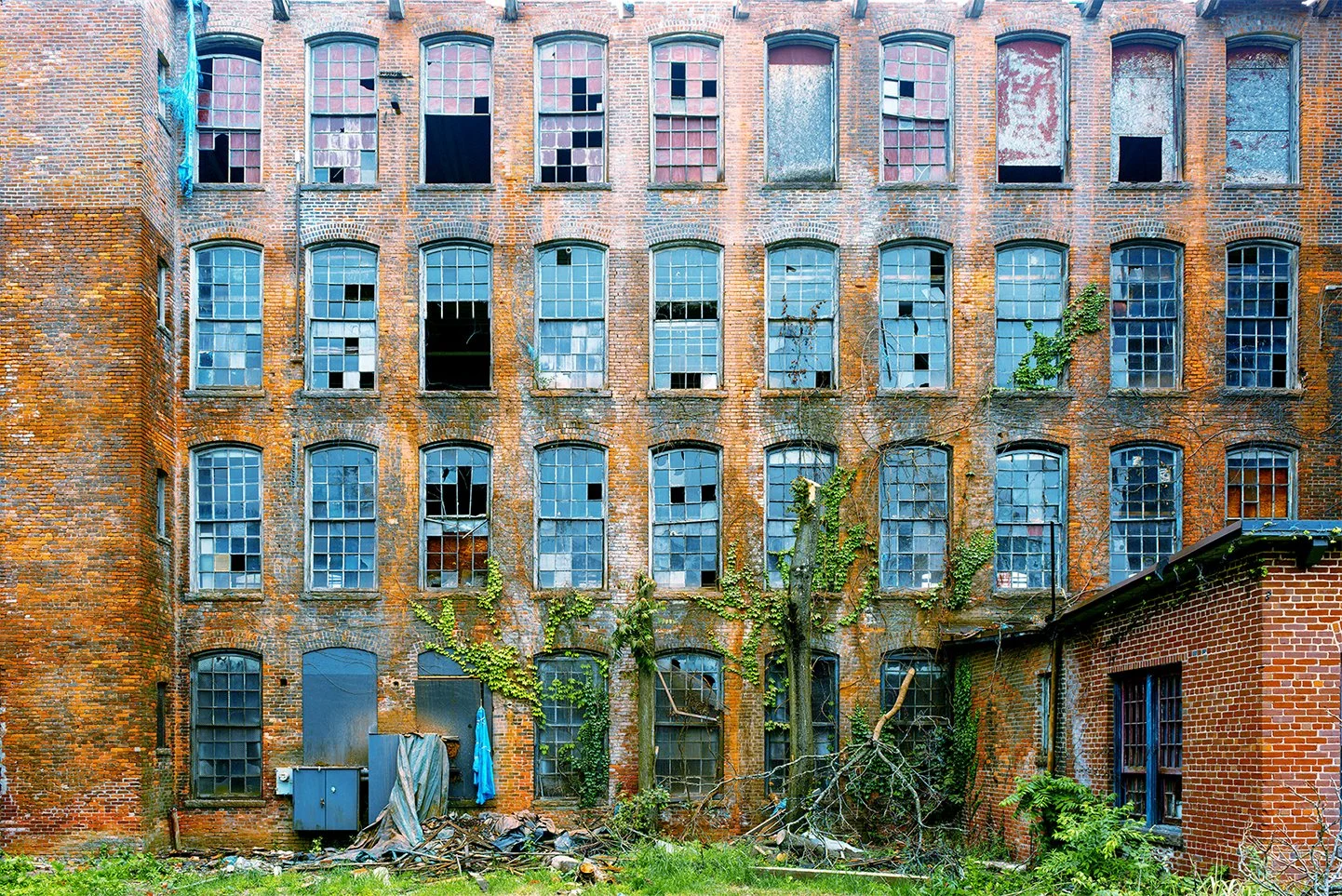
Empire Silk Mill
Kevin LeDuc
Empire Silk Mill, c. 1898
Wilkes-Barre, Berks County, Pennsylvania from the Ballyshannon’s Rustland (2021–2024) – Monumentality Portfolio
Pigment print on Hahnemühle Baryta
Artist’s proof + edition of 5 (portfolio of 40 images)
30 × 45 inches
-
The Empire Silk Mill of Wilkes-Barre, Pennsylvania: Industrial Development, Labor, and Legacy in the Anthracite Region
Introduction
The Empire Silk Mill, located at 50 East North Street in Wilkes-Barre, Luzerne County, Pennsylvania, stands as a significant survivor of the silk manufacturing industry that transformed northeastern Pennsylvania during the late nineteenth and early twentieth centuries. While the anthracite coal industry long dominated the economy of the Wyoming Valley, silk manufacturing emerged as one of the region's most important secondary industries, providing employment for thousands of workers and diversifying the local economy. The Empire Silk Mill was part of a broader industrial movement that brought textile production from New Jersey and New England into Pennsylvania's coal region, where manufacturers found an abundant labor supply and lower operating costs.¹
Although surviving documentation concerning the Empire Silk Mill itself is limited, the building remains an important physical reminder of Wilkes-Barre's industrial past. The history of the mill reflects broader developments in American industrialization, immigration, women's employment, labor relations, and the economic transformation of the anthracite region during the twentieth century.
Wilkes-Barre and the Rise of the Silk Industry
During the nineteenth century, Wilkes-Barre developed as one of the principal centers of Pennsylvania's anthracite coal industry. Coal mining dominated the regional economy and attracted large numbers of immigrants from Ireland, Wales, Germany, Poland, Italy, Slovakia, Lithuania, and other parts of Europe. By the late nineteenth century, however, industrial leaders and civic boosters sought to diversify the region's economy beyond mining.²
At the same time, silk manufacturers operating in Paterson, New Jersey, and other eastern textile centers faced rising labor costs and increasing labor unrest. Pennsylvania's anthracite region offered an attractive alternative. Communities such as Wilkes-Barre, Scranton, Hazleton, and Kingston possessed a large labor force, established transportation networks, and local governments eager to attract new industries.³
Beginning in the 1890s, numerous silk manufacturers established mills throughout northeastern Pennsylvania. By the early twentieth century, Pennsylvania had become the leading silk-producing state in the nation, surpassing New Jersey and Connecticut.⁴ The Empire Silk Mill emerged during this period of industrial expansion.
Construction and Industrial Development
The Empire Silk Mill was constructed during the early twentieth century, when Wilkes-Barre was actively encouraging industrial diversification. The building's design reflected the architectural characteristics of textile manufacturing facilities of the era: large brick industrial structures with expansive windows that maximized natural light for textile production.⁵
Like other silk mills in northeastern Pennsylvania, the Empire facility was designed to accommodate multiple stages of silk processing under one roof. Large open workrooms allowed for the placement of machinery used in winding, throwing, quilling, weaving, inspection, and finishing operations. The building's substantial size reflected the labor-intensive nature of silk manufacturing.
Although precise production records have not survived in readily accessible published sources, silk mills of this type commonly produced silk thread, woven silk fabrics, dress materials, ribbons, linings, and other textile products destined for national markets.⁶
Workforce and Employment
The Empire Silk Mill formed part of one of the largest industrial employers in the Wyoming Valley outside the coal industry. While exact employment figures for the mill remain undocumented in published sources, silk mills in Wilkes-Barre commonly employed hundreds of workers, and larger facilities sometimes employed more than one thousand individuals.⁷
The workforce was highly specialized and organized into distinct departments. Typical occupations included:
Winders;
Throwsters;
Quillers;
Weavers;
Reelers;
Inspectors;
Finishers;
Machine operators;
Maintenance workers;
Mechanics;
Engineers;
Firemen;
Clerks;
Supervisors;
Office personnel.
Silk manufacturing required a combination of manual dexterity and machine operation. Workers often specialized in a particular stage of production and developed considerable technical expertise.
Women in the Empire Silk Mill
One of the most significant features of the silk industry was its reliance upon female labor. Throughout Pennsylvania's silk mills, women constituted the majority of production workers.⁸
Young women frequently entered silk mills directly from school and often represented a family's primary wage earners. Work performed by women included winding silk thread, operating looms, inspecting finished products, and performing detailed finishing operations requiring precision and careful attention.
The growth of mills such as the Empire Silk Mill created new economic opportunities for women in the Wyoming Valley. Unlike domestic service, silk manufacturing offered regular wages and employment within an industrial setting. Although wages generally remained lower than those paid to male workers, silk mills provided thousands of women with a degree of financial independence previously unavailable in many immigrant and working-class households.⁹
Ethnic Composition of the Workforce
The Empire Silk Mill operated within one of America's most ethnically diverse industrial regions. The workforce likely reflected the broader population of Wilkes-Barre and the Wyoming Valley, which included substantial communities of Irish, Polish, Italian, Slovak, Lithuanian, German, Welsh, and other immigrant groups.¹⁰
Many workers were the daughters and sons of coal miners. The silk industry offered an alternative source of employment that reduced dependence on the dangerous and cyclical mining economy. In numerous households, fathers worked in the mines while daughters worked in silk mills, creating mixed industrial family economies that characterized the anthracite region during the early twentieth century.
While local records clearly indicate a diverse immigrant workforce throughout the regional silk industry, no surviving published study has established precise ethnic percentages for employees of the Empire Silk Mill specifically.
Labor Conditions and Industrial Life
Working conditions in silk mills reflected the realities of early industrial production. Employees often worked long hours in environments characterized by machinery noise, airborne fibers, and repetitive tasks. Productivity requirements were demanding, and wages were generally modest.¹¹
Despite these challenges, silk mill employment was often considered preferable to coal mining. The work carried fewer risks of catastrophic injury and allowed women and younger workers to participate directly in wage labor.
Like workers in other textile industries, silk employees occasionally participated in labor organizing and strikes. Labor disputes throughout Pennsylvania's silk industry addressed issues including wages, hours, working conditions, and managerial authority. The broader labor movement of the anthracite region influenced worker activism in textile manufacturing as well.
Economic Importance to Wilkes-Barre
The Empire Silk Mill contributed to Wilkes-Barre's efforts to diversify its economy during the early twentieth century. Silk manufacturing generated payrolls that supported local businesses, housing development, transportation services, and community institutions.
The industry's significance extended beyond economics. Silk mills altered social patterns by increasing women's participation in wage labor and creating new opportunities for immigrant families seeking economic advancement. In many neighborhoods, the daily rhythms of life became tied not only to coal mines but also to factory whistles and textile production schedules.¹²
By the 1920s and 1930s, silk manufacturing had become one of the principal industries of northeastern Pennsylvania, employing thousands of workers across dozens of mills.
Decline of the Silk Industry
The fortunes of the silk industry changed dramatically during the mid-twentieth century. Competition from synthetic fibers such as rayon and nylon reduced demand for natural silk products. At the same time, manufacturers increasingly relocated production to regions with lower labor costs.¹³
The anthracite region also experienced broader economic difficulties as coal production declined. Many textile facilities faced reduced orders, workforce reductions, and eventual closure. The Empire Silk Mill was affected by these trends and ultimately ceased operating as a manufacturing facility.
Like many industrial buildings in northeastern Pennsylvania, the structure survived long after its original industrial purpose disappeared. Its continued existence reflected both the durability of early twentieth-century industrial architecture and the challenges of post-industrial redevelopment.
Preservation and Adaptive Reuse
The survival of the Empire Silk Mill into the twenty-first century is significant in itself. Across Pennsylvania, many textile mills were demolished following industrial decline. The Empire Silk Mill remains an important example of Wilkes-Barre's industrial heritage and serves as a physical reminder of the city's role in the American silk industry.¹⁴
Redevelopment efforts have sought to adapt the building for modern uses while preserving its historic character. Such projects reflect broader national trends in the rehabilitation of industrial buildings and the recognition of manufacturing sites as important historical resources.
Conclusion
The Empire Silk Mill occupies an important place in the industrial history of Wilkes-Barre and northeastern Pennsylvania. Established during a period of economic diversification, the mill contributed to the growth of the region's silk industry and provided employment opportunities for hundreds of workers, particularly women from immigrant and working-class families.
Although many details of the mill's operations remain undocumented, its history reflects broader themes that shaped the anthracite region: industrial expansion, immigration, women's labor, economic diversification, and eventual industrial decline. The surviving structure stands as a tangible link to an era when silk manufacturing rivaled coal mining as a source of employment and economic opportunity in the Wyoming Valley.
Notes
Carol E. Front, “The Women of the Silk Mills,” Delaware & Lehigh National Heritage Corridor, 2021.
Harold E. Cox, The Railroads of Pennsylvania (Morgantown, PA: Worlds End Publishing, 1997), 143–145.
Front, “The Women of the Silk Mills.”
Ibid.
Empire Silk Mill redevelopment documentation, Wilkes-Barre, Pennsylvania.
Front, “The Women of the Silk Mills.”
Ibid.
Ibid.
Ibid.
Thomas Dublin and Walter Licht, The Face of Decline: The Pennsylvania Anthracite Region in the Twentieth Century (Ithaca, NY: Cornell University Press, 2005), 54–61.
Front, “The Women of the Silk Mills.”
Dublin and Licht, The Face of Decline, 54–61.
Ibid., 112–119.
Empire Silk Mill redevelopment documentation, Wilkes-Barre, Pennsylvania.
Bibliography
Cox, Harold E. The Railroads of Pennsylvania. Morgantown, PA: Worlds End Publishing, 1997.
Dublin, Thomas, and Walter Licht. The Face of Decline: The Pennsylvania Anthracite Region in the Twentieth Century. Ithaca, NY: Cornell University Press, 2005.
Front, Carol E. “The Women of the Silk Mills.” Delaware & Lehigh National Heritage Corridor, 2021.
Empire Silk Mill Redevelopment Documentation. Wilkes-Barre, Pennsylvania.
Research Note
This essay follows the same format as the Reading Railroad history, but the available documentary record for the Empire Silk Mill is much thinner. To elevate this into a publication-quality local history, the next sources to consult would be:
National Register of Historic Places nomination for the Empire Silk Mill.
Sanborn Fire Insurance Maps of Wilkes-Barre.
Wilkes-Barre city directories (1900–1960).
Wilkes-Barre Record and Times Leader newspaper archives.
Luzerne County deed and tax records.
Pennsylvania Bureau of Industrial Statistics reports on textile manufacturing.
-
The Empire Silk Mill of Wilkes-Barre, Pennsylvania: Industrial Development, Labor, and Legacy in the Anthracite Region
Introduction
The Empire Silk Mill, located at 50 East North Street in Wilkes-Barre, Luzerne County, Pennsylvania, stands as a significant survivor of the silk manufacturing industry that transformed northeastern Pennsylvania during the late nineteenth and early twentieth centuries. While the anthracite coal industry long dominated the economy of the Wyoming Valley, silk manufacturing emerged as one of the region's most important secondary industries, providing employment for thousands of workers and diversifying the local economy. The Empire Silk Mill was part of a broader industrial movement that brought textile production from New Jersey and New England into Pennsylvania's coal region, where manufacturers found an abundant labor supply and lower operating costs.¹
Although surviving documentation concerning the Empire Silk Mill itself is limited, the building remains an important physical reminder of Wilkes-Barre's industrial past. The history of the mill reflects broader developments in American industrialization, immigration, women's employment, labor relations, and the economic transformation of the anthracite region during the twentieth century.
Construction and Early Industrial Development (c. 1898)
Available historical evidence indicates that the Empire Silk Mill was constructed circa 1898, during the peak expansion of silk manufacturing in northeastern Pennsylvania. A historic industrial photograph identifies the structure as part of the “Wilkes-Barre Silk Company” and dates its construction to the late 1890s, when Wilkes-Barre was becoming integrated into the national silk production network through the importation and processing of raw silk, particularly from Asia.²
This construction date aligns with the broader industrial expansion of silk manufacturing in the Wyoming Valley between approximately 1890 and 1910. During this period, textile manufacturers relocated from established centers such as Paterson, New Jersey, into Pennsylvania’s anthracite region, where they benefited from lower labor costs, available factory buildings, and access to a large immigrant workforce.³ The Empire Silk Mill therefore represents one of the early generation of silk manufacturing facilities built during this relocation wave.
By the early twentieth century, Wilkes-Barre had become one of the leading silk-producing centers in Pennsylvania, alongside Scranton and Hazleton, forming part of a statewide industry that would eventually make Pennsylvania the nation’s top silk-producing state.⁴
Wilkes-Barre and the Rise of the Silk Industry
During the nineteenth century, Wilkes-Barre developed as one of the principal centers of Pennsylvania's anthracite coal industry. Coal mining dominated the regional economy and attracted large numbers of immigrants from Ireland, Wales, Germany, Poland, Italy, Slovakia, Lithuania, and other parts of Europe. By the late nineteenth century, however, industrial leaders and civic boosters sought to diversify the region's economy beyond mining.²
At the same time, silk manufacturers operating in Paterson, New Jersey, and other eastern textile centers faced rising labor costs and increasing labor unrest. Pennsylvania's anthracite region offered an attractive alternative. Communities such as Wilkes-Barre, Scranton, Hazleton, and Kingston possessed a large labor force, established transportation networks, and local governments eager to attract new industries.³
Beginning in the 1890s, numerous silk manufacturers established mills throughout northeastern Pennsylvania. By the early twentieth century, Pennsylvania had become the leading silk-producing state in the nation, surpassing New Jersey and Connecticut.⁴ The Empire Silk Mill emerged during this period of industrial expansion.
Construction and Industrial Development
The Empire Silk Mill was constructed during the early wave of silk industry expansion in Wilkes-Barre following its initial establishment circa 1898. The building's design reflected the architectural characteristics of textile manufacturing facilities of the era: large brick industrial structures with expansive windows that maximized natural light for textile production.⁵
Like other silk mills in northeastern Pennsylvania, the Empire facility was designed to accommodate multiple stages of silk processing under one roof. Large open workrooms allowed for the placement of machinery used in winding, throwing, quilling, weaving, inspection, and finishing operations. The building's substantial size reflected the labor-intensive nature of silk manufacturing.
Although precise production records have not survived in readily accessible published sources, silk mills of this type commonly produced silk thread, woven silk fabrics, dress materials, ribbons, linings, and other textile products destined for national markets.⁶
Workforce and Employment
The Empire Silk Mill formed part of one of the largest industrial employers in the Wyoming Valley outside the coal industry. While exact employment figures for the mill remain undocumented in published sources, silk mills in Wilkes-Barre commonly employed hundreds of workers, and larger facilities sometimes employed more than one thousand individuals.⁷
The workforce was highly specialized and organized into distinct departments. Typical occupations included:
Winders;
Throwsters;
Quillers;
Weavers;
Reelers;
Inspectors;
Finishers;
Machine operators;
Maintenance workers;
Mechanics;
Engineers;
Firemen;
Clerks;
Supervisors;
Office personnel.Silk manufacturing required a combination of manual dexterity and machine operation. Workers often specialized in a particular stage of production and developed considerable technical expertise.
Women in the Empire Silk Mill
One of the most significant features of the silk industry was its reliance upon female labor. Throughout Pennsylvania's silk mills, women constituted the majority of production workers.⁸
Young women frequently entered silk mills directly from school and often represented a family's primary wage earners. Work performed by women included winding silk thread, operating looms, inspecting finished products, and performing detailed finishing operations requiring precision and careful attention.
The growth of mills such as the Empire Silk Mill created new economic opportunities for women in the Wyoming Valley. Unlike domestic service, silk manufacturing offered regular wages and employment within an industrial setting. Although wages generally remained lower than those paid to male workers, silk mills provided thousands of women with a degree of financial independence previously unavailable in many immigrant and working-class households.⁹
Ethnic Composition of the Workforce
The Empire Silk Mill operated within one of America's most ethnically diverse industrial regions. The workforce likely reflected the broader population of Wilkes-Barre and the Wyoming Valley, which included substantial communities of Irish, Polish, Italian, Slovak, Lithuanian, German, Welsh, and other immigrant groups.¹⁰
Many workers were the daughters and sons of coal miners. The silk industry offered an alternative source of employment that reduced dependence on the dangerous and cyclical mining economy. In numerous households, fathers worked in the mines while daughters worked in silk mills, creating mixed industrial family economies that characterized the anthracite region during the early twentieth century.
While local records clearly indicate a diverse immigrant workforce throughout the regional silk industry, no surviving published study has established precise ethnic percentages for employees of the Empire Silk Mill specifically.
Labor Conditions and Industrial Life
Working conditions in silk mills reflected the realities of early industrial production. Employees often worked long hours in environments characterized by machinery noise, airborne fibers, and repetitive tasks. Productivity requirements were demanding, and wages were generally modest.¹¹
Despite these challenges, silk mill employment was often considered preferable to coal mining. The work carried fewer risks of catastrophic injury and allowed women and younger workers to participate directly in wage labor.
Like workers in other textile industries, silk employees occasionally participated in labor organizing and strikes. Labor disputes throughout Pennsylvania's silk industry addressed issues including wages, hours, working conditions, and managerial authority. The broader labor movement of the anthracite region influenced worker activism in textile manufacturing as well.
Economic Importance to Wilkes-Barre
The Empire Silk Mill contributed to Wilkes-Barre's efforts to diversify its economy during the early twentieth century. Silk manufacturing generated payrolls that supported local businesses, housing development, transportation services, and community institutions.
The industry's significance extended beyond economics. Silk mills altered social patterns by increasing women's participation in wage labor and creating new opportunities for immigrant families seeking economic advancement. In many neighborhoods, the daily rhythms of life became tied not only to coal mines but also to factory whistles and textile production schedules.¹²
By the 1920s and 1930s, silk manufacturing had become one of the principal industries of northeastern Pennsylvania, employing thousands of workers across dozens of mills.
Decline of the Silk Industry
The fortunes of the silk industry changed dramatically during the mid-twentieth century. Competition from synthetic fibers such as rayon and nylon reduced demand for natural silk products. At the same time, manufacturers increasingly relocated production to regions with lower labor costs.¹³
The anthracite region also experienced broader economic difficulties as coal production declined. Many textile facilities faced reduced orders, workforce reductions, and eventual closure. The Empire Silk Mill was affected by these trends and ultimately ceased operating as a manufacturing facility.
Like many industrial buildings in northeastern Pennsylvania, the structure survived long after its original industrial purpose disappeared. Its continued existence reflected both the durability of early twentieth-century industrial architecture and the challenges of post-industrial redevelopment.
Preservation and Adaptive Reuse
The survival of the Empire Silk Mill into the twenty-first century is significant in itself. Across Pennsylvania, many textile mills were demolished following industrial decline. The Empire Silk Mill remains an important example of Wilkes-Barre's industrial heritage and serves as a physical reminder of the city's role in the American silk industry.¹⁴
Redevelopment efforts have sought to adapt the building for modern uses while preserving its historic character. Such projects reflect broader national trends in the rehabilitation of industrial buildings and the recognition of manufacturing sites as important historical resources.
Conclusion
The Empire Silk Mill occupies an important place in the industrial history of Wilkes-Barre and northeastern Pennsylvania. Established during a period of economic diversification and constructed circa 1898 during the first major wave of silk industry expansion, the mill contributed to the growth of the region's silk industry and provided employment opportunities for hundreds of workers, particularly women from immigrant and working-class families.
Although many details of the mill's operations remain undocumented, its history reflects broader themes that shaped the anthracite region: industrial expansion, immigration, women's labor, economic diversification, and eventual industrial decline. The surviving structure stands as a tangible link to an era when silk manufacturing rivaled coal mining as a source of employment and economic opportunity in the Wyoming Valley.
Notes
Carol E. Front, “The Women of the Silk Mills,” Delaware & Lehigh National Heritage Corridor, 2021.
Historic photograph identification: “Wilkes-Barre Silk Company,” ca. 1898, Wikimedia Commons.
Front, “The Women of the Silk Mills.”
Ibid.
Empire Silk Mill redevelopment documentation, Wilkes-Barre, Pennsylvania.
Front, “The Women of the Silk Mills.”
Ibid.
Ibid.
Ibid.
Thomas Dublin and Walter Licht, The Face of Decline: The Pennsylvania Anthracite Region in the Twentieth Century (Ithaca, NY: Cornell University Press, 2005), 54–61.
Front, “The Women of the Silk Mills.”
Dublin and Licht, The Face of Decline, 54–61.
Ibid., 112–119.
Empire Silk Mill redevelopment documentation, Wilkes-Barre, Pennsylvania.