Blood Knitting Mill Inc.
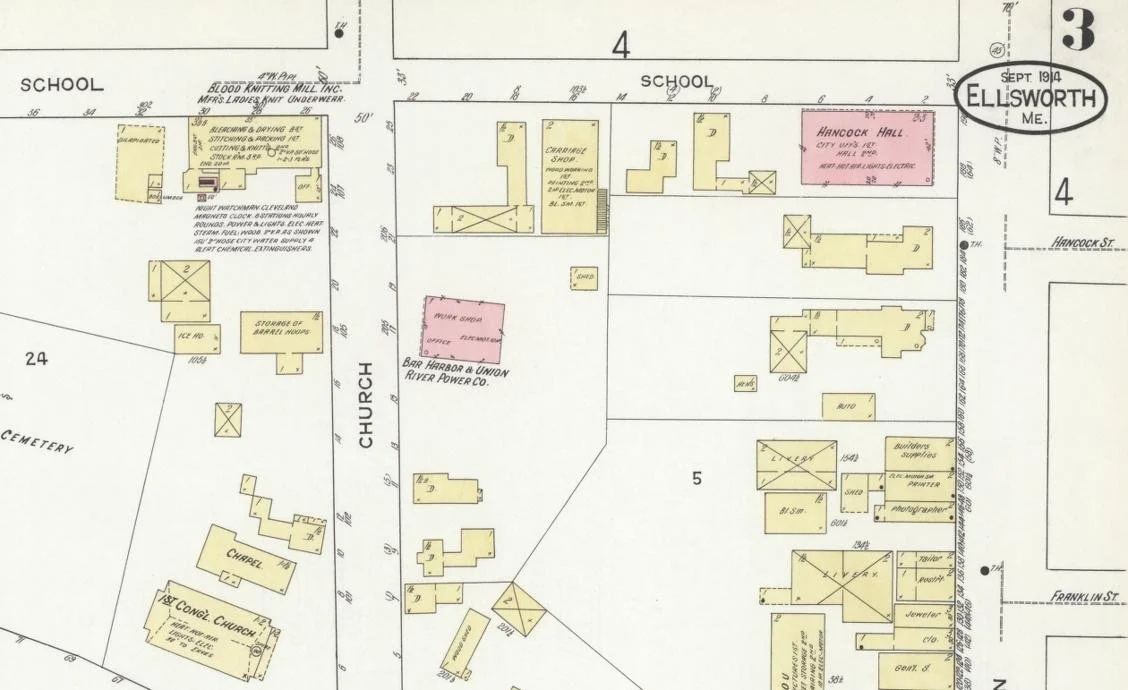
Blood Knitting Mill Inc.
Kevin LeDuc
Blood Knitting Mill Inc., c. 1914
26-30 School Street, Ellsworth, Hancock County, Maine
from the Echoes, Still (2024–2027) – Renaissance Portfolio
Pigment print on Hahnemühle Baryta
Artist’s proof + edition of 3 (portfolio of 40 images)
28 × 45 inches
-
Blood Knitting Mills: A Textile Manufacturing Company at 26–30 School Street, Ellsworth, Hancock County, Maine
Blood Knitting Mills was one of the specialized textile manufacturing companies that operated in Ellsworth, Maine, during the early twentieth century. Unlike the lumber and woodworking industries that had earlier dominated Maine manufacturing, Blood Knitting Mills produced finished textile garments for consumer markets. The company specialized in knitted clothing, particularly women’s ribbed underwear and union suits, products that were widely used in the United States before the widespread adoption of modern synthetic fabrics and changing clothing styles.¹
The earliest confirmed evidence places Blood Knitting Mills in operation by 1912. Newspaper records from that year document company stockholder activity and employment recruitment, demonstrating that the firm was already established as a functioning corporation with a workforce and organized management structure.² By 1914, the company occupied the industrial property at 26–30 School Street in Ellsworth, as shown on the Sanborn Fire Insurance Map, Sheet 3.³
The chronology of the School Street property demonstrates that Blood Knitting Mills was a later industrial occupant of the site. The 1907 Sanborn Map, Sheet 2, does not identify a knitting mill at this location. Instead, the property contained the Free Will Baptist Church and Isaac L. Hodgkins’s picture frame and cabinet shop.⁴ Between 1907 and 1914, the property was converted for textile manufacturing, creating the facility used by Blood Knitting Mills.⁵
The company was organized as a corporation with outside investment rather than as a small individual workshop. The Official American Textile Directory listed Blood Knitting Mills with a capitalization of $30,000, demonstrating a significant financial investment in textile manufacturing equipment and factory operations. Company officers included C. L. Morang as president, John O. Whitney as treasurer, and John Blood, Jr. as superintendent and buyer.⁶
The management structure shows a separation between financial administration and manufacturing operations. The president and treasurer represented the corporate and financial side of the company, while the superintendent was responsible for daily production activities and purchasing materials required for manufacturing. John Blood, Jr.’s combined role as superintendent and buyer indicates that factory management depended upon close control of both production and raw-material supply.⁷
Blood Knitting Mills specialized in knitted garments rather than general textile production. The company manufactured women’s ribbed underwear and union suits using cotton and merino yarns. These products were important items in the early twentieth-century clothing market because knitted undergarments provided warmth, durability, and comfort.⁸
The company’s products were distributed beyond the local market. A New York sales connection at 340 Broadway, New York City, indicates that Blood Knitting Mills participated in a national commercial network rather than producing only for nearby customers. The presence of a New York sales address suggests that the company marketed its goods through established textile distribution channels.⁹
The manufacturing process at Blood Knitting Mills involved several stages. The company operated 45 latch-needle knitting machines and 30 sewing machines, allowing it to produce knitted fabric and assemble finished garments. The factory also maintained bleaching and finishing equipment, enabling the company to complete multiple stages of production before shipment.¹⁰
The company’s machinery confirms that Blood Knitting Mills was a specialized knitting operation rather than a complete textile mill. It did not manufacture its own yarn from raw fibers, and available records do not identify carding machinery or weaving looms. Instead, the company purchased prepared cotton and merino yarns and converted them into finished knitted garments.¹¹
The absence of carding machines is historically significant. Carding equipment was normally associated with preparing raw fibers for spinning, while Blood Knitting Mills began its production process with purchased yarn. Likewise, the absence of traditional looms reflects the difference between knitting and weaving. The company’s primary machinery consisted of knitting machines designed to create looped fabrics suitable for underwear and similar garments.¹²
Blood Knitting Mills therefore represented a specialized stage of textile manufacturing: converting prepared yarn into finished clothing products. Its operations combined mechanical knitting, sewing, bleaching, finishing, inspection, and packing into an integrated garment-production system.¹³
Part II — Workforce, Production, Decline, and Historical Significance
The workforce of Blood Knitting Mills reflected the labor structure common to early twentieth-century textile manufacturing. The company’s production depended heavily upon machine operators and garment workers who performed specialized tasks throughout the manufacturing process. A 1912 employment notice provides one of the clearest records of the company’s labor requirements, stating that the mill sought fifty women and girls for employment. The advertisement noted that new workers received approximately three to four weeks of instruction and could earn average wages ranging from $1.00 to $1.75 per day after training.¹⁴
The recruitment notice demonstrates that Blood Knitting Mills required a trained workforce rather than immediately productive unskilled labor. Operating knitting machinery and sewing equipment required familiarity with machine adjustment, fabric handling, and quality control. The training period suggests that workers developed specialized factory skills before reaching full productivity.¹⁵
The company’s workforce can be divided into several occupational groups based on the manufacturing process:
Knitting machine operators: Workers responsible for operating the 45 latch-needle knitting machines that produced knitted fabric.
Sewing machine operators: Employees who assembled knitted sections into finished garments using the company’s 30 sewing machines.
Finishing workers: Employees involved in bleaching, pressing, inspection, and preparation of garments for shipment.
Material handlers: Workers responsible for moving yarn, partially completed goods, and finished products through the factory.
Packing and shipping workers: Employees preparing finished garments for distribution.
Supervisory staff: Managers overseeing production, quality control, and purchasing.
The company’s organization demonstrates the increasingly specialized nature of industrial garment manufacturing. Each stage required workers with specific responsibilities, allowing the factory to produce larger quantities of standardized garments than could be made through individual or small-shop production.¹⁶
The company’s peak production capacity can be estimated from its machinery rather than from surviving output records. With 45 knitting machines, 30 sewing machines, bleaching equipment, and finishing equipment, Blood Knitting Mills possessed the equipment necessary for substantial regional production. However, exact annual output figures, such as the number of garments produced per year, have not yet been identified in surviving records.¹⁷
The company’s best-known products were women’s ribbed underwear and union suits. These garments represented an important segment of the early twentieth-century clothing market. Union suits, in particular, were widely used during this period as practical cold-weather clothing. Blood Knitting Mills specialized in producing durable knitted garments using cotton and merino yarns, positioning the company within a competitive national market for underwear and related textile goods.¹⁸
The raw materials used by Blood Knitting Mills included cotton yarns and merino yarns in various counts. The company purchased prepared yarn rather than processing raw fibers, allowing it to focus investment on knitting, sewing, and finishing operations. This specialization reduced the need for spinning equipment and allowed the company to concentrate resources on garment production.¹⁹
Working conditions at Blood Knitting Mills reflected the industrial environment of early twentieth-century textile factories. Workers operated machinery for extended periods and performed repetitive tasks requiring concentration and precision. The company’s training period indicates that employees developed specialized skills, while the wage information provides evidence of the economic value placed on factory labor during this period.²⁰
The available records show Blood Knitting Mills operating successfully during the early 1910s, but the later history of the company remains incomplete. A complete record of expansion, ownership changes, decline, and dissolution requires additional research in Maine corporate filings, newspapers, city directories, and property records. The company’s disappearance from later records suggests that it eventually ceased operations or reorganized, but the exact closing date has not yet been confirmed.²¹
Several factors may have influenced the company’s later decline. Small New England textile manufacturers faced increasing competition during the twentieth century from larger textile centers, changing labor markets, and shifts in consumer demand. Companies specializing in traditional garments such as union suits and ribbed underwear were eventually affected by changes in clothing styles and the development of new materials.²²
Despite its eventual decline, Blood Knitting Mills represents an important example of specialized manufacturing in Maine. The company demonstrates that early twentieth-century industrial production extended beyond the state’s famous lumber and maritime industries. Through corporate investment, specialized machinery, trained labor, and national distribution connections, Blood Knitting Mills participated in the broader American textile economy.²³
The company’s history also illustrates the evolution of manufacturing technology. Rather than using carding machines or weaving looms, Blood Knitting Mills operated as a specialized knitting and garment-production facility. Its 45 latch-needle knitting machines, 30 sewing machines, bleaching equipment, and finishing operations show a modern industrial approach to producing finished clothing.²⁴
Blood Knitting Mills was therefore a significant but specialized textile manufacturer. Established by the early 1910s, capitalized at $30,000, employing at least fifty workers, and producing nationally marketed knitted garments, the company represented a successful attempt to establish modern textile manufacturing in Ellsworth. Although further research is required to document its final years, the surviving evidence preserves the story of a Maine factory that transformed yarn into finished clothing for American consumers.²⁵
Footnotes
Newspaper employment advertisement for Blood Knitting Mills, 1912, documenting hiring of fifty women and girls and wages of $1.00–$1.75 per day.
Ibid.
Official American Textile Directory, listing machinery, products, officers, and manufacturing details for Blood Knitting Mills.
Ibid.
Ibid.
Ibid.
Newspaper employment advertisement for Blood Knitting Mills, 1912.
Maine corporate records, Hancock County records, newspapers, and city directories require further research for exact closure date.
Studies of New England textile manufacturing decline during the twentieth century.
Official American Textile Directory; Maine manufacturing records.
Official American Textile Directory, machinery listing for Blood Knitting Mills.
Official American Textile Directory; Sanborn Map Company, Insurance Map of Ellsworth, Maine, 1914, Sheet 3.
Bibliography
Primary Sources
Sanborn Map Company. Insurance Map of Ellsworth, Maine. New York: Sanborn Map Company, 1907.
Sanborn Map Company. Insurance Map of Ellsworth, Maine. New York: Sanborn Map Company, 1914.
Official American Textile Directory: Containing Reports of All the Textile Manufacturing Establishments in the United States and Canada. New York: Textile Directory Publishing Company.
Maine newspapers, 1912, including employment notices and corporate announcements concerning Blood Knitting Mills.
Maine corporate records concerning Blood Knitting Mills.
United States Census records for Ellsworth, Hancock County, Maine.
Secondary Sources
Maine Historic Preservation Commission. Publications concerning Maine industrial history and manufacturing development.
Studies of New England textile manufacturing, labor, and industrial decline.
Historical studies of American knitting and garment production.