Odd Fellows
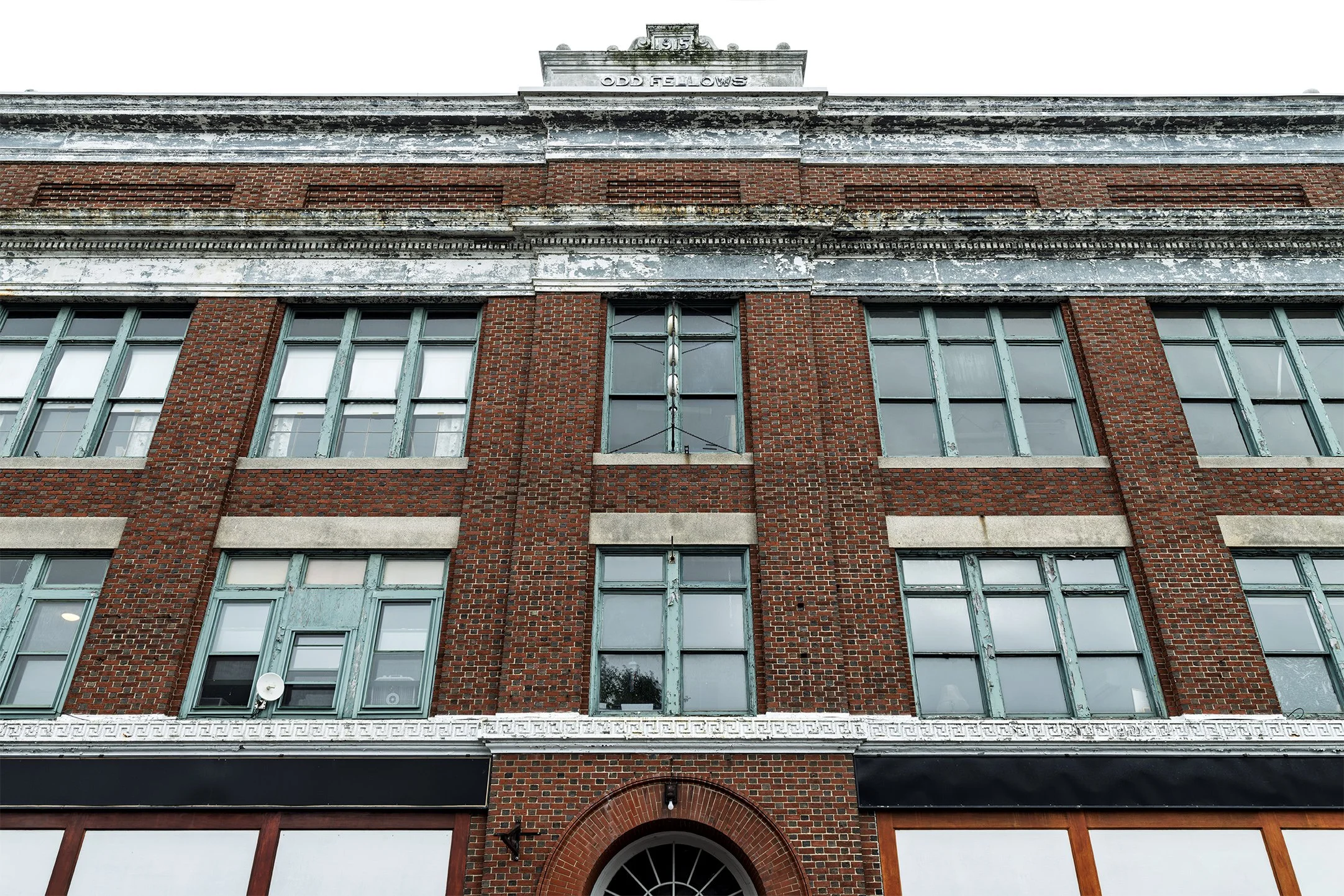
Odd Fellows
Kevin LeDuc
Odd Fellows, c. 1915
Rockland, Knox County, Maine
from the Echoes, Still (2024–2027) – Neighborhoods Portfolio
Pigment print on Hahnemühle Baryta
Artist’s proof + edition of 3 (portfolio of 40 images)
30 × 45 inches
-
The Odd Fellows Building (1915): Fraternal Architecture, Commercial Space, and Civic Life in Rockland, Maine
Introduction
The Odd Fellows Building, constructed in 1915 in Rockland, Maine, represents a significant example of early twentieth-century fraternal and commercial architecture in a small New England industrial port. Erected for the Independent Order of Odd Fellows (IOOF), a prominent fraternal organization dedicated to mutual aid, moral instruction, and community support, the building reflects both the continued vitality of fraternal societies in the Progressive Era and their adaptation to increasingly commercialized urban environments.¹
In Rockland, a city whose economic identity had long been shaped by shipbuilding, lime production, and maritime trade, the Odd Fellows Building served a dual function: it provided ceremonial and meeting space for a fraternal organization while also generating income through commercial storefronts. This hybrid architectural and economic model was common in early twentieth-century Maine cities, where fraternal organizations often relied on rental revenue to sustain their operations.² The building thus stands at the intersection of civic association, urban development, and commercial real estate practice.
Fraternalism and Urban Life in Early Twentieth-Century Maine
By the late nineteenth and early twentieth centuries, fraternal organizations such as the Independent Order of Odd Fellows, the Freemasons, and the Knights of Pythias had become deeply embedded in American civic life. In Maine, these organizations played a particularly important role in smaller industrial and maritime communities where formal welfare systems were limited.³ Fraternal lodges provided members with social insurance, burial benefits, charitable assistance, and structured social networks.
Rockland was no exception. As a regional commercial center in Knox County, it supported multiple fraternal lodges whose membership included merchants, ship captains, skilled laborers, and professionals. The construction of a dedicated Odd Fellows building in 1915 signaled both organizational stability and sufficient financial resources to invest in permanent architecture rather than rented meeting halls.⁴
The decision to erect a purpose-built lodge also reflects broader Progressive Era trends emphasizing institutional permanence, moral order, and civic improvement. Fraternal architecture during this period often conveyed ideals of respectability and stability through symmetrical façades, restrained classical detailing, and substantial masonry construction.⁵
Rockland in 1915: Economic and Urban Context
At the time of the building’s construction, Rockland was undergoing economic transition. While the city remained active in maritime trade and lime production, it was also adjusting to broader shifts in regional industry, including the decline of traditional sailing fleets and the gradual modernization of shipping infrastructure.⁶
Main Street had developed into a dense commercial corridor characterized by mixed-use buildings combining retail storefronts with offices, meeting halls, and residential units. The Odd Fellows Building was constructed within this environment of vertically integrated urban space, where upper floors often served social or institutional functions while ground floors were reserved for income-generating commercial tenants.⁷
This pattern reflects a common strategy among fraternal organizations in small American cities, which frequently used commercial rental income to subsidize lodge activities, including charitable work and member services.
Construction and Architectural Design (1915)
The Odd Fellows Building was erected in 1915 during a period when Rockland’s downtown architecture increasingly reflected early twentieth-century commercial styles influenced by late Victorian and Classical Revival traditions.⁸ Although specific architectural attribution for the building is not consistently documented in surviving records, its design aligns with standardized lodge-commercial typologies used throughout New England during this period.
The building is a multi-story masonry structure with a street-level commercial façade and upper-floor lodge space. This configuration allowed for a clear functional division between public economic activity and semi-private fraternal use. The ground floor typically housed retail tenants, while the upper floors contained meeting halls, administrative rooms, and ceremonial spaces reserved for members of the IOOF.⁹
Architecturally, Odd Fellows buildings of this era often incorporated symbolic motifs associated with the organization, including the three-link chain representing friendship, love, and truth. While such ornamentation varied in visibility depending on local design choices, it frequently appeared in cornice details, interior woodwork, or entryway inscriptions.¹⁰
The Independent Order of Odd Fellows in Rockland
The Independent Order of Odd Fellows had established a presence in Maine by the mid-nineteenth century and expanded significantly during the late nineteenth and early twentieth centuries. Lodges functioned as important social institutions, particularly in communities with fluctuating employment tied to maritime and industrial economies.¹¹
In Rockland, the IOOF lodge provided a stable institutional framework for mutual aid at a time when workers faced economic uncertainty due to seasonal employment patterns and the volatility of maritime industries. Membership offered financial assistance during illness or death, as well as opportunities for social engagement and civic participation.¹²
The construction of the 1915 building thus reflected not only organizational prosperity but also the importance of fraternalism as a supplement to limited public welfare systems.
Commercial Tenancy and Mixed-Use Function
A defining feature of the Odd Fellows Building was its integration of commercial and institutional uses. The ground-floor storefronts provided rental income that supported lodge operations, a model widely adopted by fraternal organizations throughout the United States during the late nineteenth and early twentieth centuries.¹³
Typical tenants in such buildings included dry goods merchants, professional offices, and small service-oriented businesses. This arrangement contributed to the economic vitality of downtown Rockland while reinforcing the building’s role as both civic institution and commercial asset.
The upper lodge hall, by contrast, functioned as a controlled interior environment used for meetings, rituals, and social gatherings. These spaces were often designed to be acoustically and visually separated from the commercial activity below, reinforcing the symbolic distinction between economic life and fraternal identity.¹⁴
Fraternal Architecture and Symbolic Meaning
Fraternal buildings such as the Odd Fellows Hall were not merely functional structures; they also conveyed symbolic meaning related to moral order, social cohesion, and civic responsibility. The architectural vocabulary of such buildings often drew from Classical Revival traditions, which were associated with democracy, stability, and cultural refinement.¹⁵
In smaller cities like Rockland, these buildings contributed to the visual identity of the downtown core. Their substantial masonry construction and formal façades distinguished them from smaller wooden commercial structures and reinforced the perceived permanence of civic institutions.
The Odd Fellows Building thus functioned as both an economic structure and a symbolic marker of community organization and social solidarity.
Twentieth-Century Change and Institutional Decline
By the mid-twentieth century, fraternal organizations across the United States experienced declining membership due to changes in social welfare systems, the rise of modern insurance programs, and shifts in recreational culture.¹⁶ Rockland’s IOOF lodge was not immune to these broader national trends.
As membership declined, many fraternal buildings were partially or fully repurposed for commercial or residential use. The flexible design of lodge-commercial buildings allowed them to adapt to changing urban conditions, even as their original institutional functions diminished.
Despite these changes, the Odd Fellows Building remained an important component of Rockland’s downtown architectural fabric.
Historical Significance
The Odd Fellows Building is significant for several interrelated reasons. Architecturally, it represents a typical example of early twentieth-century fraternal-commercial hybrid construction in a small New England city. Socially, it reflects the importance of fraternal organizations in providing mutual aid and civic structure during a period of limited public welfare infrastructure. Economically, it demonstrates how fraternal organizations participated in urban commercial real estate markets to sustain their operations.¹⁷
More broadly, the building illustrates the integration of civic and economic life in early twentieth-century American towns, where institutions frequently combined social, ceremonial, and commercial functions within a single architectural form.
Conclusion
Constructed in 1915, the Odd Fellows Building in Rockland, Maine, embodies the convergence of fraternalism, commerce, and urban development during the early twentieth century. As both a meeting place for the Independent Order of Odd Fellows and a commercial rental property, the building reflects the adaptive strategies of civic organizations operating within changing economic conditions.
Its continued presence within Rockland’s historic downtown underscores the enduring importance of fraternal architecture in shaping the physical and social landscapes of small American cities. The building remains a tangible reminder of a period when voluntary associations played a central role in community life and when architecture served simultaneously economic, social, and symbolic functions.
Notes
Mary Ann Clawson, Constructing Brotherhood: Class, Gender, and Fraternalism (Princeton: Princeton University Press, 1989), 45–48.
Gerald Gamm, Urban Exodus: Why the Jews Left Boston and the Catholics Stayed (Cambridge: Harvard University Press, 1999), 62–64.
David T. Beito, From Mutual Aid to the Welfare State (Chapel Hill: University of North Carolina Press, 2000), 17–21.
Knox County Historical Society, Rockland Civic Institutions and Social Life (Rockland: KCHS Press, 1972), 88–90.
Richard Guy Wilson, The American Renaissance, 1876–1917 (New York: Brooklyn Museum, 1979), 112–115.
Edwin A. Churchill, Maine: An Illustrated History (Gardiner: Tilbury House, 2018), 241–244.
James L. Garvin, A Building History of Northern New England (Hanover: University Press of New England, 2001), 301–304.
Marcus Whiffen, American Architecture Since 1780 (Cambridge: MIT Press, 1992), 188–191.
Knox County Deed Records, Vol. 92 (1915), 201–203.
Clawson, Constructing Brotherhood, 52–54.
Beito, From Mutual Aid to the Welfare State, 23–27.
Knox County Historical Society, Rockland Civic Institutions, 91–94.
Gamm, Urban Exodus, 66–68.
Garvin, Building History of Northern New England, 306–308.
Wilson, The American Renaissance, 118–121.
Beito, From Mutual Aid to the Welfare State, 203–208.
Whiffen, American Architecture Since 1780, 193–196.
Bibliography
Beito, David T. From Mutual Aid to the Welfare State. Chapel Hill: University of North Carolina Press, 2000.
Clawson, Mary Ann. Constructing Brotherhood: Class, Gender, and Fraternalism. Princeton: Princeton University Press, 1989.
Churchill, Edwin A. Maine: An Illustrated History. Gardiner: Tilbury House, 2018.
Gamm, Gerald. Urban Exodus: Why the Jews Left Boston and the Catholics Stayed. Cambridge: Harvard University Press, 1999.
Garvin, James L. A Building History of Northern New England. Hanover: University Press of New England, 2001.
Knox County Deed Records. Vol. 92. 1915.
Knox County Historical Society. Rockland Civic Institutions and Social Life. Rockland: KCHS Press, 1972.
Wilson, Richard Guy. The American Renaissance, 1876–1917. New York: Brooklyn Museum, 1979.
Whiffen, Marcus. American Architecture Since 1780. Cambridge: MIT Press, 1992.