Water Town No. 1, c. 2017
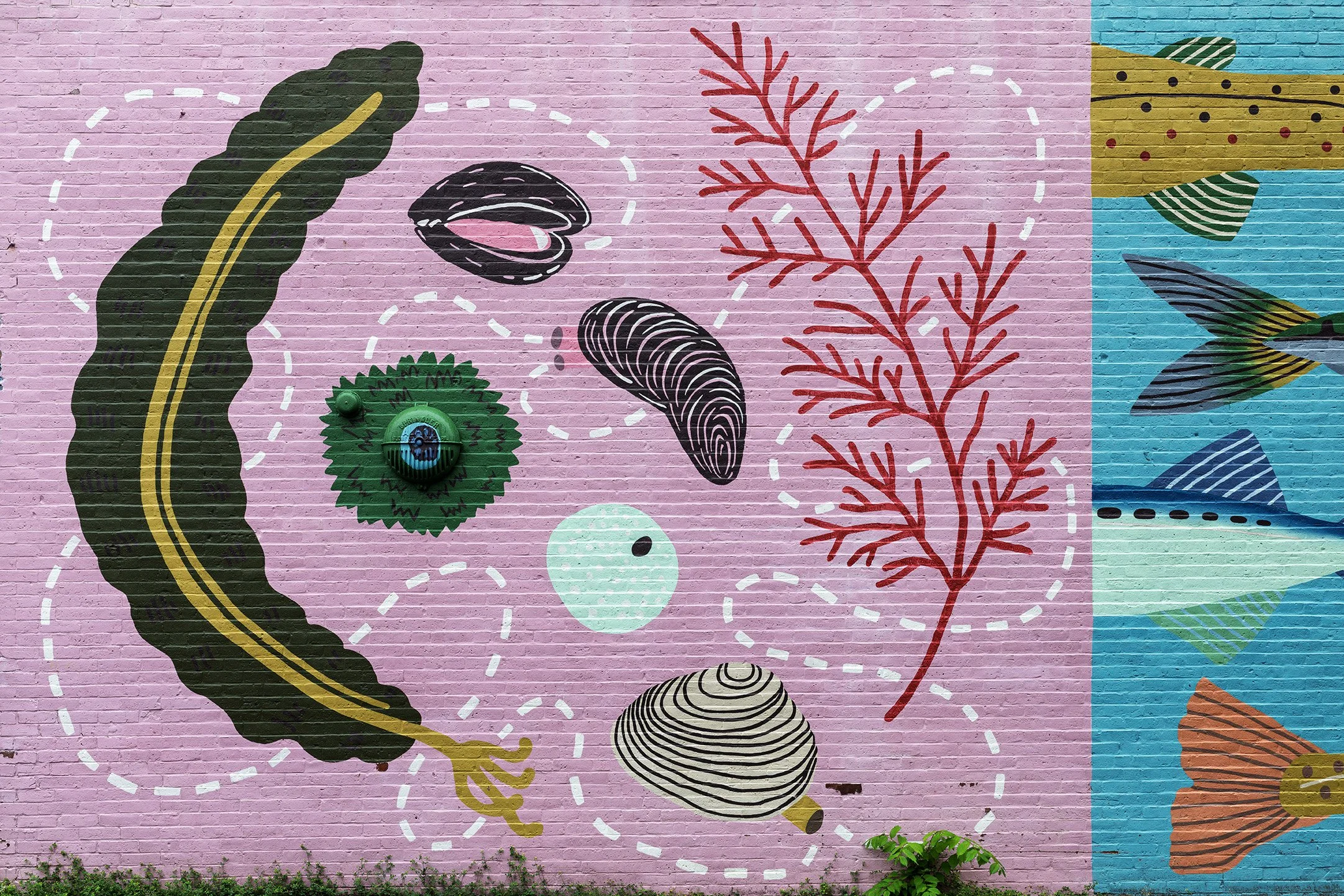
Water Town No. 1, c. 2017
Community Mural Arts Project 10 School Street Rockland, Knox County, Maine
From the Echoes, Still: Maine's Industrial Remnants Collection (2024–2028)
Murals Portfolio
Historical Narrative
Kevin LeDuc Pigment print on Hahnemühle Baryta Edition of 5 + 1 Artist's Proof (Portfolio of 40 Images)
Paper Size: 40 × 55 inches Image Size: 31.33 × 37 inches Borders: Approximately 4 inches (All Sides)
Historic Significance
Water Town, completed around 2017 in downtown Rockland, Maine, represents the city’s intersection of maritime heritage, environmental identity, and contemporary public art. Located on a prominent building along School Street, the large-scale mural was created as part of a broader movement toward participatory community art. Rather than being the work of a single artist, the mural involved professional artists, volunteers, and community participants who contributed to different sections of the composition. This collaborative approach transformed the mural from simply a decorative artwork into a public activity centered on shared creativity, civic participation, and community identity.
The mural’s imagery emphasizes Rockland’s close relationship with the sea and its coastal environment. Fish, seabirds, aquatic plants, buoys, waves, and other marine forms create a dense visual representation of Penobscot Bay and the region’s maritime traditions. Rather than presenting a literal historical scene, Water Town uses symbolic imagery to connect ecological systems with the cultural history of fishing, shipping, and waterfront life. In this way, the mural celebrates Rockland’s coastal character while also suggesting the vulnerability and interconnectedness of marine environments.
An important aspect of Water Town is the way its production blurred the boundaries between artist, participant, and audience. Community members gained experience with painting techniques while also participating in collaborative decision-making and problem-solving. The mural site temporarily became a public studio where artistic production itself became a form of civic engagement and education. This process reflects broader developments in contemporary public art, which increasingly value social interaction and community participation alongside the finished artwork. The mural’s collective authorship also challenges traditional ideas that identify a single artist as the sole creator of a work.
Ultimately, Water Town illustrates how public art can contribute to a city’s cultural identity while responding to its environmental and historical context. Its presence in downtown Rockland extends artistic activity beyond museums and galleries and into the everyday urban landscape, making it accessible to residents and visitors alike. At the same time, its collaborative origins raise questions about authorship, permanence, and the role of public art in urban development. The mural therefore functions not only as a celebration of Rockland’s maritime environment but also as a civic artwork that demonstrates how communities can use shared creative projects to define and strengthen their sense of place.
Historical Narrative
-
Water Town (c. 2017) and the Politics of Community Murals in Rockland, Maine
Rockland, Maine, has developed a distinctive identity in the early twenty-first century as a small coastal city where maritime heritage and contemporary art production intersect in the public sphere. Among the most visible expressions of this convergence is Water Town, a large-scale community mural completed in approximately 2017 on a prominent downtown building along School Street. The mural emerged from a broader wave of participatory public art initiatives in Rockland that sought to engage residents directly in the production of cultural space, transforming otherwise ordinary architectural surfaces into collective visual statements about place, ecology, and identity. In contrast to traditional mural-making practices in which a single artist or studio defines a unified composition, Water Town reflects a decentralized and participatory model of artistic production in which meaning is generated through collaboration, shared authorship, and civic engagement.¹
The mural’s significance lies not only in its visual content but also in its method of production. Community murals in the United States have long been associated with civic activism, neighborhood identity formation, and educational programming. From the Chicano mural movement of the 1960s and 1970s to contemporary public art initiatives supported by municipal agencies and nonprofit institutions, murals have functioned as tools for both aesthetic transformation and social engagement.² Water Town fits within this lineage while adapting its principles to the specific cultural and environmental context of coastal Maine, where maritime labor, ecological awareness, and tourism intersect in shaping public identity.
The mural was produced through a collaborative process led by local arts organizers in partnership with regional cultural institutions, including museum-based educational programming and grant-supported community arts initiatives. Participants included professional artists as well as volunteers drawn from the surrounding community, ranging in age and artistic experience. Rather than emphasizing technical uniformity, the project foregrounded accessibility and participation, allowing contributors to paint discrete sections of a larger composition. This approach reflects what contemporary public art theorists describe as “relational aesthetics,” in which the artwork is understood not as a self-contained object but as a set of social interactions and participatory experiences.³
The imagery of Water Town draws heavily on marine ecology and working waterfront iconography. Fish, seabirds, aquatic vegetation, buoys, and abstracted wave forms populate the mural’s expansive surface, creating a dense visual field that evokes both the biological richness of Penobscot Bay and the cultural history of maritime labor in the region. Rather than presenting a literal narrative scene, the mural operates as a symbolic assemblage in which individual motifs accumulate into a broader environmental portrait. This strategy aligns with contemporary trends in public art that emphasize ecological interconnectedness and place-based storytelling over monumental representation.⁴
The selection of imagery also reflects Rockland’s evolving identity as a site where environmental consciousness and cultural production overlap. The city’s proximity to marine habitats and its historical dependence on fishing and shipping industries provide a foundation for artistic representations that emphasize ecological systems and human interaction with coastal environments. In this sense, Water Town can be understood as both a celebration of local identity and a subtle commentary on the fragility and interdependence of marine ecosystems. The mural’s visual language avoids nostalgia, instead presenting a dynamic and layered interpretation of coastal life.
Equally important is the participatory structure of the mural’s production. Community mural programs typically operate on the principle that artistic creation can function as a form of civic education. Participants learn not only technical skills such as brushwork, color mixing, and compositional planning but also collaborative practices such as shared decision-making and collective problem-solving. In Water Town, these pedagogical dimensions were central to the project’s design. Volunteers worked alongside artists in structured painting sessions, contributing to both the execution and interpretation of the mural. This process transformed the mural site into a temporary public studio, where the boundaries between artist, audience, and subject were intentionally blurred.⁵
Such participatory methods reflect broader shifts in public art practice over the past several decades. Scholars of contemporary art have noted a move away from object-centered aesthetics toward process-oriented and socially engaged forms of practice. In this context, the value of an artwork is often measured not only by its visual impact but also by its capacity to generate social relationships and foster community engagement.⁶ Water Town exemplifies this shift by embedding itself within the everyday life of Rockland’s downtown environment, where residents and visitors encounter the mural as part of routine movement through the city.
The institutional framework supporting Water Town is also significant. Community mural projects of this type are frequently enabled by a combination of local arts organizations, municipal cooperation, and federal or state arts funding programs. In the United States, initiatives such as the National Endowment for the Arts’ community-based grant programs have played a crucial role in supporting small-scale public art projects that emphasize accessibility and local participation.⁷ While Water Town is best understood as a locally grounded initiative, it nonetheless reflects this broader infrastructure of cultural support, which has increasingly prioritized community engagement and place-based cultural development.
Rockland’s embrace of mural arts is part of a wider transformation in the city’s cultural economy. Over the past two decades, the city has developed a reputation as a regional arts destination, hosting museums, galleries, and festivals that attract both residents and tourists. Public art projects such as Water Town contribute to this cultural landscape by extending artistic activity beyond institutional spaces and into the urban fabric itself. In doing so, they challenge traditional distinctions between high art and everyday life, embedding creative expression within the lived environment of the city.
At the same time, community murals raise important questions about authorship and permanence. Unlike easel painting or sculptural works produced by individual artists, murals created through participatory processes often resist singular attribution. The presence of multiple contributors complicates conventional notions of artistic authorship, replacing individual genius with collective production. This shift has been widely discussed in contemporary art theory, where collaborative practices are seen as both democratically inclusive and conceptually complex.⁸ Water Town embodies this tension, functioning simultaneously as a unified visual composition and as an archive of multiple individual contributions.
The mural’s longevity also underscores the changing relationship between public art and urban development. While some murals are temporary interventions, others become semi-permanent fixtures of the built environment, integrated into the visual identity of a city. In Rockland, Water Town has achieved this status, becoming part of the everyday visual experience of the downtown corridor. Its continued presence reflects both the durability of its materials and the sustained relevance of its themes.
Ultimately, Water Town can be understood as a civic artwork in the fullest sense: it is produced through public participation, situated within shared urban space, and oriented toward collective identity formation. Its imagery of marine life and coastal ecology situates it firmly within the environmental and economic context of Rockland, while its collaborative production model reflects broader shifts in contemporary public art practice. As such, the mural stands as both a local artifact and a case study in the evolving relationship between art, community, and place in small American cities.
Footnotes
Miwon Kwon, One Place After Another: Site-Specific Art and Locational Identity (Cambridge, MA: MIT Press, 2002), 56–60.
Eva Sperling Cockcroft and John Weber, “Toward a People’s Art: The Contemporary Mural Movement,” in Art and Society, ed. Wallis et al. (New York: Scribner, 1977).
Nicolas Bourriaud, Relational Aesthetics (Dijon: Les Presses du Réel, 2002), 13–22.
Grant H. Kester, Conversation Pieces: Community and Communication in Modern Art (Berkeley: University of California Press, 2004), 89–95.
Suzanne Lacy, Leaving Art: Writings on Performance, Politics, and Publics (Durham: Duke University Press, 2010), 112–118.
Claire Bishop, Artificial Hells: Participatory Art and the Politics of Spectatorship (London: Verso, 2012), 1–18.
National Endowment for the Arts, “Community Arts and Public Engagement Programs,” Washington, DC.
Howard S. Becker, Art Worlds (Berkeley: University of California Press, 1982), 34–38.
Bibliography
Becker, Howard S. Art Worlds. Berkeley: University of California Press, 1982.
Bishop, Claire. Artificial Hells: Participatory Art and the Politics of Spectatorship. London: Verso, 2012.
Bourriaud, Nicolas. Relational Aesthetics. Dijon: Les Presses du Réel, 2002.
Cockcroft, Eva Sperling, and John Weber. “Toward a People’s Art: The Contemporary Mural Movement.” In Art and Society, edited by various authors. New York: Scribner, 1977.
Kester, Grant H. Conversation Pieces: Community and Communication in Modern Art. Berkeley: University of California Press, 2004.
Kwon, Miwon. One Place After Another: Site-Specific Art and Locational Identity. Cambridge, MA: MIT Press, 2002.
Lacy, Suzanne. Leaving Art: Writings on Performance, Politics, and Publics. Durham: Duke University Press, 2010.
National Endowment for the Arts. “Community Arts and Public Engagement Programs.” Washington, DC.