Industrial Arts
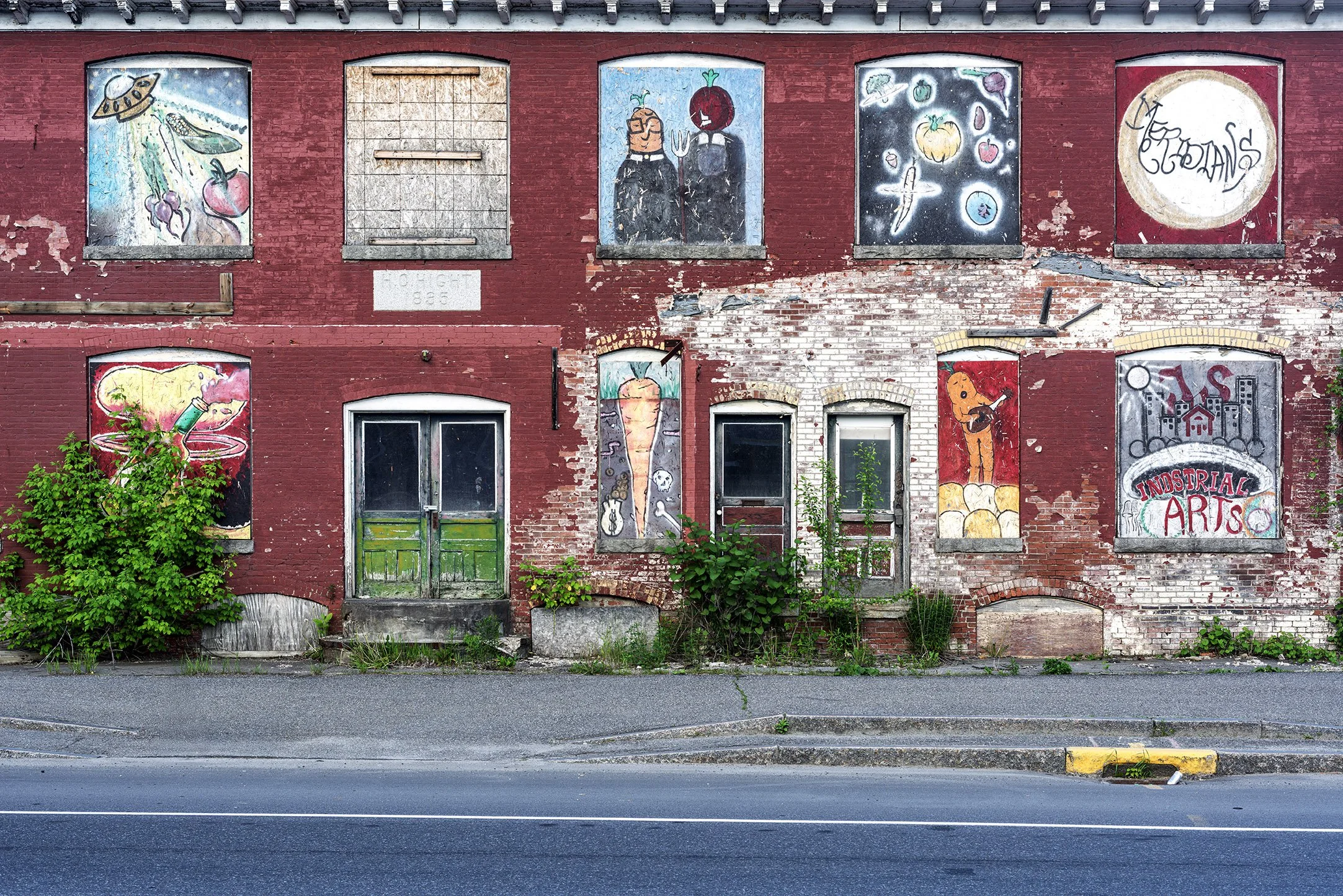
Industrial Arts
H.C. Height Livery Stable, c.1895 Upper Main Street
Fairfield, Somerset County, Maine
From the Echoes, Still: Maine's Industrial Remnants Collection (2024–2028)
Murals Portfolio
Historical Narrative
Kevin LeDuc Pigment print on Hahnemühle Baryta Edition of 5 + 1 Artist's Proof (Portfolio of 40 Images)
Paper Size: 40 × 55 inches Image Size: 31.33 × 37 inches Borders: Approximately 4 inches (All Sides)
Historic Significance
Historical Narrative
-
The H. C. Hight Building, constructed in 1895 in downtown Fairfield, originally functioned as a livery stable during the height of the horse-and-carriage era.¹ Located near the intersection of Upper Main and Bridge Streets, it offered essential services such as horse boarding and rentals for both local residents and travelers arriving by rail.²
Founding and Physical Structure
Henry C. Height, a Fairfield resident and entrepreneur, organized the stable as a family-owned business in the mid-1890s.³ The building was constructed of brick, reflecting the typical design features of late nineteenth-century Maine stables, including dedicated space for horses, carriages, and hay storage.⁴ The brick façade provided fire resistance for combustible materials such as hay and also visually aligned the structure with other commercial buildings in downtown Fairfield.⁵
Sanborn Fire Insurance Maps from 1897 depict the Hight Building as a rectangular, two-story structure with multiple horse stalls, carriage bays, and loft storage for feed and bedding.⁶ The stable could accommodate 15–20 horses simultaneously, with space for carriages and harnesses.⁷
Operations
Daily operations included feeding, grooming, watering, exercising horses, and maintaining carriages and harnesses. The stable employed 2–4 men, including a stablemaster, grooms, and a driver for livery services.⁸ Horses were rented by the hour, day, or week, and carriages were provided for social events, commercial deliveries, and private travel.⁹ During peak seasons such as summer or town fairs, operations could expand to temporary stabling of additional horses on nearby lots, with hay and grain delivered and stored in lofts year-round.¹⁰
Wages for stable workers in late nineteenth-century rural Maine were modest, typically $8–$12 per week for general grooms, with slightly higher pay for skilled drivers or stablemasters.¹¹ Labor was physically demanding, requiring early-morning and late-evening care, as well as handling potentially fractious animals.¹² Women occasionally assisted with cleaning, feeding, or office tasks, but hands-on horse care was primarily performed by men.¹³
Location in Fairfield’s Industrial Context
Fairfield’s economic growth during this period was powered by the nearby Kennebec River, which supplied waterpower for sawmills, planing mills, and factories producing doors, sashes, and blinds.¹⁴ In addition to wood products, the town had diverse businesses including a corn cannery, a clothing factory, a grist mill, and a tannery.¹⁵ The Hight Building, situated in the commercial core, thus served as an essential service within a vibrant, river-powered industrial and business ecosystem.
Decline and Adaptive Reuse
As transportation modernized with the introduction of electric trolleys and automobiles, the need for livery stables declined.¹⁶ Like many similar buildings of the time, the Hight Building was eventually repurposed for other commercial uses, adapting to the town’s changing economic and technological landscape.¹⁷ Portions of the stable may have been converted to garages or storage spaces while retaining the original brick façade and carriage bays, preserving its historical character.¹⁸
Today, the H. C. Hight Building stands as a tangible reminder of Fairfield’s pre-automobile transportation economy. Its brick construction, carriage bays, and loft spaces illustrate the functional design of late-19th-century livery operations, while its downtown location reflects the stable’s historical role in connecting residents, businesses, and travelers.¹⁹
Footnotes
Maine Historic Preservation Commission, Survey of Historic Commercial Properties in Fairfield, Maine, 2008.
Fairfield Town Directory, 1895–1896.
Ibid.
Ibid.; historic photographs indicate that the brick façade was part of the original 1895 construction.
Maine Secretary of State, Corporate and Business Filings, 1895–1900.
Sanborn Fire Insurance Company, Sanborn Maps: Fairfield, Maine, 1897 edition.
Ibid.
Ibid.
Maine Bureau of Labor Statistics, Occupational Wages in Rural Maine, 1895.
Sanborn Maps, 1897 edition.
Maine Bureau of Labor Statistics, 1895.
Ibid.
Ibid.
Ezra B. Emery, History of Somerset County, Maine (Bangor, ME: B. B. Russell, 1892), 482–484.
Ibid.
Maine Department of Motor Vehicles, early automobile registration statistics, 1910–1925.
Fairfield property tax records, 1920–1930.
York County Registry of Deeds, Fairfield lot records, 1920s–1930s.
Maine Historic Preservation Commission, 2008 survey.
Bibliography
Emery, Ezra B. History of Somerset County, Maine. Bangor, ME: B. B. Russell, 1892.
Fairfield Town Directory, 1895–1896.
Maine Bureau of Labor Statistics. Occupational Wages in Rural Maine, 1895.
Maine Department of Motor Vehicles. Early automobile registration statistics, 1910–1925.
Maine Historic Preservation Commission. Survey of Historic Commercial Properties in Fairfield, Maine, 2008.
Maine Secretary of State. Corporate and Business Filings, 1895–1900.
Sanborn Fire Insurance Company. Sanborn Maps: Fairfield, Maine, 1897 edition.
York County Registry of Deeds. Fairfield lot records, 1920s–1930s.